1. What special promise did the Saviour make to His disciples when He was about to ascend to the Father?
But ye shall receive power, after that the Holy Ghost is come upon you: and ye shall be witnesses unto Me both in Jerusalem, and in all Judea, and in Samaria, and unto the uttermost part of the earth. Acts 1: 8.
2. What is the record of one of the remarkable fulfillments of the foregoing promise?
And when the Day of Pentecost was fully come, they were all with one accord in one place. And suddenly there came a sound from heaven as of a rushing mighty wind, and it filled all the house where they were sitting. And there appeared unto them cloven tongues like as of fire, and it sat upon each of them. And they were all filled with the Holy Ghost, and began to speak with other tongues, as the Spirit gave them utterance. Acts 2: 1-4.
3. Who was the principal speaker on this occasion?
But Peter, standing up with the eleven, lifted up his voice, and said unto them, Ye men of Judea, and all ye that dwell at Jerusalem, be this known unto you, and harken to my words. Acts 2: 14.
4. What was one of the immediate results of this discourse of Peter?
Then they that gladly received his word were baptized: and the same day there were added unto them about three thousand souls. Acts 2: 41.
5. What period was this special outpouring of the Spirit to cover?
But Peter, standing up with the eleven, lifted up his voice, and said unto them, . . . Be this known unto you, and harken to my words. . . . This is that which was spoken by the prophet Joel; And IT SHALL COME TO PASS IN THE LAST DAYS, saith God, I will pour out of My Spirit upon all flesh: and your sons and your daughters shall prophesy, and your young men shall see visions, and your old men shall dream dreams: and on My servants and on My handmaidens I will pour out in those days of My Spirit; and they shall prophesy. Acts 2: 14-18.
6. What is the promise of the Master in regard to the character of the works His followers would do after He should return to the Father?
Verily, verily, I say unto you, He that believeth on Me, the works that I do shall he do also; and greater works than these shall he do; because I go unto My Father. And whatsoever ye shall ask in My name, that will I do, that the Father may be glorified in the Son. If ye shall ask anything in My name, I will do it. John 14: 12-14.
7. Under this mighty outpouring of the Spirit what will be one of the "greater works" to take place as the Gospel closes?
And after these things I saw another angel come down from heaven, having great power; and the earth was lightened with his glory. Rev. 18: 1.
NOTE.—Power is invisible. Water must be heated into invisible steam in order to drive the great locomotive that pulls the heavy train; the electric current that lights our buildings and drives our streetcars and the like is also invisible. But we may see the mighty work of this invisible power just the same. Even so may we see the results of the mighty working of the Spirit of God on human hearts. And as Christ’s coming draws nearer and nearer, we will see more and more of the manifestation of this mighty power that was revealed in the working of the Spirit on the Day of Pentecost. That shower of the "former rain" will be supplemented by the great outpouring of the latter rain to fit a people to stand before the Lord in the day of His coming.
"The Invisible Empire"
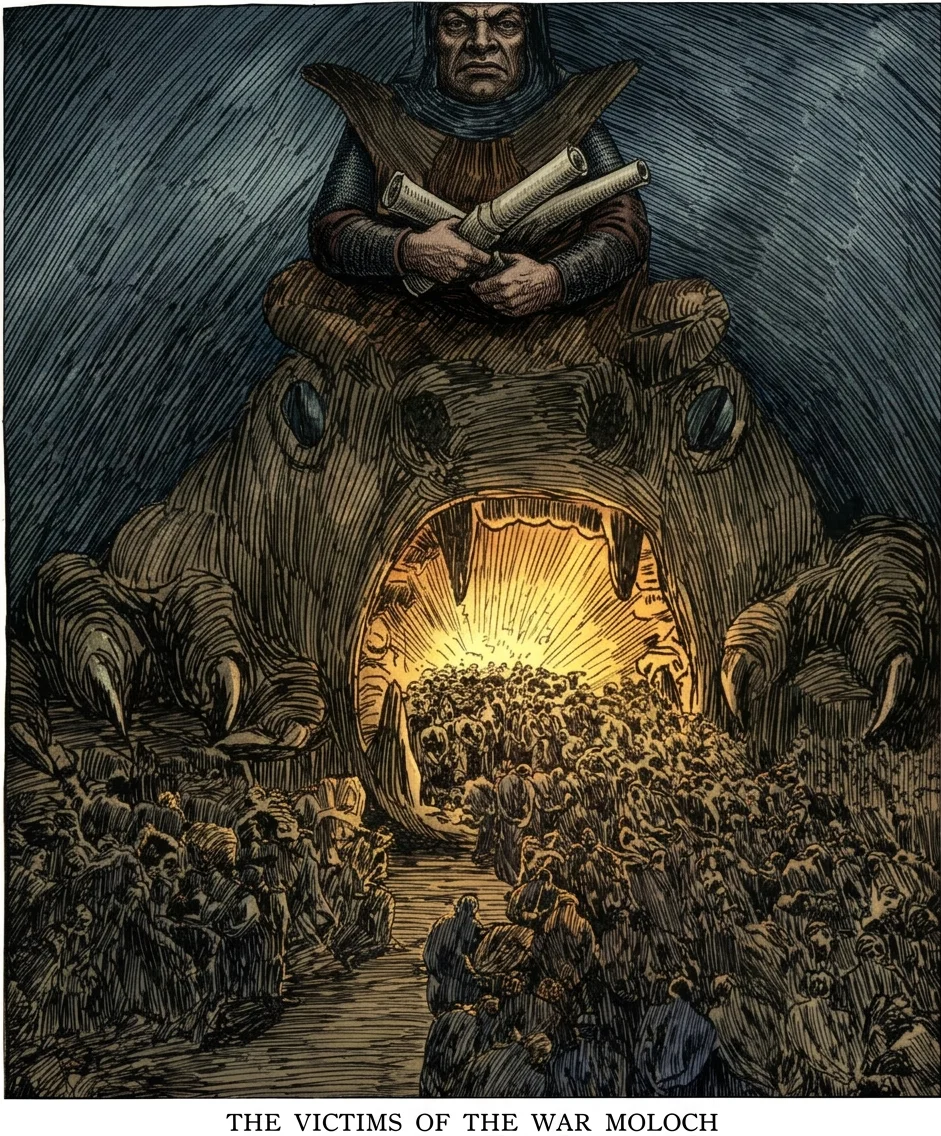
THE VICTIMS OF THE WAR MOLOCH
WHEN the late Mr. Ridpath was living, he used to speak of the great money power of the world as the "invisible empire." It is the embodiment of greed, and pays no attention to the distresses or woes of humanity. Its only thought is to hoard wealth greedily, even tho its servants be driven through rivers of blood, and the wailings of unsatisfied want and the agonies of despair receive not a single glance of sympathy.
The god of this "invisible empire" is commercialism. It must get and hold the world's markets for its commodities at no matter what cost. In order for the desires of the god of greed to be fully met, the keen eye of business must be kept ever on the alert in all parts of the world. It must allow no advantage to escape its attention.
This empire is of no particular nationality; the banner under which it marches is the sign of the almighty dollar. To open the avenues of trade in some particular locality, it may be necessary to incite nations to war, and millions of the common people must be slaughtered. But what does this "invisible empire" care? Beyond the slaughtering and the breaking up of homes and the losses of the mass of the people, there is seen great gain, and the sacrifice must be made.
By the "invisible empire" the nations are bound under the spell that they must be kept right up to date in all the paraphernalia and appliances for war. This takes not merely millions but billions of money. But the "invisible empire" can furnish this coin, and reap a harvest by furnishing it. True this war expense is supplied by a tax on the commerce of the big business concerns themselves that make up this "invisible empire;" but this tax is all added to the price that the common people have to pay for these commodities as they purchase them to satisfy the demands of every-day life.
The god of commerce, which is the god of this "invisible empire," is very closely related to the god of war. They work together in close and reciprocating sympathy. The inventive genius of man has brought about the necessity, from the standpoint of the "invisible empire," to have fleets of battle-ships that cost ten million or more each. These are displacing the battle-ships of half a decade ago, that cost only about four millions each; and now fleets of air-ships and "submarines" are being built with feverish haste to make all these great and costly ships entirely useless. But very little of the billions that are now called for to meet these vast war preparations would be demanded at all were it not for the call to protect the trade and the commerce of the "invisible empire."
When war is declared, the "big banks" must "finance" the undertaking; and this brings them great gain, while the people have to suffer. To be sure, individual instances may be pointed out where great principles of freedom are the underlying cause that leads men onto the battle-field. But even then, when men are dying for the sake of liberty, the "invisible empire" turns its ears from the sweet songs of freedom, and with eagle eye watches for opportunities to reap dividends from the great cause.
The "invisible empire" may find it to its advantage to throw a nation, or for that matter the world, into a financial panic that brings irretrievable ruin to thousands of families. Honest, industrious men in the middle and lower walks of society may be turned out of their homes, never to regain them again, through the panic. Suffering in the form of permanent loss of health, the loss of property by the aged, the orphan, and the widow, all follow in the wake of the financial panic. But the god of the "invisible empire" grimly sets his countenance and bids his votaries move on. Mercy, kindness, and love are not among the virtues that characterize this greedy god of Mammon.
The sentiments in the foregoing paragraphs may not be expressed in just the way you would express them. But do not find fault with the form of expression. Look at the facts. Every few centuries greed gathers into the hands of a small company of men a large part of the wealth of the populace. This wealth breeds luxurious vices that result in decay, and nation after nation has gone down as the result.
But heretofore this "invisible empire" has been largely confined to some leading nation of earth; and while it was producing in the vital organs of that nation the decay that meant ruin, there was room in some outlying, unoccupied territory for colonies to grow into nations, and these nations of sturdy frontiersmen would roll back upon the old crime-laden nation that was reeking in the vices of luxury, and overthrow her, and thus the race would get a new start. But the "invisible empire" would transfer its work to the new nation, and thus the ruin would be worked out again and again as one nation after another arose.
It was not till the impious Belshazzar, in the presence of "a thousand of his lords," gave himself up to the revelries of luxurious feasting and drunken carousals, that the hitherto mighty defenses of his empire crumbled, and the erstwhile insignificant and weak nation of the Medes and Persians assumed the mastery of the proud Babylon who for centuries had been the mistress of the world. It was not till the "invisible empire" had made Persia proverbial for her vices and luxuries that the little colonies of the Greeks were able to overthrow her. And in like manner Greece crumbled and was taken by Rome; and Rome in turn stood as the mistress of the world till her senators and leading men held all her wealth, and gave themselves up to the revelries of luxury, and11were in turn overthrown by the hardy colonies of so-called barbarians that had settled along her northern border.
But to-day the whole world is peopled, and the "invisible empire" that has come down through it all is reaching out for world dominion. The sentiments of greed seem to be stronger than any national ties, and the workings of the unseen hand of Mammon may be observed in every large city and in all the great capitals of the world. What sturdy people, uncontaminated by the luxuries and the vices of the age, is growing up to repeat the unvarying processes of the history of the past, and sweep away this "invisible empire," and begin a new and strong civilization? Manifestly there is none, for nowhere on the face of the earth is there any longer room for it. The next overthrow of this "invisible empire" must be from the skies above us, for it has at last succeeded in getting the whole of the earth under its feet.
This view should not be treated as a fanciful one; for aside from any line of reasoning, we have the unmistakable prophecies of the Scripture that tell in on uncertain way that the reign of greed is about to be brought to an everlasting end by the second coming of Christ. If ever there was a time when men should think clearly, soberly, calmly, and unselfishly in regard to the actual conditions as they exist all over the world, that time is now. T.
The World’s Turmoil
It has been but a few days since the despatches from England had such headings as “England Hurls Defiance at Germany” and “Asquith Declares that Great Britain Does Not Propose to Relinquish Balance of Power,” etc. Orders were given, so the despatches said, to have the fleet in readiness to move to the Mediterranean in case the Moroccan situation seemed to demand it. Then came other despatches from the continent saying that Germany was pretending to make a joke out of the whole thing, but in reality she was simply smoothing the thing over for the present because France, who was a party to the diplomatic quarrel, was fitting out the largest fleet of air-ships that could be gathered in Europe at the present time. French aviators are in the greatest numbers and have the most skill of any in the world; and the kaiser was not willing to risk further advances until he had time to bring his own air craft up to the standard. It is difficult to say how much of this air-ship talk is rumor and how much of it is fact, yet it is evident that the air-ship has come to be one of the great factors in military affairs, and the monarch who goes to war now must take it into his reckonings. No more than five years ago the air-ship was still but a dream. To-day it is different.
While all the world was watching that war situation with absorbing interest, England was suddenly required to give her strictest attention to a strike that called out some 50,000 of her troops and threw all her business and transportation interests into turmoil. She has temporarily settled this dispute by the appointing of a commission to arbitrate it. But the despatches still tell of the unsettled condition, and announce that the trouble has gone so far that it is liable to break out afresh at any moment. The leaders of the laboring men and of the government as well fear that hot-headed extremists will yet plunge the nation into the greatest labor war of the ages.
What may be the final outcome of that labor war in England can not be stated now; but while it is still unsettled, conditions are beginning to show themselves in this country that threaten to involve this whole nation in a conflict between the railroads and the laboring classes. The Harriman lines a few days ago decided on laying off a lot of men in various of their shops and offices throughout the country; and the labor-unions think it is a blow at them, and so prepare to resist it, some ninety per cent of the men having voted to meet the situation with a general strike. The unions claim that the railroads are preparing for a big fight, for they are building high stockades around some of their largest shops.
We are no party to the contentions on either side. Men are continually telling us about the wonderful brotherhood of man, and how much better this old world is getting, and that we are bordering on the time when wars and strifes will cease. The events of the days as they are passing do not seem to indicate it by any manner of means. On the other hand, they show that conditions are getting more and more tense, and outbreaks are becoming more and more violent and frequent.
The millennium of peace and quietness that has been so long promised is not yet in sight. And if men will just keep their eyes open to actual fact and real conditions, they will see that the Bible prophecies have told the story right. Violence and rioting and the threatenings of war will be more and more intense and active until the mad rush for Armageddon is finally made. And Armageddon stands on the threshold of eternity. There is nothing more clear nor scientifically accurate than the prophecies of the Bible. And the impartial observer ought to be able to see with distinctness that the program of this world is not following along the lines of the theories of men, while it is in actual and perfect accord with every prediction made by the inspired seers. T.
A Negro Burned in Pennsylvania
By Editor
A Negro Burned in Pennsylvania.—The burning of a Negro in Pennsylvania, thirty-eight miles from Philadelphia, on August 13, does not speak very highly for our boasted civilization of this twentieth century. The Negro had killed a special watchman, and after fleeing before a posse of men until he saw that all hope of escape was gone, he shot himself through the head. But he was taken to a hospital, and the bullet was taken from his head, and he regained consciousness. He made the claim that he killed the watchman in self-defense. But a mob formed around the hospital, overpowered the officers, and dragged the man, with the cot on which he was lying, to a farmhouse half a mile away, and gathered straw, rails from the fence, etc., and built a fire in which the unfortunate Negro was placed. Once he broke out of the fire and started to run away, crying, “Give a man a chance; I killed him in self-defense.” But the mob quickly caught him and hurled him back into the fire and roasted the poor fellow to death. About 5,000 persons witnessed the burning, a goodly number of whom were women and children.
The local sheriff and district attorney have declared their intention to punish the lynchers without regard to private friendship or political affiliations. The San Francisco Examiner, speaking of this intention on the part of these local officers, says:
This should be done in national self-defense. The country must quarantine itself against the contagion of such madness. The sporadic cases of fanatical mob murder must be isolated and stamped out in order to save the country from a devastating plague of barbarism.
Every right-minded person knows that if mob rule is at all permitted to go unpunished it renders every person’s life and property insecure; for there is no knowing the moment when the private grievance or hatred of some individual may lead him to inflame the mob so that he may be able to lead them to the extreme of violence and cruelty.
— ★★ —
President Taft and the Great Combines
By Editor
President Taft and the Great Combines.—On August 23 President Taft spoke to the veterans of the Civil War at their reunion in Rochester, New York. He appealed to them in behalf of the peace negotiations in progress between this country and France and Great Britain. Incidentally he turned aside from his peace talk to say that the greatest problem since the dark days in which those veterans figured in ’61 was the proper regulation of the people of great wealth. Some of his reported words are:
These new evils growing out of concentration of wealth, and the combinations which have practically controlled the market through a great reduction of the cost of production, have invited from the active-minded of to-day suggestions of remedies that are so extreme that the medicine, to many of us, seems worse than the disease.
Those who are charged with the responsibility and sobered with the difficulties find ourselves in the middle of the road, resisting the tendency to Socialism on the one hand, and the inertia of reactionary contentment with present evils and the ambition for greater concentration of financial power on the other.
Achievements of the Air-Ship
A FEW days ago Mr. Atwood flew from St. Louis to New York in an air-ship, some stretches of the distance being covered at the rate of a mile a minute. Nearly seventy-five years has been required in developing the modern railway locomotive, and a century of progress has been expended on the great ocean liner, while fully a quarter of a century has been taken in developing the automobile to its present standard of perfection and usefulness; but we have only to go back five years, to 1906, to find in all the world but two men, the Wright brothers, that could fly in a machine heavier than air. Now there are more than five hundred men that can fly in air machines, and the number is rapidly increasing. Indeed, some women as well as the men are taking it up. Manufacturers are experimenting with much more powerful machines, and it is thought that it will not be long until air craft will be on the market that can readily sail a distance of five hundred miles or over before alighting.
At the recent aviation meet in Chicago a battleship was outlined in whitewash in Grant Park, and General McCormick issued the order, "Out with the aeroplane squad!" When the order was given, seventeen air-ships arose and began circling the outline of the battleship and throwing their bombs. Each one was provided with four bombs; and one of the men landed three of his on the dummy battleship, another landed two, and several of them landed one each. Another of the aeroplanes dropped a flour bomb into a company of marines, and it was adjudged that if it had been a real bomb instead of the practise one the whole company would have been annihilated.
Every day seems to add new evidence that the predictions of the uses of the air-ship in time of war will be more than met. The butcheries of war were bad enough before this new implement was added.
Great Western Power Company Reservoir
The Great Western Power Company is working near Oroville, California, on what is said to be the largest water reservoir in the world. The water will be impounded by the large Canyon Dam, and will cover an area of from 25,000 to 30,000 acres. The reservoir will have double the capacity of the Ashokan reservoir that supplies most of the water to New York City, and, will also have double the capacity of the big Roosevelt Dam in Arizona. The power to be derived from this great body of water is to be converted into electricity.
Arizona and New Mexico Enter the Union
The bill admitting Arizona and New Mexico into the Union as States has become a law by the affixing of the signature of President Taft. He refused to sign the bill as it was at first passed, because of a clause in the proposed constitution for Arizona providing for the recall of the judges. This objectionable feature was eliminated, and the President appended his signature.
The House-Fly and Disease
Scientists have declared that the common house-fly is one of the worst means of spreading disease, particularly in the time of infectious epidemics. France, England, and the United States have joined in a crusade against this pest.
Revolution Breaks Out Again in Mexico
The revolution in Mexico has broken out afresh. Veteran soldiers who have fought under Diaz have revolted against Madero and his government, and one or two battles, desperate for that country, have been fought.
Typographical Union Renews Arbitration Agreement
The International Typographical Union, at its recent convention in San Francisco, voted to renew its arbitration agreement with publishers for three years.
Young Woman Swims Across Golden Gate
On August 20 a young lady from the University of California swam across the waters of the Golden Gate, a distance of one mile.
"A Picture of God"
It is fairly pathetic what a stranger God is in His own world. He comes to His own, and they who are His own kinsfolk keep Him standing outside the door while they peer suspiciously at Him through the crack at the hinges.
To know God, really, truly, is the beginning of a normal life. One of the best pictures of God that I ever saw came to me in a simple story. It was of a man, a minister, who lived in a New England town, who had a son, about fourteen years of age, going to school. One afternoon the boy's teacher called at the home, and asked for the father, and said:
"Is your boy sick?"
"No. Why?"
"He was not at school to-day."
"Is that so?"
"Nor yesterday."
"You don't mean it!"
"Nor the day before."
"Well!"
"And I supposed he was sick."
"No, he's not sick."
"Well, I thought I should tell you."
And the father said, "Thank you," and the teacher left.
And the father sat thinking. By and by he heard a click at the gate, and he knew the boy was coming, so he went to open the door. And the boy knew as he looked up that his father knew about those three days. And the father said:
"Come into the library, Phil." And Phil went, and the door was shut. And the father said: "Phil, your teacher was here this afternoon. He tells me you were not at school to-day — nor yesterday — nor the day before. And we supposed you were. You let us think you were. And you do not know how bad I feel. I have always trusted you. I have always said, 'I can trust my son Phil.' And here you have been living a lie for three whole days. And I can't tell you how bad I feel about it."
Well, that was hard on Phil to be talked to quietly like that. If his father had spoken to him roughly, or — had asked him out to the woodshed for a confidential interview, it would not have been nearly so hard. Then, after a moment's pause, the father said, "Phil, we'll get down and pray." And the thing was getting harder for Phil all the time. He didn't want to pray just then. And they got down. And the father poured out his heart in prayer. And the boy knew, as he listened, how bad his father felt over his conduct. Somehow he saw himself in the mirror on his knees as he had not before. It's queer about that mirror of the knee-joints. It does show so many things. Many folks don't like it.
And they got up. And the father's eyes were wet. And Phil's eyes were not dry. Then the father said:
"My boy, there's a law of life that where there is sin, there is suffering. You can't detach those two things. Where there is suffering there has been sin somewhere. And where there is sin there will be suffering. You can't get those two things apart. Now," he went on, "you have done wrong. And I am in this home like God is in the world. So we will do this: You go up to the attic. I'll make a pallet for you there. We'll take your meals up to you at the regular times, and you stay up there as long as you have been a living lie — three days and three nights."
And Phil didn't say a word. They went up-stairs, the pallet was made, and the father kissed his boy and left him alone with his thoughts. Supper time came, and the father and mother sat down to eat. But they couldn't eat for thinking about the boy. The longer they chewed upon the food, the bigger and drier it became in their mouths. And swallowing it was out of the question. Then they went into the sitting-room for the evening. He picked up the evening paper to read, and she sat down to sew. Well, his eyes weren't very good. He wore glasses. And this evening he couldn't seem to see distinctly — the glasses seemed blurred. It must have been the glasses, of course. He took them off and cleaned them very deliberately, and then found that he had been holding the paper upside down. And she tried to sew. But the thread broke, and she couldn't seem to get the needle threaded again. You could see they were both bothered. How we do reveal ourselves in the details!
By and by the clock struck nine, and then ten, their usual hour for retiring. But they made no move toward retiring. She said, "Aren't you going to bed?" And he said, "I think I'll not go yet a bit; you go." "No, I guess I'll wait a while, too." And the clock struck eleven, and the hands worked around toward twelve. Then they arose, and locked up, and went to bed, but — not to sleep. Each one made pretense to be asleep, and each one knew the other was not asleep. By and by she said (women are always the keener), "Why don't you sleep?" And he said, gently: "How did you know I wasn't sleeping? Why don't you sleep?"
"Well, I just can't for thinking of the boy up in the attic."
"That's the bother with me," he replied. And the clock in the hall struck twelve, and one, and two. Still no sleep came.
At last he said, "Mother, I can't stand this any longer; I'm going up-stairs with Phil." And he took his pillow and went softly out of the room, and up the attic stairs, and pressed the latch-key softly, so as not to wake the boy if he were asleep, and tiptoed across the attic floor to the corner by the window, and looked — there Phil lay, wide awake, with something glistening in his eyes, and what looked like stains on his cheeks. And the father got down in between the sheets with his boy, and they got their arms around each other's necks, for they had always been the best of friends, father and boy, and their tears got mixed up on each other's cheeks. Then they slept. And the next night, the father said: "Good-night, mother, I'm going up-stairs with Phil." And the second night he slept in the attic with his boy. And the third night, again he said, "Mother, good-night, I'm going up with the boy again." And the third night he slept in the place of punishment with his son.13
You are not surprised to know that to-day that boy, a man grown, is telling the story of Jesus with tongue and life of flame in the heart of China.
Do you know, I think that father is the best picture of God ever I saw? God could not take away sin. It's here. He could not take away suffering, out of kindness to man; for suffering is sin's index-finger, saying, "There's something wrong here." So He came down in the person of His Son, and lay down alongside of man for three days and three nights. That's God — our God. And beyond that He comes, and puts His life alongside of yours and mine, and makes us hate the bad and long to be pure.
To be on intimate terms with Him, to live in the atmosphere of His presence, to spend the day with Him — that is the true normal life. — Selected.
The Shepherd
By Alice Cornish Pearson
By Alice Cornish Pearson
I've known Thy voice, I've heard Thy call,
I've given Thee my life, my all.
I have not given all in vain;
I've more than all received again.
My precious Saviour, in Thy Word
Thy many promises I've heard,
That bid me ever trust in Thee,
Tho all should fall on land and sea.
My heart responds, Tho kingdoms fall,
I'll follow Thee, my guide, my all.
A yawning canyon lies before.
No bridge I see to span it o'er;
And yet Thou bid'st me be on hand,
And I must cross at Thy command.
From high above, a swinging vine;
A tendril in my hand I twine,
More firmly in my hands I grasp;
I spring; I've made the dang'rous pass!
I will not doubt, I can not fall,
While trusting Thee, my guide, my all.
Still farther on I hear Thy call.
Beneath my feet the waters fall
A raging torrent, deep and broad;
A chasm intercepts my road;
A mountain, threatening now to fall,
With overhanging rock-bound wall.
But still that urgent call I hear;
My Shepherd's voice is in my ear.
I still will trust, tho mountains fall,
And follow Thee, my guide, my all.
Within a rift I place my feet;
A slender cord mine eyes now greets;
It is for me; this is mine hour!
'Twill bear my weight; I trust its power!
No call unheard, I will go on!
I grasp it, throw my weight upon!
I know not how I'm carried o'er;
I'm quickly on the other shore.
Tho heavens depart and roll away,
My Shepherd's voice I'll still obey.
A glorious view now greets mine eyes;
A grassy plain before me lies,
The snowy mountains far beyond,
A gorgeous sky, a sinking sun.
My journey is not yet complete;
I'm resting here my weary feet.
'Tis pastures green and waters still.
I know Thy voice, I own Thy skill.
My Shepherd, tho I see Thee not,
Thou hast appointed me my lot.
So many times I'm made to choose,
Deliverance I must still refuse.
The sacrifice to make complete,
The Shepherd chose His faithful sheep.
Was suffering but for faithful Paul?
Shall righteous Job bear more than all?
For all who suffer by His side,
With Him shall soon be glorified.
When earth shall fall beneath my feet,
I'll follow still, my Shepherd sweet.
Fort Steilacoom, Washington.
The Lord's Day, the Test of the Ages
By Milton C. Wilcox
By MILTON C. WILCOX
From "The Lord's Day, the Test of the Ages"
Among the brief but comprehensive works on the Sabbath question, this, by the editor of the Signs of the Times, is one of the very best. The following from its table of contents shows its scope:
The Patriarchal Dispensation
The Institution of the Sabbath
During the Patriarchal Dispensation
Sabbath Reform
The Levitical Dispensation
The Sabbath Affirmed
During the Levitical Dispensation
Close of the Levitical Dispensation
The Christian Dispensation
Christ and the Sabbath
The Gospel of Christ and the Sabbath
Sunday in Apostolic Times
The Change of the Sabbath
The Testimony of Men
The Close of the Christian Dispensation
Copiously illustrated by original drawings and diagrams. Contains 125 pages, only 10 cents, post-paid.
Unrecognized Devotion
By H. A. Mitchell
A STORY has been told of a mother who had an idiotic daughter, and on the day when the girl was fourteen years of age a neighbor came into the house and found the mother crying bitterly. Inquiry was made as to what was the matter. Turning to the girl, the mother said: "Fourteen years I have watched over that child and cared for her, and to-day she knows no difference between me and you. O, if for just once she might know and realize a mother's care and devotion, it would pay me for these years I have spent with her."
How many there are in this world over whom Jesus has carefully watched for more than fourteen years, and yet they have never recognized Him or offered thanks for His many blessings! Unsaved one, perchance you read these lines. Can you not look up for once, at least, and kindly thank your heavenly Father for all His mercies? Careless professor, do you not sense the fact that Christ is worthy of your attention and praise? Then no longer be indifferent to His great love and care, but let your devotion to Him be what it should be. He is worthy of our full recognition and devotion.—H. A. Mitchell, in "World's Crisis."
"A SUBLIME purpose is more potent than the sternest resolution."
Graft!
By Editor
Is there or Is there Not?
What Does It Mean?
If you wish to study this subject from a careful, thoughtful, consistent view-point, you should secure a copy of the
October
Signs of the Times
Monthly.
Many other timely and interesting articles, but "Graft" in all its phases is the leading subject under consideration. The conditions are worse than alarming; they are critical. What does it mean? The present conditions are a sign of the times. View them in the light of the inspired Word, and they will become of more than passing interest.
Ten cents in coin or stamps to the publishers will secure you a copy.
Signs of the Times
Mountain View, Cal.
Other Choice Books
By Editor
In sending for the above-mentioned pamphlet, you may wish to include in your request copies of some of the following:
Christ Our Advocate
A comprehensive study of the sanctuary question. 112 pages, price 10 cents.
The Sure Word of Prophecy
A verse-by-verse study of the book of Daniel. 96 pages, price 10 cents.
The Saints' Inheritance
A beautiful study on the home of the saved. 88 pages, price 10 cents.
Christian Science
A consideration of this "science" in the light of reason and revelation. 50 pages, price 10 cents.
The Spirit World and a Future Life
Is there a supernatural power being manifested by certain mediums, or is it all fraud? If it is genuine, what is its source? 96 pages, price 10 cents.
Matthew Twenty-four
Christ's answer to the disciples' question, "What shall be the sign of Thy coming, and of the end of the world?" and the history connected with the fulfilment of this prophecy. 94 pages, price 10 cents.
Order through your tract society, or
Pacific Press Publishing Association
Mountain View, Cal.
61 Park St. N., Portland, Oregon
1109 E. 12th St., Kansas City, Mo.
Box 1599, Calgary, Alberta, Canada