Your ShelfYour Projects

Signs of the Times, Vol. 41, No. 42.

Morally Responsible for the Wicked Traffic

Signs of the Times

Oct 27, 1914

Pacific Press Publishing Association · Mountain View, California · Oct 27, 1914
Morally Responsible for the Wicked Traffic

Those Who License the Saloon Are Responsible for Its Work — Remove the Death-Traps — Relieve the Sorrows of the Drunkards' Wives and Children — Let an Army of Workers Arise to the Task
By MRS. E. G. WHITE
LICENSES for the sale of intoxicants are granted on the plea that they bring a revenue to the public treasury. But what is this revenue when compared with the enormous expense incurred for the criminals, the insane, the paupers, that are the fruit of the liquor traffic! A man under the influence of liquor commits a crime; he is brought into court; and those who legalized the traffic are forced to deal with the result of their own work. They authorized the sale of a draft that would make a sane man mad; and now it is necessary for them to send the man to prison or to the gallows, while often his wife and children are left destitute, to become the charge of the community in which they live.

A FINANCIAL FOLLY

Considering only the financial aspect of the question, what folly it is to tolerate such a business! But what revenue can compensate for the loss of human reason, for the defacing and deforming of the image of God in man, for the ruin of children, reduced to pauperism and degradation, to perpetuate in their children the evil tendencies of their drunken fathers?
The man who has formed the habit of using intoxicants is in a desperate situation. His brain is diseased, his will-power is weakened. So far as any power in himself is concerned, his appetite is uncontrollable. He can not be reasoned with or persuaded to deny himself. Drawn into the dens of vice, one who has resolved to quit drink is led to seize the glass again; and with the first taste of the intoxicant, every good resolution is overpowered, every vestige of will destroyed. One taste of the maddening draft, and all thought of its results has vanished. The heart-broken wife is forgotten. The debauched father no longer cares that his children are hungry and naked. By legalizing the traffic, the law gives its sanction to this downfall of the soul, and refuses to stop the trade that fills the world with evil.

MUST THE CURSE CONTINUE?

Must this always continue? Will souls always have to struggle for victory, with the door of temptation wide open before them? Must the curse of intemperance forever rest like a blight upon the civilized world? Must it continue to sweep, every year, like a devouring fire over thousands of happy homes? When a ship is wrecked in sight of shore, people do not idly look on. They risk their lives in the effort to rescue men and women from a watery grave. How much greater the demand for effort in rescuing them from the drunkard's fate!

THE TRAFFIC DID HIT HIM

It is not the drunkard and his family alone who are imperiled by the work of the liquor-seller, nor is the burden of taxation the chief evil which his traffic brings on the community. We are all woven together in the web of humanity. The evil that befalls any part of the great human brotherhood brings peril to all.
Many a man who through love of gain or ease would have nothing to do with restricting the liquor traffic, has found, too late, that the traffic had to do with him. He has seen his own children besotted and ruined. Lawlessness runs riot. Property is in danger. Life is unsafe. Accidents by sea and by land multiply. Diseases that breed in the haunts of filth and wretchedness make their way to lordly and luxurious homes. Vices fostered by the children of debauchery and crime infect the sons and daughters of refined and cultured households.
There is no man whose interests the liquor traffic does not imperil. There is no man who for his own safeguard should not set himself to destroy it.

LEGISLATORS, JURISTS, AND STRONG DRINK

Above all other places having to do with secular interests only, legislative halls and courts of justice should be free from the curse of intemperance. Governors, senators, representatives, judges, men who enact and administer a nation's laws, men who hold in their hands the lives, the fair fame, the possessions of their fellows, should be men of strict temperance. Only thus can their minds be clear to discriminate between right and wrong. Only thus can they possess firmness of principle, and wisdom to administer justice and to show mercy. But how does the record stand?How many of these men have their minds beclouded, their sense of right and wrong confused, by strong drink! How many are the oppressive laws enacted, how many the innocent persons condemned to death, through the injustice of drinking lawmakers, witnesses, jurors, lawyers, and even judges! Many there are, "mighty to drink wine, and men of strength to mingle strong drink," "that call evil good, and good evil," that "justify the wicked for reward, and take away the righteousness of the righteous from him." Of such God says: "Wo unto them. . . . As the fire devoureth the stubble, and the flame consumeth the chaff, so their root shall be as rottenness, and their blossom shall go up as dust: because they have cast away the law of the Lord of hosts, and despised the word of the Holy One of Israel." Isa. 5: 20-24.

FORM AN ARMY OF WORKERS

The honor of God, the stability of the nation, the well-being of the community, of the home, and of the individual, demand that every possible effort be made in arousing the people to the evil of intemperance. Soon we shall see the result of this terrible evil as we do not see it now. Who will put forth a determined effort to stay the work of destruction? As yet the contest has hardly begun. Let an army of workers be formed to stop the sale of the drugged liquors that are making men mad. Let the danger from the liquor traffic be made plain, and a public sentiment be created that shall demand its prohibition. Let the drink-maddened men be given an opportunity to escape from their thraldom. Let the voice of the nation demand of its lawmakers that a stop be put to this infamous traffic.
"If thou forbear to deliver them that are drawn unto death, and those that are ready to be slain; if thou sayest, Behold, we knew it not; doth not He that pondereth the heart consider it? and He that keepeth thy soul, doth not He know it?" Prov. 24: 11, 12. And "what wilt thou say when He shall punish thee?" Jer. 13: 21.

Would Settle Religious Controversy by Law

The Work in Effect of the "Christian Statesman"—Shall We Maintain the Separation of Church and State?

By W. F. MARTIN
THERE lies before me at this writing a copy of a magazine called the Christian Statesman. It is printed at Pittsburgh, and is issued under the auspices of the National Reform Association. On its editorial staff and among its contributors are a number of men who affix to their names such titles as LL. D., D. D., Ph. D., etc. Some of these men are well-known speakers and writers in the religious world. On the inside front cover of the magazine is to be found what we take to be a declaration of principles, setting forth the plan and scope of work of the National Reform Association and the purpose of the magazine. This reads as follows:
"The Christian Statesman is a monthly magazine of forty-eight pages, designed to promote needed reforms in the action of the government touching the Sabbath, the institution of the family, the religious element in education, the oath, and public morality as affected by the liquor traffic and other kindred evils; and to secure such an amendment to the constitution of the United States as will declare the nation's allegiance to Jesus Christ and its acceptance of the moral laws of the Christian religion, and to indicate that this is a Christian nation, and place all the Christian laws, institutions, and usages of our government on an undeniable legal basis in the fundamental law of the land."

REGULATING A RELIGIOUS INSTITUTION

According to this, if the thing considered of first importance is that placed at the head of the list, the first energy is to be expended in securing the passage by the government of a law regulating the observance of the Sabbath, thus securing governmental action on this question. The true American will naturally stop to wonder what this involves, why the government should act or legislate on the Sabbath.
The Sabbath is strictly a religious institution. It is a matter that pertains to God and not to Caesar. If the government should, through its lawmaking branch, act regarding the Sabbath, it would be legislating on a religious establishment. That would be opposed to the national constitution. That document says, "Congress shall make no law respecting an establishment of religion."
One can but wonder how far these noted divines are in harmony with this most truly American feature of our constitution. Jefferson, an American of Americans, said, "I contemplate with sovereign reverence that act of the whole American people which declared that their legislature should make no law respecting an establishment of religion or prohibiting the free exercise thereof, thus building a wall of separation between church and state."
Boston Photo News Co.

CONTRARY TO ESTABLISHED RELIGIOUS LIBERTY

The Sabbath, whether regarded as occurring on the seventh or on the first day, is altogether an establishment of religion. The idea involved in the first amendment is strictly American. It has been called America's gift to the philosophy of government. A Sabbath law would be in square contradiction to the constitution, and hence un-American. We are not inclined to question the intended loyalty of the LL. D.'s, Ph. D.'s, and D. D.'s who champion the policy of the Christian Statesman; but we do most emphatically say that their intentions are, knowingly or unknowingly, in direct opposition to the religious liberty guaranteed by the general government.
Aside from the general principle of the thing, the people of the government are not a unit as to which day constitutes the true Sabbath. The body of the people, to a greater or less degree, regard Sunday, the first day, as sacred, or to say the least, observe it after a fashion. A respectable and growing minority, however, observe with a commendable strictness the seventh day. For the general government to step in, and by a legislative act favor either one of these classes, would not be treating all its citizens with equality. Not only this, but by thus favoring one sect above another, the government would repudiate its avowed principle of civil and religious liberty. Apropos to this, note the following:
"The legislatures have not been left at liberty to effect a union of church and state, or to establish preferences by law in favor of any one religious persuasion or mode of worship. There is not complete religious liberty where any one sect is favored by the state and given an advantage by law over other sects. Whatever establishes a distinction against one class or sect is, to the extent to which the distinction operates unfavorably, a persecution, and if based on religious grounds, a religious persecution. The extent of the discrimination is not material to the principle; it is enough that it creates an inequality of right or privilege."—"Cooley on Constitutional Limitations," fifth edition, page 580.
We would humbly recommend a careful study of this paragraph to the men who compose the editorial staff of the Christian Statesman. Americans can not be too jealous of the rights purchased by blood and sealed to them by patriotism and self-sacrifice.

The Law and the Gospel

THE law and the gospel may be compared to a threaded needle. One can not sew without the needle, neither can he do that work without the thread. The two combined make a perfect implement of labor. A person can not be saved unless his conscience is awakened and aroused by the prick of the law, and then justified and forgiven by the gospel. As the needle prepares the way for the work of the thread, so the law convicts the sinner, while the gospel provides a remedy for the sin. ELIZA H. MORTON.

SHALL REIGN FOREVER AND EVER

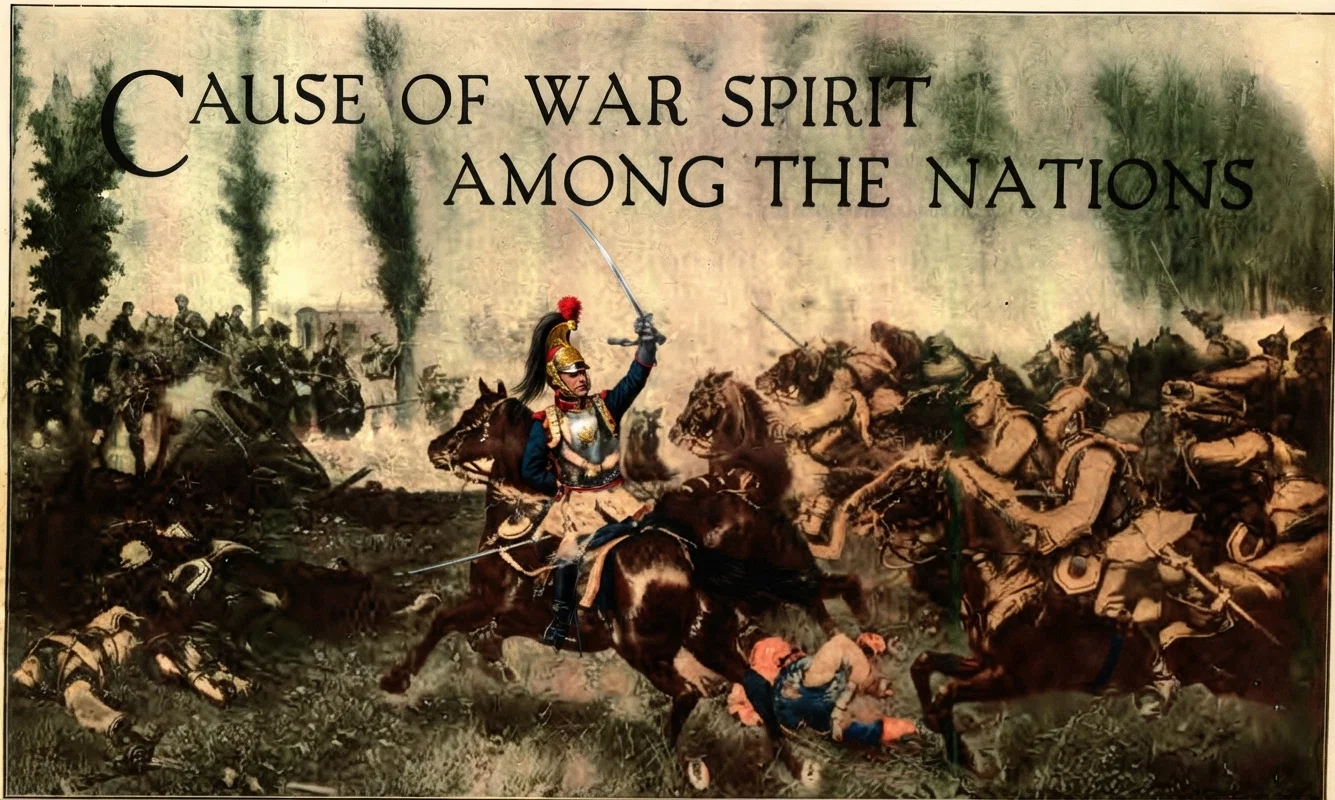
CAUSE OF WAR SPIRIT AMONG THE NATIONS
In the eighth, ninth, tenth, and eleventh chapters of Revelation is foretold a part of the war history of the nations. It is given symbolically as seven angels with seven trumpets — the trumpets indicating war. Under the sounding of each of these seven trumpets is foretold some great war cataclysm.
There is not space here to study these trumpets in detail, but the sounding of the seventh began in 1844. We know this from the following Biblical facts:

SHALL REIGN FOREVER AND EVER

When the seventh trumpet sounds, great voices in heaven say, "The kingdom of the world is become the kingdom of our Lord, and of His Christ: and He shall reign forever and ever." Rev. 11: 15. God is praised because He has taken to Him His great power and has reigned. Verse 17.
At this same time, conditions in the world among the nations are described: "And the nations were wroth, and Thy wrath came, and the time of the dead to be judged, and the time to give their reward to Thy servants the prophets, and to the saints, and to them that fear Thy name, the small and the great; and to destroy them that destroy the earth. And there was opened the sanctuary of God [margin] that is in heaven; and there was seen in His sanctuary the ark of His covenant; and there followed lightnings, and voices, and thunders, and an earthquake, and great hail." Rev. 11: 18, 19, A. R. V.
By this we learn that at the time when the nations are angry the sanctuary service will be opened, or revealed once more to this world. This intimates that so far as this world is concerned there must have been a time when apparently it was closed or unrevealed. Reference to this time is made in the eighth chapter of Daniel: "Yea, it magnified itself, even to the Prince of the host; and it took away from Him the continual burnt offering, and the place of His sanctuary was cast down. And the host was given over to it together with the continual burnt offering through transgression; and it cast down truth to the ground, and it did its pleasure and prospered." Verses 11, 12.
Regarding this time when the sanctuary work could not be clearly discerned, a voice asks: "How long shall be the vision . . . to give both the sanctuary and the host to be trodden under foot? And he said unto me, Unto two thousand and three hundred days; then shall the sanctuary be cleansed," or justified. Verses 13, 14.
Then the cleansing of the sanctuary and the opening of the sanctuary in heaven are synchronous. In other words, the cleansing of the sanctuary of Dan. 8: 14 and the opening of the sanctuary of Rev. 11: 19 are prophetic descriptions of the same event. This event took place in 1844.

SETTLING OF ALL LIFE ACCOUNTS

For example, the "justifying" or "cleansing" of the sanctuary means the settling of all life accounts as revealed in the records in the heavenly sanctuary. For nearly two thousand years, Christ received the confession of faith on the part of all who accepted Him as their Saviour; but in 1844, in addition to doing this, a new work of balancing the books, as it were, began. That is to say, the life record of each individual accepting Christ, from Adam down, was scrutinized, and his reward or punishment was determined. When disposition is made of all these cases, and the punishment meted out — at the second coming of Christ — the sanctuary is cleansed.
This work of examining records and determining the decree for each individual began in 1844. The 2,300 years dating from the going forth of the commandment to restore and rebuild Jerusalem (Dan. 9: 25), under Artaxerxes, 457 B. C., ended, as we have said, in the fall of the year 1844. At that time, the prophecy declared, the sanctuary was to be cleansed, or justified; and hence at the time when the nations of the world are angry, the time also has come that the dead should be judged and a reward given to God’s servants. Rev. 11: 18.

THE NATIONS ANGRY AT THAT TIME

All this we have said in introduction, to show that at the time when Christ begins the work of taking His kingdom, namely, in 1844, the nations are angry. We will say a few words with reference to this fact, and then we will examine into the causes underlying it.
First, the nations are angry. It is a historical fact that since 1844 most particularly, we have had the great European danger of war. In 1848 matters looked as if Europe would be dissolved in war, and they have grown no better. Every war since that time has been a war in which neither contending party was satisfied. The close of the war only called for another war to settle the questions left over from the past war. "The Eastern question" has constantly grown more complex, more threatening, more certain of a dire solution. Since 1844, particularly since 1848, it has been the Eastern question that has held the forefront

Causes of the War Spirit Among the Nations

(Continued from page 3) of attention on the part of European nations. The present war is one that is bound to affect conditions in the near East. If Austria is greatly weakened or annihilated in this present contest, it is bound to add to the might and power of Russia; and that means that Russia eventually will certainly take Constantinople, and that in turn means so much of a downfall for Turkey. And according to the prophecies, the final downfall of Turkey marks the end of earthly events.

NO COMPARISONS FROM THE PAST

Certainly the nations are angry. Since 1844 in particular, notably since the Civil War and the ironclads that developed from it, we have had the mightiest preparations of armaments the world ever heard of. In fact, it is impossible to compare the present age of war preparations with that of any other age in all the history of the world. There is nothing in the past with which to compare it. Is it possible to compare an arrow with a Mauser? Is it possible to compare a javelin or a spear with a Gatling gun or a mitrailleuse? Is there any comparison between a catapult and a 12-inch gun? Is there any comparison between a battering-ram and modern siege artillery? The former were childish toys compared with the efficient weapons of warfare to-day.
Certainly the nations are angry. Millions upon millions are spent by the nations, until the major share of the expense of the various governments is for war or preparations for war.
Surely the nations are angry; and statesmen and philosophers, writers and speakers, recognize the fact, and declare in no uncertain terms that the nations are preparing "as if for some Armageddon."

WHY ARE THE NATIONS ANGRY?

But why are the nations angry? Why are they preparing for war? Why are they entering with frenzy into strife? Superficially, the answer is, Because of distrust, because of lack of confidence in one another, because of conflicting ambitions, because of fear and dread and unrest. Never in all the history of the world were nations more aggressive, more ambitious, than they are to-day.
There never has been anything in this world that would give confidence, honesty, integrity, moral guarantees, except the gospel of Jesus Christ; and it is because the world is rejecting the gospel of the Son of God and refusing the Bible as the solemn word of Jehovah, that we have, as it were, every man becoming a law unto himself and doing those things which are right in his own eyes. Old standards are torn down, new standards erected in their places; and with the downfall of the old standards and the erection of the new goes the old morality and enters a new immorality.
Prophecy declared that in the last days perilous times would come, for men would be lovers of their own selves, lovers of pleasure more than lovers of God; and the prophecy also declared that the time would come when they would not endure sound doctrine, but would heap to themselves teachers, having itching ears, and would turn away from the truth, and be turned to fables. And the prediction of the divine Word also is that because they loved not the truth, God would give them over to strong delusion to believe a lie. This, however, is but one of the causes for the war spirit among the nations.

SATAN'S WRATH IN THIS TIME

All that is taking place in the government of heaven is known more or less definitely by Satan. When Christ began the work in the heavenly sanctuary of reviewing the
candidates for His heavenly kingdom, Satan knew it; and he came down to mankind having great wrath because he knew that he had but a short time. Rev. 12: 12. And the end of the drama is the wrathful dragon making war on the remnant — the last of the church. Verse 17.
In harmony with this we find the Scripture declaring just before Christ comes, that the spirits of devils working miracles go forth to the kings of the earth and the whole world, to gather them to the battle of that great day of God Almighty. Rev. 16: 14. These devils are successful, for they gather the nations to a place called in the Hebrew tongue Armageddon. Verse 16. Furthermore, this gathering of the nations is to make war against Christ in the person of His children. Rev. 19: 19 with 11.

THE POWER STIRRING THE NATIONS

According to this, the wrath of the nations is but their manifestation of the wrath of Satan, who is stirring them up. And why is he stirring them up? — Because he knows that he has but a short time. In other words, as the prophecy in Rev. 11: 17-19 declares, when Christ begins the work of taking His kingdom, of cleansing the heavenly sanctuary, the nations are angry. And they are angry because Satan sees in this cleansing of the sanctuary the beginning of the taking of Christ's kingdom and the ending of his own kingdom. The struggle becomes intense, and every earthly element partakes of the intensity. Satan realizes that his house is about to fall; and he begins, by every means in his power, to strengthen it and prop it and brace it to hold it from the final crash. But it will certainly go down, for it is founded upon the shifting sand of apostasy and rebellion.
But there is still another cause for the wrath of the nations. God is opposing sin, fighting it wherever it lifts its opposing
power; and in the prophecies, He pictures this final struggle as a shaking of the kingdom of evil. Remember what Christ foretold with reference to conditions just before His second appearing. He said, "Upon the earth distress of nations, with perplexity; the sea and the waves roaring; men's hearts failing them for fear, and for looking after those things which are coming on the earth; for the powers of heaven shall be shaken." Luke 21: 25, 26.
In other words, men grow apprehensive as they see all things earthly shaking as if to fall. And well they may, because even the powers of heaven are to shake, or as it is stated in Heb. 12: 26, 27, God promises to shake not only the earth but heaven, and this shaking means the removing of those things that are shaken, that that which can not be shaken may remain. God will remove sin. If necessary, He will destroy the sinner rather than continue the sin. His way is that we shall each one voluntarily get rid of sin through the means He provides, and thus be saved from our sin; but if we refuse, and cling to sin, we shall be destroyed in the destruction of sin. "For all that is in the world, the lust of the flesh, and the lust of the eyes, and the pride of life, is not of the Father, but is of the world. And the world passeth away, and the lust thereof;
but he that doeth the will of God abideth forever." 1 John 2: 16, 17.
By these things, we see that God is actually at work breaking down the power of evil, shaking every earthly element opposed to right, shaking the kingdoms of this world, shaking this earth itself; and in storms and earthquakes and tidal waves, He disturbs the earth, and shakes it, warning men of the coming doom, when the earth shall utterly fall, and as it now is, shall not rise again. Isa. 24: 19, 20.

CHRIST FINALLY TAKES POSSESSION

In the strife of nations, in their distress, and their fear of one another, and in their actual wars, the angry nations are shaken. This foretokens that the time is rapidly advancing when Christ will take complete possession of this earth, when He will be King of kings, and Lord of lords; when every knee shall bow, and every tongue confess that He is Lord, to the glory of God. So we may say that the shaking of earthly kingdoms is but a sign of the firm establishment of Christ's kingdom, now rapidly going on.
Not far hence, the shaking of the earth and the shaking of the nations will culminate, when the voice of God, speaking from the throne, will cause the mightiest earthquake
this world has ever had since men were upon it, and when confederacy against God will be dissolved, shaken apart, and when all the cities of the nations will fall, and every island flee away, and the mountains not be found. Rev. 16: 17-21.
God is shaking and will shake to the very foundation the whole citadel of evil. He is shaking the very castle of the devil. He will shake it until at last it tumbles in an irretrievable ruin; and then will be found that He who has shaken down the kingdom of sin has upreared the kingdom of righteousness.

SHINES ABOVE THE WRECK

The city of God resplendent shall shine above the wreck and the ruin of sin. It stands upon immovable foundations, built by God's own hand. It is the capital of a kingdom that shall not be given to other people; it shall stand forever. Dan. 2: 44; Revelation 21; and Rev. 22: 1-7.
In the light of these tremendous truths, let us receive the admonition of one of those scriptures that foretell them: "Wherefore we receiving a kingdom which can not be moved, let us have grace, whereby we may serve God acceptably with reverence and godly fear: for our God is a consuming fire." Heb. 12: 28, 29.

It Is a Religious Measure

Protesting that It Is Not, Does Not Change the Fact — California Has a Law Giving One Day in Seven — What the Need of a Sunday Law?

By WILLIAM MAYHEW HEALEY
For more than thirty years, California has had no Sunday law. The state enforces no religion or religious forms, but nowhere are religious worshipers better protected. The maximum penalty for disturbing a religious meeting, of any denomination, on any day of the week, is a fine of $500 and six months in jail.
Such liberty of conscience seems to have annoyed a few, as it did many people in the Dark Ages, and they have sought to have some kind of Sunday law enacted. They first asked for a law that would bring back the "Puritan sabbath of our ancestors" — the kind that compelled all to attend church on Sunday, or if absent from church, and unable to give an acceptable excuse, to pay a fine sometimes of a few pounds of tobacco.

CAN NOT DISGUISE THE RELIGION

Meeting with general opposition to this kind of law, they declared they did not want a Sunday law for religious purposes at all. Mr. G. L. Tufts, representing the advocates of the Sunday law, urged members of the legislature of 1913 to support his Sunday bill, which he declared was a temperance measure for the purpose of closing saloons one day in the week. He publicly denounced those who opposed him as being allies of the slums and working for the saloons.
Failing to get the desired support, he drafted another bill, and exempted the saloons and the liquor traffic from its provisions, and tried to have it adopted. He found but little support for his bill from either the temperance or the liquor interests.
By declaring that the proposed Sunday law is in no way religious, but only a civil law, to obtain rest for the working people, its advocates found a little comfort from a small class of laborers, by whose influence and signatures they succeeded in getting a mongrel Sunday measure on the initiative ballot.
Mr. G. L. Tufts is lecturing through the state, and saying, "There is nothing religious about the proposed law."
F. B. Perry, president of the California Federation of Journeymen Barbers, says, "We want you to understand that this is not a religious law, but a civil enactment for a day of rest."
The argument favoring the law, printed by the state, over the signature of State Senator William Kehoe, says, "It is neither a religious measure nor a 'blue law.'"

"IT IS NOT! IT IS NOT!"

If there is nothing religious about this law, why need its advocates continually cry, "It is not! It is not!" Mr. Kehoe says, in his argument, "Every civilized nation on the globe sets aside Sunday as a common rest day, and none has been so bold as to claim that in so doing religious or blue laws are being enforced upon the people."
Why do the senator and others need tell us that such laws are not religious, if no one ever said they were? This kind of argument is like a woman making public announcements in words like these: "I want it understood that I am not bad, and nobody ever said I was."

A DAY OF REST PROVIDED

Evidently the senator should be better informed on this subject; for thousands of people have called these Sunday laws religious laws, and the essential elements of the one proposed on the initiative ballot are religious. If it were purely civil in its nature, there would be no demand for it, as the state already has such a law, and has had for twenty years. See California Statutes of 1893, page 54, and read "An Act to Provide for a Day of Rest from Labor":
"Section 1. Every person employed in any occupation of labor shall be entitled to one day's rest therefrom in seven, and it shall be unlawful for any employer of labor to cause his employees, or any of them, to work more than six days in seven; provided, however, that the provisions of this measure shall not apply to any case of emergency."
If all that is wanted is a civil rest day for each week, why do they not demand it, if necessary, under this law? Observe, the present law does not specify that Sunday shall be the day of rest above other days, while the initiative proposition does. The present law has no element of persecution in it, as it gives the privilege of rest to all who desire it, but does not compel those to rest who do not choose to do so. The proposed law denies such right of choice.

WHY NOT SELECT A SECULAR DAY?

If they desire a day set apart for civil, secular purposes only, why have they not selected one of the six days that they call secular, instead of taking the only day they consider religious, and set it apart for a purpose that "has no religion in it"?
Political elections are civil matters. Why not try to have them fixed by law to come on Sunday, because more people are idle on that day than at other times? Protests would come from these same advocates of Sunday rest against the desecration of Sunday sacredness in thus using it for civil, secular purposes.
If this proposed law has nothing religious in it, why does it require persons, in order to get a certain exemption, to belong to a "religious society"? Why the expression, in the bill, "some other day than Sunday as its day of worship," if there is nothing religious about it?

SUCH A LAW IS RELIGIOUS

It is a well-known fact that Sunday is a religious institution, and resting from ordinary secular labor is an essential element in its religious observance; and any law, regardless of what name is given to it, that enforces such rest, is supporting a religious institution and church dogma.
If any choose to rest on Sunday, that is their civil right; and the same rule of liberty gives others the civil right not to rest if they so choose.
Vote against No. 45. Our present law protects all in a weekly rest day, without the elements of religion and persecution contained in the proposed law.

Special to Californians

VOTE "NO"

On the measure discussed in this article.
ALSO
On the constitutional amendment making it impossible to hold prohibition elections oftener than once in eight years — Proposition No. 47.
ALSO
On the Drastic Eight-hour Law — Proposition No. 3.

VOTE "YES"

To secure Prohibition Amendment — Proposition No. 2.
To retain the "Redlight Abatement Law" — Proposition No. 4.
For the law against prize-fights — Proposition No. 20.
For suspension of prohibition amendment — Proposition No. 39.

An Overworked Expression

We refer to the term "white slavery." It is to be deprecated that this has become the stock euphemism for prostitution; for while such an expression is useful, in this case it is partly misleading, as the evil is by no means confined to the whites. It is just as deadly and vile among Negroes and the Mongolians. Jealousy for the honor of the white race is well, but it should not lead to a light valuation of the honor and rights of other races. There is a disposition in some quarters to treat leniently the violation of the virtue of those of the subordinate races. As a whole, their standards may not equal those of the traditions of this country; but individuals are entitled to the same protection in endeavoring to conform to the ideal standard, which is the same for all. A less euphonious but more exact term is "vice slavery."
The social evil does not depend entirely upon slaving methods, and these expressions should not be applied to the traffic as a whole. The use of the first mentioned has spread, and a glamour has been imparted to that aspect of the evil, through its exploitation in fiction, theatricals, and the "movies." It has a fascination for a certain class of weak minds. Other terms are less liable to this objection. And why insist on being always euphemistic? The occasional use of some of the many "shorter and uglier" words which the English supplies in this connection, might serve well to put the matter in its native setting of sordidness and misery for every mind. W. H. S.
Continue reading: FRENCH SOLDIER OF QUIET DETERMINATION