His Peculiar Faith Causes Investigation and Court-Martial His Character Highly Commended—The Case Widely Discussed in Influential Journals
By JEAN VUILLEUMIER
“THEM that honor Me I will honor,” said the Lord to a disobedient high priest. Obedience at any cost is God’s standard of allegiance and love. Therefore we see the greatest blessings and honors placed on those who have been great in obedience,— Abraham, Joseph, David, the three worthies, Daniel, and others.
SACRIFICE LIFE RATHER THAN PRINCIPLE
Those to whom Christ said, “Ye are the salt of the earth,” are those who are willing to sacrifice their life even rather than sacrifice principle, which is only another word for the will of God.
In these times of war, when so much is said about earthly flags and national honor, it is refreshing to see examples of men who are ready to suffer persecution in order to keep God’s flag unsullied and to maintain the majesty of His law.
March 15, Le Matin, the most popular daily of Paris, published an article of one hundred and four lines entitled, “Seventh-Day Adventists—They Are Expecting Christ.” The article quotes in full three verses on the second advent and one on the Sabbath question, as our basis for believing in the near coming of Christ and for keeping the seventh-day Sabbath.
The immediate cause for this article is given as follows by the French daily:
“The council of war of the sixth corps condemned Friday a young soldier who obstinately refused to labor on Saturday, because he is an ‘Adventist.’
“Seventh-day Adventists are not numerous in France. . . . But in other lands, Adventism is more flourishing. In Germany especially military courts have often had to condemn young recruits who, like Joseph, would in spite of all rest on Saturday. Emperor William II himself became interested in their cases, and it is proposed to form for Adventist soldiers a special company which would rest on Saturday and not on Sunday.
“An inquest made by the military authority states that upon entering the army, Joseph asked for permission not to labor on Saturday. This was on December 5. A request for exemption having been refused by the colonel, Captain Delaveau wrote to Elder Augsburger and went from Epernay to Paris to see him, with the hope that he would advise the soldier to work on Saturday.
“Being questioned, Joseph declared: ‘My case is one of conscience. If I disobeyed, it was in order to obey the Bible teaching about the day of rest.’ Before he was formally judged, young Joseph was shut up in the military prison for two months. Then on February 3, he was tried before the military court of Epernay, a clean little city of Champagne, amid those remarkable vineyards which yield the wines consumed by the wealthy, and of which there are in Epernay immense cellars. First to be heard was a report by Dr. Pietrement, who, after giving the physical diagnosis of his client, proceeds to give the intellectual and moral diagnosis, as follows:
SCENE OF DESTRUCTION WROUGHT IN TERMONDE, BELGIUM, BY THE GUNS OF THE WARRING ARMIES
“ ‘He is an intelligent boy. He speaks fluently about his profession, is versed in machinery and electricity. He is earnest, never goes to saloons, concerts, or theaters. He is chaste and modest, shows tenacity, and is considered a good soldier, having never been punished. The intelligence is normal. He has neither ideas of persecution nor grandeur. The religious sentiment only is particularly developed.’
“On Saturday, day of rest, the Adventists of Paris go to church in the morning. In the afternoon, they meet at their homes, to discuss religion! In the evening, they listen to lectures or to pious readings made by their pastor. In this society Joseph has lived many years. The Bible is his book of predilection. He carries it with him, reads it, marks it, drinks it in. The Bible has become the pivot of his life. He knows many passages of it by heart, quotes the verses, refers to this or that prophecy.
“ ‘If any difficulty arises in his life, he opens his Bible. There he finds the way, and that way he will follow whatever happens. He does not drink, because God forbids it; he does not steal, because a certain command forbids it; he avoids being uncharitable, not
so much because it is wrong, but because the Bible tells him so. And naturally, he can not work on Saturday, because God has commanded to rest on the seventh day, and because his mother has brought him up to respect this day. Joseph explains his scruples and answers the questions about his religion with the smiling sadness of the martyr who suffers for his faith. Two thousand years behind his time, he is the Christian of “Quo Vadis?” following his road, quite outside of the contingencies of this world.’
“Thus closed the report of the military doctor. Then came the report of the prosecuting attorney, which was no less favorable, and which concluded by asking a small penalty, adding that he would be happy if the soldier were acquitted. Lastly came the lawyer’s plea, from which also we will quote:
“ ‘The misdemeanor which is before us gives us an opportunity to enter into an unknown world, a world which we would not have supposed to exist at this time, at least in our country. In a way, you will have to judge a martyr of the faith. Joseph is a Seventh-day Adventist. This religion rests solely upon the punctilious observance of the Decalogue and of the Bible. It is really a repetition, in our twentieth century, of the catholic apostolic religion of the first century. The Catholic6
lic Church, having become a state religion, has added the traditions to the Bible. These traditions are rejected by the Adventists, who content themselves with the texts of the holy Book.’
“Here the lawyer quotes the fourth commandment in full, and some other scriptures, and then adds:
“ ‘The commandments of God, like their Author, are eternal, and it is better to obey God than men. . . . Such is, in all its simplicity, the austere religion of Joseph. Joseph appears before us for having obeyed the law of his God rather than the law of men; for having refused to go to drill on Saturday, the day set apart by the Lord. Bible in hand, he seems indifferent to the things of this world. He is ready, if need be, to die for his faith. What will you do with him?
“ ‘Singular military crime that which results from an opposition between the law of God and the law of man! Can we condemn him for being true to his religious faith? Can a believer hesitate to obey his God first of all? Is there a human law that can coerce him to omit his religious duties? Gentlemen, as you see, the principle at stake in this debate is that of freedom of conscience.’ ”
Young Joseph was condemned to three months in prison. This condemnation was published by the four leading journals of Paris, each stating plainly that it was a case of obedience to the law of God.
Would Have Use of Mails More Restricted
By S. B. HORTON
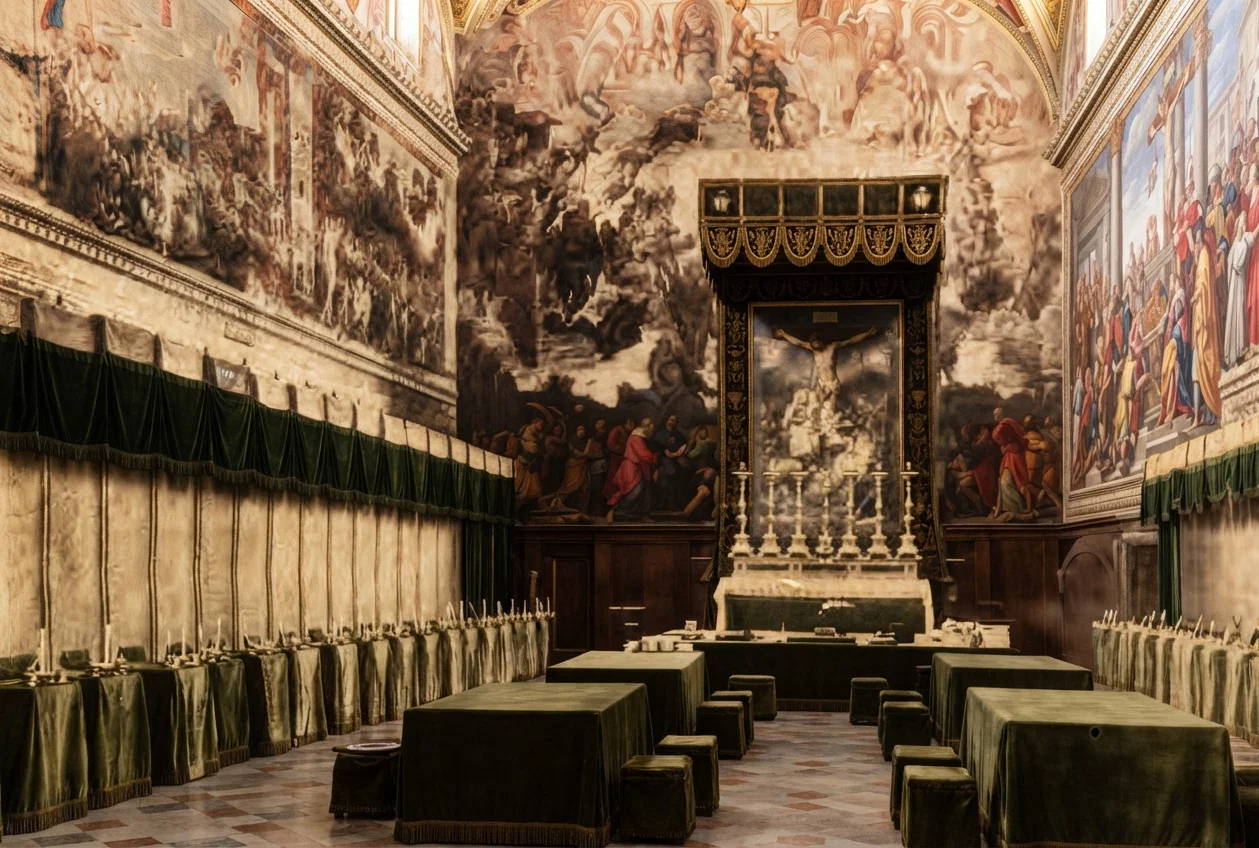
HALL OF THE PAPAL CONCLAVE IN THE VATICAN, WHERE THE CARDINALS ASSEMBLE FOR THE ELECTION OF THE POPES
AMERICAN FEDERATION OF CATHOLIC SOCIETIES
Would Have Use of Mails More Restricted
Meeting in Baltimore—Protests Against Treatment in Mexico
By S. B. HORTON
THE spirit of federation is one of the leading characteristics of this age. We have federations of both capital and labor; we have federations of social organizations; federations of the different Protestant churches; and also a federation of the various orders and societies in the Catholic Church itself.
Federations of political and social bodies we may expect. But when religious bodies combine, their chief object must be to bring to bear on the world the sheer force of their numbers. And in this thing they cease to be a spiritual power in the sense in which God commissioned His church to act. They become instead a force in politics.
The church as an overweening political machine can have but one effect. It must be intolerant of all opposition, and in the end must persecute dissenters.
We have been told for twenty-five years that the world had become too Christian and too civilized for any more war or religious persecution. But the outbreak in Europe ought to dispel the delusion concerning war, and those who had been giving careful heed to the word of God knew all the time that the worst wars the world has ever seen will occur in these last days.
In like manner we should be able to see, from the study of the thirteenth and fourteenth chapters of Revelation and kindred scriptures, that the fiercest religious despotism the world has ever known will occur in the closing days of earth's history.
The religious combinations of this time are significant, and should be watched closely and studied carefully.
THE thirteenth annual convention of the American Federation of Catholic Societies was held in Baltimore, September 27-30, opening with various religious services held at the cathedral and other places, in which Cardinal Gibbons and visiting bishops figured. On Monday evening a public reception was held, at which addresses were given by Governor Goldsborough, of Maryland, Mayor Preston, of Baltimore, Cardinal Gibbons, and others. On Tuesday a parade was conducted, in which it is claimed thirty thousand men participated.
The Catholic Church conditions in Mexico, and the part it was hoped the United States would take in the matter, occupied a very large part of the addresses and resolutions of the convention. In directing attention to the treatment of Catholic priests, nuns, and property in Mexico, Bishop Schrembs, of Toledo, Ohio, said in part:
"In near-by Mexico, thousands and thousands of men and women are being outraged in their most sacred religious convictions. Churches have been closed and desecrated. Priests and bishops have been robbed, tortured, exiled, and in some cases most brutally murdered. The very exercises of religion have been proscribed. . . . Where now are those agencies of public opinion, where is the press of our land, that it does not rise up in its might and raise a protest that can not be silenced until these outrages cease and religious liberty again triumph? The press is silent, silent as the grave in regard to these barbarities and this savagery. Instead it hails the inhuman brutes who are the perpetrators of these atrocities as the saviors of Mexico."
"A few years ago a political genius in one of his great speeches declared: 'You shall not press down this crown of thorns upon the head of labor—you shall not crucify mankind upon a cross of gold.' I had the highest admiration for those sentiments, but I can not help but feel that this political genius has an opportunity to-day to translate his rhetoric into action."
The convention subsequently adopted the following protest, and communicated it to President Wilson through a committee of three, who called at the White House and presented the same to the chief magistrate:
"September 29, 1914.
"Hon. Woodrow Wilson, President of the United States, Washington, D. C.:
"Your Excellency—We herewith respectfully convey to you, through the Rev. Richard Tierney, S. J., and Messrs. John Whalen and H. V. Cunningham, resolutions which were adopted at to-day's session of the thirteenth annual convention of the American Federation of Catholic Societies, and which resolutions read as follows:
"'Section 1. We denounce the outrages perpetrated against bishops, priests, and religious men and women in Mexico. Thousands have been robbed, tortured, exiled, and in many instances brutally murdered—and some of these were American citizens. Religious women, whose lives have been consecrated to the practise of every form of Christian charity, were subjected to what is worse than death, to the brutal lust of an inhuman soldiery."
"'Section 2. We protest against the unexplainable silence of our public press concerning these well-authenticated outrages. This mighty power for the formation of public sentiment and opinion has often made appeals even in the case of individuals, as, for instance, the Russian Jew Beiliss, or Miss Stone, the Protestant missionary, who was held in captivity by Turkish bandits. The Mexican outrages have thus far been scarcely mentioned by the press."
"'Section 3. In the name of sacred religion, which has been ruthlessly attacked; in the name of pure womanhood, which has been shamefully outraged; in the name of humanity, whose fundamental rights have been violated; in the name of Christian civilization, which, being supplanted by a rule of rapine, lust, and murder, we most earnestly appeal to our government at Washington to do its utmost toward stopping this inhuman persecution of just men and women in Mexico."
"'Section 4. By reason of the Monroe Doctrine, the civilized nations of the world look to the United States of America to exercise its great power for the preservation and maintenance of the fundamental rights of mankind on the American continent."
"'We therefore most earnestly urge upon the president of the United States not to recognize in Mexico any government which does not effectively guarantee civil and religious liberty in the true sense of the word."
RESTRICTING THE MAILS
"'Whereas, despite the continued objections of decent men, the privilege of the mails is still extended to obscene and scurrilous papers, injurious to the rights of conscience, as guaranteed by the constitution, and destructive of sound morality;
"'Be it resolved, That the Federation of Catholic Societies protest against such abuse of the mails.'"
"The gentlemen presenting the foregoing expression from the federation have been delegated to commend it to your earnest consideration, and to convey to you the kindest regards of this body.
"We have the honor to remain yours very truly,
"Charles I. Denechaud, President.
"Anthony Matre, Secretary."
On the next day Bishop Currier, of Cuba, and others called to talk over with the president the situation in Mexico. The president is reported as having promised to see that justice and protection would be accorded so far as the influence of the government could make it possible.663It appears that the Constitutionalists, who have succeeded in turning out of office the Huerta regime, do not take kindly to the Roman Catholic Church in Mexico. General Carranza is credited as having said, 'The clergy are among the worst enemies of the Mexican people.'"
General Villa, who led the armies of the Constitutionalists, upon assuming the governorship of Chihuahua is reported to have made this statement: 'We Mexicans have had three hundred years of the Spaniards. They have not changed in character since the conquistadores. They disrupted the Indian empire and enslaved the people. We did not ask them to mingle their blood with ours. Twice we drove them out of Mexico, and allowed them to return with the same rights as Mexicans, and they used these rights to steal away our land, to make the people slaves, and to take up arms against the cause of liberty. They supported Porfirio Diaz. They were perniciously active in politics. It was the Spaniards who framed the plot that put Huerta in the palace. When Madero was murdered, the Spaniards in every state in the republic held banquets of rejoicing. They thrust on us the greatest superstition the world has every known—the Catholic Church. They ought to be killed for that alone. I consider we are being very generous with them.'
A lively interest was manifested in regard to the next place of meeting. It was generally expected that the convention would hold its next annual session in San Francisco; but inasmuch as the Panama Exposition management could not guarantee that Ex-Mayor Ernesto Nathan, of Rome, should not be privileged to represent Italy at the exposition, it was voted to hold the meeting at Toledo, Ohio. Mr. Nathan received very severe castigations for his stand against the papacy several years ago while mayor of the city of Rome.
Christ's Love and Man's Ingratitude
By E. Hilliard
By E. HILLIARD
CHRIST taught the people and healed the sick during the day, and often prayed and wept in a solitary place at night. He spent many nights in communion with His heavenly Father while those whom He had healed were slumbering in the stillness of their homes.
Some were sleeping who had not known soothing slumber for many weary nights. They had forgotten the Healer, but the Healer had not forgotten them. With scarcely a thought of their sin-diseased souls, they were reaping the physical benefit of the Master's hard days of toil. Their thoughtless attitude toward their poverty of soul was that which sent our Saviour to the solitary place of prayer under the star-lit heavens. Many rejected His heavenly instruction who selfishly reaped the benefits of His healing power. This is what burdened His soul. This is why He wept and prayed while others slept. O, how ungrateful are the hardened hearts of sinful men! How could those nine lepers accept the freely proffered healing from that loathsome disease, and not even thank their Benefactor?
Ingratitude is one of the basest of sins. Our heavenly Father is greatly pleased when He sees us cultivating thankfulness of heart, through Christ, for the bountiful blessings of Heaven so freely bestowed upon us. If we would thank God more for benefits received, we would receive greater blessings to thank Him for. Often our Saviour received curses and stoning for His noble work and heavenly teaching; still He continued to heal the afflicted, and to weep and pray for the ungrateful, sinful people.
We should take courage when we remember that He is the same compassionate Saviour to-day. He never changes. He is able, dear reader, to save you and me, and He pleadingly invites us to cast all our sorrows, cares, and perplexities upon Him. He lives for the purpose of interceding for us. It is His mission in the courts of heaven. "Wherefore He is able also to save them [you and me] to the uttermost that come unto God by Him, seeing He ever liveth to make intercession for them."
A Good Motto
By J. H. H.
We are a motto-loving nation. Mottos, mottos, everywhere, good ones and poor ones, religious ones and profane and silly ones! But would not the latter part of the twenty-sixth verse of John 14 be a good motto to hang where we study the Word? "He shall teach you all things, and bring all things to your remembrance, whatsoever I have said unto you."
How often we read and read, and see only the printed page! Almost ready to give up, unable to get the meaning, we plead with God to fulfil His promise made in that verse, and lo, a light pierces the darkness of our mind! We then again realize that His promise is true, and that the Holy Spirit helps us understand. Nevertheless we are puzzled that the meaning, now so plain, seemed so mysterious before. Let us write out the motto, by all means, and then let us hang it in our hearts. J. H. H.
Resurrection of the Dead
By A. Smith
"If a man die, shall he live again?" Job 14:14. There is nothing in the forces or processes of nature that indicates an affirmative reply. Death is unnatural—an innovation upon the domain of existence. It was made possible by the introduction of sin into our world, for which there was no proper reason or excuse.
Although the planting of seeds is used as an illustration, it is inadequate as to results, from the fact that life is transmitted to the new growth before death to the seed ensues. So with the metamorphosis of the crawling worm into a most lovely butterfly, and of a water-beetle into a dragon-fly. The seed and the stock, the worm, the chrysalis and the insect, are only different forms of perpetuated life. Not so the resurrection of the dead. There is nothing that connects the dead body with the glorified, immortal one except the immutable promise of God, setting aside the courses of natural phenomena. See Eze. 37:11-14. This is the promise and hope of Israel in all time. See Acts 26:6-8; Titus 2:11-14. Paul was bound with chains, because he preached the consummation of this hope through Christ, whom the Jews regarded as an impostor. See Acts 4:2.
But why could not God have provided for the metamorphosis of the human body into a different, more beautiful, and glorious form of being, as in the worm and the butterfly?—Simply because in the creation of man, God exhausted His ideal of the form and perfection of a sentient being by making him like Himself. To improve upon this ideal would be to improve upon Deity, and to do less for man would be a concession to the triumphs of sin. See Ps. 139:14; Job 14:10-15.
Because of the union of divinity with humanity, God indeed, in the resurrection, will place man upon a higher plane of opportunity, development, and glory than he otherwise ever could have attained, without doing violence to the original perfection and purpose of his being.
But God has mysteriously made the resurrected body as dependent for its existence upon the original dead body as is the butterfly upon its ancestral worm, or the lovely pond-lily upon the repulsive mud in which its root is buried.
"This mortal must put on immortality." "God giveth it a body as it hath pleased Him, and to every seed his own body." 1 Cor. 15:53, 38. A. SMITH.
Set Your Affection on Things Above
By Paul
SET your affection on things above, not on things on the earth. For ye are dead, and your life is hid with Christ in God. When Christ, who is our life, shall appear, then shall ye also appear with Him in glory.—Paul.
A RELIGIOUS MEASURE PROPOSED FOR CALIFORNIA
By J. O. C.
Much Involved in the Proposed Sunday Law—Not Master of Your Own Time if Proposed Legislation Carries—California Should Vote "No" on No. 45 at the November Election
THIS bill, entitled "One Day of Rest in Seven," involves the reversal of God-given human rights, declared to be life, liberty, and the pursuit of happiness.
To pass this bill means invasion of human rights, unjust discriminations, prejudicial espionage, religious bitterness, social upheaval, human enslavement.
Happiness obtains only when one is permitted to use his days as best suits his judgment. When not thus free, liberty is restricted, and one is made a slave to outside dictation.
LIFE ENJOYED UNDER TWO CHARTERS
Every human right in life was bestowed by the higher charter—the voice and direction of Jehovah in man's creation. The second and lower charter—civil government—was ordained by God simply for the protection of the rights already conferred by Him.
NATURE OF THE BILL
This measure, known as the Barber's Sunday Bill, demands compulsory rest on Sunday from all honest toil, except the following: labor in the maintenance of lunch stands, ice-cream parlors, parks, bath-houses, the operation of livery stables, garages, etc. Theaters and sports of all kinds are also mentioned as "works of daily necessity," and are therefore exempted.
UNJUST DISCRIMINATIONS
Every one must at a glance recognize the injustice of these exemptions; for why should a grocer be counted a criminal for selling a loaf of bread to a hungry man on Sunday, while the lunch stand proprietor may feed people all the day and be scot-free? Again, why penalize the farmer or fruit grower for engaging in labor for the maintenance of his family, and permit the hired help in ice-cream parlors, livery stables, garages, and the actors and scene-shifters in theaters, all of whom work for maintenance wages, to follow their vocations seven days in the week as freely as they will?
PROMOTERS OF BILL MUST RECOGNIZE ITS INJUSTICE
If not, why do they exempt every kind of Sunday pleasure, and penalize useful employment if done on that day? If such a law were right for one rank of laborers, it ought to be just as right for every other division, otherwise it is class legislation, which is entirely unconstitutional. These exemptions can be looked upon only as baits held out to secure the votes of all frequenters of pleasure resorts. How church people can condemn Sunday amusements in theory, and then deliberately vote for a bill to keep them running in full blast on that day, is certainly a conundrum. No Christian can be a party to such law enforcement and be consistent.
SUPPOSED PROTECTION TO LABORING MEN
The advocates of this bill declare it to be aimed simply at employers who work men seven days each week. But this must be considered an insincere plea, for the reason that the California statutes have carried a law of this nature ever since February 27, 1893. It also has been enforced, and might be yet; for as late as 1912, in San Francisco, a Japanese proprietor of a moving picture theater was tried and fined $10.00 for failure to give an employee a day off in the week.
WHY PUNISH THE POOR LABORER?
If the proposed Sunday law is for the protection of the laborer against the greed of the employer, why not punish the oppressor, as above cited, and let the oppressed go free? The cry is that the laborer is obliged to labor. But is he? Take the barbers for example. Nearly all belong to the union. If they will but agree to shut up shop on Sunday, no labor can be demanded of them. This, too, is much more simple than to call for the enactment of a law demanding that everybody else shall rest on Sunday because they do so.
WHY A SUNDAY LAW DEMANDED
The heavenly Giver of human rights has never demanded rest of His subjects except on the day He calls His own. If one rests a day each week within his God-given rights, he must render that rest to God, whose rest day it is. But civil government can not by right order a weekly rest of citizens, because there is no day of the week owned or maintained by civil government. All days belong to Him who created and maintains them. The civil government has therefore no claim upon which to regulate the working hours or days of man's life. To undertake such work is to assume the responsibility of God toward man, and dictate heavenly duty for him. It is in this case a step toward uniting state and church, which has ever proved man's undoing. General Grant's advice is timely just now: "Keep the state and the church forever separate."
NATURAL RIGHTS VIOLATED
The bill is therefore an unwarranted interference with the most precious natural right of manhood. Man's right to life includes the right to dispose of his God-given time, as his God-given reason suggests, up to the point where his time may be employed to trench upon another's individual rights.
When confronted by the religionists of His day as to the claims of civil government upon man's time and service, the Christ of God, He who was heaven's ambassador to earth and man's surety for justice and eternal joy, decided the question thus tersely: "Render unto Caesar the things that are Caesar's; and unto God the things that are God's."
In view of this equitable arrangement, Caesar's government, or civil authority, can by right demand from no one that for which he is responsible to God alone. For instance, man's life being God's endowment solely, that life belongs to God, and man must answer to God in the great day for the use he has made of it. Civil government, having no power to give life or to continue it, can have no just right, to order its division of time into working or resting hours.
CALIFORNIA SUNDAY OBSERVANCE ALREADY MAINTAINED
In California every religious right of manhood is now guaranteed, including Sunday observance, even without a compelling law. These, too, average well with those of the states that maintain Sunday laws. Only two years after the repeal of the old California law, the Rev. W. F. Crafts, in his book on Sunday laws, said this: "Both laymen and ministers say that even in California the sabbath is, on the whole, better observed, and Christian services better attended, than five years ago."
It is thus acknowledged that this state has observed Sunday better without a Sunday law than with one. It should go on in the same way that it has gone.
A SYSTEM OF ESPIONAGE THREATENED
But now a law is demanded which assumes to fine or imprison one for working more than forty-eight hours in any given week665of seven days. And what is more, it enjoins upon peace officers of the state everywhere to inform against and prosecute any and all persons violating this provision. This discreditable work must be done by civil officials, under severe penalty, not because they have actually witnessed such infringement, but upon information from some possible enemy of the one accused. This amounts to no less than a system of espionage which is sure to beget neighborhood feuds and hateful contentions.
THE BILL'S LABOR PHASE
While outwardly assuming to be a Sunday rest day measure, when analyzed, the bill is seen to contain the elements of a restricting labor law. This is shown in its penalty threatened to all who labor more than forty-eight hours each week. If it were a bona-fide Sunday law, it ought simply to require rest on that one day, without curtailing the hours of labor one may perform on the other six days of the week. By this provision of the bill, one sees in it more than a Sunday rest. He discovers that the bill if enacted into law would demand, under penalty, that everybody rest on certain portions of each working day as well. Let voters be wary of voting away their liberties, as they will if this bill becomes law.
HUMAN ENSLAVEMENT
It is clear that inasmuch as the bill specifies the limit of hours of each week which may be used for honest toil, and permits unlimited hours for sports of every kind, it is not so much a Sunday rest that is wanted by the authors of the measure, as the control of men's time every day of the week, which would amount to human enslavement. But the bill is so disguised as to lead church people to believe that in securing its passage, they will have a genuine Sunday law. Hence their support is solicited to secure what a direct labor measure may fail to give for lack of votes.
THE BILL'S RELIGIOUS PHASE
There appears in the bill an exemption for those who belong to an association observing another day of the week than Sunday. But why should one's church-membership exempt him from the application of a just law? Could any other state law be thought just with an exemption of this nature? Suppose that some association religiously believed it right to have a plurality of wives. Ought that to exempt one of its members from the penalty of the law against polygamy? Of course not. Why then this exemption? Doubtless simply to mollify the feelings of those who may sympathize with the class named as entitled to exemption.
RESULT OF THE BILL'S ENDORSEMENT
So far as the religious phase of this proposed law goes, there are some things every voter should well consider before standing in its behalf. First of all, if this carries at the polls, no legislature has power, under the present constitution, to annul any feature of it. If once established, it must remain in force through all time, or until another initiative measure shall change it. In view of the fact that all religious legislation has ever been bad, and tends to injustice and persecution, voters should think carefully and well before enacting this bill. Religion is a matter resting wholly between man and his God, and beyond the purview of civil government. Why not therefore leave all people free in such matters, so long as they do not interfere with the rights of others?
Think of the early struggles of our country to secure religious liberty, and vote on November 3 to maintain these sacred principles. Vote "NO" on No. 45. J. O. C.