Pacific Press Publishing Company · Oakland, California · Aug 11, 1898
A LESSON FROM ABRAHAM, ISAAC, AND JACOB.
By W. N. G.
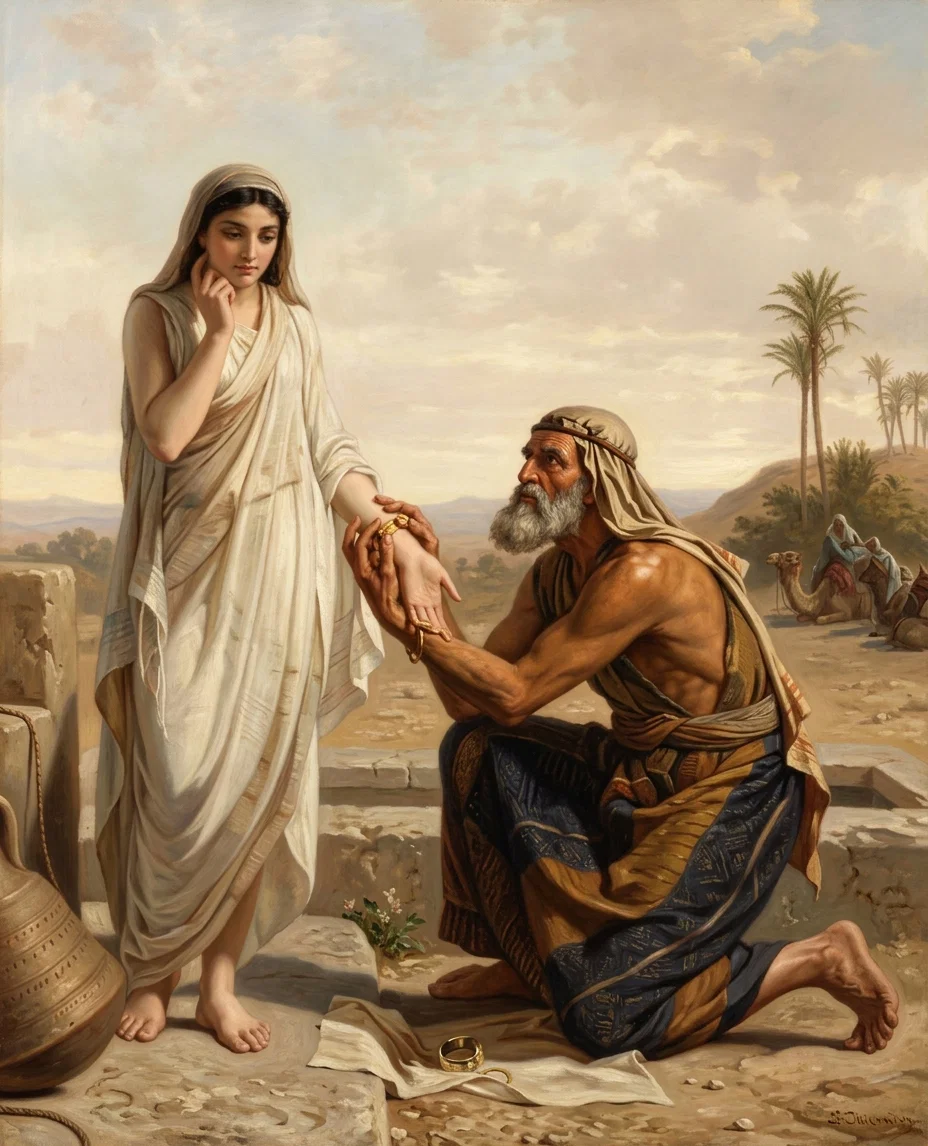
“The man took a golden ring of half a shekel weight, and two bracelets for her hands of ten shekels weight of gold; and said, Whose daughter art thou?” Gen. 24:22, 23, R.V.
“Now the Lord had said unto Abram, Get thee out of thy country, and from thy kindred, and from thy father’s house, unto a land that I will show thee.” Gen. 12:1. Abram (afterward named Abraham) “was called the friend of God” (James 2:23); therefore he made no special plea of attachment to “home and native land,” but “went out, not knowing whither he went” (Heb. 11:8). Abraham could not be a friend of God and a friend of the world—not even of kindred and country—at the same time. “Know ye not that the friendship of the world is enmity with God? whosoever therefore will be a friend of the world is the enemy of God.” James 4:4.
Abraham never returned to his native land. Even when there was a famine in the land to which God called him, he did not conclude that he had made a mistake in going there, or that his mission there was at an end. No, he went on still farther from the land from which he had come out, and sojourned temporarily in the land of Egypt. Abraham, the friend of God, was a pilgrim and a sojourner wherever he went, and dwelt in tents, indicating that he was not attached to any particular spot even in the land which he and his offspring were to occupy. If he ever sang—
“My country, ’tis of thee,” etc.,
it was with reference to the antitypical land of promise; “for he looked for a city which hath foundations, whose builder and maker is God.” Heb. 11:10.
Isaac, the son of Abraham, was a child of promise. The promises made to Abraham because of his faith were to him and to his seed (Rom. 4:13), and this seed was Christ (Gal. 3:16). Abraham had another son, Ishmael, by a bondwoman, but the seed was to come through Isaac, who was the son of Abraham’s wife, a freewoman (Gal. 4:22, 23; Rom. 9:6, 7). Isaac was the type of Christ, being a child of promise. He was submissive to his father’s will, even to being made ready for a burnt-offering; so when he was forty years old, his father made arrangements to get him a wife, and Isaac intrusted the matter entirely to him. “And Abraham said unto his eldest servant of his house, that ruled over all that he had, Put, I pray thee, thy hand under my thigh; and I will make thee swear by the Lord, the God of heaven, and the God of the earth, that thou shalt not take a wife unto my son of the daughters of the Canaanites, among whom I dwell; but thou shalt go unto my country, and to my kindred, and take a wife unto my son Isaac. And the servant said unto him, Peradventure the woman will not be willing to follow me unto this land; must I needs bring thy son again unto the land from whence thou camest? And Abraham said unto him, Beware thou that thou bring not my son thither again.”
We see that Abraham would not only not return himself to the land from which God had called him, but he would not allow his son to return, even to bring a wife away. Abraham was not slack in the matter of his son’s marriage; he had made it a subject of communion with God. This is evident from the fact that he told the servant that God would send His angel before him. It may be asked why he would send to a country to which he would not allow his son to go, and take from there a wife for his son. Two reasons seem obvious: (1) Abraham was endued with the spirit of prophecy (Gen. 20:7), and knew that the Canaanites would be eventually destroyed because of their wickedness ; therefore if Isaac were married amongst them, and his posterity were to live in close companionship and relationship with them, they would of necessity be cut off with the Canaanites. (2) Abraham trusted that there might be one in the land whence he had been called whom the Lord knew would yield to the good influences of his family (Gen. 18:19), and it would be a blessing to her to bring her away from her home surroundings. Besides this, Abraham was not lacking in knowledge of the evil results of marriage with those whose influence would tend to lead one away from fidelity to the God of heaven,—a knowledge too often2 (498)unheeded in our time, “as it was in the days of Noah,” and in the experience of Lot.
The test in Isaac’s case was, Would one be found willing to leave her country and her kindred, as Abraham had done, to become the wife of Abraham’s son, the child of promise? To find such an one was the important mission with which the God-fearing steward of Abraham’s household was intrusted, and laid under the obligation of a solemn oath. But if one could not be found willing to risk the journey with a strange man, and wedlock with one whom she never had seen, then the servant would be released from his obligation.
The servant (Eliezer) took ten camels and an abundant outfit, and went into Mesopotamia, unto the city of Nahor, Abraham’s brother. Stopping by a well outside the city, he again committed his cause to the Lord, saying: “Behold, I stand here by the well of water; and the daughters of the men of the city come out here to draw water; and let it come to pass, that the damsel to whom I shall say, Let down thy pitcher, I pray thee, that I may drink; and she shall say, Drink, and I will give thy camels drink also; let the same be she that Thou hast appointed for Thy servant Isaac; and thereby shall I know that Thou hast showed kindness unto my master.” Verses 13, 14.
The prayer was promptly answered, for “before he had done speaking” the damsel was at the well who did as he had said. And she proved to be Rebekah, “the daughter of Bethuel the son of Milcah, which she bare unto Nahor,” and was therefore the daughter of Isaac’s cousin. Eliezer was much encouraged by the manifest answer to his prayer, and humbly returned thanks to God. Upon receiving some costly presents, Rebekah ran home to show them to her family and tell them about the strangers at the well. Her brother Laban, attracted by the display of wealth, ran to the well and with much ado bade the servant of Abraham and his companions welcome to the hospitality of his father’s house. The characteristic selfishness manifested by Laban in his dealings with Jacob in after years is a fair indication that his show of friendship on this occasion was actuated by the prospect of gain rather than kindness of heart.
When Eliezer had made known his errand and requested an answer, her father and brother replied: “The thing proceedeth from the Lord; we can not speak unto thee bad or good. Behold, Rebekah is before thee, take her, and go, and let her be thy master’s son’s wife, as the Lord has spoken.” Then again the pious servant of Abraham bowed himself to the earth and thanked God for His kind providence. The hospitality of Rebekah’s family was well repaid, for besides the jewels and raiment that were given to Rebekah, Eliezer “gave also to her brother and to her mother precious things.”
When it came to the point of departing, the matter of Rebekah’s going was left entirely to her own choice, and she said, “I will go.” So, receiving the parting blessing from the family, she took her nurse and went with Abraham’s servant and his men. On arriving at Abraham’s camp, the servant made report of his mission, and Rebekah became Isaac’s wife.
The question is sometimes raised, If Abraham would not return to a country whence God had called him out, nor would allow his son Isaac to return thither, how could Jacob return there? The answer is in one word—apostasy. It was Jacob’s treachery toward Esau that caused him to flee from Canaan and take refuge in the land whence Abraham had been called, in order to escape his brother’s vengeance. And in after years, when Jacob’s posterity had been delivered from Egyptian bondage, and again planted in the land of Canaan, and had lapsed into dire apostasy, they were also carried as captives to the country whence Abraham had been called.
Now what is the lesson?—When God calls one from the world into His service, there can be no legitimate excuse for a return. A departure from God, if not repented of, must inevitably lead back to the former condition. Being “unequally yoked together with unbelievers” will surely endanger a covenant relation with God. Neither Abraham nor Isaac, altho enduring trials of faith, ever had to pass through Jacob’s trouble, or to labor as a servant in the land whence God’s representative had been called to freedom. All these humiliating experiences of Jacob and his posterity were the consequences of apostasy, and “whatsoever things were written aforetime were written for our learning, that we through patience and comfort of the Scriptures might have hope.” Rom. 15:4. W. N. G.
Lessons from Peter’s History.
By Ellen G. White
Peter was a man of hasty disposition, and everything he did was apt to be done under strong impulses. He was quick to anticipate, and of vivid imagination, but he was wanting in caution and calm forethought. His affections were strong, and he was willing to undertake anything in the service of his Master; but his impulsive temperament it was necessary to hold in check, for his impetuous nature often led him into unpleasant and false positions; and tho, while in connection with Christ and under the influence of His divine teaching, Peter learned many lessons, yet his natural traits of character often appeared.
When Christ on one occasion asked his disciples what the people thought of him, and who they said he was, they replied, “Some say that Thou art John the Baptist; some, Elias; and others, Jeremias, or one of the prophets.” Then, addressing Peter, Jesus said, “Whom say ye that I am?” With readiness and decision Peter answered, “Thou art the Christ, the Son of the living God.”
The heart of Peter had been touched by the Holy Spirit of God. Rays of light from heaven had flashed into his soul and warmed his heart with love for Christ. Jesus was acknowledged as well as known as the Messiah so earnestly looked for by the Jewish nation. “And Jesus answered and said unto him, Blessed art thou, Simon Bar-jona; for flesh and blood hath not revealed it unto thee, but My Father which is in heaven.”
In His answer, Christ did not exalt Peter above his brethren, nor give him superiority over his fellow-apostles. He did not address Peter alone, but the established Christian church. To Peter He said, “Thou art Peter”—by interpretation a stone—then, turning to His disciples, He said, “On this rock,” referring to Himself, “I will build My church; and the gates of hell shall not prevail against it.”
It was not the purpose of Christ to exalt one above another. In all His teachings He sought to lead His disciples to humility of heart. “Learn of Me,” He said; “for I am meek and lowly in heart; and ye shall find rest unto your souls.” Had Peter felt the necessity of taking the lessons of Christ more fully to heart; had he learned the meekness and lowliness of Christ, he would have saved himself sorrow which left its impress upon his memory as long as life lasted.
The more of the Spirit of Christ we have, the more humble we shall become. When we obtain their views of Christ, no words of self-exaltation will escape our lips. When the Lord gave to Job a view of His majesty, Job ceased to vindicate his own righteousness. He felt his sinfulness, and humbled himself before the purity and holiness of God. “I abhor myself,” he said, “and repent in dust and ashes.” Yet by the pen of inspiration, God presents Job as perfect and upright, one that feared God and eschewed evil. “There is none like him in the earth.”
After Jesus had worked the miracle to feed the five thousand, those who believed Him to be the Messiah wanted to make Him king, and they determined that if Christ would not consent, they would take Him by force and proclaim Him king of Israel. In this, the disciples and all the people present save the Pharisees would have united. But Jesus read the purpose of their hearts; He knew that this movement would arouse the jealousy of the priests and rulers, and thus cut short His work and defeat the purpose of His mission.
Jesus had sought to reveal to His disciples the nature of the kingdom He had come to establish. He had often told them, “My kingdom is not of this world;” but they had failed to comprehend His lessons. Now He dismissed them, telling them to take their boat, and go to the other side of the lake.
The disciples obeyed, but they murmured within themselves. They were more impatient and dissatisfied with Christ than they had ever been since they acknowledged Him as their Lord. He who could feed five thousand people in so miraculous a manner could break the Roman yoke, and make the Jewish nation free and exalted. Why, then, when popular feeling was enlisted in His favor, could they not take advantage of the occasion, and make Him king of Israel?
After dismissing His disciples and the multitude, Jesus turned to the lonely mountain for prayer. In His humanity He felt the need of strength from God. But the burden of the divine Master was for His disciples. He prayed that they might be braced for duty, and fortified for trial.
Meanwhile the disciples, in their boat on the sea, were battling with a fearful storm. The furious wind lashed the water into waves which mounted so high that the disciples expected every moment to be engulfed in the angry deep. But a lonely Watcher on the shore saw them toiling at their oars. He regarded with deepest interest that boat with its precious cargo; for these men were to be the light of the world; they were to take up and carry forward in His place the work He was soon to leave. He prayed for them.
At last the disciples saw that their efforts were in vain, that they were unable to help themselves. With feelings of remorse they remembered their impatience with Jesus, and called upon God for pardon. And now the time had come for Jesus to help them. Placing His feet upon the waters, He stepped from one white-capped wave to another, as if walking upon dry land. But a short time before in His humanity Christ had poured out his supplications to God among the rocks of the mountains; now in His divine majesty He walked the crested waves, that He might bring deliverance to the disciples He loved.
The disciples saw the Saviour walking upon the water, and they were afraid. They did not recognize their Master, but saw in this apparition an omen of their destruction. But Jesus quieted their fears. Above the roar of the tempest His voice was heard, “Be of good cheer: it is I: be not afraid.” Then Peter in his joy cried, “Lord, if it be Thou, bid me3come unto Thee on the water.” Jesus bade him come, and Peter sprang confidently out of the boat, and, with his eyes fixed upon Jesus, stepped from one white wave to another.
While Peter kept his eyes fixed on Christ, he knew no fear. But the boisterous waves aroused his fears. He looked down upon the hungry waters that seemed to talk with death. His faith failed, and as he felt himself sinking beneath the wave, he cried, “Lord, save me.”
His prayer was heard. Jesus’ hand was stretched out to grasp the sinking Peter, and His voice was heard saying, “O thou of little faith; wherefore didst thou doubt?” When Jesus was received with Peter into the boat, “immediately they were to land,”—the place where Christ had appointed to meet them.
Here is presented a case of mingled faith and unbelief. While Peter looked in faith to Christ, he walked the stormy billows in safety; but when he looked away from Jesus to the angry waters, he was afraid, and began to sink. No change had taken place in Jesus or in the waters. The change was in himself. Jesus had not bidden His disciple come to Him to perish; but instead of looking to his Lord, and thinking of His power, Peter began to think of his perilous position. He saw the great waves rolling and pitching about him; his faith gave way, and but for the power of Christ he would have been engulfed.
Christ sought to prepare His disciples for the trial that must come to their faith in His betrayal, His trial in the judgment-hall, and in His crucifixion. When alone with His disciples at Cesarea Philippi, He said, “The Son of man must suffer many things, and be rejected of the elders, and of the chief priests, and scribes, and be killed, and after three days rise again.” But Peter was not willing to accept anything of this nature in the mission of Christ.
Such an event as this, he thought, must bring the Christian church to naught. The Lord could prevent this, and such a terrible thing must not happen. With all the power of his strong feelings he exclaimed, “Be it far from Thee, Lord; this shall not be unto Thee.”
The words of Peter turned the minds of the disciples from the lesson Christ desired to impart, and called from Christ the severest rebuke He had ever uttered. “Get thee behind Me, Satan,” He said; “thou art an offense unto Me; for thou savorest not the things that be of God, but those that be of men.” It was Satan who instigated doubts in the mind of Peter, and led him to presumptuously rebuke his Lord.
And it is Satan who to-day works to deceive humanity in the same lines. It is he who puts thoughts of unbelief into the mind. It is he who suggests that those truths which involve a cross be left out of the experience and belief of God’s professed children. Many would have God’s commandments, His great moral standard of righteousness, blotted out, because it involves a cross. “Speak to us of Christ’s willingness to save the vilest of sinners,” they say. “Speak to us of faith in Christ, of the mercy of Jesus, and His promises, but do not talk of repentance and the putting away of sin.” Truths so unpopular as the law of God are altogether unwelcome to the carnal heart.
The Lord is now dealing with His people who believe present truth. He designs to bring about momentous results, and while in His providence He is working toward this end, He says to His people, “Go forward.” There are times when the Christian path seems beset by dangers, and duty seems hard to perform. The imagination pictures impending ruin before, and bondage or death behind; yet the voice speaks clearly above all discouragements, “Go forward.” We should obey this command, be the result what it may. The clouds that gather above our way will never disappear before a halting, doubting spirit. The voice of the Lord bidding His faithful ones go forward, frequently tries their faith to the uttermost. But those who think it impossible to yield to the will of God until all is made clear and plain before them, will never yield at all. Faith is not certainty of knowledge; it is “the substance of things hoped for, the evidence of things not seen.” MRS. E. G. WHITE.
The Author of the First-Day Sabbath.
By F. M. Wilcox
The law of God is the character of God in written form. As every lawmaker puts himself and his character into the law he formulates, so the omnipotent One expressed in His law of Ten Commandments His own divine attributes. This is so in the very nature of the case. God could not do otherwise than give to an instrument of this kind an expression of Himself. Hence there could come no change in the law of God and that law still continue to express His character unless there came a change in God Himself. As God is the same yesterday, to-day, and forever, the same in this dispensation as in the old, the same when He died for men as when He made the world in the beginning, we must therefore conclude that if any change has been wrought in what men regard the law of God, it has been made by another power than the Lord Jesus Christ.
Has there arisen in the universe a power that has tampered with the law of God? Is any such opposing principle brought to view in the sacred Scriptures? It does not require a very careful reading of the Word of God to see that this is the case.
For many centuries have there been two opposing principles in the universe—God and Satan. And ever since the fall of man have these two principles been manifest in the world. Both have been manifest in the flesh. God was manifest in Christ, reconciling the world unto Himself. He came not to tear down the government of God, but to exalt it; not to detract from the law, but to magnify it. And faith in Him, instead of abolishing the law, only serves to confirm its authority. The principle of evil has likewise been manifest in the flesh, and its highest manifestation is in antichrist. And the object of this principle from the beginning has been to draw subjects from the kingdom of light to the kingdom of darkness; to destroy the reputation of God in the earth, and to weaken and bring to naught His rightful authority. And it is upon this latter power that the responsibility rests of working a change in the divine requirements, so far as the practise of men is concerned. Many scriptures bring this power to view. We will content ourselves, however, with an examination of the references made by the prophet Daniel and the apostle Paul.
The prophet states that after the Roman Kingdom had become divided, there should arise a power which should speak great words against the Most High, wear out the saints of the Most High, and think to change the times and laws of the Most High. Dan. 7:25. That unmistakable reference is made here to the Papacy there can be no dispute among Protestant Bible students. That power has met every specification of the charges brought against it. It has spoken great words against the Most High in claiming to be God upon earth, to have power to forgive sins, and to be the arbiter of the consciences of men. It has worn out the saints of the Most High in the ages of the past in subjecting to death those who were unwilling to support its claims as against the leadings of their own consciences and the authority of the Word of God. The sacrifice of from fifty to one hundred million martyrs testifies to the statement of this fact. And in addition to these crimes against high Heaven, the prophet states that it would have the audacity to even dictate a change in the government of God itself.
The same work is brought to view in the epistle to the church in Thessalonica. Of this same power, under the name of the man of sin, the apostle writes that it should oppose and exalt itself above all that is called God, or that is worshiped. In enforcing the law of God as His own he would place himself on an equality with the great Lawgiver; but his exaltation above God could only come by assuming superior authority, by changing the requirements of God, and enforcing the change instead of the original requirement.
Has the Papacy met these requirements? and does it plead guilty to the charge? To prove this indeed true, we have but to call attention to the words of the Roman Church as printed in its representative publications. The following confession, which might be multiplied a hundred-fold by similar quotations, reveals the4position assumed by the papal church upon this subject:—
Question—Have you any other way of proving that the church has power to institute festivals of precept?
Answer—Had she not such power, she could not have done that in which all modern religionists agree with her,—she could not have substituted the observance of Sunday, the first day of the week, for the observance of Saturday, the seventh day, a change for which there is no scriptural authority.
Q.—When Protestants do profane work upon Saturday, or the seventh day of the week, do they follow the Scripture as their only rule of faith?—do they find this permission clearly laid down in the sacred volume?
A.—On the contrary, they have only the authority of tradition for this practice. In profaning Saturday, they violate one of God’s commandments, which He has never clearly abrogated,—“Remember that thou keep holy the Sabbath day.”—Doctrinal Catechism.
Q.—How prove you that the church hath power to command feasts and holy days?
A.—By the very act of changing the Sabbath into Sunday, which Protestants allow of; and therefore they fondly contradict themselves by keeping Sunday strictly, and breaking most other feasts commanded by the same church.
Q.—How prove you that?
A.—Because by keeping Sunday they acknowledge the church’s power to ordain feasts, and to command them under sin; and by not keeping the rest by her commanded, they again deny, in fact, the same power.—Abridgment of Christian Doctrine (Catholic).
From the foregoing prophecies and with the plain facts of their fulfilment, it is not difficult to determine the author of the observance of the first day of the week. It was not the Lord or His apostles, but it was the power which is pointed out in all the Scriptures of truth as the most dangerous enemy of the Gospel of Christ. The Sunday sabbath rests alone upon the authority of the tradition of the Catholic Church. And he who observes it pays deference, tho it may be unwittingly, to the authority of anti-christ. Respect for the Lord Jesus Christ and the proper recognition of His authority can be found only in obedience to His requirements, and the sacred keeping of the day He Himself made and set apart for the use of the redeemed of all nations. Shall we honor Christ, or anti-christ? Shall we keep the Sabbath of the Lord, or the sabbath ordained by the great enemy of the church of God? F. M. WILCOX.
“DIP IT UP.”
By Mrs. L. C. Hutchins
Out upon the boundless ocean, tempest-tossed, the voyage was long;
But the barque outrode the billows and the blast, both fierce and strong.
Anxiously they scanned the waters, joyed to meet a friendly ship—
Gone, alas, their store of water, nought to cool the burning lip!
Then they sounded forth the trumpet, and their plaint was lifted high,
“Give us water; we are dying.” “Dip it up!” was the reply.
O, how cruel seemed the answer, on the brine so far from shore—
Hardened hearts indeed to taunt them, thus to mock their anguish sore!
“Dip it up,” the voice repeated; “here is water fresh and free;
Here the Amazon, broad river, pushes back the briny sea.”
Sure enough! ’twas all about them, water pure to quench their thirst.
All their sorrow turned to gladness, mourning now to joy reversed.
Oft ’tis thus with sin-sick mortals, sad and storm-tossed day by day.
Fearing He who made forgets them, they go mourning all the way,
While around us, like the ocean, or the sunshine from above,
Flow the waters of salvation, lie the tokens of His love.
Had the mariners but doubted, never had they quenched their thirst,
Ne’er had dipped and drank the water, had they not believed it first.
Pines thy heart for full salvation? Then reach out the empty cup.
All about thee lies the blessing; only reach and “dip it up.”
Filled the cup with rocks or rubbish, little water would it hold;
Empty let it be of folly, love of self, or lust, or gold.
Moses lifted up the serpent, bade the wounded look and live.
Christ, who died to save the sinner, waits abounding grace to give.
Yes, the Spirit now invites you, bids the wanderers not to roam;
And the Bride aloud proclaims it, “Let the thirsty ones but come.”
Then let him who hears repeat it, “Come ye all with empty cup;
*Freely flows ‘life’s crystal river;’ come, poor sinner: ‘dip it up.’*
—Mrs. L. C. Hutchins.
LIVING BY EVERY WORD.
By Mary E. Halstead
IN Matt. 4:4 we find Christ meeting the tempter with these words:—
“Man shall not live by bread alone, but by every word that proceedeth out of the mouth of God.”
Here is an example to live by the Word of God. And if we follow this example, we also will be able to meet the tempter with a, “Thus it is written.” And the enemy, even tho he comes as an angel of light, will not be able to resist or gainsay the wisdom and Spirit by which we speak. Acts 6:10.
If one comes to us as a teacher of righteousness, yet in reality presenting principles under which lie dangerous errors, we will not be deceived if we are living on the Word. “To the law and to the testimony; if they speak not according to this Word, it is because there is no light in them.” Isa. 8:20.
Have we asked the Lord to bless us, and found that prayer has not been answered? If so, it is because we have not been living on the Word.
In fact, if there is any lack in our Christian experience, it is because we are not living on every word that proceedeth out of the mouth of God. For in that word there is living food to meet every condition and emergency.
From henceforth let us as followers of the meek and lowly Jesus glorify the Father by living on “every word that proceedeth out of the mouth of God.” The same power attends “every word that proceedeth out of the mouth of God”—in creation, redemption, and salvation—through our Lord Jesus Christ, in whom we are free indeed if this Word dwelleth in us.
O sinner, taste the living Word and see that the Lord is good!
MRS. MARY E. HALSTEAD.
THE SPIRIT THAT SAVES.
By G. E. Burch
“And I, if I be lifted up from the earth, will draw all men unto Me.” John 12:32. These are the words of Christ to the world. “How does Christ draw men to Him?” is the question I hear you ask.
When Christ was anointed with the Holy Ghost, He went forth teaching in all the land. When He had finished His work and was about to take His departure from this earth, the disciples were sorrowful because He was going away. But He comforted them with these words: “It is expedient for you that I go away; for if I go not away, the Comforter will not come unto you; but if I depart, I will send Him unto you.” John 16:7. Christ tells us that He receives all His power from the Father. He also told His disciples to tarry in Jerusalem until they were endowed with “power from on high.” Luke 24:49; Acts 1:4. Then, as they were assembled together, all of one accord, they received the Holy Ghost and went forth teaching, baptizing, and imparting, as active agents of God, the Holy Ghost to as many as would receive Him. Acts 2:7.
We see by these words of truth that all true Christians have a living connection with Christ and the Father. We have the same mind and power of Christ. Now as Christ receives His power from the Father, and all true Christians receive the same power from Him, we are attracted one to another by that same divine power, which is love.
It is very important for you and me to receive the power of Christ, “the Holy Spirit,” in our hearts and lives, and let Him keep us free from all the contaminating influences of the world, so that when Jesus comes, the Spirit of Christ in us will respond to His voice, and be “caught up to meet the Lord in the air.” Are we ready? G. E. BURCH.
“AND GREATER WORKS THAN THESE SHALL HE DO.”
“Verily, verily, I say unto you, He that believeth on Me, the works that I do shall he do also; and greater works than these shall he do; because I go unto My Father.” John 14:12. This is a wonderful promise to the believer. There are no conditions or qualifications for him “that believeth on Me.”
It is one thing to merely profess faith in the Son of God. It is another thing altogether to actually believe. For “he that believeth on Me, the works that I do shall he do also.” Now, are we who profess the name of Christ actually doing the works of Christ? If not, then do we really believe? The actual believer can have but one thought, and that is to work the works of his divine Master.
Not only does the believer do the works that Christ the Lord did, but “greater works than these shall he do; because I go unto My Father.” What an inspiring promise! The Master returns to the Father and intrusts His human agents with even “greater works” than He did Himself while here.
The Christian can not be conscious of doing these “greater works,” for he is all absorbed in his faithful devotion to his Lord. He is not thinking of himself, nor does he have a single selfish ambition. His every thought centers in the self-sacrificing Redeemer. He knows Jesus and Jesus only. He does not attempt to do these “greater works” of himself; for he knows that “without Me ye can do nothing.” He depends on Jesus solely and for everything. While he was of the world he was self-centered and sought to draw everything to himself. But now that he “believeth” on the Master, every one of his emotions centers in the Man of Calvary.
“He that believeth on Me,” and to none other, is the promise made. And “he that believeth” does not do it from any self-centered motive. Indeed, before the real belief in Christ can come into the mind, self must be given up; because if self remains, faith in Christ is kept out.
In other words, every man has one or the other of the two kinds of faith. The self-centered man has faith in himself. He plans to do wonderful things of himself. In fact, he has such great faith in himself that he believes that what he can not do must be an impossibility. On the other hand, the Christian has his faith reverently fixed upon Jesus. He has no faith at all in himself; he realizes the utter worthlessness of self; he has transferred all to Christ. Christ is to him all and in all.
The Master says, “He that believeth on Me, the works that I do shall he do also; and greater works than these shall he do; because I go unto My Father.” The Saviour began a great work when He was here upon earth, and He does not propose to leave that work to grow less and less in importance. He does not leave His followers to do a lesser work than He did Himself, but “he that believeth on Me” shall do “greater works.” God’s name was greatly glorified through the works of the Master while He was here in person, but even greater glory will He receive through the “greater works” that His followers perform.5
These promises seem wonderful beyond all comprehension. The Christian bows his head in humility before the divine promise and decree that he shall do “greater works” than his Lord did. He feels unworthy to be called to such work. But he is now a believer in Christ, having fully given up his faith in self, and so he says that whatsoever the Lord plans for him to do is right. It is God’s way; therefore it is unquestionably the best, and infinitely right.
The works are not done to glorify the human agent anyway. The Christian is a believer in Jesus. He has no faith in self, and in the very nature of things he does not want any self-glory. For why should he seek to glorify that which he has given up as something so wholly undesirable that he no longer wants it?
“The works that I do shall he do also.” Study this promise and heavenly decree. Do not take a contracted view of it. Seek to know it in its fulness. The “works” of the Master did not include merely the miracles that He wrought. These mighty miracles were wonderful works indeed. But the Lord lived a perfect life while clothed with just such sinful flesh as you and I have, and right here in this sinful world where we have to dwell. O, wonderful work was this! A perfect life in the flesh of sin and in the world of sin! What a thought!
“Who did no sin, neither was guile found in His mouth; who, when He was reviled, reviled not again; when He suffered, He threatened not; but committed Himself to Him that judgeth righteously.” 1 Peter 2:22, 23. What a wonderful life is described in this brief passage of Scripture! He “did no sin,” and He had no “guile.” “He was reviled,” but He “reviled not again.” “He suffered,” but in return “He threatened not.” There was no self in such a life as that. There was no impatience, no anger, no malice, no revenge, no evil of any kind or sort. Wonderful, wonderful, wonderful indeed was the Master’s straightforward, perfect, and powerful life!
And the purity of the Saviour’s life is the secure and strong foundation on which was builded the “great works” that He did. By “believing” He gives us the same foundation of power. “Abraham believed God, and it was counted unto him for righteousness.” Rom. 4:3. Then the faith that believes God brings God’s righteousness. And God’s righteousness is power.
Study this question of true faith in God; for incomprehensibly great things are prepared for him that “believeth.” In these days of peril just before the coming of the Son of man our Father in heaven wants believers who are believers indeed; for through them He will work His “greater works.” Precious privilege. Step in. There is abundant room for all in the Master’s vineyard to-day, and a mansion for each in the immortal kingdom that is so soon to be our home.
THOUGHTS
By C. F. Ladd
REMEMBER the promise.
Jesus is our Life-giver.
We must press onward.
Please God, not man.
Without Christ we are lost.
Pray for the help you need.
In many cases life is a lie.
We may deceive men but not God.
Love of self-praise is sin.
Jesus cheers us in our troubles.
There is work for us in every place.
When we meet Christ, we forget self.
If we love God, we will love His people.
Pray for the courage to do your duty.
God is not only powerful but just.
The Holy Spirit is the poor man’s commentary.
We should learn the power and use of kind words.
When we are saved, we can not keep the good news to ourselves.
We may not be called to die for Jesus, but we are called to live for Him. C. F. LADD.
THE HASTE OF LIFE.
By Bishop of Ripon
It is one of the misfortunes of our age that we have so little leisure. The haste of life brings many disadvantages; it hinders thoroughness of work, it destroys largely our reverence for life, since we hardly cherish much respect for what we do hurriedly. The result is that the world is full of hasty judgments; men are driven to decide almost before they have had leisure to deliberate. The spirit of this haste is infectious; people ask for rapid conclusions; they become impatient of a wise hesitation. The demand brings the supply. On all sides dogmatic utterances are heard; a swift survey is made. A few facts are gathered; an immature conclusion is reached and immediately announced; oracle succeeds oracle, contradicting or confirming; those who counsel deliberation are elbowed out of the way. In the multitude of oracles there is confusion. Men grow bewildered; they drift to one side or the other, having lost their vantage-ground of calm observation. Such a state of things is hardly helpful to truth. What is wanted is a quiet thought. Out of it may come clearer views, better methods of study, and the reverent spirit which is essential to the discovery of truth. God reveals nothing to the hasty. The calm waters best reflect the stars.—Bishop of Ripon.