Your ShelfYour Projects

Review and Herald, Vol. 88, No. 8.

The Heritage of the Saints

Review and Herald

Feb 23, 1911

Review and Herald Publishing Association · Takoma Park Station, Washington, D. C. · Feb 23, 1911

The Heritage of the Saints

O thou afflicted, tossed with tempest, and not comforted, behold, I will lay thy stones with fair colors, and lay thy foundations with sapphires.
And I will make thy windows of agates, and thy gates of carbuncles, and all thy borders of pleasant stones.
And all thy children shall be taught of the Lord; and great shall be the peace of thy children.
In righteousness shalt thou be established: thou shalt be far from oppression; for thou shalt not fear: and from terror; for it shall not come near thee.
Behold, they shall surely gather together, but not by Me: whosoever shall gather together against thee shall fall for thy sake.
No weapon that is formed against thee shall prosper; and every tongue that shall rise against thee in judgment thou shalt condemn. This is of the heritage of the servants of the Lord, and their righteousness is of Me, saith the Lord.— Isaiah 54:11-17.

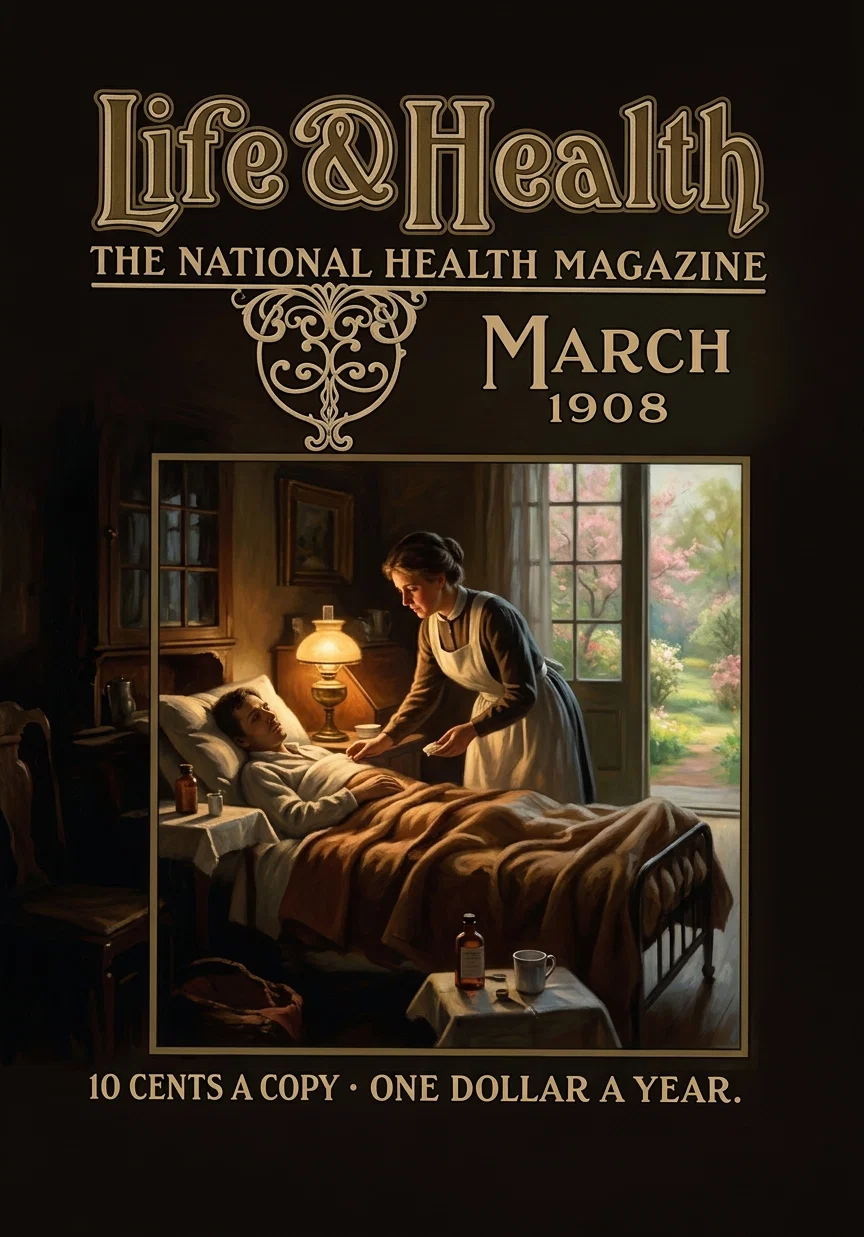
The March Issue of LIFE AND HEALTH

The March issue of Life and Health is adapted to the needs of the individual during the most health-testing month of the year. It is not a “don’t” number, void of the things to do in building up the system so it may resist disease; but it presents simple, positive measures in the treatment of such vital questions as—
Home Care of Consumptives; Rest in the Healing of Disease; Carrying Unnecessary Loads and Burdens; Overeating: the Great American Crime; The Prevention of Colds; Exposed Foods; Restfulness and Peace of God’s Out-of-Doors.

It Tells How to Prevent

The Impairing of the Mental Powers and Laying the Foundation for Insanity; Worry and Unhappiness in the Home; Having Trouble With Employed Help; Bad Habits of the Functions of the Body; Bad Habits of Placing Confidence in “Cure-Alls,”—“Rabbit’s Foot,” and Other Amulets and Charms.
The above and many other health topics of practical value to every person are treated in the March number by those who, through experience, are amply qualified to write. This number will prove to be a Good Samaritan to thousands of suffering men and women, and a strong defense against disease to the healthy who adopt these preventive measures.
PRICES: Single copy, 10 cents; 5 to 40 copies, 5 cents a copy; 50 or more copies, 4 cents a copy. Annual subscriptions, $1; six months, 50 cents.

Special Discount to Agents on Annual Subscriptions
ALL ORDERS SHOULD BE MADE THROUGH CONFERENCE TRACT SOCIETIES
A MONTHLY AT ONE DOLLAR A YEAR

“God’s Two Books;

OR

Plain Facts About Evolution, Geology, and the Bible”

Just issued. By George McCready Price, professor of Geology and Physics, Loma Linda (Cal.) Medical College, author of “Illogical Geology,” etc.
Not long ago a clergyman in Wisconsin wrote to us in a taunting way, “Do you know of any college, or even high school, that amounts to anything, which is not teaching the doctrine of evolution?”
In our own minds we had to sadly confess that this teaching has become well-nigh universal throughout the civilized world. While not all teach the evolution of man from the lower animals, there are comparatively few to-day who doubt or question the long, successive ages of the modern evolutionary geology. The truth about geology is vital, and should be understood by all.
In a recent number of “Nature” (Jan. 19, 1911), the foremost botanist of England says that the modern evolutionary theory “had its roots in Lyell,” the founder of modern geology; and he quotes another leading scientist to the effect that had it not been for Lyell and his theories of geology, “we should never have had the ‘Origin of Species.’”
The present volume gives a summary, in easy, readable language, of the wonderful discoveries that have recently been made in the rocks of Europe and America, which have done so much to confirm the Bible record. To give but one instance: Just east of the Rocky Mountains, extending over one hundred miles in the southern part of Alberta, and running nearly another hundred miles down into Montana, is a tract of country, now known to be over a thousand square miles in area, where what are called pretty nearly the “youngest” rocks are underneath, and almost the very “oldest” are on top, and yet these rocks have every physical appearance of having been deposited just as we find them. But if they were really deposited in this order, the writings of Darwin and all his followers are only so much waste paper, and the evolution theory becomes a piece of elaborate nonsense. This is only one of the many modern discoveries mentioned in this book,—discoveries which are compelling some of the best scholars of our time to acknowledge that there must be something radically wrong with this system of geology that has so long been contradicting the first chapters of the Bible.
“GOD’S TWO BOOKS” is well illustrated, giving the portraits of most of the scientists mentioned in the book, with diagrams, pictures of fossils, etc. 184 pages; cloth, $1.
Address Your Tract Society or the Review & Herald Pub. Assn., Washington, D. C.

The Blessed Hope

L. D. SANTEE
The “blessed hope” is the one that lingers, Bright with its promise, and sweet with prayer; Harps will be touched with deathless fingers, I shall hear them and see them over there; Forms will be there of matchless beauty, Walking the shining streets of gold; Rich and sweet were their lives with duty, And their joys no angel has ever told.
The “blessed hope” with its joy enfolds me, Rich with the radiance sent from heaven, And ’mid the cares of the world upholds me. There’s life eternal when crowns are given; Ties unite, that have long been riven; Friends will greet that were parted long; Eyes will shine with the light of heaven, Voices will swell the eternal song.
The “blessed hope,” with its endless gladness, Filleth the heart with its joy and peace, Bannisheth ever the gloom of sadness, Filling the soul with its glad release. God in his love has the promise given Of a home where heartache shall come no more, With never a tempest to cloud the heaven, And never a wreck on the shining shore.
Moline, Ill.

The First Christian Martyr

MRS. E. G. WHITE
Stephen, the foremost of the seven deacons, was a man of deep piety and broad faith. The veil had dropped from his eyes, and he discerned to the end of that which was abolished by the death of Christ. Though a Jew by birth, he spoke the Greek language, and was familiar with the customs and manners of the Greeks. He therefore found opportunity to preach the gospel in the synagogues of the Greek Jews. He was very active in the cause of Christ, and boldly proclaimed his faith. Learned rabbis and doctors of the law engaged in public discussion with him, confidently expecting an easy victory. But “they were not able to resist the wisdom and the spirit by which he spoke.” Not only did he speak by the power of the Holy Spirit, but it was plain that he was a student of the prophecies, and learned in all matters of the law. He ably defended the truths that he advocated, and utterly defeated his opponents.
As the priests and rulers saw the power that attended the preaching of Stephen, they were filled with bitter hatred. Instead of yielding to the evidence that he presented, they determined to silence his voice by putting him to death. On several occasions they had bribed the Roman authorities to pass over without comment instances where the Jews had taken the law into their own hands, and had tried, condemned, and executed prisoners in accordance with their national custom. The enemies of Stephen did not doubt that they could again pursue such a course without danger to themselves. They determined to risk the consequences, and therefore seized Stephen, and brought him before the Sanhedrin council for trial.
Learned Jews from the surrounding countries were summoned for the purpose of refuting the arguments of the prisoner. Saul was present, and took a leading part against Stephen. He brought the weight of eloquence and the logic of the rabbis to bear upon the case, to convince the people that Stephen was preaching delusive and dangerous doctrines. But in Stephen he met one as highly educated as himself, and one who had a full understanding of the purpose of God in the spreading of the gospel to other nations.
The priests and rulers could not prevail against the clear, calm wisdom of Stephen. They determined to make an example of him, and while they thus satisfied their revengeful hatred, prevent others, through fear, from adopting his belief. Witnesses were hired to bear false testimony that they had heard him speak blasphemous words against the temple and the law. “We have heard him say,” these witnesses declared, “that this Jesus of Nazareth shall destroy this place, and shall change the customs which Moses delivered us.”
As Stephen stood face to face with his judges, to answer to the charge of blasphemy, a holy radiance shone upon his countenance, and “all that sat in the council, looking steadfastly on him, saw his face as it had been the face of an angel.” Those who exalted Moses might have seen in the face of the prisoner the same holy light that radiated from the face of that ancient prophet. Many who beheld this light trembled and veiled their faces, but the stubborn unbelief and prejudice of the rulers did not waver.
When Stephen was questioned as to the truth of the charges against him, he began his defense in a clear, thrilling voice, which rang through the council hall. He proceeded to rehearse the history of the chosen people of God, in words that held the assembly spellbound. He showed a thorough knowledge of the Jewish economy, and the spiritual interpretation of it, now made manifest through Christ. He repeated the words of Moses, which foretold of Christ, “A prophet shall the Lord your God raise up unto you of your brethren, like unto me; him shall ye hear.” He made plain his own loyalty to God and to the Jewish faith, while he showed that the law in which the Jews trusted for salvation had not been able to save Israel from idolatry. He connected Jesus Christ with all the Jewish history. He referred to the building of the temple by Solomon, and to the words of both Solomon and Isaiah: “Howbeit, the Most High dwelleth not in temples made with hands.” “Heaven is my throne, and earth is my footstool: what house will ye build me? saith the Lord: or what is the place of my rest? Have not my hands made all these things?” The place of God’s highest worship is in heaven.
When Stephen reached this point, there was a tumult among the people. He saw the resistance that met his words, and knew that he was giving his last testimony. When he connected Christ with the prophecies, and spoke as he did of the temple, the priest, pretending to be horror-stricken, rent his robe. To Stephen, this act was a signal that his voice would soon be silenced forever. Although in the midst of his sermon, he abruptly concluded it. Suddenly breaking away from the train of history that he was following, he turned upon his infuriated judges, and said:“Ye stiffnecked and uncircumcised in heart and ears, ye do always resist the Holy Ghost: as your fathers did, so do ye. Which of the prophets have not your fathers persecuted? and they have slain them which showed before of the coming of the Just One, of whom ye have been now the betrayers and murderers: who have received the law by the disposition of angels, and have not kept it.”
At this, the priests and rulers were beside themselves with anger. More like wild beasts of prey than human beings, they rushed upon Stephen, gnashing their teeth. The prisoner read his fate in the cruel faces about him, but he did not waver. The fear of death was gone. The enraged priests and the excited mob had no terror for him. The scene before him faded from his vision. To him the gates of heaven were ajar, and looking in, he saw the glory of the courts of God, and Christ, as if just risen from his throne, standing ready to sustain his servant, who was about to suffer martyrdom for his sake. In words of triumph Stephen exclaimed, “I see the heavens opened, and the Son of man standing on the right hand of God.” As he described the glorious scene opened before him, it was more than his persecutors could endure. Stopping their ears, that they might not hear his words, and uttering loud cries, they ran furiously upon him with one accord. “And they stoned Stephen, calling upon God, and saying, Lord Jesus, receive my spirit. And he kneeled down, and cried with a loud voice, Lord, lay not this sin to their charge. And when he had said this, he fell asleep.”
The witnesses who had accused Stephen were required to cast the first stone. These persons laid down their clothes at the feet of Saul, who had taken an active part in the disputation, and had consented to the prisoner’s death.
The martyrdom of Stephen made a deep impression upon all who witnessed it. It was a sore trial to the church, but resulted in the conversion of Saul, who could not efface from his memory the faith, constancy, and glorification of the martyr. The signet of God upon Stephen’s face, and his words, which reached the very souls of those who heard them, remained in the minds of the beholders, and testified to the truth of that which he had proclaimed.
No legal sentence had been passed upon Stephen, but the Roman authorities were bribed by large sums of money to make no investigation of the case.
At the scene of Stephen’s trial and death, Saul had seemed to be imbued with a frenzied zeal, and afterward he seemed to be angered by his own secret conviction that Stephen was honored by God at the very time when he was dishonored by men. He continued to persecute the church of God, hunting them down, seizing them in their houses, and delivering them up to the priests and rulers for imprisonment and death. His zeal in carrying forward this persecution brought terror to the Christians at Jerusalem. The Roman authorities made no special effort to stay the cruel work, and secretly aided the Jews, in order to conciliate them, and to secure their favor.
Saul was highly esteemed by the Jews for his zeal in persecuting the believers in Christ. After the death of Stephen, in consideration of the part he had acted on that occasion, he was elected a member of the Sanhedrin. For a time this learned and zealous rabbi was a mighty instrument in the hands of Satan to carry out his rebellion against the Son of God, but Saul was soon to be employed in building up the church that he was now tearing down. A mightier than Satan had chosen Saul to take the place of the martyred Stephen, to preach and suffer for his name, and to spread far and wide the glad tidings of salvation through his blood.

The Everlasting Covenant

EUGENE LELAND
Neither the old covenant nor the new covenant is mentioned, as such, before the days of Moses at Mount Sinai. The new covenant is not mentioned by that name until it was foretold by the prophet Jeremiah in the thirty-first chapter of that book. The old covenant originated at Mount Sinai. “The Lord our God . . . made not this covenant with our fathers, but with us, even us, who are all of us here alive this day.” Deut. 5: 2, 3.
The covenant here mentioned, as all will agree, is the one called in the Scriptures “the old covenant,” the one “from the Mount Sinai, which gendereth to bondage.” Gal. 4: 24. It is plainly stated that this covenant was not made with their fathers, though a covenant had been made with them, as will appear from reading Deut. 8: 18: “But thou shalt remember the Lord thy God: for it is he that giveth thee power to get wealth, that he may establish his covenant which he sware unto thy fathers, as it is this day.”

His Covenant and Promise

From this scripture it is evident that the covenant sworn unto the fathers was distinct from the old covenant made at Horeb. It is also evident that the Lord designed to establish the covenant sworn unto the fathers, with the people who had the old covenant made with them; therefore a study of the two covenants involves a study of the covenant made with the fathers. What was that covenant? The apostle Peter gives the answer to this question in his remarkable sermon preached at the time of healing the impotent man at the Beautiful gate of the temple. He says: “Ye are the children of the prophets, and of the covenant which God made with our fathers, saying unto Abraham, And in thy seed shall all the kindreds of the earth be blessed.” Acts 3: 25.
This scripture identifies the covenant made with the fathers with the promise made to Abraham. Gen. 12: 1-3; 22: 15-18. This promise was renewed to Isaac (Gen. 26: 4) and to Jacob. Gen. 28: 13, 14; see also Ps. 105: 8-15. This thought is confirmed by the testimony of the New Testament scripture where the covenant made with Abraham, and the promise made to him, are used interchangeably, and spoken of as identical. “And this I say, that the covenant, that was confirmed before of God in Christ, the law, which was four hundred and thirty years after, can not disannul, that it should make the promise of none effect. For if the inheritance be of the law, it is no more of promise; but God gave it to Abraham by promise.” Gal. 3: 17, 18.
In addition to the fact that the covenant and the promise are identical, we wish to notice another point. The statement is made in verse 15 that “though it be but a man’s covenant, yet if it be confirmed,” it can neither be added to nor disannulled by anything that any other man can do after the confirmation. The force of this statement lies in the contrast that is made between a man’s covenant and God’s covenant. It may be stated in this way: If a man’s covenant is so unalterable after it is once confirmed, how much more so God’s covenant after it has been confirmed.
But was God’s covenant confirmed? Read verse 17: “And this I say, that the covenant that was confirmed before of God in Christ, the law, which was four hundred and thirty years after, can not disannul, that it should make the promise of none effect.” The object of this statement, in addition to showing that the covenant, or promise, was confirmed, is to show that the covenant was in no wise affected by the entrance of the law four hundred thirty years after. That which was promised,—the inheritance, and of course everything that is included in that term,—is to be secured by the promise, or covenant, and in no other way, notwithstanding the entrance, or addition, of the law four hundred thirty years afterward; because when a covenant is once confirmed, “no man disannulled or addeth thereto,” even “though it be but a man’s covenant.” But this is God’s covenant, and it “was confirmed before of God in Christ.”
This point should be well considered, especially by those who imagine that the people to whom the law was given sustain a different relation to the plan of salvation than do those who lived before the giving of the law, or those who have lived since the days of Christ.
One of the greatest evils that has ever afflicted the Christian church is the doctrine of—

Justification by Works

Though perhaps repudiating the idea that righteousness is attained by the law at the present time, it is supposed by many that a certain class of people, the Jews, from the time the law was given on Mount Sinai until the days of Christ, attained righteousness by the works of the law; but that since the time of Christ, righteousness has been attainedby faith. When one preaches that the law must witness to the righteousness which is attained by faith, he is at once branded by these as a law preacher, and accused of teaching justification by works. It seems to be utterly impossible for some to comprehend that one can plead for the perpetuity and binding obligation of the law, without teaching that righteousness is attained by the law. Because one preaches the gospel truth that in order to be a Christian, one’s life must conform to the requirements of the law, it does not necessarily follow that he became a Christian by, or because of, his obedience to the law, nor that he teaches any such doctrine.
Let it be plainly declared, and as distinctly understood, that righteousness is attained “without the law.” That is to say, one becomes righteous, becomes a Christian, “without the law.”
But though that statement is literally and absolutely true, it is just as true that this righteousness which is attained “without the law” is “witnessed by the law,” and the very same passage of scripture (Rom. 3:21) says so. It is just as true that no one in all the world, or at any time during all the history of the world, has ever attained righteousness by, or because of, his obedience to the law; but any man and every man who has ever attained righteousness, at any time or in any place in all the world, has done so—

By Faith Alone

But how is this faith by which one attains righteousness expressed? We answer, Simply by believing God. And what has God said?—He said to Abraham, “In thee shall all families of the earth be blessed.” Again, showing him the stars of heaven, he said, “So shall thy seed be.” Abraham “believed God” when he said that, understanding that it was the promise of the Saviour; “and it was accounted to him for righteousness. . . . So then they which be of faith are blessed with faithful Abraham.” Gal. 3: 6-9. Faith, then,—the faith which secures the imputation of righteousness now, or to any one at any time,—is expressed by simply believing the promise, or covenant, made with Abraham.
But we wish to show how this covenant was confirmed to Abraham. “For when God made promise to Abraham, because he could swear by no greater, he sware by himself, saying, Surely blessing I will bless thee, and multiplying I will multiply thee. And so, after he had patiently endured, he obtained the promise [the statement of the promise, not the realization of it; compare Heb. 11: 39]. For men verily swear by the greater: and an oath for confirmation is to them an end of all strife. Wherein God, willing more abundantly to show unto the heirs of promise the immutability of his counsel, confirmed it by an oath.” Heb. 6: 13-17; see also verses 18-20.
Possibly some may have thought, from the reading of Gen. 17: 9, 10, that circumcision was the covenant which God made with Abraham: “And God said unto Abraham, Thou shalt keep my covenant therefore, thou, and thy seed after thee in their generations. This is my covenant which ye shall keep, between me and you and thy seed after thee; every man child among you shall be circumcised.” Again we read, in Stephen’s sermon, “And he gave them the covenant of circumcision.” Acts 7: 8.
Before quoting the texts that clearly explain the meaning of these scriptures, let us note some of the reasons why circumcision can not be the covenant of promise made with Abraham:—
1. It is altogether contrary to the general idea of what constitutes a covenant. 2. It is contrary to the direct statement of scripture as to what constitutes the covenant,—“the covenant which God made with our fathers, saying unto Abraham, And in thy seed shall all the kindreds of the earth be blessed.” Acts 3: 25. 3. The covenant, or promise, is plainly distinguished from the law in Gal. 3: 15-18 and elsewhere in the Bible; but circumcision, whether as first given to Abraham, or as afterward incorporated in the law of Moses, is distinctly and plainly a law; and in no sense whatever can it be considered as a promise. 4. The covenant was established with Isaac as the son of Abraham, not with Ishmael, though he, too, was the son of Abraham, and the elder son at that; but Ishmael was circumcised as well as Isaac. Gen. 17: 20, 21. 5. If circumcision is the covenant, or promise, upon which the inheritance depends, then it follows that instead of being nothing, as Paul declares in 1 Cor. 7: 19, it is everything, not only to the Jew, but also to the Gentile as well; for the only hope of either Jew or Gentile is in the fulfilment of the promise, or covenant, made with Abraham. 6. It does not look reasonable that God would involve so much as the salvation of the whole human race in the practise of a mere rite, or ceremony, which included only the males of a single race. 7. Lastly, if circumcision is the covenant, or promise, does not its fulfilment depend more upon man’s work than upon God’s? In short, is it not—

A Token of the Covenant?

What, then, it may be asked, is meant by calling circumcision the covenant in the scriptures quoted above? The explanation is found in the eleventh verse of Genesis 17, where circumcision is called a “token of the covenant.” By common figure of speech, the token is put for the covenant itself, and called the covenant. This is a figure very often used in language. This is illustrated in another place in the New Testament. “For what saith the scripture? Abraham believed God, and it was counted unto him for righteousness.” “How was it then reckoned? when he was in circumcision, or in uncircumcision? Not in circumcision, but in uncircumcision.
“And he received the sign of circumcision, a seal of the righteousness of the faith which he had yet being uncircumcised.” Rom. 4: 3, 10, 11.
From this passage it appears that circumcision was not the covenant itself, but that it was simply intended as a sign, or token, of the covenant. No doubt there is much in the subject of circumcision that would be of interest to notice; but such notice is not necessary to an understanding of the subject under consideration in the present article, and we shall content ourselves with the brief mention of the subject herein made.
God made the promise to Abraham that in his seed all the kindreds of the earth should be blessed. But Abraham was ninety-nine years old when this promise was made, and to all human appearances, from the standpoint of nature, it could never be fulfilled. But Abraham believed God, believed that through his seed would come the promised Saviour, and his belief in an apparent natural impossibility was reckoned to him for righteousness. Rom. 4: 20-22. Practically, his own body as well as that of Sarah his wife was dead. Verse 19; see also Heb. 11: 11, 12. Therefore to believe that a child could be born to them under such circumstances, was to believe that God could bring life from the dead, and his belief in the promise was really a belief in the doctrine of—

The Resurrection of the Dead

That Abraham believed in the resurrection, is shown in his offering up Isaac. “By faith Abraham, when he was tried, offered up Isaac; and he that had received the promises offered up his only begotten son, of whom it was said, That in Isaac shall thy seed be called: accounting that God was able to raise him up, even from the dead.” Heb. 11: 17-19.
Abraham’s belief in the resurrection is also shown in the way that he looked for the fulfilment of the promise. He did not look for it to be fulfilled during his lifetime, but “he sojourned in the land of promise, as in a strange country, dwelling in tabernacles with Isaac and Jacob, the heirs with him of the same promise; for he looked for a city which hath foundations, whose maker and builder is God.” Verses 9, 10.
“These all died in faith, not having received the promises, but having seen them afar off, and were persuaded of them, and embraced them, and confessed that they were—

“Strangers and Pilgrims

on the earth. For they that say such things declare plainly that they seek a country. And truly, if they had been mindful of that country from whence they came out, they might have had opportunity to have returned. But now they desire a better country, that is, an heavenly: wherefore God is not ashamed to be called their God: for he hath prepared for them a city.” Heb. 11: 13-16. The doctrine of the resurrection, then, was the foundation and corner-stone of the covenant made with Abraham; foronly through the resurrection did he look for the fulfilment of the promises.
But in after-years his descendants drifted away from the faith which characterized his life, and began to look out upon the outward, visible sign as the all-important thing. Their whole religious life consisted in ceremonialism and formality rather than in faith, and as a natural consequence they lost sight of the covenant, or promise, and the manner in which it was to be fulfilled, and looked only for the establishment of a great worldly empire. But when they were carried away captive from their native land into a strange country, and all their forms and ceremonies were taken from them, they had nothing to rely upon, and they lost their hope. Then the bitter cry was heard, as they beheld the bleaching bones of their brethren and friends in a strange country: “Our bones are dried, and our hope is lost.”

The True Hope of Israel

But as they thus cry from the depths of their despair, looking in vain for the fulfilment of the promise in something earthly or temporal, the voice of the Lord is heard again in promise, speaking through his faithful patriarch (but whether through patriarch or prophet, the promise is ever the same): “Thus saith the Lord God; Behold, O my people, I will open your graves, and cause you to come up out of your graves, and bring you into the land of Israel.” Eze. 37: 12.
The inheritance restored through the resurrection of the dead is the true hope of Israel. This is the hope they should have cherished all the time, instead of looking for temporal dominion in this world; and this should be the Christian’s hope.
When the apostle Paul came to Rome, he called the chief of the Jews together, set before them the reason of his imprisonment, and closed his speech with this remarkable statement: “Because that for the hope of Israel I am bound with this chain.” Acts 28: 20. But Paul was a Christian. He did more perhaps than any other man to propagate and establish the Christian religion. His hope, then, was the Christian’s hope. But he declared it to be the hope of Israel. Therefore—

The Hope of Israel Is the Christian’s Hope

Just what this hope is he tells us in another place. He says: “And now I stand and am judged for the hope of the promise made of God unto our fathers: unto which promise our twelve tribes, instantly serving God day and night, hope to come. For which hope’s sake, King Agrippa, I am accused of the Jews.” Acts 26: 6, 7.
In the eighth verse he gives a hint of what he understood to be included in “the promise made of God unto our fathers,” in the question, “Why should it be thought a thing incredible with you, that God should raise the dead?” But he stated it explicitly when making his defense before the council at Jerusalem, in these words: “Of the hope and resurrection of the dead I am called in question.” Acts 23: 6; see also Acts 24: 14, 15. The hope of Israel, the Christian’s hope, is “the promise made of God unto our fathers,” of the inheritance restored through the resurrection of the dead. And this “promise made of God unto our fathers” is—

The Gospel

“And the scripture, foreseeing that God would justify the heathen through faith, preached before the gospel unto Abraham, saying, In thy seed shall all kindreds of the earth be blessed.” Gal. 3: 8. But as we have already shown (Acts 3: 25), this is the covenant made with Abraham. Therefore the covenant made with Abraham is the gospel. And because Abraham kept the covenant, believed the gospel, it was imputed unto him for righteousness; that is, God imputed his own righteousness to Abraham, because he believed the gospel; and he revealed that righteousness to him in the gospel; “for therein is the righteousness of God revealed.”
Righteousness is sometimes defined as right-doing. More properly it is right-being. But no man is naturally righteous; as it is written, “There is none righteous, no, not one.” Rom. 3: 10. It is just as unnatural, just as much a miracle, to make an unrighteous man righteous as it is to raise the dead to life. But because Abraham believed in the resurrection of the dead, righteousness was imputed unto him. And so, in revealing righteousness, the gospel reveals the resurrection of the dead; and therefore righteousness reveals life.

It Is Life

All this is revealed in the gospel, and only in the gospel; and the gospel is the covenant made with Abraham. Nothing could be added to it, because it had been confirmed in Christ. It was all-sufficient to accomplish its object, without any addition of any kind. Therefore, “the law, which was four hundred and thirty years after, can not disannul, that it should make the promise of none effect. For if the inheritance be of the law, it is no more of promise: but God gave it to Abraham by promise [the covenant, the gospel].” Gal. 3: 17, 18. And this statement is made with direct reference to the Jewish people, the very people to whom the law was given. Therefore let no man think that the Jewish people, even though the law was given to them, secured the righteousness of God by the law. This scripture shows plainly that no one, not even the Jewish people, could secure righteousness in any other way than that by which Abraham attained righteousness, and that was by believing the gospel, which is “the everlasting covenant.”
Millington, Mich.
Continue reading: England's Advent in the Eastern Question