Your ShelfYour Projects

Signs of the Times, Vol. 38, No. 31.

Question Corner

Signs of the Times

Aug 8, 1911

Pacific Press Publishing Association · Mountain View, California · Aug 8, 1911

Question Corner

"IF YE, WILL INQUIRE, INQUIRE YE."
This Inquirers' Department is conducted for the purpose of helping those who are studying the Bible. The answers are oftentimes only suggestive. They are never to be considered infallible, only as they agree with the infallible Word. The writer who may answer them does not consider that his opinion is infallible. He will simply give the best that he has, and plead with the inquirer to search the Word. Such questions only will be answered as, to the editors, seem to minister to the good of the readers and to the mission of the paper. We can not answer repeatedly in the same volume questions upon the same scripture. The name and address must accompany question, not for publication, but as an evidence of good faith, and that answer may be made by letter if deemed advisable. No letters are answered which do not contain the name of the writer. It is well always to enclose stamp for reply.

3530 — This Generation

Does the term "this generation" in Matt. 24:34 refer to the generation to which Christ was speaking, or to some other? The term "this" would seem to make it apply to His own day.
Let us take into consideration these particulars: First, that which Jesus gave was a prophecy of His coming and of the signs of His coming. He was answering the question that was asked by the disciples, "When shall these things be? and what shall be the sign of Thy coming, and of the end of the world?" Consequently, He was not speaking for that generation alone, but for all other generations down to the time of His second coming.
Second, inasmuch as it was the Spirit of Christ that inspired all the prophets, the Master must have taken into consideration all the various prophecies that pointed forward to His second coming. The book is one book, the prophecies all have the one object: the second coming of Christ and the fulfilment of God's promises in Him. Therefore, in this great literal prophecy that is recorded in Matthew 24, Mark 13, and Luke 21, our Lord not only gave various literal signs of His coming, but also presupposed more or less knowledge, on the part of those who would live just before His coming, of other great events pointing to the same climax.
Third, Jesus knew, because His Spirit inspired the prophets, that all the prophecies given by Daniel, to be given later through John, and Paul, and others, would be preached prior to His second coming; that the message of Joel would go forth, "Blow ye the trumpet in Zion, and sound an alarm in My holy mountain;" that the 2,300 days of Dan. 8:14 would reach their fulfilment in 1844; that the days foretold by the prophets, as expressed in Rev. 10:7, would be fulfilled — in fact, that all the various lines of prophecy would culminate right down in these last days in which we are now living. He knew that these things would be proclaimed in obedience to His command by His faithful servants, so that all the world would hear the message of His coming; and these signs, therefore, that He gave, would simply be corroboration of all the other prophecies given in His Word. So that "this generation" would apply not to the generation who listened to His words, but the generation in which these prophecies culminated. The term "this" does not necessarily apply to the thing then present. The present tense and the things expressing present time are often used for the future.
Take, for instance, in Ex. 12: 2, "This month shall be unto you the beginning of months." That, of course, was at the very beginning of that first month, Abib. Instruction is then given regarding the Passover. Then note the twelfth verse, which applies to fourteen days later: "For I will pass through the land of Egypt this night, and will smite all the first-born." The "this night" does not refer to the particular time at which the Lord talked with Moses, but to fourteen nights from that time. We have another expression found in Ps. 2:7: "Thou art My Son; this day have I begotten Thee." "This day" does not refer to 1,000 years before Christ, but to the time when the Lord was raised from the dead and took His official position at the right hand of the Father. These instances, and others that might be given, show conclusively that the term "this" is used in referring to the future, as well as to the present.
Our Lord carried His disciples down through a variety of signs, some of which would not at all indicate that His coming was near, some of which would increase in intensity as that day approached, and three of which would precede His coming — the darkening of the sun and of the moon, and the falling of the stars. But the darkening of the sun and of the moon, and the falling of the stars, were to be seen, not with the physical eye, but in the light of the prophecy. There have been many darkenings of the sun and of the moon; there have been various star showers. But that to which the Master referred was to come at a particular time — "in those days, after that tribulation" — that is, after the long tribulation caused by the persecution of the Dark Ages. Just prior to the time in which the days of that persecution — the 1,260 years of Dan. 7:25 and Revelation 12 and 13 — should end, came the darkening of the sun and of the moon; and a few years later came the falling of the stars.
Now these signs must be seen in the light of our Lord's prophecy, in order to be signs of the end, and they could not be seen until after the falling of the stars had taken place, Nov. 13, 1833, the most remarkable "star shower" that has ever been seen within the records of astronomical phenomena. But the message which should bear to the world the tidings of the second coming of Christ, which should prepare the world for that coming, could not be said to go forth until it went forth in its fulness, at the end of the 2,300 days beginning with 1844. That is the beginning of the time of the last great threefold message as recorded in Rev. 14: 6-14, the positive feature of which is in the everlasting Gospel proclaiming, "The hour of His judgment is come." Therefore, this generation to which our Lord referred was the generation which should bear to the world the last message of mercy, and proclaim the Lord's coming with all the accompanying signs, given not simply in Matthew 24, Mark 13, or Luke 21, but in all the various prophecies of His Word.
Now, just as the generation to which Noah bore witness of the coming Deluge did not pass until the event foretold occurred, just as the generation to which our Lord first came heard the message of His coming, just as truly will the last generation to which is borne the message of His coming witness that coming. He delays it long in order to give the world opportunity to repent. The vision seems to tarry; but it is God's long-suffering, in pity for men who have not repented.

3531 — Questions on the Law. Deut. 14: 22-28

Will you please explain Deut. 14:22-28 — more especially verses 26 and 28?
Part of this passage was briefly explained not long ago. It is instruction which the Lord gives to the children of Israel through Moses regarding their duty, and especially in connection with their great feasts. Verse 22 is very simple: "Thou shalt surely tithe all the increase of thy seed, that which cometh forth from the field year by year." That was the tithe that was paid to the Levites, and that which the Levites received they tithed for the priests. There was another tithe, which the children of Israel used for the poor and the needy in their great feasts, and that is indicated in verses 23-27. The money of the second tithe was to be used in the way there indicated. This seems to have been the tithe also mentioned in verse 28: "At the end of every three years thou shalt bring forth all the tithe of thine increase in the same year, and shalt lay it up within thy gates."
"Patriarchs and Prophets" thus expresses the thought: "This tithe, or its equivalent in money, they were for two years to bring to the place where the sanctuary was established [that is, the second tithe]. After presenting a thank-offering to God, and a specified portion to the priest, the offerers were to use the remainder for a religious feast, in which the Levite, the stranger, the fatherless, and the widow should participate. Thus provision was made for the thank-offerings and feasts at the yearly festivals, and the people were drawn to the society of the priests and Levites, that they might receive instruction and encouragement in the service of God. Every third year, however, this second tithe was to be used at home, in entertaining the Levite and the poor, as Moses said, 'That they may eat within thy gates, and be filled.' Deut. 26:12. This tithe would provide a fund for the uses of charity and hospitality."

3529 — The Second Blessing

Is there any scripture for the second blessing, or the second work of grace that we hear so much about these days?
We have said it often, and we wish to say it again: There is a second blessing and a third blessing and a fourth blessing and blessings innumerable, all the way to the kingdom of God, to the one who is faithful and persevering in God's service. "The path of the just is as the shining light, that shineth more and more unto the perfect day." Prov. 4:18. He who sheds light must receive light, and he who sheds light more and more must receive more and more light and blessing.
The apostle Paul exhorts the brethren at Thessalonica that they "abound more and more;" and to Timothy he declares, "The grace of our Lord abounded exceedingly with faith and love which is in Christ Jesus." Now many such expressions as this do not indicate that one receives at one time a blessing and then at some other time another blessing. Of course there are certain definite blessings in the Christian life: the conviction of sin is a real blessing; forgiveness is a greater blessing still; and the regeneration of the heart, taking away of the desire for sin, is a still greater blessing; but God wants these blessings to continue in larger, fuller, more abundant measure all the way through. We know of no scripture which demands what our questioner seems to indicate of a second blessing. We trust that his faith, and the faith of others, may grasp more and more abundant blessings all the way to the kingdom.
Sometimes these second blessings mean to the individual who is seeking them a state of feeling, or ecstasy; and when we get to seeking some particular thing like that, Satan is always ready with his counterfeits. The one thing above all else that we ought to seek for is a heart wholly submitted to God's will, grace for every time of need, and leave Him the outpouring of His grace.

Bible Readings on Daniel

Schedule for Week Ending August 19, 1911
Sunday August 13 Ezekiel 40, 41
Monday " 14 " 42-44
Tuesday " 15 " 45-48
Wednesday " 16 Daniel 1, 2
Thursday " 17 " 3, 4
Friday " 18 " 5-7
Sabbath " 19 " 8, 9
—★—
The first three days of the week close the prophecy of Ezekiel, upon which comments were made last week. The last four days of the week cover the book of Daniel, chapters 1-9. Daniel was also contemporary with Ezekiel; but while Ezekiel was by the river Chebar, Daniel was in Babylon, taken there when a young man, a prince of the royal family, in fulfilment of the prophecy which God gave to Hezekiah that the time would come when his own sons would be taken to Babylon and be eunuchs, or servants, in the palace of the King of Babylon. See Isaiah 39.
The career of Daniel himself was a marvelous one. He was called to be a prophet when a young man. After being tried and tested in the popular worldly schools of Babylon, he attended for three years at the university at Borsippa, doubtless proving during that time steadfast to his early teachings and to God. He came out of the school far in advance of his teachers, holding with him three devoted, faithful companions, of whom he makes mention in his book. There are those who believe that Psalm 119 was composed by Daniel, and the internal evidences seem strongly to favor it. The prophet passed through the same experiences with the same results as are recorded in that wonderful psalm. Ezekiel classes him with two eminent men such as Noah and Job. His wisdom must have been of note in the days of that prophet. See Eze. 14: 20 and 28: 3. He held a high place in the courts of Nebuchadnezzar, Darius, and Cyrus, in spite of all the plots of malignant rivals. His book is written partly in Hebrew, partly in Aramaic. It was not written as a lesson for his own time merely, but for all subsequent time as well, and most emphatically for the last days, the times in which we are now living. It contains lessons for all classes of people. Take, for instance, the following suggestive chapters, and read them with the thought of the titles in mind:
Chapter 1, God the Teacher. Chapter 2, God the Revealer. Chapter 3, The God Who Delivers. Chapter 4, God the Ruler. Chapter 5, God the Judge. Chapter 6, God the Vindicator of His People. Chapter 7 shows the great antagonistic powers against God and His government. Chapters 8 and 9 take up more fully the worship of God, and what that means to the powers antagonistic to His worship and service.
—★—

A Bible Band Member Fallen Asleep

A letter from Mr. John W. Montfort, of Wellsville, Kansas, tells us that one of the aged members of our Bible Band has fallen out of the army of the Lord, and is sleeping until the last trumpet shall call to life. May there be many more to take the places of those who fall. We know that those who are following our readings are finding help and blessing all the way.

Justification by Faith

By Mrs. E. G. White
WHEN God pardons the sinner, remits the punishment he deserves, and treats him as tho he had not sinned, He receives him into divine favor, and justifies him through the merits of Christ's righteousness. The sinner can be justified only through faith in the atonement made through God's dear Son, who became a sacrifice for the sins of the guilty world. No one can be justified by any works of his own. He can be delivered from the guilt of sin, from the penalty of transgression, only by virtue of the suffering, death, and resurrection of Christ. Faith is the only condition upon which justification can be obtained, and faith includes not only belief but trust.
Many have a nominal faith in Christ, but they know nothing of that vital dependence upon Him which appropriates the merits of a crucified and risen Saviour. Of this nominal faith James says: "Thou believest that there is one God; thou doest well: the devils also believe, and tremble. But wilt thou know, O vain man, that faith without works is dead?"
Many concede that Jesus Christ is the Saviour of the world, but at the same time they hold themselves away from Him, and fail to repent of their sins, fail to accept of Jesus as their personal Saviour. Their faith is simply the assent of the mind and judgment to the truth; but the truth is not brought into the heart, that it might sanctify the soul and transform the character. "For whom He did foreknow, He also did predestinate to be conformed to the image of His Son, that He might be the first-born among many brethren. Moreover whom He did predestinate, them He also called: and whom He called, them He also justified: and whom He justified, them He also glorified." Calling is the drawing of the sinner to Christ, and it is a work wrought by the Holy Spirit upon the heart, convicting of sin, and inviting to repentance.

The First Steps in Salvation

Many are confused as to what constitute the first steps in the work of salvation. Repentance is thought to be a work the sinner must do for himself in order that he may come to Christ. They think that the sinner must procure for himself a fitness in order to obtain the blessing of God's grace.
But while it is true that repentance must precede forgiveness—for it is only the broken and contrite heart that is acceptable to God—yet the sinner can not bring himself to repentance, nor prepare himself to come to Christ. Except the sinner repents, he can not be forgiven; but the question to be decided is as to whether repentance is the work of the sinner or the gift of Christ.
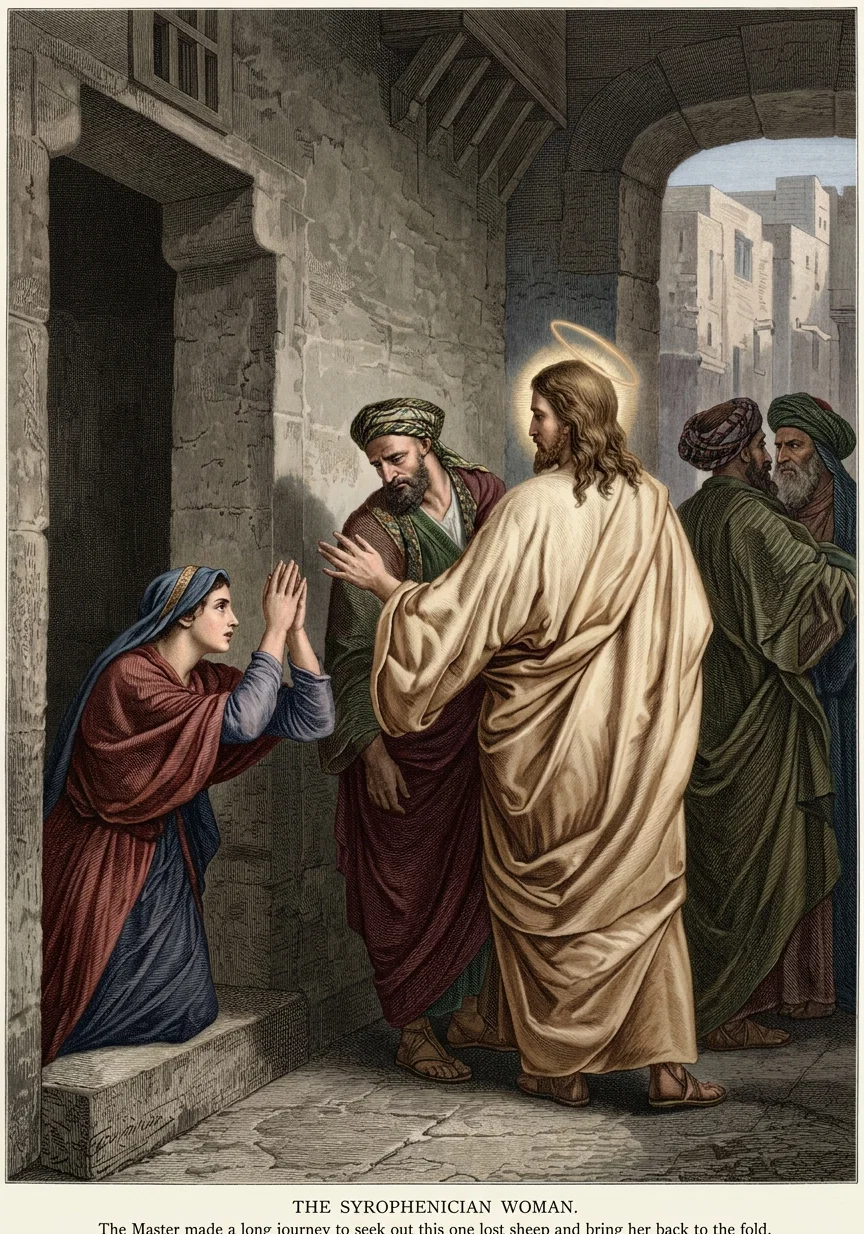
THE SYROPHENICIAN WOMAN. The Master made a long journey to seek out this one lost sheep and bring her back to the fold.
Must the sinner wait until he is filled with remorse for his sin before he can come to Christ? The very first step to Christ is taken through the drawing of the Spirit of God; as man responds to this drawing, he advances toward Christ in order that he may repent.

The Lost Must Be Sought After

The sinner is represented as a lost sheep, and a lost sheep never returns to the fold unless he is sought after and brought back to the fold by the shepherd. No man of himself can repent, and make himself worthy of the blessing of justification. The Lord Jesus is constantly seeking to impress the sinner's mind, and attract him to behold Himself, the Lamb of God, that takes away the sins of the world. We can not take a step toward spiritual life save as Jesus draws and strengthens the soul, and leads us to experience that repentance which needs not to be repented of.
When before the high priests and Sadducees, Peter clearly presented the fact that repentance is the gift of God. Speaking of Christ, he said, "Him hath God exalted with His right hand to be a Prince and a Saviour, for to give repentance to Israel, and forgiveness of sins." Repentance is no less the gift of God than are pardon and justification, and it can not be experienced except as it is given to the soul by Christ. If we are drawn to Christ, it is through His power and virtue. The grace of contrition comes through Him, and from Him comes justification.
Paul writes: "But the righteousness which is of faith speaketh on this wise, Say not in thine heart, Who shall ascend into heaven? (that is, to bring Christ down from above:) or, Who shall descend into the deep? (that is, to bring up Christ again from the dead.) But what saith it? The word is nigh thee, even in thy mouth, and in thy heart: that is, the word of faith, which we preach; that if thou shalt confess with thy mouth the Lord Jesus, and shalt believe in thine heart that God hath raised Him from the dead, thou shalt be saved. For with the heart man believeth unto righteousness; and with the mouth confession is made unto salvation." The faith that is unto salvation is not a casual faith; it is not the mere consent of the intellect: it is belief rooted in the heart, that embraces Christ as a personal Saviour, assured that He can save to the uttermost all that come to God by Him.

Believe That He Saves You

To believe that He will save others but will not save you is not genuine faith; but when the soul lays hold upon Christ as the only hope of salvation, then genuine faith is manifested. This faith leads its possessor to place all the affections of the soul upon Christ; his understanding is under the control of the Holy Spirit, and his character is molded after the divine likeness. His faith is not a dead faith, but a faith that works by love, and leads him to behold the beauty of Christ, and to become assimilated to the divine character. "For this commandment which I command thee this day, it is not hidden from thee, neither is it far off. . . . But the word is very nighunto thee, in thy mouth, and in thy heart, that thou mayest do it." "And the Lord thy God will circumcise thine heart, and the heart of thy seed, to love the Lord thy God with all thine heart, and with all thy soul, that thou mayest live."
It is God that circumcises the heart. The whole work is the Lord's from the beginning to the end. The perishing sinner may say: "I am a lost sinner; but Christ came to seek and to save that which was lost. He says, 'I came not to call the righteous, but sinners to repentance.' I am a sinner, and He died upon Calvary's cross to save me. I need not remain a moment longer unsaved. He died and rose again for my justification, and He will save me now. I accept the forgiveness He has promised."

What Jesus Taught About the Sabbath

The Sabbath was made for man, and not man for the Sabbath: therefore the Son of Man is Lord also of the Sabbath. Mark 2:27, 28.
THE Sabbath was made for man — mankind. But how was it made? The record tells us that it was made by the Creator’s resting on it, and blessing and sanctifying it, or setting it apart. Since all this was done for man, it is evident that God intended it for all men, in all ages, and in all places. And all who accept it as the Creator designed, will find in it God’s rest and God’s blessing. Since Christ is the one who created all things, the one who rested, and who blessed and set apart the seventh day, He declares Himself Lord also of the Sabbath day.
The strongest possible way in which one can teach another to regard a law, is to observe it carefully in his own life. The Saviour so strictly conformed to the Sabbath law, that on every occasion when He was charged with its violation, He refuted the charge just as successfully as He refuted the charge of blasphemy or any other sin laid against Him.
Not only did He meet the demands of the Sabbath law in His own life, but on several occasions He taught the proper observance of the Sabbath, that men might find in it the blessing He had placed there for them.
In the Gospels more space is given to the Sabbath and its proper observance than is devoted to the consideration of any other commandment; and yet between Jesus and the Jews, who were ever ready to find fault and criticize His teachings, not one word of controversy is recorded as to which day had been, was then, or was to be the Sabbath, but only regarding the manner of its observance. No dispute in all Bible times ever occurred as to which day was the Sabbath. And yet the New Testament record carries us down sixty or more years this side of the death of Jesus.
In giving instruction to His disciples for their future work, He told them to teach all nations to observe all things whatsoever He had commanded them, with the promise that He would be with them even to the end of the world. Therefore what He taught was to be perpetuated in the teachings of His disciples to the end of time.
What did He teach regarding the Sabbath? In Matt. 12:1 we find Jesus and His disciples passing through a corn or grain field on the Sabbath. The disciples were hungry, and began to pluck the ears of corn, and to eat. The Pharisees, who were with them, and always lying at the catch, said to Him, "Thy disciples do that which is not lawful to do upon the Sabbath day. But He said unto them, Have ye not read what David did, when he was an hungred, and they that were with him; how he entered into the house of God, and did eat the showbread, which was not lawful for him to eat, neither for them which were with him, but only for the priests?"
Here the Saviour taught that a deed of necessity is not out of harmony with law. In David’s case it was necessary that he should have something to eat. Nothing was at hand excepting the showbread; but the law forbidding him to eat it, was set aside in the face of his need.
This principle of law giving way to deeds of necessity is recognized even in human affairs. Take as an illustration a law forbidding the killing of certain kinds of game except at stated intervals; and yet the man who kills game in violation of the letter of this law, will be acquitted as innocent if he can but show that his act was necessary in order to preserve his life or to relieve him from suffering. While such a deed seems to be in violation of law, it is in reality in harmony with it; for the primary object of all such laws is the preservation of game, that it may contribute food to sustain the life of man. But when the man’s life is in jeopardy for lack of food, to enforce the letter of the law would be to defeat the very purpose of the law.
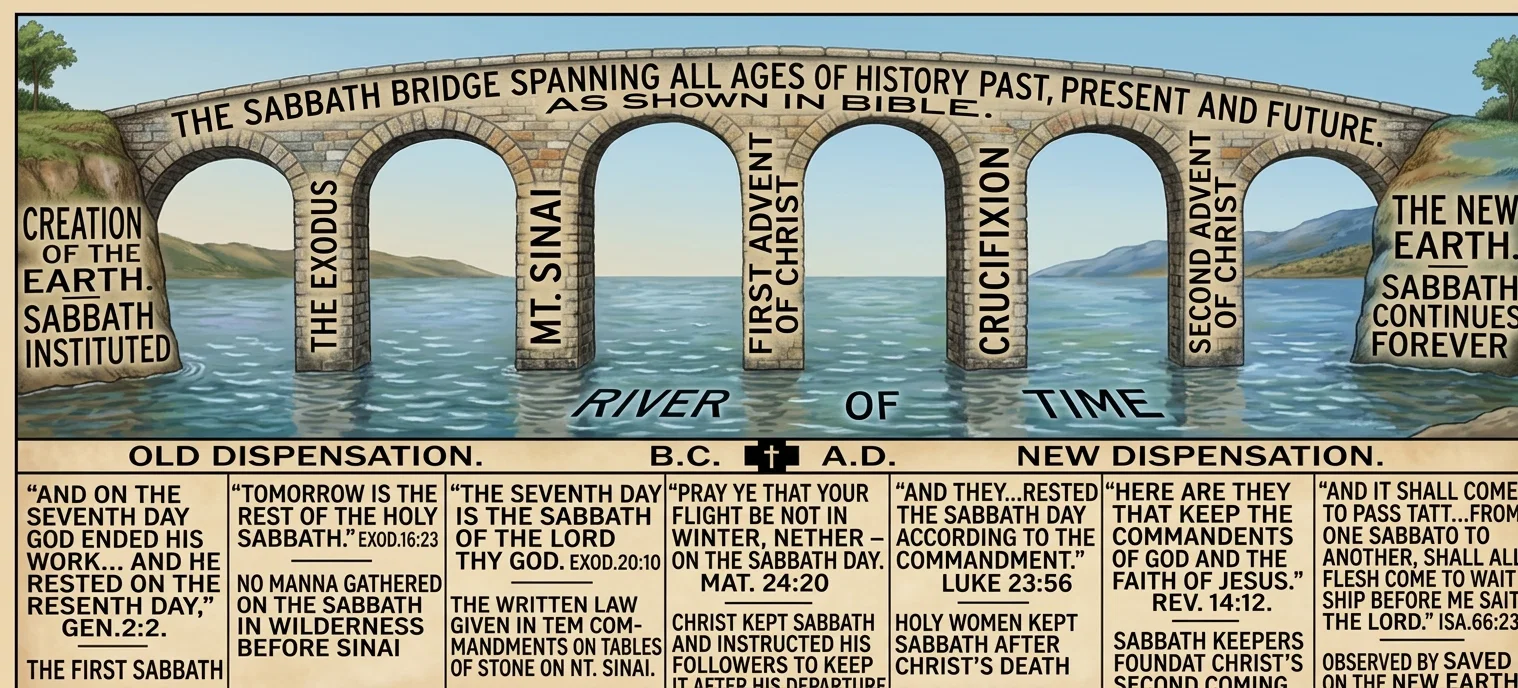
BIBLE FOUNDATIONS SUPPORTING THE PERPETUITY OF THE SEVENTH DAY SABBATH. - NOTE. MANY MORE TEXTS COULD BE GIVEN, BUT ONLY ENOUGH HAVE BEEN SELECTED TO MARK THE DIFFERENT PERIODS -
Thus when a deed is a necessity, that deed, altho seemingly a violation, is in reality an act of obedience to the law.
By this illustration, the Saviour taught that all deeds of necessity are lawful on the Sabbath day. Under this principle, if a family had no bread, it would be lawful to go and buy some or provide it in some way, even tho it involved physical labor. It is true, however, that the person who finds himself under the necessity of performing such an act on the Sabbath day, is often guilty of sin in neglecting to make proper provision the day before.
The Saviour continues: "Have ye not read in the law, how that on the Sabbath days the priests in the temple profane the Sabbath, and are blameless? But I say unto you, That in this place is One greater than the temple. But if ye had known what this meaneth, I will have mercy, and not sacrifice, ye would not have condemned the guiltless. For the Son of Man is Lord even of the Sabbath day."
The priests in the temple performed a great deal of manual labor in carrying on the work of the Lord. All that service was typical of the work of Christ, the One who was as much greater than the temple as the antitype is greater than the type, or as the substance is greater than the shadow. If the priests were blameless in laboring on the Sabbath day to carry forward a shadowy work, surely Jesus and His disciples were guiltless in prosecuting the real.
Thus Jesus taught that it is lawful to do anything which is necessary to carry on the work of the Gospel or the worship of God.
The same day, Jesus went into a synagogue. "And, behold, there was a man which had his hand withered. And they asked Him, saying, Is it lawful to heal on the Sabbath days? that they might accuse Him. And He said unto them, What man shall there be among you, that shall have one sheep, and if it fall into a pit on the Sabbath day, will he not lay hold on it, and lift it out? How much then is a man better than a sheep? Wherefore it is lawful to do well on the Sabbath days." Then He healed the man. See also Luke 13:15 and 14:3-5.
In these instances, Jesus taught that all deeds of mercy — ministering to the wants and needs of our beasts, and relieving the distress of even the dumb animals — are works which should be done on the Sabbath.
Some have suggested that we have no right to light a fire on the Sabbath day; and such cite as proof the case of the man in the wilderness who was stoned to death for gathering sticks on the Sabbath. By reading the record found in Num. 15:30-36, it will be seen that this is given as a case in which the act was a presumptuous — margin, high-handed, or defiant — one, as there was no occasion for building a fire.
But let us measure the building of a fire under ordinary circumstances, in the light of the principles laid down by the Saviour when He said, "I will have mercy, and not sacrifice." Suppose a man arises Sabbath morning and finds it cold and disagreeable. Before him lie two ways: the one, to build a fire for the comfort and convenience of his family; the other, to sacrifice comfort,health, and possibly lives to the rigid observance of the law, by building no fire. To follow the first course would be an act of mercy; the second, an act of sacrifice. The real Christian, who wishes to please God, will build the fire, and answer the criticizing one in the words of the Master: "If ye had known what this meaneth, I will have mercy, and not sacrifice, ye would not have condemned the guiltless." And in his own heart, the Spirit will witness with his spirit again in the words of the Master, "It is lawful to do well on the Sabbath days."
Thus we find that the Saviour did not intimate that the Sabbath was soon to pass away; but on the contrary, He gave full and complete instruction as to how it was to be kept. He sought to remove from it human traditions, and teach its real purpose.
He taught that the seventh day is the Sabbath, and kept that day, being our example in all things. He taught that deeds of necessity, the work of the Lord, and all deeds of mercy, are lawful on that day.
Let us follow His example and heed His instruction.

God’s Law and Forgiveness

By F. M. Oliver

Now we know that God heareth not sinners: but if any man be a worshiper of God, and doeth His will, him He heareth. John 9:31.
HE young man who stated this grand truth, was just a short time before only a poor, blind beggar. From his birth he had not been able to see the light of day or to view the beauties of nature; but now this poor blind beggar could not only see, but could discern enough spiritual truth to bring condemnation to the hearts of the proud Pharisees.
These men had turned away not only from the Lord Jesus, but from His law as well; and they would do almost anything to keep the people from believing on Christ. Thus they said, “Give God the praise: we know that this man is a sinner.” Verse 24. They were ready to cast any one out who would confess Jesus as the Christ; and the parents of the young man, fearing excommunication, said, “By what means he now seeth, we know not; . . . ask him: he shall speak for himself.” Verse 21. The parents here lost a golden opportunity of confessing Christ. Like many another, not only of that day but of ours, they feared the people, and loved the praise of man more than the praise of God.
The son represents the true follower of Jesus. He faced the frowning Pharisees, and with undaunted courage pressed the truth home to their hearts. “Will ye also be His disciples?” They who had closed their eyes to God’s Word, and were as blind spiritually as this man had been physically, reviled him, and cast him out; but Christ, knowing that he had been cast out, came to him with such comforting words that the young man believed on Him and worshiped Him.
When friends, father, and mother forsake us, then the Lord will take us up. We must be willing “to speak for ourselves,” and to choose the right, no matter if all the world should forsake us. Mark 10: 29, 30. The wise teachers of Christ’s day would make people believe that Jesus was a commandment breaker. John 9: 16. They were trying to destroy the work that Christ came to do. This is why He told them, just a short time before, that they were of their father the devil; and it is certain that they were carrying out the works of the evil one.
The prophecy of Zech. 7: 11-13 was surely fulfilled in their case. If ever a people stopped their ears and hardened their hearts so they would not hear the law of the Lord, it was this people. They had turned their backs upon the true God. They had forgotten His law, and were teaching instead the traditions of men. Mark 7: 5-9. The day Christ healed this man, was the Sabbath; and for this act of mercy the Jews said He was a sinner. Yet at the very time, they were planning how they might take His life. They were blind to the demands of God’s spiritual law; and when the goodness of God was manifested, they were ready to denounce the good as the works of the wicked one.
O, the awfulness of departing from God to the extent that we will call evil good, and good evil! The Lord is ever ready to hear and to lead those who will give heed to His law; but those who close their ears to the law, He knows afar off. “He that turneth away his ear from hearing the law, even his prayer shall be abomination.” Prov. 28: 9. “If I regard iniquity in my heart, the Lord will not hear me.” Ps. 66: 18. Christ had His Father’s law written in His heart. Ps. 40: 7, 8. And every true follower of Christ to-day, as well as at all other times, is to have the law written in his heart and in his mind. Jer. 31: 33; Heb. 8: 8-10. Jesus came to keep and to save us from the guilt of the broken law. He came to “magnify the law, and make it honorable.” Isa. 42: 21. He came to take away our sins (Isa. 43: 25); and “sin is the transgression of the law.” 1 John 3: 4.
He swept away the traditions of the Jews, saying, “Full well ye reject the commandment of God, that ye may keep your own tradition,” while they claimed that Christ’s act of healing on the Sabbath was sin. Christ, who would have them see the broadness of God’s law, showed that it was the very best way of observing the Sabbath. As He said on another occasion of the like, “It is lawful [according to law] to do good on the Sabbath days.”
When those who were bowed down by sickness and sin, and were in need of a Saviour, came before Christ, He was always ready to help. Thus He was doing the work of Him who had sent Him. Blindness covered the minds of the Pharisees, as blindness covers many in our day, and they will not come to Him that they may have life. The young man was not only healed of his physical blindness, but his spiritual eyes were opened, and he saw Christ and worshiped Him.
Reader, have your eyes been opened to God’s truths? Are you willing to forsake all things that would keep you from the kingdom of God? Would you know your duty? Christ is the Way, the Truth, and the Life. His Word is the Guide-book, and it will not lead us in the wrong way. “Let us hear the conclusion of the whole matter: Fear God, and keep His commandments: for this is the whole duty of man.” Eccl. 12: 13.

A Little While

By J. A. Powers
The cities of the nations will fall, In a little while from now; And men on the rocks and hills will call, In a little while from now; But alas for the world when its kings bow in prayer, And the sun is as black as a sackcloth of hair, And mercy has left men to hopeless de- spair, In a little while from now.
The Flood will be fresh in men's memories again, In a little while from now; And they'll know why the wicked at Sodom were slain, In a little while from now; And the scoffers that mock in derision to- day, Will cry out in terror and wildest dismay When in vain to the rocks and the moun- tains they pray, In a little while from now.
The God that has warned men for six thou- sand years, In a little while from now Will have gathered His chosen and counted their tears— In a little while from now; And the scoffers that mocked when His chosen were slain, Will find their self-righteous traditions were vain; The sepulchres whited will open again, In a little while from now.
So, on, ye bold scoffers! Make fun while you can! In a little while from now, You'll stand face to face with the dear Son of Man— In a little while from now. But He'll not be the Saviour and Advocate then, As for six thousand years He has lovingly been, But the glorified Judge of a lost race of men, In a little while from now.
Los Angeles, California.

Faith in the Lord Jesus Christ

FAITH in the Lord Jesus Christ demands not only submission to His will, but commission of ourselves to His care; because we can not submit to His will unless we commit to His care, for it is His will that we should do this. Then whatever men may do or say against us, we will, like Christ, commit our cause to Him who judgeth righteously. 1 Peter 2:23.
Continue reading: Regeneration Necessary