Your ShelfYour Projects

Signs of the Times, Vol. 37, No. 14.

Question Corner

Signs of the Times

Pacific Press Publishing Association

Question Corner

"IF YE WILL INQUIRE, INQUIRE YE."
This Inquirers' Department is conducted for the purpose of helping those who are studying the Bible. The answers are oftentimes only suggestive. They are never to be considered infallible, only as they agree with the infallible Word. The writer who may answer them does not consider that his opinion is infallible. He will simply give the best that he has, and plead with the inquirer to search the Word. Such questions only will be answered as to the editors, seem to minister to the good of the readers and to the mission of the paper. We can not answer repeatedly in the same volume questions upon the same scripture. The name and address must accompany question, not for publication, but as an evidence of good faith, and that answer may be made by letter if deemed advisable. No letters are answered which do not contain the name of the writer. It is well always to enclose stamp for reply.

3089.— Sprinkle Clean Water upon You

Will you please explain Eze. 36:25? Does it have reference to baptism? B.
The text and its context read: "For I will take you from among the heathen, and gather you out of all countries, and will bring you into your own land. Then will I sprinkle clean water upon you, and ye shall be clean: from all your filthiness, and from all your idols, will I cleanse you. A new heart also will I give you, and a new spirit will I put within you: and I will take away the stony heart out of your flesh, and I will give you a heart of flesh. And I will put My Spirit within you, and cause you to walk in My statutes, and ye shall keep My judgments, and do them."
That was God's promise to His backslidden, wayward, idolatrous people. It is also God's promise to all His backslidden children now. It contemplates complete change in life and character. The first requisite in that change is absolute cleansing from all past sins which condemn and hold the soul in bondage. Anciently in cleansing, as in the cleansing of the leper, for example, the priest took a branch of hyssop, and sprinkled the water of cleansing upon the leper seven times, and pronounced him clean. See Lev. 14:1-7. He was judicially clean. It was a sentence of authority. It was not a mere ceremonial form. It was absolute cleansing from his awful disease. For that the psalmist prays in the 51st Psalm: "Purge me with hyssop, and I shall be clean." That is, he pleads that God shall pronounce the sentence of cleansing upon him. That is what is meant in the text under consideration. At the time when God's people will return to Him with all their heart, He will pronounce upon them, as He did under that ancient ceremony, absolute cleansing from all their sins. One may be sprinkled a thousand times, or he may follow any other form, and that of itself does not cleanse. The only thing that can cleanse is God's Word saying, "Thou art clean;" and that is what is indicated by the use of the expression which carries us back to the old judicial cleansing of the leper. It has no reference whatever to baptism.

3090.— Not the God of the Dead, but of the Living. Luke 20:37, 38

Will you kindly explain this passage? Does it not show that after the body dies the soul lives? B.
If our inquirer will carefully read the scripture, and note the questions of the Sadducees which led up to our Lord's remark, we think there can be no question about it. See the record in verses 29 to 38. The Sadducees did not come and ask Jesus any question about the intermediate life or where such and such a one would be after death. They did not believe in the resurrection, and they thought they would puzzle Jesus by a question concerning the resurrection, and so they tell the old story which was one of their theological "posers" in those days, and then asked, Master, whose wife shall she be in the resurrection?
Now Jesus starts out to meet the cavil and to prove the resurrection; and yet immortal-soul people would have us believe that instead of proving the resurrection at all, He proved that the soul was immortal and lives during the death of the body, and that hence there is no need of a resurrection. This makes our Lord a pitiful logician, and utterly disproves the resurrection, in which the Sadducees did not believe. In other words, it justifies the Sadducees and condemns our Lord's argument. All believe that God is the God of the living. That was a general truth accepted by the Sadducees as well as all others who believed in God. God has called Himself the God of Abraham, the God of Isaac, and the God of Jacob, but Abraham and Isaac and Jacob are dead; and yet as God is the God of the living, and as He has styled Himself their God, in His purpose they must live; therefore they are spoken of as tho they were living, for as Jesus declares, "All live unto Him." This is explained in Rom. 4:17, where it is declared that God "calleth those things which be not as tho they were;" and so God called Abraham and Isaac and Jacob just as tho they were living, because in the resurrection they shall live, and His purpose can not fail. The scripture proves the resurrection, yet in proving the resurrection it certainly does not prove the conscious state of the dead, or the needlessness of a resurrection.

3091.— Authorship of the Psalms

Please explain how the writers of the various psalms may be determined. What authority have we for saying other than David wrote them? I. B. B.
In many cases the psalms themselves are very clear as to authorship, because it is clearly stated in the title of the psalm. Take for instance Psalm 3, "The Psalm of David when he fled from Absalom his son." And that expression is repeated over and over again. In Psalm 50, for instance, we have "A Psalm of Asaph." Asaph was one of the great singers of Israel. The margin reads, "A Psalm for Asaph." It might have been written for Asaph to set to music, by David. We are left in doubt about this in our Common Version. The Revised Version gives, "A Psalm of Asaph," with no marginal reference.
Psalm 72 is a "Psalm of Solomon." Our Common Version, however, reads, "A Psalm for Solomon," with "A Psalm of Solomon" in the margin. It may have been a prophetic psalm of David. What would make it seem to be that is the last verse of that psalm, "The prayers of David the son of Jesse are ended." This may have application, however, to the first two books of the Psalms, including Psalms 1 to 72, because largely composed of the psalms of David.
Many of the psalms seem to have been written by Asaph, one of the great singers of Israel. Psalm 85 is said to be a psalm of the sons of Korah, inspired singers of God in the priestly tribe; also 86; and also psalms of David are found among the latter psalms as well. Psalm 90 is said to be "a prayer of Moses the man of God." Some psalms are not named at all. The authorship of these is simply conjectural. Most of them are attributed to David.
There seems to be good internal evidence that Psalm 119 was composed by Daniel. The whole psalm and the experiences set forth are so in harmony with the experience of the young man in Babylon, that it seems to fit perfectly. Psalm 137 was written by one of the children of God after the restoration from Babylon, who had endured the worst of the captivity.

3092.— When Christ Comes

Will you please give a reason in the Question Corner for believing that there will be no first-day Christians alive at Christ's second coming? W. S.
We do not know what is not revealed. All that, we must leave with God. There is this, however, to be taken into consideration: God's great world-wide message as recorded in Rev. 14:6-14 and Rev. 18:1-4 will go to all the world, and all the world shall see and know and hear of God's last great Gospel proclamation. The heralding of that Gospel develops a class of whom it is said, "Here is the patience of the saints: here are they that keep the commandments of God, and the faith of Jesus." On the other hand there will be a demand from world-wide powers that men should turn from the worship of God to the worship of the beast; from the seal of God to the mark of the beast. Looking forward to that great time the prophet says, "Multitudes, multitudes in the valley of decision: for the great day of the Lord is near in the valley of decision." Joel 3:14. Surely at such a time as that every Christian in all the earth having knowledge of such a movement, will cast his lot among the ranks of God's children, and will stand a true and faithful soldier in the last great reform under the banner which carries aloft the commandments of God and the faith of Jesus.
Now if that is a right interpretation of God's message—and it seems to us there can be no other conclusion—those who are looking for the Master will be among the faithful, children obedient to His comandments.

3093.—"His Soul within Him Shall Mourn"

Please explain Job 14:22. It does not seem to agree with the 21st verse. T. J. C.
The 20th and 21st verses of Job 14 speak of the man's death. The 22nd verse speaks of his life up till the time that the change takes place. Job is telling of the troubles which come to him. The chapter itself opens with the thought, "Man that is born of a woman is of few days, and full of trouble." That continues on until at last God prevails forever against him and man passes. "Thou changest his countenance, and sendest him away. His sons come to honor, and he knoweth it not; and they are brought low, but he perceiveth it not of them." That is his death; and yet until that time "his flesh upon him shall have pain, and his soul within him shall mourn." This could not be applied to the death state, for even the most ardent advocate to immortal-soul-ism would not believe that man's soul was within his body during the intermediate state. The 22nd verse simply refers to man's life while he is here and before the change comes. It is simply a thought backward after the statement of verses 20 and 21.

3094.— Now in Heaven

Who of the former inhabitants of earth are now in heaven? D. A. V.
First, Enoch, who was translated without seeing death; secondly, there are Moses and Elijah, Moses raised from the dead, Elijah translated, both of them meeting Christ on the Mount of Transfiguration; thirdly, those who were raised from the dead at the time of our Lord's resurrection (Matt. 27:53), and who were taken to heaven when our Lord Jesus Christ ascended. Eph. 4:8. "When He ascended up on high, He led captivity captive," or as the margin reads, "a multitude of captives," trophies of His victory. It is to this ascension that the latter part of the 24th Psalm refers. There may have been other special resurrections of individuals in God's providence, but of that we are not informed.

3095.— Time of the Four Gospels

Please tell us in the Question Corner when the four Gospels were written. W. E.
Our Bible Band would have no trouble in answering this, for the book-mark given this year tells the story; not absolutely, but as nearly correct as could be ascertained. Matthew was written about the year 50; Luke, between the years 50 and 60; Mark, between the years 60 and 70; and John about the year 90, ranging all the way from 19 years after Christ's resurrection to 59 years. Referring to other points in our inquirer's question—all of the evangelists ever call the seventh day by the term which God gave—"the Sabbath;" while the first day of the week is simply known by the plain, common term of the "first day of the week."

Acquainted with God

By Mrs. E. G. White
OUR Saviour said, "This is life eternal, that they might know Thee the only true God, and Jesus Christ, whom Thou hast sent." And God declared by the prophet, "Let not the wise man glory in his wisdom, neither let the mighty man glory in his might, let not the rich man glory in his riches; but let him that glorieth glory in this, that he understandeth and knoweth Me, that I am Jehovah, which exercise lovingkindness, judgment, and righteousness, in the earth; for in these things I delight, saith the Lord."
No man, without divine aid, can attain to this knowledge of God. The apostle says that "the world by wisdom knew not God." Christ "was in the world, and the world was made by Him, and the world knew Him not." Jesus declared to His disciples, "No man knoweth the Son, but the Father; neither knoweth any man the Father, save the Son, and he to whomsoever the Son will reveal Him."
In the last prayer for His followers, before entering the shadows of Gethsemane, the Saviour lifted His eyes to heaven, and in pity for the ignorance of fallen men He said, "O righteous Father, the world hath not known Thee: but I have known Thee." "I have manifested Thy name unto the men which Thou gavest Me out of the world."
Christ came to reveal God to the world as a God of love, full of mercy, tenderness, and compassion. The thick darkness with which Satan had endeavored to enshroud the throne of Deity was swept away by the world's Redeemer, and the Father was again manifest to men as the light of life.
When Philip came to Jesus with the request, "Show us the Father, and it sufficeth us," the Saviour answered, "Have I been so long time with you, and yet hast thou not known Me, Philip? He that hath seen Me hath seen the Father; and how sayest thou then, Show us the Father?" Christ declares Himself to be sent into the world as a representative of the Father. In His nobility of character, in His mercy and tender pity, in His love and goodness, He stands before us as the embodiment of divine perfection, the image of the invisible God.
"God was in Christ, reconciling the world unto Himself." Only as we contemplate the great plan of redemption can we have a just appreciation of the character of God. The work of creation was a manifestation of His love; but the gift of God to save the guilty race, alone reveals the infinite depths of divine tenderness and compassion. "God so loved the world, that He gave His only-begotten Son, that whosoever believeth in Him should not perish, but have everlasting life."
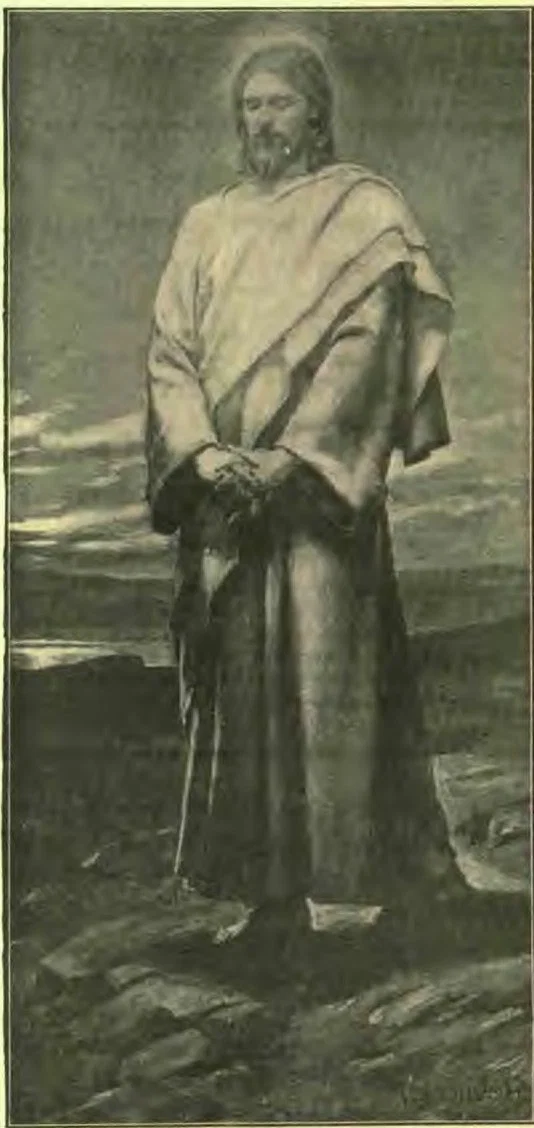
Greenvold Jesus Walking by the Son
While the law of God is maintained, and its justice vindicated, the sinner can be pardoned. The dearest gift that Heaven itself had to bestow has been poured out, that God "might be just, and the justifier of him which believeth in Jesus." By that gift, men are uplifted from the ruin and degradation of sin, to become children of God. Paul says, "Ye have received the spirit of adoption, whereby we cry, Abba, Father."
"Behold, what manner of love the Father hath bestowed upon us, that we should be called the sons of God." What love, what matchless love, that, sinners and aliens as we are, we may be brought back to God, and adopted into His family! We may address Him by the endearing name, "Our Father," which is a sign of our affection for Him, a pledge of His tender regard and relationship to us. And the Son of God, beholding the heirs of grace, "is not ashamed to call them brethren." They have even a more sacred relationship to God than have the angels who have never fallen.
All the paternal love which has come down from generation to generation through the channel of human hearts, all the springs of tenderness which have opened in the souls of men, are but as a tiny rill to the boundless ocean, when compared with the infinite, exhaustless love of God. Tongue can not utter it; pen can not portray it. You may meditate upon it every day of your life; you may search the Scriptures diligently in order to understand it; you may summon every power and capability that God has given you, in the endeavor to comprehend the love and compassion of the heavenly Father; and yet there is an infinity beyond. You may study that love for ages; yet you can never fully comprehend the length and breadth, the depth and height, of the love of God in giving His Son to die for the world. Eternity itself can never fully reveal it.
Yet as we study the Bible, and meditate upon the life of Christ and the plan of redemption, these great themes will open to our understanding more and more. And it will be ours to realize the blessing which Paul desired for the Ephesian church, when he prayed "that the God of our Lord Jesus Christ, the Father of glory, may give unto you the Spirit of wisdom and revelation in the knowledge of Him: the eyes of your understanding being enlightened; that ye may know what is the hope of His calling, and what the riches of the glory of His inheritance in the saints, and what is the exceeding greatness of His power to us-ward who believe."

The Gift of God

MANY professed Christians to-day have an idea that they must by some act on their part earn the eternal reward. It is by this deception that Satan leads many into doubt and discouragement. Eternal life is not earned; it is the gift of God through Jesus Christ. By nothing that we can do will we merit the favor of God. We can only reach out by faith and take from Him the blessings that He stands ready to bestow. To Jesus Christ belongs all credit for the blessings we enjoy in this world and for all the fulness of blessings we shall enjoy in the world to come.

Right Makes Might

LET us have faith that right makes might; and in that faith let us to the end dare to do our duty as we understand it.—Lincoln.

Be Noble

Be noble! and the nobleness that lies in other men, sleeping but never dead, will rise in majesty to meet thine own.—Lowell.

“Out of Babylon to Zion”

By Prof. Lucas A. Reed
WE are now to begin a study of that wonderful period preceding the first advent of Christ, when God set His people to the special task of restoring and rebuilding the city and temple of Jerusalem. Because of the idolatry of God’s chosen people, He had allowed them to be carried captive to Babylon. He had appointed seventy years for their captivity; but when these seventy years were fulfilled, true to His word, the message was given for them to return to their home land.
And when the time came for God’s people to go forth from Babylon, it was just as imperative for them to go as it was before necessary for them to enter that city.
At the appointed time, through His prophets, the Lord gave the proclamation for them to leave the city of the Chaldeans and return to the city which He had chosen: “Go ye forth of Babylon, flee ye from the Chaldeans, with a voice of singing declare ye, tell this, utter it even to the end of the earth; say ye, The Lord hath redeemed His servant Jacob.” Isa. 48:20. “In those days, and in that time, saith Jehovah, the children of Israel shall come, they and the children of Judah together; they shall go on their way. . . . They shall inquire concerning Zion with their faces thitherward, saying, Come ye, and join yourselves to Jehovah in an everlasting covenant that shall not be forgotten. My people have been lost sheep. . . . Flee out of the midst of Babylon, and go forth out of the land of the Chaldeans. . . . Behold, I will punish the king of Babylon and his land, . . . and I will bring Israel again to his pasture, and he shall feed on Carmel and Bashan, and his soul shall be satisfied upon the hills of Ephraim and Gilead.” Jer. 50:4-6, 8, 18, 19.
Those who remained behind at such time in the city of Babylon, did so at their peril. The providence of God at last opened the way for the chosen people to return to their own land; and those who for riches, possessions, business considerations, remained behind, failed thereby in walking in the opening providences of God. Sooner or later they would be engulfed in the ruin of the ill-fated city of Babylon.
So to-day there is a great call for God’s people to come out of Babylon. This proclamation is represented under the vision of an angel making the mighty call to the chosen ones: “I saw another angel coming down out of heaven, having great authority; and the earth was lightened with his glory. And he cried with a mighty voice, saying, Fallen, fallen is Babylon the great, and is become a habitation of demons, and a hold of every unclean spirit, and a hold of every unclean and hateful bird.” “And I heard another voice from heaven, saying, Come forth, My people, out of her, that ye have no fellowship with her sins, and that ye receive not of her plagues: for her sins have reached even unto heaven, and God hath remembered her iniquities.” Rev. 18:1-5.
This proclamation pertains to that mystic Babylon of the apocalypse of John, and is acknowledged by Christian people generally to represent the apostate church. Since that vision was given to John, the old city of Babylon, in Chaldea, has had no important place in the history of the world. But this mystic Babylon is the place where there are still some of God’s chosen people, some honest souls; and the proclamation to them is, “Come out of Babylon,” come out of her confusion of doctrines, her babel of false teachings, out of her sins and her iniquities.
He who remains in Babylon after hearing this proclamation, does so at his own peril. For the word is to flee, “that ye have no fellowship with her sins, and that ye receive not of her plagues.” And so to-day there is a call, similar to that call of old out of Babylon. God’s people are now to flee from the mystic city of confusion; they are to set their faces Zionward. They are to go forward in the path that leads them not to the old city in the land of Palestine; but they are to fix their eyes upon the city which has foundation, whose builder and maker is God,—the glorious New Jerusalem. The gates of that city are soon to open to admit the nation that keeps the truth. “Blessed are they that do His commandments, that they may have right to the Tree of Life, and may enter in through the gates into the city.”
And so this call now out of Babylon to the heavenly Jerusalem, is a work of reformation, just as that work back there under Josiah and Zerubbabel, Ezra, Nehemiah, Haggai, Zechariah, and Malachi was also a work of reformation. When God calls for His people to walk in His opening providences, He asks them to line up their lives with the true principles of righteousness.
And so, after the seventy years of captivity, God’s people were to go back to the city of Jerusalem to raise up the foundations that had fallen down, to build the walls and the temple that had fallen into decay. And similarly, God calls on those living in the last days to become restorers, repairers. “And they that shall be of thee shall build the old waste places: thou shalt raise up the foundations of many generations; and thou shalt be called, The repairer of the breach, The restorer of paths to dwell in. If thou turn away thy foot from the Sabbath, from doing thy pleasure on My holy day.” Isa. 58:12, 13.
The temple now to be completed is the great soul temple of Christ’s body, the church. This spiritual temple is to be completed and to stand forth in all its transcendent beauty before our Lord shall come. As in that time God’s people were to prepare the temple and the city for the first advent of the Messiah, so God’s people now are to restore and rebuild the great temple of truth for the second coming of the King of Glory.
Can you doubt, therefore, the importance of knowing the history and the lessons of that pre-advent reformation? God help us to study the time, and gain lessons that we need in these days, and to know the work that He has for each of us to do.

The Law of God

By Mrs. Pauline Alderman
It stands secure tho man ignores, A mighty rock on time-bound shores. The waves of sin that on it break, Its holiness would from it take; Still 'tis complete and strong in God, His mighty, never-failing Word.
My soul sweet consolation draws While bowing 'neath these sacred laws, To-day and yesterday the same, And naught in time can them defame. The nations go at death's demand; Jehovah lives; His truth shall stand.
Ages have not a promise dimmed Of all His Word, tho man has sinned; They just as brightly shine to-day As when the martyrs passed away. To what shall we compare His Word? Jehovah speaks — let Him be heard.

Saved by a Wireless

T<small>HE</small> steamer Kentucky, bound for Seattle, had sprung a leak off Cape Hatteras, February 4, and was filling rapidly. At once the wireless apparatus, which had been often in use, flashed out the distress signal, "We are sinking, latitude 23:10, longitude 76:30. — The Kentucky."
Those terrified words told exactly what was wanted. It was no eloquent plea, but expressed an eloquent need, and brought immediate assistance. Another vessel, the Alamo, many miles away, heard the message, flashed back an answer, and putting on full speed, reached the desperate crew just in time to save every person on board.
Are you in the position of the Kentucky, my brother? Flash a wireless to the great life-saving station. Let your cry go up to a tender-hearted and all-powerful God. The Master will not suffer you to perish. Keep your "wireless" ever ready by daily use, lest it be not in tune with heaven. When the great need comes, there may not be time to put the mechanism in order. Fear not for lack of eloquence—your need is the greatest possible persuasion with God.
M<small>ILTON</small> K. D<small>YMOT.</small>

Religion as a Worthy Guide

MAN has a Godward side. He thirsts for the eternal and the infinite. And it is in the proportion that religion keeps to her sphere of ministering to this want with her unique, divine, and mysterious truths, that she will be a trusted and worthy guide to lead the soul to its everlasting home.—Rev. James B. Remensnyder.

Born of the Same Parents

The Sacred History doth not a little provoke us to mutual love, by teaching that we are all of us born of the same first parents. — Hugo Grotius.

One of Earth's Great Vicissitudes

By Emma Hildreth Adams
HEN the planet—named Earth by the Creator Himself—was brought into existence, it was pronounced, as was every creature upon it, VERY GOOD.
Yet, at a period when considerable less than two sevenths of the total week—1,000 years constituting each day of the week—of the planet's history had elapsed, there occurred a stupendous and most radical change in its external conditions and its internal structure.
It was a transformation momentous in its results, and was due to some highly polluting and destructive influence, some grievous tainting, some defiling infection, which vitiated the divine product beyond its Author's endurance—a product very special, of intent very distinctive, for a purpose very exalted, the becoming the dwelling-place of the Creator Himself!
That corrupting power was SIN, the mightiest of all harmful potencies, since, unrepented of, it extinguishes BEING. Its force strikes deeply, attacks life at the very heart. Only an act equivalent to a re-creation can render void its deathful work.
Hence there occurred at the Flood such a renovation, such a cleansing, washing away of the results of sin, as involved changes and overturnings in the Earth for which even the profoundest geologists can propound no reason more convincing than that asserted by the Bible.
Yet, the cruel, mysterious element of sin was not thereby banished from the baptized Earth; for the all-sufficient reason, undoubtedly, that God's marvelous plan with reference to the planet, to the author of sin himself, and to the race of man, included centuries more of time; involved a second and more fearful chastisement of the finally disobedient, and a second, lasting purification of the darkly stained Earth itself.

Of Interest to All

Now, since the writer of this article, and all who may read it, will certainly have a part—on one side or the other, at one stage or another—in the awe-inspiring, soul-trying program, arranged ages ago, for this never-to-be-repeated cleansing of the Earth, it behooves us to heed the ringing warning, to grasp the startling information God Himself has sent out touching that great time.
The prophet Isaiah had some very clear views of that transaction. Hear him in chapter 24: "Behold, the Lord maketh the Earth empty, and maketh it waste." "He perverteth [changeth] the face thereof." "The Earth is utterly broken down, the Earth is clean dissolved, the Earth is moved exceedingly. The Earth shall reel to and fro like a drunkard, and shall be removed like a cottage; . . . it shall fall, and not rise again." "The land shall be utterly emptied, and utterly spoiled; for the Lord hath spoken this word."
Jeremiah also paints for us, in language which almost takes away one's breath, the same dreary scene, desolate beyond our conception. Notice the words: "I beheld the Earth, and, lo, it was without form, and void. And the heavens, and they had no light. . . . I beheld, and lo, there was no man, and all the birds of the heavens were fled. I beheld, and, lo, . . . all the cities thereof were broken down at the presence of the Lord, and by His fierce anger. . . . Every city shall be forsaken, and not a man shall dwell therein." For "I have purposed it," saith the Lord.
Possibly these almost inconceivable conditions, visitations, and punishments had secondary reference to the sweeping castigations visited upon Palestine and other lands because of the flagrant sins of the people. Yet were they but typical and prophetic of the great final day of reaping after ages of haughty, contemptuous sowing to Satan, from the Garden of Eden down to the dark dawning of "that great day."
Let us walk back a little and note carefully while Zephaniah paints in dismal tints the sore retributions which will distinguish "the great day of the Lord," altho his sharp threatenings and warnings applied aptly to headstrong Israel, to idol-worshiping Judah, to the sinful nations far and near.
"The great day of the Lord is near, it is near, and hasteth greatly, even the voice of the day of the Lord: the mighty man shall cry there bitterly. That day is a day of wrath, a day of trouble and distress, a day of wasteness and desolation, a day of darkness and gloominess, a day of clouds and thick darkness."
"I will bring distress upon men, that they may walk like blind men, because they have sinned against the Lord: and their blood shall be poured out as dust. . . . Neither their silver nor their gold shall be able to deliver them in the day of the Lord's wrath. . . . He shall make even a speedy riddance of all them that dwell in the land."
Woful as is the canvas, the prophet paints farther. Observe this picture also: "I will consume man and beast; I will consume the fowls of heaven, and the fishes of the sea, and the stumbling-blocks ["idols," margin] with the wicked; . . . and them that are turned back from the Lord; and those that have not sought the Lord, nor inquired for Him."
Again, using the rounded-out punishment of Babylon as a type of the final chastisement that should be visited upon the Earth, God declares, through Isaiah: "I will punish the world for their evil, and the wicked for their iniquity. . . . I will shake the heavens, and the Earth shall remove out of her place. . . . It shall be as a chased roe, and as a sheep whom no man taketh up."
And in similar strain wrote Haggai, almost three centuries later: "Thus saith the Lord of Hosts; Yet once, it is but a little while, and I will shake the heavens, and the Earth, and the sea, and the dry land; I will shake all nations, and the DESIRE of all nations shall come."

New Testament Evidence

But the foregoing pictures, visions, descriptions of the terrific changes yet to be experienced by the Earth and its inhabitants, convey but partial idea of its destiny because of sin.
The shaking, overturning, and speeding away into vast distance, as the orb is now doing, with the sun and its whole family of planets in company, convey but a partial idea of the radical test and trial awaiting it.
Let us glance at 2 Peter 3:7. There, made by an apostle whose knowledge did not come second-hand, we find the following arousing statement:
"But the heavens and the Earth, which now are, by the same word"—the word of the Lord, verse 10—"are kept in store, reserved unto fire against the Day of Judgment and perdition [utter loss] of ungodly men."
"But the day of the Lord will come as a thief in the night; in the which the heavens will pass away with a great noise, and the elements shall melt with fervent heat, the Earth also, and the works that are therein shall be burned up.
"Seeing then that all these things shall be dissolved, what manner of persons ought ye to be, . . . looking for and hasting the coming [margin] of the day of God, wherein the heavens being on fire shall be dissolved, and the elements shall melt with fervent heat?"
Doubtless Peter had heard, years before, from the lips of the Master, all those thrilling words recorded in Matthew 24, which to-day stir our hearts most powerfully. And probably, on other occasions, he had heard Christ converse on the absorbing subject. Therefore he was qualified to make the decisive declarations we have quoted.
But why should the Earth's second great renovation be an ordeal by fire? Many passages in the Word of God assert positively that the Earth and its atmosphere"shall pass away"—meet with some extreme, possibly elemental change.
If in the cleansing by water, nettles and thistles, and other fretting and noxious growths, failed to be eradicated, some agency more drastic will be required, in the second purifying, to render the planet a suitable abode for beings redeemed from sin.
Let us now recall that for six thousand years sin has had sway on the Earth. Over all its surface diseased men and diseased animals have been returning to the ground, mingling with the dust, polluting the soil.
These maladies are one giant result of sin. Therefore, from pole to pole the sphere is infested, corrupted with—SIN. Can any instrumentality less affective than flame exterminate its malign power?
In thousands of minds, to-day, there exists the idea, the belief, that close at hand there is destined to occur, upon the Earth and in the Earth, a change of conditions which will affect mightily the status, the welfare, the beatitude of man thereon.

Still Another Change

The apprehension, indefinite, but full of weight, dwells in many minds which have given the subject no testing study in the Word of God. Such a study would reveal the fact that two changes—each of vast import—await place in the future history of the Earth.
One will be the far-reaching purification by fire, because of sin. The other will be a restoration far exceeding Edenic condition, because sin will have passed away.
Hear the beloved apostle in Rev. 21:1, 2: "And I saw a new heaven [atmosphere] and a new earth: for the first heaven and the first earth were passed away. . . . And I heard a great voice out of heaven saying, Behold, the tabernacle of God is with men, and He will dwell with them, and they shall be His people, And God Himself shall be with them, and be their God. . . . And there shall be no more death. . . . THE FORMER THINGS ARE PASSED AWAY!"

The Fall of Lucifer

By Henrietta Edgar
How fair was thy beauty, Thou angel of light, Thou sun of the morning, Thou day-star so bright— A covering cherub of angels the head, In music celestial the angel choir led.
Thy beauty was perfect, Till marred by sin’s trace. Thou didst dwell with thy Maker, And lookedst on His face. By thy beauty uplifted, Thou didst fall from thy place, And plunge into ruin The whole human race.
Thou didst take by thy wiles Man’s dominion and power, And drive him in shame From his Edenic bower. Thou beginner of evil, Thou source of all wo, Soon wilt thou be vanquished, To oblivion go.
Then Jesus our Saviour Will evermore reign, And will banish all sorrow, All death, and all pain.
Flint, Mich.
Continue reading: The Everlasting Rock