Your ShelfYour Projects

Signs of the Times, Vol. 33, No. 37.

Signs of the Times

Signs of the Times

Sep 11, 1907

Pacific Press Publishing Company · Mountain View, California · Sep 11, 1907

Signs of the Times

Religious Combinations
AMONG all the religious persecutions with which almost every page of modern history is stained, no victim ever suffered but for the violation of what government denominated the law of God. . . . Extensive religious combinations to effect a political object, are, in the opinion of the committee, always dangerous. . . . If admitted, it may be justly apprehended that the future measures of the government will be strongly marked, if not eventually controlled, by the same influence. All religious despotism commences by combination and influence, and, when that influence begins to operate upon the political institutions of a country, the civil power soon bends under it; and the catastrophe of other nations furnishes an awful warning of the consequence.
—United States Congress 1828-29.

With Our Inquirers

"If ye will inquire, inquire ye."
[All questions to this department will be answered which to the editors will seem to minister to the good of the readers and to the mission of the paper. The same question can not be answered repeatedly in the same volume. The name and address must accompany question, not for publication, but as an evidence of good faith, and that answer may be made by letter if deemed advisable. It is well always to enclose a stamp for reply.]

2213.—Baptism. Its Object.

What is baptism in water for? Who are fit subjects for baptism? Can one enter the church of Christ without water baptism? Is baptism essential to salvation? W. E. R.
Baptism, or immersion, because that is what the word means, is that ceremony ordained of the Lord by which His people come into public relation with Himself. It shows forth to the world their faith in the death, burial, and resurrection of the Lord Jesus Christ. Compare 1 Cor. 5:1-3 with Rom. 6:3-6. It is by baptism that the believer is married to Christ. "Wherefore, my brethren, ye also were made dead to the law thru the body of Christ; that ye should be joined to another, even to Him who was raised from the dead, that we might bring forth fruit unto God." Rom. 7:4. "For as many of you as have been baptized into Christ have put on Christ." Gal. 3:27. See also Rom. 6:3.
The subjects for baptism are those who repent and believe. "Repent ye, and be baptized every one of you in the name of Jesus Christ." Acts 2:38. "He that believeth and is baptized shall be saved; but he that disbelieveth shall be condemned." Mark 16:16.
The intelligent Christian will follow the Lord's plan. He, therefore, will find baptism required, and he will be baptized. But there are very many who do not understand this and yet who desire to do God's will perfectly. "The eyes of the Lord run to and fro throughout the whole earth, to show Himself strong in the behalf of them whose heart is perfect toward Him." He therefore accepts them, even tho they are not literally baptized; and they are therefore members of His church, His body. Sometimes opportunity does not come to these souls for baptism. Take, for instance, the thief on the cross. There is no question at all but what he would have been baptized if opportunity had offered, but the Lord accepted him just as he was, and assured him of a place in His kingdom.
Baptism is essential to salvation, as every other duty which God has given in His word is essential. He who sees the duty of God's word and fails to do it becomes responsible for his transgression, and he certainly can not claim the power of God unto salvation if he is not willing to comply with the Lord's terms of salvation. On the other hand, if he has a heart to do God's will, and does not know what the Lord requires of him, it seems very clear and evident that God will save him without the outward act. Every commandment that God has given is essential, and yet there will be many saved in the kingdom of God who have not held these essential, because they did not understand. The righteousness of Christ will cover the failures of the sincere and honest-hearted.

2215.—Sabbath at the Poles.

Will you please tell me how people keep the seventh day where they have six months day and six months night? M. M. S.
No people live where such conditions prevail. As far north as people live they know the seventh day when it comes as they know every other day. Whether there are people at the poles or not we do not yet know. Let us wait. Suffice that to the present men have had no difficulty in obeying God if they so desired. The same is true as to the round world. Men who are Sunday-keepers and Sabbath-keepers have been round the world again and again, eastward and westward, and have had no trouble. Crossing the Pacific Ocean a day is dropped on the westward journey and added on the eastward. A missionary told us recently that the ship authorities always tried to keep Sunday. But this did not affect Sunday-keeping among those who desired to keep it. The objection has no standing. All facts are against it. It is a quibble against the truth. God made the Sabbath for man. Mark 2:27. He has scattered man over the whole inhabitable earth. Acts 17:24-26. The objection lies not against any set of men, but against God.

2212.—The Church and Prophets.

If Christ has a true church on earth, should there not be apostles and prophets in it?
A prophet is one who speaks for God. An apostle is one whom the Lord sends forth. The word apostle means one sent. Entirely erroneous ideas are obtained sometimes by holding that the apostles are a sort of board of directors to stay in one place and to act as the ruling governing body to the church. That is not the Scriptural idea. It is true that the early apostles were at one time in Jerusalem; they stayed there for some time, a great deal longer than the Lord designed that they should, because His commission to them was not to remain in one place, but to go forth to the world and bear the message of His Gospel. Neither did he confine the number to twelve, as has been taught, because there are as many as eighteen mentioned in the New Testament as apostles.
Of the gift of apostleship and prophecy, we read in 1 Cor. 12:28: "And God hath set some in the church, first apostles, secondarily prophets." Apostles are those who lead out in great reformations in God's work, and they have always been manifest, it seems clear to us, in every such reformation that has taken place. Martin Luther was truly an apostle. John Wesley was truly an apostle. But there have not always been prophets, altho it was the Lord's design that they should abide with His people. But when His people departed from His law—and in His own inscrutable wisdom this was allowed for many centuries during the Christian dispensation,—there were no prophets. So it was true in the time of Israel of old, there were times when there were no prophets in the church. With the restoration of that law there comes the spirit of prophecy. See Rom. 12:17; 19:10; Prov. 29:18.

2214.—Life Insurance. Pleasure Parties.

  1. Is it wrong to carry a life-insurance policy to provide for one's family? Does the Bible speak against it? If so give the text.
  2. Are pleasure parties or socials, not to dance or play kissing-games (as I call them), but to play croquet, eat ice-cream, indulge in innocent amusements, wrong? Does the Bible speak against such? If so where?
1. The Bible does not aim to prohibit every wrong thing or to tell us what specific thing to do or not to do under all circumstances. It deals with great principles. God demands the whole heart and soul and strength and might. He demands that we should trust Him implicitly; "for He is thy life, and the length of thy days." Deut. 30:20. He putteth and holdeth our soul in life. Ps. 66:9. The best life insurance we know is that which God gives. His promises are more if we believe them than are all the assurances of men. His religion has the promise of the life that now is and of that which is to come. 1 Tim. 4:8. Life insurance of men can not prolong life. In the vast majority of cases it is not so good as a savings bank. Life insurance sometimes places in the hearts of the beneficiaries a desire for the death of the insured. Trust in God. Economy, thrift, frugality, and diligence are a much better investment than life insurance.
2. If we are truly Christ's, the question will not be, Is it wrong for me to indulge in this, in that, in the other thing? It will not be, Lord, what can I indulge in and still be saved? It will be, Lord, What wilt Thou have me to do? And we will seek to do that which is for the glory of God. God has made us social creatures, and it is right to associate together; but an ice-cream party may be as full of selfishness and as resultant of evil as a dance, and a game of croquet may be as dishonest and wicked as a game of draw poker. The great question is, Are these for the glory of God? 1 Cor. 10:31. Do they better fit us for His service? or are they mere selfish indulgence? Social gatherings may be profitable, helpful, uplifting, and Christians should help make them so or abjure them.

2216.—Latter-Day Saints.

Is there any difference between the church of Latter-Day Saints with headquarters at Lamoni, Iowa, who have Joseph Smith, Jr., as their leader, and the body located at Salt Lake City, Utah, whose founder was Brigham Young? W. R.
We would say there is a difference, altho both claim as their founder Joseph Smith. That Joseph Smith taught polygamy is quite evident, and yet the Iowa branch claim that he did not, and do not themselves practise it. The Salt Lake branch have both practised and defended it.

2217.—Laying on of Hands.

Should the doctrine of laying on of hands and the gift of the Holy Ghost be taught and practised in the church to-day as in the ancient church?
It was not universally practised in the ancient church. The gift of the Spirit was bestowed without the intervention of hands and also with it. Acts 10:44; 8:17. There is no positive text in the word of God as to just what is duty in respect to this. If the Spirit guides in the laying on of hands, it should be done; if God chooses to give His Spirit without the intervention of human agencies, He certainly has shown Himself abundantly able and willing to do it.

2218.—The Kingdom of God.

Is the kingdom of God in the heart, or can it be so?
No, not in the fullest sense is the kingdom of God in the heart. The Lord does have an important part of His kingdom in the heart, however. He would have the law of the eternal kingdom written there. That is the very object of the new covenant and the Gospel, to write God's law in the heart of the people. See Heb. 8:8-12. So also the King ought to dwell in the heart by His Spirit, and that also is the object of the Gospel, "that Christ may dwell in your hearts by faith." Eph. 3:7. He who possesses his knowledge of the kingdom of God in his own life has received a pledge of the eternal inheritance. Eph. 1:13, 14. The true kingdom of God as far as man is concerned is this earth, now in the hands of the spoiler. There will come a time when the kingdom and the dominion and the greatness of the kingdom under the whole heavens shall be given to the people of the saints of the Most High. Dan. 7:22. "The kingdoms of this world are become the kingdoms of our Lord, and His Christ." Rev. 11:15. The earth will be renewed by the creative power of God. Then the meek shall inherit the earth and delight themselves in the abundance of peace. Matt. 5:5; Ps. 37:11.

2219.—The "Other Sheep." John 10:16.

Who are the sheep spoken of in John 10:16? E. A.
They are those to be saved from among the Gentiles, who would accept Jesus as did His disciples among the Jews. All are one in Him. See Eph. 2:12-22.

2220.—Use of the Tithe.

Does it say in the Guide Book that if we use the tithe we should restore it double?
One-fifth, or twenty per cent, should be added. Lev. 27:31. It is not God's design that men should pay Him exorbitant per cent. He lays down this rule that men may never use the tithe.

2221.—The Shekel.

In American money, how much does the Hebrew or Bible-shekel equal? C. H.
The silver shekel was worth about sixty-two cents in American money, and the gold shekel $10.92.

SIGNS OF THE TIMES

"But as we were allowed of God to be put in trust with the Gospel, even so we speak; not as pleasing men, but God, which trieth our hearts."

The Great Federation Movement

In Protestant Circles

By Asa O. Tait
CERTAIN leading spirits in the world to-day are earnestly seeking to combine and federate every organization and society that exists, and this all for the purpose of meeting what are recognized to be evils, or supposed evils, of this age. This spirit of federation is spreading rapidly and reaching everywhere.

The Prominent Organizations.

In the Protestant churches, perhaps the oldest organization of the day is the Evangelical Alliance. It made a big stir for a time, and spread a spirit of federating and combining among the religious forces of the land. Then have followed the Woman's Christian Temperance Union, which seeks to unite all the Christian women of the world for the great and laudable object of advancing the cause of temperance; the Young Men's Christian Association, that seeks to gather the young men, regardless of denominational lines, for the purposes of mutual improvement and helpfulness;
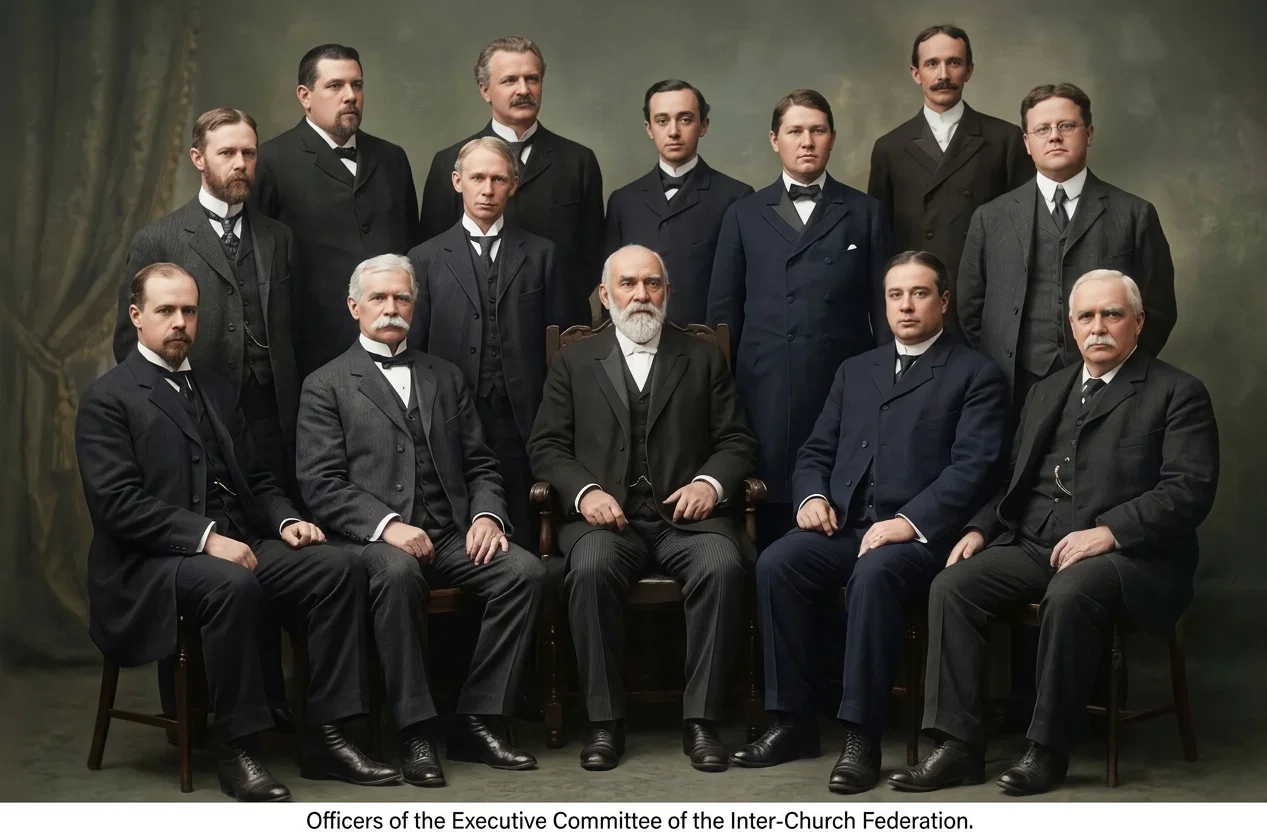
Officers of the Executive Committee of the Inter-Church Federation.
the Christian Endeavor Society, that has organized Christian young men and young women into one of the greatest organizations of this time; and, perhaps, the latest and most significant of these federating organizations is the Inter-Church Federation that convened its first conference in Carnegie Hall, New York, Nov. 15, 1905. This latter federation was the outgrowth of, or rather was suggested and called out by, the National Federation of Churches and Christian Workers that was organized four years earlier.

The Protestants Are Federated.

From the foregoing list of Protestant organizations, all of which are inter-denominational, it will be seen that the Protestant element of the country is quite well embraced in the federating movement. And this will be all the more apparent when it is considered that the Inter-Church Federation that was organized in 1905 claims to represent eighteen million of the Christian professors of the United States.
It is strikingly significant that this organizing of the Christian forces of the land should be called a "federation." There seems to be a deep-seated conviction that there never can be "unity" except on certain points that they "hold in common," and these will form the basis for "federation." It is suggested as a basis for common ground of action that there be "concentration of effort for the removal of social evils, the cleansing of the centers of vice and corruption, and the promotion of temperance, Sabbath observance, and general morality."

Federation Is General.

The foregoing outline is only of the work that is going on in Protestant circles, looking toward federation. Elsewhere in this issue will be found articles telling of the federating spirit that is moving in Catholic circles and also in the business enterprises of the world at large. What do these mighty movements signify? Are they the beginnings of a great world movement that will sweep everything before it like the crusades of the middle centuries? We have not the space to consider this phase of the subject this week, but an article next week will take up the outcome of this movement quite fully.

A Federation Is Not a Union.

No one can deny the fact that federation is a great movement of this time. But all should see that "federation" is not "unity." Christ made a most wonderful prayer for the unity of His believers. A part of that prayer is:
"I pray not that Thou shouldest take them out of the world, but that Thou shouldest keep them from the evil. They are not of the world, even as I am not of the world. Sanctify them thru Thy truth; Thy word is truth. As Thou hast sent Me into the world, even so have I also sent them into the world. And for their sakes I sanctify Myself, that they also might be sanctified thru the truth. Neither pray I for these alone, but for them also which shall believe on Me thru their word; that they all may be one; as Thou, Father, art in Me, and I in Thee, that they also may be one in Us; that the world may believe that Thou hast sent Me. And the glory which Thou gavest Me I have given them; that they may be one, even as We are one; I in them, and Thou in Me, that they may be made perfect in one; and that the world may know that Thou hast sent Me, and hast loved them, as Thou has loved Me." John 17: 15-23.
That earnest prayer of Christ to His Father is not that His followers may be federated, but that they may be one. Unity in Christ Jesus has been a great blessing to the world; but federations and religious combinations, especially when they seek to influence affairs in political circles, have been rather a curse than a blessing, as the history of the past will abundantly attest.

The Great Federation Movement

In Catholic Circles

By John S. Wightman
SINCE the Civil War there have been consolidations, organizations, formations, combinations, and federations—a banding together of the community of interests, influence, and power, alike in the social, civic, and religious worlds, upon a scale so vast and a rapidity so startling as to be absolutely unequaled in history. The colossal growth and power of modern combinations of wealth and influence and identical interests have amazed the thoughtful student of political economy and events, and arrested the attention of the whole people of the republic. And the questions that tend to continually disturb the public mind are: Whither are we drifting? and, Shall the government of the people control the gigantic combinations that threaten the stability and perpetuity of national institutions, or shall the monopolies of wealth, labor, and religion, finally control the government?

A Few of These Combines.

Not to speak of Standard Oil, American Steel, American Railway, Amalgamated Copper, the “Beef Trust,” and the thousand-and-one combinations in the financial and commercial realm, or American Federation of Labor, Western Federation of Miners, United Miners, Railway Trainmen’s Union, and the multitude of other organizations of power and influence in the labor and social world, we may well be concerned in, and allowed to consider, that latest creation of the federation spirit, that last acquisition to the federation “powers that be”—

The Church Trust.

Such Dr. Newell Dwight Hillis, of the famed Plymouth Church, characterizes the modern movement of the federation of societies of church interests and church influences to be. Some five years ago Doctor Hillis predicted that the “church trust,” in this age of trusts and combines, was “soon to come;” and in the formation of the Inter-Church organization at the notable conference of the leading churches of the land, New York, 1905, his prediction was speedily realized. Once realized, and viewing its first work, Doctor Hillis said: “The movement means the speedy union of all the Protestant churches.”
Last, but not at all least, of all these multifarious organizations, and particularly in the religions, comes

The American Federation of Catholic Societies.
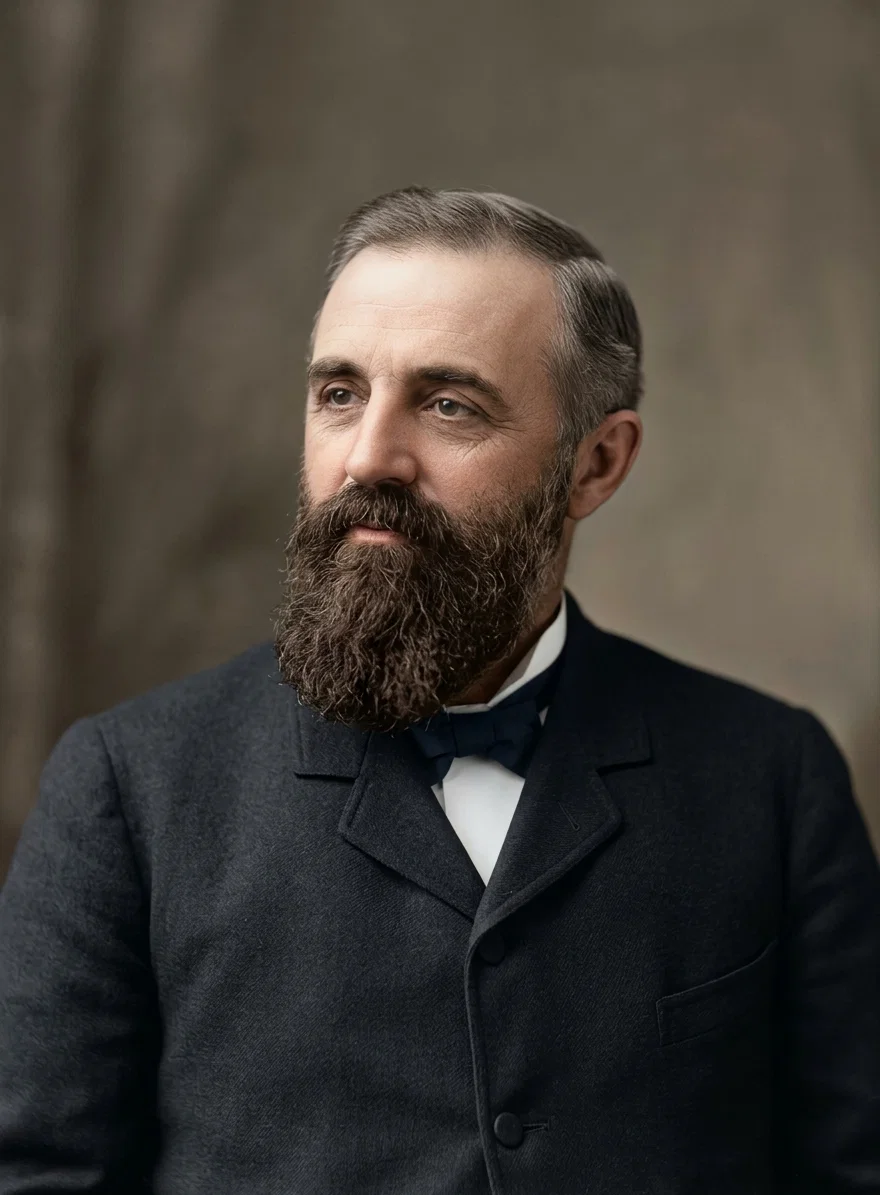
In the last analysis of its operations, this latter federation, numbering its loyal votaries by the millions, will, perhaps,—I may say beyond doubt,—exert an influence and a power upon the body politic second to none, probably first of all in importance.
Born in a first convention at Cincinnati, Ohio, in 1901, and hardly receiving any attention from the secular press, quietly making its way from convention to convention to public sentiment and influence, it has arisen from an humble inception to a very high plane of power and public estimation—a power that has been felt in Church and State, and in the nation. The deliberations of its later conventions are telegraphed to the press of a nation, to the leading journals of the world.
J. B. Oelkers, First Vice-Pres. Catholic Federation.

The Meaning of It.

American Federation of Catholic Societies means the union of all the Catholic societies of the United States and the world “for Christ and the church;” “to advance the civil, religious, and social interests of Catholics in the United States and its dependencies;” to “rise,” when needs be, “like an impregnable wall against the fierce violence of the enemies of God.”
Anthony Matre, Secretary Catholic Federation.
One of the oldest of the American hierarchy has recently stated that “a federation of all the Catholic societies of the entire United States would mean righting every wrong; for those who would do wrong would not dare face such an array of numbers.”

As a Renovator.

Pope Pius X, sending the apostolic blessing to the convention at Buffalo in 1906, states that the object of Catholic federation must be “to endeavor to renovate public and private life in conformity with the teachings of Jesus Christ.”
Writing upon the subject, Cardinal Merry Del Val says that federation and its design give joy to the sovereign pontiff, for “you are aware that he has federations of this kind very much at heart because of the abundant blessings that accrue from them to civil society.” American Federation of Catholic Societies pleads for the restoration of “the temporal power of the church” (“Public Proceedings Detroit Convention,” p. 95), and reaffirms a public “protest against the violation of the rights of the holy See, and trusts that the day is not far distant when these rights will be restored.” This kind of sentiment and thought must result not alone from primary teaching long extant in the church, but it may be traced quite directly to the world-wide encyclical from Pope Leo XIII, delivered June, 1906. That encyclical was on “Christian Unity”—“the reunion of all the Christian churches”—and in it we find:
“The fathers of the church are unanimous in considering as outside the Catholic communion any one who in the least degree deviates from even one point of the doctrine proposed by the authoritative magisterium of the church. . . . For the due preservation of unity of the faith it is not sufficient that the head should have been charged merely with the office of superintendent or should have been invested solely with the power of direction; but IT IS ABSOLUTELY NECESSARY THAT HE SHOULD HAVE RECEIVED REAL AND SOVEREIGN AUTHORITY WHICH THE WHOLE COMMUNITY IS BOUND TO OBEY.”

The Papal Plan for the United States.

Still further back, in 1892, it was reported by the Rome correspondent of the New York Sun, as to the aim of the Papacy in the United States, that “what the church has done in the past for others, she will now do for the United States. That is the reason why the holy See encourages the American clergy to guard zealously the solidarity, and to labor for the fusion of all the foreign and heterogeneous elements in one vast national family. The American church furnishes and must furnish at the present time the proof that Christianity is the school of patriotism and of national sentiment. By continuing to favor this work of unification, it will form the grandeur of the United States, andwill demonstrate the degree to which religion and the church are the generators of political and patriotic independence. Like all intuitive souls, he [Pope Leo] hails in the united American States and in their young and flourishing church, the source of a new life for Europeans. He wants America to be powerful in order that Europe may regain strength from borrowing a rejuvenated type."
These are fateful words. The American destiny of greatness and development is to furnish a renewing power, a renewed greatness and vigor for the church. It is to be made the source of a new and quickening influence in the fast-waning influence and power of Catholicism in Europe. The destiny of the one must be the destiny of the other. Like barnacles clinging to the hull of a great leviathan of the sea, both must sink or swim together.

To Be a Great Fighting Machine.

The conclusion is unavoidable. American Federation of Catholic Societies was, in fact, the apex of the wish of Leo XIII and the church—a powerful educational and political fighting machine to be used in the arena of the political and social worlds, in order that Catholic principles and will might dominate and receive recognition, become the “real and sovereign authority,” and to the end that both the “public” and the “private life” may be “renovated” and changed in “conformity with the teachings of Jesus Christ,” as such teachings are held and taught by the Roman Catholic Church.
Says former President T. B. Minahan: “Among the advantages to be gained by federation, the most desirable and important is the development of a Catholic public sentiment. Public opinion in America is the power behind the throne. To have a share in it, either in locality or nation, is to wield a power. Millions of Catholics, united and prudently asserting themselves by this means, can not fail of recognition.”
To assist in winning America to “the religion most consistent with the naturally broad and logical trend of the American mind,” is the aim of Catholic federation; and the soul-stirring acclamation of other times is as applicable now to federation as it was in the crusades of old: “God wills it” is the spontaneous voice of almost the entire Catholic press and people. Who can fail to recollect that “A Roman Catholic Nation and a Roman Catholic King” was the real cry of the crusaders in the “world’s moral midnight” times, or fail to understand that “A Roman Catholic Nation and a Roman Catholic Ruler” is the real animus of the consolidated Catholic societies of to-day?
It was President Roosevelt who recently said: “I expect to see Roman Catholic presidents in this country.” And his expressed anticipation is well within the range of near possibilities. “For this [the American Catholic interests in the Philippines] the demand of fifteen millions of Catholics is somewhat of a guarantee. It is one which no administration will dare ignore.”—Church Progress, St. Louis, Mo.
It is apparent, then, that Catholic federation will bring its influence to bear upon administrations, and the civil power.

An Instance to the Point.

As to the kind of politics in federation, Bishop McFaul relates an instance that occurred in the New Jersey Legislature. Roman Catholic individuals were opposed to the phraseology of a certain bill before the House. They appeared and demanded a change. The reply was: “The bill is right and proper and no change will be made.”
Then representatives of American Catholic societies called upon the House leaders and peremptorily demanded the change desired to be made, or “we will go back and report to our societies.” What was the result and the reply?—“Gentlemen, . . . don’t stir up a hornet’s nest on this question. What changes do you want? We will be very glad to make them.”
That which did not appear at all right to the lawmakers was made to seem expedient by the threat of a return of their refusal to the confederated power of Catholic societies. Principle gave way to policy. “This,” said McFane, “is the kind of politics in federation.”

A Real Danger.

And now appears a real danger in our land. It hardly could have been foreseen. In the American States, the decision of the ballot is final and public opinion is irresistible. The Catholic Church recognizes each of these facts; it proposes to make use of these agencies. The church teaches: “Religion is the corner-stone of order in every State. Destroy religion and you will annihilate the State. ‘The nation that will not serve God shall perish.’” Therefore, America, that it may not perish from the earth, the American system of government, must recognize in the See of Rome “a real and sovereign authority which the whole community is bound to obey.” And, further, as to the danger, Protestantism is fast drifting to the bosom of Rome. Rome sees this, too, and welcomes the change in the trend of thought.
Edward Feeney, national president of the federation, says: “There was a time when Catholic opinion was lightly held in this country. Not so to-day. Now the views of Catholics, especially on large public questions, are considered of importance.” Rev. Father Campbell says: “The real thoughtful patriotism of the country courts Catholic assistance in solving the solemn problems fraught with threatening dangers for the future.” Ah, only too true!
Yet “Rome never changes.” Steadily, with increasing power, she marches to “manifest destiny.” A little while, and all the world shall wonder after the beast; a little while, and Rome, once more clothed with the pomp and power of medieval days, shall “sit a queen,” and be able to exclaim: “I am no widow.” Is it not time that the voice of Luther may once more be heard, not alone in Germany, but in all the world?
Continue reading: The Great Federation Movement