Is it not preeminently reasonable and just, apart from all theological predilection and early training, that man's gift of life should be made conditional, that its continuance should be subject to its proper use?
Think of it! Man in the beginning was brought into this world without any choice of his own. He was not asked as to whether he should be given existence or not. In the nature of the case he could not be.
God made him an intelligent, morally responsible creature. That is in his very nature. Man, selfish as he is in sin, holds himself to some extent responsible for his conduct, and his enemy to the fullest extent. God gave man that nature, with the power of choice. Man could choose the good and refuse the evil. He could walk the way of faith in God, or he could follow the way of self. He could be faithfully obedient to God, with ever expanding mind and increasingly happy existence; or he could pervert the beneficent laws implanted in his nature, and bring upon himself misery and trouble unceasing.
God knew that some of His creatures would choose the evil, would pervert the laws of life, would bring into bondage to a perverted lower nature the higher spiritual faculties. Yet to develop character, God's creatures must be given the power to choose. Surely it would be unwisdom to make such beings immortal; to doom those who chose the evil, to an existence of misery forever. Rather would it not be the supremest wisdom to make continued life dependent on continued obedience to all the laws of life?
In such a plan there can be no injustice. If man will not follow the way of life—righteousness—but chooses rather the way of selfishness and sin, by that very course he deprives himself of life. If he will not do that which makes for life, he is deprived of life. If he will follow God's way of righteousness and therein perfect character, eternal life and immortality are his forever.
Friends, readers, the conditional plan is God's plan. Nowhere in all His Word is immortality predicated or assumed of sinful beings. In Christ Jesus there is everlasting life to the child of faith, that life held by faith on its right use in character development. When Christ comes, all those who have forever chosen Him will be made immortal. There will be no ever-burning hell to mar God's ultimate universe. God's justice will be vindicated in earth's harvest, which bestows upon every soul the fruits of his reaping. In that great hour in the court day of God when sentence is pronounced, there will be no charge of injustice or unwisdom against God. The fruitage of the ages will demonstrate His wisdom, His justice, His love. All have had their choice.
In the meantime Infinite Love pleads with us: "Be not deceived; God is not mocked: for whatsoever a man soweth, that shall he also reap. For he that soweth unto his own flesh shall of the flesh reap corruption; but he that soweth unto the Spirit shall of the Spirit reap eternal life. And let us not be weary in well-doing; for in due season we shall reap, if we faint not." Gal. 6:7-9.
To Him the Glory
CHRIST is the Author of every right impulse. Man of himself is sinful, and tends only sinward. His desires, his purposes, his tendencies, are downward in their nature. "There is none righteous, no, not one, . . . for all have sinned, and come short of the glory of God." It is the work of Christ to redeem man from this fallen and lost condition. This He does by cleansing man from sin, and giving in its place His own perfect righteousness. He creates a clean heart and renews a right spirit within man. The ransomed of the Lord can take no credit to themselves for deliverance. To the Lord alone will belong the glory. He paid the ransom price, and gives the strength to break the bands of sin.
Do We Love God?
WE say we do. But is that our only test? If it is, it is not the Bible test. This is the Bible test of love: "If ye love Me, keep My commandments;" "This is the love of God, that we keep His commandments: and His commandments are not grievous." This is the only true test of love.
The Flood in Paris, France
By Our Own Correspondent
(By Our Own Correspondent)
HE city of Paris has just been visited by a strange and unexpected disaster. This word is not too strong when we remember that out of 85,000 buildings 14,100 have been disturbed by water either in their basement or at the surface, and when we add that over a dozen neighboring cities have been inundated and have had to be abandoned by most of their inhabitants.
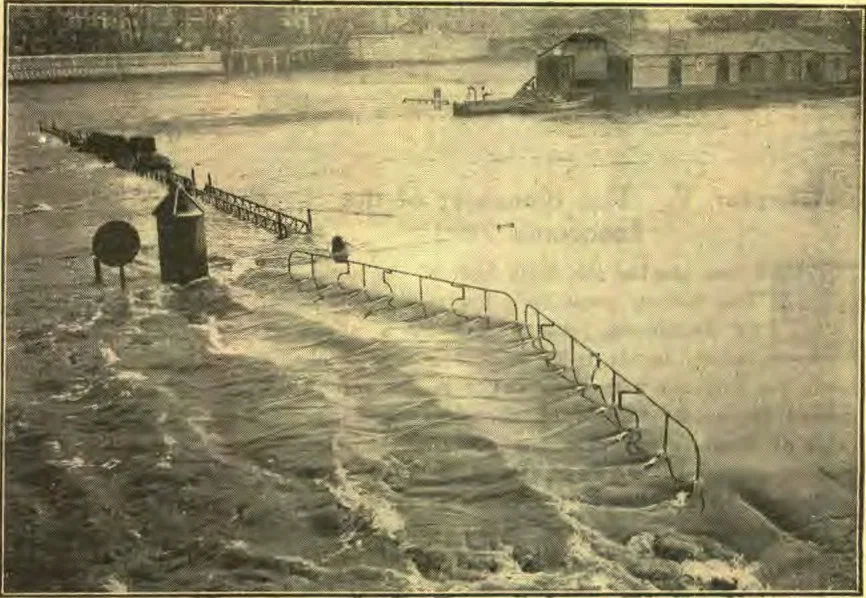
The river Seine rose from nine to eleven feet above its ordinary level. It thus became a wild and devastating torrent, invading the wharves, the squares, some of the leading avenues and boulevards, and hundreds of streets.
It is perhaps easier to imagine the havoc created by such a body of water rushing irresistibly forward through a city like Paris, than it is to describe it.
What a change came over this huge and complicated beehive of over 3,000,000 inhabitants!
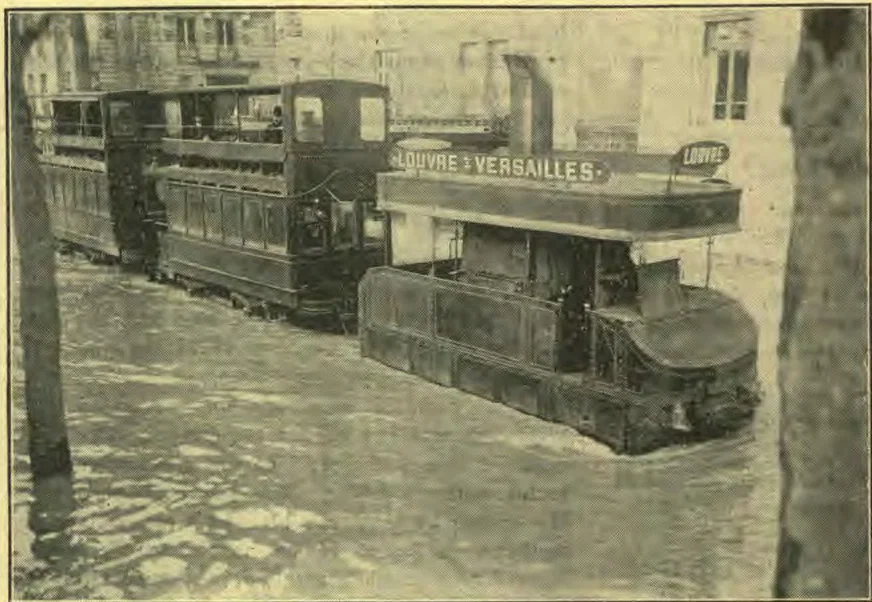
Street-cars crossing the Hotel de Ville Square
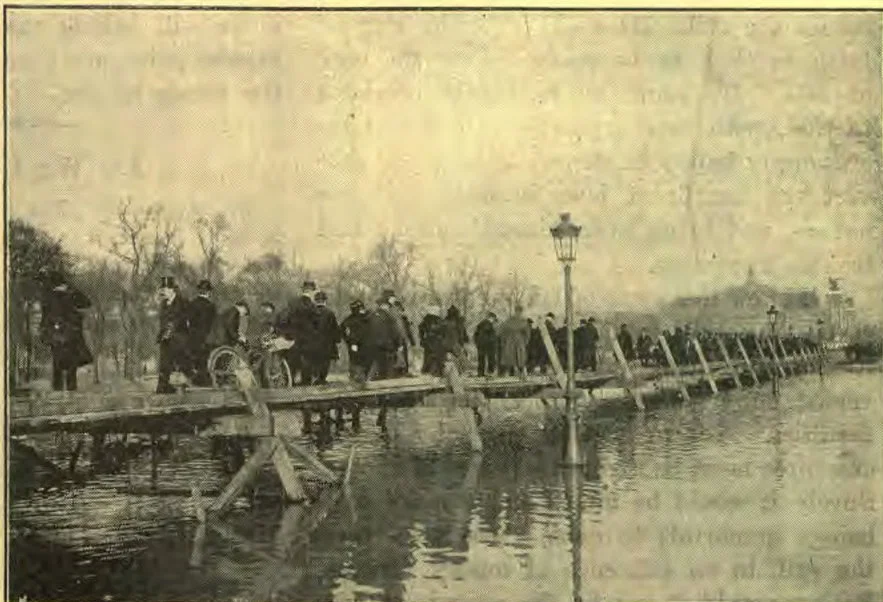
Parisian Venice — Crossing the Esplanade des Invalides
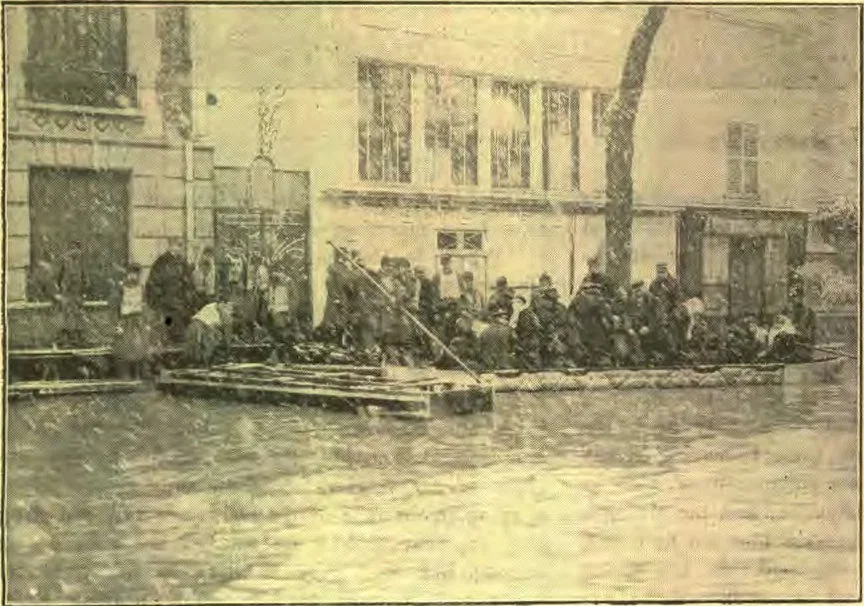
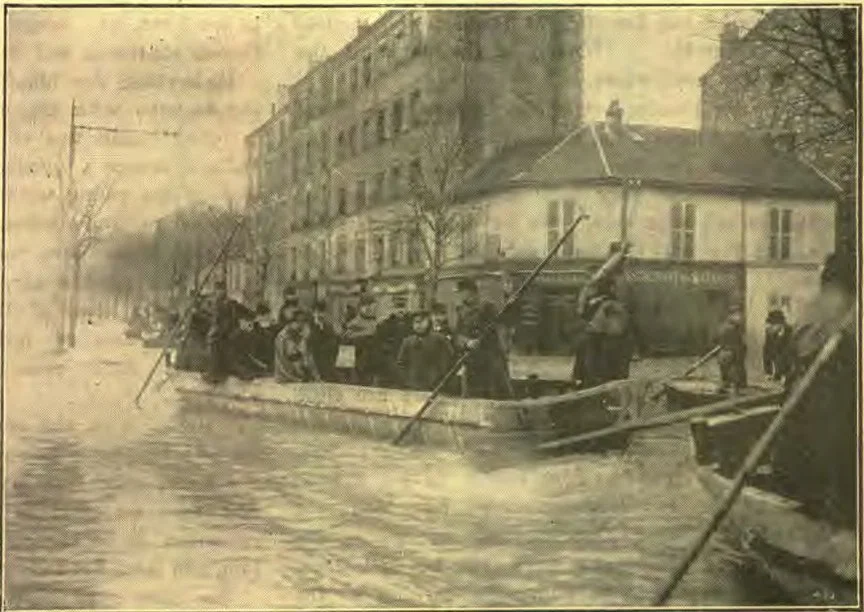
Imagine some of the finest and largest squares transformed into lakes! Look at these streets, a few days ago swarming with busy people, with cabs, automobiles, and autobuses running in all directions, now vacant and silent, or perchance traversed by some sort of boats!
Both poor and rich had to submit to many inconveniences; many were either shut up in their houses or else obliged to find shelter elsewhere. Government buildings like the foreign office, the Hotel de Ville, the Palace of Justice, the Magasine du Printemps, the Parliament Printing Office, the Hotel-Dieu Hospital, found themselves more or less invaded by water, so that the work done in these buildings had to be removed, at least from the lower floors.
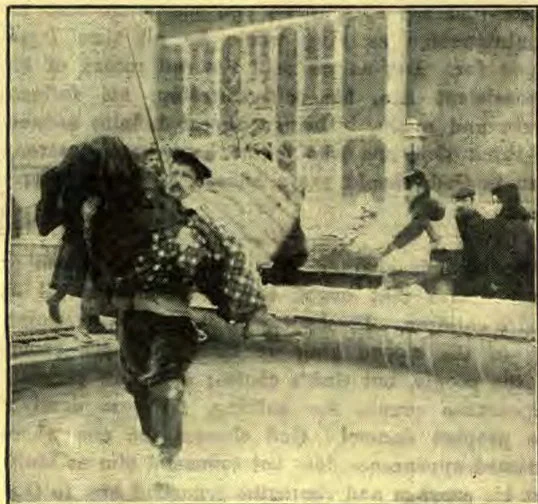
A sick woman rescued at Alfortville
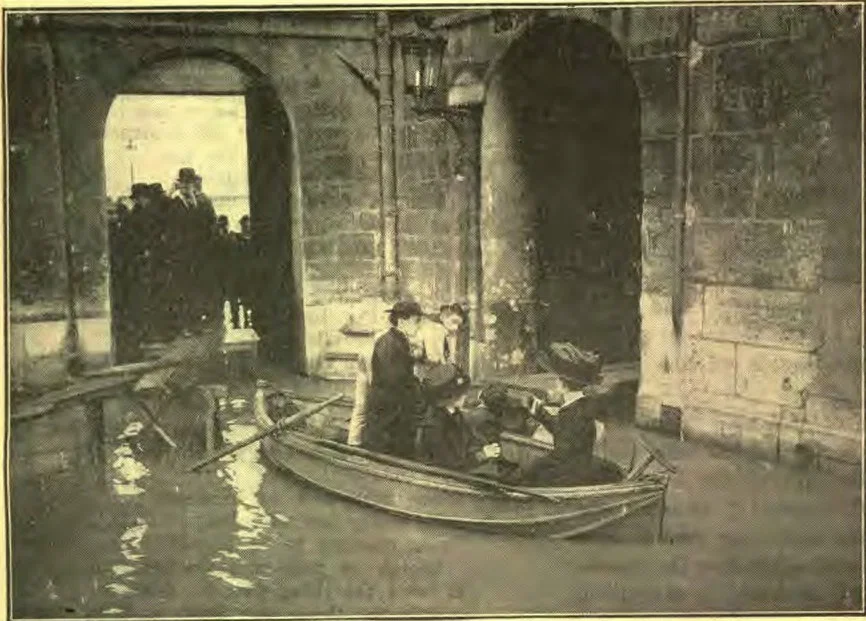
Some streets were entirely inundated, so that boats and temporary bridges were used.
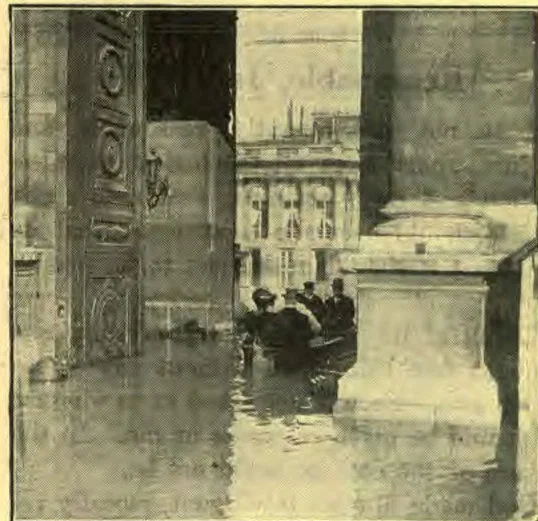
The deputies reached the Palais Bourbon either in boats or over a temporary bridge. Some went to church in the same way. Some people were furnished victuals by means of baskets let down from upper stories by a rope.
Of course street-car lines, as well as most of the lines on the well-known Metropolitan Subway, were interrupted. So were telephone communications, leaving 14,000 offices and homes deprived of this useful invention. Public clocks no more told the time. Electric light no longer shed about its radiance. On the other hand, strange enough, January 26 at noonday, while the sky was threatening and the angry river carrying loads of timber, barrels, and everything else before it, you might have seen along the Seine thousands of gaslights burning, but just extending out of the water.
Parisians, sobered down, anxiously watched the progress of this mute visitation. Generally speaking, they remained remarkably quiet and self-possessed during these days of alarm. Said Le Soleil, "Man remains impotent in the face of this invasion of unchained elements." Not a few thought of the flood; and from many lips came the words, "The end of the world." An ex-minister of state, M. Charles Dupuy, writes in a morning paper:
"The water is decreasing! In a few days, Paris will have resumed its bustle and pleasures, will have forgotten yesterday's anguish, and, careless of to-morrow's possible disasters, will return to its theaters, or find fresh amusements in the cavalcades of Lent.
"Such is the world: one wave drives the other away, and it is quite unlikely that the lessons of experience will succeed better than those of moralists in curing us of our superstitions and lightness."
100,000 working men in Paris were obliged to quit work on account of the inundation. Thousands of persons from the suburban towns had to leave their homes and enter the city to find shelter and food. Alfortville, for instance, a city of 18,000 souls, had to be entirely abandoned. Most of these persons were sheltered in the public buildings of the capital. At Gournay-sur-Marne the houses were drenched in seven feet of water. Ivry, Vitry, Cliguancourt, Levallois-Perret, Bezons, Villeneuve-le-Roi, and Villeneuve-St. Georges, were mostly under water. At Corbeil the affluent Essonne grew seven feet in one night. At Clichy, two blind women and one old man were rescued just as the water was about to reach their beds. Many persons had to run for their lives, wading through the flood while carrying their children or some valuable objects in their arms.
Deputies on their way to the Chamber by boat
It is needless to say that this disaster is greater than can be described. Millions of francs have been lost, many streets, thousands of homes, and many public conveniences have been practically ruined. Among others might be mentioned the first floor or basement of the National Museum, some fine railroad stations, and the national printing establishment. Speaking of museums, the Botanical Garden presented a rather sad looking sight when the white bears, the elephants, and the giraffe were found flooded and piteously begging help from their more fortunate guardians.
Happily, this calamity did not last over ten or twelve days. Otherwise Paris would soon have been facing a starvation problem. The arrivals at the Villette meat market on one day were one thousand oxen instead of four thousand, the usual number. Means of transit into Paris and out of it had become so disorganized and11roads so dangerous, that vegetable sellers dared not undertake the journey.
Help for the suffering population came in from all sides in great abundance. Americans in Paris and in the States sent 800,000 francs. A subscription started by the lord-mayor of London brought over 1,300,000 francs. All told, foreign countries contributed four million francs.
It must be said that this calamity was borne by the people of Paris with a good degree of courage, fortitude, and resignation. In fact, several papers have taken occasion of this to compliment their nation, and to comfort themselves against the accusation of having become degenerate. It is to be hoped that this warning will be heeded by many in the gay capital, and lead them to make serious reflections on the uncertainty of life, and the meaning of the signs of the times.
At Alfortville, near Paris — Persons rescued by the soldiers
The Seine in the heart of Paris
JEAN VUILLEUMIER.
M. Fallieres accompanied by MM. Briand, Millerand, and Lepine visiting and viewing conditions at Ivry
Leaving church, Sunday, January 30, 1910 — Paris for a time becoming a Greater Venice
Presidents’ Religious Affiliations
By Editor
Religious Views of Our Presidents.—Washington, Madison, Monroe, W. H. Harrison, Tyler, Taylor, Arthur, were Episcopalians; Adams, J. Q.12Adams, Fillmore, and Taft, Unitarians; Jackson, Buchanan, Cleveland, B. Harrison, Presbyterians, or became such; Roosevelt, Dutch Reformed; Polk, Grant, Hayes, McKinley, became or were Methodists; Pierce, a Congregationalist; Garfield, Disciple; Jefferson, Jackson, Van Buren, Polk, Lincoln, Johnson, Grant, were not, while presidents, church-members, tho some of them afterward united with churches. None of them were scoffers. Some, like Adams and Jefferson, were strong advocates of religious liberty.
The Thirteenth Census
By William Howard Taft
By the President of the United States of America
A Proclamation
WHEREAS by the Act of Congress approved July 2, 1909, the Thirteenth Decennial Census of the United States is to be taken, beginning on the fifteenth day of April, nineteen hundred and ten; and
Whereas a correct enumeration of the population every ten years is required by the Constitution of the United States for the purpose of determining the representation of the several States in the House of Representatives; and
Whereas it is of the utmost importance to the interests of all the people of the United States that this census should be a complete and accurate report of the population and resources of the country:
Now, therefore, I, WILLIAM HOWARD TAFT, President of the United States of America, do hereby declare and make known that, under the act aforesaid, it is the duty of every person to answer all questions on the census schedules applying to him and the family to which he belongs, and to the farm occupied by him or his family, and that any adult refusing to do so is subject to penalty.
The sole purpose of the census is to secure general statistical information regarding the population and resources of the country, and replies are required from individuals only in order to permit the compilation of such general statistics. The census has nothing to do with taxation, with army or jury service, with the compulsion of school attendance, with the regulation of immigration, or with the enforcement of any national, state, or local law or ordinance, nor can any person be harmed in any way by furnishing the information required. There need be no fear that any disclosure will be12made regarding any individual person or his affairs. For the due protection of the rights and interests of the persons furnishing information every employee of the Census Bureau is prohibited, under heavy penalty, from disclosing any information which may thus come to his knowledge.
I therefore earnestly urge upon all persons to answer promptly, completely, and accurately all inquiries addressed to them by the enumerators or other employees of the Census Bureau, and thereby to contribute their share toward making this great and necessary public undertaking a success.
In witness whereof, I have hereunto set my hand and caused the seal of the United States to be affixed.
Done at the city of Washington this fifteenth day of March, A.D. one thousand nine hundred and ten, and of the Independence of the United States of America the one hundred and thirty-fourth. WM. H. TAFT.
By the President:
P. C. KNOX,
Secretary of State.
Rights of Jews
WHEN the Sunday closing bill was before the Senate recently, Senator Bailey, of Texas, and Money, of Mississippi, defended the rights of Jews to observe the seventh day as the Sabbath. The former gentleman said, in the course of an eloquent speech:
"I have never attempted to discriminate against the Jew, because he has never attempted to discriminate against anybody. Not only so, but no class of people in America are more law-abiding and more thoroly respect the rights of every man than the Jews. That must be said to their honor here and in every other forum. They obey the law more exactly than any other of our fellow citizens; there are fewer of them in the poorhouses than any other race of people."
Senator Money said in part:
"There is no other people on the face of the earth who for thousands of years, without a home, have distinctly preserved their nationality and their features. The Jew of to-day is the same as the Jew of 4,000 years ago in the monumental land of Egypt. But the great crowning monument of the Jew, if I may say it, is that he has preserved his identity through all the changes and revolutions of time. Distressed, persecuted, driven from post to pillar, consigned to obscure countries, and even expelled from countries which he has made to flourish, he has never failed to preserve the original Jewish characteristics."— Detroit News Tribune.
Cigaret
"I am not much of a mathematician," said the cigaret; "but I can add to a youth's nervous troubles, I can subtract from his physical energy, I can multiply his aches and pains, I can divide his mental powers, I can take interest from his work, and discount his chances for success."—New York Observer.
Shiloh: the Man of Sorrows
By Mrs. L. D. Avery-Stuttle
Copyright, 1910, Pacific Press Publishing Association
By Mrs. L. D. Avery-Stuttle
Chapter V. The Slaughter of the Innocents
IT was nearing the ninth hour of the night. The waning moon hung low over the hills of Bethlehem, and a few stars shone faintly in the calm, still sky. The shepherds yet lingered with their flocks in the valleys toward the south. Eastward, the far-away mountains of Moab, dimly discernable against the sky, rose like gigantic sentinels, as if to guard the land given by Jehovah to the tribes of Israel.
Far to the west lay the dark waters of the Great Sea. Toward the north, and almost under the shadow of the walls of the little town, lay the valley where the tomb of Rachel, the best loved of Jacob, had been built more than seventeen centuries before.
Swiftly crossing this valley, the dull thud of their horses' hoofs echoing drearily, and the dim light falling faintly upon their burnished helmets and swords, rode two hundred Roman horsemen. They have come from Jerusalem to fulfil the command of the despot king. Now they have passed the northeastern gate, and are entering the ill-fated city. Already the soldiers are clamoring for entrance at the door of the hospitable inn; and the astonished host Jason, with staring eyes and pallid cheeks, listens to the centurion as he declares his bloody errand:
“Open! in the name of the king, where is He that is born King of the Jews?” and the ugly head of Varro the centurion is thrust into the doorway.
“What wilt thou?” trembling like an aspen, Jason the keeper demands; “verily, I am but a peaceable man, and my guests quiet and law-abiding. Truly we lead no rebellion against Cæsar, neither is Bethlehem in revolt against Herod.”
“I care not for thee, man; cease thy prating. Tell me where hideth the carpenter of Nazareth with the Babe. Surely I have heard that he hideth with thee. And I swear to thee, unless thou deliver him, thou shalt be put to torture;” and Varro straightened his giant form threateningly. Even as he spoke, poor Jason, overcome by horror, fell in the doorway, while the footsteps of the brutal soldiers echoed in every room. Already the screams of little ones in their last agony, the piercing wails of women, and the brutal curses of the soldiers fell upon the ear.
Down the silent streets of the little city, pass the grim executioners of the bloody king. Into every room and darkened chamber they enter. Shouts and groans and imprecations and brutal laughter and cries for mercy are mingled in one awful cyclone of horror and confusion and blood and death. The terrible shouts, “Where is He that is born King of the Jews?” “Where is the carpenter of Nazareth?” “Open, in the name of the king!” echo everywhere.
Finally the bloody feet of the soldiers have found the gate of Cleopas the merchant; and cruel hands seek to unbar the door.
“Ho, Cleopas! they tell us the carpenter of Galilee hideth with thee. We be not sent to harm thee, nor thy wife Abigail, only deliver to us thy guests!”
“The brave soldiers of Herod are too late; the Babe ye seek hath departed!” cries Abigail, snatching a candle and rushing to a room where slept her infant son. But the feet of the soldiers are close behind.
“Ha! I doubt not this is the young King! See, Galleo,” calls the foremost ruffian to his fellow, “shall we not tell Herod that we have done his bidding? By what time the red sun guilds the mountains of Moab, our work will be well done. Look you, woman,” he continues, turning to the trembling mother, “we be no Jews; seest thou not that we be soldiers of Cæsar? If the heart of Herod the Jew knows no pity, why should the legions of Cæsar tremble and weep like women at the sight of blood?” and in another instant the severed head of the babe has fallen at the feet of the murderer.
With a gurgling scream the woman Abigail threw up her hands, and tore madly at the long, black hair which hung over her shoulders, threw herself upon the mangled body of the child, and expired.
But Cleopas, her husband, is already upon the scene; and his tall, supple form looms up in the dimly lighted room. In his younger days, Cleopas the merchant had been a wrestler; and the strength of his good arms has not forsaken him, for he is still scarcely in the prime of manhood. In his strong hand he holds a staff, and in an instant he has hurled himself upon the soldier nearest him. It is an unequal contest; for the room is filled with bloody assassins. However, the errand of the brave soldiers of King Herod this night is not with men, but with helpless babes; and they have already done their awful work in the house of Cleopas, and with cursing and shouting they make their way again into the dismal streets.
But the right arm of the merchant has been cleft to the bone, and hangs limply at his side, with the fingers shattered and broken.
Meanwhile the bloody work goes on, and the streets echo with the wailing cries of women.
“Ho!” calls one of the soldiers, as a band of ruffians enters a goodly apartment where, by the side of his young nurse, sleeps a beautiful infant wrapped in costly robes.
“Ho! What have we here? Surely, Varro, this is the son of the carpenter. See! low lieth the head of the rival of King Herod!” And as he speaks, the headless body of the infant is parried back and forth upon the swords of the brutal soldiers.
“Hold! it is the son of the king, even King Herod!” screams the maid, tearing her hair wildly.
“Back, witch! it is the will of the king. He will have no rival in Bethlehem!” exclaims the centurion, as he thrusts the screaming woman from him, and leads his fellows once again into the streets.
The first gray light of morning is struggling with the mists of the valleys as the soldiers reach the home of Sylvanus the shepherd. Esther awakens from an uneasy slumber. The shouts of the soldiers and the screams of women and children have been mingling with her dreams.
“Where is He that is born King of the Jews? He that would usurp the throne of Herod the Great, king by the power of Cæsar?”
One moment only did Esther hesitate. Her mother heart read as by unerring instinct the import of the awful cries. Quickly snatching up her infant Matthias, and throwing a mantle about her, she rushed out into the streets, lighted faintly by the dim glare of the soldiers' torches, and escapes by an opening in the rear of the house. Wildly she struggled on, fearing lest she awaken the babe at her breast; but fear gave strength to her trembling limbs and courage to her wildly-beating heart. Once she had almost fallen in the street; but she quickly regained her footing, and plunged on, hoping to secrete herself where the shadows were densest. But at last the out-stretched arms of a soldier opened to receive her. With a cry to heaven, she struggled to release herself, and clung wildly to the babe in her arms. But the voice of the centurion Marcus rings above the din: “Let the woman go, Galleo! Herod has had blood enough! I thank the gods I have saved more than one already this night.” And the centurion parried the blow of the brutal soldier, and allowed the almost fainting woman to escape in the gray light of the morning.
Meanwhile, the soldiers at the gate, thinking that the male infant in the house of Sylvanus had been already slain, passed on to finish reaping their awful harvest of blood.
But even as they passed, a shrill cry was heard at the gate, and a young lad clad in simple shepherd's dress rushed, screaming, past them. The lad, Heber, left alone for the night with the charge of the sheep, had been attracted by the unusual confusion in the little town, and the shrill screams of the affrighted inhabitants, and remembering the dream of the eastern princes, “Beware ye of Herod,” had left his sheep, in great dismay, and hurried homeward.
He had arrived in time to see the Roman soldier raise his sword over the head of his poor mother and little Matthias, whom he at once recognized in the dim light of that awful morning.
“Mother, mother! See! Herod has come for the Babe. There is blood everywhere. Look! The skies are growing crimson with it. Blood! blood! the blood of little children, the blood of women, and the blood of babes! Wo, wo to the inhabitants of Bethlehem!” And the frenzied lad rushed shrieking up and down the confused and bloody streets, in almost every house of which lay the murdered and ghastly body of an innocent babe.
(To be continued)
Are All the Children In?
By Mrs. S. T. Perry
THE darkness falls; the wind is high;
Dense, black clouds fill the western sky;
The storm will soon begin.
The thunders roar; the lightnings flash;
I hear the great round rain-drops dash—
Are all the children in?
They're coming softly to my side;
Their forms within my arms I hide—
No other arms are sure.
The storm may rage with fury wild;
With trusting faith each little child
With mother feels secure.
But future days are drawing near—
They'll go from this warm shelter here,
Out in the world's wild din.
The rain will fall, the cold winds blow;
I'll sit alone, and long to know,
Are all the children in?
Will they have shelters then secure,
Where hearts are waiting strong and sure,
And love is true when tried?
Or will they find a broken reed,
When strength of heart they so much need
To help them brave the tide?
God knows it all; His will is best;
I'll shield them now, and leave the rest
In His most righteous hand.
Sometimes souls He loves are riven
By tempests wild, and thus are driven
Nearer the better land.
— Mrs. S. T. Perry.
It Isn't the Thing You Do
By Margaret E. Sangster
(To be continued)
—★★—
It Isn't the Thing You Do
It isn't the thing you do, dear,
It's the thing you leave undone,
That gives you a bit of heartache
At the setting of the sun.
The tender word forgotten,
The letter you did not write,
The flower you did not send, dear,
Are your haunting ghosts to-night;
The stone you might have lifted
Out of a brother's way,
The bit of heartsome counsel
You were hurried too much to say,
The loving touch of the hand, dear,
The gentle, winning tone,
Which you had no time or thought for,
With trouble enough of your own,—
These little acts of kindness
So easily out of mind,
These chances to be angels
Which we poor mortals find.
It isn't the thing you do, dear,
It's the thing you leave undone, —
That gives you a bit of heartache
At the setting of the sun.
— Margaret E. Sangster.
Chemical Production of Black Flowers
A Southern cripple, Dennis Trapley, of Savannah, Ga., has invented a formula by which three inexpensive and common chemicals can be mixed which will if properly applied produce black cotton at one tenth that of dyeing it. He says that he has produced black roses, and declares that any flower can be cultivated so that its blooms will be black. Prominent men are back of him. He declared that he had taken an ordinary rose bush and planted it in rich earth, and by feeding it his chemical the bush had produced a rose as large and heavy as an American Beauty, and as black as a coal. Further, the chemicals seemed to have a good effect on the plants. Those experimented with have grown to extraordinary size and are of fine fiber.
The Fall of Jerusalem
A Russian professor, Von Domas Zuewski, has written what is said to be the first complete story of the fall of Jerusalem in the first century after Christ. Details heretofore unknown are given in this graphic description, which sets forth that the cruelty of the Jews against their own people in Jerusalem and their enemies outside, the Romans, was only equaled by the atrocities committed by the Romans during the siege and after the fall of the city. The great town was finally subdued by hunger. During this siege the Romans crucified every Jew taken prisoner and every Jew trying to escape from the city. We are told that the wall that girded Jerusalem was further surrounded by a wall of crosses on which thousands of Jews had died; that the siege lasted five months.
Wanted
At Paradise Valley Sanitarium, three graduate nurses, and a strong woman to do chamber work. Apply with recommendations to H. W. Lindsay, manager, National City, Cal.
A Thirty-Day Bargain
If any one desires a good home in Mountain View, California, here is an opportunity. Five-room cottage, well built in every respect, modern improvements. Lot 100 x 150 feet, variety of fruit, nuts, and berries, all bearing. Near S. D. A. Church, school, and SIGNS OF THE TIMES office. For thirty days this place will be offered at a ridiculously low price. Write for particulars of this bargain. Address F. R. A., Box 293, Mountain View, Cal.