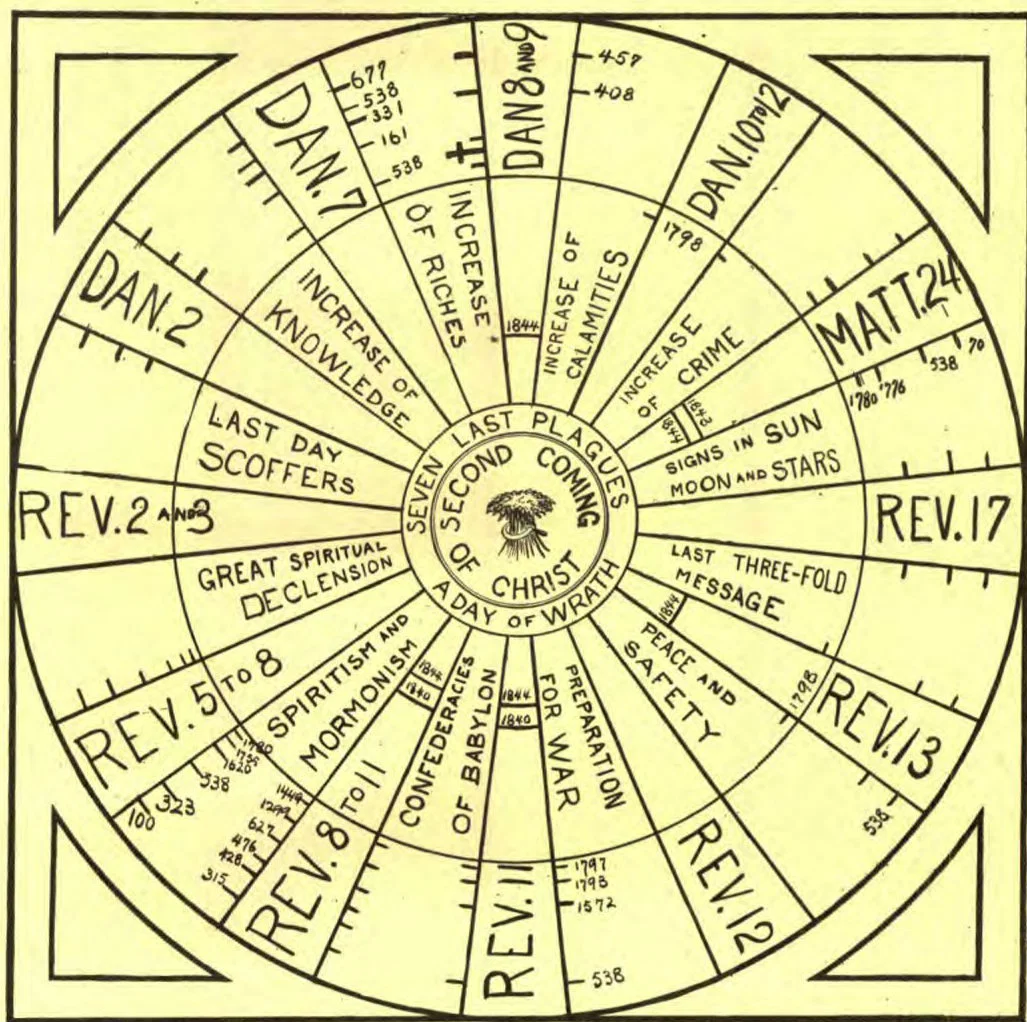
THE far-faring mariner wishes to know his whereabouts on the great waste of waters. So he takes an observation; learns his longitude and latitude; and thus ascertains how far he has come from port, and how long it will probably take him to reach his appointed haven. So the student of history may wish to know the time in which he lives; how far the world has come in the journey of time; how far it has yet to go before the final consummation. There is only one means of ascertaining such facts. The Word of God alone can show man just where he is moving in the great stream of time.
The Great Molding Dynasties of Earth
In fact the great prophecies of the Word were given for this very purpose; for did not Christ say, “When these things begin to come to pass, then look up, and lift up your heads; for your redemption draweth nigh;” “when ye shall see all these things, know that it is near, even at the doors”? And so nearly three thousand years ago, God began giving the great prophecies of the Word; and they continued to be given for several hundreds of years, until we have an accumulation of evidence that is absolutely all-convincing.
First, there is the great image of Daniel 2. Four great universal empires are designated, — Babylon, Medo-Persia, Grecia, and Rome, with Rome merging into a divided state, in the nations of Europe; and then following all these comes the fifth universal kingdom, the kingdom of Christ. We know that all these kingdoms have passed except that of divided Rome. The next great change will be the ushering in of the eternal kingdom of Christ.
The same great empires are mentioned in the prophecies of the 7th of Daniel. Here, however, they are represented by four great beasts. The same great empires are portrayed, — Babylon, Medo-Persia, Grecia, and Rome, — with added particulars and characteristics. The blasphemous conduct of the last great beast in the prophetic representation of the little horn, and the coming of the Son of Man in power and glory, the giving of the beast to the burning flame, and the ushering in of Christ’s kingdom of peace, are clearly and grandly presented to the student of the Word.
Again in the 8th and 9th chapters of Daniel we have a large portion of the same historical period once more reviewed. In this the great prophetic time period, stretching from 457 B.C. to A.D. 1844, is introduced. The prophecy becomes so definite as to give a number of clear-cut dates. History verifies that every one of these has been fulfilled. And after this great prophetic period comes the promise of the Son of Man appearing in the clouds of heaven; for between the time of 1844 and that grand and final event, the Gospel of the kingdom is to be preached in all the world as a witness to all nations, and then comes the end. Matt. 24: 14.
In the 11th chapter of Daniel we have a still further elucidation of the history of the world; more particularly than ever the history of Medo-Persia and of Grecia are outlined. The division of Alexander’s kingdom into four parts is wonderfully foretold and outlined. Every particular was fulfilled, as history plainly demonstrates. The latter part of this 11th chapter of Daniel covers the great movements of the empire of Rome. The final consummation of all things is stated in the last verse of the chapter; and the first verse of the 12th chapter announces the close of earthly dominion, when the great Prince Michael stands up to reign for the children of His people. There is a time of trouble such as never was since there was a nation even to that same time; and at that time the people of God are delivered, every one found written in the book. A resurrection of the righteous dead takes place, and salvation is brought to every loyal child of God.
Our Lord’s Sermon
In that wonderful sermon of Christ recorded in the 24th chapter of Matthew, the history of the world from the time of Christ to the end of all things is three times reviewed. After naming some of the events that would come immediately after His ascension; after stating the terrible scenes that would be enacted during the Dark Ages, under the persecutions of the Roman church, — the prophecy points to the end of all things, and states that he that endures to the end, the same shall be saved, and “this Gospel of the kingdom shall be preached in the whole world for a testimony unto all the nations; and then shall the end come.” Verse 14.
Having thus reviewed the history of the world to the end of time, beginning with the 15th verse of the 24th chapter the Saviour again outlines the same great period. In the 15th verse we have the record of things which took place in A.D. 70, when Titus, the Roman general, captured the city of Jerusalem, and wrought terrible havoc upon the bigoted Jews. Then again Christ outlines the terrible times of the great tribulation, such as has not been from the beginning of the world until now, nor ever shall be; then the proclamation of the coming of the Son of Man, and His revelation, as clear as lightning from the east shining even unto the west; and the great judgments of God, as when the eagle takes his prey. Verses 27, 28.
The closing part of the Lord’s prophecy in this 24th chapter of Matthew is a depiction of the signs that would occur immediately preceding His coming; signs in the sun, and the moon, and the stars, and upon the earth distress of nations, and then the great sign of the Son of Man in heaven. According to the statement of Christ, there were to be signs in the heavens. First, the sun was to be darkened; and it was, May 19, 1780. Secondly, the moon was not to give her light. This occurred the evening of May 19, 1780. The stars were to fall from heaven. This they did November 13, 1833. The powers of heaven were to be shaken. This is yet to occur, as represented in the 12th chapter of Hebrews, verses 25-29. It immediately precedes the coming of the Son of Man in the clouds of heaven with power and great glory, and is the final act in the shaking of the nations, the removal of the power of the kingdoms6of earth, and the setting up of the eternal kingdom of Christ.
These signs being in the past, we should learn the lesson exactly as Christ instructed. He said, “Now from the fig-tree learn her parable: when her branch is now become tender, and putteth forth its leaves, ye know that the summer is nigh; even so ye also, when ye see all these things, know ye that He [Christ] is nigh, even at the doors. Verily I say unto you, this generation shall not pass away, till all these things be accomplished. Heaven and earth shall pass away, but My words shall not pass away.” Christ’s Word is sure. Just as certainly as those signs have been given (and that is as certain as fact), just so certainly will He come before the passing of this generation.
Omens of His Coming
The apostle Peter tells us that there shall come scoffers in the last days, saying, “Where is the promise of His coming? . . . All things continue as they were from the beginning of the creation.” 2 Peter 3: 3-13. We have these scoffers to-day, and they are their own evidence that the things they deny are true. They fulfil the Word by their scoffing, and thus make it more sure, and demonstrate that these are indeed the last days.
In the last chapter of Daniel, the fourth verse, we have final instruction to Daniel as to what he should do with the prophecy which had been given to him. Here are the words: “But thou, O Daniel, shut up the words, and seal the book, even to the time of the end: many shall run to and fro, and knowledge shall be increased.” We have reached the time of the increase of knowledge. The mere statement is enough. Every one has enough information at hand to verify its truth. Knowledge has been increased as never before in all the history of the world, and the increase still continues. And many are running to and fro by means of railroads with their swiftly moving express trains, with the great steamships of the ocean driven by their wonderful turbine engines, by means of automobiles and flying machines and other modern methods of travel. There is a moving to and fro over the earth such as was not ever before in all the world’s existence. It is now paramountly true that many are running to and fro and knowledge is increased. Therefore this is “the time of the end.”
Accumulation of Riches
In the 5th chapter of James we have a warning to the rich; and there are a number of expressions in this warning which show that it is applicable at a time when there has been an accumulation of riches, which was not true at any other time, and that could not be true except in the time of the end. We have these expressions as showing the times in which the warning is applicable, as showing the time in which the rich deserve to take heed to the lesson. “Come now, ye rich, weep and howl for your miseries that are coming upon you . . . Ye have laid up your treasure in the last days. . . . Ye have nourished your hearts in a day of slaughter.” And then, changing from the rich who have oppressed, to the poor who have been op-
pressed, we have still further these words: “Be patient therefore, brethren, until the coming of the Lord. . . . Be ye also patient; establish your hearts: for the coming of the Lord is at hand. Murmur not: . . . behold, the Judge standeth before the doors.” Any one who knows anything about the times at all, knows that this is the time of an awful struggle between capital and labor, which grows more desperate every year. It is of itself one more link in the chain of evidence, one more sign that we are in the time just preceding the coming of the Judge of all the earth.
Peace and Safety Cry
And at this time, we are told that those who ought to be watchmen upon the walls of Zion, those who ought to be preachers of the Word and understand the times and the message of the times, will be saying just what they ought not to be saying. From the pulpits of the land comes one almost universal cry of peace and safety, notwithstanding the fact that God has outlined the history of the world, shown plainly that the end of all things is at hand, and draws for us in addition this lesson: “When they are saying, Peace and safety, then sudden destruction cometh upon them, as travail upon a woman with child; and they shall in no wise escape.” 1 Thess. 5: 1-11.
Another Picture
Furthermore the great camera of prophecy has photographed the times in which we live, has shown as plainly as in a sharply detailed picture the condition of humanity at the present time: “But know this, that in the last days grievous times shall come. For men shall be lovers of self, lovers of money, boastful, haughty, railers, disobedient to parents, unthankful, unholy, without natural affection, implacable, slanderers, without self-control, fierce, no lovers of good, traitors, headstrong, puffed up, lovers of pleasure rather than lovers of God; holding a form of godliness, but having denied the power thereof: from these also turn away.” 2 Tim. 3: 1-5.
Here is plainly stated the spiritual declension which has come into the churches of the land. This terrible condition, this awful array of sin, is a result of men’s having only the form of godliness, denying the power thereof. In other words, they are mere professors. Every one knows, that knows anything about the events of to-day, that one universal complaint goes up all over the land regarding the laxity of Christians, and the failure of present-day Christianity. It is another sign that our Christ is about to come.
War Preparations
Just before the coming of Christ, there is to be that awful battle, that awful clash of the powers of the earth, known as the great Battle of Armageddon. That terrible contest and its awful results are very dramatically portrayed in the 38th and 39th chapters of Ezekiel. It is also mentioned in Zech. 12: 2-4. And again we read of it in Rev. 16: 14-16.
And in connection with the awful catastrophe of that battle comes the judgment of Babylon. God does not forget Babylon nor her sins. He does not forget the great apostasy and the heresies originating in that apostasy. God does not forget the blood of the saints and the blood of the martyrs of Jesus. The final end of all these evil forces is depicted in Rev. 19: 11-21.
We know that the nations to-day are preparing for that great battle. Men of the hour are talking of that awful day, that day when the nations which so long have been preparing shall come together with all their forces, each one for his own interests. Battle-ships constantly more formidable, more expensive, more death-dealing, are being invented and built. Constantly larger and more effective guns, those that will fire more rapidly, that will deliver larger and more ponderous missiles of destruction, are being conceived and constructed. The nations of to-day unconsciously, but nevertheless certainly, are preparing for the great event named by the prophecy as the Battle of Armageddon.
All these and more than these are evidences to the student of the Word that we are living in the very last days. The world is constantly growing more wicked, more lawless, more Heaven-defying, more incorrigible. Soon, we do not know how soon, Christ will come and put an end to earthly sin and discord and death, and usher in His kingdom of righteousness and peace and immortal life. God grant that you and I may be subjects of that everlasting kingdom; that at once, without delay, we may apply for citizenship; be sure that we have qualified as candidates, live faithfully our part, stand loyal and true, and then we shall pass through the great crash of the ages, the destruction of the nations, the wreck of a world, and the ushering in of the glory that shall never pass away.
The Penalty
By J. A. Edgerton.
WE are mad — grown mad in the race for gold;
We are drunk with the wine of gain;
The truths our fathers proclaimed of old,
We spurn with a high disdain.
But while the conqueror's race we run,
Our rulers should not forget
That the God who reigned over Babylon
Is the God who is reigning yet.
Would we tread in the paths of tyranny,
Nor reckon the tyrant's cost?
Who taketh another's liberty,
His freedom hath also lost.
Would we win as the strong have ever won,
Make ready to pay the debt;
For the God who reigned over Babylon
Is the God who is reigning yet.
The ruins of dynasties passed away
In eloquent silence lie;
And the despot's fate is the same to-day
That it was in the days gone by.
Against all wrong and injustice done
A rigid account is set;
For the God who reigned over Babylon
Is the God who is reigning yet.
The laws of right are eternal laws,
The judgments of truth are true;
My greed — blind masters, I bid you pause
And look on the work you do.
You blind with shekels your fellow man,
Your hands with his blood are wet;
But the God who reigned over Babylon
Is the God who is reigning yet.
— J. A. Edgerton.
The Sabbath Through the Ages
By Charles L. Taylor
XV. The First Day in the Scriptures
By Charles L. Taylor
A Question of Fact
CARDINAL GIBBONS says, 'You may read the Bible from Genesis to Revelation, and you will not find a single line authorizing the sanctification of Sunday.' Is he correct?
Many a good, sincere Protestant Christian, who observes the first day of the week, says, 'Why, the Bible is full of proof that we are to keep Sunday in honor of Jesus' resurrection from the dead.' Is the statement correct?
Certainly one of the witnesses must be wrong. Either the Catholic is right and the Protestant wrong, or the Protestant is right and the Catholic wrong. Which is it?
This is not a question of metaphysics, nor one of moral abstraction. It is a question of fact. Does the Bible give evidence, either direct or indirect, that Sunday was or is the holy day of the Christian church? If so, we may reasonably expect at least one plain statement to that effect, and one so plain that 'the wayfaring men, tho fools, shall not err therein.' If that one plain word of testimony is not to be found, then only one conclusion may be reached; namely, that God's Word does not authorize the sanctification of Sunday.
BUT, further, if the Word of God is silent in regard to first-day observance, thus showing that Cardinal Gibbons's declaration is8correct, then, as true Protestants, we are specifically bound by our own profession of faith to disregard the claims of Sunday, and truly follow the actual teaching of the Word of God. For concerning the sanctity of Sunday, or any other matter which involves duty, it is of 'no account in the estimation of the genuine Protestant, HOW EARLY a doctrine originated, if it is not found in the Bible.' He asks, 'Is it to be found in the inspired Word? Was it taught by the Lord Jesus Christ and His Apostles?' See Dowling's "History of Romanism."
What the Record Says
It is a genuine surprise to many, when they come to make a thoro study of the question, to learn that the Scriptures are not 'full of proof' that Sunday is to be kept in honor of Jesus' resurrection, nor yet 'full of proof' that it is to be kept for any reason whatsoever. The fact is, the word 'Sunday' is not found in the Bible at all; and the expression, 'the first day of the week,' only eight times. Those eight references are: Matt. 28:1; Mark 16:2, 9; Luke 24:1; John 20:1, 19; Acts 20:7; 1 Cor. 16:2. These are all, and not one of these contains even a hint that the day thus mentioned was in any wise a sanctified day. Rather, they teach that it was a common day of labor, like all the others except the Sabbath, which at that time was kept 'according to the commandment.'
That these statements are absolutely correct may be ascertained by turning to the scriptures themselves and allowing them to speak. Matt. 28:1 reads, 'In the end of the Sabbath, as it began to dawn toward the first day of the week, came Mary Magdalene and the other Mary to see the sepulcher.' This is a statement of simple historical fact. Certain ones came to the tomb of Christ at a certain time; that time was the first day of the week. It does tell us, however, that the first day of the week came at the close of the Sabbath.
'But,' says one, 'I have heard that the Greek of Matt. 28:1 ought to be translated differently; that in order to be correct it should read, 'At the end of the Sabbaths, as it began to dawn toward the first of the sabbaths.'' This question of the translation of Matt. 28:1 was recently referred to Dr. Walter Quincy Scott of the Bible Teachers' Training School, New York City; and this in part was his reply: 'Such a rendering is impossible . . . Mian sabbaton in Matt. 28:1 can not mean anything else than 'the first day of the week.' The Revised Version correctly translates the text.' And referring to the same matter, and the answer of Dr. Scott, another Greek scholar a little later said: 'The query . . . as to 'Sabbath or Sabbaths' seems to call for a further warning. The querist asks if Matt. 28:1, opse de sabbaton, te epiphoskouse eis mian sabbaton, may not be rendered, At the end of the [Jewish seventh-day] Sabbaths, as it began to dawn toward the first of the [Christian first-day] sabbaths. The superb negative answer given should be heralded far and wide. People of excellent intention and deep piety, but with little knowledge, are making such an interpretation in fortifying themselves against Saturday keepers. . . .
'These good men had only a rusted smattering of classical Greek, and in their zeal without knowledge they stumbled upon this rendering, with a carelessness that few students of a month would make. 'A little learning is a dangerous thing.''
Mark 16:2, Luke 24:1, and John 20:1 are only a repetition of the statement made in Matt. 28:1. They simply record that the disciples, in the early morning of the first day of the week, came to the tomb of their Lord. Let the reader note, however, that both Mark and Luke take pains to mention the Sabbath that 'was past' (Mark 16:1), and that was kept 'according to the commandment.' Luke 23:56.
'But did not Jesus appear to the disciples upon the first day of the week, and say, 'Peace be unto you'? And does not this show that the disciples were met in a religious sense to celebrate the resurrection?' The answer to the query will be found in the other two Gospel references and their context.
The Simple Facts
Mark 16:9-14 acquaints us with the following facts: 1. That upon the first day of the week, when Jesus was risen early, He appeared first to Mary Magdalene; 2. That Mary went and told them 'that had been with Him'—the apostles; 3. That 'they, when they had heard that He was alive, and had been seen of her, believed not;' 4. That later Jesus appeared to two other disciples, who also went and told the eleven; 5. That when those two told their story, it was not believed; 'neither believed they them;' 6. That after all this, Jesus Himself appeared to the eleven, 'as they sat at meat, and upbraided them with their unbelief and hardness of heart, because they believed not them which had seen Him after He was risen.'
Turning to John 20:19 we learn that the meeting which Jesus attended, when He reproved them for their unbelief, was held upon 'the same day [the day of His resurrection] at evening, being the first day of the week.' We find, further, that 'the doors were shut where the disciples were assembled for fear of the Jews.' And by reading Luke's record of that meeting, we find that after Jesus had said, 'Peace be unto you,' the apostles were still 'terrified and affrighted, and supposed that they had seen a spirit;' and that the Saviour, to quiet their fears and give them assurance, asked, 'Have ye here any meat? And they gave Him a piece of a broiled fish, and of an honeycomb.' Luke 24:36-42.
The simple facts, summed up, are these: The apostles, not knowing and refusing to believe that Jesus had risen from the dead, were met in their own home or place of abode (which was barred for fear of the Jews) for their evening meal. That He might give them the evidence of sight, as well as of faith, Jesus appeared to them and reproved them for their unbelief and hardness of heart; and when they could not otherwise be fully persuaded that He was risen from the dead, He asked them for a portion of food, and ate before them.
The whole account, even to its minutest detail, is an unanswerable argument against the supposition that the disciples were met to celebrate the resurrection, or that they regarded the day as in any wise sacred.
At a Later Date
Acts 20:7 and its context is a brief but interesting account of a meeting held by the apostle Paul while out on one of his missionary journeys. The place was Troas; the time, the first day of the week. The verse reads, 'And upon the first day of the week, when the disciples came together to break bread, Paul preached unto them, ready to depart on the morrow; and continued his speech until midnight.'
The reader's attention is here called to a few specific facts. First, it was a night meeting, for 'there were many lights in the upper chamber, where they were gathered together;' and Paul 'continued his speech until midnight.' Verses 7, 8. Second, according to the Bible, the dark part of each day is the first part of each day. Gen. 1:5, 8, 13; Lev. 23:32. This, being the dark part of the first day of the week, was therefore what we term Saturday night. Third, the breaking of bread may have been only the eating of a common meal, because Paul evidently ate his ordinary supper in connection with the gathering. Acts 20:11. Fourth, the breaking of bread on any particular day was not to do honor to the day; for, in earlier times, they broke bread every day (Acts 2:46), and certainly they did not keep all days of the week. Fifth, Paul was 'ready to depart on the morrow,' that is, on Sunday morning, for Assos, a place nineteen miles distant, there to meet the rest of his company. Acts 20:7, 13. And in the morning he did depart on the trip he had planned.
The Sum of the Facts
Now what do these facts show?—Simply this: The meeting spoken of was an emergency meeting, called on the night after the Sabbath, because it was the last opportunity they would ever have of meeting with their spiritual father in the truth. The meeting ended, the apostle walked nearly all day Sunday to another point, where he took ship for home. All the circumstances show conclusively that the gathering in no wise indicates reverence for the first day of the week, but rather the opposite; for Paul, on the Sabbath, would not have walked the long distance. His custom was to rest on Sabbath, and attend to his work of preaching. See Acts 13:14; 16:13; 17:2; 18:4.
Acts 20:7 contains no hint of Sunday sacredness. Sunday was not regarded as sacred for a long period after this.
One text only remains,—1 Cor. 16:2. This word to the Corinthians is, 'Upon the first day of the week let every one of you lay by him in store, as God hath prospered him, that there be no gatherings when I come.'
Only a word is necessary to show that this text, like all the others, in no wise teaches that the first day of the week is holy time. The expression, 'lay by him in store,' shows conclusively that instead of its being a command to go to church, and there place an offering in the general collection, the thought is that the offering is to be made at home. In fact, many excellent authorities so translate it. Greenfield, in his lexicon, gives it 'with one's self, i. e., at home.' And Justin Edwards, D.D., himself an ardent first-day writer, in his 'Notes on the New Testament,' says, 'lay by him in store; AT HOME.'
And mark this: When one should 'lay by him in store, as God hath prospered him,' he certainly would need to go over his finances to learn to what extent prosperity had attended him,—a purely secular act, and one not fitted for Sabbath rest. The instruction to the Corinthian church shows that the great apostle regarded the first day of the week as only a secular day, one of the six working-days.
The new Testament is silent regarding a Sunday rest day. It speaks, but always for the Sabbath of Jehovah. Fifty-nine times it brings to view the Sabbath of the commandment, and always makes it plain that it is God's holy day. But so far as the first day is concerned, it is mentioned, as we have seen, only eight times, and in each instance it is spoken of as being only what it truly was, a common working-day.
The Christian at Work, a Presbyterian paper, has well said, 'We hear less than we used to about the apostolic origin of the present Sunday observance, and for the reason that while the Sabbath and Sabbath rest are woven into the warp and woof of the Scripture, it is now seen, as it is admitted, that we must go to later than apostolic times for the establishment of Sunday observance.'
Cardinal Gibbons, then, was right. Sunday is not sanctified by the Bible. Neither Christ nor His apostles ever instituted a change. The seventh-day Sabbath of God's immutable Word still remains; and blessed is he who, as a true Protestant, takes his stand on that Word, and faithfully remembers 'the Sabbath day to keep it holy.'
Beauty of Sacrifice
BEHOLD His self-sacrifice. No one can see the beauty of the Lord who ignores the cross. It is the cross that shows us the heart of the Master. The Rev. Mr. Morrison tells of a little maid whose mother was exceedingly beautiful, except her hands, which were twisted, drawn, distorted, and unlovely. Her daughter, with a delicate instinct of love, said nothing about this deformity for a long time after she began to observe it. But at last her curiosity overcame her self-control, and she said, “Mother, I love your beautiful face, your beautiful eyes, your beautiful brow, your beautiful neck; but I do not love your hands, because they are so ugly.” Then her mother told her the story of her hands. She said, “When you were a little babe in your cradle, one night the cry of fire rang through the house, and I ran to the nursery and found it ablaze; but God led me to the cradle where you were asleep, and I saved you, but my hands have been like this ever since.” Then there was silence for a moment, and the child said softly, “Mother, I still love your beautiful face, your beautiful eyes, and your beautiful brow; but now I love your hands best of all.” Such hands are more beautiful than the most delicate and shapely hands. The inner beauty is the real beauty.
The Babe in the manger is beautiful. The Child in the temple is beautiful. The strong Man in the carpenter shop is beautiful. The Holy One kneeling on the cold ground at night, with face turned toward the cold stars, praying to His Father, is beautiful. The smitten One, lying prone in the garden under the olive trees, crying, “Father, if it be possible, let this cup pass from Me,” is more beautiful still. But the patient Victim of human envy and malice, hanging on the cross, and praying, “Father, forgive them; for they know not what they do,” and with His dying breath crying, “It is finished,” is most beautiful of all.—Christian Advocate.
The Magdalene
By George E. Tack.
Behold her seated at the Master's feet,
Her face upturned to His pure, Godlike face,
Wherein dwell tend'rest yearning, truth, and grace,
Love's genial rays that glad her soul does greet.
She smiles; the power in His calm voice sweet,
That seven times drove demons from her soul,
She inly feels,—the power that made her whole,—
And lost in love, thinks not of drink or meat.
Gone the gray centuries; the ghostly years,
Enrobed with History's vestments, brightly gleam
With deeds of faith and love, and holy tears.
Yet o'er them soft I hear, as in a dream,
The Master's voice: "O burdened, troubled heart,
Like Magdalene, choose thou that better part."
George E. Tack.
Peabody Institute.
Respect for Authority
ONE of the chief needs of our country to-day is respect for authority. This need is apparent in church and state. Nowadays the most solemn deliverances of tribunals are sharply questioned, the most emphatic orders of officials are flouted. Reckless men are quick to make baseless assertions that bring into contempt the highest officiary. Still more reckless persons go beyond words, and defy all authority. And the deepest pity is that the utterers of suspicion have the ear of many good people; and the defiers of authority have, if not sympathy of true men, at least some who make excuses for their inexcusable lawlessness. All this is a great evil and widespread — and bad men are more and more taking advantage of it. The result is deplorable in church and state — and the worst is not yet.— Southern Christian Advocate.
Loving and Losing
"He that loveth his life loseth it." If we love self, we shall lose all. If we hate our life, we shall keep it. The life given up and devoted to God and duty, sacrificed in doing good, coming to nothing, perhaps, before men, shall grow into eternal blessedness, shall rise into nobleness, beauty, splendor of life, in the heavenly glory. A man said recently: "I have worked all my life, but have never got ahead, have never gathered any money. There has always been some human need waiting when I had begun to accumulate a little, and I had to use my savings to give help." That man has made a great deal of money, but he has little in hand. He has hated his own life and has given all to help others. Yet he has not been losing—he has been keeping his life for eternity.—S. S. Times.
Not for Self
By Robert J. Burdette
Not for Self
THAT nation is poor and that man is poor who only raises enough corn and wheat for himself. And God Himself would be poor if when I asked Him for something, He only gave me just what I asked for. I never had a prayer answered that way in my life. He gives me more than I ask or can ever think of.
God's beautiful pastures are always green when everything else is bare and brown.
We have only to lift our faces and ask for our daily bread, and, lo, all the world is His granary. And the bountiful God is bending over us; and all the fields of the world, and all the storehouses of heaven, are emptied to feed His hungry children.—Dr. Robert J. Burdette.
Our lessons begin with the book of Judges, and carry us to chapter 21. The name of the book comes from the leaders that God raised up from time to time, and whose deeds are therein recorded. They were generally called to service in the time of a great national crisis, when the nation had gone into captivity. For that reason they are called saviours. The last of the line was Samuel. Comparing 17:1 with 18:1, 31 it would seem that the book was not written until about the time that there was a king in Israel. It may have been written by Samuel or Nathan.
The chronology of the book of Judges is not an easy thing to determine, from the difficult task of deciding whether these judges always ruled consecutively or whether some of them were contemporaneous. Oftentimes the judge was over some one locality or tribe in Israel. The book presents before us a sad, sad record of the transgressions of God's people; their constant lapsing into idolatry, and the effort the great Father put forth to restore them from it. The two stories of this awful idolatry are told in the latter part of the book. It is not a record which one delights to dwell upon.
Our readers should not take from Israel's back-sliding the thought even that one can do this with impunity. Nor should they take those whom God used for the deliverance of His people as examples that He has set before us to follow. He took the very best material at His hand, and this was sometimes very crude and rough, as in the case of Samson.
We have transposed to the reading of April 4 and 5 chapters 17-21, as they record events that occurred in the early part of the history of the judges. The real story of the book ends with chapter 16.
Our first day's reading closes the book of Judges with the story of Samson; not an inviting story, and Samson is not a hero whom we would delight to follow. His character was a mixture of impulsive good with indulgent evil. Underneath it all there seems to have been, however, strong faith in God and in God's leading. We have in the case of Delilah's influence over Samson a type of the way God's people have been led away by the seductions of the world in later ages.
Very delightful is our lesson for April 11, the always interesting little story, romance, and spiritual lessons of the book of Ruth, written perhaps by Nathan about the year 1060 B.C., after the birth of David, as shown by the last verse. There are two interesting spiritual lessons brought out in the short record. One is that God is no respecter of persons, but in His great plan chooses a Moabitess, one of the despised nation, to be one of the line through which our Lord should come; and the second is the thought of the Redeemer, which is indicated in the redemption of Naomi's inheritance, pointing forward to our Lord, who had the right to redeem, and who has done so at the wonderful sacrifice of His own life.
Samuel was the last of the judges. The name means, "Heard of God;" he was given in response to his mother's asking. The first book was probably written by him. His birth as a child, his godly mother's dedication of him to the Lord's service, his call as a prophet, are told in a wonderfully interesting way in the first chapters of the book. His administration seems to have been wise, and he gained great authority in Israel, but at last had to yield to the popular wish, and resign his leadership to a king. The "schools of the prophets" were founded by him, and had doubtless great influence in teaching Israel the right way. His own sons, however, were of a different character. Perhaps the time that he was forced to spend in bringing Israel back, led to some extent to the neglect of his own family; always a sad thing in connection with God's ministers.
Saul is introduced to us in the 9th chapter, and awakens instantly our sympathy and desire for his complete success. He starts out humbly; God gives him another heart; and tho we go over the record again and again, still we can but wish that his administration as king would be all that Israel hoped for. But as we read the sad record of his inconsistent life, his self-exaltation, his failures again and again, it brings almost infinite sadness to think that one who might have been a strong man in God, should prove himself to be so utterly weak.
We have in chapter 15 a very striking lesson of disobedience that ought to come home to all of God's children. In chapter 16 we have the anointing of the second king of Israel, not the choice of the people, but God's choice; and here personal appearance counts for nothing, altho it deceives the prophet Samuel. God chooses the one whose outward appearance does not commend him as king; but his courage and character commend him to God—David, the last of Jesse's sons, is chosen.