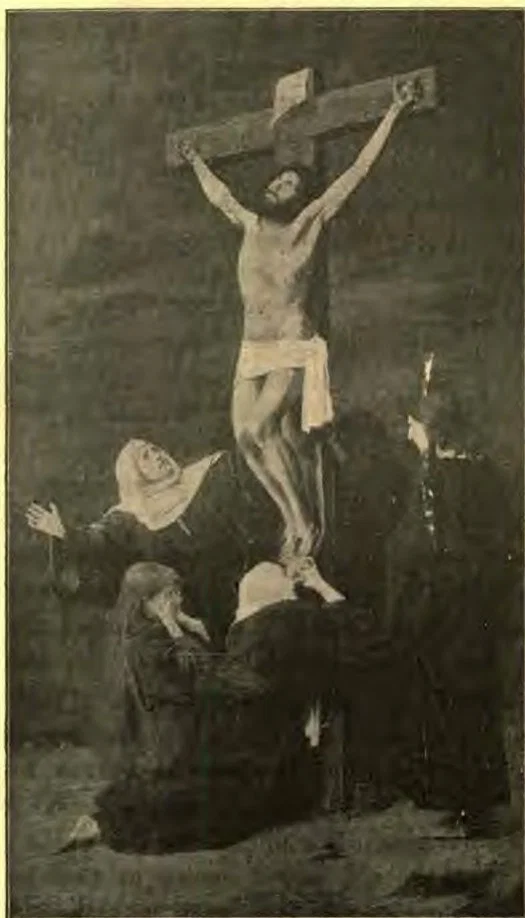
Who through Faith
Subdued kingdoms,
Wrought righteousness,
Obtained promises,
Stopped the mouths of lions,
Quenched the power of fire,
Escaped the edge of the sword,
From weakness were made strong,
Waxed mighty in war,
Turned to flight armies of aliens.
Others had trial of mockings and scourgings,
Yea, moreover, of bonds and imprisonment:
They were stoned,
They were sawn asunder,
They were tempted,
They were slain with the sword:
They went about in sheepskins, in goatskins,
Being destitute, afflicted, ill-treated,
Of whom the world was not worthy.
And These All,
Having had witness borne to them
Through their Faith,
Received not the promise,
God having provided
Some better thing concerning us,
That apart from us
They should not be made perfect.
3086.— Change of the Sabbath
Is it true that the Sabbath was changed by the pope? O.
It is not the teaching of Seventh-day Adventists that the pope changed the Sabbath, only in the sense that the pope stands at the head of that system of apostasy through which the Sabbath became changed. The change was not wrought in a moment of time. It was gradual. Even from the times of the apostles, apostasy had begun in the Christian church. In the fourth chapter of Galatians Paul tells the Galatian brethren that he was afraid of them because they were observing days and months and times and years. That these were not Jewish days is evident from the fact that he tells them they had gone back to the worship of those that were no gods; and among the days of heathenism was the wild solar holiday of all pagan times. The Sabbath has been kept all the way through the Christian dispensation by a few at least in different parts of Christendom. Sunday was never kept as a holy day until we reach centuries and centuries this side of Christ. It was never called Sabbath till the year 1000. For our readers who desire to know just the truth of the change of the Sabbath, not from some bald statement of irresponsible men, but from the very facts of history itself, we note the following works:
Bible Students' Library, No. 134, "The Lord's Day the Test of the Ages," giving a condensed and faithful history of the Sabbath and Sunday from creation down to the present time in the light of the patriarchal, Levitical, and Christian dispensations, showing also the change of the Sabbath. Price 10 cents.
Bible Students' Library, No. 187, "Who Changed the Sabbath?" giving not only Roman Catholic authority, but Protestant authority, as does "The Lord's Day," for the facts in the matter. Price 1 cent.
Apples of Gold Library, No. 45, "Historical Facts and Incidents Regarding the Sabbath and Sunday" from the earliest history onward. Price 2 cents. Every phase of the Sabbath question is covered in various publications for sale by the Pacific Press, Mountain View, Cal.
3087.— Proselyting
By X.
Sometimes earnest Christian Sabbathkeepers are accused of proselyting. Is proselyting wrong? X.
The Standard Dictionary defines “proselyte: to win over to a different opinion, belief, sect, or party; proselytize; especially to convert from one religion to another.” It defines the noun “proselyte: one brought over to any opinion, belief, sect, or party; especially one who has been won over from one religious belief to another; specifically in Jewish history, a convert to Judaism, as ‘Jews and proselytes.’”
This last expression is taken from Acts 2:10. “Proselytes,” then, means those who were won from the pagan religion.
Now as to whether the term is a reproach or not depends upon those who proselyte. If by proselyting is meant simply winning a churchmember from one church to another, merely a change of a church home, without any change whatsoever in the individual, that is one thing. In such a case as that, one church has lost a member and another church has gained a member; and presumably one church has lost so much of its income, while another has gained some in the same way. This is not a right thing to do. We do not see how any one church of the church federation could proselytize among the members of another church belonging to that federation. But if by the term is meant the preaching of advanced light and truth, based on God’s Word, that is another thing. The term then is indeed honorable.
There is not a single Christian church in existence to-day but what in its beginning, at least, when its zeal for God was warm and true, and its love for God’s truth burning and shining, put forth every effort in its power to win souls to the same zeal and love for God. Consequently the Jewish church, when it stood where it ought to stand, was doing all that it could to win the heathen; and the early Christian church did all in its power to win the Jews to the new light—faith in a risen Christ. The Christian church did all in its power to win the heathen, and doubtless the heathen called them by the most contemptuous terms equivalent to “proselyters.”
When the Reformation churches started under Martin Luther, Zwingli, and others, they also did the same. They felt that there was real light and truth in God’s Word concerning justification by faith and other vital matters; and therefore they did all in their power to win Roman Catholics; and the true, living Protestant is doing just the same to-day. But God has yet more light in His Word, as John Robinson, one of the leaders of the Puritans, declared. The Lord Himself declares that “the path of the just is as the shining light, that
shineth more and more unto the perfect day.” He tells us also that in the last days “knowledge shall be increased;” and right in that very connection He declares that those that turn many to righteousness shall shine as the stars forever and ever.
Of His Gospel in its last phase, He declares that the Gospel of the kingdom, showing that His kingdom is near, will be preached in all the world for a witness unto all nations; and in a great threefold message in Revelation 14 He has given us more in detail what the preaching of that Gospel means. It is not only the great positive truths of the Gospel which must be preached; but men must be brought back to a fear of God, to a reverence of God’s law, to a turning away from the great Babylonian confusion that exists in the world, to the rejection of the beast- and image-worship, and to the acceptance of “the commandments of God and the faith of Jesus,” in order that the church may be ready for the second coming of Christ. The man or the woman that receives those truths in his soul must teach them to others; and he does not do that in order that he may gain a member of a church, or of a different body of Christians. That is not his object; that is not the true object of any reformation,—merely to gain a churchmember, to count numbers. His object, the object of every true Christian, ought to be to save souls, and to bring to souls who are saved more of the light and blessing of God’s truth.
Now, if that is proselyting, there is not one Christian but what ought to be willing to be called a proselyter. It is what Episcopalians had to meet when they broke away from the Roman Catholic Church; it is what Methodists had to meet when they broke away from the Episcopal Church; it is what Congregationalists, and Presbyterians, and Baptists have had to meet. The terms of reproach should never move God’s people in any way only to more diligence in the service of the Master. Teach His truth, live His truth, win other souls to His truth, which has the power to save.
Please Be Definite
By Editor
Please Be Definite.—For instance, a question comes to us asking us to be so kind as to explain the meaning of the latter part of “the 28th verse of Hebrews.” But the question is not definite enough so that we may know what chapter is referred to. There are five chapters in Hebrews which have 28 verses or more: chapter 7, chapter 9, chapter 10, chapter 11, chapter 12. If our correspondent will tell us what chapter is referred to we will be glad to answer the question if we can.
In a book of lectures by Dr. French E. Oliver there is this statement: “It is impossible for me to understand how any person who knows anything about the Greek language should translate ‘sabbaton’ first day of the week. It in no wise indicates first day of the week. . . . The proper rendering of Matt. 28:1, as the Greek word for the Sabbath is plural and not singular, would read substantially as follows: ‘In the end of the Sabbath, fulfilling the prophecy of Hosea 2:11, as it began to dawn toward the first day of the sabbaths, came Mary Magdalena and the other Mary to see the sepulcher.’” Is this correct?
INQUIRER.
The gentleman has taken upon himself a tremendous task in placing his little stock of Greek knowledge against all the scholarship of the world, practically. It ought to be sufficient answer to every reasonable mind to simply take the standard versions of the Bible. The translations of these versions were made by men who observed the first day of the week,—men who would have been only too glad to find something more definite to prove the sacredness of the first day than anything which they possess; but men who, the observers of the first day of the week, felt that in their scholarship they must be true to the very best that they had, and consequently they have rendered as they have, practically uniformly. The Douay Version, or Roman Catholic translation, the Common, or so-called King James Version, the English Revised Version, the American Standard Revised Version, all are agreed; and the names of preeminent scholars connected with these assure us that the translation is correct. Then, too, we have Hinds’s interlinear Greek translation word for word, which renders the same; the Syriac Testament (Murdock’s translation), the same. Rotherham’s emphatic translation renders, “And late in the week when it was on the point of dawning into the first of the week,” the term “sabbath” there being used for the week, a use which it had in those times, as shown by Luke 18:12, where the old Pharisee in the pride of his heart boasted that he fasted twice in the week. The word there is “sabbaton.” It would be nonsense for a man to boast of fasting twice in the Sabbath. He had his weekly fasts, and of this he boasted.
For further information upon this, showing the correct translation from the very best authorities, and the utter baselessness of the statement made by the gentleman above quoted, see Bible Students’ Library, No. 154, entitled “The Sabbath in the Greek.” By mail one cent.
3088.— The Beast and the Pope
It is stated in a book before me that Seventh-day Adventists teach that the pope is the beast. Is this true?
INQUIRER.
Emphatically it is not. Seventh-day Adventists do not teach that any one man is the beast. The correct and true teaching is that the beast is that system of church and state power which has existed from Babylon down to the present time. The beast stands for a monstrosity in both church and state, a union of the two. God never made them for each other, nor were they ever designed to unite. From that horrible union comes as wretched monstrosities as Milton represents coming from the union of Satan and Sin. Sometimes this beast has existed in very mild form under various dynasties. One of the strongest, most aggressive, and worst of these forms under which that union has been a curse to the world, has been with the Papacy. The popes or the men that compose the Catholic Church are not different from other men; they are just the same as other men, with all the ambitions and failings of other men. But men led by wrong principles will always produce evil; and sometimes the more conscientious the men following the wrong principle, the worse the evil produced, and so it was all through the Dark Ages. The Roman Catholic Church is not the beast. That is an ecclesiastical organization, with just the same rights to exist as any other ecclesiastical organization. The church connected with the state forms the beast. Protestantism connected with the state power be-comes in that very sense a part of the beast regime. Upon this we shall have more to say in our study of the Revelation. The beast of Revelation 13 in its papal phase lies at the present time under a deadly wound, but ecclesiastically the Church of Rome was never stronger than at the present time; yet it will not be the papal Roman beast until that church is again given power by the civil author-ities.
Eternal Victory
By W. W. Prescott
By W. W. Prescott
Monkney VICTORY THROUGH DEATH
VICTORY! Victory in the face of apparent defeat! Victory over the kingdom of this world and the god of this world! Victory over every opposing power and all opposing powers combined, just at the time when the wisdom of this world would prophesy certain defeat. Victory such as no world-power has gained during the long-continued struggle for supremacy and permanent possession of the earth! Victory through the power of righteousness revealed in humanity, "even the righteousness of God which is by faith of Jesus Christ unto all and upon all them that believe;" that supreme gift of God to men which makes them "partakers of the divine nature" and "joint-heirs with Christ" to His throne of universal dominion! Victory which finds its best expression in the words of that immortal song: "Who is like unto Thee, O Lord, among the gods? who is like Thee, glorious in holiness, fearful in praises, doing wonders? . . . Thou in Thy mercy hast led forth the people which Thou hast redeemed; Thou hast guided them in Thy strength unto Thy holy habitation. . . . Thou shalt bring them in, and plant them in the mountain of Thine inheritance, in the place, O Lord, which Thou hast made for Thee to dwell in, in the sanctuary, O Lord, which Thy hands have established. The Lord shall reign forever and ever." This is the Gospel outlook when the eye of faith is at the telescope.
A Definite Purpose
The Gospel is not abstract, but concrete. It is not a verbal statement of truth which demands an intellectual assent merely; but a revelation of truth in life, an experience of divine power which can only be known and appropriated by personal faith. The Gospel of Christ "is the power of God unto salvation to every one that believeth; . . . for therein is the righteousness of God revealed from faith to faith." And this is based upon the fundamental truth that "the just shall live by faith." The righteousness of God revealed, not in a definition, but in a person, to be appropriated as the life of the believer, fellowship with "that eternal life, which was with the Father, and was manifested,"—this is the Gospel of Christ.
The eternal life was manifested in the flesh for a very definite purpose. "Forasmuch then as the children are partakers of flesh and blood, He also Himself likewise took part of the same; that through death He might destroy him that had the power of death, that is, the devil; and deliver them who through fear of death were all their lifetime subject to bondage." "He was manifested to take away our sins." "He hath made Him to be sin for us, who knew no sin; that we might be made the righteousness of God in Him;" "to bring in everlasting righteousness;" to "restore again the kingdom of Israel." Thus the "mystery of godliness," He who "was manifested in the flesh," was revealed, and the union of the divine life with sinful flesh was accomplished, not simply in order to provide an all-sufficient sacrifice for sin, but to bring into humanity that power of righteousness which in it could defeat the devil, deliver from fear of death by saving from the dominion of sin, restore the image of God in the soul, and so restore the kingdom to the Israel of God. This great truth is the source and the substance of all real Gospel teaching, under whatsoever form it may be presented.
It is therefore clear that present deliverance from the power and dominion of sin through the "abundance of grace and the gift of righteousness" is the experience which is the pledge of the fulfilment of all promises for the future. Thus the sharing with the King in His kingly character involves all the outward results which flow from such a life, as revealed in Him. This is the key to the understanding of all those promises which set forth the final and glorious triumphs of the Gospel. They are not the arbitrary gifts of a capricious monarch, which will be bestowed upon certain favorites, but the simple outworking of the eternal principles of the divine character as shown by the results when "that eternal life" was manifested in the flesh of Jesus of Nazareth.
Triumphing in Righteousness
The kingdoms of earth, existing in the providence of God, as revealed in Babylon, Medo-Persia, Grecia, Rome, and others, failing to recognize God as their all, and themselves as the servants of God, have utterly failed to establish either righteousness or continuance.
And yet, after all this repeated failure of earth's mightiest powers, a most glorious triumph is predicted in the declaration that "the saints of the Most High shall take the kingdom, and possess the kingdom forever, even forever and ever." What the rulers of Babylon, Medo-Persia, Grecia, and Rome, with all the power of armies and navies at their bidding, could not do, is accomplished through the power of a righteous character in the weakest child of God. "God hath chosen . . . the weak things of the world to confound the things which are mighty." "Fear not, little flock; for it is your Father's good pleasure to give you the kingdom." But the assurance of all this is found in the present cleansing from sin. "Unto Him that loved us, and washed us from our sins in His own blood, and [in so doing] hath made us kings." And of those it is said, "And they shall reign forever and ever."
Triumphing in Humility
All that is included, however, in the Gospel outlook, is not fully apprehended unless there is a clear understanding of all that was accomplished in the flesh of Jesus of Nazareth by the manifestation of that eternal life in Him. His experience is set forth as the experience of every one who is brought into life-union with Him through being born again. "Have this mind in you, which was also in Christ Jesus; who, being in the form of God, counted it not a prize to be on an equality with God, but emptied Himself, taking the form of a servant, being made in the likeness of men; and being found in fashion as a man, He humbled Himself, becoming obedient even unto death, yea, the death of the cross." And this was done with no greater inducement in view than that He might win back man for the earth and the earth for man, and that thus the original dominion might be restored. But the character which was revealed by the Son of God4in thus becoming the Son of Man for man's sake, brought to Him, as the Son of Man, and to all who are in Him, all that He gave up as the Son of God when He emptied Himself. "Wherefore also God highly exalted Him, and gave unto Him the name which is above every name; that in the name of Jesus every knee should bow, of things in heaven and things on earth and things under the earth, and that every tongue should confess that Jesus Christ is Lord, to the glory of God the Father."
Reigning with Christ
Thus the man Christ Jesus was exalted to the throne of the universe, "far above all principality, and power, and might, and dominion." And all this He shares with the humblest believer who really shares with Him in His character. Through the grace which is in Christ Jesus, man is so filled with the fulness of God through the wonderful provision of the Gospel, that he is thereby restored, not simply to the dominion which was forfeited through the loss of his kingly character, but to a seat upon the throne of the universe by the side of the King eternal, immortal, invisible. New heavens, new earth, New Jerusalem, new creatures in Christ Jesus! "Behold, I make all things new." "He that overcometh shall inherit all things; and I will be his God, and he shall be My son." "Behold, what manner of love the Father hath bestowed upon us, that we should be called the sons of God. . . . We know that, when He shall appear, we shall be like Him." O glorious outlook of a glorious Gospel! "Thanks be to God, which giveth us the victory through our Lord Jesus Christ." "Alleluia, for the Lord God omnipotent reigneth."
Christ and the Law
By Mrs. E. G. White
By Mrs. E. G. White
AT a very early age Jesus began to act for Himself in the formation of His character, and not even respect and love for His parents could turn Him from obedience to God's Word. "It is written" was His reason for every act that varied from the family customs.
But the influence of the rabbis made His life a bitter one. Even in His youth He had to learn the hard lesson of silence and patient endurance. His brothers, as the sons of Joseph were called, sided with the rabbis. They insisted that the traditions of the Jewish priests must be heeded, as if they were the requirements of God; and they were greatly annoyed at the clear penetration of Jesus in distinguishing between the false and the true. His strict obedience to the law of God they condemned as stubbornness.
They were surprised at the knowledge and wisdom He showed in answering the rabbis. They knew that He had not received instruction from the wise men, yet they could not but see that He was an instructor to them. They recognized that His education was of a higher type than their own. But they did not discern that He had access to the tree of life, a source of knowledge of which they were ignorant.
All through His ministry to this earth, Christ was a living representative of the law. No violation of its holy precepts was found in His life. Looking upon a nation of witnesses who were seeking occasion to condemn Him, He could say unchallenged, "Which of you convicteth Me of sin?"
In His sermon on the mount, Jesus did not dwell on the specifications of the law, but He did not leave His hearers to conclude that He had come to set aside its requirements. He knew that spies stood ready to seize upon every word that might be wrested to serve their purpose. He knew the prejudice that existed in the minds of many of His hearers, and He said nothing to unsettle their faith in the religion and institutions that had been committed to them through Moses. Christ Himself had given both the moral and the ceremonial law. He did not come to destroy confidence in His own instruction. It was because of His great reverence for the law and the prophets, that He sought to break through the wall of traditional requirements which hemmed in the Jews. While He set aside their false interpretations of the law, He carefully guarded His disciples against yielding up the vital truths committed to the Hebrews.
The Pharisees prided themselves on their obedience to the law; yet they knew so little of its principles through every-day practise, that to them the Saviour's words sounded like heresy. As He swept away the rubbish under which the truth had been buried, they thought He was sweeping away the truth itself. They whispered to one another that He was making light of the law. He read their thoughts, and answered them, "Think not that I am come to destroy the law, or the prophets: I am not come to destroy, but to fulfil." Here Jesus refutes the charge of the Pharisees. His mission to the world is to vindicate the sacred claims of that law which they charge Him with breaking. If the law of God could have been changed or abrogated, then Christ need not have suffered the consequences of our transgression. He came to explain the relation of the law to man, and to illustrate its precepts by His own life of obedience.
God has given us His holy precepts, because He loves mankind. To shield us from the results of transgression, He reveals the principles of righteousness. The law is an expression of the thought of God; when received in Christ, it becomes our thought. It lifts us above the power of natural desires and tendencies, above temptations that lead to sin. God desires us to be happy, and He gave us the precepts of the law that in obeying them we might have joy. When at Jesus' birth the angels sang,
"Glory to God in the highest,
And on earth peace, good-will toward men"
they were declaring the principles of the law which He had come to magnify and make honorable.
When the law was proclaimed from Sinai, God made known to men the holiness of His character, that by contrast they might see the sinfulness of their own. The law was given to convict them of sin, and reveal their need of a Saviour. It would do this as its principles were applied to the heart by the Holy Spirit. This work it is still to do. In the life of Christ the principles of the law are made plain; and as the Holy Spirit of God touches the heart, as the light of Christ reveals to men their need of His cleansing blood and His justifying righteousness, the law is still an agent in bringing us to Christ, that we may be justified by faith.
"Till heaven and earth pass," said Jesus, "one jot or one tittle shall in no wise pass from the law, till all be fulfilled." The sun shining in the heavens, the solid earth upon which you dwell, are God's witnesses that His law is changeless and eternal. Tho they may pass away, the divine precepts shall endure. "It is easier for heaven and earth to pass, than one tittle of the law to fail." The system of types that pointed to Jesus as the Lamb of God, was to be abolished at His death; but the precepts of the Decalogue are as immutable as the throne of God.
Since "the law of the Lord is perfect," every variation from it must be evil. Those who disobey the commandments of God, and teach others to do so, are condemned by Christ. The Saviour's life of obedience maintained the claims of the law, and showed the excellence of character that obedience would develop. All who obey as He did, are likewise declaring that the law is "holy, and just, and good."
Jesus takes up the commandments separately, and explains the depth and breadth of their requirement. Instead of removing one jot of their force, He shows how far-reaching their principles are, and exposes the fatal mistake of the Jews in their outward show of obedience. He declares that by the evil thought or the lustful look the law of God is transgressed. One who becomes a party to the least injustice, is breaking the law, and degrading his own moral nature. Murder first exists in the mind. He who gives hatred a place in his heart, is setting his feet in the path of the murderer; and his offerings are abhorrent to God.
The plan of redemption contemplates our complete recovery from the power of Satan. The command, "Be ye therefore perfect, even as your Father which is in heaven is perfect," is a promise. God's ideal for His children is higher than the highest human thought can reach.
The Test of Affliction
EVERY man will have his own criterion in forming his judgment of others. I depend very much on the effect of affliction. I consider how a man comes out of the furnace; gold will lie for a month in the furnace without losing a grain.—Richard Cecil.