ONE of Thoreau's quaint sayings was: “A man is rich in proportion to the number of things he can afford to let alone.” On this basis there surely never were such opportunities for wealth as at the present time, when we are surrounded by beautiful, attractive, and tempting objects which are freely bought and used by our neighbors and acquaintances. To be able to resist temptations to buy the things which we are just as well off without, and to indulge in amusements and recreations which are not for our physical or moral well-being, to be able to limit ourselves in regard to mere creditable indulgences—these are evidences of a strong character. One of the first and most important lessons which the mother of to-day must teach her child, is to let things alone. When the baby has learned to admire the pretty flowers without picking them, to see candy, fruit, or other things which he knows “taste good” without putting them in his mouth; when the child has learned not to do things simply because “the other boys and girls” do them—then he can be trusted to go out into the world alone, for he can resist temptation. When such a boy grows to manhood, his wants will be so few, his desires will be so well under control, that he will be indeed what Thoreau would call “a very rich man.”—The Congregationalist.
Windmills as Wealth Producers
Within the last few years the farmers of the prairie States have learned to utilize the energy going to waste in the wind for pumping water for irrigation. In several States the southwest wind blows almost constantly in the summer, and the blasts of heat often seriously damage the growing crops. But from an injury these winds have now been turned into a blessing, since they have been harnessed to pumps, and made to lift the water that is in vast areas at only a short distance below the surface.
Many of these wind engines are home-made, and of very curious construction; but the advantage from their use is so great that increasing numbers of well-made windmills are being set up. The windmill is almost as common in some portions of the Central West as in Holland.
A new use of this wind power is now being made. Farming is a science in the great corn and wheat country, and electricity is found of great advantage in plowing, and particularly in harvesting; this has usually been produced by steam, and then transmitted to the field where it is to be used. Only on the Pacific Coast is water power available for commercial use. In the Middle West water is scarce in summer; but wind is not. So the farmers are placing dynamos at the bases of their windmill towers, and using electric motors to run their thrashing-machines. Through the hot months the mills keep pumps going to save their crops, and in the fall they run dynamos to harvest the same.
This development of wind power works to the advantage of the small farmer. The owner of thousands of acres finds it pays him to have an expensive steam-power plant to furnish him with electricity. This the owner of a few acres could not afford to do; but he has found that a few cheap windmills, each running a two- or three-horsepower dynamo, puts him on an equality in this respect with his richer neighbor.—The Boston Globe.
In Egypt and Syria
By L. R. Conradi
L. R. CONRADI
As the route to German East Africa passes Suez, we decided to so arrange our journey that I could spend a few weeks with our workers in Egypt and Syria, and then meet the missionaries for German East Africa at Port Said. Accordingly, Brother Dail and I left Hamburg, February 16.
We reached Alexandria on the morning of the twenty-second. Elder Wakeham, and one of the Armenian brethren living there met us. We had an interesting meeting that night, and next morning took the train for Cairo. Elder Wakeham seems in good health, and since we have closed out the hygienic restaurant, he has his whole time for the gospel work. Mrs. Wakeham is in Keneh, Upper Egypt, with her children, and they are getting hold of the Arabic quite rapidly, as they live among the people and are doing some educational work for them. Dr. Keichline has opened a small office in Cairo, where he is fast winning friends among the Mohammedans, especially among the student classes, for whom he feels a special burden.
Quite recently some converts have been baptized in Egypt, and others are about ready to take the step. The prospects for our work are brightening in this dark land.
The twenty-fourth, Brethren Wakeham Dail, and I went to Port Said, en route to Jaffa. Brother Hoerner, accompanied by others of our friends, met us at the boat there. It was remarkable that ours was the first steamer from the South that had landed in Jaffa for about six weeks, and more than that, the day before, the sea had been so stormy that boats arriving from the north were not able to land. Jaffa is one of the most unhandy and dangerous seaports with which we are acquainted.
GERMAN TEMPLE COLONY, MT. CARMEL
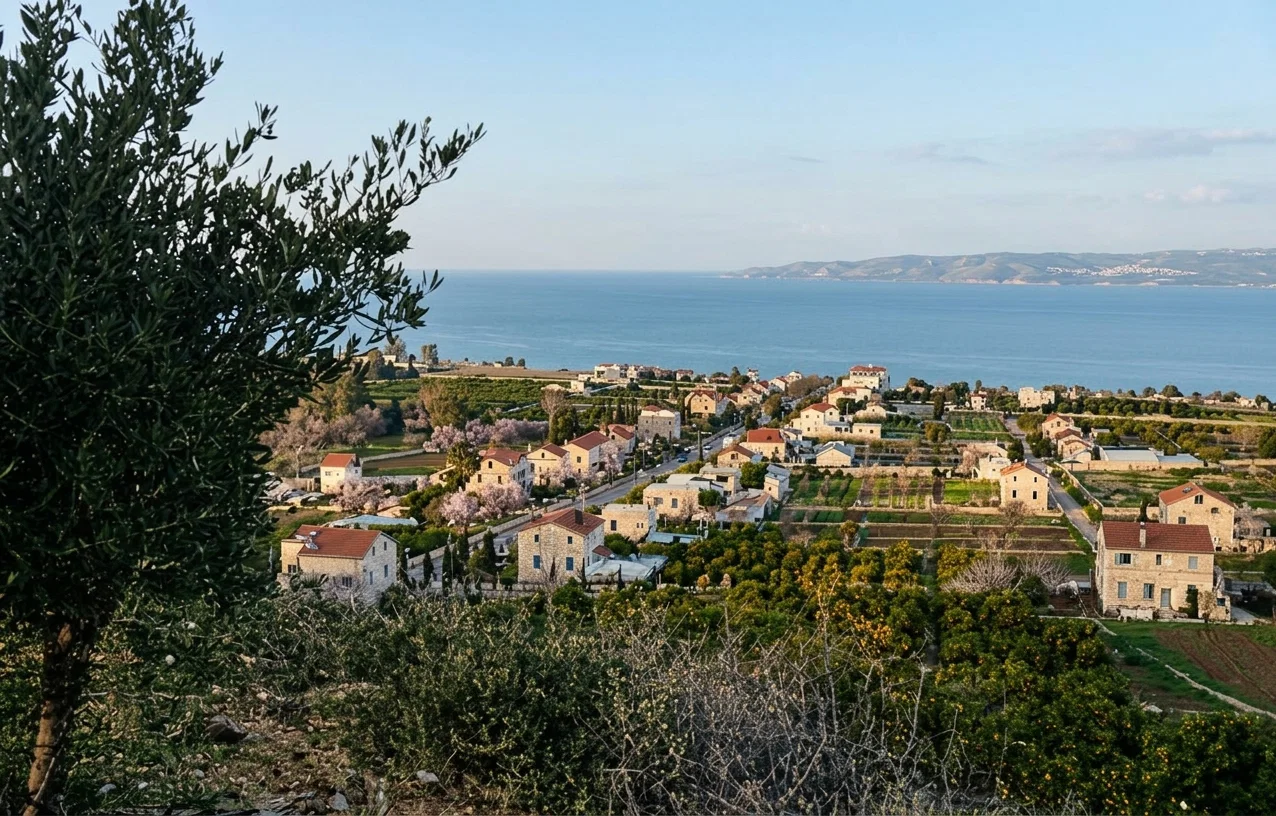
Friday we took a drive into the country to visit several institutions, and to get facts helpful to us in our work. Pleasing, indeed, was it to us who had so lately been among the snowy hills of the North, to see the immense orange groves, laden with their burden of fruit, or the almond-trees, in full bloom. We went to Ramleh, and from there visited a farm secured by the German Orphanage in Jerusalem, and then we visited Rishon, one of the leading Jewish colonies in the land of the Philistines. I was surprised while traveling through the length and breadth of Palestine to find at least thirty of these thriving colonies. The Jews have purchased large tracts of land here; a good deal of this is devoted to grape culture, and at Rishon, there is probably one of the largest wine cellars in the world.
Upon returning to Jaffa, we found that Brother and Sister Jespersson, of Jerusalem, as well as Brother and Sister Krum, and Brother Zarub, of Beirut, had arrived.
Sabbath evening we had meeting in the German Temple Colony, near Jaffa.
During the last thirty years several thousand Germans, mostly from Wurtemberg, have founded many flourishing colonies in Palestine. Their idea was to build up spiritually a temple body, by having a number of people settle here. In fact, this movement was to some extent an outgrowth of the 1844 movement—another offshoot; but as the colonists have become prosperous in worldly things, not a few have lost their old fervor. However, when I spoke of our message in their hearing, and of the providence of God in the first angel's message, one gentleman, sitting near by, responded by hearty “amens,” and in greeting me, he shook hands very cordially, and said: “Yes, that was our bright hope, and I am still glad to hear about it.”
Sabbath was a beautiful day. Seventeen of us were assembled. This is the largest number of our people that were ever together in the Holy Land. In the afternoon it was my privilege to baptize three converts under the billows of the Great Sea. They have come to a knowledge of the message through the work of our mission in Jaffa, and will all go to Friedensau to further prepare themselves for usefulness in the Syrian Mission.
Returning to the home of Brother Hoerner, we celebrated the ordinances of the Lord's house; this was a solemn occasion.
Sunday forenoon we fully organized the Jerusalem-Jaffa Seventh-day Adventist church, ordaining Brother Jespersson as elder, and Brother Hoerner, as deacon. We hope the day may soon come when we shall have a church13in each of these places, but we are thankful that at least so much has already been accomplished in this field. We are glad to report that the two medical missions in Jaffa and Jerusalem have been favored of God financially, and are paying their rent and other expenses, besides bearing half of the wages of the leading workers employed in them. And, best of all, a few have been brought to a saving knowledge of the truth through the influence of our laborers here.
As there were some questions with reference to the future of these institutions, as to whether they should remain in their present locations, or be removed to some other place, as Haifa, or Beirut, or to another part of Palestine, we determined to take a trip through the country, visiting a number of places together, and at the same time hold as many council meetings as the circumstances might admit. We mapped out our course, intending to go to Haifa at the foot of Carmel, visit Nazareth, the Sea of Galilee, and from Tiberias return via Samaria to Jerusalem. We hoped to get through in six days.
As we had beautiful weather, we were able to crowd ourselves together in one wagon, drawn by three horses, and Sunday afternoon at five o'clock we set out from Jaffa, going north through the Plain of Sharon. As spring had already begun (it was the twenty-eighth of February), the plain was covered with a rich carpet of flowers. Many trees were in bloom; the fig-tree was just shooting forth its fruit and leaves. We drove the entire night, stopping only to water and feed the horses. Our route lay a little to the east of the site of ancient Cæsarea, mentioned in Acts 21:8. At present there are only a few of the ruins left, and these are fast disappearing, as they are used for building stone, and for limestone. We also passed through quite a large Jewish colony called Zammarin. From here we turned to the sea, near the town of Tantura; this is the ancient Dor, whose inhabitants the Jews did not drive out when they took possession of the land. See Judges 1:27. At Athlit we saw large ruins of the old castle of the pilgrims, in use during the crusades. It is the last fortress which fell into the hands of the Mohammedans in 1291 A. D. About half-past five in the evening, we came up to Carmel. We rounded the promontory, and passed the thriving German colony just as we entered Haifa. In the city we met the German consul, who is very favorable to our work. He asked that we climb Carmel by moonlight, and spend the night in the health home he had erected there. Carmel is quite a range of mountains, something like twenty miles long. It is here about one thousand feet high, but its highest point lies some eighteen miles inland, where the ‘top of Carmel,’ is one thousand eight hundred feet high. Here it is that Elijah had his wonderful experience with the prophets of Baal. The butt of Carmel is beautifully covered with green, and its sides and top contain a number of vineyards and olive-trees. Isa. 35:2. There are many natural caves on this mount of God. One has a wonderful view from this mountain chain. Next morning at breakfast, the German consul was present, and he read to us the experiences he had in planting the institutions on the summit of that hill, showing how the providence of God had gone before them.
In 1870, the first houses of that German colony had been built, and even then the founder thought that some day they must have a kind of health home on the top of the hill. One great difficulty then stood in their way—the French monks held the lower part of the mountain, and had established quite a convent there. They sought in every way to make it appear that the Germans were trying to get possession of this place only that they might later on conquer the whole country. When, in 1880, they tried to get possession of some property, these monks, learning of it, built a wall across the Roman road which led up to Carmel. In 1881 some Germans were gathering wood, and a monk, with eight of his servants, thinking they were laying out a road by which they might get up to Carmel, beat them terribly, so that one of the men suffered two months from its effects. The Turks and the Germans finally united to contest with the monks their right to barricade this public road; and, according to the customs of the country, the two parties, Jan. 29, 1885, ascended the mountain to demolish a part of the wall. This brought about quite an agitation among the people. The German and French governments had to interpose, and a long court trial was the consequence. In April, 1885, the expenses of this trial had already reached three hundred and fifty dollars. Not knowing what would be the outcome, Consul Keller, for so is he called, was one day meditating upon the matter when there passed by him a bier carried by four mules, and followed by three mule drivers and a European lady. “Then it seemed that something said to me,” said the Consul, “that I should go to the hotel, for God had something for me. But I did not go until I was called there. I was informed that the lady who had just arrived, had lost her husband on the road between Nazareth and Haifa. I did all I could to help this distressed woman with the burial, and also tried to comfort her. All the German colonists sympathized with her in her great bereavement. The lady desired in some way to reward us for the kindness shown her; but I would accept nothing. However, I told my wife that if the lady should again say anything, I would surely relate to her our plans for the health institution we wished to build on Carmel. She did speak to me again, and then I told her of our project, and said it would cost us at least five thousand dollars. The lady answered, ‘All right; I will give you that amount.’ When she said it, I hardly dared to believe it. But she said, ‘You better write seven thousand dollars, because you will need it.’ The trial continued until 1887, and even Bismarck intervened in the matter.”
Finally the papal authorities in Rome asked the monks to make peace with the Germans. Oct. 18, 1887, the rights for which the Germans had been contending in court were awarded to them, but the trial alone had cost five thousand dollars. By the time the road to the summit of the hill had been finished, the rest of the money donated had been spent. All they could do was to put up a few wooden buildings. But in 1890, they decided to erect a stone building, as the lady promised them still more help. However, they found that even after the permanent building was begun, the Turkish government was opposed to the move, and sent up Turkish soldiers to destroy the work; yet, in spite of all these things, they finally succeeded in completing the structure. The present building cost twelve thousand dollars. There are olive groves and vineyards around the home, and there is also now a hotel in the same neighborhood.
Staying over night with us in the home, was a noted bank director, of Berlin. He is a prominent man in the State Department of Religion. He led in the morning worship. I had a good opportunity to speak with him about our work, and of the opening providence of God in German East Africa. He seemed very much interested.
(To be concluded)
Mission Notes
ONE new use has been found for the village cock-pits in the Philippines. A Bible Society colporteurs use them for lantern-slide exhibitions, which open a market for Bible sales.
“WE promise to keep the ten commandments and the eight beatitudes. We will daily pray in our homes also, beseeching the Lord to send us a teacher.” This is the form in which a band of heathen Chinese in the province of Szechuan, writing to a member of the China Inland Mission, offered guarantees in order to have the mission recognize them as inquirers. There is something attractive about a country where inquiries begin at this point.
THE receipts of the British and Foreign Bible Society for the year 1903-04 amounted to $1,156,179.20. Its expenses were not met by this sum. The deficit amounts to $83,581.96. During the same time the American Bible Society received $496,194.34 from all sources. Among the missionary societies the Presbyterian (North) received $1,131,510. Its expenditures exceed this amount, however, by about $40,000, and for the first time in six years it closes the year with a debt. The American Baptist Missionary Union received from all sources $735,585.02. The Presbyterian Church of Canada received $109,454, but its expenditures amounted to $135,057, making a deficit of $25,603. The Southern Baptist Convention received $247,629. The Society for the Propagation of the Gospel received $766,927.28.
Mexico
By George M. Brown
I am glad to be able to record some advancement in the work in this field since my last report. Besides printing twenty-five hundred copies of El Mensajero de la Verdad each month, we have gotten out two hundred and fifty each of the Sabbath-school lesson pamphlets for the three quarters of 1904, and a two thousand edition of each of the following tracts: The Sabbath in the New Testament, Is Man Immortal, and The Second Advent. Professor Caviness has had the oversight of this work, doing the translating and supervising the printers.
The new building for our printing-office and depository is all done except hanging the windows and doors and putting in the floor. Providence not preventing, we shall soon be able to move in, and will then be able to do our work to much better advantage than now.
The greater part of June I spent in making a trip with Elder Leland through the central part of the Republic. We visited Chihuahua, a thriving town of about twenty-three hundred people, and the capital of the State of Chihuahua (chiwawa). We were there five days, and we sold some books and secured a few subscriptions to El Mensajero. The above picture represents a group of Tarahumara Indians who live in Chihuahua. We saw some of them while we were there, and were told that they are Catholics, and come to the city in large numbers to celebrate the fiestas at Christmas and New-year's. They wear no clothes except the serapes shown in the picture, and a loin cloth. These Indians are fair representatives of many thousands in Mexico, who, though nominally Catholic, are as truly pagan as they ever were. Still even to such as these the everlasting gospel must be carried.
From Chihuahua we went to Torreon where we remained a week. This is a new and rapidly growing railroad town, it being the junction point of the Mexican Central, Mexican International, and Coahuila & Pacific Railroads.
Here we were hospitably entertained by the pastor of an independent Mexican congregation of Protestants. This pastor is a young man of strong character who, with his congregation, separated from the American missionaries because they persisted in having church festivals and entertainments. He is self-supporting, and seems very favorable toward the truth. We enjoyed talking with him about the different points of our faith and left him an English “Thoughts on Daniel and the Revelation” to study. He understands English well. At this place we disposed of more books and tracts, and took some subscriptions to the paper.
The next stop was at Zacatecas, a quaint old mining town, begirt with hills, which has a population of about twenty-seven hundred people. There we spent a day with a Protestant minister who had written to Brother Leland, questioning him in regard to the doctrines held by us as a denomination. We took our Bibles and studied the different points of truth with him and his wife in the forenoon, and in the afternoon he called in one of his members and we continued the study.
His attention was first called to the Sabbath by reading a little book written by a Catholic against the Lutherans, in which the writer charged them and all Protestants with inconsistency in claiming to take the Bible as their sole guide, and persisting in the observance of Sunday for which there is no Bible authority. Thus we see illustrated again the old truth that God will use the efforts of the enemies of the truth to bring light to those who are seeking it. This brother seems to fully believe in the seventh-day sabbath, immersion, the second advent, and other truths. I believe that he will walk in the light as fast as he sees it, for he gave up a lucrative position in the army to be a minister.
TARAHUMARA INDIANS OF CHIHUAHUA
One of the principal objects of this trip was to look over the ground with a view to opening work in a new place. Doubtless Elder Leland will soon move his family from Guadalajara and begin work either in Aguascalientes or Torreon.
A recent letter from Dr. Erkenbeck says that the sanitarium is having a better patronage than is usual at this season of the year. The medical mission in Guadalajara which is now under the supervision of the sanitarium, is doing well with Dr. P. K. Gaston as physician in charge.
Brother John Harzman has been working in Mexico City and the State of Mexico with quite good success. In recanvassing the city of Toluca he secured renewals from about one fourth of the subscribers to El Mensajero, and took enough new subscriptions to more than make up for those which were not renewed.
Elder Bodwell took over one hundred subscriptions in Tampico and vicinity during the month of May, and is now following up the interest in San Luis Potosi.
Some of Brother Kelley's Bible readers who began keeping the Sabbath some time ago are now ready for baptism, and thus the seed which he has been sowing is bringing forth fruit. We rejoice in these evidences of progress in the work in this field, and are of good courage, believing that the sickle of truth will gather sheaves for the garner of the Lord even from the long-neglected Mexican field.
In closing, I wish to earnestly ask the prayers of the brethren and sisters in behalf of those who are studying the truth here in Mexico. Pray that God will give them courage and faith to step out fully and obey all his commands.
GEO. M. BROWN.
Gold Coast, West Africa
By J. M. Hyatt
CAPE COAST CASTLE.—I have delayed making a special effort at the hall for the better class, hoping that some regular minister would soon be here to help. However, I am now thinking of starting special lectures on Sunday nights, and making an effort to get this class to attend. Our papers have made a good impression on their minds, and I am sure we would see fruit if we could have a strong lecture course at this time. We have been here over a year now, and it is past time that we make a decided effort. Many, very many, are just hanging in the balance. When I talk to them, they say they know that it is so, and that they will be lost unless they change. I fear that many of these will lose the good impression, and become bitter; then we can do nothing for them. This whole village has been stirred with our doctrine, and now is the time15to reap the fruit. Two of the ministers even acknowledged to their people that the Roman Catholics changed the Sabbath.
I lost about ten months on the language, but have taken it up in earnest now. It is very easy to learn. I want to soon begin translating some Bible readings. I can work at it as I learn the language. They have prayer books, service and hymns, also the Bible in their own tongue. Reading is done mostly in the English but many read the native tongue.
We have had no desire to leave since we came. We only hope that we shall live long enough to see our work well established. J. M. HYATT.
California
By M. H. Brown
Since leaving the work of conference secretary last September, on account of failing health, I have held meetings with the churches at St. Helena, Sanitarium, Healdsburg, Santa Rosa, and Calistoga. I have also held two meetings with the old soldiers at the Veterans' Home at Yountville. I have been living in the country where I have had the privilege of a more active life in the open air. This has resulted in a great improvement of my health for which I am very thankful.
This improvement in health enables me to do more work in the cause, and I have accepted a call from the conference and the Healdsburg church to labor at Healdsburg, in behalf of the important interests which center there.
I rejoice in the blessings which the Lord has bestowed upon me, and in the prospect of the speedy triumph of this message. M. H. BROWN.
South Dakota Conference and Camp-Meeting
By N. M. Jorgensen
The twenty-fifth annual session of the South Dakota Conference of Seventh-day Adventists was held in connection with the camp-meeting at Canton, S. D., June 9-19, 1904.
First meeting was called June 9, at 3 P. M., with Elder Burman in the chair. Hymn No. 140, “O for that flame of living fire,” was sung. Scripture reading by Elder Hayes, after which Elder Underwood led the congregation in a solemn prayer that God might lead this entire conference to his glory.
The newly organized church at Aberdeen was admitted into the conference. A committee of nineteen was elected from the floor to appoint the standing committees.
In reporting the work for the past year, Elder Burman stated that in every place where meetings had been held, some had been won for the truth. He also mentioned the excellent health of all our workers.
The following are some of the resolutions that were adopted:—
“Inasmuch as we have been urged to assist in every way the progress of missionary effort in the South,—
“1. We recommend, That a systematic effort be made in behalf of the book, ‘Story of Joseph,’ and invite every member of our Sabbath-schools to sell one or more copies of that work.
“2. We recommend the use of the Family Bible Teacher in tent-meetings, Bible readings, and home missionary efforts.
“3. We recommend, That we urge our brethren throughout the State to do more missionary work than we have hitherto done, and that a special time, a month or more prior to the holidays, be set apart for a missionary campaign.
“4. We recommend, That one or more persons be selected in each church or company, to act as local agent for certain books set aside for their special use at a discount of forty per cent; and that this local canvassing work be under the general direction of the field secretary, but that each librarian arrange for the work in his own church.
“5. We recommend, That during the coming year a canvassers’ school be conducted for the benefit of all who desire to engage in this work, time and place to be arranged by the conference committee.
“In order that our industrial school may be finished and relieved from embarrassing financial conditions,—
“6. We recommend, That a sum of eight hundred dollars [afterward voted to be sixteen hundred dollars], be raised in cash and pledges.
“7. We recommend, That conference workers report monthly, and that our president be authorized to draw their salary warrants, on the basis of the former audit.
“Recognizing the fact that the church-school teachers are sacrificing much for the cause of God,—
“8. We recommend, That they be assisted to attend the summer institute, each to the extent of twelve dollars, and fare to the institute, and from there to the respective schools to be taught.
“In harmony with the instruction given us by the spirit of prophecy,—
“9. We recommend, That our people be urged to make diligent study of our health principles, and that our workers do all in their power to agitate the subject.
“10. Resolved, That we take steps immediately to raise a fund for establishing a health institution.
“11. Resolved, That we continue the effort to place the conference business on a cash basis.
“Realizing the need of some effort being made in behalf of the religious liberty work in our conference,—
“12. We recommend, That the constitution be so amended as to provide for a religious liberty secretary.”
A health and temperance secretary was chosen, also a German corresponding secretary. With the exception of a few changes on the conference committee, the officers were re-elected for the coming year.
Credentials were granted to the following-named persons: C. A. Burman, E. G. Hayes, N. M. Jorgensen, C. Reiswig, F. L. Perry, Daniel Isaac, and R. E. Harter. The last named was also ordained. Ministerial licenses were given to J. W. Beach, J. W. Christian, N. B. Baldwin, C. M. Clark, C. F. Betts, W. A. Baker, Bertha E. Jorgensen; and missionary credentials to L. D. Randall, Milla M. Johnson, Mattie E. Randall, Geo. W. Miller, Leona Burman, and Dolphy Hayes.
The Sabbath-school secretary reported thirty-three Sabbath-schools and nineteen home-schools; total membership, 880. The tithe for the last year was $9,915.33, or nearly eleven dollars per member. Tract society sales amounted to $3,509.45, and contributions at the camp-meeting to $1,469.18.
Elder Farnsworth gave us the closing admonition: “Move out into new fields; lengthen your cords, strengthen your stakes. Preach the third angel’s message in every place. Pay an honest tithe. Be faithful in all things, and success will follow.”
We left the camp full of courage in God to press the battle to the finish.
N. M. JORGENSEN, Secretary.
Montana Camp-Meeting
By Amos E. Everett
Our camp-meeting held at Townsend, Mont., is now in the past. All who attended this meeting were certainly repaid for coming. With the exception of one day the weather was almost perfect. There was a good attendance considering the distance many of our people were forced to come, and it was evident that those who did come were there for the purpose of getting a closer connection with Christ, and to impart to others the blessings received. How good it is to be so minded. Sometimes it means a real sacrifice for many of our people to attend the annual camp-meetings, but in the very sacrifice made the blessing is received, and hearts go away strengthened to press forward in the spiritual warfare.
Elder A. T. Jones was there the last half of the meeting, and none present will ever forget the stirring testimonies of faith and courage he gave in his instruction. His visit will be long remembered by his Montana friends, and there will be always a warm place in our hearts for Elder Jones.
The medical work was well represented by Dr. H. B. Farnsworth, of Missoula, Mont., who gave some excellent discourses on the value of right living. His addresses were practical, and such talk always reaches the hearts of the hearers, bearing positive influence in stirring to action. Surely the principles of health demand our earnest attention.
At this meeting there was not a large attendance from the outside, but some were interested who, we trust, may yet cast their lot with those who keep the commandments of God. On Sunday afternoon ten persons were baptized in the Missouri River, a large crowd witnessing the baptism. Our desire is that each one who went forward in this solemn rite may remain faithful to the blessed truth and message which makes this a peculiar people.
In our young people's meeting the last Sabbath we were there, it was impressed on us that our youth must be called to bear the great burden of this work, and that they must press forward in every phase of the work to which they may be called. Wonderful possibilities are open to those who stand firm as a rock to principle, taking the Bible as their guide. Courage, determination, grit, level-headed faith,—these are some of the essentials necessary to our own salvation as well as to success in any line of work. The man who never knows defeat, will never fail of success, no matter how hampered by adversity, bodily affliction, or imaginary evils, which latter, most often, cause discouragement and defeat to many who master bravely16the real difficulties of life. It is hard for young people to launch out by faith in a work that is all of faith, and to which they are wholly unaccustomed, but this is what must be done in order to begin, and the experiences gained day by day are the great factors in the real training preparatory to the heavenly school—the higher education.
Our young people must be encouraged, loved, and helped in the work for themselves as well as in their work for others. As one well says, “Man's sincerity should never be put too rudely to the test, it needs encouragement and indulgent welcome. He who rebuffs it by inhospitality is likely to frighten it from his house.” So the sincerity of our young people should be recognized. It should be given indulgent welcome, and every help, kindness, and sympathy should be extended to those who are secretly yearning to enlist in the Master's service, yet shrink from putting themselves forward. We can only say to you who are longing for such experience, Come along, come with us and we will share our experiences together; we will fight the battles in this spiritual warfare side by side, and together share in the glorious victory. If it is to canvass for our excellent literature, we can say the same thing. Those of long experience are to extend the hand of confidence and comradeship to the youth. It is not enough simply to say, Go, and the Lord bless you, but rather, Come, and share the blessing. Such it seems to me should be the spirit manifested to young people starting out in the highest vocation to which man has ever been called—that of leading souls to Christ.
After the close of the meeting the interest was followed up for several days by personal work, though with what success we have not learned.
Plans for the summer's work were laid by the conference committee, and aggressive efforts are to be made in new fields. Tent efforts are now being made at Missoula and Pony, Mont.
We trust to see our educational work firmly carried forward, that these great principles of truth which are so essential, may in no wise be allowed to fall in the rear. Our intermediate industrial school must find a permanent location, and our church-schools also must be maintained. A great work is before us here in Montana. All are of good courage. AMOS. E. EVERETT.
Virginia
By T. H. Painter; C. B. Rule
LOWRY.—We came to this place from Ephesus, June 29, and pitched our tent in a beautiful grove near the Norfolk & Western depot. A Catholic lady kindly gave us the free use of the grove.
Our congregations have been good from the beginning, some nights the tent will not hold the people. We praise our dear Heavenly Father for this. Some are becoming interested as they hear the message of God for this time; and we long to see a good company raised up here. We shall labor to that end. But it is hard for the people to forsake their churches, and give up the old ways of living. All but one of those at Ephesus who came out in the spring are still faithful. There are a few others there who, we think, may yet obey the truth, as they study our literature. We expect to remain here till camp-meeting. We hope to have baptism Sabbath or Sunday, July 16 or 17. We expect Elder Hottel here then.