In these busy days, when time and space and expense are economized as never before, one is hardly surprised any more at the marvelous inventions in the way of accomplishing this end that are constantly springing into public notice. True, we often hear the remark, “No expense has been spared” in doing this or that, and sums of money are expended nowadays that would have horrified our grandfathers, but in the line of business this is all done that there may be a saving in the end. Buildings are built higher, trains and steamships are made to run faster, guns and war vessels are made more powerful, and in every imaginable trade and profession improved mechanical devices are finding their way, all to save time and labor, and to save and make money. But this is not all. With these better appliances and increased facilities come demands from other directions for improvements likewise, and a very important subject, that hardly finds a place in the mechanical list, but which, nevertheless, is necessarily dealt with, is the subject of food. What improvements can be made here? Did you ever stop to consider what a wonderfully convenient thing the art of canning fruits and other edibles is? It is so common that we rarely if ever think what a cry would ascend from the whole world if the art should suddenly be lost. Almost everything that serves for food is canned or condensed, pressed or preserved, from fruits and grains to all manner of flesh meats, and in this form is carried to hundreds of places where the fruits would not grow, or where bulky articles or animals for food could not be taken. Very convenient, indeed, these forms of food are.
But there is a place where even these helpful methods are too cumbersome for all that is desired, and that is with an army, on the march, in battle, or maybe invading a foreign land. In such cases, and at such times, it is a great hindrance—and a source of no little exercise of generalship—to an army to guard the supply trains and watch the base of supplies. Oftentimes these very essential adjuncts are cut off by the enemy, or if the invaders depend upon foraging for food, they may find only empty fields and the smoldering ruins of granaries and storehouses. Clearly, first of all the food supply must be sure, and it is equally apparent that the more compact that supply can be made, the more the men can carry, and the easier it will be handled.
And it is right here that military departments of many governments have placed much thought, and have set scientists at work, and some surprising results have been seen from their efforts. These men, skilled in the knowledge of the chemical properties and the constituent elements of different food substances, have set to work to extract the nutritive portions, and combine and concentrate these into the smallest possible space or quantity, that would at the same time be equal in nourishment to a very large quantity in its usual form. With the food stuffs made after such methods, and compressed to the smallest form possible, the soldier will be his own supply train.
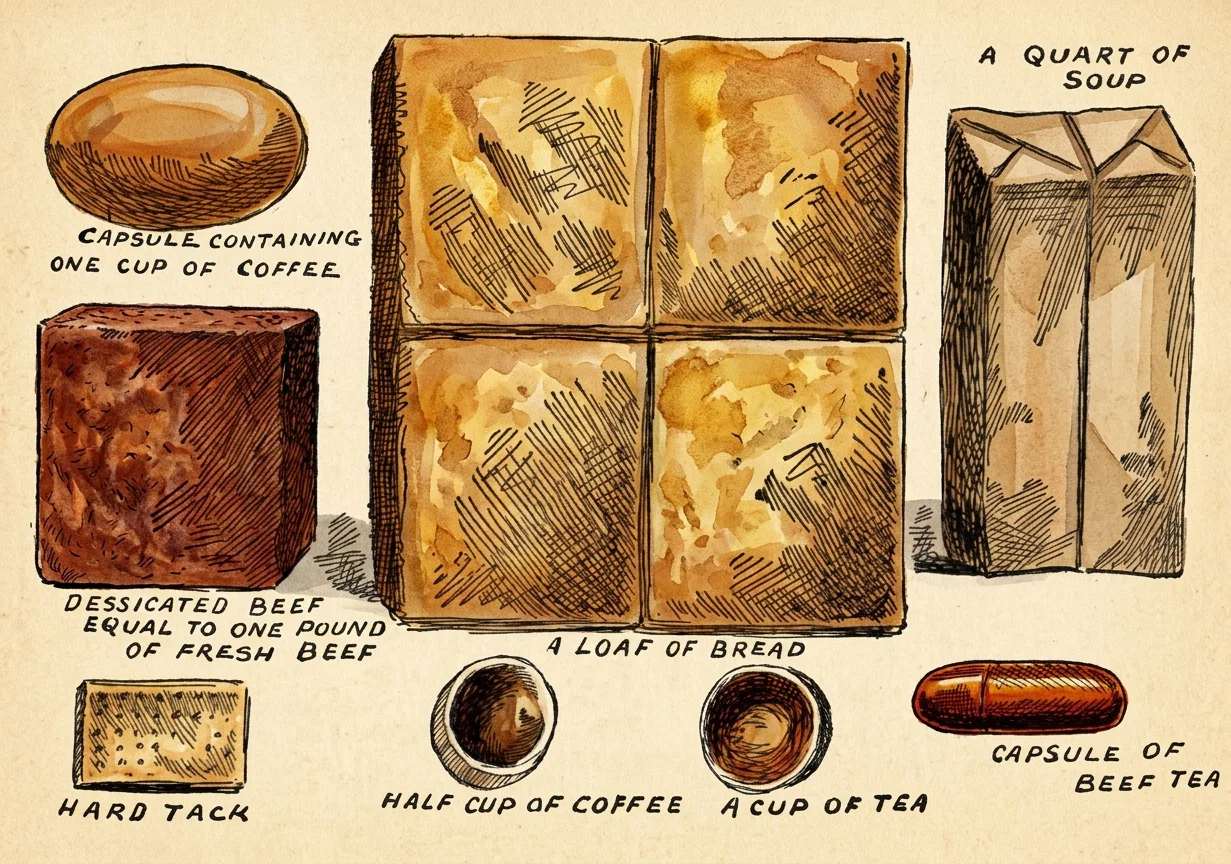
It is stated that actual tests of these new methods were made by the Japanese in their late war with China. Each soldier carried a provision belt, in which he placed the compressed food articles in the form of capsules, buttons, or small packages like cartridges, all ready to be dissolved, or easily prepared for eating when needed. There was beef condensed under enormous pressure into a small tablet, beef soup and vegetable soup in a capsule, a cup of coffee represented by a package no larger than a button, and so on. Think of the immense saving, from every point of view, possible by means of this discovery, for such it may well be called. Necessity, it is said, is the mother of invention, but it is to be observed that the so-called necessity which has brought forth these products of science, is war. A dire necessity, it may be, under the present evil condition of the world, but one that, it is hoped, will not continue much longer.
Our illustration shows the form and exact size of some of the compressed food packages now being tested by our War Department. It is hardly probable that such forms of food will ever be used outside of armies or navies, except perhaps by exploring parties and others where occasion may demand. Ordinary food will continue in demand, and it is safe to say will be fully as healthful as the concentrated article. This is, nevertheless, a wonderful achievement, a problem that, if proposed a few years ago, would have been considered a fine fable indeed. But it is an accomplished fact. This is truly the age of inventions and discoveries, and one has hardly time to ask in amazement, What next? when still more astonishing features are becoming things of the past.
Practicing Music Without Harming Growing Children's Health
“Don’t keep a growing girl or boy sitting wearily in a stiff position to practice music an hour or two at a time. It is bad for the health, and particularly bad for girls at that age. Better fifteen minutes of good, faithful practice twice a day than two hours of dull, listless, dragged-out thumping.”
Little Duties Lead to Greater Ones
“LITTLE duties, early assumed, make greater ones to follow easier of accomplishment.”
Beer Drinking Linked to Heart Disease and Tuberculosis
Dr. J. Seudtner, after making a minute study of the effect of beer drinking on health, concludes that the prevalence of heart disease in certain quarters of the German Empire is directly traceable to the large beer consumption. Tuberculosis is laid to the same excess.
Good Character as the Source of Right Conduct
“THERE can be little right doing without thinking and right being. Good character is the surest fountain of good conduct.”
THE TRANSVAAL, OR SOUTH AFRICAN REPUBLIC.
By S. N. H.
BY S. N. H.
This country is the northern extent of territory occupied by the Dutch, and, as we intimated in a previous article, it ever will be their northern boundary. Their settling in this country was on this wise: In 1845 the Boers of Orange Free State undertook to exterminate the Griquas, a powerful tribe of natives, but England interfered and united the territory of the Griquas and also that of the Boers to her dominions. A number of Boers, seeing themselves once more under the dominion of the English, packed up, crossed the Vaal River, and settled in a new country, calling it the Transvaal, and soon founded a new republic.
In 1853 the English, fearing they would not be able to retain all of their territory, which was fast increasing on their hands, allowed the people of the Orange Free State to proclaim afresh their independence. In 1877 the Dutch settlers in the Transvaal undertook to exterminate the natives from the territory which they had taken, but England again interfered, conquered them, and annexed them to her territory. Everything seemed lost to the Boers, for it was useless to go farther north. Their only hope was to regain their independence, and that by the sword. It is reported, although I have never seen it in print, that they solemnly devoted their country to God, if he would help them defeat the English and recover it. In 1880 they revolted, and defeated the English at Majuba Hill, after having killed the English general, Sir Pomeroy Coddey. On the 25th of October, 1881, the Transvaal was declared free, but under the protectorate of England. Three years later, however, the English wholly retired from the Transvaal.
“The South African republic, like the Orange Free State, lies entirely inland, and nowhere touches the sea; but in other respects it has natural advantages superior to any other portion of colonized South Africa. Throughout its wide area, estimated at 113,642 square miles, the greater part of its surface11consists of rich, grassy pasturage, and well-watered, fertile soils, while embedded in its rocky formations is an almost illimitable supply of mineral wealth. The southern and eastern parts of the republic are at an elevation of 4,000 to 7,000 feet above sea level, and known by the name of the Hoogeveld, or high country. On the edges of this plateau the land breaks off into lower hills and valleys, which is termed the Bankenveld, or terrace country. North and northeast of this, at a lower level, and enjoying a warmer temperature, is the Bushveld, or bush country, in some spots broken by a series of hills and covered by high grasses, bushes, and trees.”
—Official Handbook of South Africa.
According to the census of 1890, the total white population numbered 119,128. At the present time the entire population, including the natives, is reckoned at about 820,000 souls. The natives are estimated at 649,560. Here, as in other portions of South Africa, private capitalists and syndicates have in possession the richest tracts of land. One company, called the “Consolidated Land Company,” holds 2,341,560 acres. “And the extent held by other companies and individual capitalists may be stated at another two and a quarter million acres.”—Ib. The productiveness of the soil, both as to forest trees, fruit and shade trees, and fruits of various kinds, is almost fabulous. And yet, with all the productiveness of the soil, butter and cheese, condensed milk, fruits, etc., are imported from Holland, England, and other countries.
The great and prominent industry of the republic is gold mining. It is said to possess the best gold mines in the world. For a number of years past it ranked third in the amount of gold taken from the mines. But considering the present output, it ranks first. These mines are in the vicinity of Johannesburg, and are all in the hands of rich companies. Johannesburg is the active commercial center of the republic, while the constitutional law recognizes Potchefstrom, situated on the Mooi River, as the capital, and Pretoria as the seat of government. Pretoria is 37 miles beyond Johannesburg, in an upland valley, containing 11,000 persons, about one-half colored, who have their allotted locations on the outskirts of the town. Here is the home of President Kruger. The town is beautifully laid out, with nice buildings, surrounded by the Witwatersberg hills, and is about 4,500 feet above sea level. Nestling among hedges of roses, with lines of willow and blue gum trees, is characteristic of South African towns, and Pretoria is not an exception. It has broad streets, intersecting each other at right angles, and streams of water coursing along at their sides.
The exclusive right of constructing and working railway lines within the republic is granted to the Netherland and South African Railway Company, unless the government itself should consider it expedient to construct and work lines. The government buildings are Pretoria’s architectural glory. They have a frontage of 175 feet, a depth of 220 feet, and a height of 125 feet, to the top of the figure of liberty. They contain 136 rooms, and cost nearly $1,000,000. From this city the mail leaves twice a week for Bulawayo and Salisbury, the capitals of Matabeleland and Mashonaland. This is a route opened since the old Mafeking route. It requires but five days to go from here and stop nights. It is the nearest route. Teams are running from here almost continuously.
Johannesburg was only a few tents and poorly built huts eight years ago, and building lots sold for ten shillings which now bring £10,000. It has grown from nothing to a city of 60,000 inhabitants, including the suburbs, and 80,000 embracing the mining country around it. In the center of the city are almost all the modern improvements, but the suburbs are without underground drains or sidewalks, and are poorly lighted. The whole aspect indicates a great, overgrown city. It is estimated by those who are supposed to know that one-half of the gold output is consumed in the city for drink and attendant evils. The country is governed by about one-third of the population; that is, two-thirds of the 80,000 are gold seekers and speculators. Rents are at fabulous prices, and everything else accordingly. The very atmosphere seems impregnated with vice. I was told that over 100 persons, officers and others, had come there in the interest of the Salvation Army, but had become bewildered with the prospect of getting rich, and are now among the vilest. I asked a Jew if he kept the Sabbath; he said that he did while in London, but no one could live his religion in this place. The manner of doing business is a test of a man’s integrity if he would succeed. Yet, notwithstanding this, beneath the rubbish there are those who fear God, and a few who meet regularly on the Sabbath to seek God and study his word. In all the cities I have visited in Europe, Asia, Australia, and Africa, I never saw the like of this. It is a cosmopolitan town, where it seems that every nation is represented except Transvaalers themselves. It is a town raised up in the desert—no rivers, no roads, no trees, no means of transportation, no means of construction, for until less than three years ago there were no railroads connecting this oasis with the outer world. A recent writer thus describes the people:—
“At present it is a gambling den, where you are blinded by dust (both dusty streets and gold dust), but need strictly to keep your eyes open. Alongside distinguished, serious, and most honorable people, you have a decidedly mixed and contraband society,—millionaires, broken-down swells, shoddy barons, financial gamblers, adventurers of all nations, German, French, English, Italian, Greek, Levantine, Jews by birth and by profession, living from hand to mouth, passing their lives between the hope of being millionaires and the fear of being bankrupt, pretty women, with painted cheeks and tinted hair, on the lookout for adventurers, dying of ennui, passing their lives in card playing, dining, and dancing, while the men are at the stock exchange, the club, or drinking and chatting with barmaids covered with rouge and diamonds, whose wages are £25 a month besides extras. Dwelling in the midst of these, I repeat, exists a colony of delightful people, who necessarily hold themselves aloof from this crowd—an aristocracy of manners, a choice set, composed of financiers, merchants, engineers, people such as one meets in the best cities of Europe, and of whom I have not spoken much, precisely because they differ in nothing from their fellows in any other community.”
Such are some of the leading characteristics of the South African republic, the two leading cities, and the people.
CHURCH COURTESY TO STRANGERS.
SEVERAL years ago two strangers, well-dressed young men, entered a church in a small town and seated themselves in an empty pew. Presently an elderly woman, the owner of the pew, came to the door and motioned for them to come out until she should pass to the further end. They were offended at her discourteous manner, and marched angrily out of the church, refusing to listen to any invitation to remain.
A few years afterwards the queen of Holland, being an invalid, visited the city of Heidelberg, in Germany, for medical treatment. While there she went each Sabbath to a modest little church, occupying the back seat in order to escape notice.
One day a scholarly-looking man, plainly dressed, came into the church and took a seat near the pulpit. A few minutes later a haughty German lady swept up to the pew, and, seeing a stranger in it, ordered him by an imperious gesture to leave it.
The stranger quickly obeyed, and, going into one of the seats reserved for the poor, joined devoutly in the services. After they were over, the lady’s friends gathered round her, and demanded whether she knew who it was that she had treated so rudely.
“No; some pushing stranger,” she replied. “It was King Oscar, of Sweden,” was the answer. “He is here visiting the queen.”
Her mortification may be imagined.
A correspondent, who was an eyewitness of both these scenes, sends the story to us and asks, “Which played the more manly part, the two vain young men or King Oscar?”
The answer is obvious.—Selected.
HOW TO MANAGE BOYS.
A young teacher who has had great success with a class of little “ragamuffins” in the worst quarter of a large city was asked at a schoolteachers’ meeting to tell something of the method by which she had transformed the lawless street urchins into respectable little citizens in so many cases.
“I haven’t any method, really,” said the young woman modestly. “It is only that I try to make the boys like me, and I say ‘don’t’ just as seldom as I possibly can in my work with them. They had learned to lie, steal, and fight; but truth, honesty, and courtesy were unknown terms.
“So I began by telling them a story every morning about some boy who had done a brave, honest, or kind thing, and held him up for their admiration. And after a while I asked them to ‘save up’ good things they had seen or done to tell at these morning talks. Their eagerness about it and pride when I was pleased with their little incidents showed me they were being helped.
“There was just one boy who seemed to me hopeless. He was apparently indifferent to everything, sat for weeks, during the morning talks, with a stolid expression, and never contributed anything to the conversation. I had begun to feel really discouraged about him, when one morning he raised his hand as soon as it was time for the talk to begin.
“‘Well, Jim, what is it you have to tell us?’ I asked encouragingly.
“‘Man’s hat blew off as I was comin’ to school. I ran an’ picked it up for him,’ he jerked out, in evident embarrassment at finding all eyes fastened on him.
“‘And what did the man say?’ I asked, hoping that a ‘thank you’ had rewarded his first attempt in the right direction.
“‘You young scamp, you’d have made off with that if I hadn’t kept my eye on you!’ said the boy in the same jerky fashion.
“‘And what did you do then?’ I asked, in fear and trembling.
“‘Didn’t do nothin’ but jest come along to school,’ said the boy soberly. ‘I reckon he didn’t know no better; prob’ly he hadn’t had no sech teachin’ as I’ve got,’ and he lapsed into silence with an air of perfect satisfaction.
“I think he had a pretty severe rebuff, but he has told a great many pleasant things since that day, so you see he was not disheartened.
“Some people would say, I know that I ought to tell them how bad stealing and lying and fighting are; and yet as long as they will listen to me while I say, ‘Do be honest, do be truthful, do be kind,’ I shall not keep the other things before their minds.”
The young teacher sat down as modestly as she had risen. It was unanimously voted that whatever might be said for other methods, here—which she did not even call a method—had commended itself.—Selected.
RANK
By Helen A. Hawley
CHRIST was giving his disciples a new code of rank. We can see the picture. A mother seeking for her sons' good places in the coming kingdom, the sons affirming their own fitness for high position, the ten standing by, indignant, perhaps fearing lest the two should get the better of them. How very human they were, and how the fact that they were human helps us, beset as we are by like selfish ambitions!
Into this strife fell the words of Jesus, quiet but powerful, overturning all their ideas of rank. If one would be great in this kingdom he must serve, and then, as if to still every inward rebellion, came the little words “even as,” assuring them that he only asked of others what he came to do himself.
To take any lowly place which God willed, and think it honorable, to welcome ignominious death at the call of the King, this was the lesson taught to the disciples in that hour. Well and worthily they learned it.
“He that humbleth himself shall be exalted.” When the lesson seems hard to our human ambitions, let us whisper the words “even as,” and remember that by the lowly way we reach our Lord’s conception of rank.
—Helen A. Hawley.
AS THY DAY.
By Maclaren
AND what does your anxiety do? It does not empty to-morrow of its sorrows; but, ah, it empties to-day of its strength! It does not make you escape the evil; it makes you unfit to cope with it when it comes. It does not bless to-morrow, and it robs to-day. For every day has its own burden. Sufficient for each day is the evil which properly belongs to it. Do not add to-morrow's to to-day's. Do not drag the future into the present. The present has enough to do with its own proper concerns. We have always strength to bear the evil when it comes. We have not strength to bear the foreboding of it. As thy day, thy strength shall be. God gives us—his name be praised—God gives us power to bear all the sorrows of his making; but he does not give us the power to bear sorrows of our own making, which the anticipation of sorrow most assuredly is.—Maclaren.
THE SPIRIT OF GOD
By Joseph Harvey Waggoner
ITS OFFICES AND MANIFESTATIONS TO THE END OF THE CHRISTIAN ERA.
BY ELD. J. H. WAGGONER.
THIS is a brief but comprehensive argument on the solemn and important subject of the Spirit of God. Its chapters embrace the following heads: The Holy Spirit of Promise; The Power from on High; Circumcision of the heart; The Unity of the Faith; The Law and the Testimony; Try the Spirits; The Great Commission; Gifts in the Reformation; In the Present Century; Spirit of Prophecy Restored. These are subjects of vital importance to all and especially to those who are looking for the return of their Lord. 144 pp. Price, 15 cents.
Address.
PACIFIC PRESS, Oakland. Cal.
HE COMES.
By Warren Tefft
BY WARREN TEFFT.
“He shall come again,” so angels said,
When loved ones saw their Lord depart;
And this glad news like sunbeams sped
To fill with joy each saddened heart.
“He shall come again.” And these sweet words
Alone would cheer them in their gloom;
“He comes,” will touch those mystic chords
Which light the darkness of the tomb.
“He shall come again.” Aye, do not doubt,
Though weary years thy hope delay;
Thy longing eyes, thy joyful shout,
Shall feast, and ring through endless day.
“He shall come again.” ’Tis by this light
That hope can steer through wildest storm;
This lights the darkness of our night,
And gilds with joy each coming morn.
“He shall come again.” O, let these words
Sweet comfort give each mourning heart;
Like music sweet on trembling chords
To all the world this truth impart!
— World’s Crisis.
MEDICAL HELP FOR CHINA.
Dr. D. S. HAMILTON and wife, Dr. Bertha Nelson Hamilton, together with a number of other members of the Chinese missions, have recently gone to China. The following items concerning their work are from the Methodist Times:—
“Our purpose is to establish hospitals all through China,” said Dr. Hamilton. Physicians are always self-supporting in China and India, and if the missionaries would only study medicine, they would not have to depend on foreign mission boards for support.
“There are 3,000 volunteers in America for the missionary field, and not enough money can be raised to send one-tenth of them. Our society will help physicians only to go to China. My wife and I go far into the interior, where no hospital has ever been established, and before attempting to convert the Chinese we will first try to cure them of disease. For a year we have been studying the Chinese language. Dr. Paul Pollock, who has lived in China five years, will accompany us.”
Dr. Pollock said: “We shall take along an opium cure, as three-fourths of the men, women, and children of China use the drug, which ‘Christian’ England has forced upon them at the point of the bayonet. The Chinese demand something more than doctrine, and will listen to those who heal their bodies.”
The members of the expedition propose to name their first colony “New Chicago.”
THE PITCAIRN.
The Pitcairn, the Seventh-day Adventist mission vessel, is now returning from her fourth cruise among the Polynesian Islands. On these various trips, missionaries have been stationed on Tahiti, Raratonga, Pitcairn, Raiatea, Rurutu, and other islands, besides the islands visited where no missions have been established.
The Pitcairn called at Rurutu recently on her homeward way. As there is no wharf, the natives carried the passengers to the shore. The natives entertained them to a wholesome dinner of soup, taro, and yams, served on a tablecloth of green banana leaves spread on the floor. As they had been four days at sea, many of them suffering from seasickness, the meal was eaten with a keen relish. Several days were spent on this island, and the time was improved in doing missionary work. Elder J. D. Rice spoke several evenings, his discourses being interpreted for the natives by Mrs. Cora Chapman, who has spent several years as a missionary on the islands.
At Raratonga, where the Pitcairn called later, the governor is favorable to our work. They have never had public schools here, but they are planning to open schools in each of three villages, and supply them with teachers from our vessel. Elder J. D. Rice12and Brother Wellman, with their families, stop there for this purpose. Dr. Caldwell is stationed there as a medical missionary, and will be assisted by Miss Lillian White.—Bible Echo (Melbourne).
LEGITIMATE MISSIONARY WORK.
WITH reference to the demand that the missionary societies shall establish universities for advanced secular education in foreign countries, the N. Y. Examiner (Baptist) has this pertinent comment:—
“I see no reason to change our attitude, and I hope our people at home will think long and carefully before they allow themselves to be drawn into the same secular swirl. It is true, we have started no ‘universities,’ as have some of our sister denominations, to give a western secular education to men of the world up to the most recent standards of science and philosophy. This does not imply on our part any lack of appreciation of what a western training can do, nor an indifference to China’s progress in that direction. What it does mean is that we exalt our own proper and legitimate work, and that we will not turn aside from it to ‘meet a demand’ which the secular world may see fit to make upon us. We are a missionary organization. We exist for missionary purposes, and we will stick to legitimate missionary work. Our object is to evangelize the nation, and to Christianize those who are ready to repent and believe the Gospel. This direct work is enough, and more than enough, to utilize all the energies and the resources that we can command. Indeed, we have not enough now wherewith to do our own direct work. Therefore we have nothing to spare for bestowal on men who have no sympathy with our Christian work—who come to us to be educated for civil advancement, and that alone.”
OUR WORK AND WORKERS.
THE baptism of six converts at Wurtsboro, N. Y., is reported by Brethren W. A. Westworth and W. W. Wheeler.
ELDER S. M. COBB reports the baptism of three persons in connection with the quarterly meeting services at Dickinson Center, N. Y.
A RECENT report says that “the work in the city of Louisville [Ky.] is moving along nicely; about thirty have come out under the labors of Elder Collie and other workers.”
THE Missouri conference has chosen officers for the ensuing conference year as follows: President, W. S. Hyatt; Secretary, James Cochran; Treasurer, W. B. Tovey. At the recent meeting of the conference it was recommended to station two or more Bible workers in the city of St. Louis.
ELDER R. S. OWEN reports that the work in the Los Angeles, Cal., district is quite prosperous. New ones are taking their stand for the truth, and others are becoming interested. Three at Norwalk, six at Los Angeles, and one at Pasadena are especially mentioned. The Bible workers at Los Angeles report many interested readers. The camp meeting in that city opens on the date of this paper.
A REPORT concerning the Walla Walla College says that at the close of the first month of the present term there was an attendance of 144 students. Nearly every one is studying Bible or sacred history. “One feature of the school that has been a source of encouragement is the number of young men and women of mature minds who are planning to go into the work in a very short time.”
THE secretary of the Florida conference says that, “beginning with the freeze of last winter, a series of disasters seems to have come upon our work; . . . yet there have been more brought to a knowledge of the truth we hold so dear this year than any previous year.” When the Lord’s people shall have fully learned that he is not dependent upon circumstances that to men appear most favorable, they will learn to walk and work by faith and not by sight. And then they will see results that they have hardly dreamed of as yet.
TENT meetings were inaugurated at Sheridan, Wyoming, on the 8th ult., by Elder O. S. Ferren and Brother H. F. Ketring. With a new and comfortable tent, and a good-sized and interested audience, the brethren report encouraging prospects in this new field.
IN advocating the holding of a camp meeting in Florida, Elder Geo. I. Butler recalls some experience in Kansas, and says: “I have known families in that conference to come 400 miles with teams to attend camp meeting, and they went away expressing their great gratitude to God for the privilege they had enjoyed, and said they were more than paid for all their labor and expense.”
THE “WHITE-MAN” CURSE.
Bishop Whipple, of Dakota, who has done such a noble work among the Sioux Indians, recently said to a reporter: “The Indian is proverbially honest, unless he is demoralized by drink. In thirty-six years’ experience with the Indians, I never knew one to tell me a lie, and I never had a thing stolen by one. I asked an Indian once if it was safe to leave my property in my wigwam while I made a distant journey. He laughed and said: ‘Quite safe. There isn’t a white man within one hundred miles of you.’”—N. Y. Observer.
The bishop might have added that the Indian women were proverbially virtuous until the advent of the white man in their midst. The white-man curse is the worst evil that the poor aborigines of all countries, and the Christian missionaries sent to reclaim them, have had to contend with. And what makes it worse is that these white men, with all their evil influences, are representatives of the so-called “Christian nations,” and the natives regard them as Christians.
THE JUDGMENT
By John Nevins Andrews
By the late J. N. ANDREWS
The Events of the Judgment and their Order. Following are principal chapter headings: The Investigative Judgment, Examination of the Books, God the Father the Judge, Offices of Christ, Messages to the World, The Sanctuary in Heaven, The Crowning of Christ, The Executive Judgment, The Saints Sitting in Judgment. Bible Students’ Library No. 55. 136 pages. Paper covers. Price, 15 cents.
PACIFIC PRESS PUBLISHING CO.
OAKLAND, CALIFORNIA
Kansas City, Mo., New York City, N. Y.
CHRIST AND THE SABBATH:
Or Christ in the Old Testament and the Sabbath in the New, by Elder James White. Paper covers, fifty-six pages, sent post-paid for ten cents. Add. PACIFIC PRESS, Oakland, Cal.
The NEW WEBSTER DICTIONARY
Use Only the Latest and Best
The NEW WEBSTER DICTIONARY
—AND—
COMPLETE VEST-POCKET LIBRARY
What It Is and What It Is Not
The “New Webster Dictionary and Complete Vest-Pocket Library” stands pre-eminent, not only because of its superior excellence as a dictionary, but because it has within its covers four other books of equal excellence.
The dictionary is a practical embodiment of the great International Webster, so far as spelling and pronunciation are concerned, containing, as it does, 45,800 words, or nearly twice as many as the average pocket dictionary, and all the diacritical marks are given; both primary and secondary accents; all the syllable divisions, and second spellings and second pronunciations, precisely as in the latest edition of the unabridged Webster, the revision of 1890.
The definitions afford the richest collection of synonyms to be found in the English language, and there is an exceedingly valuable department of proper names and proper adjectives.
This dictionary is so nearly complete, and affords so good a degree of satisfaction, that it is being used in thousands of offices, studies and schools, to save the time and trouble of handling the ponderous unabridged.
The entire Library weighs only about two ounces, and is of convenient size for the vest pocket or the writing desk. It is neither too wide nor too thick.
The four additional books are as follows: (1) A pronouncing and statistical Gazetteer of the World, giving the correct spelling and pronunciation of the name of every Country, State and Province in the world. (2) A Complete Parliamentary Manual. (3) A Rapid Calculator and Compendium of Business and Social Forms. (4) A Letter Writer and Literary Guide.
STYLES AND PRICES
Elegant Cloth, Red Edges, - - 25 cts.
Morocco, Gold Stamp, Gold Edges, - 50 ”
IndexedExtra Quality, Morocco, with Calendar, Memorandum, and Stamp Holder, - 60 ”
Address,
PACIFIC PRESS PUBLISHING CO.
OAKLAND, CAL.
Kansas City, Mo. New York City, N. Y.
THE RIGHTS OF THE PEOPLE
Or Civil Government and Religion
BY ALONZO T. JONES
An Up-to-Date Pamphlet on the Principles of Religious Liberty.
This book can not fail to be of great value to all in the study of the series of S. S. Lessons on Religious Liberty for the last three months of 1895. It was not written to go with these lessons, but it is fortunate and timely that it should be published at this time.
“THE RIGHTS OF THE PEOPLE” contains fifteen chapters, the following being a portion of the chapter headings:— Christianity and the Roman Empire—What Is Due to God and What to Cæsar—The Powers That Be—How the United States Became a Christian Nation—What Is the Nation?—Who Made the Nation?—Religious Right in the United States—Religious Right Invaded—The People’s Right of Appeal—National Precedent on Right of Appeal—Sunday-law Movement in the Fourth Century and Its Parallel in the Nineteenth—Will the People Assert and Maintain Their Rights?—Religious Rights in the States.
In the four appendixes to the book are given the Declaration of Independence—The Constitution of the United States—The Dred Scott Decision, and the “Christian Nation” Decision.
This is a book of permanent value for reference and study and one that all should possess. It contains 384 pages, with several illustrations, is issued as No. 32 of the Religious Liberty Library, and is bound in paper covers. Price 40 Cents.
A FINER EDITION on laid paper is also ready. It is neatly bound in cloth. Price One Dollar.
Presents in the briefest, simplest manner a part of the Bible evidence concerning both sides of the Sabbath question. The subject is treated in a new and interesting way. Fully illustrated with diagrams and original illustrations. 128 pages, paper covers, just out, price 15 cents.
ABIDING SABBATH AND LORD'S DAY
A pointed review of two of the best recent productions for the defense of the Sunday sabbath. The best arguments in support of Sunday are undoubtedly presented in this book. 173 pages, paper covers. Price 20 cents.
CHANGE OF THE SABBATH
A brief treatise answering the question so often asked, “Who Changed the Sabbath?” 218 pages, paper covers. Price 20 cents.
NATURE AND OBLIGATION OF THE SABBATH OF THE FOURTH COMMANDMENT
A candid and thoroughly scriptural treatise on this important question. 96 pages, paper covers. Price 10 cents.
THE SABBATH AND THE LAW
This work covers the Sabbath institution from Eden created to Eden restored, and its arguments are clear and forcible and convincing. 192 pages, paper covers. Price 20 cents.
THE HISTORY OF THE SABBATH
An exhaustive treatise on the Sabbath question, in which every passage in the Bible which has any connection with the Sabbath, either in the Old or New Testament, is examined at length. It is a veritable mine of information, both Biblical and Historical, on this subject. Three volumes, paper covers. Price $1.00 per set.
. . Send for Catalogue containing Price List of other . . Publications on this Subject.
Pacific Press Publishing Co.
Oakland, Cal.
Kansas City, Mo. N. Y. City, N. Y.
Illustrated Tract.
One of the late issues of the Bible Students’ Library, entitled “The Seal of God and the Mark of the Beast.” Contains 4 original illustrations. The subject is one of vital interest to all, and now is an opportune time to circulate this tract widely. Order B. S. L. No. 130. Address your State Tract Society, or PACIFIC PRESS PUBLISHING CO., Oakland, Cal.; Kansas City, Mo.; New York City, N. Y.