Your ShelfYour Projects

Signs of the Times, Vol. 21, No. 44.

Unbelief and Its Relation to Sin

Signs of the Times

Nov 7, 1895

Pacific Press Publishing Company · Oakland, California · Nov 7, 1895

Unbelief and Its Relation to Sin

It is God's love that appeals to men. There is a judgment to meet, there is death as the result of sin; but God's love would save us from all evil. Christ died that we might not die. He lives that we may eternally live. His wrath is not against the sinner, but the sin; and it is to save the sinner from sin and the death of sin that he suffered. Sinner, does not your heart respond to such love? Will you not trust One that has done so much for you?
Unbelief.—Unbelief is not of itself sin. “Sin is the transgression of the law.” Belief, or faith, will save from sin. God gave his Son, that “whosoever believeth in him should not perish, but have everlasting life.” John 3: 16. “He that believeth on him is not condemned.” Verse 18. Why?—because “the blood of Jesus Christ his Son cleanseth us from all sin.” 1 John 1: 7. It is sin, transgression of God's law, which condemns; for “he that believeth not is condemned already, because he hath not believed in the name of the only-begotten Son of God.” John 3: 18. Unbelief leaves him in sin, and sin condemns.
Relation of Unbelief to Sin.—But is not unbelief properly called sin?—Yes; for in a sense it is the greatest of all sins; nay, it includes all sin. He who in the face of light will not believe, cherishes sin, loves sin. The Jews could not believe, because they thought more of their own honor than of the honor that came from God. See John 5: 43, 44. Sin intervenes between the soul and God, and blinds it to the light of his Gospel. But he who cherishes one sin, cherishes the very nature of sin, and thus unbelief shows that he prefers sin to holiness, transgression to righteousness. When, therefore, we find ourselves doubting God's word, we may know that sin reigns in the heart. Unbelief is an infallible indication of cherished sin, and so it is taken as standing for cherished sin. Many of the tribes of Israel did not enter the promised land because of unbelief; but this simply meant that they cherished and loved their own sinful ways instead of God's ways, and this is demonstrated by their history.
The Foes of the Church.—The church of Christ has nothing to fear from without. Skepticism and infidelity may bring to bear all their forces, may ridicule the most sacred truths, but they can not prevail against those who stand in the strength of Christ and his truth. What the church has most to fear is the infidelity and faithlessness within her own precincts. If she admits the spirit of the world, if she compromises with evil, if she willingly holds within her membership the open transgressor, the sin-lover, the worldling, she is nourishing and cherishing on her own life that which will prove her destruction. As with the Christian so with the church, the only foes to be feared are those admitted within. By bidding them come in the church bids Christ depart. By cherishing his presence, by feeding on his word, by watching against sin, we keep the foes without. The danger to the church is from within. Let her keep her own soul pure, and she need fear nothing from without.

THE GREAT GIFT.

Divine Arithmetic.

“Grace and peace be multiplied unto you,” says the apostle Peter, “according as His divine power hath given unto us all things that pertain unto life and godliness.” 2 Peter 1: 2, 3.
Have we, then, all things that pertain to life and godliness? If we believe that, there isn’t the like of it anywhere in the world as to possession. It discounts everything. “All things that pertain unto life and godliness.” They are all ours.
I can claim it all, and know it is mine, and yet not rob you in the least. It is all yours too. Grace is not divided; it is multiplied, the apostle says. It is not, “Grace and peace be divided among you.” The Lord’s arithmetic is always in progressive ratio. Having his grace and righteousness, we may take for the multiplier just as many people as there are in the world, so that every one of us has the whole of it.
Not only so, but it is multiplied to every individual as well. How can anybody believe that and be gloomy, or despondent and discouraged? He has given to you by his power all things that pertain to life and godliness. If you believe that and always believe it, there will be steady progress in divine life.

Prayer with Thanksgiving.

All the time is the time to believe the Scriptures. But many professed Christians do not believe the Scriptures when they pray. They go to the place of prayer, and leave the promises behind. They go to the bank, and leave the check book at home, and then wonder that they get nothing. “He that cometh to God must believe that he is, and that he is a rewarder of them that seek after him.” Heb. 11: 6. His divine power hath given unto us all things, and they are ours to possess now.
He who believes that he has been given all things, righteousness and life, and holds to that belief, finds in it righteousness. That is our victory; for “this is the victory that overcometh the world, even our faith.” The man who believes this word will never go to the Lord and be disappointed. All that he has to do is to take, and take, and keep taking.
By this we can understand what the apostle says, “In everything by prayer and supplication with thanksgiving let your requests be made known unto God.” Phil. 4: 6. How can a person who believes the word of God contain himself for thankfulness? It can not be otherwise than that thanksgiving will accompany every prayer of faith; and that which is not a prayer of faith is useless.
We have as good a title to life and godliness as the Lord Jesus Christ himself, because it is his by divine right, and he gives it to us. He has as good a right to give it to us as he has to possess it. Then we have as good a right as he has. No one can convey to another a better title than he himself has; but in this case the Lord has given us himself, and so we have his right and title.
We do not come to the Lord, then, in an uncertain, halting way, to ask for we know not what; not as the Samaritans, of whom Jesus said to the woman, “Ye worship ye know not what.” “We know what we worship.” Instead of coming to the Lord, and praying and going away without knowing that we have received anything, feeling as in a fog, we can walk in the sunlight all the time, thanking God in all of our petitions that he has given us all things, and finding strength in our knowledge of the fact.
But there are so many professed Christianswho are always living in a fog bank. Clouds are always over them. They do not know whether they have anything or not, and are always talking about how needy and helpless they are. But it is a true and faithful saying that God’s divine power hath given us all things pertaining to life and godliness. Then take of the Lord’s free gift.

Exceeding Great and Precious Promises.

The apostle Peter goes on from the words with which we began, “Whereby are given unto us exceeding great and precious promises; that by these ye might be partakers of the divine nature.” O, the wonder of the promises of God! We take the promises and by them become partakers of the divine nature. All we have to do to be partakers of the divine nature, is to believe that he has given it to us.
How can there be any dull thankless prayers? How can there be any half-hearted, lifeless testimonies? Every heart that believes must sing for joy, for this same apostle says that, believing, we “rejoice with joy unspeakable, and full of glory.” We have been groping in darkness, wretched, and miserable, and poor, and blind, and naked, and he comes to us with all things, and says: “All are yours. Take them. Buy without money.” It is because the things that he gives can not be purchased with money. They have been bought by the precious blood of Christ.
“Unto you that believe he is precious,” because his promises are precious. All the promises of God are in him; and so by believing his promises we are simply laying hold upon Christ. Christ dwells in the word. “Christ liveth in me,” is the cry of the believer. There is power in that to put the devil to flight. Maintain it in the face of the enemy, and that Name that is above every name,—that Power that has spoiled principalities and powers,—dwelling in you will accomplish the same thing for you that it did before in the world. That is resisting the devil steadfast in the faith; and when we resist, he flees. E. J. W.

The Righteousness of God

The two lessons that we have already had, have covered the introduction to the main body of the epistle. The first seven verses are the salutation; the next eight treat of personal matters concerning the apostle and the brethren in Rome, the fifteenth verse being the link which unites the introduction to the directly doctrinal portion of the epistle. Let the reader note carefully the verses referred to, and he will readily see that this is not an arbitrary division, but that it plainly appears. If in reading any chapter, one will note the different topics touched upon, and the change from one subject to another, he will be surprised to find how much easier it is to grasp the contents of the chapter, and to hold them in mind. The reason why so many people find it difficult to recall what they read in the Bible, is that they try to remember it in bulk, without giving special thought to the details.
In expressing his desire to meet with the Roman brethren, the apostle declared himself to be debtor to both Greeks and barbarians, both to the wise and to the unwise, and therefore ready to preach the Gospel even in Rome, the capital of the world. The fifteenth verse, and the expression, “Preach the Gospel,” give the keynote to the whole of the epistle, for the apostle glides from this naturally into his theme. Accordingly, we have next

The Gospel Defined. Rom. 1:16, 17.

“For I am not ashamed of the Gospel of Christ; for it is the power of God unto salvation to every one that believeth; to the Jew first, and also to the Greek. For therein is the righteousness of God revealed from faith to faith; as it is written, The just shall live by faith.”

Questions on the Text.

What had the apostle declared himself ready to do?
“I am ready to preach the Gospel to you that are at Rome.” Verse 15.
Of what was he not ashamed?
“I am not ashamed of the Gospel of Christ.”
Why was he not ashamed of the Gospel of Christ?
“Because it is the power of God.”
In what respect is it the power of God applied?
“It is the power of God unto salvation.”
To whom is the Gospel the power of God unto salvation?
“To every one that believeth.”
In what order?
“To the Jew first, and also to the Greek.”
What is revealed in the Gospel?
“For therein is the righteousness of God revealed.”
How is it revealed?
“From faith to faith.”
Of what is this an illustration?
“As it is written, The just shall live by faith.”
“Not Ashamed.”—“I am not ashamed of the Gospel of Christ.” There is no reason why any man should be ashamed of the Gospel; nevertheless, many men have been and are ashamed of it. Many people are so ashamed of it that they could not think of lowering themselves so much as to make a profession of it; and many who do make a profession of it are ashamed to let it be known. What is the cause of all this shame?—It is that they do not know what the Gospel is. No man who really knows what the Gospel is, will be ashamed of it, or of any part of it.
Desire for Power.—There is nothing that men need and desire so much as power. It is a desire that God himself has planted in man. Unfortunately, the devil has deceived the most of mankind, so that they seek for power in the wrong way. They think that it can be found in the possession of wealth or political position, and so they rush to secure those things. But these do not supply the power for which God has created the desire. This is shown by the fact that they do not satisfy. No man was ever yet satisfied with the power that he obtained by wealth or position. However much they have, they desire more. No man finds in them just what he thought he would; and so he grasps after more, thinking that he will find his heart’s desire farther on; but all in vain. Christ is “the desire of all nations” (Hag. 2:7), the only Source of complete satisfaction, because he is the embodiment of all the real power there is in the universe—the power of God—“Christ the power of God” (1 Cor. 1:24).
Power and Knowledge.—It is commonly said that knowledge is power. That depends. If we take the statement of the poet, that “the proper study of mankind is man,” then certainly knowledge is anything but power. Man is nothing but weakness and sin. All men know that they are sinners, that they do things that are not right, but that knowledge gives them no power to change their course. You may tell a man all his faults, and if you tell him nothing more, you have weakened rather than strengthened him. But he who with the apostle Paul determines to know nothing “save Jesus Christ and him crucified,” has knowledge that is power. “And this is life eternal, that they might know thee the only true God, and Jesus Christ, whom thou hast sent.” John 17:3. To know Christ is to know the power of his endless life. It is for lack of this knowledge that men are destroyed. Hosea 4:6. But since Christ is the power of God, it is quite correct to say that power is the one thing that men need; and the only real power, the power of God, is revealed in the Gospel.
The Glory of Power.—All men honor power. Wherever power is manifested, there will always be found men to admire. There is no one who does not admire and applaud power in some form. Powerful muscles are admired and boasted of, whether they be those of man or of beast. A mighty engine that moves vast weights with ease always attracts attention, and men honor the one who constructed it. The man of wealth, whose money can command the service of thousands, always has admirers, no matter how his money is obtained. The man of noble birth and position, or the monarch of a great nation, has multitudes of followers who applaud his power. Men desire to be connected with such an one, because they derive a certain dignity from the connection, although the power is not transferable. But all the power of earth is frail and but for a moment, while the power of God is eternal. The Gospel is the power, and if men would but recognize it for what it is, there would not be any who would be ashamed of it. Paul said, “God forbid that I should glory, save in the cross of our Lord Jesus Christ.” Gal. 6:14. The reason for this was that the cross is the power of God. 1 Cor. 1:18. The power of God, in whatever form manifested, is glory, and therefore it is a thing for glory, and not for shame.
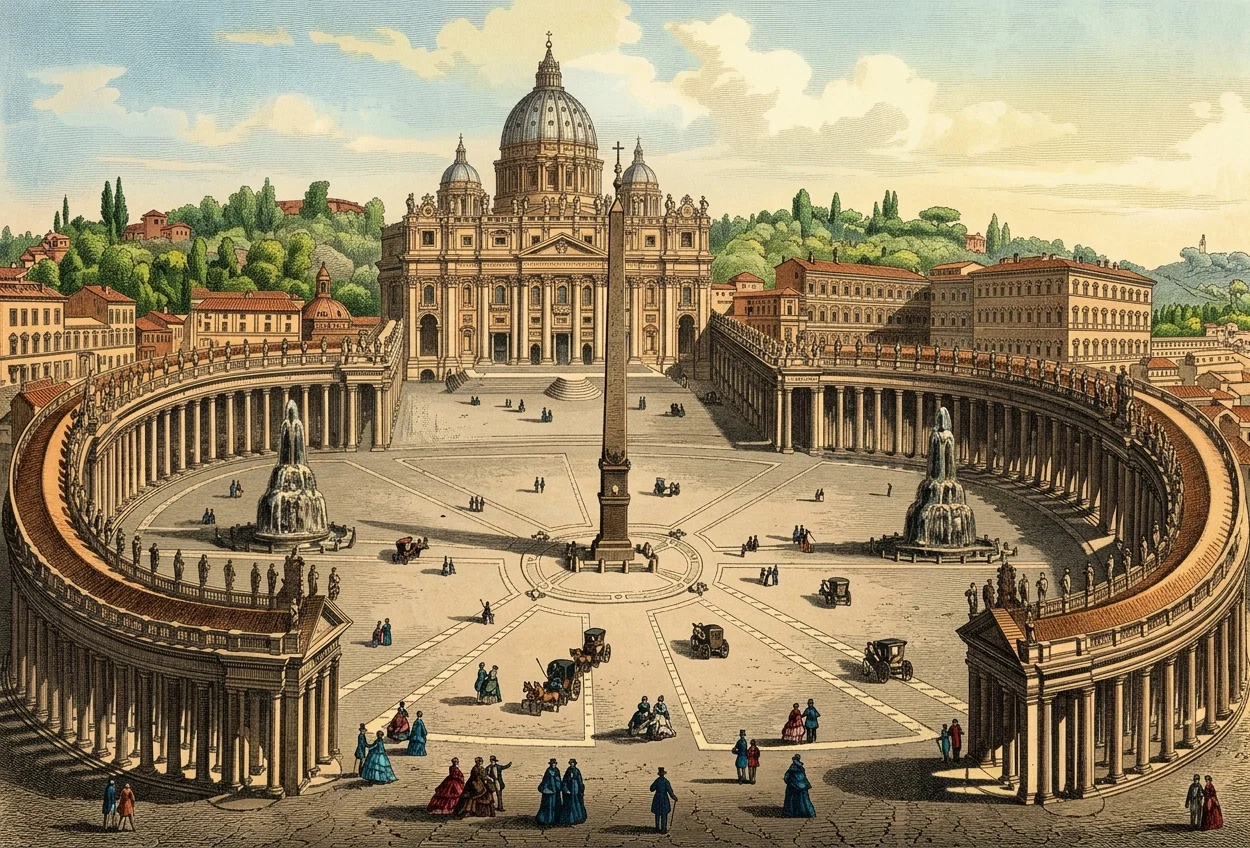
Church of St. Peter, Rome.
Christ not Ashamed.—Concerning Christ we read, “For both He that sanctifieth and they who are sanctified are all of one; for which cause he is not ashamed to call them brethren.” Heb. 2:11. “God is not ashamed to be called their God; for he hath prepared for them a city.” Heb. 11:16. Surely if the Lord is not ashamed to be called the brother of poor, weak, sinful mortals, man has no reason to be ashamed of him. “Behold, what manner of love the Father hath bestowed upon us, that we should be called the sons of God.” 1 John 3:1. Ashamed of the Gospel of Christ! Could there possibly be a worse case of the exaltation of self above God? For to be ashamed of the Gospel of Christ, which is the power of God, is an evidence that the man who feels thus ashamed really thinks himself superior to God, and that it is a lowering of his dignity to be associated with the Lord.
“Ashamed of Jesus! sooner far Let evening blush to own a star; He sheds the beams of light divine O’er this benighted soul of mine.”
“Ashamed of Jesus! just as soon Let midnight be ashamed of noon; ’Twas midnight with my soul till he, Bright Morning Star, bade darkness flee.”
Saved by Faith.—The Gospel is the power of God unto salvation to every one that believeth. “By grace are ye saved through faith; and that not of yourselves; it is the gift of God.” Eph. 2:8. “He that believeth and is baptized shall be saved.” Mark 16:16. “As many as received him, to them gave he power to become the sons of God, even to them that believe on his name.” John 1:12. “With the heart man believeth unto righteousness.” Rom. 10:10. “This is the work of God, that ye believe on him whom he hath sent.” John 6:29. Faith works. Time would fail to tell of those “who through faith subdued kingdoms, wrought righteousness, obtained promises, . . . out of weakness were made strong,” etc. Heb. 11:33, 34. Men may say, “I can not see how it is possible for one to be made righteous simply by believing.” It makes no difference what you can see; you are not saved by sight, but by faith. You do not need to see how it is done, because it is the Lord who does the work of saving. Christ dwells in the heart by faith (Eph. 3:17), and because he is our righteousness, “he also is become my salvation” (Isa. 12:2). We shall have salvation by faith illustrated more fully as we proceed in our study, because the book of Romans is devoted wholly to this one thing.
“To the Jew First.”—When Peter, at the request of Cornelius, the Roman centurion, and the command of the Lord, went to Cæsarea to preach the Gospel to the Gentiles, his first words when he heard the story of Cornelius were, “Of a truth I perceive that God is no respecter of persons; but in every nation he that feareth him, and worketh righteousness, is accepted with him.” Acts 10:34, 35. This was the first time that Peter had ever perceived that truth, but it was not the first time that that thing was true. It had been a truth as long as God had existed. God never chose anybody to the exclusion of anybody else. The wisdom that comes from above is “without partiality.” James 3:17. It is true that the Jews as a nation were wonderfully favored by the Lord; but they lost all their privileges simply because they assumed that God loved them better than he did anybody else, and were exclusive. All through their history God was trying to make them see that what he offered them was for the whole world, and that they were to pass on to others the light and privileges which they shared. The cases of Naaman, the Syrian, and of the Ninevites to whom Jonah was sent, are among the many instances by which God sought to show the Jews that he was no respecter of persons. Then why was the Gospel preached “to the Jew first”?—Simply because the Jews were nearest. Christ was crucified at Jerusalem. It was from there that he commissioned his disciples to preach the Gospel. At his ascension he said, “Ye shall be witnesses unto me both in Jerusalem, and in all Judea, and in Samaria, and unto the uttermost part of the earth.” Acts 1:8. It was most natural that they should begin to preach the Gospel in the place and to the people nearest them. This is the secret of all missionary work. He who does not labor in the Gospel in his home, will not do any Gospel work although he goes to a foreign country.
The Righteousness of God.—The Lord says: “Lift up your eyes to the heavens, and look upon the earth beneath; for the heavens shall vanish away like smoke, and the earth shall wax old like a garment; and they that dwell therein shall die in like manner; but my salvation shall be forever, and my righteousness shall not be abolished. Hearken unto me, ye that know righteousness, the people in whose heart is my law.” Isa. 51:6, 7. “Mytongue shall speak of thy word; for all thy commandments are righteousness.” Ps. 119:172. The righteousness of God, therefore, is his law. Let this not be forgotten. The term “the righteousness of God” occurs frequently in the book of Romans, and much confusion has resulted from giving it arbitrary and varying definitions. If we accept the definition given in the Bible, and do not abandon it in any instance, it will simplify matters very much. The righteousness of God is his perfect law.
Righteousness and Life.—But the ten commandments, whether engraved on tables of stone or written in a book, are only the statement of the righteousness of God. Righteousness means right doing. It is active. The righteousness of God is God’s right doing, his way; and since all his ways are right, it follows that the righteousness of God is nothing less than the life of God. The written law is not action, but is only a description of the action. It is a picture of the character of God. The very life and character of God are seen in Jesus Christ, in whose heart was the law of God. There can be no righteousness without action; and as there is none good but God, it follows that there is no righteousness except in the life of God. Righteousness and the life of God are one and the same thing.
Righteousness in the Gospel.—“For therein is the righteousness of God revealed.” Wherein?—In the Gospel. Bear in mind that the righteousness of God is his perfect law, a statement of which is found in the Ten Commandments. There is no such thing as a conflict between the law and the Gospel. Indeed, there are not in reality two such things as the law and the Gospel. The true law of God is the Gospel; for the law is the life of God, and we are “saved by his life.” The Gospel reveals the righteous law of God, because the Gospel has the law in itself. There can be no Gospel without law. Whoever ignores or rejects the law of God, has no knowledge whatever of the Gospel.
The First View.—Jesus said that the Holy Spirit should convince the world of sin and of righteousness. John 16:8. This is the revelation of the righteousness of God in the Gospel. “Where no law is, there is no transgression.” Rom. 4:15. Sin can not be known except by the law. Rom. 7:7. Therefore it follows that the Spirit convicts of sin by making known the law of God. The first view of the righteousness of God has the effect of making a man feel his sinfulness, just as we feel our littleness when gazing upon a lofty mountain. And as the grandeur of the great mountains grows upon us, so God’s righteousness, which is “like the great mountains” (Ps. 36:6), appears greater the more we look at it. Therefore he who looks continually at the righteousness of God, must continually acknowledge his own sinfulness.
The Deeper View.—Jesus Christ is the righteousness of God. And “God sent not his Son into the world to condemn the world; but that the world through him might be saved.” John 3:17. God does not reveal his righteousness in the Gospel in order to cause us to cower before him because of our unrighteousness, but that we may take it and live by it. We are unrighteous, and God wishes us to realize it, in order that we may be willing to receive his perfect righteousness. It is a revelation of love; for his righteousness is his law, and his law is love. 1 John 5:3. So “if we confess our sins, he is faithful and righteous to forgive us our sins, and to cleanse us from all unrighteousness.” 1 John 1:9, R. V. If when the preaching of the Gospel reveals to us the law of God, we reject it and find fault with it because it condemns our course, we are simply saying that we do not desire that God should put his own righteousness upon us.
Living by Faith.—“As it is written, The just shall live by faith.” Christ is “our life.” Col. 3:4. We are “saved by his life.” Rom. 5:10. It is by faith that we receive Christ Jesus, for he dwells in our hearts by faith. Eph. 3:17. Dwelling in our hearts, he is life, for out of the heart are the issues of life. Prov. 4:23. Now the word comes, “As ye have therefore received Christ Jesus the Lord, so walk ye in him; rooted and built up in him, and stablished in the faith.” Col. 2:6, 7. As we receive him by faith, and we walk in him as we have received him, we shall “walk by faith, and not by sight.”
“From Faith to Faith.”—This seemingly difficult expression, which has been the subject of so much controversy, is very simple when we allow the Scripture to explain itself. In the Gospel “the righteousness of God” is “revealed from faith to faith; as it is written, The just shall live by faith.” Note that “from faith to faith” is said to be parallel with “the just shall live by faith.” Just means righteous. The reader has noticed that the Revised Version has “righteous” in 1 John 1:9 where the old version has “just.” Both are the same. God’s life is righteousness; he desires that our lives shall be righteousness also, and therefore he offers to us his own life. This life becomes ours by faith. That is, just as we live naturally by breathing, so we are to live spiritually by faith, and our whole life is to be spiritual. Faith is the breath of life to the Christian. So just as we naturally live from breath to breath, we are to live spiritually from faith to faith. We can live but one breath at a time; so we can not live spiritually except by present faith. If we live a life of conscious dependence upon God, his righteousness will be ours, for we shall breathe it in with every inspiration. Faith gives us strength, for those who have exercised it “out of weakness were made strong.” Heb. 11:34. So of those who accept the revelation of God’s righteousness “from faith to faith,” it is said, “They go from strength to strength; every one of them in Zion appeareth before God.” Ps. 84:7.
E. J. W.

One Lawgiver

One Lawgiver.—“The true church,” says a Roman Catholic writer, “like the true state, is ever on the alert to detect and condemn error. She makes new laws, new definitions, to meet new errors. What should we say of a state that never legislated for three hundred years?—Why, that it was no state. So of a church.” But the true church never legislates at all. “There is one Lawgiver, who is able to save and to destroy.” James 4:12. “For the Lord is our Judge, the Lord is our Lawgiver, the Lord is our king; he will save us.” Isa. 33:22. The true church never usurps the place of its head, by presuming to make laws for itself. And the difference between the laws which the Lord has laid down for the church, and those which men make, is that while the latter require continual amending to meet new conditions, the former, coming from Him who sees the end from the beginning, are never out of date. Nothing can possibly arise that has not been foreseen and provided for in the Bible.

SALT IS GOOD.

BY MRS. E. G. WHITE.
“Salt is good; but if the salt have lost his savor, wherewith shall it be seasoned? It is neither fit for the land, nor yet for the dung-hill; but men cast it out.” Salt possesses preservative qualities which prevent corruption. Christ, who was the light of the world, who was a propitiation for our sins, and for the sins of all who believe in him, said, “I sanctify myself, that they may also be sanctified through the truth.” Christians should have a vital connection with God; their lives, their character, purified through the truth, should possess saving qualities that would keep the world from going into utter moral corruption. Christians receive instruction from Jesus, their Example. They should pray in faith that they may be connected with his saving grace, that the righteousness of Christ may be imparted to them. Their influence will save the world from a large amount of crime and iniquity, and work the reformation of many souls.
But of how much value is salt that has lost its savor? When those who claim to be Christians, do not in their words and actions reveal the attributes of Christ, they are represented as salt that has lost its savor. Whatever may be their profession, they are looked upon by men and angels as insipid and disagreeable. Of such Christ says: “I would thou wert cold or hot. So then because thou art lukewarm, and neither cold nor hot, I will spue thee out of my mouth.” They have a form of godliness, a profession of religion; but it is contradicted by their lives. Any attempt on their part to advocate truth has no weight; for they have lost their connection with God. The sincere believer diffuses vital energy, which is penetrating, and imparts new moralpower to the souls for whom he labors. It is not the power of the man himself, but the power of the Holy Spirit, that does the transforming work. “The law of the Lord is perfect, converting the soul.” The salt has retained its savor, and it has an influence that is perceived and estimated upon the characters of those who possess it. The Lord says, “I will make a man more precious than fine gold, even a man than the golden wedge of Ophir.” He who receives Christ by living faith has a living connection with God, and is a vessel unto honor. He carries with him the atmosphere of heaven, which is the grace of God, a treasure that the world can not buy. He who is in living connection with God may be in a humble station, yet his moral worth is as precious as was that of Joseph and Daniel, who were recognized by heathen kings as men with whom was the Spirit of God. They were representative men, and were intrusted with the most important responsibilities. Because of their living connection with God, they had power with God and with men, and of them it could truly be said, “Ye are the salt of the earth.” They represented the character of Christ, and were as salt possessing saving qualities essential for the transformation of the character of those with whom they associated.
Daniel was beloved of God. He who brought in everlasting righteousness, the Anointed, the Holy One of God, gladly accepted the consecrated agency of his servant, through whom he worked by imbuing him with his Holy Spirit and imparting to him grace for grace. Of Daniel and his companions in Babylon the heavenly record states, “God gave them knowledge and skill in all learning and wisdom; and Daniel had understanding in all visions and dreams.” Thus was the Lord God of heaven represented in the courts of Babylon. He was also represented in the kingdom of Egypt by his servant Joseph. These men were representatives of what it means to be “the salt of the earth.” Through these agents God could and did work to make known his majesty to the heathen kingdoms of the world.
It was their moral integrity that constituted them the “salt of the earth.” Joseph would not sacrifice his purity of character. When tempted to evil, he met the tempter, saying, “How can I do this great wickedness, and sin against God?” Jesus of Nazareth is the representative of the Father. He is the vital chain by which man is bound to God. In him all fullness dwells, and from him the Christian may receive a constant supply of grace, that is represented by his saving properties of salt. Those who have a personal interest in Jesus Christ will possess those qualities of character which are represented by salt, which will work for the saving of the world. Thus it is that Christians become living witnesses for heaven. By their life they testify, saying, “I know whom I have believed, and am persuaded that he is able to keep that which I have committed unto Him against that day.”
But Christ uttered a sorrowful fact when he said, “If the salt have lost his savor, wherewith shall it be seasoned?” How shall the world be preserved from moral corruption? Let these words have due weight upon the mind. The Lord Jesus Christ, the Anointed One of God, is seeking to assimilate our characters to his own. Although we profess great things, we are represented as salt that has lost its savor, and as entirely worthless, unless the Holy Spirit can use us as channels by which to communicate to the world the truth as it is in Jesus. By precept and example we are to reveal to the world that Christ has made reconciliation for sin, that he is our only hope, the One who has brought in everlasting righteousness. He is the Anointed Priest that ever liveth to make intercession for every individual soul. Our only efficiency is Jesus Christ. We are to represent to the world his love, both in words and works. We are constantly to express to the world our appreciation of God’s unspeakable gift, which he has given to us because of the great love wherewith he hath loved us. “For God so loved the world, that he gave his only-begotten Son, that whosoever believeth in him should not perish, but have everlasting life.”
In the gift of Jesus is included the whole heavenly treasure. But what a fearful responsibility rests upon those who hear the truth, and who claim to believe it, and who are yet not sanctified through the truth. They testify to the world that the truth which they claim to believe has no sanctifying power, and thus they make of none effect the truth of God. It is the privilege of those who accept of Christ to reach a high standard in character, and thus become living epistles, known and read of all men, as were Joseph in Egypt and Daniel in Babylon. There is no reason why we should not possess fragrance of character through the merits of Christ, and be recognized in heaven as laborers together with God. Through Jesus Christ we may have a saving influence upon the world. Christ would have every one of us a savor of life unto life. He would impute to us his righteousness, in order that we may communicate his goodness, mercy, and love to fallen humanity. When we enter into the joy of our Lord, praise will ascend to the throne of God, and we shall say, “No credit belongs to us; Christ did it all, and to his name be all the glory.”

DUTY

BY G. W. WORTHEN.
I HOLD that love to man is love to God, And love to God is love to man; The path of duty diligently trod Helps carry out God’s wondrous plan.
Two travelers, one wintry day far North, In comfort wrapt in skins of bear, Unmindful of the howling blast sent forth, By reindeer drawn, all free from care,
Espied a form half hidden in the snow. In haste one to his rescue went, And worked away till both were all aglow, Not caring for himself, but all intent
On being neighbor to the one in need. The other sped for fear of cold, Secure, he thought, nor helped in the good deed; But icy frosts his face and limbs enfold.
By one the two were saved, and thus ’tis plain That selfish ones are not most blest; For what seemed first but loss at last was gain; But most to him with love possessed.
Who for My sake his life would lose shall gain. Tenfold the measure shall be filled Of him who sowed, maybe in tears and pain, And for man’s good his fields have tilled.
Willowglen, Cal.
Continue reading: THE DEVELOPMENT OF CHARACTER