Your ShelfYour Projects

Review and Herald, Vol. 79, No. 45.

Publishers' Page
Earlier text: The Weather Signal Is Out

A Day in the City

A Trip to Canton — No. 2

A Day in the City
MRS. J. N. ANDERSON
ACROSS the bridge from the shameen, past the military guard, the gates of Canton opened to us; and we entered full of expectation, but not without some inward shrinkings; for the streets were thronged with people, many of whom gazed at us with unfriendly brows, and some uttered low imprecations. In this respect the atmosphere is very different from that of Hongkong. There, the European belongs to the higher class, and everything makes way for him; here, he is only one of the fan gwi (foreign devils), as he will doubtless hear for himself within a few yards of the entrance. Still, not a few manifest an entirely courteous attitude, especially those who hope to be benefited commercially by the coming of the foreigner.
“The city is much cleaner than in former years,” the guide said, as he led the way down a series of stone steps into a narrow alley where fearful odors arose from the half-open drain. “When Li Hung Chang was viceroy of the Kwang Provinces, he compelled the people to clean it up,” he continued. Thankful for what improvement had been made, we still recognized an urgent demand for a second edition of Li Hung Chang’s sanitary reforms.
And yet, how can there be much reformation? The city seems to have been built with a direct view to the propagation and dissemination of vice and disease. There is no municipal water supply. Most of the water used is taken from wells sunk in the street, or wherever there happens to be space. Much is carried into the city by coolies, and sold by the two bucketsful; but as we saw them slipping along with their burdens, we wondered what it ever could be used for,—so cloudy and yellow it looked. Those who can afford it may obtain drinking water from springs in the hills. The guide pointed out the location of one of these hillside springs from which a continual stream of carriers was issuing. This water is considered especially good, and costs ten cents a bucket at the well, fully one mile outside the wall. But even this lies in the natural drain of the surrounding hills, which are filled with graves of human beings.
The two-story houses are without windows or other means of light and ventilation, except as the wooden doors are taken off and set aside during the day; and the tile floors are often damp and moldy. One sees no pleasant cottages with surrounding trees and lawns, but the nature-loving people have tried to supply their absence by roof and veranda gardens, and by potted shrubs and plants tucked in wherever a bit of vegetation can thrive. The coarse brick walls hug one another without so much as a path between, and frequently the business for support of the family is carried on in the same room in which the family lives. Some idea of the density of the population can be gathered from the fact that within a circuit of ten miles a population of two and one-half million maintain an existence.
The guidebook says that the streets are from three to ten or twelve feet wide. Passing down one of average width, I stretched out my arms in an attempt to measure it, but was unable to straighten them for the abutting walls on either side. The coolies who carried the chairs kept up a constant shouting to clear the track. Foot passengers and burden bearers were obliged to hug the walls in order for us to pass. Still other streets, if a mere crack between the walls may be so dignified, were too narrow to admit chairs, or even to allow the passing of foot passengers except as each turned his body sidewise. Some of the best streets are from twelve feet to one rod wide, and these are lined with first-class shops tastefully arranged, and displaying elegant fabrics and beautiful wares to be seen at their best only in native markets. In the provision stores may be seen Columbia River salmon, sugar corn from Iowa, tinned fruits from California, cheese from Hollandand Switzerland, baked goods from England, Scotch whisky, French wines, Manila tobaccoes, etc.
The Canton blackwood, famous the world over, is here seen in all its ebony richness. The Chinaman may delight in tinsel and vanities in the make-up of trumpery for joss; but when it comes to furnishing his home, things of a substantial and enduring character are preferred to the limit of his means; and the heavily carved, beautifully polished furniture, often profusely inlaid with variegated pearl, displayed in the blackwood shops, is intended to last a succession of generations.
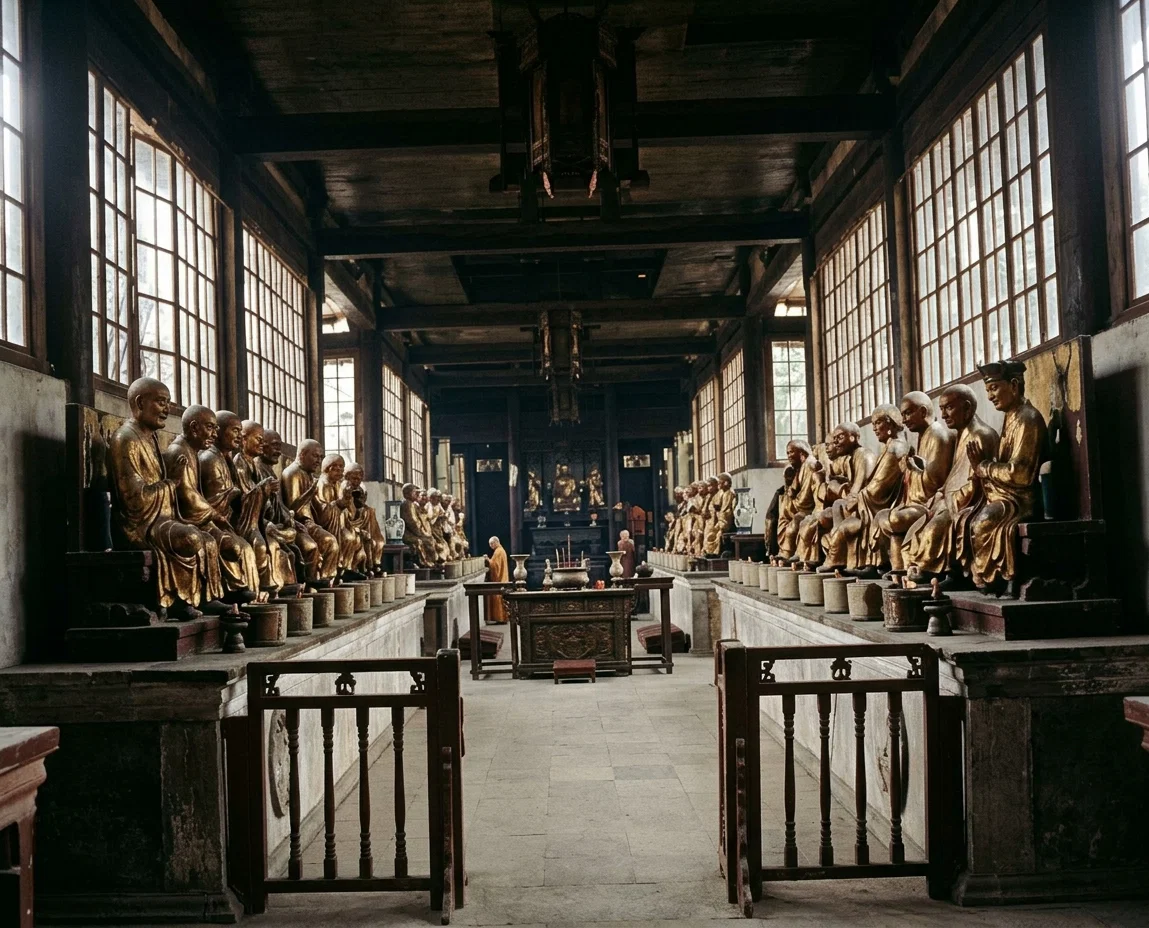
TEMPLE OF THE HOLY FIVE HUNDRED.
“This is a place for the manufacture of kingfisher jewelry,” the guide said, dismounting and leading the way into a small room where eight or ten men were at work on ornamental trinkets. Tiny bits of the plumage of the kingfisher in varying and harmonizing shades of blue, green, and purple, are inlaid by hand on delicate settings of silver of artistic designs. But there is, no doubt, a cruel history back of these pretty baubles; for the glossy, silken tufts from which these clippings are made give evidence of having been torn from the quivering form of living birds.
The linen factory was a large, well-ordered plant for the production of the popular Chinese grass cloth. Embroidering is also carried on in the same establishment. Silk portières, coverlets, scarfs, shawls, and garments, tastily wrought with marvelous skill by men and women who make it a life work, were displayed in bewildering profusion. Such of these establishments as are under the management of Europeans have introduced the manufacture of thread and silk laces, Battenberg, drawn work in linen, etc.
The wages paid to women and girls for such labor probably does not exceed ten cents (United States money) a day; but this is more than they might expect to realize from, to them, more menial labor in some more useful calling.
Having consented to the guide’s proposition first to see the Chinese water clock, and then take tiffin (the common term in the East for the midday meal) at the five-story pagoda, we mounted a series of stone flights to a small house on top of a high mound. Inside, the guide said, “This is the way Chinese measured time in ancient days,” pointing to a tier of jars, arranged so that water poured into the top one, drips from a well-worn copper spout into the second, from that to a third, and thence to a fourth at the bottom, in which is set on a float a graduated brass scale resembling the scale on a thermometer. Every drop increases the depth of the water, and lifts the indicator. “It is now twenty minutes to twelve,” he said, and our watches tallied. For five hundred years the unceasing drip of this primitive contrivance has measured off the span of men’s lives. Presently the musical drops seemed to become vocal and pleadingly eloquent for the four hundred million of darkened souls outside, who are passing away at the rate of one for each crystal drop, passing away without God and without hope in the world.
The five-story pagoda is an old-time watchtower built on a hill overlooking the plain at the highest point of the city wall, and commanding a view of the city and surrounding country which fully repaid us for the hard climb up the ascent.
After tiffin we went first to the “City of the Dead.” From the name, one might expect to be taken to a cemetery, but instead we were let down before a well-kept inclosure filled with long rows of one-story buildings. These structures are divided into sections, and rented out for the deposit of the bodies of well-to-do Chinamen, waiting an opportunity for interment in “lucky ground.” Each section contains two rooms. In the second the body or bodies are deposited in sealed coffins. The first is a reception room for the friends who come to worship the departed, and is fitted up with seats, a tiny oil lamp perpetually burning, and a table on which is set an incense urn, a cup of tea, a bit of food, and frequently a floral offering.
All visitors to Canton are taken to the Temple of Five-hundred Buddhas. Five hundred wooden images, adult size, all different representations of the Indian Gautama Buddha, each with an incense urn before it, are set in a row around the principal room. Among them is a figure of Marco Polo, who is erroneously believed to have introduced Buddhism into China. Almost at the entrance is placed a Buddha with several infants in its lap and arms. This is a special object of devotion by childless wives, who, because childless, are often neglected and desolate in this land of polygamy and concubinage.
As we left the temple, a half-crazed opium sot rushed frantically after us, begging piteously for a few cents with which to gratify his vice.
Chinese are very devoted to their system of medicine, and apothecary shops are abundant. Dried lizards, bugs, toads, snake skins, hartshorn shavings, silkworms, asbestos, oyster shells, together with all manner of seeds and dried herbs,—some otherwise valueless rendered effective by being gathered on festival occasions,—anything that is disgusting enough to be considered good for medicine, and some things known to Western materia medica, are at hand at prices to suit. These failing, the seeker after health may have recourse to the wisdom of his gods at the Doctor’s Temple. Here are stored very ancient and therefore highly prized prescriptions. The inquirer takes his place at the altar before the elaborate throne on which are seated three medical deities, picks up a cylindrical bamboo box containing strips of bamboo wood, each numbered, corresponding to a prescription in the books. This he shakes till one falls out. The number on the fallen piece indicates his remedy. He burns a bit of incense on one altar, and, by way of paying his doctor’s bill, a bit of joss money (mock bills of red and gilt paper) on another, pays the attendant ten cents in more substantial currency, and goes off to get his prescription filled.
The building itself is quite elaborate in architectural design, for China. The massive columns supporting the portico of a recent addition are of single pieces of granite, entwined with chiseled forms of the Great Dragon, to us quite suggestive of the superstition and idolatry for which the edifice stands.
One of the offenses of which the foreigners are accused is that of stealing Chinese children, and gouging out their eyes for use in compounding their medicines. Any of this administered to a Chinaman is supposed to cast over him a spell, bringing him forever under the influence of the foreigners. The great number of blind beggars wandering about the streets in pairs or in small groups might strengthen this suspicion were there no more obvious causes.

Dedication in Jamaica

AGAIN we have been made to rejoice by the completion of another house of worship. This one is located at Fonthill. We now have good, substantial buildings scattered over the island, silent but constant reminders to all who pass them of the great warning message that the Lord is sending to the island of Jamaica and to the world.
This church is eighteen feet wide by forty feet long, built of Spanish walling. The outside is in imitation of cut stone. The inside is painted a light-blue. The pulpit and seats are of cedar, and are varnished. It is a well-finished building for the place. Some have made real sacrifices during the building of it. One brother, a carpenter, remained so closely at the work for months that he provided only the barest necessities for himself and family. A young man who lives forty miles from there, and who is not a member of the church, spent, altogether, three months in assisting them; and yet it has taken nearly three years to complete the house, for everything has to be done by hand. All the materials have to be conveyed to the spot on the heads of individuals or on the backs of donkeys. The brethren being very poor and having families to care for, months at a time would elapse during which they were unable to help on the church, and it is only through the assistance that has been given them that they have been enabled to complete it. Over one hundred dollars in cash was donated. When the materials were ready, there being no mason, one of our ministers took the trowel and built the foundation pillars, and remained with the brethren until the frame was up.
This is the third building that has been erected by this company. The second was provided with a corrugated iron roof, and stood until the increasing number demanded a larger one.
This is the second oldest company in the island. A sister from Kingston visited some friends at this place, talked the truth, and left some reading matter with them. Soon two began to keep the Sabbath. They imparted the light they had received to their neighbors. The good work has gone on until the present membership is fifty-seven, besides children. No public effort by a minister has been made.
The dedication of the building took place on the sixteenth of February. Brethren W. J. Tanner and H. F. Humphrey and the writer being present. The house was handsomely decorated for the occasion with foliage plants, flowers, and oranges, a beautiful arch over the rostrum being the crowning feature. There was a large attendance of outsiders. The exercises passed off nicely. Preaching services were held in the evening with a still larger attendance. Many became much interested, and pleas were made for more meetings; so Elder W. W. Eastman has gone there in answer to the call.
I can hardly close without mentioning the view from the windows of the church, which is one of almost unrivaled beauty. The church is built upon a mountain crag. Looking down hundreds of feet, a beautiful valley is seen, dotted with sugar estates which extend away in the distance until met by the blue waters of the Caribbean Sea. Across the valley, and on every side, rise to great heights ever-green mountains of almost endless variety of forms. As the eye wanders over this grand panorama, the mind almost involuntarily turns to the wonderful Being who created it all, and acknowledges him as worthy of all adoration and praise.
F. I. RICHARDSON.
Kingston, Jamaica.

Greater New York a Needy Field

Much has been said, but none too much, about the neglected field of the South. It has been neglected, and a great injustice has been done to it, and now is the time to redeem ourselves. So with the foreign fields. The message is to go to every nation, kindred, tongue, and people; but when the Saviour gave the commission to his disciples, he told them that they should be witnesses “both in Jerusalem, and in all Judea, and in Samaria, and unto the uttermost part of the earth.” They were to begin and continue their work in Jerusalem and Judea until Jerusalem should be surrounded with armies. So with our large cities. The time will come when there will be a threefold union of the Protestants, Spiritualists, and Roman Catholics to enforce the observance of the first day of the week. Then will come the time to leave the cities of America. The time to leave the cities has not arrived, but the judgments of God are already in the earth, and the dark cloud of God’s wrath is arising; and at the present time the question comes home with great force. What are we going to do for our large cities? In them are millions who have never heard of present truth.
We have in the United States thirty-eight cities each containing over one hundred thousand inhabitants. These rank in importance according to their position and the number of inhabitants. The aggregated population of these cities is about one fifth of the seventy millions of people in the United States. Three of these cities—New York, Chicago, and Philadelphia—each contain one million inhabitants. The city of Greater New York contains twice the number of Chicago, and nearly three times that of Philadelphia. As to its commercial relation to the world, it stands first in importance. It is the wealthiest city. Wall Street dictates to London in finances. It is the second city in the world as to the number of inhabitants. London stands first by one third more than Greater New York, but it should be remembered that in New York there are the greater number of inhabitants in the smaller area. New York City is the gateway to Europe through which our laborers pass as they go east.
Within less than a radius of fifteen miles we have nearly four million people. On the island of Manhattan it is said that the houses average five stories high. It can better be appreciated by comparison. There are no States which have had greater light than the States of Michigan and California, with their publishing houses and sanitariums, their editors, ministers, physicians, and trained nurses; yet the entire number of inhabitants of the State of Michigan is a million less than is found in New York; that is, if all the inhabitants of the State of Michigan were placed in one city, it would then lack over a million of having as many as Greater New York.
California contains 1,485,053 inhabitants. It has been worked for twenty years or more by our best men. It has in it a publishing house, sanitariums, scores of churches; and yet in Greater New York there are nearly three times that number of people, and I think it is safe to say that there are more people in Greater New York who have never heard of the third angel’s message than there are people in all the State of California. Here we have a population of every class of people in the world. There are over half a million of the Jews who make no profession of any belief in Christ, and we have not one laborer among them. There is nearly one tenth as many people in Greater New York as there are in England, Ireland, Scotland, and Wales taken together. If one should have a congregation of one thousand each night in the year, it would require over ten years for each of the inhabitants of the city to hear one sermon. Now, what have we done? Who has a burden to labor in this city? About twenty-five years ago the work began in Brooklyn. At different times work has been done among the Scandinavians, who number about eighty thousand; also among the Germans, who number over a million. And what are we doing to-day to help these people? During the past season Elder Melsen has held tent meetings among the Scandinavians. Elder Reinke has conducted a similar effort for the Germans. The conference has been unable to furnish either company with more than one worker. Elder C. H. Edwards has had a tent in the Bronx, a suburb containing two hundred thousand people. Elder Warren has been with us in our work in the hall on Fifty-ninth Street.
We know of but one man in the past who has taken hold in New York with a real burden of the work to make this his continued field of labor; this is Elder Franke, who began his labor in the city in 1895. In the winter he secured halls, where he preached each Sunday night. Three summers he held tent meetings. Others have come in from time to time, and held meetings in different parts of the city. As a result of this labor between six and seven hundred have accepted the Sabbath. There is one church of Scandinavians, one of Germans, and one of the English-speaking people in Brooklyn; another church of English in the Bronx, three churches on Manhattan Island and another about to be organized. What are these efforts among four million people? We have no permanent treatment rooms in all the city, and until of late not a vegetarian restaurant. Now we have three, within a few rods of one another, and each of them has a good patronage.
Fifteen months ago my wife and I came here by the advice of our brethren. God has greatly blessed our efforts. Some who have accepted the truth inconnection with the efforts of the training school are now among our most efficient workers. We have brought into our family from time to time workers from Florida, Ohio, Nebraska, Massachusetts, Dakota, and Indiana. The majority of those who have been with us have been inexperienced. Our principal work has been to train laborers for the field. New England has sent two. One of them is doing successful work in Boston. Another has returned on account of sickness in her home, but is prepared to take hold of the work in almost any place. Others are in other conferences, making their work self-supporting.
One year ago when Elder Brunson was with us, in answer to prayer God gave us a hall on West Fifty-ninth Street for a rent of six hundred dollars a year. The price of the hall was six thousand dollars. The owner of it paid fifteen hundred dollars a year rent for the land on which it stands, besides water rates, taxes, etc. He rented it to us for $12.50 a week. From the time we first came to the city, the use of a room in a very wicked part of the city has been given us. As the result of the services held in this room a number of Sabbath keepers, believing all points of present truth, have been raised up. If labor is continued with them, they will soon be organized into a small church. They are colored people. The work among the colored people demanded a hall in a better locality. The price of this hall was forty dollars a week, but it was finally secured for twenty-five dollars. Three public meetings have been held continuously during the summer in halls exclusively under our control. One of our workers has been invited to give a talk on the book of Revelation one day each week, at one of the noonday meetings for business men in the heart of the city, conducted by the Baptists. There is a good interest.
Some persons of influence have recently taken their stand upon the truth at the hall on Fifty-ninth Street, and are awaiting baptism. If we had paid the usual price for these three halls, they would have cost us at the rate of six thousand five hundred dollars a year, but we have paid at the rate of nine hundred dollars a year. We recognize in this the special providence of God.
Last winter we held in the Metropolitan Lyceum two cooking classes and one health school, and one cooking school among the colored people, and a health school among the Danes. The church that has been organized since we came to the city, including the workers, has paid in tithe $2,106.22. Of this sum those Sabbath keepers received into the church by letter paid $717.38, and the new Sabbath keepers who joined by baptism, $606.28. Between fifty and sixty have decided to keep the Sabbath. Some of these are in the country, others have joined other churches, while still others are here in No. 3 church. For the financial statement see Bible Training School, November number. This church has now been received into the conference, and we enter an entirely new field in Brooklyn. We have secured rooms at a cost of ninety dollars a month. We feel grateful to God for what he has wrought for us. We are encouraged to venture out on his promises. During the past fifteen months, our house rent alone has been $1,275.25, and we have paid the workers while in training $2,591.62. This is besides our hall rent and other expenses. Less than one hundred and fifty dollars of this sum has come from any conference whatever, but most of it has been earned and gathered by personal labor with the people.
The present plans are that Elder Franke will occupy the Carnegie Lyceum each Sunday night, as he has done the last two winters, and labor in the city proper, and we in Brooklyn.
A number of trained nurses who are anxious to take the Bible studies will be with us this winter. Our new workers are gathering now, and by the first of November we expect to enter upon a vigorous campaign with a strong company of about twenty,—nurses, Bible workers, and colporteurs.
Were we to look at the expense of the enterprise this coming winter, we would not dare to enter upon it; but knowing how God has sustained us in the past, we believe that he will carry us through. We can be helped financially in two ways: first, by donations to the Bible Training School; secondly, by individuals and conferences paying the cost of educating workers. Last year there were those who sustained certain workers for six months. It will cost five dollars a week to support one laborer. Six months would cost one hundred and thirty dollars. This would fit an ordinary worker to do efficient work. And most of all, we want the prayers and sympathy of our brethren and sisters. Shall we go forward this coming winter? Will our brethren stand by us? A careful record is kept of every cent received by us, and our books are audited by the Atlantic Union Conference auditor.
Our address is “Vendome,” corner of Gates and Grand Ave., Brooklyn, New York.
S. N. HASKELL.

A Canadian Industrial School

It has been apparent to those who have had to do with the work in the Canadian field, that the conditions were such as to warrant the establishment of an industrial school in order that the young people may be educated and trained to take up the work in their own field. The constituency being small, and the majority of the members poor, caused some to look upon the enterprise with disfavor, for fear that the plan could not be carried through, but there have been those who have realized that the greatest blessing which could come to the field would be a school where the principles of Christian education could be taught, and that an effort ought to be put forth to save our young men and women from the evil influences with which they are usually brought in contact in securing an education.
At the time of the organization of the Canadian field, Elder W. C. White introduced a resolution favoring the establishment of a school, and granting the proceeds of the sale of “Christ’s Object Lessons” for that purpose. This received the approval of Sister White, Elder Daniels, Professor Prescott, and other members of the General Conference Committee who were present at that time. The officers of the Canadian Union Conference, after carefully considering all the conditions, came to the conclusion that it would be better for each province to establish a school when the time had fully come, than to try to maintain one school for the entire field.
Ontario, although the largest conference of the union conference, has only a small constituency, and finds itself continually handicapped because of its lack of laborers who understand the condition and needs of the field, and who feel a deep interest in the success of its work. At the last camp meeting held in June, over thirty-five hundred dollars was pledged for the purchase of a site, and a committee was appointed with power to buy if such a place could be purchased at reasonable figures. After looking at a number of places, the committee finally selected a farm of fifty acres located one mile west of Lorne Park, and thirteen miles southwest of Toronto, on the main line of the Grand Trunk Railroad. The farm is in what is known as the “fruit belt,” and is protected from the early frosts, being only one mile and a half from Lake Ontario. There is four acres of timber bush, which will provide wood for some time to come, also a fine orchard containing about seventy-five trees, and four hundred grape vines, which in 1901 yielded a net profit of four hundred dollars. There is a variety of soil upon the place, and it is especially adapted to the growing of small fruits and vegetables; and its close proximity to the Toronto market, which is the best in the province, gives it a commercial value.
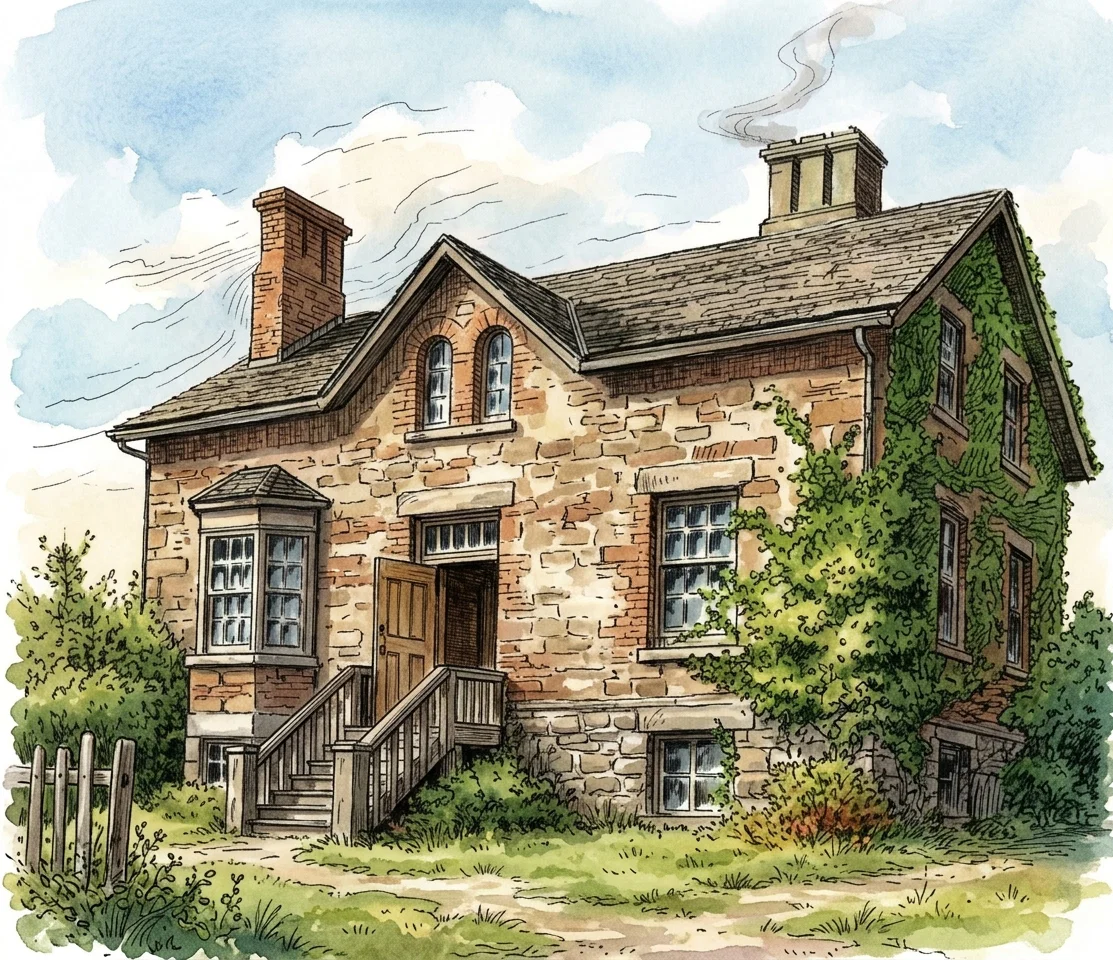
THE SCHOOL HOME
THE SCHOOL HOME
There is a large, twelve-room stone house upon the place, which can be made into a most excellent school building. Fine large barns and other necessary outbuildings complete the make-up of this place, which, by careful management, will make a most desirable locality for our industrial school. The place has cost us six thousand five hundred dollars, and with a dormitory, which it will be necessary to build, and with equipment for the farm, will cost about eight thousand dollars. The committee wish to go slow in the matter of adding too much expense, believing that, as the farm will have a regular income from the first, and the matter of payment has been made very easy, it will not be a difficult matter to clear the place in a few years if careful and judicious management is exercised from the first.
The Ontario brethren and sisters have responded nobly in this enterprise, and are looking forward with pleasure to the opening of the school. We are aware that the proposition is one that will have to be handled carefully; but we are promised wisdom from above, and thus with confidence we go forward.
Some of our brethren and sisters who are more favorably situated, with opportunities which we do not possess, can appreciate the difficulty under which a small conference of six hundred members must be placed in making a desperate effort to instruct its young people inthe principles of Christian education, and they may wish to assist us in this enterprise. Any assistance whatever will be most thankfully received, and we are confident that the donors will be remembered by our Heavenly Father, who enunciated that grand principle, “Give, and it shall be given unto you.”
All donations which may be sent to the undersigned will be acknowledged in The Messenger, and applied on the school enterprise.
We ask an interest in the prayers of our brethren and sisters everywhere as we move forward in this work.
J. W. COLLIE, President Ontario Conference. Brantford, Ontario.

Greater New York Conference

THE first annual session of the Greater New York Conference was held Oct. 7-12, 1902, at 159 E. 112th St., New York City. The president, Elder H. W. Cottrell, presided throughout the session. Fifty-one delegates were seated, representing seven churches.
The first meeting was opened with the singing of the doxology, and prayer was offered by Elder S. N. Haskell. The president then read from the fifteenth chapter of Acts, and in his opening remarks expressed the wish that this session should be a model of Christian piety.
Elder Haskell presented the request of New York City English Church No. 3 to unite with the conference; it was accepted by vote, and its delegates were seated.
The usual committees were chosen, as follows:—
On Nominations: Luther Warren, E. H. M. Sell, C. Meleen, J. J. Kennedy, J. C. Hennessy.
On Ways and Means: E. E. Franke, Edward Nelson, C. H. Edwards, E. E. Miles, S. N. Curtiss.
On Credentials and Licenses: S. N. Haskell, Luther Warren, E. H. Hall, E. E. Franke, O. E. Reinke.
On Auditing: E. H. Hall, R. H. Martin, M. Sheldon, W. B. Walters, J. L. Johnson.
On Revision of Constitution: S. N. Curtiss, J. J. Kennedy, H. W. Cottrell.
Robert H. Martin was elected secretary for the session.
In view of the fact that so many of the brethren were obliged to work in the daytime, it was voted to hold the preaching service in the morning, and to devote the afternoon and evening to the business sessions.
The following resolutions were adopted during the session, after full and free discussion, with wonderful unanimity of sentiment:—
1. Recognizing the many blessings which our Heavenly Father has granted us in the past, and knowing from his messages to us that a wonderful work is to be accomplished in Greater New York, we consecrate ourselves anew to his service, and promise by his help to devote our lives more fully to his service.
And further, we thank him for the reproof and instruction so lovingly sent, and desire to remove every hindrance to the rapid progress of the message in this conference.
Whereas, The Lord has given to us special instructions through the Testimonies of his Spirit, for the work at this time, therefore,—
2. Resolved, That we urge all our people to get these Testimonies, especially Volume VI, and study them prayerfully and earnestly, so that we may advance with the message, and that the truth may lose nothing at our hands.
Whereas, The circulation of the printed page is one of the most effective means of reaching the masses, and,—
Whereas, All our people can do something in this work, therefore,—
3. We recommend the systematic use of tracts in envelopes, as proposed in the Free Fireside Circulating Library, or some similar plan, and urge each one of our people to take up this house-to-house work.
Whereas, The Sentinel of Christian Liberty is the only periodical in the United States devoted wholly to the propagation of the principles of the separation of religion and the state, and as God through his Spirit has highly commended the work of the same, therefore,—
4. We recommend, That our people throughout the conference not only study the periodical themselves, but also circulate it as far as possible, and that The Sentinel be furnished for one year to each of the members of the State Legislature who represent Greater New York City, and that the money for the same be raised at this meeting.
This resolution created much enthusiasm, and about twenty-five dollars was immediately raised toward this Legislature Fund.
5. We recommend, That our conference make an earnest effort to secure means to assist in the building or purchase of a suitable boat for use in New York harbor, to take the place of the small boat known as the “Sentinel.”
6. Resolved, That we recognize our moral responsibility for our quota of “Christ’s Object Lessons.”
In connection with the discussion of this resolution a canvass was made of the audience, resulting in the sale of eight hundred and sixty-two books.
Whereas, The publishing houses agreed to print three hundred thousand copies of the book “Christ’s Object Lessons” for the financial relief of the schools, free of cost, on the condition that the cost of material be met by the people, therefore,—
7. Resolved, That we become responsible for our apportionment of the expense for material, and that we take measures to secure the amount at once.
8. Resolved, That the members of the conference committee be constituted superintendents of districts, as follows: Bronx, Brooklyn, Manhattan, the German work, the Scandinavian work; and that the manager of the Pacific Press Publishing Company be a member of the committee, representing the publishing interests; and that all work be under the general direction of the conference president.
9. Resolved, That a Scandinavian church of Seventh-day Adventists be organized in Manhattan as soon as possible after this meeting closes, and that our Scandinavian brethren and sisters in the other churches who reside in Manhattan be urged to unite with said church.
10. Resolved, That we pay the salary of a teacher in South Lancaster Academy, not exceeding twelve dollars a week, from Jan. 1, 1903, till the close of the school term.
11. Resolved, That we urge all our people to subscribe for the Atlantic Union Gleaner and The Bible Training School.
12. Resolved, That we do everything possible to bring up the standard of our Sabbath-school work, and to this end we recommend that Sabbath-school conventions be held from time to time to make a study of the best methods to be used in our Sabbath schools.
13. Resolved, That we make a special effort to circulate the extra editions of Zions Vaktare and Evangeliets Sendebud among the Scandinavian population of our conference.
14. Resolved, That as officers, ministers, and people we give our most hearty and intelligent support to the regular canvassing work, to the end that our publishing houses be more fully employed in the publication of present truth, and that the truth in printed form be given to the world.
The following officers were elected for the ensuing year: President, H. W. Cottrell; Superintendent of Bronx, C. H. Edwards; Superintendent of Manhattan, E. E. Franke; Superintendent of Brooklyn, Luther Warren; Superintendent of German work, O. E. Reinke, Superintendent of Scandinavian work, C. Meleen; Superintendent of mission, S. N. Haskell; Representative of publishing interests, S. N. Curtiss; Secretary, R. H. Martin; Treasurer, E. H. Hall; Auditor, George W. Palmer; Sabbath-school Secretary, S. N. Curtiss; Assistant Sabbath-school Secretary, Mrs. S. N. Curtiss; Educational Secretary, Luther Warren.
Credentials were granted to O. E. Reinke, C. Meleen, Luther Warren, C. H. Edwards, A. Anderson.
Ministerial Licenses were given to George A. King, W. R. Uchtmann, Geo. A. Stevens, and missionary licenses to Mrs. E. H. Hall, Bessie Shonsbye, Mary Hanniford, Mrs. R. Leo, Mrs. M. A. Neale, J. H. Carroll, J. J. Kennedy.
The laborers gave brief reports of their work during the year, and the president’s closing remarks were full of encouragement and good cheer. Meeting closed with benediction by Elder S. N. Haskell.
H. W. COTTRELL, President.
R. H. MARTIN, Secretary pro tem.
Continue reading: From East to West: Visit to Emmanuel Missionary College