A GREAT storm is approaching. It will be universal, and great will be the loss of life.
“Thus saith the Lord of hosts, Behold, evil shall go forth from nation to nation, and a great whirlwind shall be raised up from the coasts of the earth.” Jer. 25:32. The storm cloud of the nations is gathering on the horizon. The whirlwind of the Lord is soon to go forth. “And the Lord shall be seen over them, and his arrow shall go forth as the lightning: and the Lord God shall blow the trumpet, and shall go with whirlwinds of the south.” Zech. 9:14. It will be a terrible storm, and the wicked will not escape. “Behold, the whirlwind of the Lord goeth forth with fury, a continuing whirlwind: it shall fall with pain upon the head of the wicked.” Jer. 30:23. The righteous are protected. “The name of the Lord is a strong tower: the righteous runneth into it, and is safe.” Prov. 18:10.
Get ready. The storm is soon to break in upon us.
Heavenly Helper, Friend Divine
HEAVENLY Helper, Friend divine,
Friend of all men, therefore mine,
Let my heart as thy heart be,
Breathe thy loving breath through me.
Only at thy love’s pure tide,
Human thirst is satisfied.
He who fills his chalice there
Fills with thirstier souls to share.
Sweet Words Like Returning Birds
“Sweet words
Are like the voices of returning birds,
Filling the soul with summer.”
A Cure for Impatience
By D. H. Kress
D. H. KRESS, M. D.
We go to the doctor to be cured of rheumatism, and we resort to prayer to be cured of impatience. Nevertheless, that which is responsible for the one is often responsible for the other.
Rheumatism is caused by the circulation or deposits of irritants, or foreign products, in muscles or muscle sheaths. When the muscles are moved, friction is produced as they glide over each other; this sets up an inflammatory process, and causes pain. When these pains appear, the patient consults a doctor. The doctor says, You had better abstain from the use of sugar, jams, puddings, and food containing sugar. Also use in great moderation soups, porridges, and other soft, starchy foods. He recognizes that sweets and soft, starchy foods readily undergo fermentation, thus forming the acids and irritants that are largely responsible for this disease. He also recommends the disuse of flesh foods on account of the uric acid and the large quantity of waste or foreign products they contain. Tea, he tells his patient, if he is an up-to-date and intelligent physician, must be entirely discarded, because it makes dyspeptics, as it interferes with the process of digestion, and favors fermentation, then besides, it contains a poison very similar in character to uric acid, called theine.
The patient follows the directions given. In a short time the system unloads some of these irritants, and the pain ceases. He ever after thanks the physician for the kind advice and good counsel.
Impatience is due to the same irritants and foreign products which cause rheumatism. By their circulation through the brain, rasping the delicate brain and nerve cells, the nerves are set on edge. The least noise irritates; everything appears to go wrong; home is made very unpleasant by such an inmate. All the sweetness of home life is destroyed. It is hard often for the person to believe that the trouble all exists with himself. He feels that he is a terribly abused individual, a persecuted saint, of all men most miserable. No matter where he may be, he will feel abused. He would feel abused in heaven itself. The music of the harps would grate upon his nerves, and the angels’ voices would be thunder to him. He goes to the Lord in prayer, and pleads for the needed grace to be patient. I do not say that it is impossible for such a person to be kept patient, but he is on a constant tension, and must be constantly on guard. It is possible for a person covered from head to foot with mosquitoes to live, and receive grace to endure, but certainly life would be made more pleasant by having the mosquitoes brushed off. In the same way, life would be more pleasant, and it would be much easier to be patient if the blood were cleansed of these irritants.
The same good advice given to the rheumatic patient will be a help to the impatient patient; for that which is responsible for the one, is largely responsible for the other. Very frequently the Lord answers such prayers by pointing out the causes of impatience, and then calls upon us to remove the causes. Human hands had to remove the stone from the grave of Lazarus before the words could be spoken, “Lazarus, come forth.” We must co-operate with nature, and do all that human hands can do, then our prayers will be answered, and we shall be able to testify, “Faithful is he that promised who also will do it.” We shall ask and receive.—Australasian Good Health.
“The Model Woman”
By J. H. Egbert, D. D.
SOLOMON’S model woman was a wife and mother, a model for all who contemplate matrimony,—sympathetic, kind, faithful, wise, and discreet, commanding the confidence and winning more and more the hearts of husband and children. She is enthroned queen in heart and home.
There is some work which can be best performed by unmarried women untrammeled with domestic cares, and the accomplishment of such work is worthy of the highest praise. The Florence Nightingales and Clara Bartons have been veritable angels of mercy to those who, had it not been for their tender ministrations, would have died unaided, with wife, mother, and sister far away and unconscious of their need; but we find no nobler type of womanhood than in the home, and there is nothing in Scripture or in reason which suggests that virginity is more holy than marriage, or that a maiden can be more saintly or useful than a wife and mother.
Solomon’s model is evidently not a “St. Agnes” (the typical bride of the church), nor even a “Virgin Mary,” but we recognize her rather in Sarah, Naomi, Hannah, Eunice, and the women whose influence in the home has molded and fashioned the character of the truly great men and women of all ages.
Another characteristic of the model woman is thrift. “She . . . worketh willingly with her hands,” she rises early to care for the interests of her household. Her claim to superiority rests not in the “blueness” of her blood, nor in languid innocuousness, passive innocence, nor even in slowness of speech (a quality much to be desired and regarded by many as one of the lost arts).
She is rather a prototype of the “New Woman” of modern times in regard to bodily activity and physical development. “She girdeth her loins with strength, and strengtheneth her arms.” She had a “gymnasium,” but it was fitted up with distaff, spindle, and loom. Time has12relegated these adjuncts of a well-ordered home in B. C. 1015 to the attics of old farmhouses or the drawing rooms of the city mansion; but the spirit which once moved the model housewife to card, spin, and weave is dominant in the ideal woman of to-day. Dress, or a desire to be “in fashion,” is said to be woman’s bane. Eve, with no sweeping, dish-washing, or mending, truly dwelt in Eden. In an evil hour she became interested in “dress reform,” and applied her limited knowledge of needlework to the manufacture of fig-leaf garments; her life became a burden, second only to the “white man’s,” and it has passed into a proverb that “woman’s work is never done.” The model woman does not leave the kitchen entirely to the cook. She appreciates the fact that the gastronomic tastes of her family have much to do with the answer to the question, “Is marriage a failure?” Solomon’s model “bringeth her food from afar.” No doubt she did the marketing herself, she was “up” betimes “while it is yet night,” to prepare the morning meal. Her husband did not “get” his own breakfast.
Nothing cools the most ardent love of a new husband sooner than cold or indifferently or insufficiently cooked victuals. This wise woman understands also how important house furnishings are in regard to this great question concerning marriage. Taste in the selection and arrangement of furniture, and neatness in dress, and tidiness in the keeping of the house, are weighty factors in this great problem. The phrase, “All her household are clothed with scarlet,” conveys the idea that the wardrobe of the entire family is kept in order. Much of the prejudice existing among men against women with “literary tastes,” and many of those interested in “reform,” emanates from their experience with cold, cheerless homes and their accessories. None but bachelors enjoy sewing buttons on outer garments, or using safety pins for want of buttons on nether underwear. And the most doting father soon tires of the company of the sweetest baby when all his spare time is spent in nursing it, while the mother is either preparing or delivering her celebrated lecture on “How to Make Home Pleasant.”
On general principles, “home” is unquestionably woman’s sphere, but some have no home. Shall they be debarred the privilege of trying to secure one by earnest endeavor in any honorable sphere of work to which they are physically and mentally adapted? Surely this is no more degrading or unwomanly than to endeavor to secure a husband for the sole purpose of securing the necessary means of support. The fact that women are entering and adorning so many departments in the business world proves that “Wisdom is justified of her children;” for, as Solomon says, “Her own works praise her in the gates.”
The most prominent element, however, in this model character is charity. “In her tongue is the law of kindness.” “She stretcheth out her hand to the poor; yea, she reacheth forth her hands to the needy.” Her people praise her. “Many daughters have done virtuously, but thou excellest them all.” “Her children rise up, and call her blessed; her husband also, and he praiseth her.” Charity, the best of all graces, is the crowning glory of the model woman.—J. H. Egbert, D. D.
Autumn
By Channing
A varied wreath the autumn weaves
Of cold gray days and gloomy weather,
And strews gay flowers and withered leaves
Along my lonely path together;
I see the golden-rod shine bright
As sunshowers at the birth of day —
A golden plume of yellow light,
That robs the day god’s splendid ray.
The aster’s violet rays divide
The bank with many stars for me,
And yarrow in blanch tints is dyed
As moonlight floats across the sea.
I see the emerald woods prepare
To shed their vestiture once more;
And distant elm trees spot the air
With yellow pictures softly o’er.
I saw an ash burn scarlet red
Beneath a pine’s perpetual green,
And sighing birches hung their head,
Protected by a hemlock screen;
Yet light the verdant willow floats
Above the river’s shining face,
And sheds its rain of hurried motes
With a swift shower’s harmonious grace.
The petals of the cardinal
Fleck with their crimson drops the stream,
As spots of blood the banquet hall
In some young knight’s romantic dream.
No more the water lily’s pride
In milk-white circles swims content;
No more the blue weed’s clusters ride,
And mock the heavens’ element.
Now speeds from out the river’s thought
The spirit of the leaf that falls;
Its heaven in that calm bosom wrought,
As mine among yon crimson walls;
From the dry bough it spins to greet
Its shadow in the placid river;
So might I my companions meet,
Nor roam the countless worlds forever!
Autumn! thy wreath and mine are blent
With the same colors; for to me
A richer sky than all is lent,
While fades my dreamlike company;
Our skies glow purple — but the wind
Sobs chill through green trees and bright grass;
To-day shines fair — yet lurk behind
The times that into winter pass.
So fair we seem, so cold we are,
So fast we hasten to decay!
Yet through our night glows many a star
That still shall claim its sunny day.
— Channing.
Gentleness Toward Those We Meet
“WE know so little of the hearts
That everywhere around us beat,
So little of the inner lives
Of those whom day by day we greet;
O, it behooves us one and all
Gently to deal with those we meet!”
Fruit Juice and Beef Juice
THE late Dr. Austin Flint asserted that many persons have been starved to death by the use of beef tea as the result of the popular notion that beef extracts, beef juices, beef teas, meat broths, represent a concentrated form of nutriment. It is difficult to understand how this absurd fallacy originated, but it is high time that it was thoroughly exposed.
The writer has encountered a large number of cases in which persons have evidently suffered great injury from the continuous use of beef extracts and meat broths. Many physicians have reported similar instances. An eminent French surgeon recently asserted that beef tea is simply a solution of ptomains (germ poisons). The most eminent authors at the present time agree that beef tea has little or no nutritive value. Says Bunge, “We must guard against supposing that meat bouillon possesses a strengthening and nourishing influence. In regard to this, the most delusive notions are entertained, not only by the general public, but also by medical men. Until quite recently the opinion was held that bouillon contained the most nutritive part of meat. There was a confused idea that a minute quantity of material—a plateful of bouillon can be made from a teaspoonful of meat extract—could yield an effectual source of nourishment, that the extractives of meat were synonymous with concentrated food.”
Bunge further asserts that the only value possessed by bouillon is that it “tastes and smells agreeable.”
The eminent French chemist Hassel estimated that to furnish sufficient beef tea to supply the body with the amount of proteids or albumin required by a man one day, would necessitate the use of fourteen and one-half pounds of beef. To furnish the proper amount of other elements, for instance, carbohydrates, in the form of beef tea, would require a still larger amount of meat. The principal ingredient of meat extracts of various sorts is the waste products of the body, which consist largely of urea, this in life being eliminated through the kidneys. For example, Liebig’s extract of beef contains only .05 per cent of albumin, but nearly 60 per cent of excrementitious substances, while Valentine’s meat juice contains but .44 per cent, with nearly 25 per cent of waste substances.
The extract of excrementitious substances found in beef tea and meat extracts, when applied to the brain of a rabbit, a portion of whose skull has been removed, manifests its poisonous properties at once by paralyzing the part to which the application is made. A solution of these substances applied to a living frog’s muscle paralyzes it so that it will not respond to the action of electricity, to which the normal muscle is very sensitive.
Fruit juices, on the other hand, contain a large percentage of nutrient material ready for immediate absorption. The best and perhaps the most nourishing of all is the juice of the grape. Ripe sweet grapes contain more than sixteen per cent of carbohydrates, nearly fifteen per cent of which is in the form of levulose, which represents perfectly digested starch, and is a nutriment ready for immediate use by the body after absorption. The juice of the grape contains very little nitrogenous matter.
Beef extract contains practically no albumin. In febrile conditions, the system requires a very small amount of proteids, being prepared neither to digest nor to appropriate this class of food elements.
The most important class of food elements in fevers is carbohydrates, which should be administered in a form as nearly ready for absorption as possible. All the digestive fluids are absent in fever, so it is highly desirable to administer the foods, as far as possible, in a state requiring only absorption. The reviving effect at once experienced by a weary person from the eating of ripe grapes or drinking a glass of unfermented fruit juice is evidence of the high value of this class of nutrients. The administration of meat in any form or of meat extractives to fever patients is a most unscientific procedure.
It is strange that we are so slow to recognize the results of laboratory research borne out by practical everyday experience. In no class of cases is the use of fruit juice contraindicated, and it is of high value not only in cases of fever, but in the case of feeble invalids of all classes, and as an aseptic food in cases of chronic toxemia and bacteriological infection of the stomach. The free use of grape juice or slightly acid fruit juices of other kinds is one of the best of all means of cleansing the stomach from pathological microbes and of encouraging normal digestion. This property of fruit juice and of fresh fruit is one which ought to be utilized in the treatment of many forms of febrile diseases.—Good Health.
Why Not to Me?
By A. L. Vail
A BIRD that dies upon the wing,
A bird that nevermore shall sing,
May, dying, breathe a broken song,
That, borne by genial winds along,
Shall cheer, beneath a mournful star,
A weary soul who plods afar
From where the smitten songster fell,
Unable all to even tell
Whence came the song.
If thus unto a bird is given
The power to send its music riven,
A messenger of peace and healing,
Some glint of hope and love revealing,
Why not to me, though rude my singing,
If from a loyal heart upspringing,
Be granted gift of song or story,
For man and God, for grace and glory,
To right some wrong?
— A. L. Vail, in Baptist Commonwealth.
Our Work in the South American West Coast Mission Field
By J. W. Westphal
J. W. WESTPHAL
GOVERNMENT HOUSE, QUITO
This field is composed of the following republics: Chile, Bolivia, Peru, and Ecuador. It is over four thousand miles long, reaching from two degrees north of the equator to the fifty-sixth parallel south — too long to be permanently operated as one field, or from one center. The population is about ten million. In Bolivia and Ecuador nothing has yet been done. Elder E. Balada went to Lima, Peru, to open up the work about four months ago. Reports come to the effect that several have now begun to keep the Sabbath, and are rejoicing in the new-found light.
Three colporteurs, sent to Chile by the Mission Board, have labored in this field in the past, but two have returned to the States, and the other is not working at present. Five years ago Elder G. H. Baber came to take charge of the work, laboring here until the arrival of Elders A. R. Ogden and H. F. Ketring, who were recommended to come to this field by the last General Conference. This has been the extent to which help has been provided for these ten million souls. However, the Lord has blessed the effort, and to-day there are over one hundred Sabbath keepers who have been baptized, and the total number of Sabbath keepers is not far from one hundred and seventy-five.
The canvassers have done excellent work, and it has indeed been the right arm of our strength in this field. Many pages of literature have been scattered throughout Chile, and excellent results have already been realized, a good share of the Sabbath keepers in that country having thus received a knowledge of the third angel’s message.
Many of the lay brethren are also active workers, and their labor is not in vain in the Lord. Several who were brought into the truth in this way have been baptized since the writer has been here.
Señales de los Tiempos, our Spanish paper for this field, is also doing good work. Up to the first of January last, two thousand copies were printed monthly. Then we began to print an edition of three thousand, but have now reached five thousand, and the list is still growing without increasing the expense to the Mission Board. It is being demonstrated that the paper will sell, and that subscriptions may readily be obtained. Free postage for periodicals in both Chile and Bolivia makes it a favorable time for work with our paper, and we hope by this means to open up our work in Bolivia.
There is not one canvasser in the field to-day, and the ministry is inefficient on account of the language. As the result of the canvassers’ work, there are Sabbath keepers in the field who greatly need instruction; but the ministers cannot do as much as they otherwise would, because they lack a knowledge of the language. It may not be amiss to say that more attention should be given in our schools in the States to the study of the Spanish and Portuguese languages. There are about eighty million people speaking these tongues, and it is time that definite plans were laid to reach them.
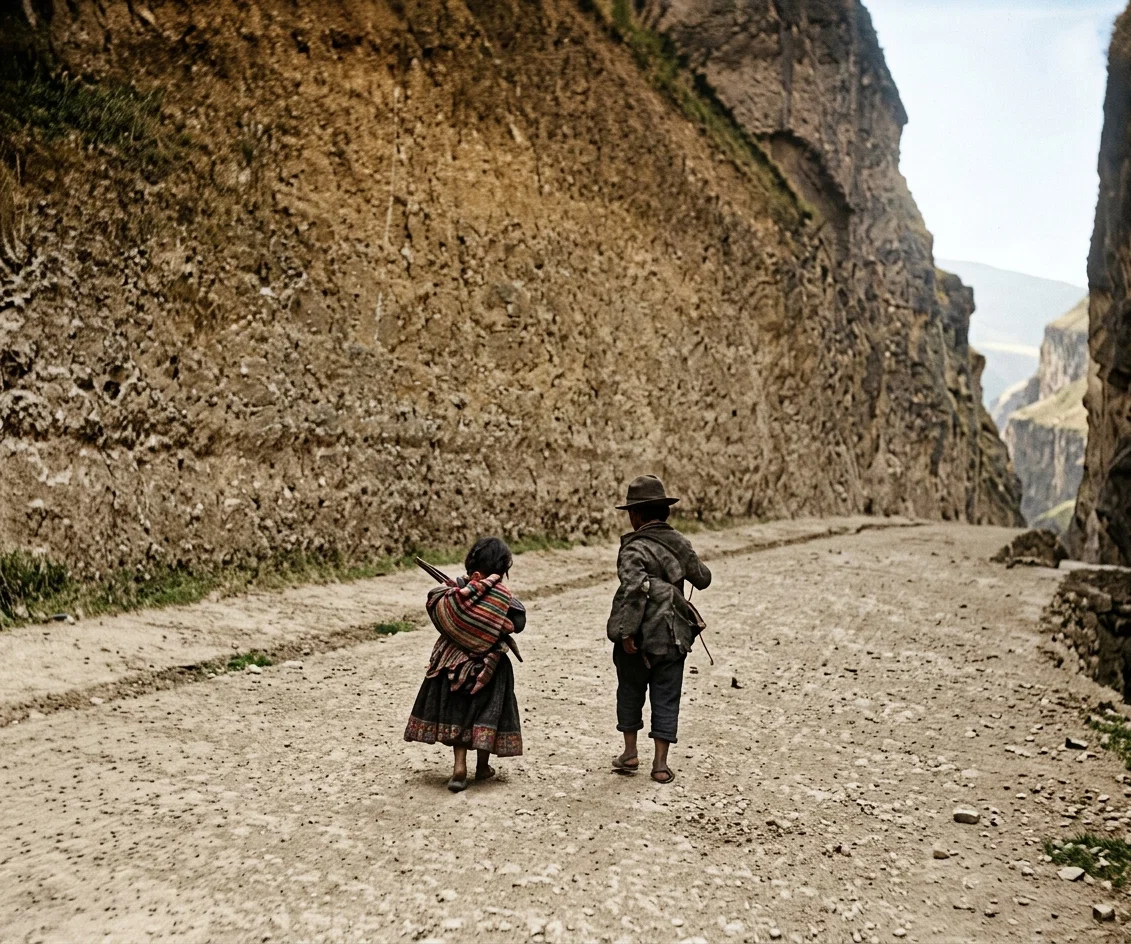
TWO LITTLE PERUVIANS
Our recent trip south will result, we think, in securing two or three persons for the canvassing work, and they are men who are capable of making a success of it. This will be a small effort for Chile, but it does not contemplate the other countries of this field at all. The experience in Chile and other South American countries has demonstrated that the work can best be opened up in new countries by the earnest, God-fearing canvasser; and we ought to have at least two for each of the other republics of this field, at once.
Those who come to this field should be such as can and will become one with the people. Otherwise, they cannot help them. Jesus became one with us and of us, in order to lift us up; and he never haughtily passed the poor and lowly.
We need a school in this field for the training of native help. Such a school is even more necessary in fields where the educational advantages are limited than it is in the States. It will not do to send our young people to the States for an education. Rather, those from the States might to advantage come to these fields to complete their education, in getting those things that will be of practical help in working for this people.
Buenos Ayres.
The General Meeting in Finland
By Louis Richard Conradi
L. R. CONRADI
Of the four fields in the Scandinavian Union Conference, Finland has thus far received the least help and attention. This may be partially due to the fact that Finland does not naturally belong to Scandinavia, but was added by conquest. Centuries ago the Swedes overran the northern shores of the Baltic, while the Germans conquered the southeastern; and, although Russia long ago wrested these lands from the Swedes and Germans, yet the Swedish and German languages still remain in the ascendency in these districts.
The country of Finland is twice the size of the State of New York, and contains a population of 2,700,000, of whom 2,300,000 are Finns. The Swedish language predominates in the cities, and is the vehicle of thought employed by the nobility and the educated and merchant classes, while Finnish prevails in the interior and among the rural districts. About 400,000 speak Swedish, and until the present time our ministerial work has been confined almost entirely to the Swedish-speaking inhabitants, and, previously to the arrival of Brother Anderson last autumn, we had only one minister in the field, so even the Swedish people in Finland were not very liberally provided for.
As all literature, both Swedish and Finnish, must be printed in Finland (otherwise we cannot circulate it), we found it necessary to start our own depository, located in Helsingfors, where the printing of their books and the publication of their Finnish journal have been done by outside parties. The canvassing work opened favorably for they sold about six thousand dollars' worth of books a year, but their canvassing force was not stable, and the publishing house did not reap the benefits it should have realized. The years immediately preceding the present one witnessed an actual crisis in the work there, during which the cause of present truth retrograded rather than advanced. But of late a decided change for the better has taken place, a good foundation is being laid for the development of every branch of the work, and brighter days are ahead. Elders Hoffman and Anderson have held a successful series of tent meetings in Wasa, in spite of the rainy14cold season. Twelve took their stand, and a good interest remains to be followed up during the winter. In other places nine more have begun to obey, and our brethren report a promising opening, and a desire to hear the word. Brother Anderson is becoming better acquainted, and expects to give special attention to acquiring the Finnish language. He will now labor at Björneborg. We should certainly associate a few promising young men and women with our ministers here, not only as assistants to them, but that these young people may themselves be educated to labor in both languages.
GENERAL VIEW OF BORGA
The tithe shows a favorable increase. Since 1900 it has more than doubled; it was then $350, and it is now over $700, or about eleven dollars per capita. We have seventy members in Finland now. Brother and Sister A. Boettcher, who moved here from Germany, have learned the Swedish language, and are proving a substantial help to our depository and church in Helsingfors. Through their efforts a Finnish brother of some education has accepted the message, and he has already proved very helpful in the work of translating and correspondence. Brother Hamar, who came from Sweden to assist in the canvassing work, is rapidly acquiring the Finnish, and has been abundantly blessed in his labors. He was able to turn over one hundred dollars of his earnings as a donation to the Finnish depository. We have appointed him general canvassing agent, while hitherto Brethren Sherrig and Lind had to make expensive trips thither, and were able to remain only a short time, rendering what assistance they could to the gospel colporteurs in the field. Until recently, the depository did its printing and binding on credit, and was thus at the mercy of the printers, paying from ten to twenty-five per cent more than the work could have been done for in other places; but by a careful management of the appropriations received from the Mission Board, we have now paid off all indebtedness, so that the depository owns its stock, which is valued at three thousand dollars, and secures all benefits derived from the cash system. Times are very hard on account of the terribly wet and cold season, some districts actually suffering from famine; and business firms are only too glad to allow the most favorable rates to those who do a cash business.
Our general meeting was held in Borga, an old seacoast town near Helsingfors , October 7-12. Borga has about seven thousand inhabitants. Elder Hoffman has made his home here for several years, and eight souls have taken their stand in this place. Of the seventy Sabbath keepers, thirty-five were in attendance, and we had a good meeting. Brother E. Lind, our general canvassing agent in Sweden, accompanied me, and he will remain there for some weeks, to assist in advancing the interests of the publishing work. Those present pledged about fifty dollars toward paying for two hundred copies of “Christ's Object Lessons,” in the Swedish, which the brethren plan to sell for the advancement of the educational work there. The evening meetings were held in a large hall, with from fifty to one hundred in attendance, and the running expenses were fully met by the collections.
All in all, the prospects for the cause of God in this country are brightening. What Finland needs is more laborers. What are two or three workers among nearly three million people? Some States in America have forty or more workers for such a population. Two thousand copies of the Finnish paper are printed, the loss on the same for last year amounting to about one hundred dollars; but thousands of this messenger of truth ought to be distributed. As hundreds and hundreds of Finns are emigrating to America and settling in the United States, why should not some plan be devised to circulate that journal and our other Finnish literature among them? We are only half awake to our opportunities; let us be up and doing.