Your ShelfYour Projects

Review and Herald, Vol. 84, No. 24.

Dedicatory

Review and Herald

Jun 13, 1907

Review and Herald Publishing Association · Tacoma Park Station, Washington, D. C. · Jun 13, 1907

Dedicatory
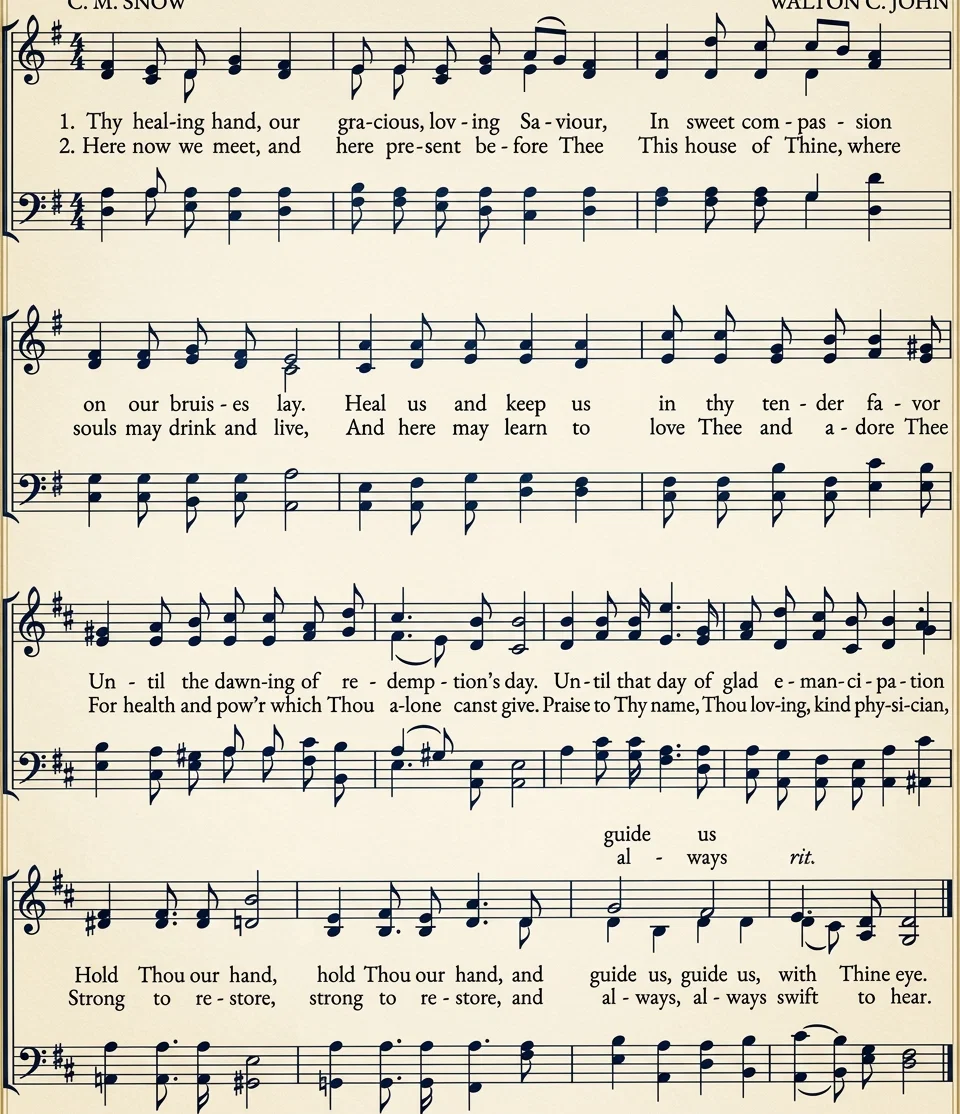
Through all Thy life while here a man of sorrow Thy healing hand and feeling heart were bare; Sin, sickness, woe, could never wait the morrow, If Thou, our God, didst touch the stricken there. Blest be Thy name, Thou loving, kind restorer, Here let Thy hand in healing power be seen. Thy heart of love is touched with every feeling Of woe that smites Thy stricken children here. So sanctify these instruments of healing; Give of Thy power, and bless from year to year, Lord, bless Thine own, and grant Thy Holy Spirit, While now this house to Thee we dedicate.

Our Publishing Work

The Lord gave the word: great was the company of those that published it. Psalm 68:11.
See last paragraph on this page for instructions where to order.
HAVE you examined the new series of True Education Readers? Note what was said about this series on the second page of the REVIEW, the May 30 issue.
THE Southern and the Review and Herald Publishing Associations do not seem to be able to print “New Testament Primers” fast enough to supply the demand. “They sell at sight.”
ONE of the new solicitors for Life and Health recently sent her second order for the June number of the journal; and doubling her first order, she explains that fifty copies did not last her more than two hours. She has earned her share of the $150,000 fund, and is now selling Life and Health to pay her sister’s share. This ought to be a suggestion for others.
RECENTLY a letter came addressed to Liberty, containing a year’s subscription and the following explanation: “I found a copy of Liberty on a street-car. I was surprised and pleased to learn that such a publication was printed. The copy I found contained my sentiments, and I want to give such a publication my hearty support and encouragement.” There are thousands of other men who will appreciate Liberty as this one did. Who will help to place it before them?
“EARLY WRITINGS” sparkles with the plain principles of the third angel’s message, and brings to the reader a store of information and instruction that will be especially helpful at the present development of our denominational work, and will do more to establish faith and confidence in the gift of the spirit of prophecy among this people than any other book published. It contains a compilation of the first published Testimonies, with foot-notes giving dates and explanations. It is a reprint of the old book published in 1851, under the title of “Experience and Views,” with no change in the original idea and sentiment. Bound in plain cloth, 154 pages, 75 cents, post-paid.
“HOME AND HEALTH” is our new health book, especially designed for home reference, treating of the many details pertaining to the home and the care of the body. Its general scope embraces “The Home”—how to make it; “General Housekeeping”—all of its details; “The Diet”—what it should be; “The Care of the Body”—revealing the simple things one must do to keep the body healthy; “The Care and Training of Children”—sound common sense for all parents; “The Home Treatment of Disease”—a valuable instructor, doctor, and nurse. This book will prove to be an all-round, valuable counselor in every feature of home and health. It contains 592 pages, and is illustrated with over 250 original drawings made especially for the book. We want 500 agents to present the book to the public. Write to the State tract society for particulars in connection with soliciting for “Home and Health,” rates to agents, etc.
“THE CHURCH: ITS ORGANIZATION, ORDER, AND DISCIPLINE,” is a book our church-members need to study at this time. It contains the instruction given to the church through direct Testimony in a condensed, classified form, arranged especially for study and reference. Every home should have a copy, and every individual should become familiar with its teachings. It is a pamphlet of 184 pages; price, 25 cents.
“THE GREAT ADVENT MOVEMENT” accurately cites the progress of the denomination from the beginning down to the present time. There is no other book circulated of such importance and thrilling interest to the readers of the REVIEW. This timely publication will strengthen faith and confidence in the great advent movement. Its readers will have a more perfect knowledge of the dealings of God with this people, and of the message they are giving, and will be better prepared to unite their efforts in advancing this great work. We therefore heartily commend the book to our REVIEW readers. Bound in plain cloth, 400 pages, $1.50.
“OUR LITTLE FOLKS’ BIBLE NATURE” is a child’s kindergarten book which has been recently revised and enlarged. It is composed of simple graded lessons in Bible nature, beginning with a narration of the events in the week of creation, and continuing the Bible stories in the order given in the Scriptures. It is a beginner’s graded book of the sentence-method order. Each subject is thoroughly illustrated with new drawings made especially for the book. It is also illustrated with fifteen beautiful colored plates, and contains 159 pages, bound in attractive board and cloth covers. In addition to being a book for general home use, it is especially adapted for church-school work as a reader. Prices, 25 and 50 cents.
“THE STORY OF DANIEL THE PROPHET” is a biographical, historical, and prophetic book, revealing in the life of Daniel and his close connection with God all the vital principles for the gospel message at the present time. It contains a clear, concise treatise on the prophecies of Daniel, given with an interesting study of the sanctuary and its services. The book will be a delight and source of information to every student of the prophecies. The story of Daniel, while interwoven with historical facts, is presented in so pleasing a manner that it may become attractive to all, and Daniel’s example is so favorably impressed that no person can read the book without receiving valuable lessons. Price, $1, post-paid.
Orders for any publication mentioned on this page may be sent to any conference tract society, or to Review and Herald Publishing Association, Takoma Park Station, Washington, D. C., or Battle Creek, Mich. Also Pacific Press Publishing Association, Mountain View, Cal.; Portland, Ore.; Kansas City, Mo.; Southern Publishing Association, Nashville, Tenn., and Forth Worth, Tex.

Editorial Letter

Jottings from the Editor’s Note-Book

The weather was exceedingly warm for the time of the year when we left Hongkong, and it continued this way until we had crossed the Indian Ocean, but the sea was very smooth, and we had a favorable voyage in every way.
The table at which I was assigned a seat in the dining saloon was filled with missionaries returning to Europe and America from Japan and China, and I made some pleasant acquaintances among them. One gentleman and his wife had been stationed at Kobe, Japan, and had been among the patients at our sanitarium in that city. They spoke appreciatively of the work of the Drs. Lockwood; and the fact that I was personally acquainted with them, and had recently stayed at the sanitarium, was a sufficient introduction to them. This also announced my denominational connection, and opened the way for some discussion of our general mission work. Another gentleman and wife were from Frederick, Md., and of course were well acquainted in Washington. I invited both of these missionaries to visit our headquarters, and to address our workers upon the mission work in Japan, and I hope they may be able to do so before they return to their fields in the far East.
A run of four days brought us to Singapore, where I was much gratified to be able to spend a day on shore at our mission station. Elder E. H. Gates, who attended our conference at Shanghai, in company with some of the other workers met me at the wharf, and extended a cordial welcome. It was a special pleasure to meet Brother and Sister G. F. Jones, who were formerly fellow laborers in England, and whom I had not seen since the General Conference of 1901. Their hands have been strengthened by the arrival of several earnest workers from Australia (Singapore is under the supervision of the Australasian Union Conference), and the outlook for the spread of the message is most encouraging.
In the evening a good company gathered in the mission rooms, and I presented to them some of the vital principles of this third angel’s message, and what is involved in their acceptance. The audience was composed of Europeans, Malays, and Chinese, and the work is being carried forward in behalf of these and other nationalities. Here I had the privilege of meeting Brother Timothy, the young man who carried the Sabbath truth to Brother Keh at Amoy. He is still seeking to extend the truth as the Lord opens the way before him.
Although there has been bitter opposition against our work on the part of some of the other missionaries in Singapore, yet the Lord has helped the brethren to meet this in such a way as to gain decided victories for the message, and to turn public sentiment in their favor. There was also marked evidence of a favoring providence in their being able to secure a new house in an excellent location for a reasonable rent, in spite of the fact that the owner was offered more by another party. We were thankful to note these encouraging omens, and to learn of the general prosperity of the work at this mission station. We hope future reports will tell of rich harvests reaped in this field.
Our next call was at Penang, where we remained about twelve hours; but as we have no workers there, I stopped but a short time on shore. A quiet voyage of four days brought us to Colombo, where I hoped to find a representative of this message, but after two or three hours’ search I learned that the last worker had left for Calcutta in December. I regretted to find the field abandoned, and am glad that plans have since been formed to lift up the standard again where the breezes “blow soft o’er Ceylon’s isle.” Colombo is not so large a city as some other ports of the East, and Ceylon has a population of only three millions, but it is an important station in the highway from Europe to the far East, and also to Australia, and the light of truth should shine forth from this center.
To my surprise, the weather was somewhat cooler after leaving Colombo, and we did not suffer any special discomfort in passing through the Red Sea, although during the hottest part of the season passengers have fainted on deck on account of the almost unbearable heat. Our ship anchored off Aden just before entering the Red Sea, and again off Suez just before entering the Suez Canal, but no passengers went on shore at either place, and from the deck we could see only barren rocks and the sandy desert. The view was interesting, but not attractive. We tried to persuade ourselves that we could see Mount Sinai a few hours after we had entered the Red Sea, but our better judgment refused to be convinced. Of course we must have crossed the route taken by the Israelites in their journey from Egypt, but we could not locate it with certainty. This whole country is rich in historical associations to one who believes the Bible, and I would gladly have spent a little time there, but the way did not seem to be open to do so on this journey.
Passing through the Suez Canal is an experience of much interest. It is unusual and strange to be on the deck of a ten-thousand-ton ship with the land on either side only a stone’s throw distant, and in some cases the channel is so narrow that the greatest care is necessary to prevent running aground. In fact, this is a mishap which is altogether too common, and I thought at one time that we were to know what it meant, but a quick reversing of the engines saved us from it. For a considerable portion of the distance the speed does not exceed four miles an hour, and the whole time occupied in getting through the canal was twenty-one hours, but we were tied up to the bank four hours in order to let other ships pass us. The opening of this canal has wrought great changes in the commerce of the East, and it is likely that the opening of the Panama Canal will cause similar changes in the commerce of the West.
It required nearly a whole day to coal our ship at Port Said, and this gave a good opportunity to see this city. Here were more strange sights to interest one from the West: the Turkish women,with their faces carefully covered and their feet bare; the bright-red fez worn by nearly all the men; the water-carrier selling water from a skin; the many curios of attractive workmanship; the beautifully woven silks and shawls; the Mohammedan mosque in which a strange worship was being carried on; and with all the rest, a people bent on extracting every penny possible from the pockets of foreigners. Port Said is an important port, and the harbor was full of the steamships of the different nations. The one thing lacking was a representative of this message to make known the truth for this time. I hope this lack may soon be supplied.
As we passed along the coast of Crete and sailed on through the Mediterranean, I thought of that other voyage taken many centuries ago when the ship was driven up and down for fourteen days, and when all hope of seeing land again was lost. The contrast is very marked between the comforts enjoyed by our missionaries in their travels now and the hardships experienced by the apostle Paul and his companions. But greater facilities are required now in order to be able to carry the message in one generation to a larger world than was known in Paul’s day.
We sighted the south coast of Italy Monday noon, April 8, passed through the Straits of Messina the same afternoon, and anchored in the harbor of Naples early the next morning. This brought to an end my long sea voyage, and I was again back in the Western world, although still thousands of miles from my starting-point, and among a people of a strange language, but I had left the East behind me. I shall, however, never be able to shut out from my mind the impression of the almost uncounted millions of the far East who are “without hope, and without God in the world,” and I carry a burden for them such as never rested upon me before. I have left the East, but the East is still with me.
I spent a short time at Naples, and among other things I viewed with special interest the city and harbor of Pozzuoli, the ancient Puteoli where Paul landed when he took his journey to Rome under circumstances very different from mine. Then Puteoli was a busy place of no little importance as the principal port of the capital of the great empire, but it is now a sleepy old town, a mere reminiscence of the past.
I journeyed to Rome by a fast train, and although no brethren could meet me either at Appii Forum or the Three Tavens, yet Brother Everson met me at the station, and welcomed me to the Eternal City, and I was soon comfortably settled for my stay. Of my experiences I will write later. W. W. P.

Is It Not Time to Do Great Things for God?

It is certainly very appropriate that Seventh-day Adventists should each year make a fourth-of-July offering to aid in proclaiming the third angel’s message to the world. This is consistent with the character of our message. On the fourth of July the American people will spend many thousands of dollars for drink, tobacco, races, dances, and fireworks. The most of this large sum of money will be worse than wasted. And this while the great river of lost humanity is pouring over the falls into an abyss of eternal ruin.
Jesus died for every one of these poor sinners. He is now offering his life of mediation for them, and many of them do not know it. Their lot has been cast beyond the light of the glorious gospel. The third angel’s message is that gospel revealed in all its fulness. It is now to be proclaimed to all the world—every nation, kindred, tongue, and people. It has reached our hearts, and it now calls upon us to make it known to our fellow men in every land. The fourth-of-July offering is to be one of the expressions of our response to this call. Will that response be general, whole-hearted, and large? Will it be in keeping with the importance of the need and the ability God has given us?
This offering this year is to be applied on the $150,000 fund, and that fund is to be used in providing most important and greatly needed facilities for hastening this cause to its close. Surely the time has come for Seventh-day Adventists to arise and do something large. We have come to the place where the people must act. This is the only solution of this problem. Many hours and days and weeks of anxious thought and earnest prayer by the most experienced and devoted men in our ranks have been given to the various facilities to which this offering is to be devoted. They have seen that these facilities are absolutely necessary for the advancement of this cause. The question of calling for this large fund was most carefully considered in all its details by the General Conference Committee. All agreed that it be done. Whether it will be raised, and when, must rest now with the people.
It certainly looks as if when a careful and prayerful decision is reached by those chosen by the people to lead out in the work, to do a definite, specific thing, all the people should loyally step forward as one man and do it. Unless this is done, what is there to encourage the leaders to devise any definite plans for progress? The prompt, hearty, united response by the people of God when they are called to service, may be illustrated by the following story told of some British soldiers who were called to suppress a rebellion among the Ashanti tribes on the west coast of Africa:—
One morning the officer in command came to speak to the soldiers as they were drilling on the level stretch of land. He said: “Soldiers, I have a dangerous enterprise on to-day. I need so many men. Every man that goes may lose his life. It is as serious as that. I am telling you frankly. I could draft you, but I don’t want to. I would like to ask for volunteers. I want those who will volunteer for Her Majesty’s sake to advance a pace.” They were drawn up in a straight line, and thinking the men might be influenced by his look, he swung on his heel, and off, then back again, and looked. The line stood as straight as before. His eye flashed fire. “What, not a single man to volunteer!” Then a fellow standing at the end of the line next to him saluted and said, modestly, “If you please, sir, every man has advanced one pace.”
This is the way the believers in the third angel’s message should step forward when duty calls. Then the work would be hastened, and the end, for which the surviving pioneers in this cause, and many younger ones as well, so devoutly long, would come.
A. G. DANIELLS.

The General Conference Committee Council at Gland, Switzerland

Second Report

The committee voted that all the laborers of conferences and mission fields in attendance should be invited to participate with the committee in the deliberations of the council. The following standing committees were appointed:—

Standing Committees

On Plans and Recommendations: W. W. Prescott, G. A. Irwin, R. A. Underwood, J. C. Raft, G. B. Thompson, E. E. Andross, W. J. Fitzgerald, J. T. Boettcher, Guy Dail, W. B. White, W. Ising, W. H. Meredith, G. Schubert, M. A. Altman, S. F. Svensson, M. L. Andreasen, J. Curdy, C. E. Rentfro, L. Mathe, J. Erzberger, H. J. Loebsack, J. Pieper, L. R. Conradi, A. G. Daniells, Frank Bond, J. G. Gillatt.
On Appropriations: L. R. Conradi, I. H. Evans, P. A. Hansen, W. A. Spicer, E. T. Russell, J. H. Schilling, R. C. Porter, L. P. Tieche, Wm. Covert, S. G. Haughey, W. D. Mac Lay, G. F. Haffner, J. G. Oblander, N. P. Nelson, O. Wildgrube, E. Frauchiger.
On Publishing Work: I. H. Evans, L. R. Conradi, H. R. Salisbury, W. A. Spicer, W. C. Sisley, W. T. Bartlett, J. Robert, W. W. Prescott, H. Hartkop, E. Arnesen, H. H. Dexter, E. Lind, C. T. Everson, Walter Bond, J. Vuilleumier, A. C. Christensen, R. G. Klingbeil, D. P. Gaede, Jens Olsen, S. Jespersson, Fred Anderson, D. Ostlund, J. F. Huenergardt, E. Schwantes.
On Educational Work: F. Griggs, H. R. Salisbury, O. Luepke, O. A. Johnson, J. Vuilleumier, W. H. Wakeham, L. Muderspach, H. F. Schuberth, D. Isaak, J. M. Erikson, W. E. Howell.
On Medical Work: P. A. De Forest, E. Meyer, A. B. Olsen, R. S. Ingersoll, Mrs. Olive P. Ingersoll, V. Pampaian, R. G. Edib, C. Reihlen, John P. Hansen, G. A. Irwin, A. G. Daniells.
Of great encouragement to the council was the report of the treasurer of the General Conference, I. H. Evans, which appears in the opposite column.
On the reading of the Auditor’s report, certifying to the correctness of the accounts, the Treasurer’s report was accepted.
Many expressions of thankfulness to God were uttered in the discussion of the report, as it was seen how his blessing upon the believers had granted prosperity financially to the cause, enabling more workers than ever to be sent forth into the fields, allowing the establishment of new missions, and yet reducing obligations. The General Conference, unorganized, which for years had carried a considerable indebtedness, was now free from debt. These conditions brought satisfaction to the council in view of the fact that the calls for help from the wide-open fields come with tremendous force. Again and again as the workers have presented the victories gained and the doors opening on every side, the council has been mightily moved, and stirred with deep anxiety to press the message forward in the mission fields. Never was the lack of funds so distressingly felt by a council.
As already announced in the REVIEW, the council voted to devote the midsummer offering to the missionary enterprises represented in the $150,000 fund. It was the sentiment of the council that this fund should be quickly made up, thus establishing the missionary training centers benefiting by it, so that with all its powers the denomination may answer the calls from literally the whole wide world for the living preachers to go in among the people who are praying God for light, or who are unwarned and unconcerned about the things coming upon the earth.
Day by day through the meetings the council is studying the needs of the fields as they are presented by the workers representing them. These reports have led every president of an organized field to feel more deeply than ever that the strong must help the weak, and that unitedly Northern Europe and America, with colonial fields where the work is strong, must go forth among the millions amid the darkness of Catholic and heathen lands.
Little French Switzerland, the smallest of conferences, presented a splendid report. It devotes fifty per cent of its income to other fields. It aims to train workers for other countries. While now taking up work among the Catholics inits own territory, it has supplied nine workers to France, one to Belgium, and one to the West Indies. Elder Tieche, the president, told of incidents showing that the cause is gaining larger recognition in this interesting field in which the council is gathered.
Nearest neighbor to the place of council is the great French field, where two hundred Sabbath-keepers are stretching every nerve to carry the truth among the forty millions of France. Fierce opposition is sometimes met, stones are thrown, and men have sought to break up meetings; but wherever the little band is able to make the effort, souls have taken their stand for the truth. The field needs help to set men into the colporteur work at the lowest wages,—men, too, who have proved their loyalty by giving up well-salaried positions, and enduring privations month after month with never a thought of yielding the truth. The field could keep two tents running if it had them. Elder Dexter’s appeal for France stirred every heart.
A little band of workers and believers are here from Spain. Brother Walter Bond reports twenty-three baptized in that newly opened field, three of whom have turned back, but the rest are true and faithful amid persecution. The believers are workers. We were told of two sisters providentially saved from a mob sent after them by a priest to stone them. They were unconscious of being followed. As they passed through a country path, a man came from a little cottage and beckoned them to come in and sit down and eat some grapes. The mob, following rapidly along the path, went past them, and searched in vain for the sisters, the mob and villagers afterward being stricken with the conviction and fear that the Lord had miraculously snatched them away.
The British Union has made reports of its field, showing progress in all the conferences of that great and important union.
Word just reaches the council that two young men in Germany are under arrest for declining military duties on the Sabbath. Hearty prayers were unitedly offered for these and other young men in these fields who must bear the brunt of existing military law. Through all these trials and by these trials the truth is being proclaimed. But these experiences are stern realities to our brethren and sisters who pass through them. The German newspaper reporting one case said the young man walked from the court to begin a six-months’ imprisonment with head erect and courageous trust in his God.
Elder Boettcher brought cheering word to the meeting that Bavaria, so long denying to our people the right of religious assembly, had just granted liberty to Seventh-day Adventists to meet and sing and pray, with none to make them afraid. The believers can scarcely realize that this great deliverance has come. The council rejoiced with these believers. It is one world-wide work, and God is finishing it.
W. A. SPICER, Secretary.

The General Conference Association *Financial Statement Dec. 31, 1906

General Conference Receipts and Disbursements for the Biennial Period Beginning Jan. 1, 1905, and Ending Dec. 31, 1906

RECEIPTS                         DISBURSEMENTS Overdraft on Gen. Conf. Assn., Jan. 5, 1905               $2,252.16 Washington Building Fund         $65,164.52      61,458.23 District of Columbia            14,531.11      12,983.04 Publishing houses             20,749.91      33,858.03 Conferences and tract societies      13,679.02      27,335.32 Specific and special accounts       39,193.64      35,134.11 Depositors                51,987.30      35,965.76 Expense                            7,758.45 General Conference building                   14,066.56 General Conference session (1905)     4,239.82       2,697.95 General Conference Association      8,878.50      59,225.53 General Conference Corporation      1,544.62       5,687.56 Haskell Home               2,750.68       4,265.81 Merchandise               12,195.15      12,147.54 Missionary Acre             1,171.21 Religious Liberty Bureau         5,660.46       1,332.15 Work for the colored people       13,092.14      11,100.25 From conferences for support of laborers 33,871.69 Laborers and mission fields                  273,468.09 Missions                107,660.46 Annual offering             81,962.82 First-day offerings           46,413.21 Midsummer offering           18,845.75 Sabbath-school donations        66,145.45 Tithe                 20,365.58 Second tithe               3,773.30 Orphanage fund              4,398.40       4,081.33 Loans                 10,789.02      26,185.20 Pacific Press Fund            5,915.80       5,949.31 $150,000 fund              7,470.15       3,869.48 Cash on hand Dec. 31, 1906                  21,627.85                    $662,449.71     $662,449.71
Comparative Statement for the Biennial Period Jan. 1, 1905, to Dec. 31, 1906 Resources Jan. 1, 1905         $27,195.20 Resources Dec. 31, 1906         67,652.30 Gain in resources for biennial period   $40,457.10 Liabilities Jan. 1, 1905         $71,831.43 Liabilities Dec. 31, 1906        38,398.75 Decrease in liabilities for biennial period $33,432.68 Gain in resources for the biennial period from Jan. 1, 1905, to Dec. 31, 1906 $40,457.10 Gain in decrease of liabilities for the biennial period from Jan. 1, 1905, to Dec. 31, 1906 33,432.68 Grand total gain for biennial period              $73,889.78

The General Conference Association Financial Statement Dec. 31, 1906

RESOURCES Bills receivable            $62,474.21 Echo Publishing Company          2,230.90 Evans, I. H., Trustee          2,757.70 New Zealand Tract Society         675.85 Real estate               5,818.60 Conferences               1,585.75

LIABILITIES Bills payable              $82,775.13 Deposits                 850.50 Claremont Sanitarium            19.57 Dower, Amelia, estate           150.32 Evans, I. H., Administrator        281.00 General Conference Corporation      5,892.88                     $89,969.40 Net deficit Dec. 31, 1906        $14,426.39

GAINS General Conference Association Fund    $2,607.38 Interest                 3,227.50 Rent                    44.68 Christian Record              24.26

LOSSES Expense                 $33.25 Michigan Conference            40.00 Taxes                   56.97 Notes not counted good         1,745.00 General Conference Assn. Library       .45                     $1,875.67Net gains                $4,028.15

General Conference Corporation Resources and Liabilities Dec. 31, 1906

RESOURCES Real estate, Takoma Park (Inventory)   $25,841.41 Bills receivable            118,116.75 General Conference Association      5,892.88 Ministry of Healing, initial expense    1,165.60 Relief Bureau expense           3,750.26 Southern Publishing Association       518.26 Washington Training College       1,351.25 Riggs National Bank           6,250.26 Cash on hand Dec. 31, 1906        102.00 Total resources            $162,988.67

LIABILITIES Bills payable             $137,634.86 Accrued interest payable         617.96 Depositors' accounts           6,375.00 Total liabilities           144,627.82 Excess of resources over liabilities Dec. 31, 1906 $18,360.85

Loss and Gain Statement for the Biennial Period Jan. 1, 1905, to Dec. 31, 1906 ### LOSSES Expense                 $144.74 Interest                626.06 Insurance                747.35 Real estate (Battle Creek)       27,629.39 Total losses             $29,147.54

GAINS General Conference Corporation fund   $15,534.87 Real estate (Takoma Park)        2,758.84 Total gains             $18,293.71 Net loss for biennial period      $10,853.83

NOTE.—The apparent loss on real estate of $27,629.39 was not a real loss. The General Conference Corporation bought this property for the debts of the International Medical Missionary and Training-school Association. The General Conference paid 43,292.25 for this property. It was then inventoried at $75,000, showing on the books a gain of the difference, $31,707.75. Later, when the General Conference sold this property to the American Medical Missionary College, it was sold for $47,370.61. As the property was inventoried at $75,000, it is evident that the books must show a loss of the difference between that and the inventoried price, of $27,629.39. Yet there was no real loss, as the conference sold the property for more than it paid for the same. The apparent loss is in book entries.
The actual gains of the General Conference, the General Conference Association, and the General Conference Corporation for the biennial period ending Dec. 31, 1906, are as follows:— General Conference     $73,889.78 General Conference Assn.   4,028.15 General Conf. Corporation   16,775.56 Total gain        $94,693.49
If we should write out the book entry loss of $27,629.39 on the Battle Creek College property, we would still have a net gain of $67,064.10 during the biennial period. I. H. EVANS, Treasurer.

Christian Science and Cruel Superstition

THE following paragraphs we clip from the Home Herald, of Chicago, that our readers may see the fruit of that belief miscalled “Christian Science:”—
“John R. M., the four-months-old child of Mr. and Mrs. James W. M., of —— street, died yesterday morning about eleven o’clock, and a physician, who had been called too late, refused to give a death certificate.”
The above paragraph appeared in an Eastern newspaper a few days ago. The father stated that lack of faith was responsible. The physician was irreligious enough to refuse the certificate, because he had not been called to see the child twenty-four hours prior to its death, the period required by law.
To a reporter the father made the following confession: “I believe that healing is the work of the Lord, not of man, because the Scriptures teach us so.” “What did you do to relieve the child’s pain?” he was asked. “We prayed, fed it, and gave it water.”
This in Christian America! Indorsed by a Christian elder, and perpetrated by a Christian father! It is strange that the purest types of faith are thus perverted, and that parental love must be strangled thus in the name of Jesus Christ. We dare not believe that mysticism is an ailment of the church today; far otherwise. In such instances, however, a bit of skepticism would be a work of grace.
And yet we can hardly agree that skepticism is necessary even in so aggravated a case of cruel superstition as this. A heart of pity and a little common sense ought to be a sufficient antidote, to say nothing of the love of Christ in the heart and a due sense of parental responsibility.
Continue reading: One Hundred and Fifty Thousand Dollar Fund