Signs of the Times, Vol. 33, No. 14.

Contained in this Issue

Signs of the Times

Apr 3, 1907

Pacific Press Publishing Company · Mountain View, California · Apr 3, 1907

Contained in this Issue.

THE PARABLE OF THE SOWER.
OUR HIGH CALLING.
QUESTIONS.
2037.—Handling Snakes; 2038.—Public Prayer, Matt. 6: 6; 2039.—The Immutable Law, Matt. 5: 17-19; 2040.—The Seal of God; 2041.—2 Kings 8: 26 and 2 Chron. 22: 2; 2042.—Various References; 2043.—Time of the Passover.
THE GREAT SALVATION.
"Ye Are My Witnesses."
"I COUNSEL THEE."
THE GENEALOGY OF CHRIST.
IN HIS SNARE.
JOSEPHUS AND CHRISTIANITY.
"HOW READEST THOU?"
NONE GOOD.
OUR JESUS.
PILLARS OF HEALTH.
Mush and Liquid Foods.
MAGGIE'S GIFT.
HUMAN AND ANIMAL TUBERCULOSIS.
A WOMAN OF MILLIONS.
CHINA.
Chinese Education.
SAN FRANCISCO'S GREATER CALAMITY.
IDAHO'S NEW SUNDAY LAW.
THE SUNDAY NEWSPAPER.
THE CIGARET BOY.
SUNDAY-LAW NOTES.

Poetry

'Tis Not the Gift.
"As the Hart Panteth."
Thou Will of God.
Signs.
The Gift I Ask.
A Prayer.

PRICES

TO CHURCHES ON SUBSCRIPTIONS TO

Signs of the Times

Including Series of 26 Special Numbers

1. Regular Club Rate, 2 cents per copy per week, on copies subscribed for by members in the regular church club (Five or more to one name and address).
2. Four or more new yearly subscriptions furnished at one time by one person, $1.00 each.
3. This same rate will be given on this special six months series, if: a. The subscriptions are new; b. Not less than four are subscribed for by one person; c. The order is sent through the Church Librarian.
4. During publication of this series, a special rate of 30 cents for three months subscriptions to single names and addresses, when conditions given in No. 3 are complied with.
Note.—It is understood that on subscriptions where addresses are changed at the expiration of three months, 5 cents additional will be charged.
It is also understood that correspondence with persons whose names are being sent direct to the office shall be taken up by the members with first paper, so as to save refusals.

Signs of the Times

"Pasadena, Cal., March 5, 1907. "SIGNS OF THE TIMES, "Dear Sir: "It has been my good fortune to have two numbers, Feb. 6 and 13, 1907, of the SIGNS OF THE TIMES fall into my hands. I have been so pleased and interested that I want to know if I send a post-office order to Mountain View, it will reach you."

A Boon to Parents and Teachers

True Education Reader No. 2 has just been published. It is for use in Grade 2, that is, the second school year.
It is also admirably adapted for use in the homes where children do not have church-school privileges.
It will, in connection with Book One of the same series, put the children in possession of a complete key to English reading.
Its lessons are developed from the school-room work of the author, Miss Katharine B. Hale, who has successfully taught primary, public, and church schools, and is now teaching in Walla Walla College.

THE GOOD SHEPHERD

NEW PHONOGRAM LESSON BLEND DRILL | eth | call' eth lēad' eth tāk' eth lēav' eth | put' teth gō' eth flē' eth sē' eth | strān' gēr Shēp' hērd scāt' tēr eth fōl' low | hirē' ling thêrē' fōrē cātch' eth cār' eth |
THE SHEPHERD'S CHARGE.
1. The Good Shepherd calleth His own sheep by name, and leadeth them out.
2. When He putteth forth His own sheep, He goeth before them. The sheep follow Him, for they know His voice.
3. A stranger will they not follow, but will flee from him, for they know not the voice of strangers.
4. Jesus said, "I am the Good Shepherd. The Good Shepherd giveth His life for the sheep.
5. "An hireling, and not the shepherd, fleeth.
It presents, in connection with Books One and Three of the series, a great panoramic view of God's plan for this earth in the beginning, the successive steps in the wonderful work of creation, something about each of these steps, a sketch of certain selected Bible biographies, including the life of the perfect Child Jesus, His work, His sacrifice, the plan of salvation finished, and the new earth.
It contains 256 pages, is fully illustrated, and is bound in cloth. Price, post-paid, 75 cents.

FORTY-THREE PERSONS.

809 Copies for the Six Months Subscribed For.

On March 16 the plan for a course of connected Bible lectures (Beginning May 1) to be given in this year's volume of the SIGNS OF THE TIMES was explained to the San Francisco Church. At once the members were interested, and began to consider their opportunities for using this series. Here is the record of subscriptions ordered at that meeting:
Entire membership of church 209 Members present (So few on account of storm) 60 Blanks returned 43
2 persons subscribed for 2 copies, total 4 copies 8 " " " 5 " " 40 " 16 " " " 10 " " 160 " 3 " " " 15 " " 45 " 3 " " " 20 " " 60 " 6 " " " 25 " " 150 " 3 " " " 50 " " 150 " 2 " " " 100 " " 200 " --- 43 809

THE PARABLE OF THE SOWER.

How Do We Hear?
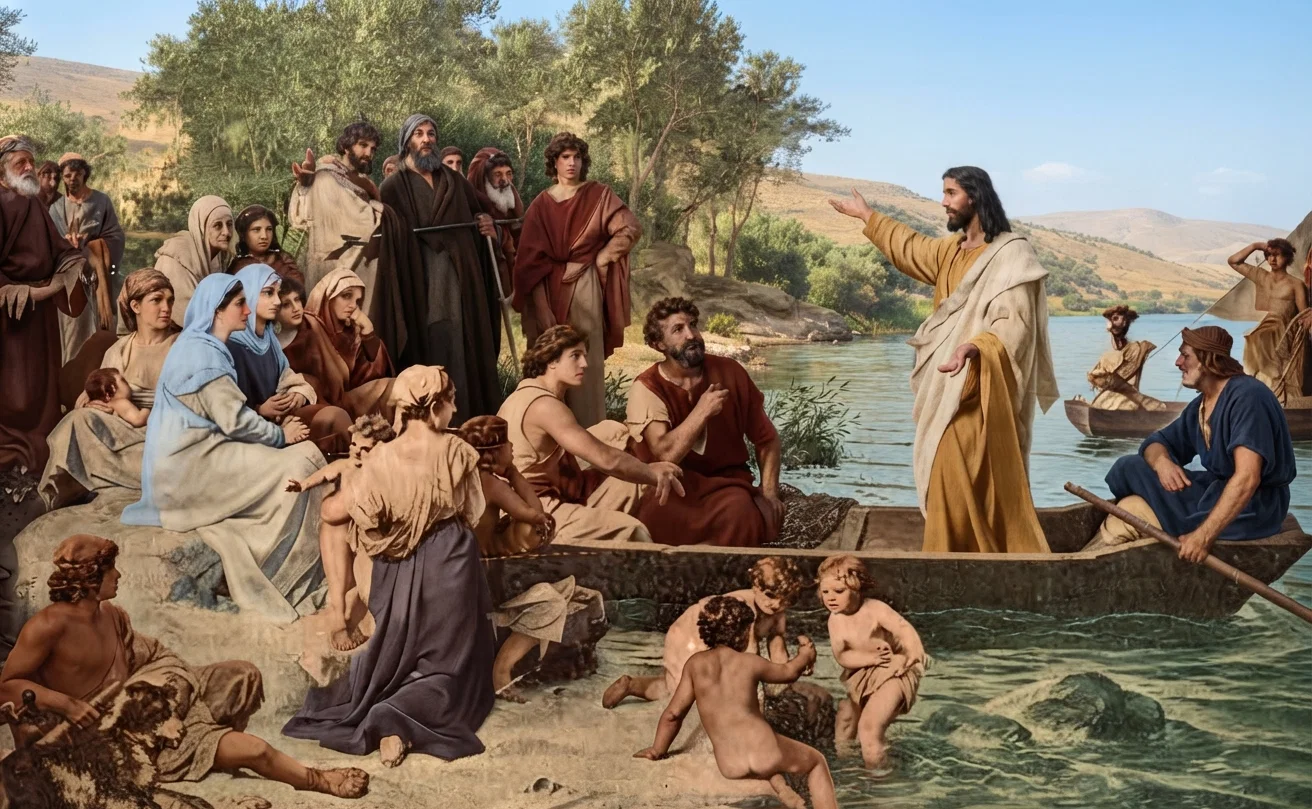
LISTEN, reader, to one of the simple lessons of our Lord; it is full of eternal importance to you. It was spoken by the lake-side of beautiful, blue Galilee, the Master in a common fishing boat, so as better to see the people; the congregation on the shore. The parable was a simple one, repeated before them many times every year:
CHRIST TEACHING FROM BOAT.
"Behold, the sower went forth to sow, and as he sowed, some seeds fell by the wayside, and the birds came and devoured them: and others fell upon the rocky places, where they had not much earth; and straightway they sprang up, because they had no deepness of earth: and when the sun was risen, they were scorched, and because they had no root they withered away. And others fell upon thorns; and the thorns grew up and choked them: and others fell upon good ground, and yielded fruit, some a hundredfold, some sixty, some thirty. He that hath ears, let him hear." Matt. 13: 3-9.
Slow of heart, the people did not understand its import; even His disciples did not, whom He had just ordained apostles. They come to Him and ask Him the meaning of the parable; and thus He gives it:
"When any one heareth the word of the kingdom, and understandeth it not, then cometh the evil one, and snatcheth away that which hath been sown in his heart. This is he that was sown by the wayside.
"And he that was sown upon the rocky places, this is he that heareth the word, and straightway with joy receiveth it; yet hath he not root in himself, but endureth for awhile; and when tribulation or persecution ariseth because of the word, straightway he stumbleth.
"And he that was sown among the thorns, this is he that heareth the word; and the care of the world, and the deceitfulness of riches, choke the word, and he becometh unfruitful.
"And he that was sown upon the good ground, this is he that heareth the word, and understandeth it; who verily beareth fruit, and bringeth forth, some a hundredfold, some sixty, some thirty."
---O---
No PARABLE goes "upon all fours." We must not force from it unnatural meanings. It is usually designed to teach one great lesson; and the truths of the lesson of this parable are that (1) "The seed is the word of God" (Luke 8: 11); (2) That the field or place of sowing is the human heart; (3) That the sower is Jesus Christ or His messengers; (4) That upon the condition of the heart, the reception of the word, is dependent the result of the harvest; (5) That we are responsible for the condition of the field. Study the parable with this thought in mind, remembering that the important thing is to hear aright.
---O---
FIRST, the wayside hearer: He has not time to listen. He catches a word here and another there. But the vital seed does not enter the soil. The beaten paths of loved pleasure and sin are too hard; and the devil, in whose service he has lived so long, sends his carnal agents of evil angels and unholy thoughts to cast out the seed. The Master is in His word, and He will not dwell in the heart which desires Him not.
---O---
SECONDLY, the stony-ground hearer has never broken up the soil nor gathered out the stones of sin, nor removed the evil in his nature. He wants the word and its blessings; he does not care to dig deep, or to know how much of useless stones cumber the ground of his heart. He is quick to hear, quick to respond, but there is no depth. The plowshare has not gone below the surface. The rain of God's refreshing falls upon the stony ground. The seed in the shallow soil, warmed by sun and stone, springs up, and gives wonderful promise of growth, but the hot sun of summer heat, the persecutions and hardship of a life of discipline, beats pitilessly down, and the growth withers, the promises fade, the hopes die. O, how many there are who thus start out hopefully in the Christian life, and after a little fail. They did not "break up the fallow ground" by heart-searching and repentance.
---O---
THIRDLY, the thorn-ground hearer represents another class, which more greatly arouses our sympathies. They do receive the seed. It does germinate in their hearts. They love it and cultivate it to some extent, but they do not root out the constantly up-springing thorns of the carnal heart. The cares of the world press in. O, how many weary, work-worn mothers and fathers feel them! The deceitfulness of riches with its snares on every side tempts the ambitious. "The pleasures of life" (Luke) tempt the young; and cherished, they choke the seed. "The lusts of other things entering in, choke the word, and it becometh unfruitful" (Mark), or "bring no fruit to perfection" (Luke). They do give promise. The soil of the heart can bear; but the thorns of ambition, pride, pleasure, lust, are allowed to grow, and the fruit perishes half-grown. It is unutterably sad.
---O---
THERE is yet another class, those who hear the word; who receive it as the word of God; who let that word enter into the very depths of their souls; who, when the word reveals the hardness, break it up by confession; when it shows the stones, gather them out; when it reveals unholy ambition, let the power of the word destroy it; when the deceitfulness of riches lures, set over against them the riches of God's glory; when lust and pleasure clamor for the mastery, subdue them by the two-edged sword and the shield of faith; who let the searching, burning, surging power of the word purify the soul, and implant within it the righteousness and power of God, and so develop "trees of righteousness, the planting of Jehovah, that He may be glorified." Let the word into the heart; let it have free course there, and it will bear fruit; for "no word of God shall be void of power."
---O---
How different was the teaching of Jesus Christ from that of present-day methods. They often begin with the smallest circumstance and endeavor to lead up by successive steps to greater truths. Frequently the greater things are greater only in the elaborate formulas and calculations which surround them. These elaborate processes raise man no higher in the moral scale, save no life, benefit no soul, save to afford a kind of mental discipline. But Jesus takes the simplest thing and by it lifts the mind to the sublimest heights, enlarges it with the thought of God, and gives the soul an outlook never known before. The common seed becomes a symbol of the word of God. The stony, thorn-filled soil of earth beneath the feet is a symbol of the sin-filled, sin-loving, human heart. But if that heart is yielded to the Master Sower, broken up by confession, and the Seed received by faith, its power will change the life and bring forth fruit unto God. And God will demonstrate that to every soul, peasant or prince, sinner or scientist, or scientist-sinner, for all need the quickening power of the word. Friend, how do you hear?

OUR HIGH CALLING.

HOW many people there are in this great world who are waiting for calls, for invitations. Glad indeed all are if called to a profitable, pleasant pursuit; glad if it will aid them in obtaining education and experience; glad if it brings them into an association with men who are truly great and in high position.
How proud an Englishman would be to be called to the personal service of King Edward! What an honor he would esteem it to be! How much greater would be the honor and appreciation if the poor man or boy were told that the king had called him with the view of adopting him forever in the royal family, sharer and heir of the royal prerogatives and benefits.
Imagine, reader, the grandest things of earth to which a mortal might be invited, the most coveted positions to which he might be called, and all these are intrinsically nothing compared with the invitation to which we call your earnest attention in this article.

The Caller and the Called.

The One who calls is "the Lord our God" (Acts 2: 39), "the God of all grace" (1 Peter 5: 10). Those who are called are the "sinners," those who have "come short of the glory of God," the "whosoever" of earth. Matt. 9: 13; Rom. 3: 23; John 3: 16. The great God, the Creator of the heaven and the earth, the sin-hating God, loved the poor sinners of earth with such intensity, such depth of love, that He gave His only-begotten Son to save them, to endeavor to tell the lost wanderers that He longed for their return and called them back. "Look unto Me, and be ye saved, all the ends of the earth," He cries; "for I am God, and there is none else." The great, infinite, everlasting God calls the poor, dying sinner. Marvelous love!
Men call us here to pleasant pastimes and profitable pursuits; but to accept the call we must leave places more pleasant, pursuits more profitable. But not so God. He calls us, it is true, from things pleasant to the natural heart, but they are in the ultimate the things which curse and crush, bruise and bind, debase and destroy. God calls us from the lust and sin and vice and crime and murk and shame and idolatry of earth; from "the lust of the flesh, the lust of the eyes, and the pride of life," all of which shall perish and pass away. "Come ye out from among them, and be ye separate saith the Lord, and touch no unclean thing; and I will receive you." From Babylon, with all its awful corruptions and waiting destruction, God calls. It is the voice of Infinite Love calling us from sure destruction which our blinded, sin-loving heart can not discern.
From this woful condition of bondage and strife we are called to a royal priesthood, to glorious liberty and freedom, to the peace of God that passeth understanding. 1 Peter 2: 9; Gal. 5: 13; Col. 3: 15. And we are called to these conditions because these conditions belong to the character of holiness and sanctification to which He calls us, even His own character. 1 Peter 1: 15; 1 Thess. 4: 7. We are therefore called to be saints, holy ones, separated, sanctified ones, separated from the world, set apart unto God. Rom. 1: 7.
From the blood relationships of this world, dear tho many of them be, unsatisfactory as all of them are, because sooner or later marred by strife, separation, or calamity, and severed by death, God calls us to eternal relationship to high Heaven. "And I will receive you, and will be to you a Father, and ye shall be to Me sons and daughters, saith the Lord Almighty." 2 Cor. 6: 17, 18.
Then "the fellowship of His Son Jesus Christ our Lord," fellowship "with the Father, and with His Son Jesus Christ," "fellowship one with another," with all who are in Him! 1 Cor. 1: 9; 1 John 1: 3, 7. What more could we ask than a fellowship which never palls and which leads us on to the eternal heights of God?
The message of the call is indeed rightly named the "Gospel," the "Good Tidings" of God's love. 2 Thess. 2: 14. Another has called it "His own glory and virtue" (2 Peter 1: 3), because the Gospel "is the power of God unto salvation." In it is summed up and revealed the glory and virtue of Jesus Christ.

A Purpose.

In this wonderful invitation God has a purpose. Men sometimes call other men to do this or that because they have some selfish object or purpose in view. God also has a purpose in calling us, but it is no selfish purpose; it is divinely disinterested benevolence. We are "called according to His purpose" (Rom. 8: 28), a purpose of which we will learn more in later studies. Suffice to say that all the power of God is enlisted in the effecting of that purpose. All things will be made to contribute to its success. It can not fail, because God can not fail.
In that purpose there is to the successful one "eternal life, whereunto thou wast called." There is also tribulation, suffering, trial, persecution, but in all this there is blessing, because Jesus Christ is with us in the trial. 1 Peter 2: 19-21; 3: 9. There is God's "eternal glory in Christ, after" the sufferings. There is all that is holy and pure and true and good and worthy of eternal perpetuation in the call of God to thechildren of earth. It is well called "the high calling of God in Christ Jesus." Who pausing to think of what it means, could refuse to hear the call, the blessed, glorious call of God to the children of earth? Wherefore give diligence to make your calling sure. 2 Peter 1: 10.

2037.—Handling Snakes

Questions
Questions
[We are willing to answer all questions in this department that are practical for the department and that would minister to the general good of our readers, but we answer no questions unless the name and address accompany the question. We do not ask this for publication, nor will it be published unless the inquirer so desires; we ask it, however, as an evidence of good faith, and that we may answer by letter if deemed best. Inquirers will please take notice. There is no departure from the rule. Unsigned questions reach the waste basket by the most direct route.]

2037.—Handling Snakes.

Is one in league with the devil who can handle snakes with impunity?
There has been prejudice against the snake from the unknown past, based on the fact that when Satan tempted our first parents, he came to them in the form of a serpent. The enmity which God placed between the seed of the woman and the seed of the serpent has seemed to continue as a part of the prophecy to the literal beast itself that was used as a medium by the devil; and yet without any question whatever, there are very many of the animal kingdom much more offensive and evil than the snake. Of course there are many poisonous kinds; there are many also which are perfectly harmless. We can readily understand how a child that knew nothing of the prejudice whatever, that had a natural instinct for zoology, a love for all kinds of insects and creatures, would handle snakes just the same as he handles all the other creatures. One naturally following these lines would find remunerative employment in taming or handling the most venomous, such as snakes, reptiles, etc. We would hardly wish to say that one was in league with the devil who could handle them with impunity, and yet it is not an agreeable calling, and we would advise any one who could handle them to seek some employment that is more elevating, refining, and educative. To us a tarantula is much more repulsive than a snake, but we would not care to have anything to do with either of them. We would much prefer to take some nobler animal of God’s kingdom if we want to lavish our attention or labor upon the brute creation.

2038.—Public Prayer. Matt. 6:6.

How can we be in harmony with Matt. 6:6 and teach and practise public prayer? Is there any reward for public prayer but the hypocrite’s reward? Does the Lord forbid adding to or taking from His word?
Matt. 6:6 should be taken in connection with the context. What our Lord prohibits is not public prayer, but PRIVATE prayer in PUBLIC. The class condemned in the fifth verse were not condemned because they prayed in public, with a congregation of their own, but they were those who made their private devotions out on the street corners that they might be seen of men, just as they may be found in the East at the present time, just as the Mohammedan spreads his rug down at certain times of the day wherever he may be, and prays before the public. Private devotions should be in private, as the Lord instructed in the sixth verse. He certainly did not condemn as hypocritical the public prayer of Solomon, as recorded in 1 Kings 8:12-53, for when that prayer was ended God answered by fire from heaven, which came down and consumed the burnt-offering and the sacrifice, “and the glory of Jehovah filled the house.” 2 Chron. 7:1. He did not condemn our Lord as hypocritical when He made the prayer with the disciples in John 17. Neither did He condemn as hypocritical the prayer of the apostles as recorded in Acts 4:24-30, for when they had thus prayed, “the place was shaken, wherein they were gathered together; and they were all filled with the Holy Spirit, and they spake the word of God with boldness.” Evidently the Lord did not condemn the public prayer at the time the deacons were set apart, as recorded in Acts 6:6, for the Spirit of God rested upon them. Nor have we reason to believe that He condemned Paul as a hypocrite when in his last meeting with the brethren at Ephesus he kneeled down upon the beach and prayed with them all. Acts 20:36. That there is hypocritical prayer does not set aside the truth that the mere making of many prayers in form is of no particular benefit. On the other hand, a prayer offered in secret, or in public, if it comes from the true heart of submission and faith, is equally acceptable with God. What our Lord condemns in Matthew 6 is the ostentatious private prayer in public.

2039.—The Immutable Law. Matt. 5:17-19.

Is Matt. 5:17-19 in harmony with the fourth commandment? If so, how can we teach that the first day of the week or Sunday is the Lord’s day?
We can only say for ourselves that we do not so teach. Mark 2:27; Isa. 59:13; and Ex. 20:8-10 show very clearly that there is but one day which the Lord calls His in the Scriptures, and that day is the seventh day, the Sabbath of Jehovah our God. What our Lord tells us in Matt. 5:17-19 is that the law is not changed, not even to one jot or tittle, to the smallest letter or point of a letter that would make any change in its meaning, that it is easier for heaven and earth to pass than for one tittle of the law to fail. Luke 16:17. It is in perfect harmony with the fourth commandment, and shows how binding the commandment is.

2040.—The Seal of God.

What is the seal of God? Is not the seal of God the Holy Spirit?
Tho the Holy Spirit is that which IMPRESSES the seal, it is not the seal. A seal is that which gives authority to a legal document. God has given His law, that law must have its seal; that seal must show the authority of the Law-giver, the extent of His jurisdiction. There is one commandment which sets this forth in God’s law, and that is the fourth commandment. It reveals Him to us as Jehovah our God; that is His name. It gives us the extent of His jurisdiction and His right to rule over us, the Creator of heaven and earth, and enjoins that we shall remember His Sabbath to keep it holy, a commandment covering every day of the week. It is utterly impossible for one to truly observe the fourth commandment and not keep every other commandment of God’s law. There are prophecies like Isa. 8:16, 17; Isa. 58:13; Rev. 7:1-3, which show very clearly that the seal of God’s law has been broken down, that His Sabbath has been trampled underfoot, and that in the last days a restoration will take place. That is called in Ezekiel 9 setting God’s mark upon His children, and in Rev. 7:1-3 sealing them with His own seal, in Rev. 14:1-5 impressing upon them His own name and character; but the power by which this is done is the Spirit of God. And “grieve not the Holy Spirit of God, by whom ye are sealed in the day of redemption.” The mark of the beast is the very opposite of the seal of God. It is that which will in the last analysis of character distinguish between the followers of Jehovah and the followers of the beast. In other words, it will be the change which the beast-power has made in the law of God, enforced by civil statutes, the law and religion of men opposed to the law of God.
In 2 Kings it is stated that Ahaziah, king of Judah, was twenty-two years old when he began to reign, and in 2 Chronicles that he was forty-two years old. In my Holland Bible, 2 Chron. 22:2 says that he was thirty-two years old.
This is probably an error or mistake made in copying, a mere change of a letter, and the trouble was caused. The scrupulousness of many of the scribes of the Jews after they once found an error in the Scripture text would lead them to persist in copying it, even tho they knew it was wrong, rather than to seek to hunt up the originals. The mistake in the Holland Bible would show that the error is in 2 Chronicles instead of in Kings. His age in Chronicles would make the son two years older than his father. Dr. Adam Clarke says, “In all the manuscripts which have been collected, which amount to several hundred, not one confirms the forty-two years.” The Hebrew letter mem for forty is quite similar to the Hebrew caph for twenty, and if the ancient Hebrew letters, now called the Samaritan, were used, which is quite probable, there is still less difference between the two letters, just one little mark of the pen.

2042.—Various References.

A sister sends us several texts such as Exodus 12, Lev. 23:4-9; Deut. 5:6-15; Lev. 23:10, 11, 15; Ex. 19:1-9 and Ex. 40:22, 23 from which the individual endeavors to reason that the Sabbath was a movable affair, changing every year, beginning with the first of the year. In other words it is the theory that has been suggested by Akers, Jennings, Meade, etc., the latest advocate of which is Gamble.
The whole force of the theory is the jumbling together of the weekly Sabbaths and the yearly Sabbaths, and then confusing all who do not understand it by endeavoring to make them believe that the annual Sabbaths were weekly Sabbaths. No one ever understands their explanations, but they furnish an excuse. To our readers who are troubled with this we refer to the following tract which completely answers Mr. Gamble’s theories. A. G. L. No. 78, “The True Seventh Day,” price two cents.
The yearly Sabbaths sometimes fell on the seventh day of the week, and sometimes on other days of the week, just the same as does the Fourth of July, New Year’s, or any other yearly holiday not fixed to any particular day of the week.

2043.—Time of the Passover.

Matt. 26:17, 19, 2; Mark 14:12, 14, 1, 2; Luke 22:8, 15; John 18:28. Please harmonize these scriptures. How is it that Jesus ate the Passover and the Jews had not eaten it?
Some scholars tells us that there were two different times of eating the Passover among the Jews at that time. Jesus seemed to anticipate by a day the Passover which the Jews ate, eating it on the evening before, but He met their time of the Passover by Himself dying at the very time when the Passover lamb was killed, between the evenings; that is, the time between three o’clock and sunset. See margin of Ex. 12:6. Jesus celebrated the feast with His disciples in order that He might teach them the great lesson and institute the Lord’s Supper before He died. But He met the type when He died upon the cross, “for our Passover also hath been sacrificed, even Christ.”

THE GREAT SALVATION

By GEO. W. REASER.

"YE ARE MY WITNESSES."

"Ye are the light of the world. A city that is set on an hill can not be hid." "Let your light so shine before men, that they may see your good works, and glorify your Father which is in heaven."
ONE of the most potent factors in convincing men of the reality of the religion of Jesus Christ, and of its purifying, saving, and keeping power, is the life that approaches the nearest to perfection in reflecting the life and works of the Great Originator of this system of religion.
Jesus is declared to be "the Light of the world." His light shines forth in the midst of the moral darkness that enshrouds the earth, illustrating the character and the love of God, and shedding forth the light and glory of heaven in beauty and loveliness of character upon the pathway of "every man that cometh into the world." All glory, all beauty, all loveliness, all happiness, all grace, all attractiveness, find their center and circumference in Him, and naturally shine forth from Him.
The disciples of Christ are His representatives among men, and one of the most effective ways of winning souls to Him is in exemplifying His character in our daily lives. "Our influence upon others depends not so much upon what we say as upon what we are. Men may combat and defy our logic, they may resist our appeals; but a life of disinterested love is an argument they can not gainsay. A consistent life, characterized by the meekness of Christ, is a power in the world." Such a life baffles argument, silences the scoffer, lends hope to the fainting, glorifies God and Christ, and is so acceptable in the sight of Heaven that God says "Thank you," to the one thus meriting His approbation.
The Father sent the Son into the world to be the light of the world, and a witness to the truth. So also Christ addresses His followers as He sends them forth as light-bearers, saying,

"Ye Are the Light of the World."

Again He says, "Arise, shine; for thy light is come, and the glory of the Lord is risen upon thee." The necessity for shining is then set forth: "For, behold, the darkness shall cover the earth, and gross darkness the people; but the Lord shall arise upon thee, and His glory shall be seen upon thee."
It must be manifest that

No Self-centered Life

can in any degree represent Christ and His pure and undefiled religion to the world; for the central thought in the only religion of heavenly origin is self-dethronement, self-abnegation, self-sacrifice. Supreme selfishness is satanic; supreme sacrifice, Christlike. A self-centered Christian is a contradiction of terms, an utter impossibility. The expression can only describe a subject of Satan, masquerading in "the livery of heaven."
A luminous body must either be composed of luminous material, or else be charged with luminous matter. Humanity is not luminous unless surcharged with the Spirit of Christ. The indwelling, or reincarnation of Christ, will shine forth in deeds and words characteristic of the Christ-life.
One thing of paramount importance to the Christian church collectively, is, that there should be perfect oneness,—oneness in doctrine, oneness in purpose, oneness in love, oneness in organization. This would be positive evidence to the world that Christ came to unify "His body," and that, to-day, He is again incarnated, or dwelling in that body, as thus only could all have one mind, and that the mind of Christ. He made this the burden of His last prayer for His disciples, even to the close of time. What overwhelming evidence to the world of the reality of the Christian religion would such a condition as this furnish!
The world at large will not come to the word of God to receive life and to learn the way of salvation. While it is true that the works of God in nature are a constant witness to all, yet the Lord's true disciples will give infallible proof in their lives of the reality of the religion of Jesus Christ.

"Worthy of God."

We are further importuned to "walk worthy of God," who hath called us "unto His kingdom and glory." What wonderful incentives to holy living, that we may "walk worthy of God," and bring no reproach upon that worthy name whereby we are called.
Some "profess to know God; but in works deny Him." Such, by their ungodly lives, actually give occasion to the enemies of the Lord to blaspheme that worthy Name.
The greatest possible stumbling-block to non-professors is the inconsistent course of professors. When those who profess creative power incorporated into their lives, to enable them to live victoriously over sin, are conquered by sin and its author, then unbelievers scoff at the reality of the religion of Jesus Christ. When King David was, for the time being, overcome by Satan, in stealing Bathsheba, the wife of Uriah, devils rejoiced and ungodly men blasphemed and do still. Friend, shall you and I cause rejoicing in the camp of demons, or in the courts of heaven? Satan desires each of us, that he may sift us as wheat. When we are placed in the doubly-heated crucible of temptation, shall devils be convulsed with Satanic joy, or shall a grand anthem of praise fill the courts of glory!

All-sufficient Grace

may be appropriated to overcome the fiercest temptation. When you and I, professing Christ as the captain of our salvation, permit sin to have dominion over us, we virtually say to the man who has never felt the power of a risen Saviour animating his whole being, that there is not sufficient power in Christ to keep us from sinning, and that Satan, the author of sin, is stronger than Christ, the Author of righteousness.
Millions have given faithful witness to the truth by laying down their lives upon the altar of sacrifice. Their ashes, blown and scattered over the earth by the winds of heaven, have been, as it were, vitalized by the life principle, placed by the Creator in all seeds, and being thus planted in the heart and conscience of men, have sprung up and borne a glorious fruitage of blood-bought souls unto eternal salvation.
While it requires genuine Christian courage, faith, and fortitude to seal one's faith with his own life-blood, yet may it not require even more grace to endure "the conflict manfully," for a period of many weary years,—always manifesting the meekness, gentleness, and patience of Christ,—than to face a lion's den, a fiery furnace, or the Roman inquisition? And may not such a life be as fruitful in winning souls to Christ?
How many who read these lines have come to that point of Christian perfection, in complete consecration, that they can say from the heart with the apostle, "Father, glorify Thy name, whether it be by my life or by my death." The condition of the world needs just such consecration as this.

"We Are Made a Spectacle

unto the world, and to angels, and to men." This world is the great theater of all the universe. On this vast stage of six thousand years' duration, the great controversy between Christ and Satan is being fought to a finish. The people of this world, the inhabitants of unfallen worlds, millions of angels, the Saviour who died on Calvary and triumphed over sin, Satan, and death to give us a glorious victory over all these, and the God of love and all grace, are watching with intense interest the part that you and I play in the great drama. Fellow Christian, altho in times past we have walked unworthily, as we desire souls saved eternally by the example of our lives, let us appropriate abounding grace to enable us to live true to our profession. There can be nothing more convincing than the power of example.
Let us not be forgetful of the potency of this tenth agency in the plan of salvation; and, contrariwise, of eternal loss of souls where there is mere profession, without vital godliness.
Thank God, the world is not left withoutwitness. There are redeemed ones living to the glory of God. There are those once bound by Satan and led captive by him at his will who are daily appropriating grace to "walk worthy of God." Such lives point the sinner to the Sinless One, and will condemn the blasphemers and scoffers in the day of final reckoning. Would that all who profess Christ would live His pure and undefiled religion before men and thereby win souls.
"So let our lips and lives express The holy Gospel we profess; So let our works and virtues shine, To prove the doctrine all divine."
Continue reading: 'TIS NOT THE GIFT