Your ShelfYour Projects

Signs of the Times, Vol. 31, No. 49.

THE GLORY OF ZION

Signs of the Times

Dec 6, 1905

Pacific Press Publishing Company · Mountain View, Cal. · Dec 6, 1905

THE GLORY OF ZION

Great is Jehovah, and greatly to be praised, in the city of our God, in His holy mountain. Beautiful in elevation, the joy of the whole earth, is mount Zion, on the sides of the north, the city of the great King. God hath made Himself known in her palaces for a refuge. For, lo, the kings assembled themselves, they passed by together. They saw it, then were they amazed; they were dismayed, they hasted away. Trembling took hold of them there, pain, as of a woman in travail. With the east wind Thou breakest the ships of Tarshish. As we have heard, so have we seen in the city of Jehovah of hosts, in the city of our God: God will establish it forever. (Selah.) We have thought on Thy loving-kindness, O God, in the midst of Thy temple. As is Thy name, O God, so is Thy praise unto the ends of the earth; Thy right hand is full of righteousness. Let Mount Zion be glad, let the daughters of Judah rejoice, because of Thy judgments. Walk about Zion, and go round about her; number the towers thereof; mark ye well her bulwarks; consider her palaces: that ye may tell it to the generation following. For this God is our God forever and ever. He will be our guide even unto death.

Good Holiday Books

The following books sell readily at all times of the year; but their attractive appearance and contents make them especially desirable as holiday gifts:

Things Foretold

An attractive book for children, giving simple lessons in prophecy, showing how some things foretold have been fulfilled, how others are being fulfilled, and how still others must be fulfilled soon.
With these interesting talks, the writer weaves in helpful moral lessons, drawn from the experiences of Daniel and his fellow captives in Babylon, and also sets forth sound principles of right and justice that can not fail to mould and strengthen the young minds for good.
While the book is designed for children, many of the older people will be attracted by its easy manner of introducing and explaining points of prophecy.
112 pages; 21 chapters. Price 50 cents.

Gospel Primer

The object of this little work is to teach the child to read and at the same time instill into the young mind thoughts of God and His goodness.
The book begins with an attractive alphabet, each letter of which is connected with some Bible scene, then comes the word method, followed by short Bible stories.
The book is so attractive that even the children can sell it readily.
128 pages. Price, board, 25 cents; cloth, 50 cents. Also in German, Danish and Swedish.

Making Home Happy

This little book tells how an unhappy home was made happy. It pictures before the reader in interesting story form the relations that should exist, and the lines of influence that should be guarded and cultivated in every home.
The book is bright and cheery throughout; and the good, wholesome lessons taught will appeal to old and young alike.
Beautiful cover design; 200 pages. Price, paper, 25 cents; cloth, 50 cents.

Our Little Folks' Bible Nature

This book contains simple lessons on nature, taking up the subjects in the order of creation. It is designed as a beginner's book in reading, and at the same time to teach beautiful lessons from nature, based on the Bible.
128 pages. Price, board, 25 cents; cloth, 40 cents.

Uncle Ben's Cobblestones

Familiar talks with boys and girls about the common articles of every-day use, such as air, water, sunshine, fire, smoke, glass, coal, salt, paper, matches, etc.
Uncle Ben has a very pleasing way of telling about the origin and use of these various things. There is a ray of sunshine streaming throughout the whole book, and yet it does not touch the fickle so prevalent in books for children.
The purpose of the book, aside from the useful information given, seems to be soul culture, for we observe on every page a moral fragrance that will impress young minds in the right way.
Uncle Ben tells about more than one hundred different things in all, and intersperses happy thoughts that bring good cheer to young and old.
221 pages. Price 75 cents.

Story of Daniel the Prophet

A biography of this wonderful prophet of God. Entirely new in its conceptions and designs. The scriptures narrating the story are printed in parallel columns with the author's delineations and interpretations. This one feature of the book alone renders it very serviceable and desirable.
In connection with the story of this remarkable life, a clear and forcible exposition of the prophecies is also given. The author has endeavored not to arouse controversy, but to suggest thoughts, both in the story and side references, that will create a religious interest and further study in the things of God.
The book contains both a scriptural and a general index of subjects, has eighteen chapters, and 369 pages. Price $1.00.

Steps to Christ

This book, by Mrs. E. G. White, presents in a simple and attractive manner, the steps by which the sinner may find Christ and be made complete in Him.
While the book is an excellent guide to inquirers and young converts, it also contains a wealth of counsel and encouragement for those older in the way, who are experiencing difficulties.
The all-pervading spirituality and wholesome counsel blended throughout its pages, cause the book to meet with general acceptance. Once read, it is often re-read and studied as a guide-book in the way of salvation.
Thirteen chapters; 163 pages. Price, paper, 25 cents; cloth, 50 cents.
Also in German, Danish, Swedish, French, Dutch, Spanish, Finnish, Portuguese, Italian, Polish, Bohemian, and Welsh, in cloth bindings only. Price, 50 cents.

Thoughts from the Mount of Blessing

An excellent companion volume to "Steps to Christ," by the same author.
This book is an exposition of Christ's Sermon on the Mount, written in beautiful and eloquent language, and bringing out helpful and encouraging thoughts from the Master's words, that were so abundantly laden with Spirit and life.
In imagination the reader is taken back to the scene on the mountain side, where He sits with the disciples, and enters into the thoughts and feelings that filled their hearts. Understanding what the words of Jesus meant to them, we may discern in them a new vividness and beauty, and may also gather for ourselves their deeper lessons. A book for those who enjoy a quiet hour of study.
218 pages. Price, cloth, 60 cents.

Terms of Subscription.

Per Year, post-paid . . . . . . . . . . . . . . $1.50 Six Months, 75 cts. Three Months, 40 cts. To Foreign Countries, per year, $1.75.

SPECIAL TERMS.

1. One new yearly subscription and one renewal, or two new yearly subscriptions, sent at one time, $2.50.
2. Two new yearly subscriptions and one renewal, or three new yearly subscriptions, sent at one time, $3.25.
3. Three new yearly subscriptions and one renewal, or four new yearly subscriptions, sent at one time, $4.00.
Sample copies sent on application.

SPECIAL NUMBERS BOUND TOGETHER.

As the most of our readers are aware, we have just published a series of four Special numbers of the SIGNS OF THE TIMES. These numbers are very closely connected, and are sold as a series only. For the convenience of those who desire to deliver them all at once, we have bound together Nos. 1, 2, 3, and 4, the prices of which will be as follows:
One to four sets to one or more addresses, per set, $.25 Five or more sets to single addresses, per set, .16 Twenty-five to five hundred sets to one address, per set, .11
We will continue to sell these Special numbers separately as we have heretofore, at the regular rates, which are:
One to four sets to one or more addresses, per set, $.20 Five or more sets to single addresses, per set, .15 Twenty-five to five hundred sets to one address, per set, .10 Five hundred and upward, .09
Address, SIGNS OF THE TIMES, Mountain View, Cal.

TO FRIENDS.

"Enclosed find P. O. order for one dollar and ninety-five cents, for which please send one set of the four Special numbers of the SIGNS to each of the following addresses. (13 names and addresses.) I have heard from two of the persons to whom I sent the other sets. They were delighted with them, as well as the message they contained. I am trying to send them to my friends, and they all thank me for them. Mrs. O. L. Parker."

YOU CAN DO THE SAME

A BROTHER in New Brunswick has just sent us an order for four new subscriptions to the SIGNS OF THE TIMES, and a renewal of four old subscribers. The cash for the payment accompanied the order. He secured these subscriptions among neighbors.
Have the mighty truths for these times, presented from week to week in the SIGNS OF THE TIMES, stirred your heart? If so, how can you keep from going to your acquaintances and asking them to take and read the paper. It may be something of a task for you to do this, but the times are urgent, and every effort must be made to reach the world quickly with the message of the Lord's soon coming.
A. O. T.

THE MIGHTY WORD OF GOD.

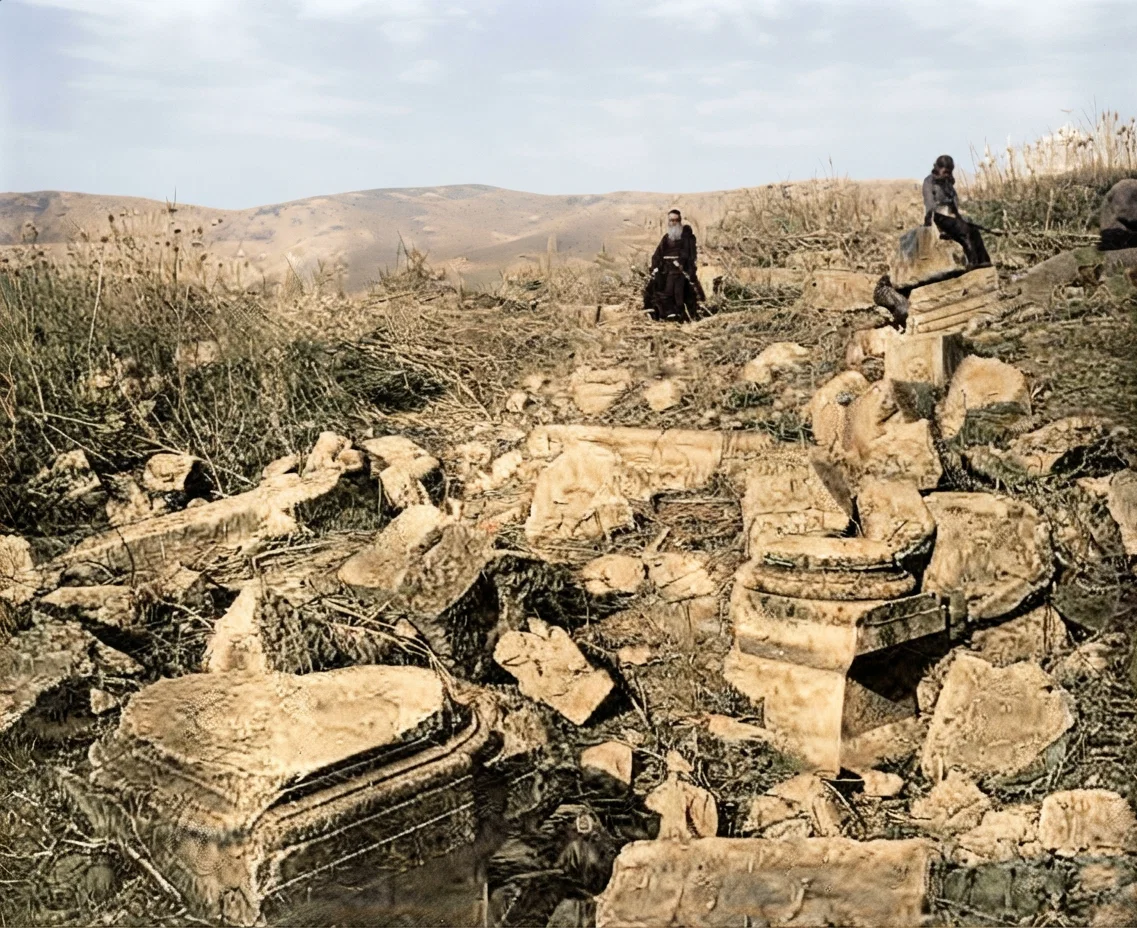
ON the surface a ruin is not an inspiring sight; yet it may teach an inspiring lesson. Its still voices may whisper to our despondent souls hopelessness and despair; yet they may also ring, to the ear rightly attuned, a glad note of triumph. It will depend upon our attitude as to what we shall see and hear.
ON this page is a photographic reproduction of the ruins of ancient Capernaum. All there are of the once proud city of beautiful Galilee is the record of its past and its ruins.
Ruins of Capernaum.
Ruins of Capernaum.
It was a busy city, surrounded by a populous and wealthy country. The ruins themselves speak of its former greatness. A colony of Jews were here, and for them a wealthy Roman centurion had built a synagog. It was a city exalted in pride unto heaven, doubtless on account of its growth and prosperity.
THIS city, with its active teeming population, Jesus made His earthly home; it was "His own city." Mark 2:1. Here Matthew-Levi was chosen for apostleship. Matt. 9:9. Simon Peter and Andrew belonged here, and it was probably near Capernaum on the beach of the sea that Jesus called them from the fisherman's net to follow Him and become fishers of men. Mark 1:16-21. Here also, doubtless, lived John and James.
IN Capernaum many of Christ's miracles were wrought. Here He healed the centurion's servant. Here His cooling touch drove from Simon's wife's mother the fierce burning fever. Here, in "His own city," He spoke forgiveness to the soul of the paralytic and healed his body. Here the spirit of an unclean demon was cast from a chained soul. Here virtue went from Him in response to the touch of faith upon the hem of His garment, and stayed the ebbing of the life current in the poor, timid, nameless woman. And this immediately preceded the giving of life to the daughter of Jairus, the ruler of the synagog. Here, too, was given the wonderful instruction of John 6 to a people so gross that they understood not its meaning. Capernaum not only prospered in material things; but great blessings and opportunities came to her direct by the literal presence of the Son of God.
AND yet all these blessings touched but the hearts of the few. The great mass moved on unheeding, uncaring, till her day of blessing had passed and the curse came: "And thou, Capernaum, which art exalted unto heaven, shalt be brought down to hell [hades]; for if the mighty works which have been done in thee, had been done in Sodom, it would have remained unto this day. But I say unto you, it shall be more tolerable for the land of Sodom in the day of judgment, than for thee." Matt. 11:23, 24.
IT was no arbitrary curse that our Lord pronounced upon the populous city because He was offended. He was but stating her chosen doom. She had sowed to selfishness, lust, pleasure, worldly gain; she must reap the legitimate fruit of sowing—destruction. She had rejected the mighty Word which would save her; she must meet the destruction of the power of that Word perverted. "The ways of Jehovah are right, and the just shall walk in them; but transgressors shall fall therein." Hosea 14:9.
BUT the ruins of Capernaum have their cheering as well as their solemn lessons. We may go on carelessly as she, and die in our sins and by our sins. The mighty Word, by which we would not live, is perverted to our own destruction. "The strength of sin is the law." But we may also know that as the might and power of that Word was the destruction of the careless city, so it is "mighty to save" all who trust in it. Its potency is exhibited in the character of Jesus Christ, triumphant over all sin and death and the evil one; and through Him it may be equally potent in us. God's Word abides. Kingdoms may wax and wane, empires flourish and decay, men and their plans and schemes may come and go; the mighty Word of God abides and prevails forever. Rejected, and the fate of Capernaum is ours; received, and we abide with it eternally. 1 John 2:15-17.

Crime and Sin.—

When statistics show a decrease in the percentage of crime in any given region, it does not follow that there is any decrease of sin. Such statistics are sometimes made up from the number of arrests made in a given time, but arrests are not a fair gauge of criminality. There are certain classes of secret law-breakers who are not arrested at all. Sometimes the number of convictions are taken into account, but the ways of escaping conviction are on the increase. But crime is one thing, while sin is another. Sin is the transgression of the law of God; crime is the transgression of human law. Sometimes these laws conflict, when, as the scripture informs us, "we ought to obey God rather than men."
When men enact and undertake to enforce religious laws, these laws always conflict in some principle with the law of God. So the obedience of them is sin; to disobey them is crime. Many "reformers," in pursuit of what they call "civic righteousness," really induce men to commit sin, while they imagine that they are working wonders in reducing crime.
The statistics of crime may be reduced by ignoring some laws, or overlooking their violation; but God keeps the statistics of sin and sinners, and He makes no mistakes; the day of reckoning will surely come. It is possible for crime to be materially reduced in appearance, while sin is greatly increased. Sin is so deceptive, that men of wide reputation for morality may be the worst of sinners—“workers of iniquity.” G.

“GRACE AND TRUTH.”

Another “Edition” Needed.

BEFORE us lies a little tract with the above title, several copies of which have been sent us. It is said to be “the first edition, 1905.” Here is the statement on which the teachings of the tract are based (Italics ours):
“The law was given by Moses, but grace and truth came by Jesus Christ” (John 1:17) is the brief and weighty way in which the Bible sets before us the change in the dealings—or rather the contrast in the dealings—of God with man consequent upon the coming of the Son of God into the world.
The dispensation of the law begins and ends with Moses. The dispensation of grace is not a development of that which preceded it. It begins where the other ends, and is in entire contrast with it in all its features.
It is of the utmost importance to Christians to understand the true character and object of the moral law. There is a tendency in the mind to confound or mix the principles of law and grace, so that neither the one or the other can be rightly understood. Law is shorn of its stern and unbending majesty, and grace is robbed of all its divine attractions. God’s holy claims remain unanswered, and the sinner’s deep and manifold necessities remain unreached, by the anomalous system framed by those who attempt to mingle law and grace. In point of fact, they can never be made to coalesce, for they are as distinct as any two things can be.
Law sets forth what man ought to be, grace exhibits what God is. How can these ever be wrought up into one system? How can the sinner ever be saved by a system made up of half law, half grace? Impossible. It must be either the one or the other. The law, like everything else emanating from God, was perfect so far as it went—perfect for the object for which it was administered; but that object was not, by any means, to unfold, in the view of guilty sinner, the nature and character of God. There was no grace, no mercy. “He that despised Moses’ law died without mercy.” Heb. 10:28.
The writer of the above does not stand alone in holding that God gave the law, and dealt with man by law from Moses to Christ; then law was dropped and people were dealt with by grace. There was not mere change in God’s dealings, but actual “contrast” in God’s dealings with His children.
The strange declarations are made in the light of such wonderful truths as these:
“I am Jehovah; I change not.” Mal. 3:6. “Every good gift and every perfect gift is from above, coming down from the Father of lights, with whom can be no variation, neither shadow that is cast by turning.” James 1:17. “Hear, O Israel; Jehovah our God is one Jehovah; and thou shalt love Jehovah thy God with all thy heart, and with all thy soul, and with all thy might.” Deut. 6:4, 5. “Jesus answered, The first [commandment] is, ‘Hear, O Israel; The Lord our God, the Lord is one; and thou shalt love the Lord thy God with all thy heart, and with all thy soul, and with all thy mind, and with all thy strength.’” Mark 12:29, 30.
The requirements given by Moses are the requirements given by Jesus, as they were given by Christ to Moses.
Yet according to the tract under review God was gracious up to the time of Moses; but from that time till Christ came He was ungracious, without mercy. Moses and Samuel and David and Elijah and Isaiah knew naught of God’s grace and mercy. That writer would have us believe that these men were deceived by the Word of Jehovah given to and through Moses:
“Jehovah, a God merciful and gracious, slow to anger, and abundant in loving-kindness and truth; keeping mercy for thousands [of generations, Deut. 7:9], forgiving iniquity, transgression, and sin.” Ex. 34:6, 7.
Over and over is it sung in that dispensation that “His mercy endureth forever,” and that He is “full of compassion and gracious,” and “gracious and full of compassion;” over and over the psalmist sang it. Yet in it all, according to this tract he was mistaken; for he also believed in law, and sang:
“O how love I Thy law, It is my meditation all the day;” “I delight to do Thy will, O my God, Yea, Thy law is within my heart.”
Of course none of the men of God living in that age knew aught of this double system; they believed in God’s grace and kept His “commandments and statutes and laws.” And yet mistaken as they were (according to the tract referred to) that mixed—divinely mixed—system made men fit for translation without seeing death, as Elijah, for instance. Of course, Jesus tells us that neither one jot nor tittle could pass from the law (Matt. 5:17-20). Paul declares that we do not make it void by faith (Rom. 3:31); John declares that “this is the love of God that we keep His commandments, and His commandments are not grievous” (1 John 5:3). We read, too, that there is justice in this dispensation; for while he who despised Moses’ law died without mercy, “of how much sorer punishment” is he thought worthy who slights the work of Christ. Heb. 10:29. More than this, the law is itself an expression of God’s “mercy” unto thousands of them that love Me and keep My commandments.” Ex. 20:6. Jesus declared to the Jews who were doing so many little things punctiliously, that they had omitted the weightier matters of the law, justice, and mercy, and faith,” “and the love of God.” Matt. 23:23; Luke 11:42.
God is ever the same, the great I AM, His law always demanding the highest conduct; His grace and mercy ever pardoning the repentant sinner. His law has ever condemned the sinner; His grace has ever wrought to bring the receptive heart back to Him. The broken law makes necessary the abounding grace; the healing grace binds up the wounds of transgression and establishes law in the heart of the believer.
What does the text at the beginning of our quotation mean?—Simply this: All that God could do through mortal man was to give His law as mere outward precepts. That is all that Moses could do. Christ came down to give God’s precepts as enabling acts to the heart of faith. Moses so received them, and the law from Christ became a Gospel of power, shining from his face. But the people would not hear God’s voice; hence, they received it as outward law only; and law without is always death; while law within is power and peace and rest. Outside of man it is to him mere fact; within his heart it is living “truth.” Ps. 119:142. And “grace and truth” came not through or by, but to Moses as truly as it did to John or Paul.
Surely we hope this tract will pass to its second edition, a messenger of truth, not error.
O, why not see God as He is, just, good, merciful, gracious, loving, and eternally unchangeable?

TEACHING THE CHILDREN.

WHILE it is in the order of the Lord that children should be educated in those things which are essential to comfort and happiness and usefulness in this life, it never was designed that their education should become a matter of parental pride. As soon as it becomes such, the real purpose is lost, and a door is opened to the introduction of many evils.
Systems of education have been built up, which have been made, through parental pride, the instruments of torture and death to the children that have been forced into and through the system. There are continually coming to our attention illustrations of the pitiless struggle between children who are constitutionally or mentally weak and the present educational system. Children have been required within a certain time to master a given amount of learning. They have done so; and when the examinations were passed, they have dropped into a mental lassitude due to brain fag, from which they have never recovered. The thought of taking up a book for study is as rasping on their nerves as the scraping of a fire shovel on a stove bottom is to a nervous wreck. There has been a strain and a lesion of brain tissue which has never mended.
One has said that “the world is going university mad;” and with the hundreds of victims that are every year offered on the altar of parental pride in the shrine of enforced education, it certainly looks as if the speaker had grounds for his declaration. An education is a blessing if the principles learned are in harmony with the principles of divine truth. The educated mind, with the same degree of spirituality, will accomplish more for God than the mind that is not educated. But the physical and spiritual welfare of the child should be a matter of far greater consideration than the acquirement of a certain amount of book learning in a specified length of time. The pitiful little wrecks that have been laid away this year as the result of educational strain should forever settle in the parent’s mind what his duty is in the matter. The ambitious parent who drives his child through a certain course of study at the expense of health and life, or of future usefulness, is guilty before God. The fact that a certain course is marked out and that some accomplish it without apparent injury to themselves, is no excuse for any parent allowing his child to wreck its life or usefulness in the attempt to master the task. Thousands are doing it because they do not want it to appear that their child is not as “smart” as their next-door neighbor’s. Many who have done so are now wondering why their children are not able to accomplish anything above the most ordinary in life. We have heard the remark, “John and Mary have had the very best education the schools could give them; but the Smith children who have no better education are all doing well, and mine are doing nothing. I don’t understand it.”
Brain fag, mental lassitude, mental debility, are written all over the lives of such children; and they are not to blame for it either. Their brains have become like the stomach that has been gorged and its muscles stretched beyond power to return to their proper shape and functions, or like the steam boiler that has been weakened by excessive pressure until only a small head of steam can be carried.
Life is more important than the deepest philosophy the child can be forced to learn; health is more precious than the solutions of the problems of Euclid or the declensions and conjugations of Greek and Latin. The full, symmetrical, perfect development of an entire human life is of infinitely greater importance than all the philosophies and mythologies and aphorisms of the ancients, or the heaped-up and pressed-down wisdom of modern economics, psychology, and commercialism. Let the child and the man be educated; but never permit that education to become the shroud or the grave that shall hide away the little lives entrusted to your keeping. “The fear of the Lord is the beginning of wisdom;” and they in whose hearts the fear of the Lord reigns will not be tempted to sacrifice their little ones on the altar of pride. S.

THE LORD'S SPECIAL COVENANT.

Of all the covenants spoken of in the Scriptures there is just one that God calls distinctively His own. It is not a covenant with any specific individual or people, with which they have anything to do but to obey. It is a covenant that all men are under obligation to observe. It was not an agreement, but a commanded covenant. "And He declared unto you His covenant, which He commanded you to perform, even ten commandments; and He wrote them upon two tables of stone." Deut. 4:13.
This is a plain statement of what God's covenant is. It was this covenant which the Israelites had covenanted to keep. They made the agreement to keep whatever God would say before they knew what He was going to say. Ex. 19:4-8. This constituted what is known as the "old covenant." It was a covenant, or agreement, to keep the Lord's covenant of ten commandments. After they heard His words, they confirmed their agreement.
But they soon failed to keep the Lord's covenant, and in this failure they broke their own covenant with God—that is, they broke the "old covenant." So the Lord's covenant of mercy, called the "new covenant," is the only hope of the disobedient. He makes that with a people, also called Israel and Judah, who will receive His covenant, or law, in their hearts. Jer. 31:31-34. A formal profession of righteousness must always prove a failure; only the law of God in the heart can keep one in covenant relation with God. Such covenanters are Israelites indeed, prevailers with God. Gen. 32:28.
God's covenant of ten commandments does not fail because a faithless people fail to honor their promise to keep it. A foreigner who desires to become a citizen of the United States takes an oath to obey the laws of the land. If he afterward violate the said laws, he breaks his covenant with the government; but that does not affect the validity of the law. Nor is the law to be repealed on that account. Moreover the naturalized citizen who has a heartfelt regard for the law, will always prove faithful to his covenant with the government—his oath of allegiance.
God's special covenant, which He says is the law of ten commandments, is a permanent, perfect covenant. "He sent redemption unto His people; He hath commanded His covenant forever." Ps. 111:9. This is why the people need redemption, because the covenant, or law, which all have violated, must stand forever. If the law could be set aside, there would be no more sin, for "sin is not imputed when there is no law" (Rom. 5:13); therefore there would be no necessity of redemption.
But "the law of the Lord is perfect, converting the soul" (Ps. 19:7); it is not to be abolished. Speaking of Christ under the title of David, the Lord says, "I will make Him My firstborn, higher than the kings of the earth. My mercy will I keep for Him forevermore, and My covenant shall stand fast with Him." See Ps. 89:18-29. Again He declares, "My covenant will I not break, nor alter the thing that has gone out of My lips." Verse 34.
Corroborating this declaration is the testimony of Christ: "Think not that I am come to destroy the law or the prophets; I am not come to destroy, but to fulfil. For verily I say unto you, Till heaven and earth pass, one jot or one tittle shall in no wise pass from the law till all be fulfilled." Matt. 5:17, 18. Luke reports Him as saying, "It is easier for heaven and earth to pass, than one tittle of the law to fail."
Instead of abolishing one tittle of the law, Christ Himself magnified the law and made it honorable. Isa. 42:21. And "he that saith he abideth in Him ought himself also so to walk even as He walked." 1 John 2:6.
G.

Is It Belief?

There is much professed belief in God's Word, or the Bible. Yet that Book declares and repeats in various forms and ways, and at various times, the story of the evil days and dangers through which we must pass. Do the prophecies, the warnings, mean nothing? Do all of the precepts of God mean nothing? Is the life and example of Christ Jesus of no effect? Is His Spirit powerless for a better life? Judging from the practise of present civilization, all these questions should be answered in the affirmative. But "shall their unbelief make the faith of God without effect?—God forbid; yea, let God be true, but every man a liar," Rom. 3:2.

Christian Gratitude and Assurance

The Christian is God's by creation, His by redemption, and His by regeneration. Every fiber of his being ought to respond in grateful praise to God's goodness. He has not only all the promise of "the life which now is" that other men have, but he has the assurance of the life "which is to come." He is assured that "God worketh all things with him for good" if he only loves God, and lives yielded to God's purpose. Therefore he can "rejoice evermore;" he can "in everything give thanks." Men may abuse him; he knows that it is worse for them than for him, because the injury to him is merely temporal at the most; the injury to them is that of character, which unless repented of is eternal. "Great peace have they that love Thy law, and they have no stumbling block."

Question Corner

1738.—Subjection to Proper Authority. Rom. 13:1-3.

Please explain Rom. 13:1-3 and 1 Tim. 4:1-3. J. C.
The latter text must wait for more room. We will republish an article on it before long. The first text is simply instruction to be subject to proper authority. We understand that "the higher powers" of verse 1 are the same as the "rulers" of verse 3. Civil government is an ordinance of God. It may be administered by evil-designing men, still the institution of civil government is of God, a necessity for sinful, unregenerate men. The worst of civil government is better than anarchy. But civil government is better than anarchy. Yet civil government has its sphere. Outside of that it has no authority. Where man's duty to God transcends it, "we ought to obey God rather than men." Acts 5:29; 4:19. God calls Nebuchadnezzar His "servant," and gave him all his kingdoms, but when he demanded that which was contrary to God's law, God justified His servants in their disobedience. See Jer. 27:6; Daniel 3; 4:34-37. In all things where conscience toward God or our fellow men do not contravene, obey the civil power. Laws may be unjust, taxes oppressive; yet for Christ's sake obey the law. 1 Peter 2:13-17. See also Matt. 17:24-27.

1739.—Is There an Eternal Hell? Jude 7; Isa. 66:23, 24.

Will you tell me what the above scriptures mean? Is there an eternal hell? A. H.
For the explanation of Jude 6, 7 read 2 Peter 2:4-6. Jude gives us an example of the punishment of the wicked in the doom which came to Sodom and Gomorrah. He tells us that they are set forth as examples, suffering the punishment of eternal fire. Peter tells us that that fire turned the cities of Sodom and Gomorrah into ashes, condemned them with an overthrow after making them an example unto those that should live ungodly. The eternal fire is so called because eternal in its results, and not in its burning. It will eternally burn up that upon which it preys, so John the Baptist declares in Matt. 3:12, where the wicked are likened to chaff. "The chaff He will burn up with unquenchable fire." That is, it can not be quenched until it does its work. You will notice that the passage in Isaiah does not refer to living wicked which are cast into this fire, but to the carcasses of the wicked, rendered by the American Revised Version, "The dead bodies of the men that have transgressed against me." And they are part of that chaff which shall be burned up with unquenchable fire.

1740.—Where Do We Go at Death? 2 Cor. 5:1, 2.

Do we go right to heaven when we die, according to 2 Cor. 5:1, 2? A. H.
The scripture referred to does not teach that. It simply declares that if the earthly tabernacle of our house be dissolved, if we die, we have a building from God, a house not made with hands, eternal in the heavens. There is nothing said in this scripture as to the time when that shall be given to us. The thought is simply this, that we need not fear the death come to us; God cares for His children, and has prepared for them homes and mansions. If you will read the context you will notice that three conditions are set before us in which man may be found: first, in this "earthly house," longing for something better, "in this tabernacle," "at home in the body," etc., that represents the Christian in this mortal life; secondly, "unclothed" and "naked," "dissolved," referring to the condition in death. For that the apostle did not long; he did not desire that. Third, "clothed upon," "swallowed up of life," the simple expression denoting the eternal state of being when our Lord shall come and change this mortal into immortality; and not until Christ comes will this change take place. 1 Cor. 15:51-54. See also Rom. 8:23. In this last scripture we are told that the relief from the groaning, from the waiting, will be when our body itself is redeemed at the resurrection.

WHEN FAITHFULNESS IS EXPECTED.

It is a standing admission in political circles that political ambition unfits a public official for impartial discharge of his public duties. In almost every instance where the incumbent of an important executive office is not a candidate for re-election, he is deemed to be free in the matter of zealous execution of his trust. The logical inference is that otherwise he is not supposed to be free.
The latest instance that we have noted is the case of the San Francisco district attorney, who is not at present a candidate for office. Referring to grave charges against a noted leader in city politics, a daily paper says that “the grand jury is in session, and San Francisco has a district attorney who is free from the trammels of office-seeking. He is footloose and free to act.” This statement is made with the air of a matter-of-course admission that an official is not expected to be impartial in his duty if that kind of devotion would tend to estrange any influential support of his future political designs.
The leading journals are both the moulders and the reflectors of public sentiment, and when they tacitly admit that an important public servant is hardly to be expected to injure his chances for further political position, it would seem that the people have come to look upon the situation in about the same light.
The Lord said of the Israelites, in the days of their backsliding, it was “like people, like priest;” so it is in modern politics, like people, like office-holder. The spirit of the times is self-serving, and the representatives of the people, carrying the spirit of the times with them, are apt to find their opportunities while nominally serving the people.
Verily the way of the office-seeker is a dangerous way; for a political ambition is covetousness personified. And this is conceded where the office-seeking official is hardly expected to be true to his trust if such faithfulness stand in the way of his future success. G.

ENFORCING THE LAW.

The men who are most prominent in the public eye and who are apparently in the line of succession for the highest places in the gift of the nation are men who are insisting that law is law, and that it should be enforced for that reason.—Exchange.
A LL the bitter persecutions of all the “dark ages” of the world’s history were simply the work of law enforcement. The rigorous treatment of the Israelites in Egypt was a process of law enforcement. The casting of Shadrach, Meshach, and Abednego into the fiery furnace was the enforcement of a royal law. So was the throwing of Daniel into the lion’s den. Saul’s bitter persecution of the disciples at Jerusalem was by authority of the law. Saul was a great stickler for law enforcement. All the Christian martyrs—numbering millions that have been put to death by the sanction of any government, were the victims of law enforcement.
It is a fact that there are hundreds of laws, and many very prominent ones, that the people would gladly have repealed; but in the main the people are powerless in the matter of law-making. It is only by the expensive processes of agitation and petitioning immediately preceding an election that the people can exercise any perceptible influence on the men who are supposed to represent them as law-makers. With many bad laws, the people’s will is best subserved by letting them lie dormant.
We are not assuming, however, that there is not a lack of enforcing some very wholesome laws because of favoritism toward personal or political friends. And some laws were not expected to be enforced; they were enacted for political purposes, and often legislators vote for measures they do not endorse, in order to secure return support for some pet measure in which they are personally interested. The strict enforcement of all the laws in any of the “civilized” countries of the world would produce a condition of tyranny that would stir up a revolution within a few years. Such is the imperfection of man’s work.
G.
Continue reading: SIMPLY A SIGN OF THE TIMES