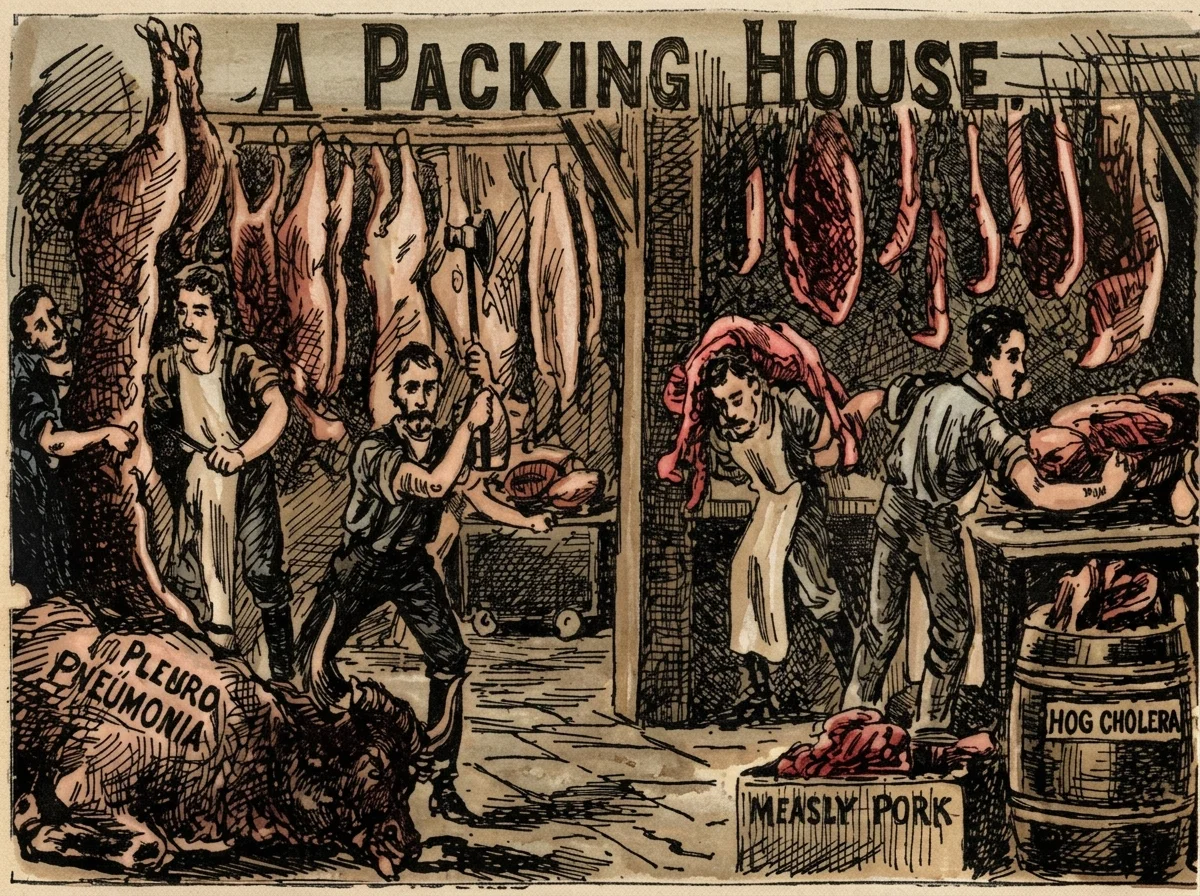
Reader, does it ever occur to you that the tender beefsteak or juicy mutton-chop which you so much relish for breakfast may be less wholesome and nourishing than you have supposed it to be? In Bible times, and indeed among most nations at the present day, bread was the staff of life; but the average American evidently believes that beef or flesh food of some kind is the chief means by which strength is to be replenished. The error of this opinion is shown by the fact that millions of human beings are practically vegetarians, and yet enjoy most excellent health; and the additional fact that the strongest and the longest-lived of all members of the animal kingdom are not flesh eaters. The object of this article is not, however, to argue the question whether the use of flesh food is harmful or unnecessary, but to call attention to the fact that much of the flesh food consumed is either in a diseased state or liable to be diseased.
All of the domestic animals which are used as food are liable to diseases, many of which are similar to those from which human beings suffer. Consumption, or tuberculosis, scrofula, rheumatism, typhoid and malarial fevers, smallpox, scarlet fever, pleuro-pneumonia, influenza, carbuncle and jaundice, are a few of the diseases to which food-animals are liable, to say nothing of such functional disorders as torpid livers, dyspepsia, and deficient or disturbed secretions. Besides these diseases, there are those terrible maladies, tapeworm and trichinosis, which are known to arise from the use of diseased flesh, and from this cause only. These disorders are known to be exceedingly prevalent among cattle and hogs, and increasingly so.
Reader, do you feel no uneasiness on this subject? Then come with us for a visit to a packing-house in some large western city, where thousands of animals—cattle, sheep and hogs—are daily slaughtered and prepared for market. We will not undertake to study the whole immense business in all its details, but will just glance about here and there and note what we may see that has a bearing on the question which we are considering. Perhaps the first thing we note is a long inclined plane up which is being driven in single file, a long line of hogs, fat, unwieldy and blear-eyed. Most of them look as tho they were not enjoying the best of health, and a few appear to be positively sick. There is one that is evidently scarcely able to walk. He totters slowly along, and at last falls in the middle of the procession. If he had held out to the other end, he would have been seized by the legs, swung up, his throat cut, and in a twinkling he would have been in the course of preparation for the pork barrel. Now he is doomed to go to the rendering establishment, where he will be thrown into a great cauldron, and stewed up with a lot of other sick hogs, for a few hours, after which a great part of him will appear in the shape of first-class steam-refined lard.
There is no question that vast numbers of hogs sick with hog cholera, and other diseases to which the animal is subject, find their way in one form or another into the stomachs of the people. If the sick porker had been able to reach the top of the inclined plane, he would have been eaten without so much circumlocution; and if his consumer had died of some mysterious disease, it would probably have been charged to Providence or the weather instead of the pig or the packer. Unquestionably, thousands of deaths of this sort do occur every year, the real cause of which is seldom suspected. A few years ago a family in Michigan was made sick by the use of steam-refined lard. A portion of the lard was sent to an eminent microscopist, who reported that he found in the lard the germs of hog cholera, which certainly was sufficient explanation of the sickness.
Let us take a look at the dressed carcasses which are lying about in scores. Here is one, the flesh of which is of a dark purple color. The color signifies that the animal was suffering with an acute fever when it was killed. Will this flesh be likely to make pure blood and healthy tissues?
Here is another which has a pale pink color. What does this signify?—Simply that the butcher got the start by a month or two of a consumption, which was preying upon the animal’s vitality. If we had seen its lungs, we should have found them studded with tubercles. It is more than likely that those who eat the flesh of this animal will consume some millions of tubercles in so doing; and it is possible that some of them who happen to take their steaks a little rare10will contract the disease. It is very probable that this is one of the most common sources of the rapid increase in prevalence of this greatest of all the scourges of civilization. According to the most reliable statistics, it appears that about one-fifth of all who die fall victims to this most incurable of maladies. Here is one source of infection with the disease which it would be wise to avoid.
That carcass over there which has a golden yellow cast was from an animal which had jaundice. The flesh is stained with bile; and yet some one will eat it with no thought of the horrible grossness which he is consuming.
Suppose we take a closer view of some of the fine rounds and roasts which are going to be served up on somebody’s table before a week has passed. Here is a piece of splendid-looking meat, which would be quite likely to make a carnivorous man’s mouth water for a liberal slice of it. Let us cut off a bit and put it under a pocket microscope which we happen to have with us. You notice some little white specks scattered here and there. Do you ask what they are?—These are small cysts. In each one of them is curled up a little tapeworm. When the flesh is eaten, the sac will be dissolved by the gastric juice, and the little worm will be liberated. It will soon fasten itself by a pair of minute booklets to the side of the intestine, and will begin to grow, feeding upon the digested food which ought to nourish the host who furnishes him a lodging. Our worm may go on growing until it reaches a length of fifty or a hundred feet, or even more. The careful study of tapeworms which has been made within the past few years has developed the fact that in nearly all cases in which persons become infected by these loathsome parasites they have been obtained from beef or veal.
According to the report of an expert who investigated the matter in the state of Indiana, about one in ten of all hogs are infested with trichinae. When this infected pork is eaten, as most of it undoubtedly is, it is likely to give rise to a disease known as trichinosis, one-half the cases of which prove fatal.
It has been ascertained in England that the use of the flesh of animals which have died of pleuro-pneumonia is a cause of a malignant and very deadly form of disease known as malignant carbuncle. Dr. Livingstone observed the same thing in South Africa.
It has been asserted by a most eminent authority on this subject, Professor Gamgee, that one-fifth of all the meat sold in the markets is from diseased animals.
RELIGIOUS RIOT IN MELBOURNE.
By Editor
A RIOT of considerable dimensions occurred between Catholics and Orangemen in Brunswick, a suburb of Melbourne, Sunday afternoon, July 19. An announcement and arrangements for an Orange procession in this suburb at the time stated, incited a counter-call for a general massing of Catholics from all over Melbourne and its suburbs at the same time and place. This call brought out fully 15,000 men, and, altho the Orange procession was abandoned, the assembled mob was so bent on having a “fray” that rioting was freely indulged in. Men and horses were knocked down, ladies’ boquets and scarfs were seized, a Wesleyan church, in which the Orangemen were holding their meeting, was besieged, and, altogether, says the report, “such a sight was never seen in Brunswick before.”
Protesting against the proposed procession, the “Rev. Father” Luby, Catholic priest of the place, had previously “declared that if the procession were held there would be bloodshed.” But when his assembled co-religionists, notwithstanding there was no procession, began to wreak their vengeance on individuals and everything with a spot or show of yellow on it, he ran into their midst and tried to quell the riot, telling the men “there was now no necessity for this,” as there was to be no march that day, and that their conduct would be made known all over the world to their disgrace. But they were past his control. “The vast concourse swayed from side to side of the broadway like a human sea in violent commotion,” and for four hours held in possession the principal street of the suburb in spite of priest and local police. One hundred police and mounted troopers had to be called to hold the mob in check.
We wish it to be known that we have no sympathy whatever with any opposition to the Papacy along papal lines. The weapons of the Christian’s warfare are not carnal, neither must the servant of the Lord strive, but be gentle unto all men, meekly instructing those who oppose themselves. 2 Cor. 10:3, 4; 2 Tim. 2:24, 25. The Gospel of Jesus Christ and the word of God are the only lawful weapons for Christians to use in opposing error. But if any think religious animosities have all died out, or that the spirit actuating the Papacy is less relentless or less violent in its nature now than formerly, such scenes as the one just described should undeceive them.—Melbourne Bible Echo.
“TOO MANY OF WE.”
“MAMA, is there too many of we?”
The little girl asked with a sigh,
“Perhaps you wouldn’t be tired, you see,
If a few of your children would die.”
She was only three years old—the one
Who spoke in that strange, sad way,
As she saw her mother’s impatient frown
At the children’s boist’rous play.
There were half a dozen who ’round her stood,
And the mother was sick and poor,
Worn out with the cares of the noisy brood,
And the fight with the wolf at the door.
For a smile or a kiss, no time, no place—
For the little one, least of all;
And the shadow that darkened the mother’s face
O’er the young life seemed to fall.
More thoughtful than any, she felt more care,
And pondered in childhood’s way
How to lighten the burden she could not share,
Growing heavier day by day.
Only a week, and the little Claire
In her tiny, white trundle-bed
Lay with blue eyes closed, and the sunny hair
Cut close from the golden head.
“Don’t cry,” she said—and the words were low,
Feeling tears that she could not see—
“You won’t have to work and be tired so,
When there ain’t so many of we.”
But the dear little daughter who went away
From the home that for once was stilled,
Showed the mother’s heart, from that dreary day,
What a place she had always filled.
—Woman’s Journal.
WHEN COAL WAS FIRST USED.
When coal was first introduced into London as a fuel, very serious objection was taken to its use. In the beginning of the fourteenth century, the brewers and smiths of the city, finding the high price of wood pressing hardly upon their returns, resolved to experiment with coal; but immediately an outcry was raised against them by persons living near the breweries and forges, the king was petitioned, and a law passed prohibiting the burning of coal within the city.
Those who tried it, however, found the new fuel so much superior to wood that they persisted in its use. But so determined was the government to suppress what was thought to be an intolerable nuisance, that a law was passed making the burning of coal a capital offense, and at least one man was executed under that law. The ladies were bitterly opposed to the use of coal for domestic purposes. They considered the smoke to be ruinous to their complexions, and would not attend parties at houses in which the objectionable fuel was used. Some persons would not eat food of any kind that had been cooked on a coal fire.—Selected.
LOVE VS. FEAR.
By Fannie L. Fancher
BY FANNIE L. FANCHER.
“O MAMA, I’m so sorry for Johnny Green; his legs and arms are always covered with long red marks, ’cause his father and mother whip him so much!”
“Why do they do so? Is Johnny a very bad boy?” I asked.
“Why, no, mama, he’s just as good as any seven-year-old boy, but he’s so ’fraid of ’em that he just will tell lies, an’ of course he gets found out. I’m sure I wouldn’t be good if I got whipped all the time.”
This little boy, for whom my son’s sympathies were aroused, was the oldest child of people living on our block. All that I knew of them was that the husband and father was a “pillar” in his church; hence it would never do for his son to be a liar, and therefore the constant whipping process. Ah, unwise parents! When Johnny gets too old to be governed by fear, then what?
There is a tendency for young mothers to resort to the whip for every trivial wrongdoing; but let them remember that such a course soon blunts the delicate sensibilities of a child, rendering him hardened and ugly. He will soon exclaim in anger, “Whipping don’t last long, and to kill me you dassn’t!” Therefore reserve the rod, if used at all, till some great transgression warrants such severity.
An eminent horse trainer says: “The legitimate and proper use of the whip is calculated to operate upon the sense of fear almost entirely. The affectionate nature must be appealed to in training horses as well as in training children; for if only the passions are excited, the effect is injurious. This is a vital principle, and can be disregarded in the management of sensitive and courageous colts only at the risk of spoiling them. I have known many horses of a naturally gentle character to be spoiled by whipping but once, and one horse that was made extremely vicious by being struck with a whip while in his stall.”
I know a little seven-year-old boy who was inclined to loiter when returning from school. The mother gets no cruel whip to lacerate the flesh of her child. Instead, she removes from the tea table his favorite foods, and provides him a dish of easily digested bread and milk, and, tho it is yet broad daylight, he is sent to his bed, there in solitary confinement to ruminate over the hard “way of the transgressor.”
Do not send a child supperless to bed, since an empty stomach is not conducive to refreshing sleep, and growing children need each and every meal to supply nature’s waste and growth. This heroic method of punishment was formerly resorted to by mothers unfamiliar with hygiene. An aged mother once boasted that she had often sent a son supperless to bed because he was loth to commit to memory his Bible lessons. Think you that this course instilled in his heart a love for the book?—No, indeed; it produced quite the contrary effect.
Let love ever have full sway between parent and child; then there will be little, if any, need of the rod; for “if ye love Me, keep My commandments,” and “perfect love casteth out all fear.”—Housekeeper.
Bearing Troubles One at a Time
NEVER bear more than one trouble at a time. Some people bear three kinds—all they have ever had, all they have now, and all they expect to have.—Edward Everett Hale.
THREE GOOD BUSINESS HINTS.
“LLOYD’S COMMERCIAL GUIDE” gives the following advice to its readers: “Never sign a paper without reading it; and if, after reading, you do not understand it, have it thoroughly explained before you put a signature to it. It is best to get some third person, who is not interested in the matter at all, to explain the meaning of what is not clear, or to point out words that may have two meanings in the document.
“Always make a memorandum in your little book of any contract you undertake for money or any agreement to work. It saves much trouble to keep a memorandum book, and put down the dates when you either pay or receive money. Whenever money passes on account, set it down. If any money or thing of value goes through your hands, give a receipt for it and make a memorandum. Your receipt settles the amount that passes, and that can not be disputed. When you pass it to a third party, get a receipt and keep it. This form is as important in the transfer of income, trust money, or valuables among your own family as with other persons.
“Never allow a person to do any service for you without first agreeing upon the cost to you. This rule, strictly adhered to, will save you many annoyances.”
WONDERS OF ANCIENT GLASS BLOWING.
THE glass blowers of ancient Thebes are known to have been as proficient in the particular art as is the most scientific craftsman of the same trade of the present day, after a lapse of forty centuries of so-called “progress.” They were well acquainted with the art of staining glass, and are known to have produced that commodity in great profusion and perfection. Rossellini gives an illustration of a piece of stained glass, known to be 4,000 years old, which displayed artistic taste of high order, both in tint and design. In this case the color is struck through the vitrified structure, and he mentions designs struck entirely in pieces from one-half to three-quarters of an inch thick, the color being perfectly incorporated with the structure of the piece, and exactly the same on both the obverse and reverse sides.—Christian Work.
NOSTRILS OF THE HORSE.
The Nose the Only Medium of Breathing—The Soft Palate.
The large, open nostrils of the Arabian horse is a sign of endurance, as the horse can not aerate his lungs through his mouth like a dog and other animals. He can only breathe through his nose. The soft palate forms a complete partition between the mouth and throat, and can only be elevated or allow the passage of food or water backward by compression such as that which occurs in swallowing.
The passage of air through the mouth is entirely prevented by the soft palate. By plugging a horse’s nose he may be readily suffocated. It is because breathing can only be performed through the nasal organs that spacious, open nostrils are considered not only beautiful, but necessary, for they allow at times of unusual exertion for the free passage of large volumes of air into the over-tasked lungs during respiration.
Deserving Success
“It is well to hope for success, but it is still better to deserve it.”
Excusing Faults
“Bad men excuse their faults; good men will leave them.”
AN EXPANSIVE GOSPEL.
By J. C. Hiden
BY J. C. HIDEN, D.D.
When the Master said, “Beginning at Jerusalem,” he evidently meant to establish what strategists call “a base.” The beginning must be somewhere, and there were many reasons for selecting Jerusalem as the point. But the same text, which is so often quoted in behalf of home missions, is just as good authority for foreign missions. Luke 24:47 is decisive on this point. “Repentance and remission of sins” were to “be preached in his name among all nations, beginning at Jerusalem.”
In none of our Lord’s final directions is there the slightest hint that Christianity was to wait upon civilization; nor does anything in that “missionary magazine,” the Acts of the Apostles, give the least color to such a view. The wise according to this world often tell us that it is useless to attempt to evangelize barbarians; that we must first instruct them in at least the rudiments of civilization, and thus prepare them for the reception of the Gospel. This view savors of the baldest rationalism. Does God care only for civilized people?—No. Christianity does not come to help man after he has helped himself, but in his helplessness; and it is quite easy to lay too much stress upon what is called “the connection between Christianity and civilization.” We know that not a few of the most cultivated men in ancient, as well as in modern, times, have been very wicked. Julius Caesar was one of the most accomplished men that ever lived. From a moral point of view, the boasted Greek civilization was rotten to the core. Even Plato’s “Republic” advocates the twin villainies of “communism” and “free love.”
Between Christianity and civilization there is, indeed, an antithesis which is too frequently overlooked, even by thoughtful men. Civilization is mainly a social force, operating upon a community. Christianity is a spiritual force, operating upon the individual. It is about as difficult to civilize an individual as it is to convert a state. Rough people can be converted.
Among the Greeks one and the same word meant “morals” and “manners.” The same linguistic phenomenon appears in Latin; and the reason is that morals were manners, and nothing more. However highly “cultivated” a heathen people may be, they will still be barbarians morally. Christianity makes an immense difference between morals and manners. Samuel Johnson was not so “elegant” as was Lord Chesterfield; but he was a much better man than the polished, licentious nobleman; Chesterfield was the nobleman, but Johnson was the noble man.
Some critics would have us believe that the sermon on the mount is all right, and that the New Testament morality is of a high order; but that the Old Testament is so full of barbarisms that our cultivated age can not accept it as authority. But again I ask, Does God care only for people of cultivation? Did not Paul preach at Lystra, as well as at Athens? The Pentateuch presents marked internal evidence that much of it was immediately addressed to people who had recently emerged from slavery, and were still in a semibarbarous condition.
John Foster wrote the most splendid of his essays to show why men of taste were so generally opposed to evangelical religion; and it now seems to be in order for some smart critic of the Wellhausen school to write an essay to show why God cares nothing for barbarians.
Paul evidently did not think that uncultivated people were outside of the pale of God’s sympathy, or of Gospel work. He was debtor both to the Greeks and to the barbarians; to the wise and the unwise. “The regions beyond,” whether inhabited by scholars or ignoramuses, were the regions which especially fired his ambition and kindled his zeal. He was always anxious to go to some new place where Christ had never been preached; and he seems never to have asked whether the place was “cultivated,” or whether the people were civilized.
Let any pastor ask himself the question, “Are my most cultivated people my best people?” One of the very best members of any church that I have ever served could barely spell his way, with many blunders, through a chapter of the Bible; and some of the most troublesome church members that I have ever known were very highly educated.
The Gospel is indeed expansive. It is addressed to people of all grades of culture, and to those of no culture. Greeks and barbarians are to be all won by Christ, and one in Christ.—N. Y. Independent.
MISSIONARIES FILLED WITH THE SPIRIT.
By J. H. Horsburgh
There is scope for missionaries of the highest intellectual ability. But the crying need of to-day is hundreds of ordinary people—filled with the Spirit of God. Women as well as men are greatly needed.
A college training, tho useful, is not necessary. The best college training for the interior is to live for a time at home in one little room in a back street. Eat plain boiled rice, bread, and vegetables. In the morning commune with God, and study—especially your Bible. In the afternoon go out angling (for “men” of course), make a point of systematic visiting and individual conversations. In the evening throw yourself heartily into God’s work, always being careful to take the lowest place, and learn from others more experienced than yourself.
If possible get a kind, crotchety friend to come and live with you. Never get put out with him, nor be anything but yielding and cheerful. Keep on doing this. Those who give up, however bright they may be, are not trained enough. Those who do not get tired will have proved themselves to be splendidly trained collegiate.
The qualification is a Christ-like spirit—humble, patient, persevering, loving. (Brethren,pray for us). A great test is willingness to be snubbed. The missionary society will gladly entertain offers of service from both men and women of this stamp.
Means of Support.—The society [the Young People’s Foreign Missionary Society] gives no “salaries” in the strict sense of the word. We shall be allowed to draw what we need for necessary maintenance, and in the far interior we shall not, of course, need very much. House accommodation will be provided. And it is hoped the mission will be developed in proportion as the Lord gives the means. Anyone who has $250 a year, and about $250 to pay the first cost of passage and outfit, may come at his own charges. (Christian parents, could you not manage this, perhaps, for your son or daughter?) Those who live simply and in native style will not need to spend so much as that. But there should be a margin to draw upon in case of need.—J. H. Horsburgh, M.A., Missionary in mid-China.
SLAVERY IN AFRICA.
KHARTOUM, the headquarters of the slave merchants of the Nile, is situated on that river 1,100 miles from the Mediterranean, and has 50,000 inhabitants. Twelve large slave corporations here do a prosperous business, and this city alone clears $3,000,000 annually by the sale of young girls.
Armed parties are sent up the river from Khartoum to the “Slave and Ivory Lands,” where numerous stations are established. Each encampment contains 200 Nubian Arabs with their negro slaves or wives. From these centers they issue in the dead of night, armed to the teeth, and stealing down on a native village, surround it, concealing themselves in the long grass. Just as the day is breaking, torches are applied to the grass huts, which are dry as tinder. Instantly the doomed village is in flames, and as the unfortunate people rush out, volley after volley of musketry does its deadly work and all the men, women and boys are pitilessly murdered.
Then the girls from 4 to 15 years of age are taken away to the encampment, together with the ivory, the result of the year’s hunting. The horrible indignities and shameful lives these poor girls are now subjected to we will not attempt to describe; then they are marched overland to the shipping stations on the river and taken down to Khartoum in slave boats.
On landing, their stiffened limbs almost refuse to support them as they stagger across the city to the slave market, followed by scores of eager purchasers. Here thousands are exposed for sale at $5.00 to $200 apiece, just like cattle. A Mohammedan told our pioneer missionary he had seen 25,000 of these slaves in the city of Mecca, who had been smuggled across the Red Sea by night.
These massacres are going on all the time in Central Africa. Village after village is burned and whole districts depopulated by bands of armed Moslems, for the sake of the ivory and young girls, everybody else being killed and standing corps burned. Dr. Barth tells us that the sultan of a city south of Lake Tchad, in one of his annual expeditions, captured 10,000. H. M. Stanley, on ascending the Kongo, saw 118 villages laid waste and desolate, which had been flourishing and populous on his previous descent of that river.
These practices have come down from time immemorial, and are sanctioned by long custom; their very religion teaches them not only to do such things, but also that the negroes, because they are pagans, deserve such treatment.
If a stranger were dropped from a balloon into Central Africa, he would have little trouble in finding his way to the coast or nearest large river. He need only wander in12a circle till he sees a heap of bones, some poor slave girl’s skeleton, and then follow the trail of bones and skeletons across the country. Three-fourths of the girls captured die on the way, and every one brought to the markets represents 10 persons killed in the capture or starved or ill-treated to death on the long, wearisome march. These bleaching skeletons are crying out night and day to God for vengeance, not only against the Mohammedans but particularly against the Christians, for declining to put an end to this fearful state of things by sending missionaries to teach them the principles of Christianity.—Y. P. F. M. Journal.
LIKE FATHER LIKE CHILDREN.
By J. E. Rankin
BY J. E. RANKIN.
Thou callest, Lord, the stars by name;
To do thy will, they come, aflame,
In the blue corridors of night,
Obedient to, “Let there be light!”
So let thy children everywhere
The Gospel torch uplifted bear.
Thou robest the lilies of the field
In raiment which no loom can yield;
They tremble as thou passest there,
And yield their perfume to the air;
So may the children of the light
Love’s perfume yield in spotless white.
Thou hear’st the ravens when they cry;
From thy high throne of majesty,
Dost stoop their hungry mouths to feed,
And satisfiest all their need;
So may thy children by thee fed
Give to thy poor the Living Bread.
—New York Observer.
Interlinear Greek-English New Testament
With the Authorized Version conveniently printed in the margin for ready reference, together with the various readings of the Greek text of the editions of Elzevir 1624, Griesbach, Lachman, Tischendorf, Tregelles, Alford, and Wordsworth.
LOVE,
Bible scholars know should replace the word “charity” in 1st Corinthians XIII. There are thousands of similar instances. In all such instances that other word, “the word that illumines,” may be found at a moment’s notice, and on the instant in the INTERLINEAR NEW TESTAMENT.
The text is well printed, with a PROPERLY ACCENTED GREEK TEXT, and where the arrangement of the word-for-word rendering is likely to be mistaken by a person unacquainted with the Greek idiom, the words are numbered to assist the student. It will be of real help to any Bible student.
SPECIAL INSTALLMENT TERMS TO CLERGYMEN.
Neatly bound in dark olive green cloth, stamped in gold. 670 pages.
PRICE $3.00, POSTPAID.
Address,
PACIFIC PRESS PUBLISHING CO., Kansas City, Mo., and New York OAKLAND, CAL.
A Profession Instead of a Vow
A SMALL number of students in Denmark having, as we see by the Blad, been induced by Mr. Wilder to enter into the Students’ Movement, exception has been taken to the solemn promise to go abroad. The students have therefore modified it into a profession of a present intention to go abroad, not to be lightly given up, but, in view of possible developments of duty, not binding with so much of the stringency of a vow. It is worthy of note that even in the Catholic Church some of the later orders, especially the Oratorians and the Paulists, substitute such a profession of present intention for a vow, so that if strong reasons should appear for leaving the order, the conscience may not be entangled by an irrevocable engagement. As an eminent Roman Catholic clergyman has said to the present writer, “Vows hardly agree with a free age and a free land.” The present disposition to reintroduce them among Protestants is of dubious import. “Be not entangled again with the yoke of bondage.”—Missionary Review.
OUR WORK AND WORKERS.
AT South Onondaga, N. Y., August 22, nineteen persons were baptized.
ELDER R. M. KILGORE and company are holding tent meetings in Cleveland, Tenn., and report large audiences.
ELDER M. G. HUFFMAN reports seven new Sabbath-keepers as the result so far of meetings held at Gardiner, Maine.
In connection with the recent Virginia camp-meeting, nine persons were baptized. The meeting was held at Charlottesville.
FROM Washington County, Ala., we have a report of seven accessions to the faith, under the labors of Brother J. M. Elliott.
THE Ohio Conference has re-elected its old officers for another year: President, Elder I. D. Van Horn; Secretary, E. A. Merriam; Treasurer, D. K. Mitchell.
At the recent annual camp-meeting of the Tennessee River Conference, held at Clarksville, Tenn., Elder F. D. Starr was elected president of the conference and also of the tract society.
EIGHT persons were baptized at Plymouth, Eng., August 9, and the interest in the meetings held there is said to be increasing, notwithstanding a bitter opposition on the part of ministers and others.
ELDER B. F. PURDHAM has commenced tent work in Archdale, Randolph County, N. C., where the Society of Friends is the religious organization, and the only religious people strong enough to own a house of worship.
ELDER C. L. TAYLOR, formerly of Mount Vernon Academy, of Ohio, has been called to the important position of instructor in the Bible in Walla Walla College. We trust he may have the especial blessing and aid of the Great Teacher.
HERETOFORE we have stated that Elder E. W. Farnsworth was to labor in Australia, but since his departure we have advices from Elder W. C. White, the General Conference representative in that section, that he will be assigned to the New Zealand field. This will be joyful news to the New Zealand brethren, as urgent work has long been deferred there on account of a lack of laborers.
WALLA WALLA COLLEGE, COLLEGE PLACE, WASH.
THE new college year begins September 16. A number of important changes have been made in the courses of study, which allows the faculty to give its entire strength to the developing of students for the work in a shorter time than we have been prepared to do in the past, with the old arrangement of courses. Any one desiring to become acquainted with our work may do so by applying to the president, E. A. Sutherland, for a calendar.
CAMP-MEETINGS IN CALIFORNIA.
THERE are two more camp-meetings to be held in California this year:—
Sacramento, October 1 to 11.
Los Angeles, October 29 to November 8.
Both of these meetings will be of great importance. Our local meetings are becoming more and more meetings of much spiritual blessing and great profit. Such were the meetings at Santa Rosa and Eureka. Such, we believe, the above meetings will be.
It is especially desired that there shall be a large attendance of our people. It is hoped that all our church, tract society, and Sabbath school officers in these districts will be present, as instruction will be given in the various lines of church and missionary work. Prepare now to come to the meeting, and come expecting a feast of good things from the Lord’s table. Laborers for these gatherings will be announced later. Any desiring further particulars will write to Elder A. J. Breed, 1324 Linden Street, Oakland, Cal.
BIBLE SANCTIFICATION: A CONTRAST OF TRUE AND FALSE THEORIES.
By Mrs. E. G. White.
This is a pamphlet of only 84 pages, but its value is not to be judged by its size. It is just what its title indicates: a faithful presentation of Bible truth on this important subject, and an exposure of the false theories prevailing in regard to it. Every believer in Bible truth should read it. Buy it, read it, and lend it to your neighbor. Price, 10 cents.