GENUINE faith is not a myth, something so indefinite and so mysterious that we can not comprehend it. It is simple confidence in the word of God. How, then, can those have faith who are ignorant of God’s word—of the plan of salvation revealed in the Bible? Is it not evident that the reason why so many of those who profess Christianity have so little faith is because they neglect to study prayerfully the Bible, and because they are not duly impressed with the reviving truths which the Bible contains? Indeed, through this neglect the truths of the plan of salvation lose their force upon the mind, and, to a greater or less extent, leak out of the mind; for the best of human memories is imperfect, so that a frequent repetition of the impressions of revealed truth upon it is necessary. Faith itself needs new and numerous supplies of old and new truths to be kept alive, and to take upon itself strength and spiritual muscle and sinew to cope with sin and the powers of darkness and do valiantly for “Jesus the Author and Finisher of our faith.” Heb. 12:2.
Hence the importance of constantly searching the Scriptures, and giving to the great events clustering around Jesus our first thoughts and closest attention, ever aiming to glean from them new truths and new beauties. By so doing, the impressions of the great truths of the plan of salvation will become stronger and stronger, and the habits of faith will be so interwoven in every thought and emotion of the soul, that it will be as natural to believe as it is to breathe.
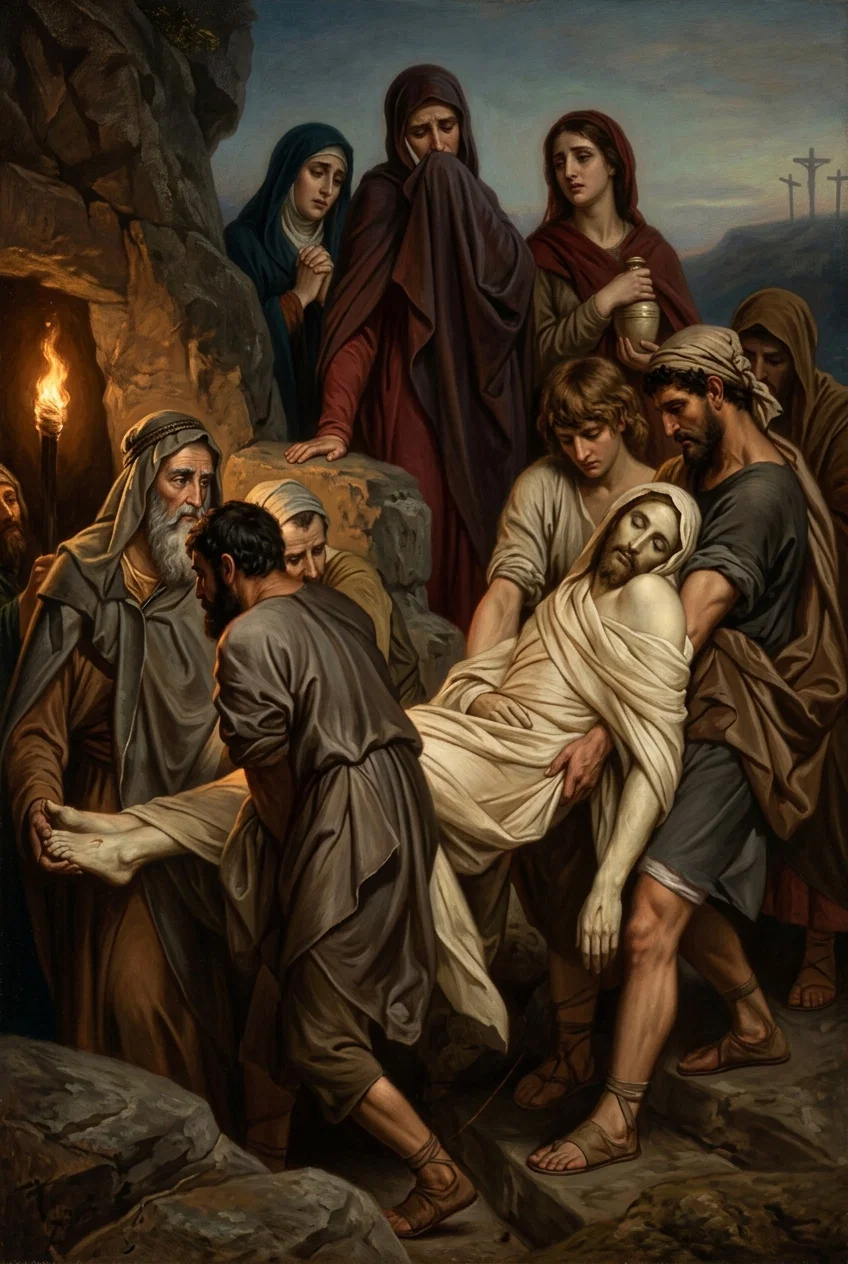
By faith we see Joseph of Arimathea gently and respectfully take the body of Jesus down from the cross, and, with the aid of Nicodemus and the holy women, prepare it for its interment, and then put it in a costly sepulcher with the rich, in fulfilment of the following prediction of Isaiah: “And he made his grave with the wicked, and with the rich in his death; because he had done no violence, neither was any deceit in his mouth.” Isa. 53:9; Matt. 27:66; John 19:38, etc.
By faith we see Jesus arise from the tomb and conquer death and the grave, opening up before us a door of hope; and by it we see him ascend to heaven in glory and majesty, attended by bright seraphs, who rejoice at his triumph and at the success that has attended his earthly mission, in fulfilment of the following inspired predictions: “For thou wilt not leave my soul in hell [the grave, Hebrew]; neither wilt thou suffer thine Holy One to see corruption.” Ps. 16:10. “When thou shalt make his soul an offering for sin, he shall see his seed, he shall prolong his days, and the pleasure of the Lord shall prosper in his hand.” Isa. 53:10, etc.
By faith we see Jesus welcomed in heaven by his dear Father, and by all the angelic host, in harmony with the following prophetic words of David: “Lift up your heads, O ye gates; and be ye lifted up, ye everlasting doors; and the King of glory shall come in. Who is this King of glory? The Lord strong and mighty, the Lord mighty in battle. Lift up your heads, O ye gates; even lift them up, ye everlasting doors; and the King of glory shall come in. Who is this King of glory? The Lord of hosts, he is the King of glory.” Ps. 24:7–10.
By faith we behold Jesus seated as king-priest on his Father’s throne and at his Father’s right hand (Zech. 6:12, 13; Heb. 8:1–3, etc.); and, as we contemplate him as occupying this honored and exalted position, the following words, with which he used to encourage his disciples, come to us with special force, greatly strengthening our faith: “All power is given unto me in heaven and in earth.” Matt. 28:18. “If any man serve6me, him will my Father honor.” John 12:26. “Father, I will that they also, whom thou hast given me, be with me where I am; that they may behold my glory, which thou hast given me; for thou lovedst me before the foundation of the world.” John 17:24.
By faith we behold Jesus as our faithful and sympathizing high priest, pleading in our behalf the merits of his own precious blood spilt on Calvary, and hear him telling us, with yearning love and the tenderest pity: This blood was shed for you. My sufferings were to save you from suffering. I laid down my life that you might obtain pardon, escape the second death, and have eternal life. My righteousness that I wrought when on earth may be yours. All the means and resources of heaven are at your disposition, that you may be saved, and finally be with me in this blissful place, and enjoy its abiding riches and never-fading glories.
Living, saving faith removes the veil that separates us from Jesus, so that we can, in a certain sense, behold and enjoy his glory. By living faith we may enjoy the love, cheering words, and precious counsels and invitations of Jesus, and his pleading in our behalf. And, as we see the past faithfulness of Jesus, we rest assured that he will fulfil the repeated scriptural promises that he will come again to conclude the work that he commenced at his first coming, and we say in our hearts, “Come, Lord Jesus.” Rev. 22:20.
By this faith the sinner may plunge into the precious fountain drawn from Immanuel’s veins, wash all his sins away, and clothe himself with the pure robe of Christ’s righteousness. Zech. 13:1; Rev. 7:13, 14. By it he may secure the presence and help of the mighty Spirit of promise, and of the pure and mighty angels who rejoiced when God laid the foundations of our earth, and who are now “sent forth to minister for those who shall be heirs of salvation.” John 14:16–18; 16:7, etc.; Job 38:6, 7; Heb. 1:14, etc.
Before genuine faith in lively exercise demons quail and flee, and apparently insurmountable difficulties disappear. By this faith, light, hope, courage, and strength come to the soul, and victories over sin, sinful habits, the flesh, the world, and the devil, are achieved; and by it it is possible for us to do all the works that God enjoins upon us; “for all things are possible to him that believeth.”
Faith and Unbelief.
Faith honors God, while unbelief dishonors him by making him a liar. “He that believeth not God,” says the beloved apostle, “hath made him a liar; because he believeth not the record that God gave of his Son.” 1 John 5:10. God says he will pardon and justify the repenting believer, and finally give him eternal life (providing that he will, after being pardoned and justified, live a life of faith); and he who truly believes, takes God at his word, and says, God is a God of truth. I comply with the conditions he lays down. I repent and believe, and know that pardon and justification are mine. I purpose to live a life of faith, to “live by the faith of the Son of God, who loved me, and gave himself for me” (Gal. 2:20); and I believe God will show himself true to his promise, by giving me eternal life at last.
Unbelief says: You are too great a sinner to be forgiven and justified. God is a liar. He tells you he will forgive and justify you if you repent and believe; but before you can claim and reasonably expect to receive such blessings at his hands, you must wait till you are better; you must make yourselves better by your own efforts. And, besides, to venture all on faith is to take a leap in the dark; for you can not see how all that is promised you after you have commenced to walk and live by faith, can be brought about. There are trials, sufferings, and giants by the way.
Such is the language of unbelief, the language whereby Satan deceives souls, and deprives them of the benefits and blessings of the plan of salvation. Listen not to such suggestions of the arch deceiver, of the destroyer. If men can make themselves better without faith in Christ, what need is there of ever believing in Christ to improve and reform? What the soul that is burdened by sin and that is entangled and perverted by sinful habits and practices, wants, is the assurance of pardon and justification, deliverance from the bondage of sin, and power to do right and to break the power of sinful habits—all of which is secured by that faith which is accompanied by repentance. It is only by the help that comes through faith that we can become better.
We may therefore rest assured that when we are tempted to put off faith in Jesus for such reasons, Satan is at our heels, and is trying to deceive and ruin us by his insinuations. He admits that we should be better, as a mere matter of policy; for he does not want us to be better. He would shut faith out of our minds, and lead us to rely solely upon our own endeavors to do right, that we may remain in our sins, and perish at last. And what are all the giants with which he would frighten us, compared with the fearful wages of sin, with the portion of unbelievers in the lake of fire in the day of God’s just but fearful wrath?
How pained are faithful parents when their children distrust them, and how pleased they are when their children place implicit confidence in their word, and promises! And how must our heavenly Father feel toward us when we distrust him and doubt that he will be true to his word, and fulfil the promises he has made us, if we regard the conditions on which their accomplishment depends! On the other hand, how pleasing it must be to God to see us place implicit confidence in his word and promises, and to see us act accordingly!
The exercise of living faith involves venturing. In temporal things, those who venture nothing have nothing, while those who venture much, in harmony with prudent, well-defined plans, are those who reach encouraging results. They may not see at first the way clear in every particular; but they settle on general principles which have been thoroughly tested and which experience has shown to indicate the way to success.
So in spiritual things. We must venture by faith from first to last. If we do this, we shall succeed and make acquisitions that will as far surpass temporal acquisitions as heaven is higher than earth, and as eternal things are more precious than the fleeting things of this mortal life.
(Concluded next week.)
FEAR NOT.
By Zinzendorf
If the way be drear,
If the foe be near,
Let not faithless fear o’ertake us!
Let not faith and hope forsake us!
For through many a foe
To our home we go.
—Zinzendorf.
The Power to Do What Is Right
“MEN know well enough what they ought to do; but what they really need is the power to do it—and that power comes from Christ.”
ARE WE READY FOR TURKEY TO FALL?
By W. N. Glenn
BY W. N. GLENN.
It is everywhere the fad for religious people and religious journals to berate the so-called Christian governments because of their alleged apathy in the matter of annihilating the Turkish government. These Christian journals and other Christian teachers seem to be oblivious of the meaning of the course they so persistently urge upon the great European powers and upon the United States. While the condition of things in Turkey is indeed deplorable, it is peace and prosperity as compared with the reign of war and bloodshed that must inevitably follow in Europe if the treaty powers were to let go their support of the “sick man of the east” and endeavor to recover the means they have invested in his maintenance. The heads of all these powers are aware of the terrible consequences of withdrawing their support from Turkey. Irresponsible talkers and writers may think it religious and patriotic to clamor for the overthrow of the Turkish dominion, but the statesmen who are responsible for the peace of their various empires, kingdoms, and republics, know the meaning of rash action too well to be goaded into general warfare by the cry of ambitious seekers after temporary notoriety. Behind the “powers that be” is the God of heaven. “The Most High ruleth in the kingdom of men, and giveth it to whomsoever he will.” Dan. 4:17, 25, 32. When his time comes for the government of Turkey to be overthrown, it will be done. In his providence the peace of Europe has been maintained by the combination of European powers to maintain Turkey in position. In his providence the settlement of the Eastern Question by force of arms has been averted for many years, and why? The answer is given in Revelation 7:1-3. God has a message going to the world (chap. 14:6-12), the last message of mercy, a message calling men to prepare for the judgment, a message showing the fall of the corrupt Babylonian church, because she has rejected his law and made the nations drunk with the wine of the wrath of her fornication, a message calling men back to obedience to his law, which is the standard of the judgment which the message proclaims. The winds of a general war are being held, until this message has been carried to every nation and kindred and tongue and people, until the work of sealing the servants of God is completed. The final downfall of Turkey is the drying up of the river Euphrates, spoken of in Revelation 16. It will be the signal for the gathering together of the “kings of the earth and of the whole world, to gather them to the battle of that great day of God Almighty.” Verse 14.
Let those enthusiasts who are so lustily calling for the overthrow of Turkey ask themselves the question, Are we ready for the result? In immediate connection with this tragic event, the Lord says: “Behold, I come as a thief. Blessed is he that watcheth, and keepeth his garments, lest he walk naked, and they see his shame.” Verse 15.
Creation Groans for Christ
“Jesus, thy fair creation groans—
The air, the earth, the sea—
In unison with all our hearts,
And calls aloud for thee.
Thine was the cross, with all its fruits
Of grace and peace divine;
Be thine the crown of glory now,
The palm of victory thine.”
THE TEST AT REPHIDIM.
By Ellen G. White
BY MRS. E. G. WHITE.
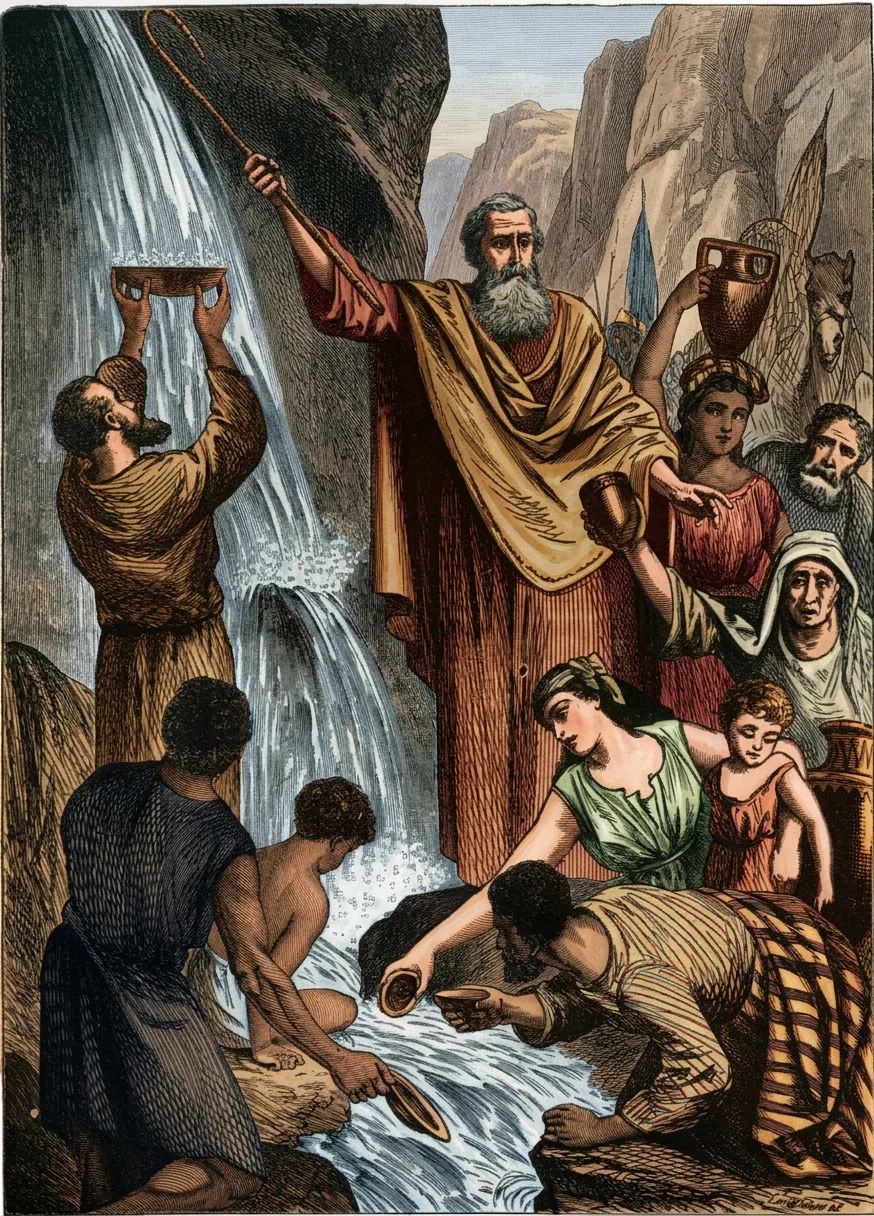
“ALL the congregation of the children of Israel journeyed from the wilderness of sin, after their journeys, according to the commandment of the Lord, and pitched in Rephidim; and there was no water for the people to drink. Wherefore the people did chide with Moses, and said, Give us water that we may drink. And Moses said unto them, Why chide ye with me? wherefore do ye tempt the Lord? And the people thirsted there for water; and the people murmured against Moses, and said, Wherefore is this that thou hast brought us up out of Egypt, to kill us and our children and our cattle with thirst? And Moses cried unto the Lord, saying, What shall I do unto this people? they be almost ready to stone me. And the Lord said unto Moses, Go on before the people, and take with thee of the elders of Israel; and thy rod, wherewith thou smotest the river, take in thine hand, and go. Behold, I will stand before thee there upon the rock in Horeb; and thou shalt smite the rock, and there shall come water out of it, that the people may drink. And Moses did so in the sight of the elders of Israel. And he called the name of the place Massah, and Meribah, because of the chiding of the children of Israel, and because they tempted the Lord, saying, Is the Lord among us, or not?”
By the command of God, the children of Israel were brought to Rephidim, a place destitute of water. He who was enshrouded in the pillar of cloud was leading them, and it was by His express command that they were encamped at this place. God knew of the lack of water at Rephidim, and he brought his people hither to test their faith; but how poorly they proved themselves to be a people whom he could trust! Again and again he had manifested himself to them. He had slain the first-born of all the families in Egypt to accomplish their deliverance, and had brought them out of the land of their captivity with a high hand; he had fed them with angels’ food, and had covenanted to bring them into the promised land. But now, when difficulty rose before them, they broke into rebellion, distrusted God, and complained that Moses had brought them and their children out of Egypt only that they might die of thirst in the wilderness. By their lack of faith they dishonored God, and placed themselves where they could not appreciate his mercies.
Many to-day think that when they begin their Christian life they will find freedom from all want and difficulty. But every one who takes up his cross to follow Christ comes to a Rephidim in his experience. Life is not all made up of green pastures and cooling streams. Disappointment overtakes us; privations come; circumstances occur which bring us into difficult places. As we follow in the narrow way, doing our best, as we think, we find that grievous trials come to us. We think that we must have walked by our own wisdom far away from God. Conscience-stricken, we reason, if we had walked with God, we would never have suffered so.
Perhaps doubt and despondency crowd into our souls, and we say, The Lord has failed us, and we are ill-used. He knows about the strait places through which we are passing. Why does he permit us to suffer thus? He can not love us; if he did he would remove the difficulties from our path. “Is the Lord with us, or not?”
But of old the Lord led his people to Rephidim, and he may choose to bring us there also, in order to test our faithfulness and loyalty to him. In mercy to us, he does not always place us in the easiest places; for if he did, in our self-sufficiency we would forget that the Lord is our helper in time of necessity. But he longs to manifest himself to us in our emergencies, and reveal the abundant supplies that are at our disposal, independent of our surroundings; and disappointment and trial are permitted to come upon us that we may realize our own helplessness, and learn to call upon the Lord for aid, as a child, when hungry and thirsty, calls upon its earthly father.
Our heavenly Father has the power of turning the flinty rock into life-giving and refreshing streams. We shall never know, until we are face to face with God, when we shall see as we are seen, and know as we are known, how many burdens he has borne for us, and how many burdens he would have been glad to bear if, with childlike faith, we had brought them to him.
In the hour of need we can gain no power by looking to ourselves. Our eyes need to be anointed with the heavenly eye-salve, that we may discern our spiritual poverty and lack of faith. God is declared in all his dealings with his people; and with clear, unclouded eye, in adversity, in sickness, in disappointment and trial, as well as in prosperity, we are to behold the light of the glory of God in the face of Jesus, and trust to his guiding hand. Remember the power and love God has shown us in time past. He “so loved the world, that he gave his only-begotten Son, that whosoever believeth in him should not perish, but have everlasting life.” Then will he not find a way for us out of our difficulties?
By their doubt and unbelief God’s people do much to grieve the heart of God, and tempt a withdrawal of his mercy. But through all, his love is unchangeable. The waves of mercy may be beaten back, but again and again they flow to the hearts of undeserving human beings. God loves his purchased possession, and he longs to see them overcome the discouragement with which Satan would overpower them. Let no thought of unbelief afflict your souls; for unbelief acts as a paralysis upon the spiritual energies. Do not magnify your difficulties, but keep the Lord in your remembrance, watching unto prayer.
And to us the Scripture comes: “Moses verily was faithful in all his house as a servant, for a testimony of those things which were to be spoken after; but Christ as a Son over his own house, whose house are we, if we hold fast the confidence and the rejoicing of the hope firm unto the end. Wherefore as the Holy Ghost saith, To-day if ye will hear his voice, harden not your hearts, as in the provocation, in the day of temptation in the wilderness; when your fathers tempted me, proved me, and saw my works forty years. Wherefore I was grieved with that generation, and said, They do always err in their heart, and they have not known my ways. So I swear in my wrath, They shall not enter into my rest. Take heed, brethren, lest there be in any of you an evil heart of unbelief, in departing from the living God. But exhort one another daily, while it is called To-day; lest any of you be hardened through the deceitfulness of sin. For we are made partakers of Christ, if we hold the beginning of our confidence steadfast unto the end.”
HOPING IN THE MERCY OF GOD.
By E. Hilliard
BY E. HILLIARD.
The eye of the Lord surveys the entire universe. His infinite gaze penetrates every corner of his created works. The millions of worlds freighted with unfallen beings are seen by him, and cared for. There is one world among the many, the most of whose inhabitants are at enmity with its Maker. But, notwithstanding this, its Maker has created circumstances congenial to its inhabitants, and these circumstances are the only conditions under which they could exist. The brightness, beauty, and glory of other worlds could not be endured by the people of this sinful earth. “Cursed is the ground for thy sake,” said the Author of the world. It was for man’s sake that the curse which has blighted our world was pronounced upon it.
While the care of God is over other worlds, his eye is especially upon this world of sin. As he looks over its teeming millions, his eye is especially fixed upon certain ones. Who are they? Why does he notice some more than others? Does not the Bible teach us that God is no respecter of persons? It certainly does. Let us see, then, who it is that he looks to so closely, and why he regards them. “Behold, the eye of the Lord is upon them that fear him, upon them that hope in his mercy.” Ps. 33:18. Why is his eye upon them that hope in his mercy? The answer is, “To deliver their soul from death [second death], and to keep them alive in famine.” Verse 19.
God loves to do this for those who dare to hope in his mercy. He takes great pleasure in such. Hear his words, “The Lord taketh pleasure in them that fear him, in those that hope in his mercy.” Ps. 147:11. The meaning of the word “mercy” is, “disposition to overlook injuries, or treat an offender better than he deserves.” If God takes pleasure in treating the penitent sinner better than he deserves, why should not the sinner rejoice to be so treated? When the sinner knows that he has merited the punishment of death, it is impossible for him to realize that he is to be treated with life, is to be fed in famine, and delivered out of trouble, until he views the character of God aright.
God’s eye is upon the people of this world to see who will trust in his mercy, to see who will turn from their wicked ways, and believe they will be treated better than they deserve. This world is the most interesting place of the Creator’s universe. All of the inhabitants of heaven are looking upon it. It is the place where the Creator of innumerable worlds expired. He made his grave among the sinful people of this sin-cursed earth. In bodily pain and mental agony Christ breathed out his life on the cross. The Garden of Gethsemane and the little mount of Calvary are the most memorable and attractive spots of God’s universe.
Satan has misrepresented the character of God. He has caused people to think that God’s decrees are arbitrary; that he is angry with men, and loves to destroy them. When the mind is disabused of this Satanic deception, the individual sees that the reverse is true; that God is full of compassion, and loves to have men repent, hope in his mercy, and trust his power to save them. Sinner, will you do it? Will you hope in his tender compassion? Dare you believe that the great God is as kind and good as he says he is? Listen to his word, and then look with a believing heart toward heaven. “Who is a God like unto thee, that pardoneth iniquity, and passeth by the transgression of the remnant of his heritage? he retaineth not his anger forever, because he delighteth in mercy. He will turn again, he will have compassion upon us; he will subdue our iniquities; and thou wilt cast all their sins into the depths of the sea.” Micah 7:18, 19. Look up, believe, and live.
Tonga, Friendly Islands, South Pacific Ocean.
Question Corner
“Enquire, and make search, and ask diligently.”
No. 415. Mine Hour.
PLEASE explain John 2:4, “Mine hour is not yet come.”
W. H. S.
The hour when he should be manifested as the Son of God. His mother thought that then was a good time to manifest himself; Jesus said: What is that to thee and me? “Mine hour is not yet come;” that belongs to God.
THE view is advanced by some that the pronoun “he” in Rev. 13:15, 16 refers to the papal beast. How may I know whether this be so?
T. H.
By the laws of language. In verse 11 John saw “another beast.” This beast he calls “he” in verses 12, 13, and 14. The law of grammar would demand that “he” in verses 15, 16 refer to the same antecedent, “another beast,” as does the same pronoun in the verses preceding. Notice what he does: “He spake” (verse 11), “exerciseth” and “causeth” (verse 12), “doeth” (verse 13), “deceiveth” (verse 14). “He had power” (verse 15), and “he causeth” (verse 16). The change in the form of the verb makes a repetition of the pronoun necessary in verses 15 and 16. By the common law of pronouns and their antecedents you may know that the above view is not so.
No. 417. Discerning of Spirits.
PLEASE explain 1 Cor. 12:10, “To another discerning of spirits, etc.
MRS. M.
The apostle is enumerating some of the spiritual gifts which God has bestowed upon various members of his church. One is given the power to work miracles, to do things contrary to or above the laws of a sin-perverted nature. “To another prophecy,” revealing present and future events and dangers, etc., or instructing in duties which the church might not see unless God called attention to them in that way. “To another discerning of spirits,” able to read the motives and animus of persons, especially Satan’s agents. See Matt. 22:17, 18 for a record of how it was exercised by our Lord; or Acts. 5:3, and 8:20-23, of its exercise by Peter. “To another divers kinds of tongues;” that is, speaking in foreign tongues as God saw there was need. “To another the interpretation of tongues,” ability from God to say what the speaker in an unknown tongue meant.
No. 418. Christ’s Coming to Earth.
DOES the Bible teach that our Lord will come to earth more than once more?
The Lord comes to this earth (in the sense of standing upon it) but once more, and that is at the end of the thousand years, when the New Jerusalem shall descend out of heaven from God. Compare Rev. 21:1-5; 20:9, 11; Zech. 14:4. When he comes for his saints, they will be caught up together with Christ in the clouds. 1 Thess. 4:16, 17. But then it is that the saints enter upon their eternal reward. It is true that that reward is not then upon this earth, and yet the New Jerusalem and the Paradise of God are a part of the new sinless earth. That glorious city is the capital and metropolis of the new earth. That Paradise is the garden which God planted for man on this earth in the beginning. It is because of this that we are told that Christians not only seek a country, but a continuing city. Heb. 11:14; 13:14. The city is a part of the eternal reward. Again, the time of Christ’s coming is sometimes spoken of as a single event and one day, when it all covers many events and all the great day of the Lord. In that day all these various events will be fulfilled. When the saints meet Christ in the clouds he comes after them; at the end of the thousand years he comes with them. For a fuller exposition of these things see Bible Students’ Library, Nos. 55 (“The Judgment, Its Events and Their Order”), 65 (“The Great Day of the Lord”), 124 (“The Manner of Christ’s Coming”), the prices of which are 15 cents, 5 cents, and 2 cents respectively. It will pay our readers to obtain these little publications. We believe they will make these matters plain.
Heaping Up Treasure
Heaping up Treasure.—The Lord through his prophet declares that the rich men of these times have “heaped treasure together for the last days;” and he intimates that the methods used to obtain the treasure are not commendable and the certain wo coming upon them is deserved. See James 5:1-8. Among the many ways by which treasure has been heaped together by the rich is the organization of great combines, trusts, and various other monopolistic agencies. There are now said to be in this country 137 trusts, with an aggregate capitalization of $1,507,000,000. Fifteen hundred million can not be comprehended by mortal. Upon this matter a great public journal remarks:—
“If the United States had a population of 75,000,000 it would have not more than 15,000,000 heads of family, so that the capitalization of these9monopolies represents more than a hundred dollars per head of family.
“It is evident that the business, the politics, the entire life of the people must be radically affected by the monopolistic movement which within less than twenty-five years has extended throughout the country, drawing in one enterprise after another, until now it threatens to force both production and distribution to a speculative basis. This inflation of capital will be but the beginning of systematic fraud, having the restriction of trade for a means and the extortion of unearned profits for an object.”
The trust power stops at nothing. It nullifies all laws made to check it, and neither state or national government seems strong enough to control it. The worst of this is that the capital stock of many if not all these monopolies is enormously inflated, and yet there are dividends—profits—on this inflated stock. For instance, the “Dressed-Beef Trust,” organized for the purpose of controlling the meat supply of the country, is capitalized at $100,000,000, when it is said to be doubtful if it has $5,000,000. The Sugar Trust is said to be capitalized at $75,000,000—ten to one on its investment. It is such methods of business that cause the wildest speculation on such common every-day necessities as making matches and biscuits. These gigantic trusts are among the things that are rapidly making this country and all the great countries of the world plutocracies. They bring wealth to the few and oppression to the many. And Inspiration has told us that these are signs of the last days. Pilgrim, do not lose heart. “Be patient, therefore, brethren, unto the coming of the Lord.” “Stablish your hearts; the coming of the Lord draweth nigh.”
Young People's Knowledge of the Bible
Dean Fremantle, the well-known English divine, declared in a recent address before the Ripon Training School, London, that Bishop Boyd Carpenter, a shrewd and wide observer, told him that there is less knowledge of the Bible among the young people in 1896 than there was among those of twenty years ago. There is much said and studied—about the Bible, but there is comparatively little study of the Bible itself.
Imperiled
Imperiled.—Says Charles Roads, D.D., of Philadelphia, on “Christian Endeavor in Citizenship”:—
“The platforms of each of the great parties have several issues and the party orators will discuss all of them. Here is our opportunity to show that the Christian features of our government are being imperiled, and that we must defend them and entrench them securely, as the amendment [to the Constitution, recognizing the rulership of Christ] will do.”
But whatever features truly Christian are to be seen in this government came not through legislation, but by being implanted by the Spirit of Christ in the hearts of the people of the government. When a feature of the Christian religion is made a matter of human legislation, it ceases at that moment to be Christian. It may have the form, but it is a mere shell. Nothing is so imperiling the Christianity of these men engaged in this work of national reform as the very work they are doing. Genuine Christianity will live despite all legislation.