Your ShelfYour Projects

Signs of the Times, Vol. 31, No. 9.

AMERICAN PROTESTANTS PROTEST
Earlier text: AMERICAN PROTESTANTS PROTEST

The Wonderful Land of Life

By L. D. Santee
GLADLY the pilgrim turns his feet to the radiant pearly portal. Crimson and gold its glow, where cometh no pain or strife. Sweet and long is the rest, in the home of the soul immortal, Free from the woes and cares of earth, in the wonderful land of life.
Sweet and glad is the thrilling truth, telling a coming Saviour. Sweeter the message grows, in a world where sin is rife. Giving the soul to Jesus, the spirit, by pure behavior, Is writing your name in heaven, in the wonderful land of life.
Sacred the altar of prayer, that unites the spirit with heaven, That binds our souls to the Master, away from a world of strife. Crimson and gold is the light that the city of God has given, And the host unnumbered come with joy to the wonderful land of life.

Forewarned of Jerusalem's Doom

An Abomination of Desolation—Miracles and Signs Are Not Conclusive—Do Not Allow the False Christs to Deceive—The Sexton's Bell Is Not the Signal—We All Go Together

By EUGENE W. FARNSWORTH
"When ye therefore shall see the abomination of desolation, spoken of by Daniel the prophet, stand in the holy place, (whoso readeth, let him understand:) then let them which be in Judea flee into the mountains." Matt. 24:15, 16. The Saviour here gave His endorsement of the prophet Daniel. Some men reject that prophet entirely; but the Saviour quotes him as authority, and tells us that when we read what he wrote, we should understand it. Furthermore, none should try to prevent any person from understanding it. "Let him understand."

TRUE ESTIMATE OF AN ARMY

Christ quotes from Dan. 9:27. In the twenty-first chapter of Luke the thought is made a little clearer. He says, "And when ye shall see Jerusalem compassed with armies, then know that the desolation thereof is nigh." Verse 20.
Please notice that by combining the thought in the two foregoing texts, we see that the Saviour calls the Roman army an "abomination of desolation." That is the name given of Heaven to an army. I sometimes wonder if armies have grown better since Christ gave this definition. Look at a devastating army passing through a country, burning houses, killing cattle, and destroying property of all kinds, leaving death and destruction in its track. It creates desolation wherever it goes. Are not armies still an "abomination of desolation"?
The Saviour came to bring peace on earth, and the song sung by angel voices was, "On earth peace, good will toward men." The theme under consideration will bring us to the full consummation of peace.
It was in the year 70 of the Christian era that the Roman general Titus encircled Jerusalem with his army, and then began a siege that was terrible in its results. Josephus tells us that a million men, women, and children died or were sold into slavery, as the result of the siege that overthrew Jerusalem. It was certainly a terrible experience.

BY THIS SIGN KNOW YOU SHOULD FLEE

The Saviour said to His people, When you see this sign—when the army occupies the holy place, this consecrated part of the ground—then let them who are in Judea flee to the mountains. About Jerusalem and the priestly cities, all the ground, to a distance of two thousand cubits from the wall, was regarded as holy.
"Let him which is on the housetop not come down to take anything out of his house." Matt. 24:17. No time must be lost. Advantage was to be taken of every moment left. The desolation of the city was so near that every one who believed God, must act instantly and flee for his life. It is said that not a single Christian perished in the downfall of Jerusalem. When they saw the sign God gave, they fled for their lives over the Jordan River. It would be well if other signsgiven in this chapter were as faithfully heeded.
"But pray ye that your flight be not in the winter, neither on the Sabbath day." Verse 20. This counsel was given because there would be great suffering if the people were obliged to flee from their homes in cold weather. Christ taught them to pray, for forty years, that God would so ordain circumstances that when the great destruction came they would not be forced to flee in winter.

RECOGNIZED AS CLEARLY AS WINTER

"Neither on the Sabbath day." Does not the Saviour recognize the fact that the Sabbath would be sacred, and that it should be observed, as late as the time when Jerusalem would be destroyed, in A.D. 70? He recognized the existence of the Sabbath as He recognized the existence of winter. If the Sabbath was to be kept holy in the year 70 of the Christian era, I submit that the Sabbath is holy to-day. If the seventh day was sacred after Christ went to heaven, then it is sacred 1,900 years after that event.

TRIBULATION AND MARTYRDOM

"For then shall be great tribulation, such as was not since the beginning of the world to this time, no, nor ever shall be. And except those days should be shortened, there should no flesh be saved: but for the elect's sake those days shall be shortened." Verses 21, 22. As we come down the stream of time from the destruction of Jerusalem a little way, the great and incomparable persecution of God's people began. Under pagan Rome, millions of God's people suffered death. Various historians give the total number who have been put to death at from fifty to seventy-five millions; but how many, no man will ever know till the books of heaven are opened, and the Lord shall write up His people. Then it will be known who suffered martyrdom during the Dark Ages.

FALSE CHRISTS AND FALSE PROPHETS

"Then if any man shall say unto you, Lo, here is Christ, or there; believe it not. For there shall arise false christs, and false prophets, and shall show great signs and wonders; insomuch that, if it were possible, they shall deceive the very elect." Verses 23, 24. At the present time, if people see anything miraculous, many conclude at once that God wrought the miracle. It may be that He did, or that He did not. Please notice the text again: "For there shall arise false christs, and false prophets, and shall show great signs and wonders; insomuch that, if it were possible, they shall deceive the very elect."
The Saviour states plainly that false prophets and false christs will arise, that they will work miracles and do great wonders, and if we follow them because of the miracles they do, we shall be led astray. If a man will believe miracles rather than the word of God, the devil will furnish plenty of miracles on which to base his faith. Jannes and Jambres went in before Pharaoh and worked miracles that satisfied the mind of the king, and that experience will be repeated. A sign is not necessarily wrought by the power of God. It may be a manifestation of the power of the devil.
"Behold, I have told you before. Wherefore if they shall say unto you, Behold, He is in the desert; go not forth: behold, He is in the secret chambers; believe it not." Verses 25, 26. Now why? And what does that mean? I have seen long trains carrying hundreds of people to Salt Lake City. To the question, "Where are you going?" the reply would be, "We are going to Zion."
When going to Utah from the west, we pass through what was a great desert. If Salt Lake City is approached from the east or the north, the traveler passes through desert. If it is said to you, "Behold, He is in the desert," are you going? If the well-meaning people who have gone there believing they were going to Zion had believed what the Saviour said in this text, none would have emigrated thither.

NOT IN SECRET CHAMBER

Further He says, "If they shall say unto you, . . . . Behold, He is in the secret chambers; believe it not." If you read the old-time literature of Spiritualists, you will find that many writers believed that the manifestation of Spiritualism was the second coming of Christ.
In a few scriptures, the grave is called the chamber of the dead. Some theologians teach that when a man dies, that is the second coming of Christ. If that were true, however, there would be as many second comings of Christ as there have been saints that have died, while it is plainly to be seen that there can be but one second coming. Christ said, "If I go, . . . . I will come again." John 14:3.

NOT ON SIGNAL OF SEXTON'S BELL

"For as the lightning cometh out of the east, and shineth even unto the west; so shall also the coming of the Son of man be." Matt. 24:27. Shall we say that Christ's second coming occurs when a man dies? Death is not the gate to heaven, and a man does not go there under the toll of the sexton's bell. The Archangel's trump is the signal for men to go to heaven. When a man dies, he goes into the grave; and when Christ comes back, that is where He finds him. It will be a public event when the saints go to heaven. John 5:25-27.
The resurrection is the gateway to heaven, and the resurrection takes place when Jesus comes the second time. All the redeemed go to heaven "together." 1 Thess. 4:15-17. Are not you glad of that? We are not going one at a time. We shall be "caught up together with them in the clouds, to meet the Lord in the air: and so shall we ever be with the Lord." We are going to the throne of God together. It matters not at which side of the city I may go in, nor which gate you pass through, but we shall all go "together."

Christianity and Feeling

A Soul Experience Not a Mere State of Feeling — The Tint of the Apple or Peach as Related to Its Flavor an Object-Lesson to Professing Christians

By H. W. COTTRELL
CHRISTIANITY is an experience wrought out with one's self and the Lord. It is good for the one who possesses it, and also good in a living degree for those with whom he associates, provided he is in possession of the genuine article.
True character is often counterfeited. A truthful person is counterfeited. An honest man is counterfeited. Government notes are counterfeited. Repentance has its counterfeit. Conversion has its counterfeit.

CHRISTIAN METHODS COUNTERFEITED

The method of making men Christians is counterfeited nowadays. Christ's method or plan was, and still is, to love, persuade, and impel. The modern yet ancient man-made plan is to compel by civil law, fines, imprisonments, police force, and if necessary at the point of the bayonet, as is evidenced by the Dark Ages.

HOW DO YOU FEEL?

Christianity is soul experience, and not a state of feeling brought upon one as the result of surroundings. Feeling is not Christianity. A Christian may feel happy or he may feel sad. Either of these conditions may be brought to him through circumstances; but whether he feels happy or sad, he is a Christian. Christianity is a life condition, not feeling.
"How do you feel?" This is a query often put to Christians. The reply to the query whether one is feeling well or not well, is of no consequence, because feeling is not fact. "How are you?" The Christian can truthfully say: "I am at peace with God. All is well." Blessed experience! No longer a theory of feeling which serves to deceive! Feeling sometimes places one at the top of the ladder, and when the environment changes that brought to him the emotion or feeling, he finds himself on the lowest round of the ladder if on the ladder at all.

LIKE TINT OF APPLE OR PEACH

I may say, by way of illustration, that feeling is to Christianity as the tint or color is to peach or apple. The quality of the fruit is first found to be in the seed. Then it enters the trunk, the bud, the growing, green, forming fruit. Then as it ripens, God perchance tints it. Possibly the shade of color extends no deeper than the skin. This may be removed, but the quality will remain. The fruit does not lose its quality when, because of local conditions, the color or tint God placed upon it through nature is removed by some one who desires to eat the fruit.
As the tint is to the peach, so is feeling to Christianity. The quality of Christianity, like that of the fruit, is first found in the seed — Christ. The quality is next seen in the individual as he is "growing in grace." He ripens through experience. The Christ who changes sinners to Christians, tints them with feelings of joy and gratitude.

DOES NOT REMOVE QUALITY

As one with a knife may remove the tint from the fruit with the skin, but can not thusremove the quality, so the severe trial of one's faith may remove feeling, but it can not remove Christian quality.
Professed Christianity, composed of sentiment, emotion, feeling, is flavorless when the feeling is, for any cause, extracted therefrom.
Reader, let us permit Christ — the seed — to abide in both you and me.

Humility

HUMILITY is a virtue to be longed for, sought, and prayed for, but it is not one to be paraded. There is something incongruous, almost self-contradictory, in a profession of humility. To be sure, our Lord spoke of Himself as "meek and lowly in heart," but He also challenged His enemies to bring any charge of sin against Him. He was superior to our ordinary human infirmities and limitations, and could, therefore, without ostentation, say of Himself many things which we dare not say of ourselves. Let us diligently cultivate lowliness of heart, but let us be on our guard lest we grow proud of our success in attaining it.—Christian Advocate.

The Master Counterfeiter

Counterfeit Worship Introduced —

A Special Day Set Apart for It—Is It to Be Accepted? : : : : :
By GEORGE W. REASER
DOUBTLESS all Christians will concur in the statement that the arch-deceiver of the human family is also the master counterfeiter of the worship and service of Jehovah.

THEY CHOSE THE BRIGHTEST OBJECT

Early in the history of the human family, as men became forgetful of the true God, though having had implanted in their natures the desire to worship, how natural it was that Satan should persuade them to worship the brightest object they could see, and regard it as the creative God! Thus sun-worship, as a rival of the worship of Jehovah, became almost universal. Egypt, the earliest of kingdoms that oppressed the people of God, was the center for this cult.

THEN THEY SET APART A DAY

The next logical step, after the introduction of sun-worship, was to set apart a day for the worship of the sun. Such a day would not suit Satan's purpose unless it was a rival of the day set apart by Jehovah for His worship. Every historian knows that the day chosen for the worship of the sun was the first day of the week, which, because of the purpose to which it was devoted, was designated "Sun-day." Thus was bequeathed to the modern world the name applied to the first day of the week.
After the introduction of sun-worship, and the dedication of a definite day in each recurring week for the worship of the luminary that gives light to the earth, the Sun-day became the rival of the day given by Jehovah to His people for divine worship.

THE TWO RIVALS

Thus one day was the symbol of true worship, and the other the symbol of false worship. Finally, after the coming of Christ into the world, and after "the falling away" foretold, the system which professed to be Christianity, became somewhat popular. In the course of time — in the early part of the fourth century — Constantine, the ruler of the world, professed conversion from paganism to Christianity; and apparently for the sake of making himself more popular, he proclaimed Sunday as the Christian sabbath, and gradually the service which pertained to the Sabbath was transferred to Sunday. Thus was Sunday, the rival to the Sabbath of Jehovah, adopted into the so-called Christian church.

DOES JEHOVAH ACCEPT IT?

Question: When the change in the day of the Sabbath was attempted by Constantine, the ruler of the pagan world, and the rival to the Sabbath of Jehovah was thus recognized, did Jehovah abandon His own day, accept the rival institution, and transfer the blessings that He had pronounced upon the Sabbath to the rival? The settling of this question aright ought to establish every true Christian in keeping the Sabbath of Jehovah. Let every loyal heart say, "As for me and my house, we will serve the Lord," we will keep the Sabbath of Jehovah rather than its unholy rival.

A Morning Prayer

"My voice shalt Thou hear in the morning, O Lord; in the morning will I direct my prayer unto Thee, and will look up." Ps. 5:3.
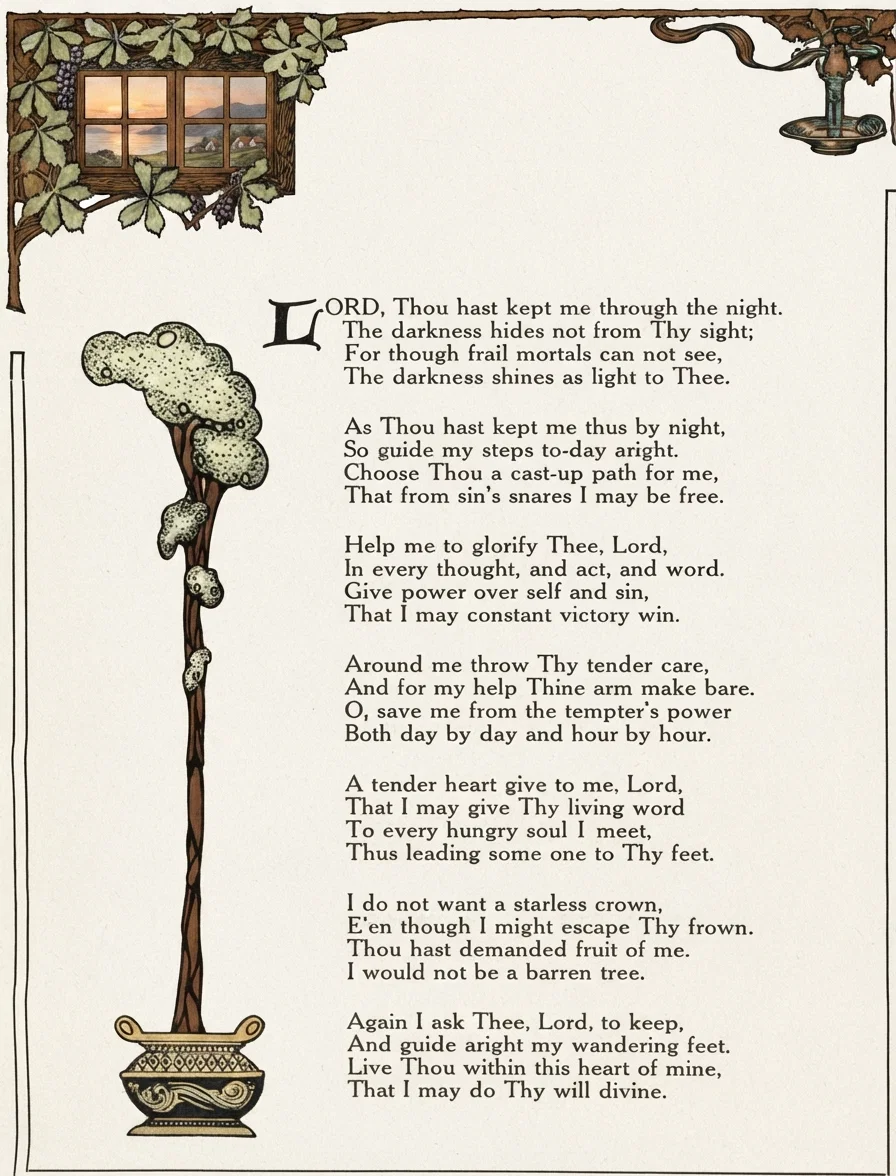
LORD, Thou hast kept me through the night. The darkness hides not from Thy sight; For though frail mortals can not see, The darkness shines as light to Thee.
As Thou hast kept me thus by night, So guide my steps to-day aright. Choose Thou a cast-up path for me, That from sin's snares I may be free.
Help me to glorify Thee, Lord, In every thought, and act, and word. Give power over self and sin, That I may constant victory win.
Around me throw Thy tender care, And for my help Thine arm make bare. O, save me from the tempter's power Both day by day and hour by hour.
A tender heart give to me, Lord, That I may give Thy living word To every hungry soul I meet, Thus leading some one to Thy feet.
I do not want a starless crown, E'en though I might escape Thy frown. Thou hast demanded fruit of me. I would not be a barren tree.
Again I ask Thee, Lord, to keep, And guide aright my wandering feet. Live Thou within this heart of mine, That I may do Thy will divine. C. P. BOLLMAN.
A Morning Prayer
A Morning Prayer

Jonah and the Whale

The Bible Story and an Uncovered Nineveh Tablet : : :

By STEMPLE WHITE
WHILE the pen is mightier than the sword, the spade is yet mightier than the pen, especially when that pen is used by the "higher (?) critic."
The following, clipped from a tract written by Thomas James McCrossan, B.A., B.D., of Minneapolis, shows how archeology confirms the simple, truthful story of Jonah and the whale:
"When Hilprecht uncovered Nineveh, he found what I consider to be the true reason why God saved Jonah by means of a fish. In the palace of the king, he found the history of Berosus. This history tells what the Ninevites believed concerning their great god Daggan, half fish and half man. It tells how Daggan came to earth and taught the Ninevites all they knew,—how to build their houses, till the soil, and sow their grain. He taught them, too, the principles of mathematics; in fact everything. At night he would sleep in the sea, for he was amphibious. Then, before he went away for good, he told the people that ages apart he would send messengers from heaven to teach them further, and that these messengers would all come up out of the sea. Hilprecht also found a tablet to one of these messengers who actually did come up out of the sea, and his name is 'Ioannes,' which he says can only be interpreted in that language as Jonah.
"Now God could have saved Jonah in ten thousand different ways; but He knew the people were looking for a messenger from Daggan, to come up out of the sea, so He saved him by this peculiar but convenient method. God would have witnesses near by to see him cast up. When he first entered Nineveh, no one seems to have paid much attention to him; but soon these witnesses tell their story to the king, and at once the word would go out that this man was Daggan's own messenger. Then all repented."
O that the critic would bear in mind that the harder he throws his boomerang, the swifter it returns on his own head! "The Scripture can not be broken." God's word is as inflexible as His throne is eternal.

Withholding Our Heart’s Service

"In withholding our heart's service from the Lord, we fail to benefit our fellow man, and thus rob God of the glory that would flow to Him through the conversion of others."

Enduring Temptation

"BLESSED is the man that endureth temptation: for when he is tried, he shall receive the crown of life, which the Lord hath promised to them that love Him."

When the Feelings Are Not Stirred

THE neutral state is a common experience, as regards feeling, even to the Christian,—the neutral state, no positive feeling that one wants to do wrong, no decided feeling of interest in doing right.
This is a valuable experience if rightly used; for true religion is not a matter of feeling in any degree. It is a matter of principle. The best time to learn how to live by principle is when the feelings are in the neutral state. It is then possible to do right simply because of the fact that we know it to be right, not because we feel right. Seasons of "brain storm," either of passion or of religious fervor, are poor times to begin our training in living by principle.
Thank God for times of indifference of feeling. Let such times be filled with every possible practise of Christian activity, prayer, praise, work for souls, or whatever the occasion affords. J. A. L. DERBY.

THE WORLD MISSIONARY MOVEMENT A SIGN OF THE END

A Conviction Spontaneous in Many Denominations—An Unseen Power Is Pressing the Work—A Reformatory Message

THERE was recently held in Garden City, Long Island, a representative meeting of all the Protestant missionary societies in the United States and Canada, in which reports were given surveying the whole world situation from the missionary point of view, with the discussion of methods of work, both in the preparation of missionaries and in the pressing of the work on the mission field.

A MIGHTY MOVEMENT AND A SIGN

The development of a mighty movement for the carrying of the gospel message to all the world is one of the remarkable signs of our times. As the end draws near, the providence of God begins to lay upon the hearts of believers a burden for the great unevangelized world; and as events have marked the rapid approach of Christ's second coming, more and more has the burden of evangelizing the world been pressed upon the heart of Christendom.

A TOTAL OF TWENTY-SIX MILLION

To take the one item,—devotion of means to this work: The reports presented at this conference of missions for North America showed that the American societies last year spent over $16,000,000 in this work. Supplementary reports showed that the European societies had expended a sum that brings the total for Protestant foreign mission service up to the immense figure of $26,000,000 during 1913. True, this is a small amount as compared with what is spent on war and preparation for war; but it is a sign of the times that must cheer the heart of every believer, to see the ever-strengthening and increasing effort to spread the light of God's word in all the dark corners of the earth. It is impossible to refer to all the sources of this income, but the following is the list of societies devoting more than a quarter of a million dollars a year to this work:
Presbyterian, North . . . . . . . . . . . . . . . . . . . . . $1,800,000 Methodist Episcopal . . . . . . . . . . . . . . . . . . . . . 1,500,000 Baptist . . . . . . . . . . . . . . . . . . . . . . . . . . . . . . . . 1,100,000 Congregationalist . . . . . . . . . . . . . . . . . . . . . . . 1,048,000 Woman's Methodist . . . . . . . . . . . . . . . . . . . . . . 837,000 Protestant Episcopal . . . . . . . . . . . . . . . . . . . . . 823,000 Methodist Episcopal, South . . . . . . . . . . . . . . . 790,000 Presbyterian, South . . . . . . . . . . . . . . . . . . . . . 637,000 Southern Baptist . . . . . . . . . . . . . . . . . . . . . . . . 580,000 Seventh-day Adventist . . . . . . . . . . . . . . . . . . . 444,000 Canadian Methodist . . . . . . . . . . . . . . . . . . . . . 380,000 Christian (Disciple) . . . . . . . . . . . . . . . . . . . . . . 352,000
We thank God for the record our own Seventh-day Adventist society can present in this list, numbering so few as we do. Surely the "little flock" of Adventist believers are pressing forward with their eyes upon the dark regions beyond. This ought so to be. And yet greater results, we know, will be aimed at; for those who believe that the coming of Christ is "even at the door" have nothing else to live for, or to do business for, than to press the gospel message of the Lord's soon coming to the uttermost parts of the earth.

WHY THIS TREMENDOUS MOVEMENT

We thank God also for every effort that is spreading the light of the blessed Word among the nations. Why is this tremendous movement on just now? Well we know. It is because the coming of the Lord Jesus is at the door, and He has given us the chiefest sign of all in just such a work as we see fulfilling before our eyes: "And this gospel of the kingdom shall be preached in all the world for a witness unto all nations; and then shall the end come." Matt. 24:14.

IT IS A MESSAGE OF REFORM

Every agency that is spreading the living Word abroad is contributing to the hastening of that glad day. No one, however, can read those verses of Revelation 14, from the sixth verse onward to verse 14, describing the rise of the special message of preparation for the coming of the Lord, telling of the glorious second appearing of the Saviour, without seeing that inspiration plainly declares that the final message of the gospel to all nations and tongues is a message of reform, calling men away from the traditions of men to the commandments of God and the faith of Jesus in this time of Christ's closing work of judgment in the heavenly sanctuary. This is the message that has made Seventh-day Adventists a people in the world, and the power of God attending it has rapidly spread this movement into all the continents of earth. The Lord is fulfilling His word before the eyes of this generation, and soon the Saviour will come. W. A. S.

A WORD TO OUR READERS

We send no papers from this office to individuals without pay in advance. When persons receive copies without ordering them, they are sent by other parties, and we can give no information in regard to them. Persons thus receiving copies of the SIGNS are not indebted to the office, and will not be called upon to pay for them. Please read the papers you may receive, and hand them to your friends to read.

DATE OF EXPIRATION

The SIGNS wrapper bears date of last issue due on your subscription. Unless renewed in advance, paper stops with expiration date.
If herewith is an order-blank, you will know you have overlooked sending renewal. You will not wish to miss a single issue. Back numbers often can not be furnished.

SCRIPTURE QUOTATIONS

Our authority for the doctrines we teach is the Bible. Quotations are usually from the King James Version or the American Standard Revised.

A CONVINCING REJOINDER

Logic Not Refuted—Beheaded Nevertheless

IN the reign of Henry VIII, king of England, the union of church and state was the settled policy of that government. As is ever the case in such a system, the king had spies in all parts of his realm to catch dissenters by some word dropped in an unguarded moment. Sir Thomas More, who became so eminent as to be raised by the king to the office of lord chancellor, afterward displeased that monarch by his adherence to religious principles, which forbade him to sanction the royal union with Anne Boleyn, and so he was sent to the tower on the charge of being suspected of holding heretical opinions. Shortly after his imprisonment, he was visited by one of the king's trusted inquisitors, named Robert Rich.
In the course of conversation, this judicial scout began to talk in a professedly friendly way about the cause of dispute for which More was a prisoner. "Suppose," said he, "there were an act of Parliament that all men should take me for king; would you not take me for king?" Knowing full well the current history of English monarchy, Sir Thomas quickly replied, "Yes, sir, that I would; for a Parliament may make a king and depose him." "Yet one further question," put in the wily royal agent: "Suppose there were an act of Parliament that all the realm should take me for pope; would you not then take me for pope?"
To this question, so consistent with united church and state doctrine, the answer of Sir Thomas was not only discreet, but in perfect accord with righteous principles. "Your first question," said he, "applies to temporal government. But suppose the Parliament should make a law that God should not be God; would you then, Mr. Rich, say so?" Of course, the inquisitor's lips were sealed; yet upon his report of the conversation to the privy council, the verdict of "guilty" was pronounced, and the alleged offender was beheaded without delay.
This historical incident, taken from "Knight's History of England," readily shows the evil of a civil government's interference with human conscience. When both church and state can be satisfied, each to act within its God-given sphere, the occasion for such interviews as the one here cited will be a thing of the past. Would that it might be so! J. O. C.

The Chains of Habit

"The tiny chains of habit are seldom heavy enough to be felt until they are too strong to be broken."

A MORAL NATURE IMPLANTED IN MAN

This Moral Nature Responds to a Moral Government and a Moral Law—The Law Before Sinai—The Law Given at Sinai

THAT there was originally implanted in man a moral nature is clearly evident. The innate sense of right that leads the heathen to worship he knows not what, his blind efforts to please a god whom he knows not, and the American Indian's worship of the Great Spirit, are evidence of the remains of a moral law originally implanted in the hearts of men as the basis of God's government. "For when the Gentiles, which have not the law, do by nature the things contained in the law, these, having not the law, are a law unto themselves: which show the work of the law written in their hearts, their conscience also bearing witness, and their thoughts the meanwhile accusing or else excusing one another." Rom. 2: 14, 15.

IMPLANTED IN THE HEARTS OF MEN

In the beginning, therefore, God had a law, which He implanted in the hearts of men. From the first chapter of Romans we learn that this was a moral law. Its violation led to all kinds of immorality. The reason men are in darkness to-day with reference to God's law is, "because that, when they knew God, they glorified Him not as God, neither were thankful; but became vain in their imaginations, and their foolish heart was darkened." Rom. 1: 21. Man is therefore not left in doubt as to whether God in the beginning established a moral government. Since God is a moral governor, justice demands that the law of His government be so plainly declared that all may know its requirements.
To announce to the world that "the wages of sin is death" (Rom. 6: 23), and that "whosoever committeth sin transgresseth also the law: for sin is the transgression of the law" (1 John 3: 4), and then to proceed to hold men accountable for a morality in keeping with the requirements of that law, without having plainly proclaimed the law so that there can be no misunderstanding it, would be the worst of tyranny. We can not charge God with this conduct. No just government would make such demands upon its subjects without clearly revealing to them its laws.

REVEALED AT CREATION

That God did reveal His law at the time of creation is unquestionable. "Where no law is, there is no transgression." Rom. 4: 15. Since sin is the transgression of the law, and since there is no transgression without a law, it follows that wherever we see transgression, there was a law. Therefore, when Satan sinned, he transgressed the law. In Eze. 28: 14 he is spoken of as "the anointed cherub that covereth." God says: "I have set thee so." "Thou wast perfect in thy ways from the day that thou wast created, till iniquity was found in thee. By the multitude of thy merchandise they have filled the midst of thee with violence, and thou hast sinned: therefore I will cast thee as profane out of the mountain of God: and I will destroy thee, O covering cherub, from the midst of the stones of fire." Verses 15, 16.
"Thou hast sinned" is God's reason for removing Satan from his position as covering cherub. The law of God's moral government was transgressed. This is evidence that God's moral law was proclaimed before the fall of the angels.

ADAM UNDERSTOOD THE LAW

Adam sinned. Paul says his sin was disobedience. "As by one man's disobedience many were made sinners, so by the obedience of one shall many be made righteous." Rom. 5: 19. To what was he disobedient? — To the law, the transgression of which is sin. Therefore Adam had a knowledge of the law of God's moral government.
Paul uses another argument to prove the existence of the law from Adam to Moses: "For until the law sin was in the world: but sin is not imputed when there is no law. Nevertheless death reigned from Adam to Moses, even over them that had not sinned after the similitude of Adam's transgression, who is the figure of Him that was to come." Rom. 5: 13, 14. The fact that sin was imputed from Adam to Moses proves the existence of God's moral law during that period.
Why does Paul leave this argument with the days of Moses? Why does he not pursue it through the history of Israel? The answer is given in verses 20, 21: "Moreover the law entered, that the offense might abound. But where sin abounded, grace did much more abound: that as sin hath reigned unto death, even so might grace reign through righteousness unto eternal life by Jesus Christ our Lord."

THE TEN COMMANDMENTS GOD'S MORAL LAW

In the days of Moses the law was proclaimed under circumstances that leave no room for question. From that time God's moral law was known as the Ten Commandments.
"And God spake all these words, saying, I am the Lord thy God, which have brought thee out of the land of Egypt, out of the house of bondage.
"Thou shalt have no other gods before Me.
"Thou shalt not make unto thee any graven image, or any likeness of anything that is in heaven above, or that is in the earth beneath, or that is in the water under the earth: thou shalt not bow down thyself to them, nor serve them: for I the Lord thy God am a jealous God, visiting the iniquity of the fathers upon the children unto the third and fourth generation of them that hate Me; and showing mercy unto thousands of them that love Me, and keep My commandments.
"Thou shalt not take the name of the Lord thy God in vain; for the Lord will not hold him guiltless that taketh His name in vain.
"Remember the Sabbath day, to keep it holy. Six days shalt thou labor, and do all thy work: but the seventh day is the Sabbath of the Lord thy God: in it thou shalt not do any work, thou, nor thy son, nor thy daughter, thy man servant, nor thy maid servant, nor thy cattle, nor thy stranger that is within thy gates: for in six days the Lord made heaven and earth, the sea, and all that in them is, and rested the seventh day: wherefore the Lord blessed the Sabbath day, and hallowed it.
"Honor thy father and thy mother: that thy days may be long upon the land which the Lord thy God giveth thee.
"Thou shalt not kill.
"Thou shalt not commit adultery.
"Thou shalt not steal.
"Thou shalt not bear false witness against thy neighbor.
"Thou shalt not covet thy neighbor's house, thou shalt not covet thy neighbor's wife, nor his man servant, nor his maid servant, nor his ox, nor his ass, nor anything that is thy neighbor's." Ex. 20: 1-17.
"These words the Lord spake unto all your assembly in the mount out of the midst of the fire, of the cloud, and of the thick darkness, with a great voice: and He added no more. And He wrote them in two tables of stone, and delivered them unto me." Deut. 5: 22.
This is a plain proclamation of the moral law as uttered by God Himself. It was at the time of the establishment of the old-covenant kingdom, which represented the kingdom of God as originally established. Hence we have the law of the kingdom plainly before us as proclaimed by the King to His subjects. There is no excuse, therefore, for any intelligent man, with a Bible in his possession, for not knowing the law of God's moral government. R. C. P.
Continue reading: THE WHOLE CREATION WAITS