Review and Herald, Vol. 86, No. 33.
God's Thought of UsReview and Herald
Review and Herald Publishing Association · Takoma Park Station, Washington, D. C. · Aug 19, 1909
God's Thought of Us
The Second Number of the Protestant Magazine Now Ready
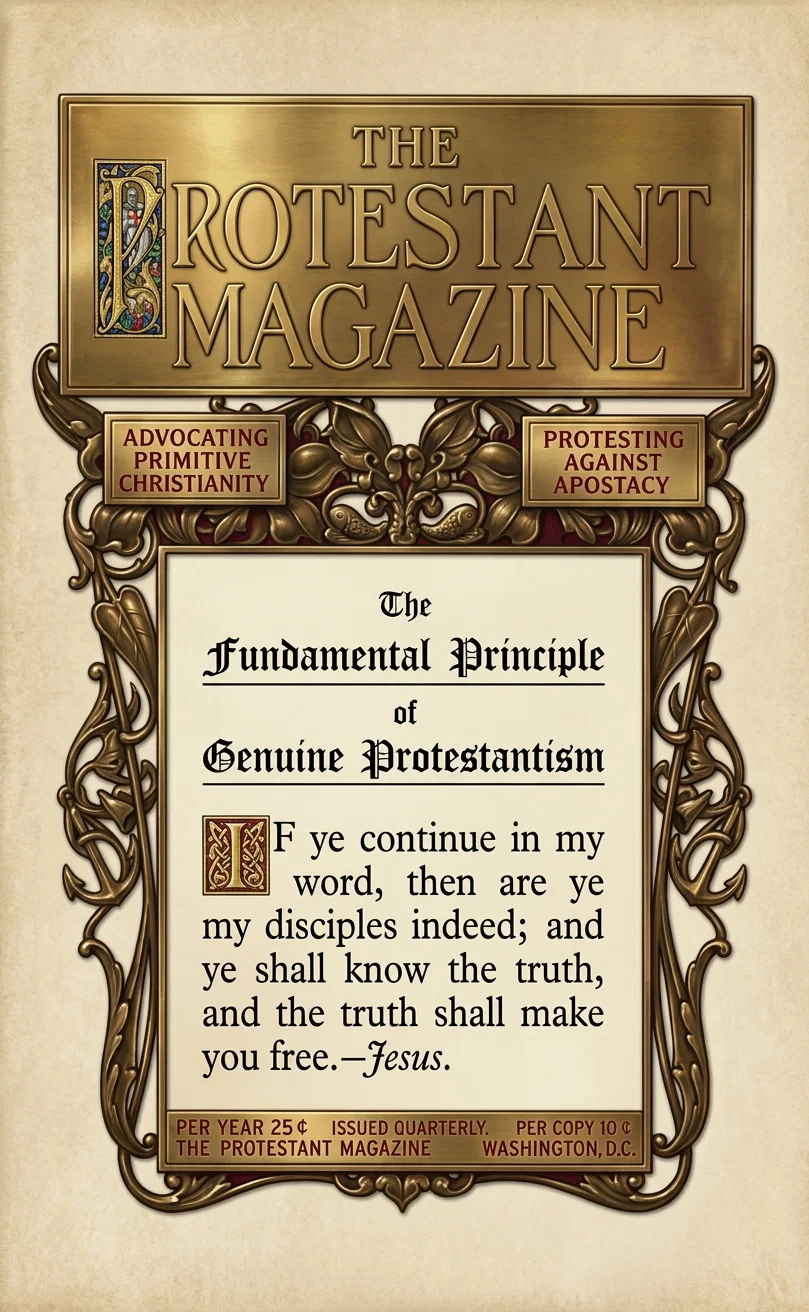
Noteworthy Commendations
Contents of Number Two
Price of This Magazine
How You May Use the Magazine
THE WORK — AND — THE WORKERS
The Conditions of Salvation
Editorial
The Conditions of Salvation
“Armies of the Aliens” Put to Flight
Our Turbulent World
A Personal Creator
The best and wisest of them [evolutionists], however, (note that it is not said those that are the most severely logical in the application of their system!) see that evolution by itself alone is not sufficient to explain the facts that actually exist. So they frequently refer one to some ever-present superintending power that does the rest. They may not, however, refer us to a personal God. Quite frequently they ultimate in an impersonal pantheistic conception of nature—like the heathen of old—or, as Dr. Wallace puts it, “some great source of energy and guidance”—whatever he means by this expression.
Now in reality, this “great source of energy and guidance” (that some, like the Athenians of old, are thus blindly groping after) is the personal God. And this God is the One who “in the beginning created the heavens and the earth” (Gen. 1:1); who “created the great sea monsters, and every living creature that moveth wherewith the waters swarmed, after its kind, and every winged bird after its kind” (verse 21); who also “made the beasts of the earth after their kind, and the cattle after their kind, and everything that creepeth upon the ground after its kind” (verse 25); and who finally capped the creative climax when he “created man after his own image.” Verse 27. Notice that all were created after their kind, and all without the intervention of Darwinian, Lamarckian, or any other kind of evolution. This stupendous fact of creation—a truth too high and noble, apparently, for some minds to grasp—this is the highest truth known to man. . . .