"SPLENDID!" said Mrs. Bingle, pulling the collar up and skirt down, and setting the pocket flaps, as farmer Bingle tried on his new overcoat. "Real silk-velvet collar."
"Yes, and such a piece of cloth! Forty-five dollars for the whole thing."
"Forty-five dollars!" echoed Sam and Jim, admiringly.
"Yes. Seventeen for the tailorin' and trimmin's, and twenty-eight for the cloth. It'll do me till I'm gray."
"What you goin' to do with the old one, pa?" asked Jim.
"It's a good coat yet," said Mrs. Bingle. "Sam'll be grown into it by two years more."
"First-rate coat. But—I was thinkin' some of givin' it to Parson Graves. You see, it'll go on my account for the year, and I won't have so much to pay on his salary."
Mrs. Bingle measured with her eye how much Sam would have to grow before fitting well into the roomy coat, and decided it might be at least three years, in the course of which time, added to the seven during which it had been doing duty on Sundays and great occasions, it might begin to look old-fashioned, and Sam might object to wearing it, that young gentleman having already begun to develop a taste for clothing which came reasonably near fitting him. So it was agreed that Parson Graves should have the old overcoat.
Accordingly, on the next Saturday, when the farmer and his wife were about to drive into the country town, he asked at the last moment, "Now where is that coat?"
"Bless me!" cried Mrs. Bingle, "I've been so busy over the butter and eggs, if I didn't clear forget about it! Sally, Sally," she ran into the house calling to the girl who helped in the kitchen, "run up to the spare chamber and take that overcoat that hangs there, and some of them papers that lays on the shelf, and wrap it up well and bring it to me."
Sally brought it, and the huge bundle lay in Mrs. Bingle's lap as she rode.
"It is a good coat," she observed, half-regretfully, smoothing with her finger a corner of the cloth which peeped through a hole in the paper, and began revolving in her mind the possibility of Sam's growing into it in two years. "Sam won't be likely to get any ready-bought coat half as good as this."
"Like as not he won't," agreed the farmer, "but never mind. It's more blessed to give than to receive, you know."
The Bingle household awoke the next morning with the impression that something of an event was impending in the family, which impression became, with full wakefulness, defined into the remembrance that the new overcoat was to be worn for the first time on that day. There was, however, no undignified haste nor trifling in the matter. The morning chores were done, morning prayer conducted with its time-honored lengthiness, and then the farmer leisurely shaved himself as usual, at one of the windows of the great kitchen, before saying, in as indifferent a voice as he could command:
"Jim, run up-stairs and get my overcoat."
Jim went, but delayed until his mother had put the last touches to the bow in her bonnet-strings, a process which was almost invariably interrupted by her husband with remarks that they would be late for church, before he was heard shouting:
"I can't find it."
"Where are you lookin'?"
"In the closet in your room."
"It's in the closet in the spare chamber," called his father.
Another long delay, and then Jim came down-stairs without it.
"I tell you it's on one of them pegs in our closet," said Mrs. Bingle, "I'll go myself. It's dark, and he can't see, but it's there, for I put it there myself."
"No," said Mr. Bingle, calling after her, "it's in the spare chamber closet. I put it there."
She was heard stepping briskly from one room to the other, then back, and then back again. Then down the stairs, when she stood before them in silence, on her face blank consternation, and on her arm—the old overcoat!
"When did you hang it there?"
"I don't know—the day after it came, I guess. The old one always hung there, so I took it down and hung the new one there."
Mrs. Bingle sank into a chair.
"It's gone."
"Gone to Parson Graves!" The boys stared, open-mouthed, unable at first fully to take in the calamity.
"But you can get it again," at length Jim said, hopefully.
"Of course," said Sam. "You can tell Parson Graves it was all a mistake, and it was the old coat you meant for him, and of course he'll change back."
But the farmer shook his head ruefully.
"No, that won't do. It's done, and it can't be undone," he said with a groan. "Don't one of you never let on about its bein' a mistake."
The family and the old coat were late at church, thus missing the sight of the entrance of the new coat, but it lay over the arm of the little sofa in the pulpit. And farmer Bingle never could recall a word of that service through which he sat trying to bring himself into some friendly recognition11of the fact that he presented his minister with a forty-five dollar overcoat, which he could not hope to have count anything near its value on his yearly assessment, for who ever heard of a country parson having such a coat?
"Don't he look fine, tho!" ejaculated Sam, as Mr. Graves came down the aisle.
"And don't Mrs. Graves look set up!" said Jim.
"Enough to make any woman, to hang on in a piece of cloth like that," said Mrs. Bingle.
Mr. Bingle was unhitching his horses as Mr. Graves came out of the church door, and did not at first raise his eyes as he listened to the remarks passing around.
"Bless me! What a fine-lookin' fellow our parson is anyhow! Where on earth did he get that coat?"
"Must have had a fortune left him."
Mr. Bingle could not help feeling that the coat had been well bestowed, as its wearer came to meet him with outstretched hands and a few quiet, tho very earnest words of acknowledgment of his gift. The coat had fitted the farmer well, but there was something more than the mere filling out of good cloth in the minister's dignified bearing; and in the scholarly face which appeared above it, something which stirred up a feeling in many members of the congregation that this servant of the Lord had not hitherto been clothed in a fashion worthy of his high office.
"That's a shabby old hat to wear with it," said one of the village storekeepers. "I'll see about that before another Sunday comes 'round."
As Mr. Bingle felt the grasp of his pastor's hand, he began almost to be glad he had given him the coat; and then, as the fact of his having given it was whispered about, to feel ashamed of receiving so much credit for an act which he never would have thought of performing. For an honest and really warm nature lay under the crust of parsimonious selfishness which had hardened over his heart, as it has, alas! over so many, which might overflow in deeds of kindness to bless those who have given, not grudgingly, but their whole selves to the Master's service.
"I feel like a liar; yes, I do!" said Mr. Bingle to his wife, with an energy which startled her, as they rode home. "To have that man shakin' me by the hand, and talkin' about my generosity, and his wife's eyes beaming up at me, and me not able to right out and tell 'em I'm a grudgin,' tight-fisted old—I tell you what!"—he gave his horses such a vigorous cut with the whip that Jim and Sam, on a back backless seat of the bob-sleigh, nearly went over backwards into the snow, "I've got to get even with myself somehow, but I don't know just how, yet."
It was astonishing what a commotion farmer Bingle's gift created in the parish. Not one eye had failed to mark the justice done by Mr. Graves' goodly figure to the goodly garment, and with an awakening pride at the possession of such a fine-looking pastor came a desire to see him thoroughly well equipped, which desire found expression in such a visitation at the parsonage as had never before been dreamed of. Cheap goods and cast-offs were ignored in the generous supply of winter comforts which each giver made sure should be in keeping with the new overcoat, and the wives and mothers had seen to it that Mrs. Graves and the children should look fit to walk beside that tailor made-up piece of cloth.
Mr. Bingle had smiled with a light in his eyes which came up from somewhere under that broken crust, at the set of furs which his wife carried to Mrs. Graves that night. But in the early gray of the winter morning he, with Sam's help, quietly unloaded in the back yard of the parsonage, a firkin of butter, the same of lard, and six barrels of his best apples, packed for market.
"A good forty-five dollars' worth if I'd carted it half a mile further," he said to his wife, with a face which shone as he sat down to breakfast.
"And not a soul heard us," said Sam, rubbing his hands in great glee. "Wish't I could see 'em when they find out!"
"Now I'm even," said the farmer. "And it was the best day's work I ever did when I gave away that coat by mistake."—Standard.
SEEK TRUTH.
By Willis Leonard Clanahan
Met a traveler on a stony way.
“Where fare you, brother?” And I made reply,
“I seek Contentment. It is far, they say,
Yet sweet streams flow there and cool shadows lie.
“But few the way to that fair land have found,
Tho for it millions eagerly have sought,
And few have stood on that enchanted ground,
Tho of its joys they’ve dreamed, and for them fought.
“I chose Ambition. ‘Surely this,’ I said,
‘Will lead me to this country of delight.’
It ended in a dark morass, instead,
With not one star to pierce the rayless night.
“I sought for Riches. ‘This will lead me there!’
I cried, expectant; but tho wealth I massed,
The roadway to Content lay otherwhere,
And onward o’er the dreary way I passed.
“I sought for Love to light me to the goal,
But even Love, whose charms so much delight,
Led me in mazes, and my weary soul
Languished in gloom. Ah, who shall lead aright?”
The wayworn traveler took me by the hand,
And earnestly he gazed into my eyes.
“Seek Truth,” he said, “to know and understand,
In Truth the secret of Contentment lies.”
—Willis Leonard Clanahan.
FOR HEALTH'S SAKE.
By A. M. H.
It is hard to make up one's mind to wash a soft, fleecy pair of woolen blankets, but if they have been in constant use for a season they may have absorbed so many unhealthy vapors as to be unfit for further use, especially if they have been used as coverings for the sick, and they should be washed no matter how white and clean the blankets may seem.
The practise of having blankets dry-cleaned is no longer followed, and intelligent housekeepers who study the laws of hygiene know that the process does not clean or disinfect like a strong suds with a day's exposure to air and sunlight. Germ life may exist for months in the fleecy surface of a fine woolen blanket. They should be well aired each day before windows, and those in every day use should be kept clean by sewing a wide piece of cheesecloth on each side of the comfort that comes next to the head.
Both the all-wool and cotton blankets are made soft and white by shaking them well to free them from lint and then washing them through a warm pearline suds to which a little ammonia has been added, and the temperature of the water in which they are washed and rinsed should always be the same, for change of temperature is what thickens the blanket and makes it hard and stiff.
When dry, take from the line, fold smoothly, and press under a heavy weight for several days. Blankets thus washed will retain their original freshness through many seasons of use.
A. M. H.
"THE GIFT OF LOVING."
By M. Ella Russell
It is in loving, not in being loved,
The heart is blessed;
It is in giving, not in seeking gifts,
We find our quest.
If thou art hungry, lacking heavenly bread,
Give hope and cheer.
If thou are sad and wouldst be comforted,
Stay sorrow's tear.
Whatever be thy longing or thy need,
That do thou give.
So shall thy soul be fed, and thou, indeed,
Shalt truly live.
—M. Ella Russell.
Bank of Mountain View
By Editor
If you haven't already done so, why don't you drop us a postal asking us to send you a copy of our monthly paper, "The Bank of Mountain View Journal." It is very interesting. It is full of good ideas, and it is free to you for the asking. If you live in the East, send for a copy and see how we do it in California. We still hold ourselves ready to furnish you with information about Mountain View. Write us.
Address
Bank of Mountain View
Mountain View, Santa Clara County, California
Southern Pacific
Whether going East or coming West, do not fail to take advantage of the most essential features of traveling
Speed,
Comfort,
Safety
Which are given the greatest attention in the equipment of the
Overland Limited
Running over the Southern and Union Pacific. Secure tickets and make reservations for berths from any
Local Agent
Southern Pacific Company
--- OR ---
City Ticket Office,
Ferry Bldg., San Francisco, Cal.
EASY MONEY.
A. E. Loveland, Johnson, Vt., writes: "On Friday I sold six dozen E-Z Washing Tablets; my mother sold five dozen, and another friend sold four dozen,—fifteen dozen in one day! Nearly every one likes the Tablets." Agents make a profit of over 100 per cent. Not necessary to canvass. Send 5 cents for samples and particulars. Either sex. Address, Alfred Mallett, Elkridge Station, Baltimore, Md., or to Clinch Mercantile Co., Grass Valley, Cal., Pacific Coast Supply House.
Humility and Self-Disclosure
WHOEVER talks about his humility shows that he hasn't any—to speak of.
Get on the Lord’s Side
It is not worth while to ask the Lord to come over on our side. He never changes, and if He is not already on our side it is because we are on the wrong side. The thing for us to do is to get on His side, and then His help and His protection are sure. "Come unto Me," says Christ, "all ye that labor and are heavy laden, and I will give you rest." And "He is able also to save them to the uttermost that come unto God by Him."
NEWS FROM VALPARAISO.
By Ed. W. Thomann
Valparaiso, August 22, 1906.
SIGNS OF THE TIMES, Mountain View, Cal.
August 16, at 8 P. M., a fearful earthquake visited Valparaiso. The shock was probably stronger than the one in California, but the fire did not do so much harm as in San Francisco. It is likely that there are over 2,000 dead in Valparaiso alone. The day before yesterday 750 were buried. Thousands of people are homeless. Many, many heretofore wealthy people are now so poor that they have nothing to eat except what the authorities are distributing.
Martial law is ruling. Many robbers have been shot down, and many terribly stabbed. After 6 P. M. no one is allowed to walk in the street. At night any one found in a suspicious place is shot down, if he can not show a special recognition from the authorities and justify his being there.
Food is coming from south and north and is distributed quite freely. Water is not wanting, tho people have to go in some places more than a mile to get it. Most of the people are living in tents and shelters built of whatever they can find. Many are13building little huts, because nearly all houses are dangerous to live in, and the earth trembles nearly every day a little. The heaviest and largest buildings have suffered most. The principal part of the city is nearly all in ruins, and it is said that there is not a house in the whole town that has not suffered.
And our people are alive and have suffered comparatively little. The house where we had the office was burned down, but not before many things could be taken out. Brother Steele, who lived there, saved nearly all his things and also the account books and some other things of the office. But the boxes of books were too heavy to be carried away in a moment. The department where we had the printing paper was not burned, so we have still a good supply of paper for the Señales de los Tiempos. Books that had not reached the office, but were in the custom house, are probably safe, so our loss is not so very large.
We consider it providential that we did not buy a press for our paper before this earthquake. The Lord surely has cared for us. We are very thankful to Him for His tender love. My wife and I were in Serena, about two hundred miles farther north where the earthquake was not so strong. I am of good courage.
ED. W. THOMANN.
THE DESTRUCTION OF VALPARAISO.
By William Steele
WHEN we read of the destruction of San Francisco by earthquake and fire, and of the terrible scenes witnessed there a few months past, little did we think that so soon we would be called upon to witness scenes equal or surpassing those in California.
At 7:50 on the evening of August 16th, Valparaiso was visited by three distinct shocks which followed each other in rapid succession, destroying the greater part of the city. Valparaiso contained about 200,000 inhabitants; the business section of the city being built on the plain and the residence portion on the surrounding hills. Of the business section but one street remains that was not completely demolished or burned by the fire which followed. It seemed that hardly a moment had passed until the whole city was illuminated by the fires which sprang up in all parts. The residence portion suffered severely from the effects of the shocks, many of the houses burned also.
It is hardly necessary to describe the scenes that took place here, as they were almost identical with those of San Francisco, which have been already vividly portrayed before the minds of the people. The terrible roar of the earthquake, the crash of falling buildings, the screams and cries of the people as they called upon the Virgin Mary to save them, leaves an impression on the mind that time can not efface.
The house in which we were living was not destroyed by the earthquake, but was subsequently burned. We were able to save the most of our household goods, but the book deposit belonging to the mission was completely destroyed.
Not one of the brethren lost their lives, as God's protecting care was over them, the same as when the city was visited by such a dreadful epidemic of small-pox last year, during which time it was said 15,000 people died, yet not one of the brethren suffered from the disease.
The loss of life in this present disaster is estimated at 3,000, but the exact number will never be known as in some cases whole families were buried in the ruins, and many bodies have been incinerated.
In this I am saying nothing of the destruction of Limache, Quillota, Llai-Llai, and other smaller places, several of which were completely destroyed.
Up to the present the food supply has been ample for the need, as much was stored in the custom house, nevertheless much suffering is bound to follow.
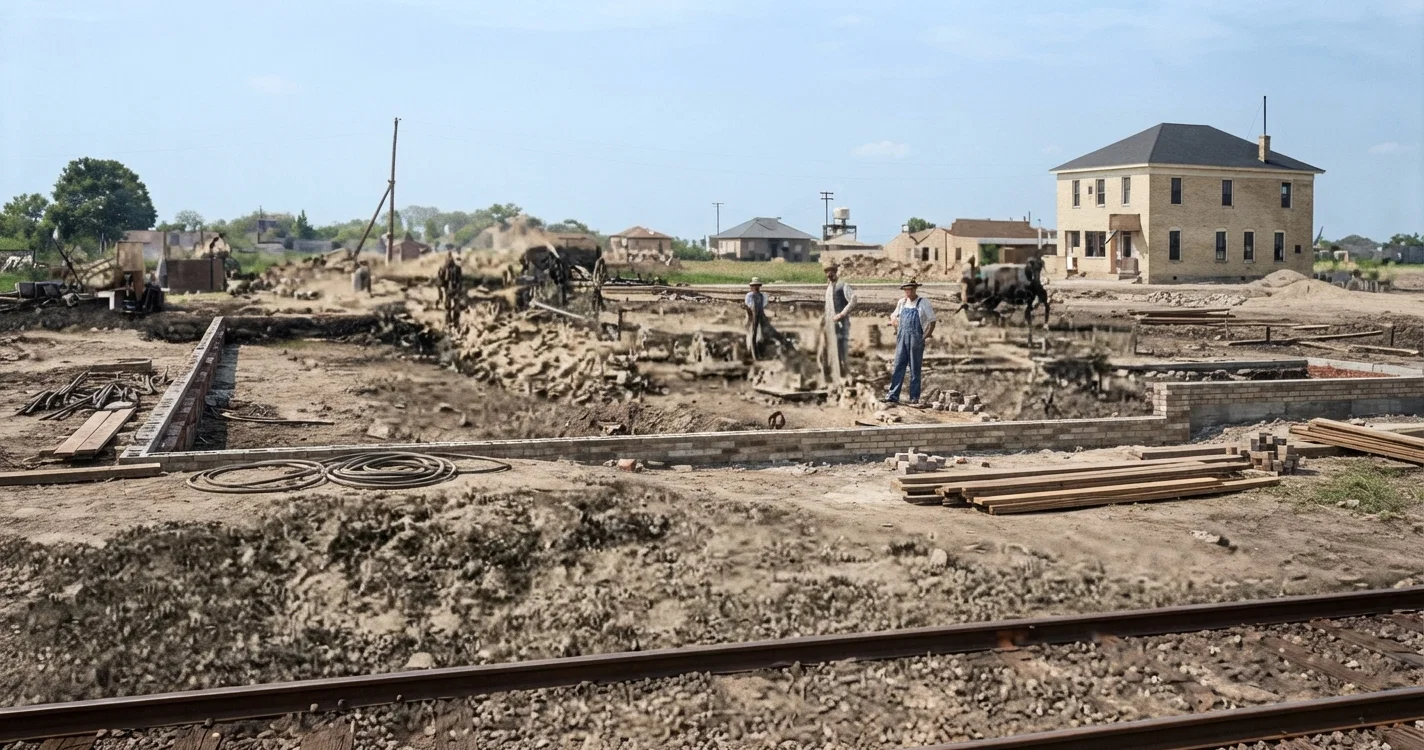
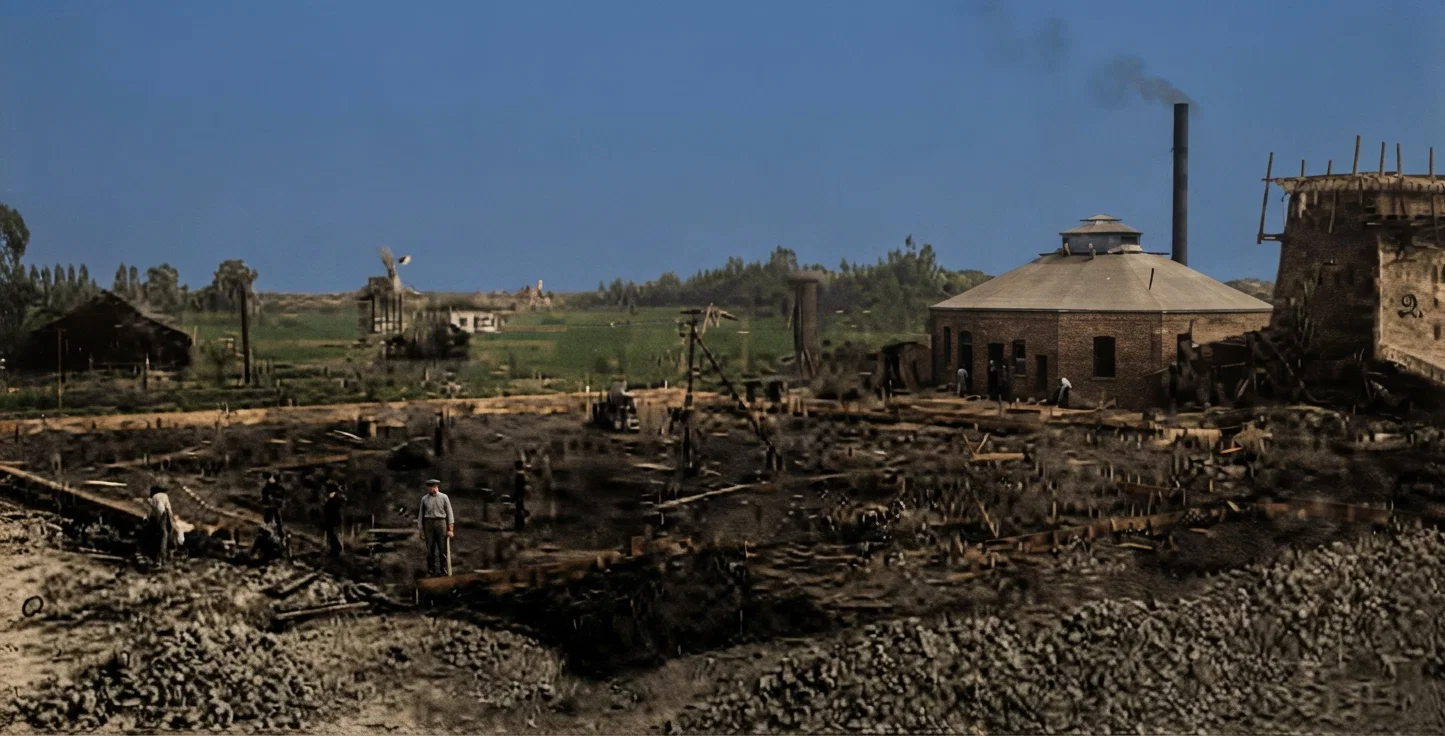
The Pacific Press grounds, Oct. 9, 1906, prepared for cement floor and frame, looking from the boarding house, where the offices now are, northeasterly. The power house and tank house to the right.
The railroads have been so damaged that it will be impossible to get them cleared for perhaps several months. The only way by which any one can leave the city is by small coast steamers. They have offered free passage to all who desire to go north or south. Also the European ships have done likewise for all who desire to sail for Europe.
A captain of a ship who was in San Francisco, April 18, at the time of the earthquake there, said that the earthquake in Valparaiso was much stronger than in San Francisco. The fact is that there is not a building in Valparaiso or surrounding towns which was not badly damaged or completely destroyed. The matter is summed up in saying that the San Francisco horror is equalled or surpassed.
Since beginning this article a heavy rain has commenced falling, which greatly adds to the misery of the people, as the majority of them are camping in tents hastily made from blankets, sheets, carpets, etc. We have one room in a house which has been considerably damaged, but thus we are sheltered from the rain. Have been sleeping out of doors as the tremors are still prominent, but to-night it looks as if we would be obliged to sleep indoors.
We can better understand now why the Lord permitted our house to be burned eight months ago. If we had been living in that place at the present time we should certainly have been killed, as escape would have been well-nigh impossible. We are grateful to our heavenly Father for His bountiful care. Our past experience was a preparation for the present trial through which we are called to pass.
The loss to the mission will be between $550 and $600. This is not large, but only eight months ago the mission was burned, and we were just getting on our feet again when the catastrophe came.
Our courage in the Lord is good, and we thank Him for a living faith which can take hold of Him in such times of trial. We know of a surety that these things are sure signs of His soon coming, and we also know that if we withstand these trials we shall be strengthened for the yet greater things that are to come. "As thy day is so shall thy strength be," is one of His promises; we rely on these. WM. STEELE.
Casilla 787, Valparaiso, Chile, Aug. 23, 1906.
WORDS.
By Eliza H. Morton
LIKE a cloudless sky at noon,
Like a balmy day in June,
Like a bird-song in the air,
Like a fragrance everywhere
Is the word of kindly cheer
That at times falls on the ear.
Like a wind from ice-bound land,
Like a discord from a band,
Like a blow upon the cheek,
Like a pain that makes one weak
Is the cruel, careless word,
That at times is often heard.
Let thy words then be with grace,
Let the light shine from thy face,
Let the Spirit have full sway
In thy heart by night and day,
Then thy words will be like rain,
Backward to its source again.
Eliza H. Morton.
OUR WORK AND WORKERS.
By Editor
IN connection with recent visits of Brother H. Nicola to the church at Glenwood, Mich., four candidates were baptized and added to the church.
The addition of six members to the church at Lafayette, Ind., is noted in the Reporter as a result of labor by Brother B. Hagle, who has been engaged in tent labor there.
BROTHER G. W. REASER reports to the Recorder that the chapel for the benefit of the colored people in a suburb of Los Angeles has been completed, and services are being held regularly.
THE Indiana Reporter notes the addition of two members to the church at Franklin, the result of labor by Sister Rothbaust. Also, that three persons have been added to our ranks at Seymour.
WRITING to the Workers' Bulletin from Lisbon, Portugal, Brother C. E. Rentfro announces the first baptism by our people in that country. Four candidates were baptized by Brother Schwantes. This brother was about to open work in Oporto, a city of 150,000 inhabitants.
AT the recent session of the Canadian Union Conference, Brother W. H. Thurston was re-elected president. Other officers are: Vice-president, Wm. Guthrie; secretary and treasurer, B. B. Noftsger. A formal request was sent to Ohio Conference to liberate Brother J. O. Miller, Academia, that he may accept the invitation to labor at St. Johns, N. F.
IN the Southwestern Union Record, Brother A. P. Heacock reports the baptism of three persons near Hot Springs, Ark., and three others at Little Rock. He also reports that the Sanitarium at Little Rock is enjoying much prosperity and blessing. A new building is now being erected in the suburb of the city, which will more than double the facilities of the institution.
FROM the Southwestern Illinois Herald we clip this testimonial: "The SIGNS OF THE TIMES should have a wider circulation than it has. A good work has been done with the Special number, but we should not wait for these special numbers. A club should be taken in every church and company for use in missionary purposes. Every member could use at least one copy and others could use from five to 100 copies every week. We need to arouse to the importance of the message we bear. The King's business requires haste and activity on the part of every believer."
IN the Canadian Union Messenger, Brother W. H. Thurston says: "The outlook for the work in the Canadian Union Conference was never brighter than at the present time, and we hope for still greater progress in the future. The annual meetings have all been held, and the attendance of the public and the interest manifest at all these gatherings is an evidence that the people in general desire to know the reasons of our faith. The passing of the Dominion Sunday Law is another step in the fulfilment of prophecy. Shall we slacken our efforts now because the Sunday law is passed? Not for an hour; but instead let us move on with more zeal and earnestness warning the people of the impending judgments. Four or five more ministers are being located in the Canadian Union Conference this fall, and they will join us in proclaiming the message by voice and pen, and as we all unite in the different lines of work we shall certainly see gratifying results for all faithful efforts."
THE framework of the Pacific Press Publishing Company's new building is nearly completed as we go to press, and the builders are making every effort to get it under cover before the rain sets in. The clearing away of the debris, gathering out the parts of machinery in the hope of saving some, and the collection of melted type metal from the soil, cleaning bricks for new foundations for the building, for machinery, and for a new vault, have combined to make a tedious job. But willing hearts and busy hands and a determined purpose, under favorable weather and the blessing of God, are showing encouraging results. The work before us beckons us onward, and there is neither time nor inclination to become discouraged when the obstacles loom up. The calls from our agents and missionary workers at large con-
THE SPECIAL NUMBERS OF OUR FOREIGN PAPERS.
By Editor
NOW IS THE TIME
For all to plan to scatter these good papers and tracts among their friends and neighbors.
OUR SPECIAL NUMBERS PRESENT
The larger number of topics which will appeal to the general reader, while the regular issues present special lines of truth.
THE ARTICLES
Will be contributed by many of our leading workers, among whom are Elders W. A. Spicer, R. A. Underwood, A. T. Robinson, H. Shultz, and others, who will write on the following topics: "The Fields Are Now Ripe for Harvest," "The Sanctuary," "The Coming of Christ," "The Signs of the End," "Religious Liberty," "The Eastern Question," "Capital and Labor," etc. Many other subjects of vital importance will be considered by our contributors.
The special number of our German paper, The Hausfreund, will be issued the later part of October. The Danish-Norwegian (The Sendebud) and the Swedish (The Vaktare) specials will follow about the last of November.
These specials will have beautiful cover designs and a larger number of illustrations than we have ever used before. As this year has been one of great disaster, we have obtained many good views of the San Francisco fire, with some from Mount Vesuvius, Valparaiso, and other places. They will certainly be good sellers. Price, 5 cents each. Ten or more, 3 cents each. Order of your state tract society or of the International Publishing Association, College View, Neb.
LITERARY NOTICES.
By Editor
"Songs in the Night," by Helen Maud Merrill-Phelps.
This is a collection of twenty-five original poems, beautifully printed and beautifully bound in strong ornamental cover paper, with water color and illuminated design on the cover of gilt cross and lilies of the valley, with the inscription in gold, "In the beauty of the lilies." It is nicely illustrated by photogravures from the masters of Biblical painting. The poems are chaste, elevating, helpful. Here is a stanza we take almost at random from a poem entitled, "The Unspeakable Riches of God."
" 'Tis the mantle of love that envelops the soul,
It is love's power alone
Gives supremest control;
It is faith never failing from friend unto friend,
It is Christ in the heart,
It is 'world without end.' "
The price is $1.50 for the water-color cover. Address the author, Helen Maud Merrill-Phelps, 270 Lincoln Ave., San Diego, Cal.
"The Double Doctrine of the Church of Rome." By Baroness Von Zedtwitz. Fleming H. Revell Company, Chicago, Ill.
This beautifully printed, neatly bound book of 64 pages describes in language free from passion, animosity, and prejudice why the author severed her connection with the Church of Rome and renounced its doctrines. Her action was not one of impulse, but settled conviction after years of study. She says: "My intimate connection with the Catholic Clergy, but especially with the hierarchy, both in America and Europe, has brought me into near touch with not only the secret inner workings of the Roman Church, but also with the doctrines by which it is governed." So she writes understandingly. It is a clear setting forth of what the title calls for.
"Illogical Geology; the Weakest Point in the Evolution Theory." By George McCready Price, author of "Outlines of Modern Science and Modern Christianity." 96 large pages, pamphlet form, price 25 cents. The Modern Heretic Company, 257 South Hill Street, Los Angeles, Cal.
This pamphlet is written for a purpose by a man who has convictions born of loyalty to his highest light and bred in earnest study. While it deals with scientific questions by scientific methods, it is written for the earnest student as well. By the study the author has found what to him seems "the phenomenal weakness of the geological argument," and he gives us the result of this study in the present work. Every minister of the Gospel ought to read the work. Students of science ought to read. Order as above.
"The Good Way." Book and Chart. By W. H. Wild. Price $1.00.
The chart is an emblematic production, 23x30 inches, lithographed in nine colors and varnished. It illustrates these great Bible themes, the Law of God, the Good Way, the Ladder of Sanctification, the Broad Way, the Home of the Saved, Idolatry, Prophecies of Daniel, the Dark Day, the Great Meteoric Shower, the Gospel Train, the Messages of Revelation 14, the Second Advent, etc., a score of subjects in all, in emblem on the chart and explained in the book. It will be a constant help and blessing in the home, a help to the mother in rearing children, and to teachers in Sabbath- and church-schools. The price of both book and chart is $1.00. If it is desired mounted and varnished, ten cents extra. Address W. H. Wild, Hinsdale, Ill.
LOVE.
By Susie M. Best
HEREIN is love; to daily sacrifice
The hope that nearest to my bosom lies,
To mutely bear reproach and suffer wrong,
Nor lift the voice to show where both belong.
Nay, now, nor tell it e'en to God above.
Herein is love, indeed! herein is love!
—Susie M. Best.
Go Forward in Hope
By Editor
tinually admonish us to "go forward." The good words received daily from brethren and sisters throughout the field are enough to keep the spirits in good cheer, while the hope of final victory is ever kept bright by the infallible promise, "Fear not, for I am with you."
WANTED FOR MISSIONARY WORK.
(Always prepay postage.)
CLEAN copies of all our denominational papers and tracts for a missionary stand. Address, Mrs. N. C. Freeman, 2122 First Avenue, Birmingham, Ala.
Wanted: Woman to Care for Invalid
WANTED.—A strong, middle-aged woman to care for an invalid. Light housekeeping; grown son only besides invalid mother. For particulars apply to Mrs. A. Carter, Sanitarium, Cal.
The Catholic Church in France
By Editor
The condition of the Catholic Church in France is looked at in various ways by the prelates of that church. It would seem as tho there would be almost a division in the church itself. Many of the Roman Catholic bishops and clergy are disposed to favor the French law, some of them in this country are defending it, and while they feel that France has not used the church justly, yet contend that the church is very much freer than before. Notwithstanding the pope has condemned the French Government in its action, and Archbishop Farley of this country tells us that he looks upon the condition of things there with sorrow and despair, and "if the state does not show a more conciliatory policy toward the church, and if it drives the church to drastic measures, perhaps there will be scenes in France that have never been witnessed in the world." Really it would seem to an outsider that it would be well for the church in France to decide the question, rather than a board of cardinals in Italy only one of whom is French. This is the substance of the appeal made to the pope by many bishops and priests. They feel that trial ought to be made of the law before such measures are taken, as has been pointed out by our European correspondent.