Your ShelfYour Projects

Signs of the Times, Vol. 32, No. 42.

JOY AND PEACE IN AFFLICTION

Signs of the Times

Oct 31, 1906

Pacific Press Publishing Company · Mountain View, California · Oct 31, 1906

JOY AND PEACE IN AFFLICTION.

Sometimes a light surprises The Christian while he sings: It is the Lord who rises With healing in His wings. When comforts are declining, He grants the soul again A season of clear shining, To cheer it after rain.
In holy contemplation, We sweetly then pursue The theme of God's salvation, And find it ever new. Set free from present sorrow, We cheerfully can say, E'en let unknown to-morrow Bring with it what it may.
It can bring with it nothing But He will bear us through; Who gives the lilies clothing, Will clothe His people, too: Beneath the spreading heavens, No creature but is fed; And He who feeds the ravens Will give His children bread.
Tho vine nor fig-tree neither Their wonted fruit should bear, Tho all the field should wither, Nor flocks, nor herds be there; Yet God the same abiding, His praise shall tune my voice; For while, in Him confiding, I can not but rejoice. —William Cowper.

An After-the-Fire Story

By the Book Department Manager

WHEN the five o'clock bell rang Friday evening, July 20, our pressroom boys were finishing a twenty thousand edition of "Heralds of the Morning." The plates for the last form were still on the press.
Five thousand copies more in process of binding were on the gathering boards and around the bindery sewing machines.
Fifty full morocco prospectuses were being finished for delivery the following Monday to as many anxious agents whose old cloth prospectuses were badly worn.
Two hundred eleven copies of the complete book, new edition, had been delivered to the shipping room that afternoon, and had been forwarded to our Kansas City house, with the exception of a sample copy which had been sent to the writer's home.
In the field there were more than one hundred agents successfully soliciting orders.

AND THAT NIGHT THE FIRE CAME.

The most of the following night was spent in counsel by the board of directors, foreman, and others.
Before the flames had died down one of our most experienced men was on a fast train bound for the East, with the sample copy of "Heralds of the Morning," and with orders to secure the publication of a large edition at the earliest possible moment.
As the plates and engravings were all gone, this was no light task.
So successful was he in his mission that within ten days after the fire a ten thousand edition of the book had been contracted for with a large Kansas City firm, and typesetting machines and photo-engravers began work.
And here came a strange experience. Our agents, many of them had poor prospectuses, some of them torn, others nearly worn out. They pasted in loose leaves, sewed in sheets of writing paper for additional names, and some ceased putting names in their prospectuses at all, but they all kept at work.
Girls without previous experience took orders for $50, $60, $68.50, and then some one jumped to $100, $150, and some experienced workers up to $240, $255, and finally one man took orders for $280 worth of this book in a single week.
Remember, this was done with old prospectuses, and at a time when the securing of books was somewhat questionable.
It proves beyond a doubt that "Heralds of the Morning" is a book with a mission; that its mission is one in which the people of the world are interested.
When, after various delays, books began to be delivered, orders had piled up so that almost four thousand copies—about four tons—had to be sent by express, at mail rates.
One agent in an almost inaccessible portion of California had to have nearly 100 books sent to him by mail. Imagine the surprise of the mail carrier, who usually carries three or four pounds of mail, to receive a consignment to one party of 200 pounds! But orders had been taken and books must be delivered, even tho Uncle Sam's letter carriers had to be pressed into service.
It was soon found that the three hundred copies being delivered by our Kansas City binders each day were not sufficient, hence the following telegram was sent to our Kansas City representative:
"Try St. Louis binders for 'Heralds' and 'Controversy.' Try make forfeiture contract."
In a few hours back flashed this message: "Binding material all here. Kansas City firm signs penalty contract to-day. Letter."
When letter came it contained copy of a contract calling for a heavy forfeiture for every day in which at least 500 copies of "Heralds of the Morning" were not delivered.
Because of this increased output and the return of many students to college, we can now assure those who may have hesitated to sell "Heralds of the Morning," fearing they could not secure books, that they will be supplied promptly.
A limited number of new prospectuses are ready, and will be sent post-paid for 50 cents each to those who have arranged for territory with their state tract society or state agent. There is yet ample time for a rousing holiday delivery! Who will take advantage of it?

HAVE YOU A COPY OF THE "SIGNS OF THE TIMES" BOOKLET?

It contains help for every individual or society desiring to engage in systematic missionary work. One of our readers, whose opportunities for missionary work are limited, is following one plan outlined in this booklet. She has been mailing one copy of the SIGNS regularly to a friend in Canada. She has recently received a letter from this friend telling her how much she enjoys reading the SIGNS, and how she passes it on to her neighbors, it thus going the rounds, bringing a blessing to each home in her neighborhood. This is only one example of what can be accomplished by small efforts being carried on continuously. You will receive suggestions and encouragement for your work from this booklet.
Note the cover page, with contents given below.

SIGNS OF THE TIMES BOOKLET.

CONTENTS.
1. What the "Signs" Has Accomplished. (a) Number of its Converts in One Conference. (b) Five Noteworthy Examples. 2. Club Rates for Churches. Showing Exact Cost of Any Club —5 to 100 Copies—For Any Period—One Week to One Year. 3. "Signs" Rates. (a) Single New Subscriptions. (b) To Foreign Countries. (c) Renewal Subscriptions. (d) In Clubs. (e) To Agents.
  1. Who are Agents?
  2. How to Organize and Pay for a Church Club.
  3. How to Use the "Signs."
This booklet is filled with encouraging items and valuable suggestions.
Your State Tract Society will be glad to send you a copy free; or address SIGNS OF THE TIMES, Mountain View, Cal.
Copies will be sent free on request. Order from your State Tract Society, or address the SIGNS OF THE TIMES, Mountain View, Cal.

INFLUENCE OF THE "SIGNS OF THE TIMES."

The following good letter comes from a man and wife who are engaged in Christian work in Canada. Note their appreciation of the SIGNS OF THE TIMES.
"Dear Christian Friends: We deeply sympathize with you in this terrible calamity which has befallen you, and earnestly pray for your future success. Please accept our small offering, $1.00. I might add we are very much interested, and also blessed in reading your valuable paper, the SIGNS OF THE TIMES, and are surprised it did not come to our notice sooner. The first copy brought to us was the San Francisco earthquake number of April, 1906. God bless you."
You, dear reader, may know of a home where the SIGNS OF THE TIMES would receive the same hearty welcome.
You are interested in circulating in these evil days a periodical which brings a blessing to homes. Request your tract society to send you a copy of the SIGNS OF THE TIMES booklet.
It is free, and will be of special encouragement and assistance to you.

“GET THEE UP ON A HIGH MOUNTAIN.”

THE above is the call of God to the one who aspired to tell good tidings to Zion. “O thou that tellest good tidings to Zion, get thee up on a high mountain.” Isa. 40:9. No narrow view would God give His servants. No narrow message would He have them bear to others.
It must be a large mind to apprehend the thought of God; for His “commandments are exceeding broad.” It needs larger view than the plains afford. It needs clearer air than the fog-filled valleys know. The mountain brings breadth of vision and clear, unclouded outline.
THE mountains have always been associated with the work of God. In the very beginning Eden was planted on the highest elevation of the new-made earth; for from thence to all its parts flowed the fourfold stream, bearing everywhere the floods of life-giving water. When God, to test His servant’s faith, told Abraham to offer up Isaac, He sent him weary miles to Mount Moriah. There Abraham obtained clearer, grander, broader views of God’s love, sacrifice, and care.
WHEN God would speak His holy law to all the world through Israel, He came down upon rugged Sinai, amid the wilds of earth claimed by no nation, that all nations might have a portion in Israel’s God. Once and twice He called Moses up into that Mount, where each time he was shut in with God for forty days and nights. Up Mount Nebo to the very top of Pisgah climbed “the man of God” to take clear, heaven-aided vision of the Promised Land he was permitted to see, but could not enter, because of his sin.
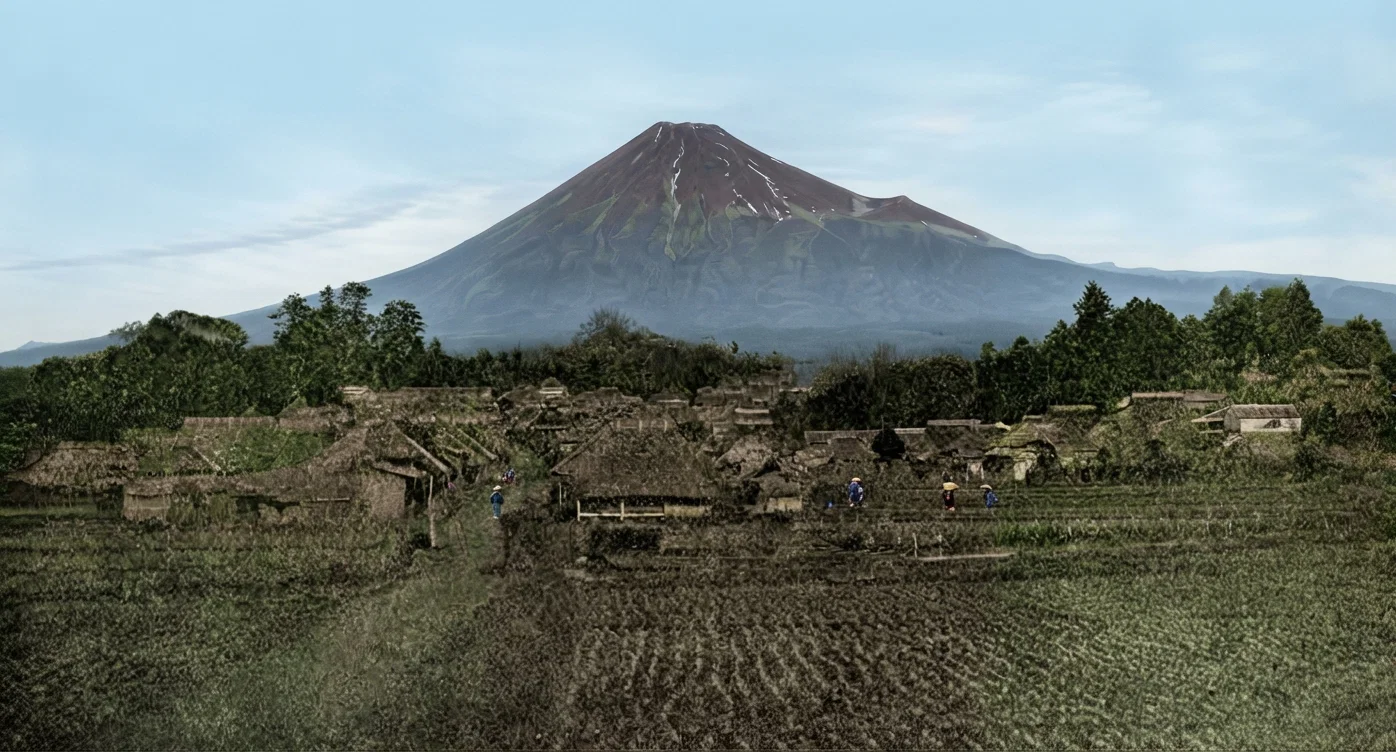
Fujiyama, or Fuji-no-Yama, or Fuji -San, the Sacred Mountain of Japan.
THE mountains speak of strength. “Which by His strength setteth fast the mountains; being girded with power.” From the sinking pit of Sodom Lot fled for safety to the mountains. The mountains of Palestine opened their secret places to David, who fled from the hatred and wrath of Saul. From the rugged mountain region of the Jordan, God called His strong prophet Elijah, nurtured among the must-be-overcome difficulties of the rugged rocks and turbulent torrents.
NATURALLY in all lands the mountain becomes a symbol of strength and power; and if men know not the God who “by His strength setteth fast the mountains,” they deify and worship the mountain itself. Therefore the “high places” among the heathen. Therefore the high places among Israel before the temple was built on Mount Moriah. The mountain was the strongest, greatest, holiest, most prolific in its abundant springs of life-giving waters, offering more secluded places for the hunted exile. The very term came to be a symbol of God’s great salvation. The psalmist calls to his soul,
“Flee as a bird to your mountain.” “Jehovah, by Thy favor Thou hast made my mountain to stand strong.” “As the mountains are round about Jerusalem, so Jehovah is round about His people.” “His foundation is in the holy mountains.” Thus by illustration and metaphor of the strongest, grandest, things of earth, God would reveal to us His righteousness, His holiness, His purity, His strength in our behalf. His “righteousness is like the great mountains.” His word, His truth, is like the pure snow-waters which flow from Mount Lebanon, while the perversions of men are like the brackish waters of the broken cisterns of men.
GET thee up, soul, on the high mountain of God's goodness and truth. Take long views, broad views of God's wondrous love. Men are prone to look at the immediate surroundings, and measure God by what the physical eyes see. Israel could only see themselves worthy of salvation. Even Elijah could see himself alone as the loyal of God, when he was but one of seven thousand and one. The disciples saw so slowly God's plan and work. The harvest field seemed to them four months away as they looked at the green, growing grain; Jesus tells them to lift up their eyes on the spiritual fields white already for harvest. They would confine their work to Judea and Jerusalem forever. God shows them the great world to be warned and invited. Beyond Jerusalem was Judea, and beyond Judea was Samaria, and then all the world. View the world from the throne of God's love and mercy, keep the vision ever in mind, and then go down to the spiritual lowlands and tell the needy ones the wonderful vision of the mountain of God.

THE COST OF UNBELIEF.

IT is impossible to compute what men lose through unbelief of the Gospel. Nothing so blinds men to their best interests as unbelief of the Word of God. The people who were contemporaneous with Christ on earth allowed a golden opportunity to pass by rejecting Him as their Saviour. The Jews were looking for Messiah, but would not believe in Him when He came, altho He fulfilled all that was said of Him in the Scriptures which they professed to believe. Even in the way of mighty works for their temporal benefit, they lost much more than we can imagine. On occasion of a visit to Nazareth, the people who had known Him from childhood spurned His claim to being a prophet, and the record says, 'He did not many mighty works there because of their unbelief.'
In the book of Malachi it had been prophesied that Elijah the prophet would be sent as the forerunner of the Lord (Mal. 3:1; 4:5, 6), and the people were also expecting some one to come in this capacity. And of John the Baptist, Jesus said, 'If ye will receive it [believe his message], this is Elijah which was for to come.' The blessing that was to come through Elijah was that he would 'turn the heart of the fathers to the children, and the heart of the children to their fathers'—through his message of the coming of Messiah. Of course such a message to a believing people would create a sentiment of joy and gladness in all, parents and children alike. But they didn't believe, and therefore lost the blessing.
Christ laid down this rule, 'According to your faith be it unto you.' So the blessings of His appearance to those among whom He mingled were limited to their faith. Thousands of people were healed of physical ailments who never received anything in the way of spiritual help, because that was the extent of their belief in Him. Because they saw Him heal others they believed He could heal them; but they did not believe in Him as a Saviour from sin and as a fountain of eternal life. So they got just what their faith claimed, and no more. They lost eternal salvation through unbelief. Many believed that He could feed them with loaves and fishes who rejected Him when He offered them the bread of heaven.
The same principle holds good in those who have a measure of faith in Christ as a Saviour. Their blessings are limited by their faith. His promise is, 'Ask, and it shall be given you; seek, and ye shall find; knock, and it shall be opened unto you.' But the Spirit, through the apostle James, tells us, 'Ye ask, and receive not, because you ask amiss, that ye may consume it upon your lusts.' All such asking is unbelief, for there is no selfishness in true faith.
Again James assures us that he who asks of the Lord must 'ask in faith, nothing wavering.' Of the wavering man he says such an one 'is like a wave of the sea driven with the wind and tossed.' Such a man is unstable in all things; he could not imbibe, and therefore could not profit by, the spiritual blessings of God. 'Let not that man think that he shall receive anything of the Lord.'
The great aggregate of loss to the unbeliever, in contrast with the gain to the believer, is briefly summed up in these words of our Saviour: 'He that believeth on the Son hath everlasting life; and he that believeth not the Son shall not see life; but the wrath of God abideth on him.'
Surely unbelief is an expensive privilege—a costly choice. G.

TWO SABBATH QUESTIONS.

IN the Herald of Gospel Liberty, published at Dayton, Ohio, a correspondent makes request for some one to show him "if any man kept any day for about the first 2,700 years after the advent of man on the earth or till after the law was written by Moses on Mount Sinai."
This is a very easy thing to show to any one who will not close his eyes to the scriptural evidence and refuse to see. About a month before the Israelites came to Sinai, they observed the seventh-day Sabbath in their camp "between Elim and Sinai." From that time on it was specially marked by the withholding of the manna on the seventh day. This incident is fully detailed in Exodus 16.
But this was not the beginning of the Sabbath-day institution. The Sabbath day had been practically obliterated from the minds of the people by Egyptian bondage, and was vividly brought to their attention again. Christ, by whom all things were created (John 1:1-3, 10; Col. 1:16, 17), tells us that "the Sabbath was made for man," and that He (Christ) is "Lord of the Sabbath day." Mark 2:27, 28. In Gen. 2:2, 3 we learn just when and why the Sabbath was instituted. Now we have it plainly set before us that the Creator (who was Christ) made the Sabbath for man when there was but one man and woman, and to argue that no man observed it for 2,700 years is not at all reasonable. That the masses fell away from obedience to God's law, Sabbath and all, is very true; the Deluge is evidence of that. That "death reigned from Adam to Moses" (Rom. 5:14) is proof that sin existed; for death is the result of sin (Rom. 6:23). And "sin is the transgression of the law" (1 John 3:4), therefore the law must have been in operation; for "sin is not imputed when there is no law." Rom. 5:13.
All the commandments of God are righteousness (Ps. 119:172; also verses 137, 138, 144); therefore the Sabbath commandment in the beginning was righteousness. While the antediluvians eventually became so corrupt that God summarily destroyed them, yet there were all the time some righteous ones who obeyed God. Abel, Enoch, and Noah are especially noted; and after the Deluge God testifies that "Abraham obeyed My voice, and kept My charge, My commandments, My statutes, and My laws." Gen. 26:5. But even if the commandment of God were ignored by every man in the world, the validity of the statute would not be affected, nor would the obligation be cancelled. When Adam disobeyed and ate the forbidden fruit, the commandment was not annulled. God's laws are not repealed in that way. "It is easier for heaven and earth to pass, than one tittle of the law to fail." Luke 16:17.

No New Law Needed.

The same correspondent asks that some one will show him "any place in the New Testament where Christ or any of the apostles recommended the keeping of any day, except assembling themselves together on the first day."
There was no occasion for any special recommendation concerning the day of the Sabbath in those times. Christ told the people plainly that He had not come to destroy one jot or one tittle of the law, but to fulfil it. To fulfil the law means fully to obey it. There was no question among either Jews or Christians in those days about the day of the Sabbath. The law which Christ came to magnify and make honorable (Isa. 42:21) settled that point. The practise of the disciples of Christ is plainly indicated by the action of the women who followed Him to the cross on the day before the Sabbath. "They returned, and prepared spices and ointments, and on the Sabbath they rested according to the commandment. But on the first day of the week, at early dawn, they came unto the tomb bringing the spices which they had prepared." Luke 23:56; 24:1, R. V.
Further along we have the practise of Paul recorded. While at Corinth for a year and a half he worked at his trade as a tent maker with Aquila and Priscilla during the week, and preached to the people in the Jewish synagogue on the Sabbath day. When the Jews would no longer allow him that privilege, he preached to the Gentiles and others who would listen in a house near the synagogue. Here he did not change his custom, which would have been quite natural had he been disposed to set forth another day as the Sabbath. Acts 18:1-11. This action corresponds with his experience at Antioch in Pisidia. See chapter 13:42-44. The apostle John, when in exile on Patmos,had a vision while "in the Spirit on the Lord's day," thus indicating that he was observing the Sabbath. But the only weekly Sabbath that the Lord ever has designated as His "holy day" is the seventh day of the week. Isa. 58:13. And this is the day He set apart and blessed in Eden, and commanded on Sinai, and observed in person while on earth; and which His apostles continued to observe after His departure. This is the day He made holy, and which He commands us to remember and keep holy. Man can not make any day holy, nor can he keep any day holy which competent authority has not made holy. G.

Question Corner

WE receive from time to time questions without the writers' names, and we have said from time to time that we can pay no attention to these. For instance, we have just placed in the waste-basket one signed "A Friend." We are perfectly willing that one should ask a question and sign it "A Friend," but we must have the writer's name as evidence of good faith. We have all that we can possibly reply to, in the paper and out, of those who let themselves be known, not to the public if they do not wish, but to the editors of the paper. We will respect all their confidences, but we must have their names. Questions which we consider will be of general interest or profitable to the paper we will answer in that way; other questions we will answer by letter, always, if stamp is enclosed. We can not promise to reply by letter if it is not. A postage stamp or so is not very much to any one of our readers, but the great many postage stamps required to answer letters of interest only to those who write them amount to quite a sum in the course of a year to the SIGNS OF THE TIMES. We believe our correspondents are willing to do this, but often forget.

1917.—The Sheet Let Down from Heaven.

In Peter's vision a sheet was let down from heaven with all manner of beasts and creeping things contained in it. God said they were clean. Does this nullify the law of clean and unclean beasts in Leviticus 11? S.
God gave to Peter that vision for a specific purpose. Peter thought there was only one race of people on the earth fit for salvation, and that was the Jewish race. God presented before Peter the children of men by the symbol of all those beasts and creeping things. Peter thought they were all unclean, "and a voice said, What God hath cleansed call not thou common." Now what did this mean to Peter? Did it mean that he was at liberty to indulge his appetite in any way he might choose? Did it mean that the Lord said unto Peter, I would have you eat all manner of four-footed beasts and creeping things? Let Peter himself say just what it meant. "Unto me hath God showed that I should not call any man common or unclean." Acts 10:28. Read both the tenth and the eleventh chapters of Acts and there find the lesson. The distinction between clean and unclean beasts is not an arbitrary distinction which God has made, but exists in the very nature of the beasts themselves; and we know no Scripture whatever which teaches us that their nature has ever been changed.

1918.—Ordinances on the Sabbath.

Is it not wrong to hold the ordinance of feet-washing on the Sabbath on account of the labor connected with it? There does not seem to me the same objection to the Lord's Supper. T. B.
The Sabbath commandment does not forbid work for God. Jesus said, "It is lawful [according to law] to do well on the Sabbath day." He also said, "The priests in the temple profane the Sabbath day and are blameless;" that is, they make that day a day of labor for the service of the temple, but they were blameless in that, because they were doing it not for themselves, but for God. The temple service called for twice as much labor on the Sabbath day as it did on other days. On other days but one lamb was to be offered in the morning and one in the evening, but on the Sabbath day this was doubled. See Num. 28:1-10. As indicated by the Scriptures in Isa. 58:13, the Sabbath is to be kept by "not doing thine own ways, nor finding thine own pleasure, nor speaking thine own words." It is not to be a day of laziness. God has not designed it to be a day of slackness, but of earnest spiritual exercise, which will develop Christians. The bread of God's presence, or showbread, was placed in the sanctuary fresh each Sabbath; so God would have a wholesome spiritual activity on the part of His people. Therefore in the carrying out of the ordinances which God has given there certainly can be no transgression of His other commands more than there was in marching around Jericho when God commanded it.

1919.—Bible Names of the Months.

Will you kindly give through the columns of the SIGNS the Jewish names of the months? I am unable to find them in any works to which I have access. J. E. G.
The Jews had two years—the sacred and the civil. The first year began with the month Abib, or Nisan (Ex. 12:2), corresponding in part to our April; second month, Zif (1 Kings 6:1); third, Sivan (Esther 8:9); fourth, Thammuz (Zech. 8:19); fifth, Ab (Ezra 7:8); sixth, Elul (Neh. 6:15); seventh, Tisri, or Ethanin (1 Kings 8:2; 2 Chron. 5:3); eighth, Bul (1 Kings 6:38); ninth, Chisleu (Neh. 1:1); tenth, Tebeth (Esther 2:16); eleventh, Shebeth (Zech. 1:7); twelfth, Adar (Esther 3:7; 9:27). The civil year began with the seventh month of the sacred year, or Tisri. It began with the Feast of Trumpets. The tenth day was the Day of Atonement, the fifteenth day began the Feast of Tabernacles, followed by first-fruits of wine or oil. See Lev. 16; 23:34; Deut. 16:13. The months nowhere exactly correspond with our months. Tisri corresponded with the last of our September and the first of October, beginning about September 20 and closing, of course, about the same time in October. Their Rosh Hashonah occurred September 20, the Feast of the Blowing of Trumpets, and the Day of Atonement (Yom Kippur) ten days after, or September 29. For further light upon the question read "Practical Lessons from the Experience of Israel for the Church of To-day," by F. C. Gilbert, a Hebrew Christian. That work gives great help in the study of the books of Moses.

1920.—Casting Out Devils.

Jesus cast out devils. These devils asked to be permitted to enter the swine. It seems they talked; how could this be? Have persons these devils now? S. B. S.
The proper term is not devil but demon, as in the American Revised Version. There is but one devil mentioned in the Scripture, diabolos, the devil; the others are demons or the angels or messengers of the devil. These were once among the angels of light, but they fell. Rev. 12:7, 8; 2 Peter 2:4. These, of course, are spiritual beings, and when men utterly turn from God and yield themselves to the influences of Satan, the demons come in and possess the men. When the demoniac of the miracle attempted to talk, the demons used his organs of speech, they talked through him. When the man himself would have cried out for mercy to Jesus, the demons made him say, "What have I to do with Thee, Jesus the Son of the Most High God?" They tried to make that man identify himself with them, but Jesus broke the power of Satan and set the prisoner free. Yes, there are persons to-day just as truly possessed of demons as there were in ancient times. A few months ago we published an article in the SIGNS OF THE TIMES, written by one in heathen lands, which gives clear evidence that all the characteristics of the New Testament times are manifest among those possessed of demons in heathen lands to-day; and we have the same things manifest at times in civilized lands.

1921.—Saved During the Three Angel's Messages.

Please tell me, will there be none saved during the Third Angel's Message but the 144,000? A. D. A.
We suppose that by "during the Third Angel's Message" the questioner means during the time that the great threefold message of Revelation 14 is given to the world, from 1844 onward. Yes, we believe there will be many thousands saved during the time of the giving of that message apart from the 144,000. There are thousands upon thousands who are and have been living up to all the light they have had, who never have seen, nor will see until eternity shall dawn, the light that shall shine upon and develop the 144,000. These will be saved by virtue of their faith in Christ. The 144,000 are those who are saved out of the very remnant, those to whom special light is coming, who have developed a certain character. They at least will be ready, prepared for our Lord when He comes. Whether there will be others besides the exact number is an open question. In the general reckoning all through the Bible of the number of God's people, it is the men who are numbered. It does not mean that women are excluded, but they are not among the definite numbers. The real object with every soul should be that he shall be ready for the Lord's coming and that he shall do just as much as he can to tell the glad tidings of that event to others that they also may be prepared.

1922.—The Lord's Choosing. Jer. 3: 14.

What is meant by "one of a city and two of a family"? Does it mean that there will not be a whole family saved? A.
By family in the above text is not meant simply families as we now designate them, but families in Israel, great divisions of the tribes. They might include many local families. The expression would indicate that not all would heed God's call to return and repent of their backslidings; but if they would not return, the Lord promises that He will gather out all those that do, however small their number. There may be but one in a city, there may be but two in a family which has several cities, yet the Lord would save them. It does not preclude any in a family, it does not for a moment teach that we should cease in any way to labor for all members of the family. It is the Lord's promise to even a few that the salvation of those who truly turn to Him is not in any way dependent on the salvation of a city or any number of professed followers of His.

1923.—Dates of Certain New Testament Books.

Will you kindly give me the probable dates of the four Gospels, the Acts, and the Revelation? S.
It is impossible to give the exact dates. It is to some extent a matter of question; but the general agreement among conservative scholars as given in Smith's Bible Dictionary and in the Oxford helps, and others, is as follows: Matthew between the years 50 and 60; Mark, 63 to 70; Luke 58 to 60; who probably wrote the Acts in 62 or 63; John, 70 to 83; some as late as 97, 98; the Revelation, written down near the very close of the first century doubtless between the years 95 to 97. This is fixed by Domitian's reign, who banished John to the Isle of Patmos, and whose reign closed in 97.

1924.—Voting for Prohibition.

Is voting for prohibition wrong? A.
It may be and it may not be; it depends altogether on the motive, the method, etc. Certainly it would be a grand thing for the whole land if the manufacture and sale of intoxicating liquors were prohibited. And when one places his protest against it in the form of a ballot as a man ought, certainly there is nothing wrong in it. It is the very proper thing to do.
Continue reading: TRUTH OR ERROR? HOW CAN WE KNOW?