Your ShelfYour Projects

Signs of the Times, Vol. 27, No. 18.

THE SANCTUARY COURT AND ITS FURNISHINGS

Signs of the Times

May 1, 1901

Pacific Press Publishing Company · Oakland, California · May 1, 1901

THE SANCTUARY COURT AND ITS FURNISHINGS.
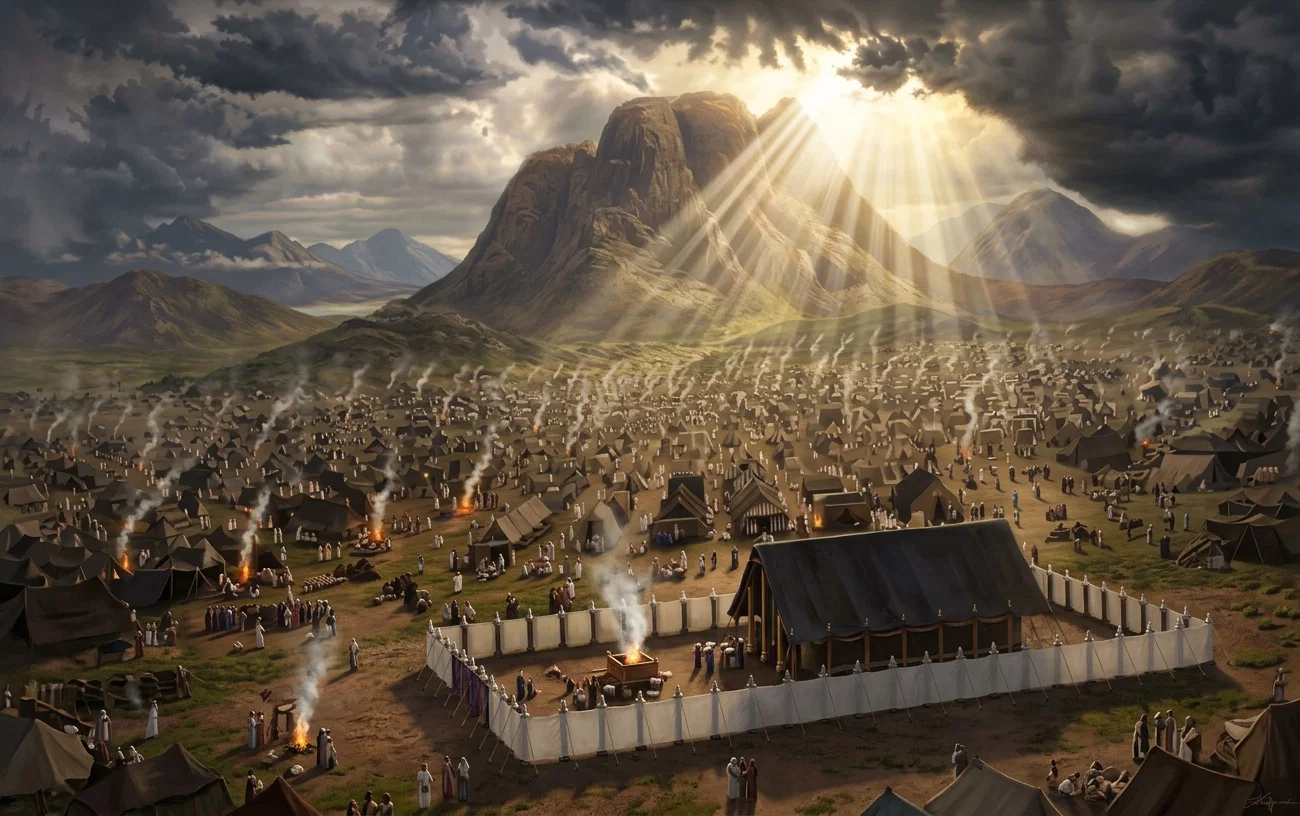
The sanctuary proper stood within an enclosure a hundred and fifty feet long and seventy-five feet wide. This enclosed spot was known as “the court of the tabernacle.” Its boundaries were marked by brass “pillars,” or posts, set at regular intervals, with curtains made of fine linen, seven and a half feet high, stretched from one post to another, and fastened at each point to a silver hook placed for that purpose. At the east end was a “gate,” or passageway thru the frail bulwark, thirty feet wide, and having drapings of blue, purple, and scarlet. When entering the place, these must be parted at some sectional division of the draping. Ex. 27:9-18.
The Sanctuary and Its Surrounding Court, as Seen in the Camp of Israel.
Just inside the entrance to the court, but directly between it and the door of the tabernacle, stood the altar of burnt-offering. Ex. 40:6; Lev. 4:7. This was a structure seven and one-half feet square, and four and one-half feet high, constructed of acacia wood, and overlaid with heavy brass plate. Its top, where the fire was kindled, was a grate, open, after the manner of net work, thru which the ashes were sifted into pans set beneath. Ex. 27:1-8.
All animals to be sacrificed for burnt-offerings, whether for sin atonement or trespass-offering, were to be killed in the court of the tabernacle just north of the altar of burnt-offering. Lev. 1:10, 11; 6:25; 7:2. The blood of these sacrifices was received in some suitable vessel, and after the priest had dipped his finger in it and put some of it on the horns of the altar, the rest of the blood was poured out at the base of the altar. Lev. 4:7, 18, 30.
This was a very significant service. Any person who brought one of these offerings to the sanctuary, did so because he was in some way a transgressor of God’s law. “The wages of sin is death,” Rom. 6:23. Whoever brought a sin-offering to the altar, thus acknowledged himself worthy of death. His substitute, tho entirely innocent, was therefore required to give up its life in behalf of the sinner. The life of the flesh being in the blood (Lev. 17:11), a portion of the blood was put on the altar, to signify that a life had paid the penalty of the transgression which required the service. In this was faintly shadowed the law of substitution by which the innocent Christ, as the Lamb of God, was called to spill His blood for guilty rebels against God.
The Creator of the universe so loved the world of mankind, to whom He had given existence, that He gave His only-begotten Son to rescue from perishing in their rebellion, all who would be saved. This provision was made from the very beginning (Rev. 13:8), so that from the days of Abel, blood was offered in token of deserved death, and in faith of a coming Redeemer to save from such fate. Accordingly, in the fulness of time Christ came, and died for the sins of the world. Gal. 4:4, 5; 1 Cor. 15:3. The blood then offered by the divine Sacrifice is the cleansing power by which all who take the prescribed measures may have their own sins washed away. 1 John 1:7; 1 Peter 1:18, 19.
Another article of furniture held a prominent place in the court of the tabernacle. This was known as the laver. This was no ordinary vessel, tho it was used for no other purpose than that of a wash-basin, at which the priests cleansed their hands and feet. Ex. 30:18-21. We do not know its size or exact shape, but are told that it was constructed of nothing less than the highly polished, brazen mirrors in which the women worshipers had been wont to behold their own countenances. Ch. 38:8. This vessel was placed between the altar of burnt-offering and the door of the sanctuary, so that the priests, on passing from the service at the altar to complete their work in the sanctuary, might stop, before entering so holy a place, and cleanseaway the stains of blood and other filth adhering to their hands or feet. This was absolutely necessary, as to appear in the presence of God in behalf of others without such cleansing, was quick and absolute death.
Thru following Christ we become a royal priesthood to do service for others. 1 Peter 2:9. That office may require more or less service of a menial character. Before entering on even this, we too should be cleansed, and may become so thru the Word of the Lord. John 15:3. But when our Saviour was about to transfer His earthly responsibility to His disciples, He first taught them the true nature of humility by which they might enter upon their mission properly. In the presence of all the others, He washed the feet of each one. When questioned by Peter as to the meaning of this service, the Saviour replied that he who was not washed, could have no part with Him in His work. John 13:8-11. So, then, all who would now do service for the Master must be morally washed at the laver of regeneration, which was well illustrated by the Saviour in the physical cleansing of His disciples’ feet. By following this great example, His people may now, as then, even tho they have been washed in the cleansing blood of Christ, prevent the introduction of dissension, strife, and alienation, because this lowly service softens and subdues the heart and brings about a union that no other act can produce. J. O. CORLISS.

THE DIVINE TEACHER.

In His manner of teaching, Christ has given us the secret of all effectual teaching. He did not appeal to the understanding merely. He sought to reach the heart. With the greatest simplicity He presented sublime, eternal truths.
Christ’s words were forcible and easy to be understood. His illustrations were those best calculated to impress with convincing power the minds of all classes of people, the learned as well as the unlearned. By the objects with which His hearers were most familiar, on which their eyes rested daily, He illustrated His lessons. A city set on a hill, salt which has lost its savor, the candle set in a candlestick, the vine and the branches, the shepherd and the sheep, the fruitless tree, the narrow gate, thru which men seek to enter but are not able, the wide gate, which admits the multitude, the sower and the seed, the tares among the wheat,—by these things Christ illustrated divine truths, knowing that afterward, whenever His hearers should see these objects they would recall the words He had spoken.
Christ spoke with clearness, and in a distinct, melodious voice. His tones were natural and even. Had He raised His voice to an unnatural key, as so many speakers to-day do, its pathos and melody would have been destroyed, and much of the force of the truth would have been lost.
The Jewish teachers had taken away from the people the key of knowledge. The rabbis had shut the kingdom of heaven against the poor and ignorant, leaving them to perish. Christ came to proclaim the Gospel to all humanity, high and low, rich and poor, learned and unlearned.
Christ is the originator of all truth. By the work of the enemy the precious gems of truth had been torn from their setting and placed in a frame-work of error. Christ came to replace the jewels of truth in their rightful position. He rescued them from the rubbish of error, gave them a new power, and bade them stand fast forever. He could use these truths with perfect freedom; for He was their author. He had cast them into the minds of each generation; and when He came to the world, He vitalized and re-arranged the truths which Satan had robbed of life. Clothing them with more than their original freshness and power, He gave them to the world for the benefit of future generations.
To us has been given the precious legacy of Christ’s teaching. This is recorded in His Word. In order to make it our own, we must search the Word diligently. Many truths are hidden, as the precious ore is hidden in the earth. And we must not only search; we must ask God for wisdom to aid us in searching. The truths essential for us to know are too deeply buried to be discovered by unaided human research.
Satan has misrepresented God’s purpose, and caused man to look upon Him in a false light; yet thru the ages God’s love for man has never ceased. Christ, the divine Teacher, came to reveal the Father as a merciful, compassionate Being, full of goodness and truth. The Saviour swept back the shadow in which the enemy had enveloped the Father, declaring, “I and My Father are one; look on Me and behold God.”
Christ came to give knowledge to the ignorant and hope to the despairing. He offered men wisdom which would make them wise unto salvation. He sought to lighten their self-imposed burdens of worldly anxiety and care. He invited them to come to Him, to exchange their cumbersome, galling yokes for His yoke, which is light. And down thru the ages have been sounding the gracious words of invitation, “Come unto Me, . . . and I will give you rest.”
Christ has most precious lessons for us to learn. Strength of purpose and moral courage are obtained thru His grace. He is made unto us “wisdom, and righteousness, and sanctification, and redemption.” His treasures of truth have been opened to us, that we may understand the great love wherewith God has loved us. “Wherefore gird up the loins of your mind; be sober, and hope to the end for the grace that is to be brought unto you at the revelation of Jesus Christ; as obedient children, not fashioning yourselves according to the former lusts in your ignorance; but as He which hath called you is holy, so be ye holy in all manner of conversation; because it is written, Be ye holy; for I am holy.” MRS. E. G. WHITE.

PETER'S LOST OPPORTUNITY.

In the garden of Gethsemane Peter lost the opportunity of his life. The history tells of his effort to defend the Saviour with a sword, which met with a rebuke from the King of love. What a different scene it would have been, had Peter come forward and offered himself at least to go with his Master to death. Peter realized his mistake in after years, and was glad to say like Paul, “I am crucified with Christ.”
If we would be crucified with Christ, we must “present our bodies a living sacrifice;” we will not be compelled to make the sacrifice. Let us not make the mistake that Peter made in the garden, for no display of outward zeal and bodily exercise can take the place of the entire giving up of self. The way of joy is the way of the cross—“who, for the joy that was set before Him, endured the cross.”
Are you seeking joy? Look for the cross; and when you find it, take it up cheerfully. Remember that “the cross is not greater than His grace.” “If any man will come after Me, let him take up his cross, and follow Me.” L. J. BURGESS.
Minneapolis, Minn., Box 989.

“THE CRUMBLING LIE.”

Writ on a ruined palace in Cashmere.
“The end is nothing, and the end is near.”
What promptings of vain-glorious unbelief, What crushing mightiness of mortal grief, E’er wrought damnation in a work so brief?
Where is the hand that graved that dreary lie? Where is the heart once insincerely high? Dust!—as the dust the desert wind blows by.
O son of man — son of man’s baser part— The end is naught where naught is in the heart; Thy hand hath traced thy judgment—dust thou art.
The fault was thy poor self—the common crime; Self was the god and glory of thy prime, That failed and feebled with the weight of time.
Too close to earth! Things kindred to thy clay Called to the flesh, and found an easy prey, Then stole thy birthright—stole thy soul away.
For the day dawned, and evening drew her pall; Seasons recurred, and genius slipped the stall, And yet ye knew no purpose in it all.
Earth’s thousand types thy fallacy denied; Life died to life to keep thy need supplied; And yet of hand and heart, lo, thou hast lied.
Still a lone truth thru thine unreason ran: “The end is near!” Yea, verily, O man, The end was with thee when thy life began.
Fixed from the first, when life took shape and span, This steadfast truth reveals creation’s plan: Time’s great memorial to God is man.
Love gave thee life, and sang thy cradle song; Love whispered when the way was rough or wrong; Love mourned the failure, mourned thee sore and long.
O, how shall Love forgive the fool whose life With sacrilege and blasphemy is rife, Who spurs the world to fear and doubt and strife? Mark 3:29.
With seeing eyes and ears attuned to hear, Then had this message quickened all Cashmere: “The end is Love, and love is ever near.”
Alamosa, Colo.                     F. T. ELKIN.

THE HOME OF THE SAVED.

DO THE Scriptures teach that the earth will be the final home of the saints?"
In affirming the above question I am not setting forth any new or strange doctrine. The saints in every age have believed and taught this truth. It has been taught by the wise and good in the Methodist Church. John Wesley preached it, Isaac Watts sang it, and Dr. Adam Clarke wrote it. The latter, in his comments on 2 Peter 3:13, says:—
The present earth will . . . be renewed and refined, purged from all moral and natural imperfections, and made the endless abode of blessed spirits.
But the question calls for the teachings of Scripture rather than the teachings of man.
When our Saviour after His resurrection would present the Messianic promises, it is written that “beginning at Moses and all the prophets, He expounded unto them in all the Scriptures the things concerning Himself;” saying, “All things must be fulfilled, which were written in the law of Moses, and in the prophets, and in the psalms, concerning Me.” Luke 24:27, 44. I will try to follow the Great Teacher’s plan of exposition in presenting the subject of the saints’ inheritance, a subject which is inseparably connected with the redemptive work of the Captain of our salvation.
In the inspired record of the “first dominion,” as presented in the first chapter of Genesis, we learn that the earth was made for man. After the creation of the earth, after it had received the finishing touches of beauty and glory from the hand of the King of glory, the Lord Jesus Christ, for “all things were made by Him” (John 1:3),—after the kingdom had been thus prepared at the “foundation of the world,” there was as yet no king to have dominion; and “God said, Let us make man in our image, after our likeness; and let them have dominion . . . over all the earth. . . . So God created man in His own image, . . . male and female created He them. And God blessed them, and God said unto them, Be fruitful, and multiply, and replenish the earth, and subdue it, and have dominion.” Gen. 1:26–28.
This, in brief, is the story of the first dominion. This is the kingdom “prepared from the foundation of the world” to be inherited by the blessed of the Father. But this first dominion was of short duration. Thru transgression Adam lost the kingdom which was thus prepared. But this fallen monarch, this captive king, was cheered with the promise of the birth of a Seed who should dethrone the usurper and deal him a mortal wound, while Himself suffering a bruise that should heal. The apostle Paul, quoting the eighth psalm, refers thus to the first dominion, to its loss, and to its final restoration:—
“For unto the angels hath He not put in subjection the world to come, whereof we speak. But one in a certain place testified, saying, What is man, that Thou art mindful of him? or the son of man, that Thou visitest him? Thou madest him a little lower than the angels; Thou crownedst him with glory and honor, and didst set him over the works of Thy hands; Thou hast put all things in subjection under his feet. For in that He put all in subjection under him, He left nothing that is not put under him. But now we see not yet all things put under him. But we see Jesus, who was made a little lower than the angels for the suffering of death, crowned with glory and honor; that He by the grace of God should taste death for every man. . . . That thru death He might destroy him that had the power of death, that is, the devil; and deliver them who thru fear of death were all their lifetime subject to bondage.” Heb. 2:5–15.
Thus it is made plain that the results of the death of the Seed of the woman, the second Adam, would include the restoration of man to his first dominion thru the destruction of the devil, who by the deceitfulness of sin dethroned the first Adam and usurped his dominion.
“And Thou, O tower of the flock, the stronghold of the daughter of Zion, unto thee shall it come, even the first dominion; the kingdom shall come to the daughter of Jerusalem.” Micah 4:8. Thus does the prophet Micah also predict the work of Christ and the restoration of the first dominion.
The apostle Peter, after referring to the purification of the old heavens and earth by water, and after declaring that “the heavens and earth, which are now, by the same word are kept in store, reserved unto fire against the day of judgment and perdition of ungodly men,” says, “Nevertheless we, according to His promise, look for new heavens and a new earth, wherein dwelleth righteousness.” 2 Peter 3:7, 13.
This promise of a new earth as the final home of the saints, will now be traced thru Moses and the prophets by means of the covenant which God made to Abraham and his seed.
“The Lord said unto Abraham, after that Lot was separated from him, Lift up now thine eyes, and look from the place where thou art northward, and southward, and eastward, and westward; for all the land which thou seest, to thee will I give it, and to thy seed forever.” Gen. 13:14, 15.
Abraham was a man of faith, and his look was the look of faith. And therefore he looked “afar off,” and inasmuch as he was promised all that he could see, and inasmuch as he looked by faith, he saw all that faith could see. And that this was all the world is plainly declared by the apostle Paul thus: “The promise, that he should be the heir of the world, was not to Abraham, or to his seed, thru the law, but thru the righteousness of faith.” Rom. 4:13.
And thus did the Lord promise the world to Abraham and to his seed forever. But Abraham’s faith not only embraced the promise of the world, but also the promise of the “seed, which is Christ,” thru whom both himself and the world were to be won from the hand of the enemy. And this is what made him glad. “Abraham rejoiced to see My day; and he saw it, and was glad,” the Saviour says. John 8:56.
That this promise of the world referred not to the present world, but to “the world to come,” the new earth, is evident from many scriptures. In the first place, altho God promised the earth to Abraham, and later confirmed that promise by an oath, and, because He could swear by no greater, swore by His own life that He would give it to him,—notwithstanding all this, Abraham has never received a foot of it, according to the dying testimony of the martyr Stephen, as follows: “And He gave him none inheritance in it, no, not so much as to set his foot on; yet He promised that He would give it to him for a possession, and to his seed after him.” Acts 7:5. The promise to Abraham was repeated to Isaac, “Unto thee, and unto thy seed, I will give all these countries.” Gen. 26:3. The same promise equally personal and definite was made to Jacob, thus, “The land whereon thou liest, to thee will I give it, and to thy seed.” Gen. 28:13. Yet notwithstanding the Lord thus definitely and personally promised the possession of the earth to these three saints and to their seed, yet it is written of them all: “These all died in faith, not having received the promises, but having seen them afar off, and were persuaded of them, and embraced them, and confessed that they were strangers and pilgrims on the earth.” “And these all, having obtained a good report thru faith, received not the promise; God having provided some better thing for us, that they without us should not be made perfect.” Heb. 11:13, 39, 40.
Thus it is plain that these saints of God have never yet received the oath-confirmed promise of God to give them the earth for an everlasting inheritance. And it is also true that they are waiting for us to “obtain a good report thru faith,” so that they with us may receive the promised inheritance. And since these all died in faith that they would receive the promise, their faith must have looked beyond death to the resurrection, for the fulfilment of the promise. The apostle Paul voices this hope of the fathers in his defense before Felix, as follows:—
“But this I confess unto thee, that after the way which they call heresy, so worship I the God of my fathers, believing all things which are written in the law and in the prophets; and have hope toward God, which they themselves also allow, that there shall be a resurrection of the dead, both of the just and unjust.” Acts 24:14, 15.
And inasmuch as the resurrection occurs at the second coming of Christ, it is clear that the ancient worthies looked forward to this event for the realization of God’s promise and oath to give them the eternal inheritance.
I am led to exclaim here, What faith to see so much so far away!—to see the earth made new by the hand of God after being cleansed by the consuming fires of His presence,—to see the New Jerusalem, the promised metropolis of the new earth, “a city which hath foundations, whose builder and maker is God.” Why is it that these glorious things were seen by these saints, when they were so far off, while the supposed successors of these saints, who are living thousands of years nearer their realization, do not discern them, or if at all, only dimly? In this, history is but repeating itself. Paul declares that “Moses and all the prophets” saw “that Christ should suffer, and that He should be the first that should rise from the dead, and should show light unto the people and to the Gentiles.” Acts 26:22, 23. All this they saw hundreds and even thousands of years before it was fulfilled; but the chief priests and the leaders of religious thought, who lived at the time of its fulfilment, not only did not see it, but crucified Him whom their father’s faith had seen.
  • (Concluded next week.)

THE KINGDOM OF HEAVEN.

Tho ever since the fall the earth has been under the dominion of Satan, he rules only as a usurper. There have always been some who have been loyal to God. When, upon a certain day, as recorded in the first chapter of Job, Satan came before the Lord, and by implication claimed dominion over the earth, the Creator reminded the fallen angel that his title was not clear; that He, Jehovah, had a servant there in the person of Job. Again: “When Israel went out of Egypt, the house of Jacob from a people of strange language; Judah was His sanctuary, and Israel His dominion.” Ps. 114:1, 2. Moreover, when the children of Israel demanded a king, the Lord said to Samuel, “They have not rejected thee, but they have rejected Me, that I should not reign over them.” 1 Sam. 8:7.
These texts show clearly that the Lord has ever had a kingdom in this earth. This kingdom over which the Lord reigned, in so far as it pertained to civil duties, was given to Saul, then to David, to Solomon, and so on down to Zedekiah. In 1 Chron. 29:23 we are told, in so many words, that “Solomon sat on the throne of the Lord as king instead of David his father.”
In the days of Zedekiah (B. C. 588) this dominion was transferred to Babylon, as foretold in Eze. 21:25-27. As indicated also in the same scripture, this dominion passed in turn from Babylon to Medo-Persia, then to Grecia, and then to Rome. Rome ruled God’s people as a distinct nation until the destruction of Jerusalem, A. D. 70. Then this phase of the kingdom ceased, to be no more “until He come whose right it is.”
But while this national dominion became extinct, never to be again until Christ comes crowned “King of kings and Lord of lords” (Rev. 19:16), the spiritual dominion, something that had never been committed to any earthly king, was re-established even more firmly than before.
As we are told in Matt. 21:33-45, this spiritual dominion was taken from the priests and rabbins and given to “other husbandmen.” The Lord did not destroy His vineyard and plant another. He destroyed the husbandmen, and gave the vineyard—the vine that He brought out of Egypt, His church—into other hands. To Peter, as representing the twelve, He said: “I say also unto thee that thou art Peter, and upon this rock [the truth that Peter had just avowed, that Jesus was the Christ] I will build My church; and the gates of hell shall not prevail against it. And I will give unto thee the keys of the kingdom of heaven; and whatsoever thou shalt bind on earth shall be bound in heaven; and whatsoever thou shalt loose on earth shall be loosed in heaven.” Matt. 16:17-19.
This kingdom, as here re-established and given into other hands, differs from the theocracy of Israel in this respect, that while in the theocracy were united the spiritual and the civil, the kingdom of heaven is purely spiritual. Said the Saviour to His disciples: “Ye know that the princes of the Gentiles exercise dominion over them, and they that are great exercise authority upon them. But it shall not be so among you; but whosoever will be great among you, let him be your minister; and whosoever will be chief among you, let him be your servant; even as the Son of man came not to be ministered unto; but to minister, and to give His life a ransom for many.” Matt. 20:25-28.
Israel was once God’s kingdom upon earth. That feature of it that pertained to the administration of civil justice was, on the demand of the people, given into the hands of a king. It was this that was given in turn to Babylon, Medo-Persia, Grecia, and Rome. The spiritual dominion remained in the Jewish church,—that is, in the sense of administration. There never was any legislative authority given either to Moses or to the elders of Israel; God was the law-giver. And this is true of the church to-day.
The church as reorganized by Jesus Christ during His earthly ministry and upon the day of Pentecost—the vineyard taken from the wicked men and given to others—is just what “the church in the wilderness” was, stripped of all connection with the civil authority. That is to say, it is a pure, self-governing democracy. Said the Saviour, “One is your Master, even Christ; and all ye are brethren.” Matt. 23:8. By these words is all lordship, both civil and spiritual, forbidden to Christians. The supreme duty of the Christian is to order, not his brother’s life, but his own life, according to the divine law. To Peter’s anxious inquiry concerning another’s duty, the Saviour answered, “What is that to thee? follow thou Me.”
The lesson that God would teach His people now is the same that He sought to teach them under the theocracy, namely, separation from the world, and self-government under the divine law. In one sense of the term these can not be learned, but must come into the life and experience by the presence of the Lord Jesus Christ in the heart. “I am crucified with Christ,” the apostle said, “nevertheless I live; yet not I, but Christ liveth in me; and the life which I now live in the flesh I live by the faith of the Son of God, who loved me, and gave Himself for me.” Gal. 2:20.
This is Christian experience; this is self-government. This is the kingdom of God that “cometh not with observation;” for it is within, even in the heart and in the life. C. P. BOLLMAN.
Chicago, Ills.

SUFFERING IN HIS NAME.

WHILE our loved Jesus was on earth, He often talked with the disciples of the trials which awaited them. They would be brought to witness before kings and rulers. They would be scourged in the synagogs, and hated of all men, for His name’s sake, and the time would even come when whosoever would kill them would think he was doing God service. They were to expect all these things; for surely “the servant is not greater than his lord. If they have persecuted Me, they will also persecute you.” John 15:20. But said Jesus: “Fear not them which kill the body, but are not able to kill the soul; but rather fear Him which is able to destroy both soul and body in hell.” “Whosoever therefore shall confess Me before men, him will I confess also before My Father which is in heaven. But whosoever shall deny Me before men, him will I also deny before My Father which is in heaven.” Matt. 10:28, 32, 33.
In fulfilment of the Saviour’s words, a storm of persecution soon burst upon the church. Stephen, a man of great faith and wisdom and mightily endowed with the Holy Spirit, became involved in a dispute with enemies of the faith, and when they could not answer his arguments, they accused him of blasphemy. Being permitted to answer to this charge, Stephen showed that the Jewish nation had slain the Just One of God. This so increased their rage that they rushed madly upon him and stoned him to death. In his dying hour Stephen “looked up steadfastly into heaven, and saw the glory of God, and Jesus standing on the right hand of God.” Acts 7:55. And so the first Christian martyr “fell asleep,” calling upon the Lord Jesus to receive his spirit, and saying, “Lord, lay not this sin to their charge.” Verse 60.
Persecution soon became so great in Jerusalem that the great body of Christians were scattered and dispersed thru the surrounding regions. Wherever they went they preached the Word, and thus the Gospel was spread abroad. Saul of Tarsus, in his blind zeal, entered into houses, and, dragging forth men and women, committed them to prison, believing that in so doing he was serving God. But as Saul journeyed to Damascus, intending to slaughter the saints of God, a light far exceeding that of the sun shone around him at midday, and a voice called to him, “Saul, Saul, why persecutest thou Me?”
Saul fell to the earth, struck blind by the light from God’s throne, and, trembling with fear, he said, “Who art thou, Lord?” and as these words penetrated his awe-stricken senses, “I am Jesus of Nazareth, whom thou persecutest” (Acts 22:7, 8), he tremblingly asked, “Lord, what wilt Thou have me to do (Acts 9:6)?” Thus miraculously was the church delivered from her fierce enemy, who became, under God, “a chosen vessel” to proclaim the Gospel to the Gentiles.
After a few years, the Christians again suffered persecution, under Herod Agrippa, who beheaded James, the brother of John, and cast Peter into prison. Now indeed was the church in deep distress, and took refuge in prayer. Supplications ceased not, but arose continually from one little praying band after another, and reached the throne on high.
As Peter slept soundly within prison walls, bound with a chain on either hand to the Roman soldiers who guarded him, the angel of the Lord appeared, and a great light shone within the gloomy dungeon. Peter’s chains fell off, and he, as in a vision, and not knowing whither he went, followed the angel. The massive iron gate swung open, and when they had passed thru, the angel departed, and Peter stood half dazed in the street of the city, not yet able to realize the truth that the Lord had sent His angel and delivered him from the hand of cruel Herod.
The perils of the apostolic church are most truly and graphically delineated by Paul in relating his own experience: “Of the Jews five times received I forty stripes save one. Thrice was I beaten with rods, once was I stoned, thrice I suffered shipwreck, a night and a day Ihave been in the deep; in journeyings often, in perils of waters, in perils of robbers, in perils by mine own countrymen, in perils by the heathen, in perils in the city, in perils in the wilderness, in perils in the sea, in perils among false brethren; in weariness and painfulness, in watchings often, in hunger and thirst, in fastings often, in cold and nakedness.” 2 Cor. 11:24–27.
Yet, while contemplating these hardships, the great apostle to the Gentiles could say, “But none of these things move me, neither count I my life dear unto myself, so that I might finish my course with joy, and the ministry, which I have received of the Lord Jesus, to testify the Gospel of the grace of God.” Acts 20:24.
Later in life, when nearing the close of his career, this faithful herald of the Gospel was enabled thru God’s grace to say: “I am now ready to be offered, and the time of my departure is at hand. I have fought a good fight, I have finished my course, I have kept the faith.” 2 Tim. 4:6, 7.
And so, rejoicing in tribulation, did the twelve apostles bear witness to the truth, and one after another sealed their testimony with their blood. But the faith for which they died could not be extinguished; it lived in thousands of humble, pious hearts, who followed meekly in the footsteps of their dying Lord.
AUGUSTA W. HEALD.

MORMON MORALS.

[The following article comes to us from the Utah Gospel Mission, of 739 Republic Street, Cleveland, O., behind which are many prominent clergymen of various Protestant denominations in all parts of the country. It speaks for itself.]
A RECENT convert to Mormonism makes the following statement, viz.:—
To the Public—
My home is in Vicksville, Southampton Co., Va. I am thirty-eight years old, and have a family of six children. My sister-in-law died after the death of her husband, and left five children to my care. I had been a Christian more than four years before the Mormon missionaries came to my house, and had found great comfort in the Christian life. I was a member of the Christian Church, sometimes called the Disciples. Nine members of my family were also members of the church. George Whittle and Henry Taggart, Mormon missionaries, came to my house early in December, 1899. They have made their home with me since they came, until this time, in May, 1900. (That is the way they preach the Gospel without purse or scrip.) There were six other missionaries coming often to my house and remaining several days at a time. They told us that we must gather to Israel, flee to the mountains; that this was the commandment of the Lord. They talked like Christians, and I believed what they said and trusted them. They said when Christ came, He would come to the temple, and we ought to be there. They said polygamy had been done away with—that no one was living in polygamy, nor had been for a great many years. They told us we could not live our religion in Virginia, but ought to come to the mountains. They said the Saints here (in Utah) were a pure people—no such wickedness as in the States. They represented Utah as a paradise. They wanted us to come to the temple and be sealed to each other as husband and wife and children.
They wanted me to sell all and come with my family. We all joined the Mormon Church, and believed what the missionaries had told us. But I did not want to sell my little home until I had come to see. They said I could take up as much land as I wanted when I came, so I decided to come, and sold all my farming implements, my mechanical tools, my horse and timber that I had ready to work. I got money enough to come and go back again. They did not want me to take money enough for me to return—said I would like it here. I came on and went to the friends at Preston, Idaho, to which place they had directed me. I called at Mrs. Whittle's, and learned that her daughter, sister of our missionary, was living in polygamy—the second wife of Mr. Pond. I learned also from the Mormons that the sister of Elder Taggart was a polygamous wife.
These facts startled me, as both of the missionaries had declared to us again and again that no one had been in polygamy for a long time; polygamy was a thing of the past. If they had told me the truth, I would not have come to Utah, nor would I have sacrificed my property to come.
While visiting among the brethren at Preston, I discovered that the Saints would swear, for I heard them. They would ask a blessing at the table, and presently begin to curse. They would pray and swear right along. I had never been used to that, and it hurt me.
President Snow, the “mouthpiece of God, prophet, seer, and revelator,” came up to conference at Preston. I thought now we will hear something good; if he does speak for God, he will surely say something good and helpful. But to my surprise he did not. He talked all the time about tithing. They must “pay up.” It was money, money, money, all the time, no Gospel at all, nothing about the love of God, nothing about our Saviour, whom I loved. I was sick and disheartened. I could neither sleep nor eat.
The Saints wanted me to come to all their meetings, but I could not. The missionaries had deceived me. Instead of a paradise, I found the Saints swearing, living in polygamy, and the young people were vile beyond description. Instead of the prayer-meeting, they had the dance. Instead of the Gospel of love, they preached money. I went out and lay down in the fields, crying to God for help to get away, back to my home again.
All these facts and conditions I found out from the Saints. I did not go to any of the denominations for information. I heard with my own ears, saw with my own eyes, and sorrowed in my own heart.
The Mormon missionaries who profess to preach without purse or scrip cost me, a poor man with a large family, about three hundred dollars. But I am thankful that I did not bring my family. I thank God that He has made it possible for me to go back home. I will warn all my neighbors against the falsehoods and deceptions of the Mormon missionaries. I make these statements to warn people against the Mormon deceivers. It is the worst thing I have ever heard of.—Frank S. Johnson.
Continue reading: THE PRODIGAL SON