ONLY LINE WITH ITS OWN TRACKS FROM SAN FRANCISCO TO CHICAGO
THE CALIFORNIA LIMITED
The Santa Fe new and sumptuous train, through to Chicago in 75 hours. Leaves every morning at 9 o’clock.
OVERLAND EXPRESS, with through Palace and Tourist Sleepers, to Chicago, every evening at 8 o’clock.
BAKERSFIELD LOCAL leaves every morning at 7.20, and STOCKTON LOCAL every afternoon at 4.20, giving best service through the San Joaquin Valley.
PERSONALLY CONDUCTED Tourist Excursions every Monday, Thursday, and Saturday, in Vestibuled Tourist Cars.
The service on these Personally-Conducted Excursions, is all that counts for comfort and convenience. Clean linen and bedding, the proper lavatory and toilet accommodations are provided. The aisles are carpeted and the windows double, to keep out the dust, and wide to allow an unobstructed view of the scenery en route. Full information regarding the Santa Fe Route, with handsome folder and correct map of the section through which it runs, may be had at the Company’s offices.
CALL OR WRITE
1118 BROADWAY, OAKLAND
641 MARKET ST., SAN FRANCISCO
The Overland Limited
When you go East, take
“The Overland Limited”
(Via UNION PACIFIC RAILROAD
Less Than Three Days to Chicago
Four Days to New York
Leaves Oakland Daily at 10:30 A. M.
“The Fast Mail”
Three and One-half Days to Chicago
Both Pullman and Tourist Sleepers through to Denver, Kansas City, Omaha and Chicago Daily without Change. Leaves Oakland at 6:44 P. M.
EVERY DAY IN THE YEAR
PERSONALLY-CONDUCTED TOURIST EXCURSIONS TO THE EAST EVERY WEDNESDAY AND FRIDAY EVENINGS
Steamship Tickets to and from all points in Europe by all trans-Atlantic steamship lines
H. V. BLASDELL, Passenger Agent
1160 Broadway, Oakland, Cal.
MISSION WORK IN THE SOCIETY ISLANDS.
By B. J. Cady
The Tahitians are not of a savage or fierce disposition; on the contrary, they are mild and peaceable in their demeanor. They are inclined to be cowardly, and have great respect for persons. Being fearful of offending, they very seldom make any objection to what one is saying to them, even tho they may not agree with the speaker. They will listen attentively to what is said, responding occasionally with the words, “parau mau,” which mean truth. They think a great deal of what people, especially their own people, will think or say of them. This makes it hard for one to come out and do differently from the rest, so they usually move like a flock of sheep,—all together. When one does have courage to follow out his convictions of duty, and accept of religious views which are contrary to those held by the majority of the people, it is no light matter. A move of this nature is not easy in the United States, where there is so much independence of thought and action; but in a land where the people have been educated to believe that what the leaders think and say is right, it is harder still.
Seventh-day Adventist Mission House in Papeete, Tahiti.
A Protestant Church on Tahiti.
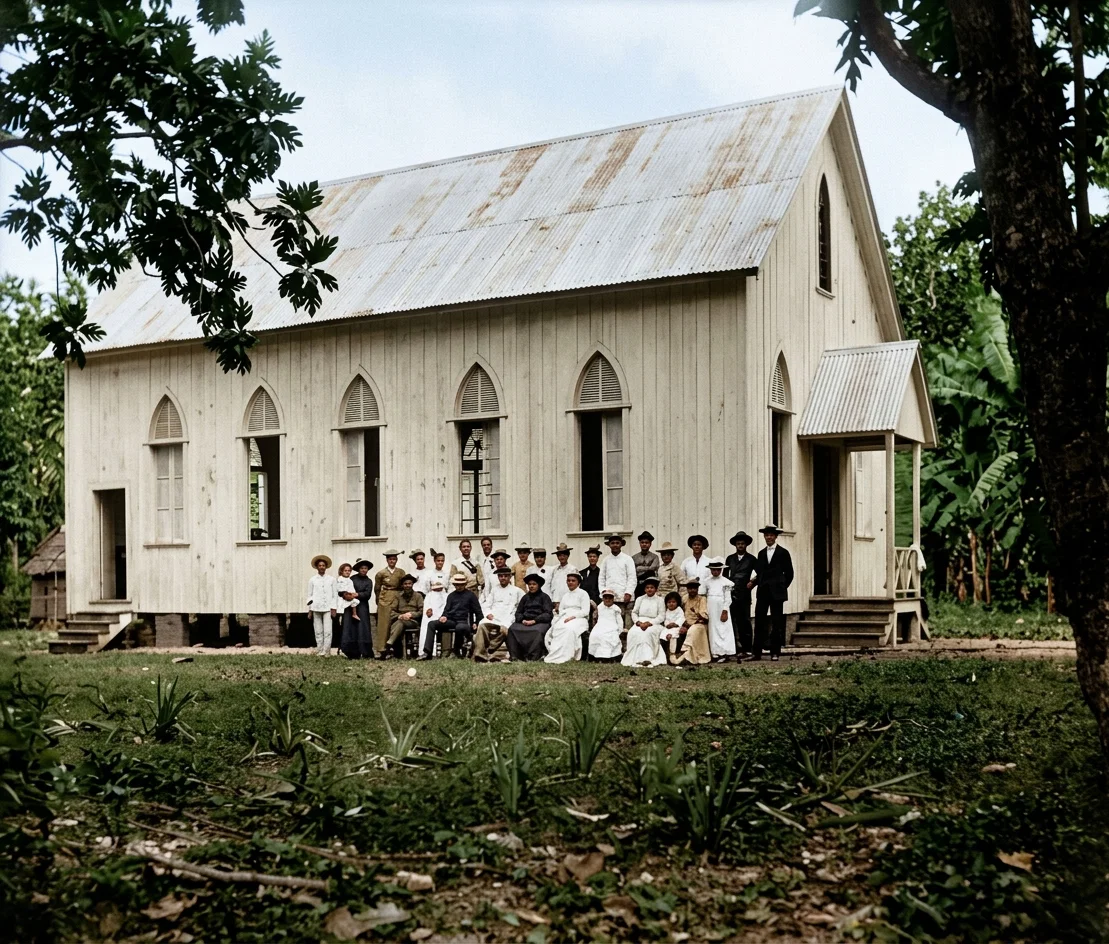
Seventh-day Adventist Church in Papeete, Tahiti.
The first missionaries, who went from England to Tahiti about a hundred years ago, found it hard to change established ideas and customs, and they labored for years before they were rewarded by even one convert to Christianity. Gradually others were added to the number of those who worshiped the true God, until at length it became more popular to be a professed Christian than otherwise. Then all came over on the side of Christianity, and so to-day all are nominal believers in Christianity, tho many are non-professors.
The early missionaries labored under the mistaken idea that church and state should be united, and that it was their duty to compel others to do what they thought was right. So as soon as they had gained sufficient influence over the people to have matters their own way, they got them to pass various religious laws. With few exceptions, the most zealous church-members were the ones who held the government offices. Of course this had a tendency to make hypocrites; for it never makes people better at heart to compel them to be outwardly religious. And so to-day, tho most of the people make a profession of Christianity, it is largely a form, and the power of godliness is sadly lacking.
Many church-members, as well as others, can not be trusted, but make a practise of lying, stealing, drinking, and breaking many of the commandments. They seem to think that if one does not get noisy and quarrel or fight after drinking, there is nothing wrong about it.
There was formerly a law forbidding any other than the established religion in these islands. Two Catholic priests came there, desiring to stay and propagate their religion. But the people would not allow them to remain; they put them into a boat and started them out to sea. As the priests were French, France found in this a cause of complaint against Tahiti. She already had possessions in this part of the sea, and wished Tahiti also, so took possession of the island.
So, now, French laws are in force, and give more liberty of conscience. Any religion is allowed an entrance, and several different sects are represented.
The first English missionaries taught the natives that Saturday was the seventh day of the week, and the Sabbath, and they observed the seventh-day Sabbath for many years. When the French came, they proposed that the people change and observe Sunday. The pastors of the church also used their influence to get the people to change, and in time they succeeded in making the change. The natives were then taught that Sunday was the seventh day of the week, and Saturday the sixth day. Saturday is also called “mahana maa,” or food day, meaning the day to prepare food for the Sabbath (Sunday).
It seems to be the custom of many missionaries, when they go into heathen lands, to teach their followers that the Ten Commandments are all binding, including the fourth commandment, which says, “The seventh day is the Sabbath of the Lord thy God; in it thou shalt not do any work.” But when a true seventh-day keeper comes, they have to acknowledge, as some have in the islands, that the day they keep is not the one taught in the fourth commandment. They then say that they keep the first day of the week because Christ arose on that day. But if this be true, why teach that Sunday is the seventh day? Why not teach them the commandment which tells them to keep the first day of the week as the Sabbath? The answer is plain. It is simply because there is no such commandment in the Bible. So the first day is substituted for the seventh day, tho it can not be otherwise than a counterfeit sabbath; for there is no commandment in Old or New Testament for keeping the first day of the week as the Sabbath.
At one of our meetings a priest was in attendance, with many others, to hear what we had to say. The13priest said to the Protestant people: “Those seventh-day people are true Protestants. You are not. The Bible tells you to keep the seventh day, and you do not do it. My father, the pope of Rome, says to keep the first day of the week, and you obey him. Now if you are going to keep the pope’s sabbath, and not the one the Bible commands you to keep, you ought to obey my father in Rome in other things, and become good Catholics.” The priest said to us, “If you will write to my father in Rome, and get him to change the Sabbath back to the seventh day, then I will keep it.”
Side View of Mission House in Papeete.
Truly there has been a falling away in the keeping of God’s Word, and a substituting of man’s word in its place. But we have found in our experience that the islands still wait for God’s law, and we believe that many will choose to obey God rather than man. B. J. CADY.
LO, HE COMES.
By Mrs. M. L. Moon
List the notes of joy and gladness;
Signs foretell the Lord is near:
Banish every thought of sadness,
Silence every doubt and fear.
Long has been the night of sorrow;
Long our hearts been filled with dread;
Soon the Saviour's voice resounding
Calls the living, wakes the dead.
Hasten on, O day of brightness;
Help us, Lord, our work to do,
That thy robe of purest whiteness
Clothe us when we're called to go.
Lest our weary feet should falter,
Keep us, Lord, from day to day;
Never let our courage languish,
Guide us in the narrow way.
Mrs. M. L. Moon.
San Jose, Cal.
Our Work and Workers.
Thirty-four members have been added to the church at Cleveland, Ohio, since January 1, twenty of whom were baptized by Brother E. J. Van Horn.
The Wisconsin Conference will hold its annual meeting in camp at Grand Rapids. The time is set for June 12–23, subject to change if deemed advisable.
Several of our brethren lost quite heavily by the fire at College View, Neb., March 22. The fire occurred in the night, and destroyed a large part of the business portion of the town.
The Cleveland Sanitarium training class for nurses will start a new class May 15. A duplicate of the first year’s course at Battle Creek Sanitarium will be given. A limited number only can be accommodated. Write to A. W. Herr for further information.
Besides the need of missionary work right at home, and in foreign lands already entered, do not forget that there are still over 10,000,000 square miles of unoccupied districts in various heathen lands where missionaries thus far have never entered.
An Ohio canvasser says: “The books are much appreciated, and the people treat me so kindly that I feel the hand of the Lord in it and long to work more earnestly each day. Many appreciate my efforts to lead them to something better, and speak of it.”
By the time the date of this paper comes around, California Conference will have started on the grand canvass for “Christ’s Object Lessons.” The month of May is to be devoted to the work. It is a grand book, handsomely illustrated, and ought to sell well. Price, cloth, $1.25.
Recently a representative of the International Religious Liberty Association was conversing with one of the most influential senators of one of our eastern commonwealths, who expressed himself as strongly opposed to Sunday legislation, and inquired of the religious-liberty worker if he had ever seen the Sentinel of Liberty or knew anything of its character. The senator spoke of it in hearty terms of commendation.—California Missionary.
The church-school idea is coming to the front among our people—too slowly, perhaps, but surely. Prof. E. S. Ballenger, of Healdsburg College, reporting to the California Missionary, notes that thirteen of the churches in this conference have schools, aggregating nearly four hundred pupils. With but one or two exceptions, these are doing excellent work. To this information he adds the following: “Now is the time to lay plans for a church-school. Do not wait until next fall; begin at once to organize for the work. We were unable to fill all the applications for teachers last fall because many of them were received too late. Send in your application early, and thus give us time to find or develop teachers.”
On their return from India to America, Dr. O. G. Place and wife passed thru this city recently. They reluctantly left the work in that mission field because of the ill health of Mrs. Place. They were accompanied by two native youth, a boy and a girl, whom they intend to educate.
In the Workers’ Bulletin, Brother C. F. Adams says: “The church-school work is a success. By faith we knew it would be; by experience we know it is.” That is the way with all Gospel work. “By grace ye are saved thru faith.” “Being justified by faith we have peace with God.” “The just shall live by faith.” “Receiving the end of your faith, even the salvation of your souls.”
In the accounts of the war in China, it is said that the Japanese troops have great advantage over the Europeans, because they read the Chinese language. Remember that point in sending for literature. There is plenty of Chinese that both Chinese and Japanese can read. They are fond of little tokens of remembrance, and five cents will buy two pretty booklets in Chinese—one in regard to strong drink, and the other relating to opium. Send to W. C. T. U., 132 McAllister Street, San Francisco.
The Lord works in mysterious ways. In other words, He works with small things, and overrules in peculiar circumstances. Reporting the canvassing work in Missouri to the Workers’ Record, Brother G. Phillips says: “I know one man who sold one twenty-five cent ‘Gospel Primer,’ and now three are keeping the Sabbath on account of reading it. Another sold one ‘Bible Readings,’ and the man who bought it did not like it, so traded it for an old pistol; and ten began keeping the Sabbath after reading this book.”
Seventh-day Adventists have Sanitariums at Battle Creek, Mich.; St. Helena, Cal.; Chicago, Ill.; Lincoln, Neb.; Portland, Or.; Boulder, Cal.; Basel, Switzerland; Guadalajara, Mexico; Claremont, South Africa; Apia, Samoan Islands; Honolulu, H. I.; Sydney, N. S. W.; Copenhagen, Denmark; Keene, Texas; Frederikshavn, Denmark; Cleveland, Ohio; South Lancaster, Mass.; Oklahoma, I. T.; Calcutta, India; Avondale, N. S. W.; Dunedin, England; Des Moines, Iowa; Christchurch, N. Z.; Little Rock, Ark.; Spokane, Wash.; Wheeling, W. Va.; and Friedensau, Germany. They have treatment rooms at as many different places. The Gospel includes “the redemption of our body” (Rom. 8:23), and the care of the body as well as of the soul must come into the “everlasting Gospel” (Rev. 14:6) in its last appeal to a dying world.
The following significant comments are from the Missionary Visitor: “Besides the calls from Japan, India, and the Mediterranean field, Elder Munson, in Sumatra, is very much in need of two teachers—a man and his wife—to assist in the school work. Elder Mead urges that at least two families be sent to join the little company in Matabeleland. Some one should be sent to the Gold Coast, West Africa, where the few native Sabbath-keepers have been without help for more than three years. In every letter they plead for a minister. They are doing what they can to hold up the torch of truth. In British Guiana, South America, Elder Babcock should have help, and one or two laborers should be provided for Argentina. There are other calls which seem as imperative, which, with these we have enumerated, will demand the attention of the General Conference or Foreign Mission Board immediately after the close of the Conference. How are the men to be found to fill these places? He who has given to every man his work, He who brought each one into existence because he was needed, knows whom He would have go, but He has placed the power to secure laborers in our hands. Not that He could not complete His work without us, but because He has made us ‘laborers together with Him.’”
Book Notices.
A Hundred Years of Missions, or The Story of Progress Since Carey's Beginning. By Rev. Delaran L. Leonard, Associate Editor of the Missionary Review of the World, 430 pages. Funk & Wagnalls Co., New York, London, Toronto.
This book is indeed what many have long needed, what many others interested in missions have wanted, a résumé of the last century in mission work. It embraces in its scope what can be found only by searching many volumes. Its twenty-one chapters take up the great mission movements which have left marks of note in Europe, America, India, Africa, Turkey, Persia, China, Korea, Japan, Spanish America, among the American Indians, and in the islands of the sea. The author sketches missions in the early centuries, reviews the non-missionary centuries, and the great missionary revival of modern times. The book will prove a hand-book for those interested in missions.
Early Conversion. By Rev. E. Payson Hammond, paper covers, 224 pages, price 25 cents. J. S. Ogilvie Publishing Company, 57 Rose Street, New York.
The book is designed to show how children and young people may be led to Jesus Christ and prepared for church-membership. It abounds in practical illustrations. Mr. Hammond has for many years been a successful worker in these lines. The book will prove helpful to every worker for children and youth.
Nervous Breakdown. By Albert Abrams, A.M., M.D. Bound in cloth, 50 pages, Hicks-Judd Company, San Francisco.
In this little monograph there are many good things said when the author lets alone Darwinism, Hypnotism, etc., and confines himself to the causes, symptoms, and general treatment from the standpoint of effects and causes, and natural rational treatment. He impliedly defends a moderate use of the worst nerve-destroying drugs, alcohol and tobacco. These are evil and only evil.
“Six Months Abroad for Six Hundred Dollars.” By E. H. Kellar, Carrollton, Mo. This little pamphlet gives the account of a tour taken by a gentleman and his wife in Germany, Belgium, Egypt, Palestine, Turkey, Syria, Greece, Italy, Switzerland, France, England, and Scotland. It gives valuable data in detailed expenses. Sent post-paid to any address for 50 cents.
“The Life Boat,” volume 3, neatly bound in cloth and roan, has come to hand. This excellent publication thus bound forms a book that is good to place in the reading-rooms of jails and reformatory institutions, and one that every Christian worker can study with profit. Address The Life Boat, 1926 Wabash Ave., Chicago, Ill.
A Clipping-File can hardly be called a book, but if well used it may be made more useful than many volumes. There is one before us now made by the Clipping-File Company, 48 Fairview Avenue, Cleveland, Ohio, which can be easily thus used, because its fine enclosure envelopes give definite and complete instruction how properly to file clippings, with many valuable suggestions which the instructed may develop as he will. The file is well bound in cloth, the shape of a square box or volume, 8½ inches wide by 10½ high by 2½ thick. Each volume encloses 10 envelopes or pockets of size to fit the box, with indexes for their contents. On the front of each case or volume is printed the word “Clippings,” but the purchaser may have any other title he will printed on it, such as business papers, or theology, with the number of the volume. One can thus make a valuable library of his own, easy of access, and as limited or complete as his circumstances will permit. Address the company above.
“Brooklyn Eagle Library,” No. 57, is entitled, “Christian Science Claims Un-scientific and Un-Christian. Eddyism; Its Healings and Fallacies Investigated,” by W. H. Muldoon (“Mul”). Published by Brooklyn Daily Eagle, Eagle Building, Brooklyn, N. Y.
15 “So when they had broken their fast, Jesus saith to Simon Peter, Simon, son of John, lovest thou Me more than these? He saith unto Him, Yea, Lord; Thou knowest that I love Thee. He saith unto him, Feed My lambs. He saith to him again a second time, Simon, son of John, lovest thou Me? He saith unto him, Yea, Lord; Thou knowest that I love Thee. He saith unto him, Tend My sheep. He saith unto him the third time, Simon, son of John, lovest thou Me? Peter was grieved because He said unto him the third time, Lovest thou Me? And he said unto Him, Lord, Thou knowest all things; Thou knowest that I love Thee. Jesus saith unto him, Feed My sheep. 18 Verily, verily, I say unto thee, When thou wast young, thou girdedst thyself, and walkedst whither thou wouldest; but when thou shalt be old, thou shalt stretch forth thy hands, and another shall gird thee, and carry thee whither thou wouldest not. 19 Now this He spake, signifying by what manner of death he should glorify God. And when He had spoken this, He saith unto him, Follow Me. 20 Peter, turning about, seeth the disciple whom Jesus loved following; which also leaned back on His breast at the supper, and said, Lord, who is he that betrayeth Thee? 21 Peter therefore seeing him saith to Jesus, Lord, and what shall this man do? 22 Jesus saith unto him, If I will that he tarry till I come, what is that to thee? follow thou Me.”
Golden Text: “Lovest thou Me?” Verse 17.
SUGGESTIVE QUESTIONS.
(1) Where, and on what occasion did the events recorded in this lesson occur? Note 1. (2) After they had eaten, what did Jesus say to Peter? What was Peter’s reply? Then what command did the Lord give him? Verse 15. Note 2. (3) In what manner were this question, and reply, and command repeated? Verse 16. Note 3. (4) How was Peter’s love still further tested? How was Peter affected by this probing of his heart? How did he express his feelings? What command did Jesus again repeat? Verse 17. Note 4. (5) What did Jesus say regarding Peter’s youth? How would it be in his old age? Verse 18. (6) What was the significance of this prophecy? To this, what command did Jesus add? Verse 19. Note 5. (7) As Peter turned about, whom did he see? Verse 20. (8) What did he ask concerning this disciple? Verse 21. (9) What did Jesus say in reply to this question? Verse 22. Note 6.
NOTES.
1. The occasion to which the record of this lesson is the sequel, is found in the preceding verses of the chapter. Seven of the disciples were together in Galilee, and Peter proposed going a-fishing. The others went also, and after toiling all night they had nothing for their labor. Early in the morning Jesus appeared on shore, and told them to cast their net on the right side of the ship. When they had done so, they caught a very large draft of fishes. Then they recognized the Lord, and when they came to shore, He had prepared some food for them. Adding some of the fishes they had caught to what Jesus had prepared, they ate a meal, and the further occurrence, noted in the lesson, followed.
2. “Lovest thou Me more than these?” The inquiry is whether Peter loved Him more than the other disciples loved Him. Before Peter’s fall he had implied that such might be the case. On the night of His betrayal, Jesus had said to His disciples, “All ye shall be offended because of Me this night.” Matt. 26:31. And Peter had replied, “Though all men shall be offended because of Thee, yet will I never be offended.” Verse 33. On the present occasion, also, Peter had left the boat hastily and rushed ashore to greet the Lord, leaving the others to do the necessary labor of bringing in the fishes which had been providentially provided for them. If all the brethren had been as demonstrative as Peter, the whole draft and the net also would have been lost. A little careful husbanding of the means the Lord has provided is often as important as a zealous display of enthusiasm.
3. The question is put the second time, but the answer is based on the Saviour’s knowledge, as before. No self-sufficiency is manifested, as in former times. The Lord’s command, “Feed My sheep,” is a repetition of the assurance that He had work for Peter to do—important work, the work of caring for His flock. When a man’s wealth is invested in sheep, it is a great trust that is reposed in his shepherds.
4. “Peter was grieved.”—We can hardly imagine that he was grieved with the Lord; but rather that he was grieved because he had placed himself in a position where he had reason to believe that the Lord doubted his sincerity. Still, notwithstanding his consciousness of unmerit, he still appeals to the Lord’s knowledge of his heart. That knowledge had been well tested when Jesus had foretold Peter’s denial of Him, and His own death and resurrection. But the repeated command, “Feed My sheep,” is the assurance of confidence in the once erring disciple. It was a confidence that would not have been placed by one who did not know the heart of the penitent as well as the heart of the erring.
5. “Follow Me.”—Peter has been assured of a place in the Gospel work, and he has been told the manner of his death in behalf of the faith, and now what is to be the course he shall pursue? The Master had passed thru all this before him, and had come off victor. Besides this, He knew all things, and therefore could tell the one who was to go over the same road just what to do; and He summed it all up in the words, “Follow Me.” Peter understood that, for he had labored in the Master’s company, and learned His manner of life and work and suffering. Peter was not to run ahead of the Master; he was to follow. And this counsel was not alone for Peter, it was for all, even unto the end. There is no other way to success. Jesus says, “I am the way, the truth, and the life.”
6. “What Is That to Thee?”—This reply to Peter’s question, “What shall this man do?” is an emphatic denial of any claim that Peter was to have the supremacy. Otherwise it would have been his business what that other disciple should do. Jesus did not relinquish the leadership when He ascended to heaven. In giving the commission to His disciples before His departure, He added the assurance, “Lo, I am with you alway, even unto the end of the world.” By His Spirit, thru the Word, He is the Leader of all who will follow Him by obedience to His Word. Peter was to feed the sheep—he was restored to the apostleship; but in no sense was he placed above the others.
(See also editorial article, entitled, “The Proof of Love,” on page 7 of this paper.)
EGGS
EACH VARIETY $1.00 AND $2.00 PER 15
Fancy Black Langshans, White Wyandottes and Barred Plymouth Rocks
Illustrated Price-list and Valuable Information free for stamp.
C. H. TYRRELL
SIOUX RAPIDS, IOWA
INTERNATIONAL SERIES
THE SABBATH SCHOOL
LESSON 6.—MAY 11.—THE COURT, ALTAR OF BURNT-OFFERING, AND LAVER.
[Note to the Student.—These lessons are not designed to be exhaustive, but suggestive. In references to the “Desire of Ages,” in the lessons, the subscription edition is referred to. Those who have only the trade edition will find the matter in chapters 1, 4, 11, 27, 71, 77, 78; also read “Patriarchs and Prophets,” chapters 5 and 30. “Christ Our Advocate,” Bible Students’ Library No. 129 (price, 10 cents), and “Looking unto Jesus” (price, $1.00) will be found a great help. The SIGNS OF THE TIMES will have an article on the subject of each lesson this quarter by J. O. Corliss. Read these articles in connection with the study of the lesson. We have not space to print all the scriptures. Let the student study them carefully from the Bible. Those printed are from the Revised Version.]
SUGGESTIVE QUESTIONS.
1. In what was the sanctuary enclosed? By what was it surrounded? What was its size?
Ans.—By the court, 100x50 cubits, enclosed by brass pillars set in sockets of silver, 5 cubits apart, on which were hung a curtain of fine twined linen five cubits wide. The gate on the east side was 20 cubits wide. See Ex. 27:9-18.
2. Of what was the gate or door composed? Where was it placed?
“The hangings for the one side of the gate shall be fifteen cubits; their pillars three, and their sockets three. And for the other side shall be hangings of fifteen cubits; their pillars three, and their sockets three. And for the gate of the court shall be a screen of twenty cubits, of blue, and purple, and scarlet, and fine twined linen, the work of the embroiderer; their pillars four, and their sockets four.” Ex. 27:14-16. (Note 1.)
3. On entering thru the door into the court, what would be reached first?
“And thou shalt set the altar of burnt-offering before the door of the tabernacle of the tent of meeting.” Ex. 40:6.
4. What offerings were slain there?
Ans.—Burnt-offerings, sin-offerings, trespass or guilt-offerings. See Lev. 1:10; 6:25; 7:2.
5. What was done with the blood?
“And the priest shall put of the blood upon the horns of the altar of sweet incense before the Lord, which is in the tent of meeting; and all the blood of the bullock shall he pour out at the base of the altar of burnt-offering, which is at the door of the tent of meeting.”
“And the priest shall put of the blood upon the horns of the altar which is before the Lord, that is in the tent of meeting, and all the blood shall he pour out at the base of the altar of burnt-offering, which is at the door of the tent of meeting.”
“And the priest shall take of the blood thereof with his finger, and put it upon the horns of the altar of burnt-offering, and all the blood thereof shall he pour out at the base of the altar.” Lev. 4:7, 18, 30.
6. What is the blood declared to be?
“For the life of the flesh is in the blood; and I have given it to you upon the altar to make atonement for your souls; for it is the blood that maketh atonement by reason of the life. Therefore I said unto the children of Israel, No soul of you shall eat blood, neither shall any stranger that sojourneth among you eat blood.”
“For as to the life of all flesh, the blood thereof is one with the life thereof; therefore I said unto the children of Israel, Ye shall eat the blood of no manner of flesh; for the life of all flesh is the blood thereof; whosoever eateth it shall be cut off.” Lev. 17:11, 12, 14. (Gen. 9:4.)
7. For what purpose did Christ shed His blood or give His life?
Ans.—At the east end of the tabernacle between the altar of burnt-offering and the sanctuary, for the use of the priests in washing. See Ex. 30:18-21.
9. How are we washed and cleansed?
“Peter saith unto Him, Thou shalt never wash my feet. Jesus answered him, If I wash thee not, thou hast no part with Me. Simon Peter saith unto Him, Lord, not my feet only, but also my hands and my head. Jesus saith to him, He that is bathed needeth not save to wash his feet, but is clean every whit; and ye are clean, but not all.” John 13:8-11. (John 15:3. Note 2. “Desire of Ages,” p. 646.)
NOTES.
1. By carefully comparing the statements in verses 9-18, it will be seen that the gate of the court was on the east end. This corresponded, of course, to the door of the tabernacle, which was at the east end in both the sanctuary which Moses built and the temple which Solomon built. See Eze. 8:16, and “Christ Our Advocate,” pp. 20, 21.
2. The people came to the sanctuary, where God dwelt between the cherubim, thru the gate or door of the court, by the altar of burnt-offering and the laver. So we come to the heavenly sanctuary, where God dwells, thru Christ, who is the door (John 10:7, 9), the sin-offering (Heb. 9:13, 14; 10:10-14), that was slain at the altar of burnt-offering, and the living Word by which we are cleansed from sin (John 1:1; 15:3; 1 Cor. 10:4; Eph. 5:25, 26). Christ was symbolized by the smitten rock which gave water to the people in the wilderness. When Aaron and his sons were chosen for the priesthood, they were washed all over by Moses, who was a representative of Christ. The new birth is spoken of as the washing of regeneration. Titus 3:5, margin. Ps. 119:9, 11 shows how we are cleansed by the Word.
VIRGINIA HOMES.
You learn all about Virginia lands, soil, water, climate, resources, products, fruits, berries, mode of cultivation, prices, etc., by reading the Virginia Farmer. Send 10 cents, for three months’ subscription, to Farmer Co., Emporia, Va.