THE peace which comes from a knowledge that God for Christ's sake has forgiven us our sins, and has placed his own righteousness upon us, is worth more to us than all the world beside. This is the peace which the world can neither give nor take away. John 16:22. It is not given as the world gives. Chap. 14:27. The world gives only that for which it has received an equivalent. But the Lord gives the "wine and milk" of his peace to the believer "without money and without price." Isa. 55:1. Read also the rest of the chapter.
Those who forsake their wicked ways and thoughts, and return unto the Lord, shall receive an abundant pardon (verse 7), and "be led forth with peace" (verse 12).
The Lord's cry is, "Peace, peace to him that is afar off and to him that is near." Isa. 57:19. He asks: "Have I any pleasure at all that the wicked should die? . . . and not that he should return from his ways and live?" Eze. 18:23. He gives the answer to this question himself in verse 32: "For I have no pleasure in the death of him that dieth, saith the Lord God, wherefore turn yourselves and live ye." Again, in Eze. 33:11, the Lord repeats this thought in more emphatic terms: "Say unto them, As I live, saith the Lord God, I have no pleasure in the death of the wicked; but that the wicked turn from his way and live; turn ye, turn ye, from your evil ways; for why will ye die, O house of Israel?"
If only we knew God as he is here revealed in his tender compassion, calling out to erring man to turn from evil and live, our love for him and peace in him would know no bounds. "Acquaint now thyself with him, and be at peace." Job 22:21. "Thus saith the Lord, thy Redeemer, the Holy One of Israel; I am the Lord thy God which teacheth thee to profit, which leadeth thee by the way that thou shouldest go. O that thou hadst hearkened to my commandments! then had thy peace been as a river, and thy righteousness as the waves of the sea [never absent or wanting]." Isa. 48:17, 18. All who do thus acquaint themselves with God, will find that his very nature is peace. But the Lord says again (Isa. 57:20, 21): "But the wicked are like the troubled [or stormy] sea, when it can not rest, whose waters cast up mire and dirt. There is no peace, saith my God, to the wicked." The reason for this will be apparent when we turn to the Saviour's words in Matt. 12:43-45. The first idea is that of the unclean spirit going out of a man. It would be impossible for that which had never been in a man to go out of him. Satan, therefore, dwells in men's hearts by nature, having been admitted there by the fall of our first parents. While in their hearts he is leading mankind to think evil thoughts and crystallize them into action. Read Eph. 2:1-3; Matt. 12:34, 35; Mark 7:21-23; Gal. 5:19-21. The thought comes first, as the seed of evil; and, when retained, the action follows as a natural outgrowth. This is the philosophy of all action; the thought first, the action next.
Satan works along that line with men, and thus rules in the unregenerate heart, taking peace from the life. But Christ's work is to cast the devil from the heart, and bring the peace of God into the life. How can this be done but by sending his Spirit, which has no concord with Belial, into the heart of the believer? Gal. 4:6. Then it is that the unclean spirit goes out of a man.
The Spirit of Christ carries the power or strength of God. Compare 1 Cor. 6:14 with Rom. 8:11, and read Eph. 3:16, etc. Therefore the Lord says to the repentant sinner, "Let him take hold of my strength, that he may make peace with me; and he shall make peace with me." Isa. 27:5. In his desire that man should cease his rebellion and be at peace with his Maker, God offers him his strength, with which to accomplish the change, and promises distinctly that the peace shall be made in this way.
The presence of the enemy in the heart is that which takes away the peace. When the believer takes hold of God's strength by faith, the unclean spirit goes "out of a man," as from a house, leaving the heart's temple purified—"swept and garnished." Matt. 12:43, 44. "The righteousness of God which is by faith of Jesus Christ unto all and upon all them that believe," has been applied to the heart, and it is clean. Rom. 3:22. The result is peace with God. Rom. 5:1, 5.
But how may this peace be retained? In Isa. 26:3, we read, "Thou wilt keep him in perfect peace, whose mind is stayed on thee; because he trusteth in thee." To stay in any place is to remain there. So to have our minds stayed on God is to keep our thoughts with God continually. The enemy will come back to the house whence he was cast out, and will strive, by suggesting evil thoughts, to regain an entrance there. Keep the mind stayed on God. Give no place to the evil thought, and its father will find no foothold in your heart. The Spirit of God will repulse his attack. It is only when we take our minds off from God, and yield them to Satan again, that he re-enters the heart and makes the last state of man worse than the first. Then keep the mind stayed on God, and God will keep you; for he has promised it.
"Be careful [or anxious] for nothing; but in everything by prayer and supplication with thanksgiving let your requests be made known unto God. And the peace of God, which passeth all understanding, shall keep your hearts and minds through Christ Jesus. Finally, brethren, whatsoever things are true, whatsoever things are honest, whatsoever things are just, whatsoever things are pure, whatsoever things are lovely, whatsoever things are of good report; if there be any virtue, and if there be any praise, think on these things. Those things, which ye have both learned, and received, and heard, and seen in me, do; and the God of peace shall be with you." Phil. 4:6-9. May it be so with the reader and writer.
Fresno, Cal.
A LESSON FROM ISRAEL'S WISEST KING.
By Ellen G. White
BY MRS. E. G. WHITE.
"Be thou strong therefore, and show thyself a man; and keep the charge of the Lord thy God, to walk in his ways, to keep his statutes, and his commandments, and his judgments, and his testimonies, as it is written in the law of Moses, that thou mayest prosper in all that thou doest, and whithersoever thou turnest thyself; that the Lord may continue his word which he spake concerning me, saying, If thy children take heed to their way, to walk before me in truth with all their heart and with all their soul, there shall not fail thee (said he) a man on the throne of Israel."
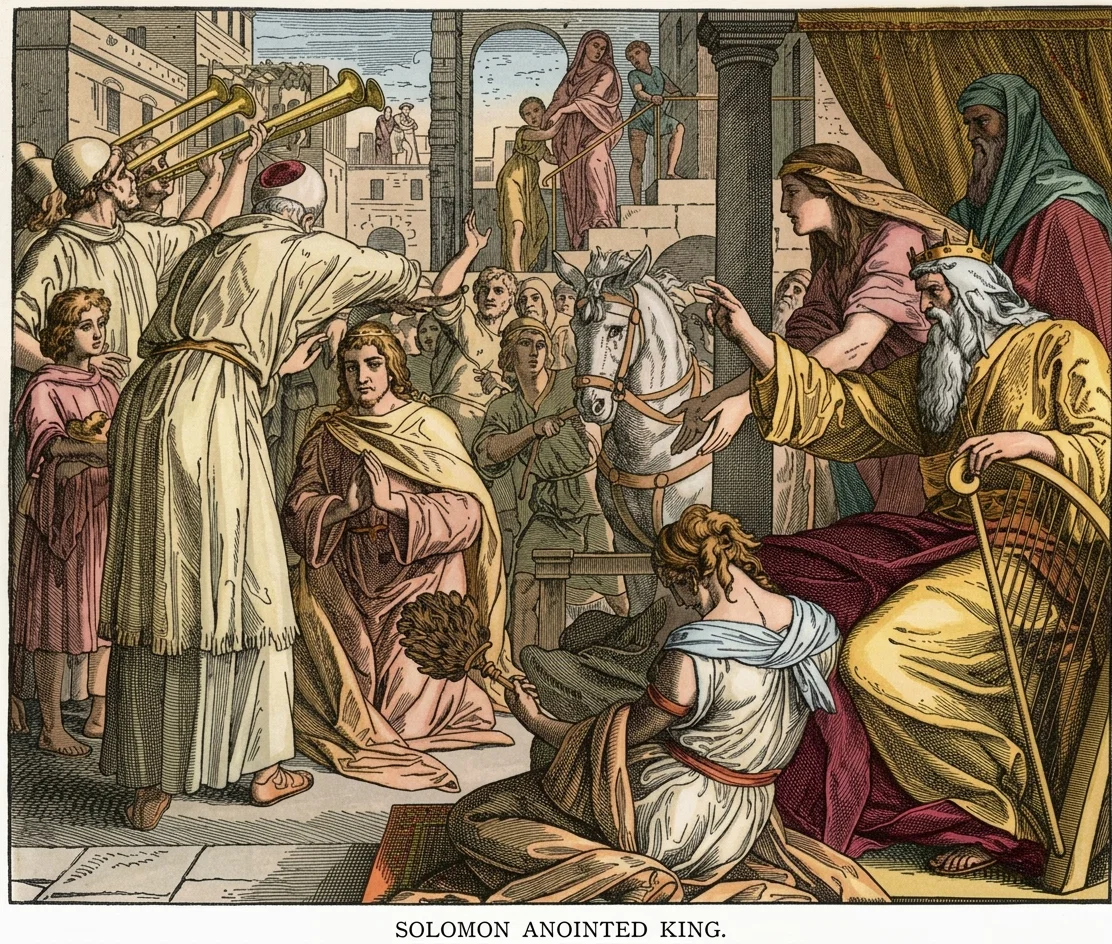
This was David's dying charge to Solomon. The aged monarch had already invested his son with kingly authority, and now he bids him perform faithfully the duties devolving upon him. He counsels him not to show himself merely a warrior, a statesman, or a sovereign, but to reign as a strong, good man. He entreats him to display a noble, manly nature, to show mercy and loving-kindness to his subjects; and he adds, "Then shalt thou prosper, if thou takest heed to fulfil the statutes and judgments which the Lord charged Moses concerning Israel. Be strong, and of good courage; dread not, nor be dismayed."
In his early youth Solomon was a noble character. He was named "Jedidiah," which means "Beloved of the Lord." He was the pride and hope of his father, and "tender and only beloved in the sight of his mother." And during the first years of his reign Solomon fulfilled the promise of his youth. He loved God, and was beloved of God. The Lord appeared to him in a dream, saying, "Ask what I shall give thee." And Solomon answered the Lord in these words, "Give thy servant an understanding heart, . . . that I may discern between good and evil." The Lord granted this request, "and Solomon's wisdom excelled all the wisdom of the children of the east; for he was wiser than all men."7
Had Solomon relied continually on the Lord, had he kept the precepts and commandments enjoined upon him, what a history would have been his! But the unerring pen of inspiration, while it records his virtues, also bears faithful witness to his sad downfall. After a morning of promise and a manhood of integrity, Solomon took a course displeasing to the Lord. He did not continue to walk before God in truth. Raised to the pinnacle of human greatness, and surrounded with the gifts of fortune, he became dizzy. He was extolled by kingly powers for his unsurpassed wisdom, and he could not stand the flattery. Thus the very gift of heaven,—the wisdom which was entrusted to him by God, and which should have reflected honor upon the Giver,—filled Solomon with pride. He built the temple, and it was a marvel of richness and glory, unequalled by any work of human art. A greater than Solomon was the designer of this building; the wisdom and glory of God stood revealed there; but the honor was diverted from God and given to Solomon.
God singled out the children of Israel as his people. He separated them from other people, making them the repository of his law; and it was his design that they should preserve his honor in the earth. They were forbidden to mingle with idolatrous nations, and in no case were they to intermarry with them. A wise barrier was thus erected between them and the rest of the world, and their safety consisted in observing these landmarks. But he who by his loyalty and integrity, could have done much to preserve God's people from backsliding, he who at the dedication of the temple had urged them—"Let your hearts therefore be perfect with the Lord our God, to walk in his statutes, and to keep his commandments,"—he set the example of apostasy. In his thirst for political power, he cultivated and encouraged alliances with pagan kingdoms, and violated the express command of Jehovah by taking wives from among them.
Solomon thought himself strong enough and wise enough to maintain the purity of his religion and yet deviate from the commands of God. He thought he could convert his wives to the true religion, and that by thus binding himself with idolatrous nations, he could win them all to the service of the true God. But we can not incorporate light with darkness. Christ has no fellowship with Belial. By a union with idolaters, the king's own faith was perverted. The power and purity of true religion lost their influence over him. His conscience became marred and blunted; his finite judgment, in which he placed so much confidence, led him far astray, and wild license was regarded by him as independence and toleration. He lost his connection with God, and no longer realized that God was his wisdom and his strength.
SOLOMON ANOINTED KING.
Solomon thought to gain more power by thus allying himself with the heathen nations around him; and he was enriched with the gold and silver which was transported from Ophir and Tarshish, but it was at the cost of sacrificing noble principles and betraying sacred trusts.
One false step leads to another. Solomon's alliance with heathen nations was followed by evils which led the children of Israel to violate the law of God. The people became contaminated with the principles and practices of the heathen. Polygamy was introduced into Palestine. The pure religious service instituted by God was replaced by idolatry of the darkest hue. Human sacrifices were offered; and the licentious rites practiced by the inhabitants of the Noatic world, were countenanced.
And "it came to pass, when Solomon was old, that his wives turned his heart after other gods; and his heart was not perfect with the Lord his God." From being one of the greatest kings that ever wielded a scepter, whose exalted wisdom made him renowned throughout the world, Solomon became profligate and intemperate, the tool and slave of others. His character, once noble and manly, became enervated and effeminate. His faith in the living God was shaken and supplanted by atheistic doubts. Unbelief marred his happiness, weakened his principles, and degraded his life; gloomy and soul-harassing thoughts troubled him night and day. The justice and magnanimity of his early reign were changed into despotism and tyranny; and his extravagance was sustained by grinding taxes, which were imposed upon the people. Poor, frail human nature! God can do but little for men, because they so soon lose their sense of dependence upon him.
The Lord would have all learn a lesson from the record of the life of Solomon. He desires his servants to preserve their holy and peculiar character. "Be ye not unequally yoked together with unbelievers" is his command; "for what fellowship hath righteousness with unrighteousness? and what communion hath light with darkness? and what concord hath Christ with Belial? or what part hath he that believeth with an infidel?"
While we are to be kind and courteous to all, we are not to connect with those who we know are acting in opposition to God. Solomon was estranged from God by the influence of his heathen wives; and God has forbidden his people to unite with unbelievers; for in so doing, they bring untold sorrow upon themselves, and reproach upon the cause of God. They may think, like Solomon, that their influence over those who are in the wrong will be beneficial; but too often they themselves, entrapped and overcome, yield their sacred faith, sacrifice principle, and separate themselves from God. By one false step they place themselves where they can not hope to break the chains that bind them.
I would warn all, both young and old, Be careful what friendships you form and what companions you choose. Take heed lest what you now think to be pure gold turns out to be base metal. Worldly associations tend to throw obstructions in the way of your service to God; and many souls are ruined by unhappy unions, either business or matrimonial, with those who can never elevate or ennoble. Because of this, many men and women are without hope and without God in the world. Their noble aspirations are dead; by a chain of circumstances they are held in Satan's net.
Beware of following any voice but that of God. Those who call themselves sons and daughters of God, and yet walk contrary to his wise arrangements in order that they may follow the promptings of their own unsanctified hearts, which are ruled by passion and impulse, will have a bitter harvest to reap in this life, and their course may result in the loss of their souls.
Keep your religion pure and untainted. Worldly interests may tempt you to yield your principles, but "what shall it profit a man if he gain the whole world, and lose his own soul?" Worldly greatness is no equivalent for integrity, honesty, a pure heart, and a noble, unwavering purpose to do right. Even Solomon, in all his glory, was not arrayed like him who possesses the ornament of a meek and quiet spirit, untouched by the tinsel and show of the world.
God would have us learn the solemn lesson that we are working out our own destiny. The characters we form in this life decide whether or not we are fitted to live through the eternal ages. No man can with safety attempt to serve both God and the world. God is fully able to keep us in the world, but not of the world. His love is not uncertain and fluctuating. Ever he watches over his children with a care that is measureless and everlasting. But he requires us to give him our undivided allegiance. "No man can serve two masters; for either he will hate the one and love the other, or else he will hold to the one and despise the other. Ye can not serve God and mammon."
Solomon was endowed with wonderful wisdom, but the world drew him away from God. We need to guard our souls with all diligence, lest the cares and attractions of the world absorb the time that should be given to eternal things. God warned Solomon of his danger, and to-day he warns us not to imperil our souls by affinity with the world, saying, "Come out from among them, and be ye separate, and touch not the unclean, and I will receive you, and I will be a Father unto you, and ye shall be my sons and daughters, saith the Lord Almighty."
"NEARER TO THEE."
By Frank L. Stanton
They were singing, sweetly singing,
And the song melodiously
On the evening air was ringing:
"Nearer, O my God, to thee!"
In my eyes the tear-drops glistened
As it stirred the twilight dim,
And I wondered as I listened
If it brought them nearer him.
Were they like the wanderer, weary,
Song and life in sweet accord,
Resting in the darkness dreary
In that nearness to the Lord?
Had his Spirit ever sought them,
To be slighted or denied?
Had that dear song ever brought them
Closer to the Saviour's side?
I have heard its music often,
Felt its meaning deep and sweet,
And my weary heart would soften
Singing at my Master's feet;
"Nearer thee"—O precious feeling!—
Nearer thee in gain and loss;
Nearer thee when I am kneeling
In the shadow of thy cross!
Nearer thee when love descending
Falls in blessing on my head;
Nearer thee when I am bending
O'er the graves that hide my dead!
Nearer thee in joy, in sorrow,
'Tis the same where'er I roam;
Nearer thee to-day, to-morrow,
O my King, my Christ, my home!
—Frank L. Stanton.
The Weight of the Cross
"The poor man has this consolation; a wooden cross is lighter than a cross of gold."
EVERLASTING PUNISHMENT.
By C. A. Wyman
BY C. A. WYMAN.
"AND these shall go away in everlasting punishment; but the righteous into life eternal." Matt. 25:46.
By those who believe in the doctrine of "eternal torment," the above text is taken as conclusive proof that the wicked will live always, suffering the most excruciating tortures that can be invented.
Because it is seen that God will punish for sin, and that only in this life is there an escape offered to those who believe, therefore from the premise that "the soul is immortal and can never die," the wicked are represented as living forever in the torments of the damned.
Were the doctrine true, that "man has inherent immortality," then the logic of the torment theory would be quite invincible. But as a wrong premise always leads to a wrong conclusion logically, it is often safe to test the truth of the premise by the logic of the conclusion.
Who Have Eternal Life.
To live eternally in torment, it will be necessary to have eternal life; but as by the text, the righteous only go into life eternal, it follows that the wicked can not have a life to endure an endless suffering.
But the Saviour says again, "He that believeth on the Son hath everlasting life; and he that believeth not the Son shall not see life; but the wrath of God abideth on him." John 3:36. As the wicked do not see eternal life, it follows, scripturally and logically, that they can not have a punishing eternal in duration. And since "the wages of sin is death" (Rom. 6:23), it follows that sinners can not live, but must die; for "the soul that sinneth it shall die." Eze. 18:20. But as "the wages" "is death," it follows that the punishment will sever the life of the wicked. "For, behold, the day cometh, that shall burn as an oven; and all the proud, yea, and all that do wickedly, shall be stubble; and the day that cometh shall burn them up, saith the Lord of hosts, that it shall leave them neither root nor branch." Mal. 4:1. With the root and branch obliterated, what can there be for the fire to feed upon?
So strongly is the doctrine of "eternal torment" intrenched in the creeds of Christendom, that the most unscriptural, absurd, and contradictory positions are taken to uphold it. It is represented that the wicked have endless life, and that as soon as they die, they go into a burning hell, there to receive endless suffering. Thus man, whom Satan has led into sin, is plunged into torment, while the arch-rebel, with all the fallen angels, yet go about as roaring lions, seeking whom they may devour.
The Devils Not in Torment.
To those who will see it, it is clearly revealed that the devils themselves are not come into torment, for we read that "when he [Jesus] was come to the other side into the country of the Gergesenes, there met him two possessed with devils, . . . and, behold, they cried out, saying, What have we to do with thee, Jesus, thou Son of God? art thou come hither to torment us before the time?" Matt. 8:28, 29. Thus the instigators of sin are not as yet receiving the reward of their deeds. Yet the popular belief consigns their victims to endless misery as soon as they close their eyes in death.
By these creeds man is made to suffer longer than Satan, for the first victim has nearly six thousand years the start of his cruel oppressor, and Satan is not bound till the Lord comes. Rev. 20:1-3. What wonder is it that men are made infidels when they hear from thousands of lips and pens, that the wicked are writhing in the pains of hell, and Satan and all his hosts of angels are free to gather in their harvest of victims! Such teachings are too appalling for the common feelings of humanity, and that Being whom we call God, whose very principles are love and justice, is degraded and clothed with Satanic attributes.
Life in Old Colony Times
By Charles Morris
CHAPTERS IN UNITED STATES HISTORY.* NO. 7.
BY PROF. CHARLES MORRIS.
Life in Old Colony Times.
Contrast in Conditions — Population in 1763 — Colonial Houses — The Kitchen and Its Hearth — The Best Room — Life in the City and on the Plantation — Distinctions in Rank and Dress.
THE year of 1763 was a turning point of much interest in the history of this country. It marked the end of the long struggle with France for dominion in America, and the beginning of the events that led to the struggle with England for American independence. It is therefore a good point to pause and consider the condition of the people of the colonies at that period, observing some of their habits and customs, their comforts and discomforts, their methods of thinking and modes of life. In these days of railroads and trolley cars, electric lights and telegraphs, stoves and furnaces, cheap clothing and furniture, canned food and tropic fruits, and endless labor-saving devices, it is difficult to comprehend the sparseness of life in colonial times. Yet we may console ourselves with the idea that our forefathers of the past century were not troubled seriously about the hardness of their lot, and that they may have looked back with commiseration on the condition of the earlier settlers of America and felt glad of their great advantages.
In 1763 the population of the whole country was probably not much greater than that of New York City to-day. There were probably more than a million and a half of people in the colonies, but less than two millions. About one-sixth of these were negro slaves. These might be found in every colony, but the bulk of them were in the south. Those owned in the north were principally house servants, and were kept in the cities, there being no need for them on the farm. The people were mainly of English origin, tho there were many Dutch, Germans, French, Irish, and Scotch. They nearly all lived east of the Alleghany, while the western country was still a wilderness, and in possession of its savage original owners.
Philadelphia, New York, Boston, and Charleston were the chief cities, yet even Philadelphia, the largest of these, had only about twenty thousand inhabitants. Of inland towns, Lancaster, Pa., with perhaps six thousand people, was the largest. There were comfortable brick and stone houses in the cities, but the houses of the farmers were built of rough-hewn timbers. The older ones were of logs cut square and laid together. The later ones were framed in heavy oak timbers, firmly braced together and covered with split clapboards. The roofs were made of split cedar shingles, fastened with large wrought iron nails, the doors of oak plank, doubled and nailed together, the nails or spikes being arranged in diamond shape. They were fastened at night by heavy wooden cross-bars. The windows were small, and contained a few small, diamond-shaped panes of glass, set in lead frames. In the humbler
log houses oiled paper often took the place of glass. The lack of a clock was overcome by making the house itself a timepiece. It faced due south, so that the sun "shone square in" at noon. The earlier and later hours were indicated by the angles made by the sunshine on the floor.
In the interior these houses were far from comfortable, in our sense of comfort. The walls were rough and unfinished, the floors bare, the bedrooms small and poorly provided. Warmth outside the living rooms no one dreamed of, and to go to bed and rise in winter was a severe penance. Toilet appliances were sadly wanting. The morning ablutions were usually made in the kitchen basin or at the outdoor pump. In winter the struggle to escape freezing was one of the chief ends of life.
The chief apartments of a colonial mansion of the north were the kitchen and the "best room." The kitchen was the principal living room, and the only one in which winter comfort was usually to be had. Its center of attraction was the great fireplace, with its roaring fire. The vast chimney into which it opened was about twelve feet square at the base, the fireplace being wide enough for seats to be placed at the side, and for the stars to be seen through its top. A large "back log" formed the foundation of the fire. On the andirons rested a smaller "front log," and heaps of smaller timber were piled between. Over the fire swung an iron crane, with pot-hooks to hold the pots for cooking. Cooking was also done by the aid of spits and skillets, and in a brick oven built in the chimney, which was heated by a fire built in it, then swept clean of ashes, and the bread or beans set in to bake. It retained its heat a long time.
If by chance the fire went out, it was no small matter to rekindle it. Friction matches were not yet dreamed of, and sparks struck into tinder by flint and steal, or live coals borrowed from a neighbor's hearth, were the only means of regaining the vanished flame. For illumination the fire had largely to do duty. Oil had come little into use. Gas and electricity were marvels of the far future. The tallow candle did nightly duty. But this was not the trim factory candle with which we are familiar, but its home-made predecessor, whose thick wick brought the snuffers into constant requisition. As regards the utility of the hearth fire as a warming agent in cold weather, doubtless many of my readers can speak from experience. It meant to roast on one side and freeze on the other, while the eyes were none the better for the smoke which made its way into the room.
From the bare joists overhead, just high enough to let one walk upright, hung bunches of herbs and seed-corn, and strings of drying apples. In the better buildings the walls were plastered and whitewashed, but in many the bare timbers were visible. The furniture was plain and scanty. There might be a tall wooden clock; a dresser adorned with pewter dishes, often considered too good for ordinary use; a spinning wheel; and, less commonly, a loom for weaving. In poorer houses wooden platters were used to serve food upon. This food was greatly lacking in variety. Salt meat or fish, a few garden vegetables, bread of rye and corn, and bean porridge formed the staple dishes. Tea and coffee were rare luxuries in country houses. Many of the vegetables now common were then unknown. Tomatoes—"love-apples" as they were called—were deemed poisonous, and the tropical fruits which we use so abundantly were never seen.
The "best room" was used only on occasions of ceremony. At other times it was kept as dark and damp as a vault. Here was the splendor of the house; brass andirons, polished till they shone like gold; high brass candlesticks, with attendant tray and snuffers; the uncarpeted floor, sanded and marked off in9neat designs; the family portraits on the wall; on a shelf the family's small store of books, including the Bible, with perhaps Fox's "Book of Martyrs," Addison's "Spectator," Young's "Night Thoughts," and similar works for the improvement of the mind. The novel, which forms our daily mental dessert, rarely found its way into this serious company.
Going south we would find differences. The Dutch mansion of New York was usually of brick; its gable end, which receded in steps to the peak of the roof, facing the street, its door adorned with a great brass knocker; the polished floor scrubbed until it fairly shone. Philadelphia, the largest American city, was noted for the elegance of its brick and stone residences, sitting back in the midst of green gardens and orchards. The plantation houses of the great southern estates were grand and spacious, much of their interior woodwork of solid oak and mahogany, richly carved and paneled, while their sideboards shone with gold and silver plate, and their tables groaned with all the luxuries that money could procure. All the labor was done by slaves, menial labor being considered degrading to a white man, and hosts of negroes stood ready to perform any task which the needs of the household demanded.
The distinction of rank of the Old World had been brought over to the New, and the democracy of the present day was but slowly making its way. Only the gentry, including ministers and their wives, were addressed as Mr. and Mrs. Others, above the grade of the servant, were called Goodman and Goodwife. The farmer and his family were dressed in coarse "homespun" cloth, woven on the family loom. Mechanics and working men generally wore red or green baize jackets, and leather breeches and aprons, with shoes of coarse "neat's leather." Calfskin shoes were reserved for the gentry.
The colonial gentleman, when in full dress, far surpassed his successor of the present day in the bravery of his attire. Long velvet coats, knee-breeches, white silk stockings, and shoes with silver buckles made up the essential parts of his attire. His long hair was powdered white, and tied in a twist or queue with a black silk ribbon, while on it rested a three-cornered cocked hat. White lace ruffles fell over his hands. A gold-headed cane, and a gold or silver snuff-box were indispensable marks of gentility. His morning costume was a silk or velvet cap and dressing gown. The embroidered velvet of his evening attire was gay with gold or silver lace and buttons, and glittering knee buckles. Ladies wore dresses of brocade and rich silk.
These distinctions of dress were at an earlier period fixed by law, every one being obliged to dress in conformity with his or her rank and wealth. As an instance may be cited the case of one Alice Flynt, who had ventured to wear a silk hood, and was ordered to appear before the court and show that she possessed the £200 required to entitle her to wear so costly a garment.