BRIEFLY to review the ground over which we have passed, we have learned:—
1. That the woman of Revelation 12 symbolizes the church of Christ;
2. That the Man-child born of that woman is our Lord Jesus Christ;
3. That the dragon is, as expressly declared, a symbol of Satan in his relation to the work and people of God through earthly systems of government under his control;
4. That he at first fell from heaven and "drew after him the third part of heaven's sons," the angels;
5. That in his conflict of the pre-advent ages with Michael our Lord, culminating in the crucifixion and its attendant events, our Lord was not only victorious in himself, but assured eternal victory to all who trust in him;
6. That the dragonic watching and waiting before the travailing church began with her captivity in Babylon; and that with Babylon began that infernal system of church and state government which has intoxicated, perverted, and cursed, with a curse of which there is none heavier, all the nations of the earth; and that the first head in this system of government through which Satan has especially wrought, is Babylon;
7. That the same system was continued throughout Medo-Persia, Grecia, and Pagan Rome, under the latter of which the Man-child was born, who gloriously conquered in the conflict and was caught up to God and his throne;
8. That following this defeat the dragon—Satan—continues his work by persecuting the woman, the church, clear through to the end, he, the devil, being behind every persecuting power and the instigator of all the persecution;
9. That in chapter 13 we have presented before us not the symbol of Satan as the chief instigator of persecution, but his active agent, church and state governments symbolized by a wild composite beast of seven heads and ten horns, the horns contemporaneous and the heads successive;
10. That this beast shows the unity of the Satanic principle and system manifest in the four beasts of Daniel 7,—lion, bear, leopard, and ten-horned beast,—in Daniel they being represented as separate and distinct empires, in the Revelation as one continued system under seven heads, each head giving a distinct character to the beast or system during the time it exists;
11. That the head or form of church and state government which followed Pagan Rome was Papal Rome, during the continuance of which head the beast was a papal beast;
12. That Papal Rome received its power and seat and authority from the dragon, the devil, and exercised it during a period of 1,260 years.
Some Primary Considerations.
But before enlarging upon the specifications given in our last of Rev. 13: 1-10 we wish to present before the reader two very important considerations: (1) Why these prophecies are given, and why we present this exposition of them; (2) a definition of terms relative to the Papacy; and the various phases of the Papacy. An understanding of these will help materially to an understanding of the prophecy in question.
1. Object of the Prophecy.
God's object in giving this prophecy is the same as his object in giving all prophecy. It is stated by Peter, who speaks of the "more sure word of prophecy, whereunto ye do well that ye take heed, as unto a light that shineth in a dark place, until the day dawn, and the day star arise in your hearts" (2 Peter 1:19); and again, as stated in Rev. 1:1, it is given "to show unto His servants things which must shortly come to pass." God gives light to lead men out of darkness. He points out the evil and good in both principle and practice, that we may shun or refuse the evil and choose the good. He does not present before us the evils of the Jewish nation, the sins of Sodom, or the corruptions and persecutions of apostate Christianity, because he hates any soul in connection with any of them. He reveals the past, with its evil and evil consequences, that by it we may take warning. He has warned us against the development of the Papacy, not because he does not love the men connected therewith, but because the system is evil.
It is for this cause that we expound these prophecies. It is that we may show to those who may be connected with the papal system, both within and without the Roman Catholic Church, that the system is evil and tends only to evil ends. Against one soul connected with it we bear no ill will, no malice. We war not with men, but with principles of evil which pervert righteousness and truth, mold characters for evil, elevate things above men for whom Christ died, and turn men into demons. We entreat the reader to lay aside all prejudice and examine the underlying principles. If they are evil, reject them; if they are good, lay hold of them. God will care for the rest.
2. A Definition of Terms.
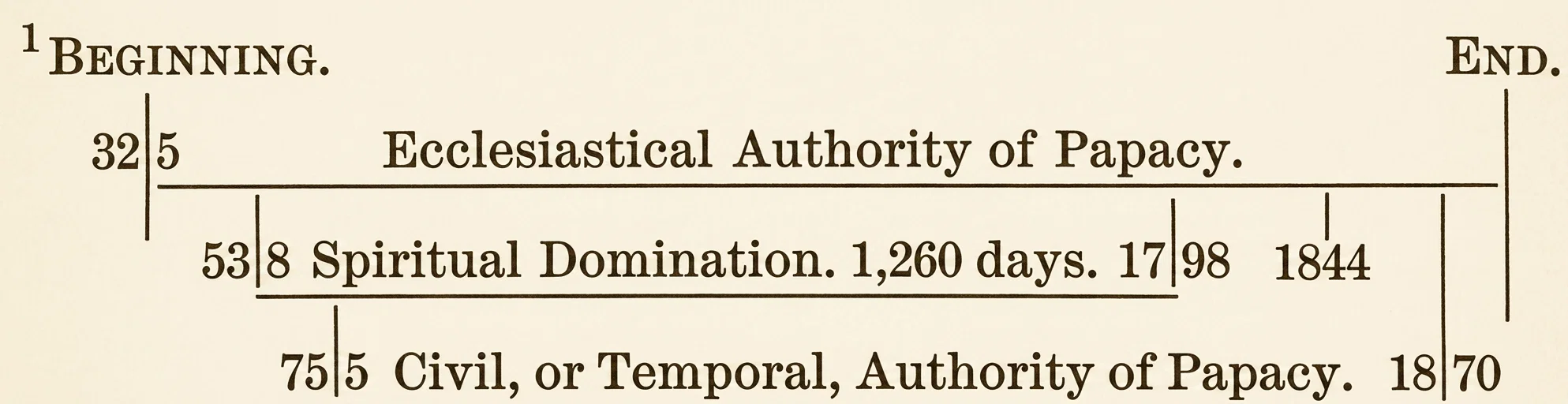
By the term "Papacy" we refer to that system of ecclesiastical government known as the Roman Catholic Church, of which the pope is the supreme head. Many of its principles are, however, dominant in organizations outside of that body. By the Temporal Power of the Papacy we refer to the rule of the succession of popes over the states of the church which began with the grant of Pepin, king of France, in 755, and ended with the utter taking away of his dominion in 1870. The Ecclesiastical Power of the Papacy, or Roman Catholic Church, may be said to have begun at the Council of Nice, 325, when the Roman Catholic Church was established by law, through the Emperor Constantine. The Spiritual Domination of the Papacy, the power by which it possessed the means to persecute, began in 538 and ended in 1798, and will again be restored. These phases may, perhaps, best be set forth by the following diagram:—
The Ecclesiastical authority or power of the Papacy, or Roman Catholic Church, is that which she possesses in common with other ecclesiastical organizations. While logically it leads to a union with the state, it can exist and flourish separate from the state. In this condition it holds only that power and influence over its membership which its teachings and threats have upon the consciences3and fears of its devotees. This power and this authority lie wholly within itself apart from civil power. It elects, chooses, or appoints its own rulers and orders from pope to nun. It possessed this power previous to its spiritual domination and temporal dominion and after it lost them, and it is not dependent upon them. Its Spiritual Domination began in 538. This is marked by two important events. In 533 Justinian, emperor of Rome, declared that the bishop of Rome should be "Head of all the Churches." The account of this, says Croly, is "to be found in the 'Annals of Baronius,' vol. 7., p. 194, fol. Antwerpia." In Justinian's letter, addressed to "the most holy archbishop of our city of Rome, and patriarch," occur the following statements:— Therefore we have made no delay in subjecting and uniting to your holiness all the priests of the whole East. . . . We can not suffer that anything which relates to the state of the church, however manifest or unquestionable, should be moved without the knowledge of your Holiness, who are the Head of all the Holy Churches.*
The letter also mentions that the incumbent of the rival see, the archbishop of Constantinople, was "desirous in all things to follow the apostolic authority of his Blessedness," the pope of Rome.
The same year, March 25, in a letter to Epiphanius, Justinian refers to his letter to the bishop of Rome, and, says Croly, "repeats his decision, that all affairs touching the church shall be referred to the pope, 'Head of all Bishops, and the True and Effective Corrector of Heretics.'"
In the same month of the following year, 534, the pope returned an answer repeating the language of the emperor, applauding his homage to the see, and adopting the titles of the imperial mandate. He observes that, among the virtues of Justinian, "one shines as a star, his reverence for the apostolic chair, to which he has subjected and united all the churches, it being truly the Head of all; as was testified by the rules of the Fathers, the laws of princes, and the declaration of the emperor's piety."*
This letter of Justinian is not all the evidence of this action concerning the see of Rome. The 131st edict of the "Novellæ" of the Justinian code, on ecclesiastical titles and privileges, chapter 2, states: "We therefore decree that the most holy pope of the elder Rome is the first of all the priesthood." The archbishop of Constantinople was given second rank. The ninth edict states that in Rome "was the supremacy of the pontificate."*
But this decree could not be carried out at once. Italy was possessed by the Arian Ostrogoths, who believed, at least to a limited extent, in religious liberty. This was preeminently true of Theodoric, who reigned till 526. The next year Justinian came upon the stage of action, with the ambition "to unite all men into one faith." As above shown, he elevated to the head of the church the bishop of Rome, the incumbent of which at that time was John II. After
the death of Theodoric the Arian Ostrogoths had become divided. Justinian began his crusade against them by sending Belisarius against the Arian Vandals of Africa, over whom Gelimer was king. This expedition was in the interests of the faith. Belisarius was successful, and Gelimer was captured and the Vandals overthrown in 534. The Arian worship was suppressed, and the Catholic Church established. Having suppressed the Arians and established the Catholic faith in what were the Vandal dominions, in 536 Belisarius entered Italy. He entered Rome December 10 of the same year. But this was not the conquest of Italy. The Gothic nation, aroused, besieged Belisarius in Rome. Says Gibbon:—
The whole nation of the Ostrogoths had been assembled for the attack, and was almost entirely consumed in the siege of Rome.*
One year and nine days after (538), they were utterly defeated, and Rome was in the hands of Belisarius. It was the third kingdom plucked up before the unholy ambitions of the Papacy, as set forth in Dan. 7:8, 24. These were as follows: Heruli, 493; Vandals, 534; Ostrogoths, 538.†
"Avenge, O Lord, thy slaughter'd saints, whose bones
Lie scattered on the Alpine Mountains cold;
. . . . . In thy book record their groans
Who were thy sheep. . . . .
Their martyr'd blood and ashes sow
O'er all the Italian fields, . . . .
That from these may grow
A hundred-fold, who, having learned thy way,
Early may fly the Babylonian woe."
—Milton.
Here began the supremacy of the Papacy, or its spiritual domination, as a world power, acknowledged as such by the ruling power of earth. It was then truly "Head over All the Churches" and "the True and Effective Corrector of Heretics." And altho this power was not at once exercised, here it began in decree, and here it began in the prophecy. This acknowledgment was the basis of its persecuting power. Here the papal head came fully into existence as having control of the diabolic system of church and state government. It was formed by this union of church and state. The Papacy was given the power to define heresy and declare what its punishment should be, and its decrees were executed by the civil power, except where God's providence interposed to check her unholy ambition and revengeful spirit.‡
What Makes a Persecuting Power.
It is in the light of persecuting powers or different phases of one great world-wide persecuting system, that the heads are presented in prophecy; and a persecuting power is always made up of a union of church and state. To this two things are essential:—
1. It must be a religious power or it will not persecute;
2. It must have civil power to enforce its decrees or it can not persecute.
The Roman Catholic Church has no power to persecute in England or Italy to-day. The Papacy exists there, but only as an ecclesiastical power. For a hundred years and more the Federal government of the United States has not persecuted. It would not in the very nature of the case, because it had no connection with the church. But let the civil power acknowledge the claim of the ecclesiastical to define heresy and to declare its punishment, and a persecuting power is immediately formed. As regards the beast, a new head springs into existence.
The destruction of that head—of a persecuting power—may be accomplished either
by destroying the ecclesiastical system, which would be nearly equivalent to destroying the people who espouse it; or by the taking away of the civil power, the power to punish heresy. Either would be a deadly blow, but the former would be almost impossible and entirely improbable.
Civil Power of the Papacy.
The third phase of the Papacy, as shown in the diagram, is her civil or temporal authority, which began under grant of Pepin, 755, of the States of the Church, and ended in 1870, when Victor Emmanuel wrested from the pope his last vestige of temporal power. The taking away of this power is thus set forth in Daniel 7:26:—
"But the judgment shall sit, and they shall take away his dominion, to consume and to destroy it unto the end." The spiritual domination of the Papacy, of the 1,260 years, ended in 1798. The "judgment" here referred to is that mentioned in verses 9 and 10, which began in 1844.* "They shall take away his dominion." "They" evidently refers to the other horns, or the governments symbolized by them. And history upon this point confirms the prophecy. In 1844 the States of the Church had an area of 16,000 square miles, and a population of 3,000,000. Four years afterward began the revolution in France and northern Italy. This greatly affected the Papal States. In the following year they revolted, but through the aid of the French were brought to submission. Peace reigned outwardly till 1859, when the slumbering fires of revolution were again manifest in the revolt of Romagna, which was not opposed. This province was annexed to Sardinia in 1860. The same year the provinces of Umbría4and Marches revolted, and placed themselves under Victor Emmanuel. These provinces were also annexed to Sardinia. Thus from 1848 to 1860 the consuming process had reduced the territory of the Papacy from 16,000 square miles to 4,500 and its population from 3,000,000 to 700,000. In 1870 the last vestige of temporal dominion was taken away. This temporal dominion over a few provinces in Italy must not be confounded with the spiritual domination over the nations for 1,260 years. Having these phases of the Papacy before us, all of which are set forth in the word of God, we need but briefly to consider the specifications of the prophecy of Rev. 13: 5-10, as given in our last. The first four verses of the chapter outline the beast in his entire career, including its deadly wound, and its restoration to power. Verses 5 to 10 read as follows:— "5. And there was given unto him a mouth speaking great things and blasphemies; and power was given unto him to continue forty and two months. "6. And he opened his mouth in blasphemy against God, to blaspheme his name, and his tabernacle, and them that dwell in heaven. "7. And it was given unto him to make war with the saints, and to overcome them; and power was given him over all kindreds, and tongues, and nations. "8. And all that dwell upon the earth shall worship him, whose names are not written in the book of life of the Lamb slain from the foundation of the world. "9. If any man have an ear, let him hear. "10. He that leadeth into captivity shall go into captivity; he that killeth with the sword must be killed with the sword. Here is the patience and the faith of the saints." Here are the specifications:— a. A mouth speaking great things and blasphemies against God and his name. (Verses 5, 6.) It is therefore a religious power, which blasphemes God. b. It should continue forty and two months. (Verse 5.) The same period is elsewhere called "a time, times and a half," "a thousand two hundred and threescore days." (See Dan. 7:25; Rev. 11:2, 3; 12:6, 14.) As short-lived beasts are used to symbolize long-existing dynasties, kingdoms or systems of government, so to be consistent, short periods of time are used to symbolize longer periods. A year is a "time." (See Dan. 4:16; 11:13, margin.) According to the Bible mode of reckoning time there are thirty days in a month (compare Gen 7:11; 8:4, 3), and twelve months in a year, making 360 days in a year. A "time," one year, "times," the dual number, two years, and a "half time," three and one half years, equal to forty-two months, 1,260 days; this, according to symbolic time, "a day for a year" (Eze. 4:6), symbolizes a period of spiritual domination for this head of 1,260 years. c. It is a power which works against the very truth of God, God's name or character, his dwelling-place, and his angels. (Verse 6.) d. It makes war with the saints, and overcomes them, killing them with the sword. (Verses 7, 10.) e. He had power over all nations, tongues, etc. (Verse 7.) f. All those who are not Christ's will yield to his worship. (Verse 8.) g. He will finally receive a death stroke, and by violence his power shall be taken away. (Verses 10, 3.) h. Yet shall the death stroke be cured, and the beast in that form shall live again. (Verse 3.) Still other specifications are given of the same power in Dan. 7:8, 20-26. There is but one power or system to which these specifications in toto apply, during this period, and that is to that system of church and state government known as the Papacy. Let us consider them more fully:— 1. Great Words and Blasphemies.—There have been blasphemous powers many. The whole beast system, from Babylon to the end, is blasphemous. But that phase of the system above all others which, tho pretending to be a representative of God and of the religion of Jesus Christ, has blasphemed God is the Papacy. To blaspheme is "to speak of God or divine things in terms of impious irreverence." In no more effectual way can this be done than to attempt to degrade God to the level of man by exalting man to the place of God. The apostle Paul declares that "the Head of every man is Christ" (1 Cor. 11:3), but in the system of the Papacy the pope is placed at the head, with numerous subheads between. This is manifest in his claim to be the infallible interpreter of the word of God, thus taking the place of the Spirit of God; in the claim of authority to forgive sin, thus assuming the place of God; in the claim of the transmutation of the wafer into the body and blood of Christ, thus making the priest a creator, and Christ subject to him; in his claim to try, judge, and pronounce sentence upon heretics, thereby assuming greater authority than that of Christ (John 12:47); in the titles arrogated to popes and bishops contrary to God's word and thus blasphemous; and in many other ways has the papal system spoken great things and blasphemies. Among its self-assumed titles are "Arbiter of Heaven and the Lord of the Earth," "the Master of the Universe," "Vicar of Christ," "Most Divine Head of All Heads," "Light of the World," "Lion of the Tribe of Judah," etc., etc. 2. Period of Continuance.—The special time when it should exist as a persecuting power, when the saints and law of the Most High should be given into its hand (Dan. 7:25) is 1,260 years. As shown above, this period of its spiritual domination began in 538, to which if 1,260 years be added we are brought to 1798. 3. The Blasphemy of God's Name, etc.—God's name is a symbol of his character of goodness and mercy. (See Ex. 33:18, 19; 34:6, 7.) But by no power has God's goodness and mercy been put so far away from man as by the Papacy. In Jesus Christ every soul may approach, boldly approach, the throne of Infinite Grace and find pardon and help. God is not at enmity with us; it is "the carnal mind" that "is enmity against God." (Rom. 8:7.) He loves us and longs to save us. But the Papacy makes God one afar off, who needs to be placated by purchase or penance, around whom is a cordon of saints and bishops and priests whose good favor the poor soul must solicit before it can approach God's presence. Thus has it blasphemed his name, or character. It has brought into the Christian church the pagan and Satanic doctrine of the inherent immortality of the soul, and thus, before the day of judgment and awards, it has, contrary to the Bible, peopled heaven with intercessory saints, and purgatory and hell with suffering sinners. It is all but a continuance of the old Babylonian demon worship and pagan tartarus translated into an apostate Christianity. It makes man's salvation depend on the good works of men instead of the free grace of Jesus Christ. It makes the saints to whom the intercessory prayers are offered omnipresent, like God, or, rather, deceives those who thus seek the aid of "saints" with the veriest mockery. In almost every imaginable way is the character of God and Christ's priesthood in the sanctuary above, and the ministration of holy angels, perverted by the erroneous doctrines held by many sincere souls, but not the less soul-destroying. 4. War with the Saints.—We need not recount the war of the Papacy against the people of God. It is estimated that during the 1,260 years over fifty million souls went to their deaths at the cruel and merciless hand of the Papal phase of that Satanic system. Of course the Papacy did not count them Christians; neither did the Jews count Christ a good man. "He is worthy of death," said they, because "he deceiveth the people" and "subverteth the nation." He is a Samaritan and hath a devil. They are worthy of death, said the Papacy. They are heretics, Jews, infidels, apostates, traitors against civil power. They ought to die. And then she turned them over to the often merciless power of Papal governments to be tortured and executed by methods most ingeniously cruel, Satanic, and inhuman. Even tho those put to death were every one heretics, it is, according to the words of Jesus Christ, greater heresy to put even the heretic to death. (See John 12:47; Luke 9:53-56.) 5. Power over All Nations.—This spiritual domination over the nations represented by the ten horns is to be considered in a general way, and not in its absolute sense. There never was a time during the 1,260 years when all the kingdoms of western Rome were thoroughly united in upholding and obeying the Roman See. But by promises, persuasion, craft, combinations, threats, and wars, these kingdoms were kept subject to the Papacy during the great part of this period. The completer fulfilment of that prediction is yet to be seen. 6. The Worship of the Beast.—The highest worship is not in form or words, but in obedience. This is expressed in the following words of our Saviour: "Why call ye me Lord, Lord, and do not the things which I say?" (Luke 6:46.) "Thou shalt worship the Lord thy God, and him only shalt thou serve." (Matt. 4:10.) True service, the doing of God's commandments, is the highest form of worship. As God alone is the only object of worship, it follows that the worship of the beast is a false worship opposed to that of God. And as the highest proof of worship is obedience, it likewise follows that the worship of the beast is obedience to the law of the beast instead of obedience to the law of God. The whole duty of man is summed up in obedience to God's commandments (Eccl. 12:13), his holy law of liberty (James 2:8-12), of which Jesus Christ was the exemplification (Ps. 40:7, 8; John 15:10), and the Decalogue is the summary. The law of the beast power is opposed to God's law. Its distinguishing feature is and must be the difference between the two laws. The prophet Daniel, speaking of the same power, said: "He shall think to change the times and the law." (Dan. 7:25, R. V.) And this the Papacy has sought to do; it has attempted to change the law of God in that particular which relates to time, not only as regards the day, but as regards the time of beginning of the day. The law of God declares, "Remember the Sabbath day to keep it holy; . . . the seventh day is the Sabbath of the Lord thy God." (See Ex. 20:8-11.) But "Butler's Catechism," of the Roman Catholic Church, declares that what is commanded by the Sabbath law is "to sanctify the Sunday." And that church further declares in numerous works of authority in substance like the following, which we quote from one, the "Doctrinal Catechism," p. 101:— "Ques.—Have you any other way of proving that the church has power to institute festivals of precept? "Ans.—Had she not such power, she could not have done that in which all modern religionists agree with her,—she could not have substituted the observance of Sunday, the first day of the week, for the observance of Saturday, the seventh day, a change for which there is no Scriptural authority." Another Catholic work, called "Abridgement of Christian Doctrine," has the following:— "Ques.—How prove you that the church hath power to command feasts and holy days? "Ans.—By the very act of changing the Sabbath into Sunday, which Protestants allow of; and therefore they fondly contradict themselves by keeping Sunday strictly, and breaking most other feasts commanded by the same church. "Q.—How prove you that? "A.—Because by keeping Sunday they acknowledge the church's power to ordain feasts, and to command them under sin; and by not keeping the rest by her commanded, they again deny, in fact, the same power." To worship is to obey. Knowingly to obey the Papacy instead of God is to worship the Papacy instead of God. This Rome by deception and force, has caused all nations to do. And in the crisis now rapidly developing, all will, without excuse, be found on one side or the other. The question is, Shall it be God's word? or tradition, however hoary that tradition may be? Will we accept or continue to pass the well-worn counterfeit bill which will be burned in the fire of just wrath? or will we accept the genuine gold of God's truth? 7. The Death Stroke of the Beast.—Verse 3 of Revelation 13 declares, "I beheld one of its heads as it were wounded to death;" literally, "slain unto death." (See R. V., margin.) It was as truly killed or slain as was the Lamb of chapter 5:6. So also in chap. 13:10: "He that leadeth into captivity shall go into captivity; he that killeth with the sword must be killed with the sword." The influence of the Reformation weakened the power of Rome in the German and British dominions; and those powers threw off the yoke of the Papacy, and prospered, notwithstanding the anathemas of popes. In the persecutions that waged in Catholic countries oftentimes the rulers saw that the best citizens were either slain or forced to flee to Protestant countries or the open arms of the unknown America. In 1776 Maria Theresa of Austria issued her decree of toleration, and in 1798 the death stroke was given to that head—the papal—of that Satanic system of earthly rule, by General Berthier, acting under the orders of the French Directory, and Pius VI. was taken prisoner, dying in captivity Aug. 29, 1799. But it was not the mere captivity of a pope which dealt the death blow. Such things had occurred before. It was the taking away of the spiritual domination, the undoing of the dignity conferred by Justinian, the taking away of the civil power. The Papacy was no longer acknowledged the "Head of All the Churches;" "The True and Effective Corrector of Heretics." Previous to that time no greater honor could be accorded a sovereign than to be crowned by the pope or his envoy, but after that none was so poor as to do him homage. Pope Pius VI. at that time lost his civil power, but the ecclesiastical power of the Papacy was not destroyed; and even to the time of his death, at Valence, France, Aug. 29, 1799, he was the head of the Roman Catholic Church, but not the recognized Head of the Church and Corrector of Heretics by the governments of Europe. The French Republicans would have been glad to have overthrown the Papacy entire, but this they could not do. Within itself it possessed the power of perpetuating the ecclesiastical system independent of civil power. Says one historian:—
However desirous the French Republicans might be that Rome should not have another pope when Pius VI. expired, the great bulk of those who professed its religion felt very differently. Austria gave effect to their wishes. The emperor procured a meeting of the dispersed cardinals at Venice, then an appendage to his monarchy, and they elected, on the 14th of March, 1800, Barnabas Chiramonti to fill the papal see. He called himself Pius VII., and within a few weeks of his election he entered his capital as a sovereign prince, the French armies having sustained such reverses in the preceding autumn as left Southern Italy to its ancient masters.
Afterward negotiations were opened with France, Napoleon acting as first consul. But it is noticeable that the spiritual domination of the Papacy had gone, and the pope was obliged to accept the conditions of Napoleon if he would retain any hold upon France at all. This was most manifest immediately after the restoration of the temporal power in the connection of the Papacy with France. Napoleon thought it best to re-establish religion, in order that the religious French might not be governed by foreign bishops. He divided his realms, marked out the bishops' sees, fixed their salaries, brought the pope to his coronation, and then crowned himself, took the management of things into his own hands generally, limited the powers of the Papacy, and the Papacy was obliged to submit. The spiritual domination of the Vatican was gone. That phase of the persecuting system represented by the papal head, was slain. The Papacy, as a persecutor, was killed. All Europe felt the humiliation of the Papacy, and the abject attitude of the pope toward infidel France drove away the last respect or fear which lingered in European governments.
8. The Healing of the Deadly Wound.—Note again that the head was wounded unto death. The R. V. margin reads, "Slain unto death." The word rendered "slain" is the same as is rendered "slain" in Rev. 5:6, 9, 12; 13:8; 18:24. The prophecy declares that "his death stroke was healed." R. V. There must therefore be restored to him just what he lost. The deadly wound was given by taking away one of the essentials of a persecuting agency, control of civil power to enforce its decrees. To heal that wound that control of civil power must be restored. The governments of earth must again acknowledge the pope of Rome, Head over All Churches, and True and Effective Corrector of Heretics. Then will that phase of the beast again live, and all the world shall wonder and worship. This will be more fully considered in connection with Revelation 17.
Faith, Life, and Trial
"Faith makes the Christian. Life proves the Christian. Trial tests the Christian."
Every Plant Shall Be Rooted Up
Every plant which my heavenly Father hath not planted shall be rooted up.—Jesus.
An Unintelligible Sermon
In the sermon he spoke of ethics and economics, encyclopedic man, speculative orthodoxy, psychology, isosceles triangle, unifying force from the great Universal Self, elaborate scheme of social organization, Antinous and Apollo, complex realism, sociological expansion, and the old skeleton of a defunct philosophy, etc.,—all of which, while doubtless intelligible to the Lord, was an unknown language to nine-tenths of the congregation. —Toronto Guardian.