Signs of the Times, Vol. 27, No. 39.
THE LESSON OF DANIEL ONESigns of the Times
Pacific Press Publishing Company · Oakland, California · Sep 25, 1901
THE LESSON OF DANIEL ONE.

Two Systems of Education.
Education To-day.
Do American men and women realize that in five cities of our country alone there were, during the last school term, over sixteen thousand children between the ages of eight and fourteen taken out of the public schools because their nervous systems were wrecked, and their minds were incapable of going on any further in the infernal cramming system which exists to-day in our schools? And these sixteen thousand helpless little wrecks are simply the children we know about. Conservative medical men who have given their lives to the study of children, place the number whose health is shattered by over-study at more than fifty thousand each year. It is putting the truth mildly to state that of all American institutions, that which deals with the public education of our children is at once the most faulty, the most unintelligent, and the most cruel.—Edward Bok, in Ladies’ Home Journal, January, 1900.
Every physician has many children under his care, and how many times little ones are brought to us who are beginning to have restless nights, are losing their appetites, growing haggard and old in appearance, with loss of energy and ambition. Upon investigation we find that they go to school at 9 in the morning, stay there until 2:30 or 3 in the afternoon, have numberless exercises and recitations, go home, and at once go to their books and study a good part of the afternoon, then eat their dinner, and have more study at night until bed-time. By that time they are feverish and excited; and when they go to sleep, they are muttering over their lessons, showing very plainly the trouble that is on their minds. Is it any wonder that they soon break down and have to be taken from school, when they can not sleep or eat properly, and have no time for play? This is all during the formative period of life, when the child is growing, and should be storing up energy, instead of using up all that it gains, and even more.—S. F. Examiner, Jan. 24, 1900.

Thousands of young men and women are turned out every year by our schools and universities upon an exact pattern, like sausages from a Chicago factory. Each is provided with precisely the same stock of knowledge, and consequently the market becomes overcrowded with an enormous number of workers, all trained to perform the same set of functions.
The wickedness and bribery and wholesale stealing from tax-payers for the benefit of the few lies almost wholly at the doors of men who move in what are called the “well-to-do,” or “exclusive” circles. It lies at their doors to-day, and it has lain there from the beginning of human government.
Who will show us how to make children learn from actual experience that duty, truth, and honor yield the only satisfactions that stay with us? He will be an educational philosophy worth talking about. When its clear, dry light arises in the moral firmament, the paths of wisdom will be easier to follow than they are at present, under the dancing will-o’-the-wisps of “free election,” and the moonshine of “pedagogy,” both of which too often make worldly success look like the only thing worth living for.
What is the effect on the public of this “Gospel of Wealth”? What is the influence of these men of vast fortunes who, on several occasions, have stood forth as examples of right living?
This influence tends strongly to degrade the common morals. Let them amass their wealth; let them enjoy all the material good this earth permits; let them exert their power for weal or for woe in the markets of the world; but in the name of all that is good and precious to the human heart and imagination, let them not be set up before our young men as the great models of conduct to be imitated. . . . There has been wealth in the land before now; but the riches of these men is so colossal as to obtain an entirely new force. It acts with hypnotic effect on the imagination; it benumbs the senses, and in its vast glitter the eyes are blinded to all the simpler and purer attainments of life. . . . We are stricken down by these men with a delirium of material drunkenness, and they allow us no escape from its fascination.
A Sense of Need.
I have always been strongly in favor of secular education, in the sense of education without theology; but I must confess I have been no less seriously perplexed to know by what practical measures the religious feeling, which is the essential basis of conduct, was to be kept up, in the present utterly chaotic state of opinion on those matters, without the use of the Bible. The pagan moralists lack life and color, and even the noble stoic Marcus Antoninus is too high and refined for an ordinary child. . . . By the study of what other book could children be so much humanized and made to feel that each figure in that vast historical procession fills, like themselves, but a momentary space in the interval between two eternities; and earns the blessings or the curses of all time, according to its effort to do good and hate evil, even as they also are earning their payment for their work?
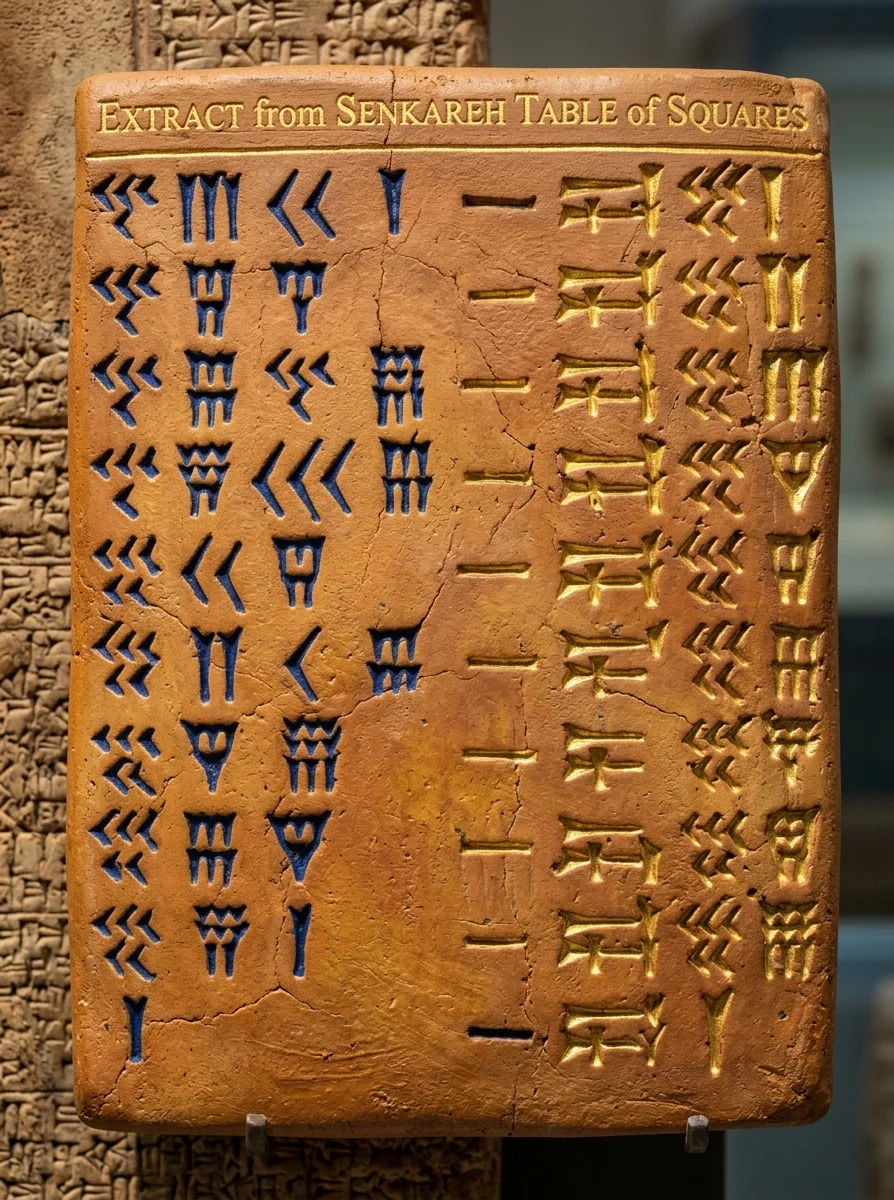
Extract from Table of Squares found at Senkareh, Chaldea