Your ShelfYour Projects

Signs of the Times, Vol. 27, No. 39.

THE LESSON OF DANIEL ONE
Earlier text: DEAD TO THE LAW

THE TOAD'S STORY.

[Susan T. Perry, in N. Y. Observer.]
One day I was passing along a country road, and I saw some boys trying to stone a toad that was hopping across the road; when a few words of remonstrance were spoken to them, the largest looked up and said, “Toads h’aint good for nothin’.”
It was such a pretty bit of wayside that the persecuted toad had hopped into for protection. There were little moss-covered rocks, all around whose base the bright golden-rod was blooming, and red tops of the “queen of the meadow.” The boys were trying to find a stick to poke about with, so they could drive the toad out of its hiding-place. A lecture on cruelty to animals given in a direct manner might be lost on those boys, but a story would not.
“It’s a hot day, boys, and you all look tired,” said the writer. “Don’t you want to sit down here on the rocks under these willow trees and rest yourselves while you listen to a story about toads?”
The boy who evidently had the characteristics that go to make up a leader, said, “Well, if it’s a right down good, funny story, I don’t care if we do.” So, when he sat down, all the rest sat down. You know boys are something like sheep; when the leader jumps over a fence, the rest of the flock are pretty sure to follow. When they were all seated, the story was told, and this is what it was:—
On an island near the coast of Massachusetts a lady lived who wrote beautiful poetry; her name was Celia Thaxter. She had a fine garden, or would have had, were it not for the slugs that got up early in the morning and destroyed many of the plants, and then hid themselves, like sneak thieves, as soon as the sun came up, so no one could find out what had done the mischief and where they were secreted. There were no toads on this little island, for some reason; perhaps they do not like living so near the sea. A gentleman who was a naturalist came to see this lady, and when he found she was having so much trouble with the slugs, he said: “Why, where are your toads, and why are they not attending to business? Toads always take care that the slugs don’t make much headway with their destructive tendencies.” The lady said she had never seen a toad on that island.
“Why don’t you import some?” he asked.
It was a new thought and a good one. Mrs. Thaxter immediately sent word to an inland friend that she wanted some toads. In a few days a box came by express, directed to her. She opened it, and on the top of some dry earth there were three as miserable, homesick, travel-tired toads as you can imagine.
“Ha! Ha! Ha!” laughed the boys. “Sendin’ toads by express! Did you ever hear tell of such a thing?”
The lady immediately turned the hose on to this box, and out of the baked dry earth one toad lifted its head, and then another; and when she had turned the box into the middle of the garden, out jumped ninety toads!
They went right to work to hunt out the slugs for their breakfast. And the lady wrote to the friend who sent the toads: “If there is one thing I adore more than another, it is the toad.” In France they make a business of catching toads and selling them to gardeners.
The boys had given close attention to the story. The leader said, “Well, now, that was a funny story; but tain’t really true, is it, lady?”
“Yes, every word of it is true.”
It was quite evident, as one boy looked at another, and they fanned themselves with their torn hats, that the toad story had made a hit in the audience.
“We won’t stone ’em no more, lady. They’ve riz right up, them toads have, to be things of consequence. Come, boys, we’ve got ter get back to the holler before supper. Good-by, lady.”
“Good-by, boys. I hope you will never be cruel to any of God’s dumb creatures after this.”
They waved their hats in the air, and in a few moments were out of sight.

KEEP WATCH!

Like human beings, watches suffer from exposure—they take cold or they may catch the contagion of dynamos.
Watches often suffer from changes of temperature. After a watch has been worn next to a warm body all day, it should not be left over night on cold marble or near an open window. The cold is likely to contract the metal pivots, and, however slightly, tighten up the works. The next morning, for no apparent reason, one’s watch will be found to be losing time. It frequently happens that watches are slightly magnetized by electricity given off by the human body. Dark people are more likely to exert this influence over their watches. This influence is, besides, more common among women than with men. Persons of this sort can never hope to carry the correct time unless they carry their watches in rubber or steel cases. One must not lay his watch down for the night in a horizontal position. It should always be hung vertically, as it is carried during the day. If the pivot of the balance wheel is in the least worn, this change of position tends to loosen the “cap jewel.”
Every one has had a watch suddenly stop for no apparent reason and go on again when slightly shaken. This may not happen once a year, but all watches are liable to such an accident. This is due usually to the catching of the delicate hair spring. It is caused by some sudden movement, such as jumping on or off a car. The jolt must come at the exact fraction of a second when the spring is in position to catch, so that the chancesof such an accident are rare. A watch should be oiled every eighteen months. Women are said to be the best customers of the watch-doctor, since they seldom wind their watches regularly. A watch should be wound early in the day, and not, as is the common practise, at bedtime. The reason for this is that the spring is the tightest during the day, while the watch is being carried and is less sensitive.—The Scotsman.

MIZPAH

“The Lord watch between me and thee, when we are absent one from another.” Gen. 31:49.
Go thou thy way, and I go mine— Apart, yet not afar; Only a thin vail hangs between The pathways where we are. And “God keep watch ’tween thee and me”— This is my prayer; He looks thy way, He looketh mine, And keeps us near.
I know not where thy road may lie, Or which way mine will be; If mine will lead through parching sands, And thine beside the sea; Yet “God keep watch ’tween thee and me,” So never fear; He holds thy hand, He claspeth mine, And keeps us near.
Should wealth and fame, perchance, be thine, And my lot lowly be; Or you be sad and sorrowful And glory be for me; Yet “God keep watch ’tween thee and me,” Both be His care; One arm ’round thee and one ’round me, Will keep us near.
I sigh, sometimes, to see thy face, But since this may not be, I’ll leave thee to the care of Him Who cares for thee and me. “I’ll keep thee both beneath My wings,” This comforts, dear; One wing o’er thee and one o’er me— So we are near.
And tho our paths be separate, And thy way is not mine, Yet, coming to the mercy-seat, My soul will meet with thine; And “God keep watch ’tween thee and me,” I’ll whisper there; He blesseth thee, He blesseth me, And we are near.
—Anon.

SWINE’S FLESH.

A CONTRIBUTOR to the Sabbath Recorder gives some good testimony to evil effects of the use of swine’s flesh as food, from which we take the following:—
“What is the testimony of history and experience to the effect of swine’s flesh upon the human system, as regards health and long life? Here we are confronted with the great fact that the Jews, observing the dietary laws of Moses, are and have always been, the healthiest people on the globe. In A.D. 1348, when the Black Plague almost depopulated Europe, not an orthodox Jew was touched; and because the Jews would not take the disease and die like their Gentile neighbors, they were bitterly persecuted, tortured, and in many cases put to death—charged with having poisoned the wells and springs, and thus having caused the plague. It is well known that this people have general, if not absolute, immunity from the cholera plague. Some years ago, when the cholera swept through London, but one Jew died of the disease. At Toulon, in 1884, but two Jews fell victims to the cholera, altho one-fifth of the population was Jewish. A lecturer in Owen’s College, Manchester, England, some years ago made the statement that no Jew was ever known to have cancer. The London Lancet, a medical journal of wide repute, took it up and requested reports from all cancer hospitals. It is believed that nothing contradictory to the lecturer’s statement has yet been found.
“A writer in Michigan speaks of being accustomed to a serious attack of bilious fever every spring which laid him up for weeks, thus incurring debt and loss of time. He says, ‘When I stopped the use of pork I was free. We have decided to let swine alone. If God created the swine, did He not know whether clean or unclean? In my native land the common people can not afford to eat pork, neither have they skin diseases or rheumatism. There are no weakly women there, except the higher, pork-eating class.’”
“The truth set forth in these articles first came to the attention of the writer thirteen years ago. Previous to this time he and his family were troubled with boils, salt-rheum, diphtheria, etc.; but from that date until this hour the product of the hog—pork, lard, ham, sausage, sparerib, everything—has been utterly banished from their home; and the blessed result of immunity from the diseases named, as well as benefits in many other ways, makes them very desirous that others should share the blessings through having their attention called to this important matter.
“Facts and figures similar to the above are abundant for such as have eyes to see and ears to hear; and all who believe that life is worth living will do well to study the laws given by Moses, and heed well their precepts.
“And it may be, in view of the facts cited, that the earnest seeker for truth and blessing may find a new meaning in such scriptures as, ‘My son, forget not my law; but let thine heart keep my commandments: for length of days, and long life, and peace, shall they add to thee.’ ‘Hear, O my son, and receive my sayings; and the years of thy life shall be many.’ Prov. 3:1, 2:4, 4:10.”
The above facts could be attested by many thousands throughout the United States, the majority of whom eat no flesh food at all.

DO YOU NEED A BIBLE?

If so, we are sure you would like a GENUINE OXFORD BIBLE, with large, clear print, nicely bound in flexible leather, overlapping edges, leather lined, and silk sewn. It is a beauty. It contains the references, concordance, and all necessary teachers’ helps.

HERE IS A SAMPLE OF THE TYPE

OFFER--We will give this Bible FREE for four yearly subscriptions, new or old, to the SIGNS OF THE TIMES. It will require only a little effort on your part to secure a copy.
This offer is limited, so do not delay.
Address, SIGNS OF THE TIMES, Oakland, California

THE PEARL OF PRICE.

Hie, hie, my soul! On, on! The goal Lies just beyond. Stay not; these fond Alluring toys For yonder joys Disdain. Love’s price Is sacrifice.
M. ELISABETH BURNS-HOWELL.
Alameda, Cal.

THE GOOD RESULTS OF A LONG FAST.

It can not be denied that those physicians who have recommended protracted fasting as a means of relief in chronic diseases are entitled to public thanks, not indeed that in every case their judgment as to the end of a fast has been confirmed by the issue, tho we have not been able to hear of many cases of serious evil. We have the personal acquaintance of several who have fasted much longer than we had supposed possible, and been in much better health since.
George P. Cooley, of Chicago, who a month ago was almost a physical wreck, broke his thirty-one-day fast at noon, August 15. He was racked with rheumatism until it seemed as if he could not bear the pain any longer, and suffered severely from catarrh and nervous afflictions. A telegram to the Tribune says after a month of absolute fasting he considers himself a well man, is without a pain or an ache. His eyes, which, when he began to fast, were badly inflamed, are bright and clear.
In this city resides a gentleman who has twice fasted himself out of very serious complications. Let no reader, however, on account of this note conclude that protracted fasting is the thing for him to do on his own account, and without the supervision of a person thoroughly acquainted with the human constitution. Some fasters have immediately resumed, contrary to all medical rules, by eating a large meal. We have not heard of any serious consequences from that, but Mr. Cooley appears to have been more cautious. With a few friends he left his room and went to a restaurant near by, and ate a piece of bread, a plate of soup, a dish of oatmeal, and a small slice of watermelon. We have long tried to work upon the theory, that amid the temptations encountered on every hand it is difficult to eat too little or to have the meals too far apart. It comes, however, to this, that that rule is usually applied after violations of it have made it necessary.—Christian Advocate.

Picturesque Route to Pan-American, Buffalo

If you are going to Buffalo, to New York, or to any Eastern point beyond Chicago, bear in mind that the Grand Trunk Railway System runs

SOLID VESTIBULE TRAINS

With sleeping cars, dining and cafe cars, through to principal Eastern points, without change.
QUICK TIME • LUXURIOUS SERVICE
Fine Scenery • Courteous Attendants
All trains for Buffalo and New York run via Niagara Falls, crossing the famous Steel Arch Bridge. Passengers allowed a stop-over at the great cataract.
The Grand Trunk is also the favorite route to Toronto, Montreal, Quebec, New England, and the Atlantic Coast via the White Mountains. It has won the title of the Great International Tourist Route, and offers its patrons an endless variety of summer tours.
Inquire of Agents, or address
GEO. W. VAUX, A. G. P. & T. A.,
Grand Trunk Railway System, Chicago, Ill.

VIRGINIA HOMES.

You learn all about Virginia lands, soil, water, climate, resources, products, fruits, berries, mode of cultivation, prices, etc., by reading the Virginia Farmer. Send 10 cents, for three months' subscription, to Farmer Co., Emporia, Va.

When you go East, take “The Overland Limited”

Via UNION PACIFIC RAILROAD
Less Than Three Days to Chicago. Four Days to New York. Leaves Oakland Daily at 10:36 A. M.

“The Fast Mail”

Three and One-half Days to Chicago
Both Pullman and Tourist Sleepers through to Denver, Kansas City, Omaha and Chicago Daily without Change. Leaves Oakland at 6:44 P. M. EVERY DAY IN THE YEAR
PERSONALLY-CONDUCTED TOURIST EXCURSIONS TO THE EAST EVERY WEDNESDAY AND FRIDAY EVENINGS
Steamship Tickets to and from all points in Europe by all trans-Atlantic steamship lines
H. V. BLASDEL, Passenger Agent. 1160 Broadway, Oakland, Cal.

GREAT CLEARANCE SALE

For October and November IN BARRED PLYMOUTH ROCKS BLACK LANGSHANS, and WHITE WYANDOTTES
To make room, will sell at HALF USUAL PRICE for immediate orders
C. H. TYRRELL, Sioux Rapids Iowa

AGENTS

wanted. Ladies and gentlemen. Commissions liberal; goods salable; exclusive territory. Address, A. K. ATTEBERRY, Knoxville, Ill.

IN NEGRO-LAND.

The Soudan is an extensive region of Africa lying south of the Sahara, and extending to within about five degrees of the equator. Its area is “perhaps 2,000,000 square miles, and its population is variously estimated at from 80,000,000 to 90,000,000.” The climate is tropical, with two seasons, a wet and a dry. During the wet season there are tremendous thunder-showers, and continuous down-pours, flushing the watercourses and flooding the low-lying areas.
Wherever the country is well-watered, the rich soil and tropical heat produce a luxuriant vegetation. The forests are extensive and exuberant. Here grows the giant baobab, attaining a girth of eighty feet. Here, too, are superb palms, beautiful tamarinds and euphorbias, graceful mimosas and acacias, the honey-yielding jerjak, and many other trees both curious and beautiful. The forests abound in insect-life. There are myriads of termites, very large bees, wasps, and ants, and a variety of beetles and butterflies.
The lion, panther, hyena, and jackal are the chief beasts of prey. The rhinoceros finds a home in these forests, as do zebras, giraffes, antelopes, and “endless species of monkeys.” Large herds of elephants frequent the swampy districts about Lake Tchad; and crocodiles and hippopotami abound in the rivers, which are also the haunts of numerous flocks of waterfowl.
Men who have seen and studied the country tell us that in all parts of the Soudan, but especially in the southern portions of it, “there are vast tracts of rich lands filled with untouched treasures, lying fallow, and covered with millions of human beings, who can easily be brought under the influence of civilization.”—Encyclopedia of Missions, vol. 2, p. 356.
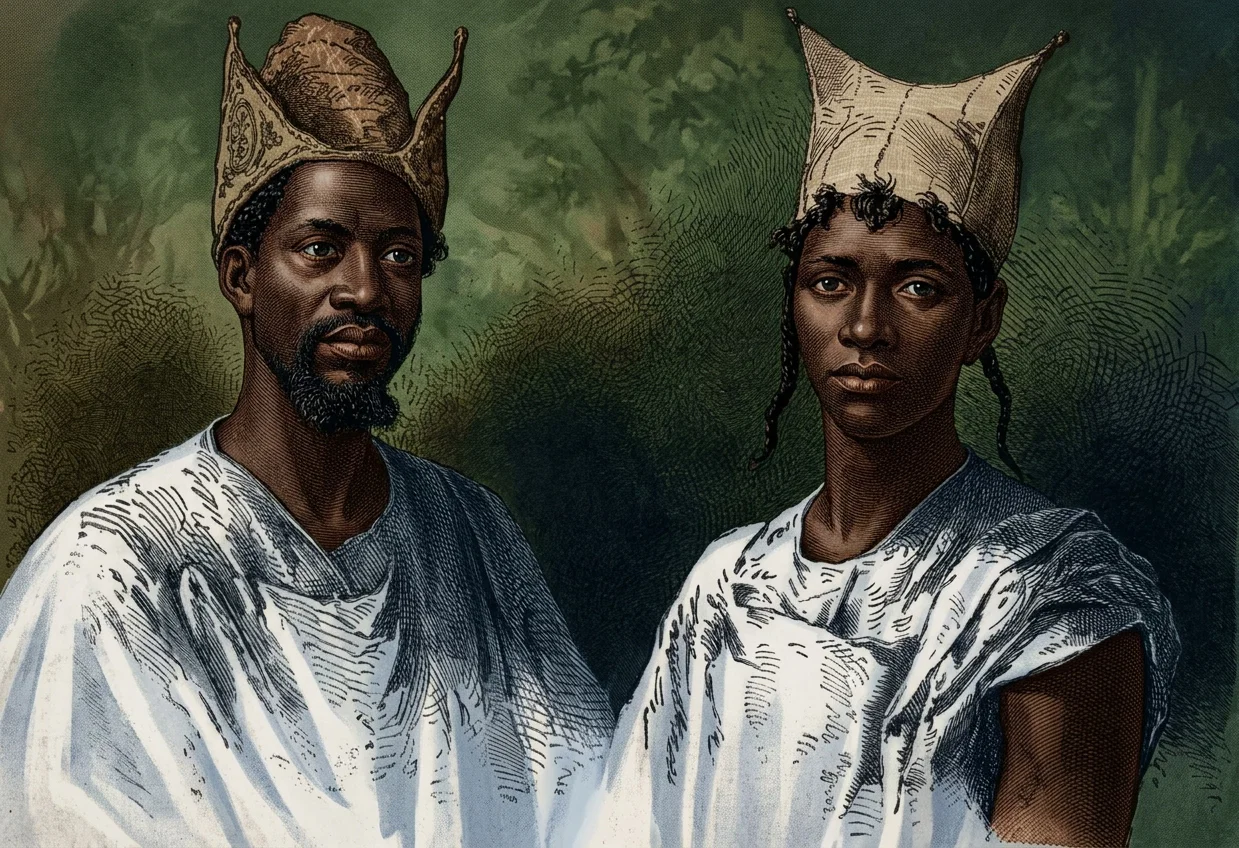
This tropical region,—tropical in its climate, its productions, and its animal life,—is the homeland of the negro, tho in “other sections, especially to the south, occasional tribes of negroes may be met with.” Its name, Bilad es-Soudan, “the country of the blacks,” implies this. Many tribes of pure-blooded or mixed blacks are found within its borders. Of these the Mandingoes are a leading race in the western part of the Soudan, where their simple language is generally spoken. The Bambarras, a powerful tribe, numbering about 2,000,000 people, are of Mandingo stock.
Types of Bambarras.
Types of Bambarras.
The Bambarras and some other negro tribes of the Soudan profess the Mohammedan faith; but their allegiance to the new religion is said to be little more than nominal. There are, however, many Mohammedans in the Soudan—Arabs, many of them traders, and not a few slave-traders.
The great mass of the negroes are pagan. Indeed, Africa is said to include six-sevenths of all the pagans in the world. The negroes are very superstitious. They believe in spirits and a spirit-world, and in witchcraft in its various forms. “This faith is made by the priests and medicine-men an instrument of terrible oppression; and it is thus the source of ‘wide-spread misery.’”
Faith in a spirit-world also involves a belief in life after death. Hence the human sacrifices at the burial of kings and chiefs so common in Ashantee and Dahomey, on the Niger, and in some central African countries. The deceased must be honorably attended to the world of spirits; wives and slaves, therefore, must accompany him, and the sacrifice sometimes takes the horrible form of interment alive. On the other hand, many tribes have no conception of a future existence. “When a man was born, he was born,” said one chief, “and when he died, he was dead; and there was an end of the palaver.”—Encyclopedia of Missions, vol. 1, p. 9.
These African negroes are not so much given to the worship of idols as are the people of some other countries. Their religion is what is called fetishism.
A fetish is a charm; and almost any object—a tree, a stick, a stone, a shell, a plant, the limb of an animal, a vessel filled with some strange compound—may have power imparted to it by certain medicine-men—power to preserve the owner or bearer from danger, or power to injure his enemies. Particular fetiches fulfil particular purposes. “One guards against sickness, another against drought, a third against the disasters of war. One is used to draw down rain, another to secure good crops, and a third fills the sea and rivers with fishes, and brings them to the fishermen’s net.”
An army of missionaries have gone to the great Dark Continent, and many are laboring there now. But there is a wide field unoccupied. Eastern Soudan especially is practically virgin territory, so far as missionary effort is concerned, and no doubt millions there have never even heard the story of the cross.
E. J. BURNHAM.

TWO PICTURES FROM LIFE.

A WRITER in Gospel in All Lands gives two pictures which illustrate the difference between the heathen and the Christian mother in the face of death.
A black-eyed baby lay moaning its young life away on the brick bed of a dreary mud house in Peking, China.
The feeble voice, growing weaker and weaker, was now and then drowned in the sobs and groans of the young mother, who gazed in despair upon her dying child. She longed to press it to her aching heart; but she had always heard that demons are all around the dying, waiting to snatch the soul away, and so because it was dying she was afraid of her own baby.
“It is almost time,” said the mother-in-law, glancing at the slanting sunbeam that had stolen into the dismal room through a hole in the paper window; and she snatched up the helpless baby with a determined air. The mother shrieked, “My baby is not dead! My baby is not dead yet.”
“But it has only one mouthful of breath left,” said the old woman; “the cart will soon pass, and then we shall have to keep it in the house all night. There is no help for it; the gods are angry with you.”
The mother dared not resist, and her baby was carried from her sight. She never saw it again.
An old black cart drawn by a black cow passed slowly down the street; the little body was laid among the others already gathered there, and the carter drove on through the city gate. Outside the wall he laid them all in a common pit, buried them in lime, and drove on.
No stone marks the spot; no flower will ever blossom on that grave.
The desolate woman wails, “My baby is lost; my baby is lost; I can never find him again.”
The black-eyed baby’s mother is a heathen.
A blue-eyed baby lay moaning on the downy pillows of its dainty crib, and it was whispered softly through the mission, “Baby is dying.”
With sorrowing hearts we gathered in the stricken home, but the Comforter had come before us.
“Our baby is going to rest,” said the mother, and tho her voice trembled, she smiled bravely and sweetly upon the little sufferer.
“We gave her to the Lord when she came to us,” said the father reverently, and he threw his arms lovingly around his wife.
As we watched, through our tears, the little life slipping away, some one began to sing softly:—
“Jesus, lover of my soul; Let me to Thy bosom fly.”
The blue eyes opened for the last time, and with one long gaze into the loving faces above, closed again, and with a gentle sigh the sweet child passed away.
“Let us pray,” said a low voice. We knelt together, and heaven came very near to us all.
There are no baby coffins to be bought in Peking,so a box was made; we lined it with soft white silk from a Chinese store. We dressed baby in her snowy robes, and laid her lovingly in her last resting-place. We decked the room with flowers, and strewed them over the little one.
The next day we followed the tiny coffin to the cemetery.
With a song of hope, and words of cheer and trust, and a prayer of faith, we comforted the sorrowing hearts.
Now a white stone marks the sacred spot where we laid her, and flowers blossom on the grave that is visited often, and tended with loving care.
“The Lord gave, the Lord hath taken away; blessed be the name of the Lord,” said the baby’s father, while baby’s mother answered, “Our baby is safe; we shall find her and have her again some glad day.”
The blue-eyed baby’s mother is a Christian.— Adapted.

A WORKER’S PRAYER.

“For I have received of the Lord that which also I delivered unto you.” I Cor. 11:23.
Lord, speak to me, that I may speak In living echoes of Thy tone; As Thou hast sought, so let me seek Thy erring children, lost and lone.
O lead me, Lord, that I may lead The wandering and the wavering feet; O feed me, Lord, that I may feed Thy hungering ones with manna sweet.
O strengthen me, that while I stand Firm on the Rock and strong in Thee, I may stretch out a loving hand To wrestlers with the troubled sea.
O teach me, Lord, that I may teach The precious things Thou dost impart; And wing my words, that they may reach The hidden depths of many a heart.
O give Thine own sweet rest to me, That I may speak with soothing power A word in season, as from Thee, To weary ones in needful hour.
O fill me with thy fulness, Lord, Until my very heart o’erflow In kindling thought and glowing word, Thy love to tell, Thy praise to show.
O use me, Lord, use even me, Just as Thou wilt, and when, and where; Until Thy blessed face I see, Thy rest, Thy joy, Thy glory share.
— Frances Ridley Havergal.

Drawing Near to God’s Altar

“THE closer you come to God’s altar, the more likely you are to be God’s missionary.”

OUR WORK AND WORKERS.

FIFTEEN persons were baptized at Clear Lake, Wis., August 2, by Brother J. B. Scott.
FIVE converts are reported as fruit of the German meetings held in a tent at Wausau, Wis.
ELEVEN candidates were baptized during the recent camp-meeting at Sioux Rapids, Iowa.
AT the local camp-meeting held at Cambridge, Neb., August 13–18, four persons were baptized.
A CHURCH of twenty-five members was organized at Merrill, Wis., on the 1st inst., by Brother C. J. Hermann.
CAMP-MEETINGS in October are announced as follows: Woodbine, Harrison County, Iowa, 1–6; Red Bluff, Cal., 3–13.
AS FRUIT of meetings held at Fayetteville, N. Y., by Brethren D. A. Ball and S. B. Whitney, nine persons have decided to obey the truth.
BROTHER J. B. BECKNER, of Missouri, recently sailed from New York for Jamaica, where he will labor under the auspices of the Mission Board.
THREE candidates were baptized at Erskine, Minn., August 31st, by Brother J. C. Christensen, who has been laboring in the interest of the Scandinavian people.
AT Sherburne, Minn., after four meetings conducted by Brother D. Nettleton, while on his way from South Dakota to Nebraska, three young persons were baptized and added to the church.
BROTHER J. W. BOYNTON, who went from Nebraska the past summer to labor in the Northwest Province, Canada, writes from Alberta to the Nebraska Reporter concerning the country in that northern latitude. We copy the following:—
The country seems to be well adapted to stock raising in the southern portion, and mixed farming in the north. Crops look fine, altho late. Harvest will begin the latter part of August. Cereals of all kinds and garden vegetables do well. The summers are short, and the winters longer than in Nebraska, but all unite in saying that the winters are fine. There is good sleighing all winter, as the snow does not drift, there being but very little wind at any time. There is plenty of rain during the summer. I find many people here from the States, and all seem kind and friendly. Homestead land can still be obtained by going twenty miles from the railroad, at different towns along the line.
BROTHER W. WOODFORD, whose departure for Australia in June last was noted in this paper, writes from Sydney, N. S. W.: “We all arrived safe, and enjoyed the Union Conference at Cooranbong. The missionary spirit pervaded the entire session. The plan to take up the work of freeing our school from debt by selling ‘Christ’s Object Lessons,’ was heartily indorsed, and a fund of £460 [$2,300] was raised by the delegates present to buy material for the manufacture of the books. The harvest is ripe; pray the Lord to raise up laborers.”
On the 16th inst., ten missionaries sailed from San Francisco for Tahiti, to engage in work in the South Sea Islands. Brother B. J. Cady and wife, who, after ten years of service returned to America to attend the General Conference and incidentally to visit friends, are on their way “home,” accompanied by the following named persons: L. A. Roth, wife, and three children, of San Francisco; G. F. Jones and wife, of England; George Beckner and wife, of Texas; Miss Anna Nelson, of Wisconsin; and Miss Pura Brodien, a native of the Society Islands, who is returning to her home.

HOW THE “SIGNS” IS APPRECIATED.

I must say, Praise God for the fulness and graciousness of the divine light of truth that has been shed upon my life, my heart, my mind, and all my being, through the blessed medium of the pages of the SIGNS OF THE TIMES. It seems to me to be a consecrated channel through which the Holy Spirit is poured out according to the Word of the Lord, “I will pour out My Spirit upon all flesh.” The Lord is fulfilling this declaration to all who will read or hear the Word of truth. This journal is like a candle placed upon a candlestick. All can see the light, and may it shine more and more unto the fulness of the perfect day. It is so brilliant that they who run (Hab. 2:2) can not fail to see it, and may read and understand. God, through His agents, is sending out the light. He is proclaiming the Gospel of peace, the acceptable year of the Lord. He invites, “Look unto Me, and be ye saved, all the ‘ends of the earth.” Let the people hear and be glad.
How Mrs. E. G. White is pouring inexhaustible floods of the Holy Spirit down into our very souls, until it permeates our whole being. How she does raise us up to God. What a blessing to earth she is! What child of God can read her writings without being filled with that holy unction which fires her soul? Let God be thanked for such a comforter to the traveler in the rough and thorny way that leads from this wilderness beset with pitfalls, snares, temptations, the devil and all his agents, to those mansions in which we hope to rest eternally from all our labors and cares.
There are others who write as with the pen of inspiration, and help to make the SIGNS a great channel of light; but the world knows them, and it is not my purpose to name them now.
The Gospel of the Son of God is spreading to the inhabitants of earth with wonderful rapidity. Nearly all the elements—the winds, the waves, steam and electricity—are aiding in the spread of the glad tidings of salvation. The winds are wafting the white-winged ships that are bearing the message “over the ‘ocean waves;’” steam is propelling the thundering trains that are carrying it “into all the plains;” while electricity is carrying it over land and under the great deep. God is using all His creation to proclaim the Gospel of the kingdom of Christ; for the earth, the sea, and all that in them is, are but the combined agents of the Most High. We are in “the fulness of the times.” “A few more risings and settings of the sun,” and we shall see Him as He is. “A short work will the Lord make upon the earth.” Let all the ends of the earth prepare to meet the Lord; for He will not much longer delay His coming. “He which testifieth these things saith, ‘Surely I come quickly. Amen. Even so, come, ‘Lord Jesus.’” JAMES W. POE.
408 S. Cap. St., Washington, D. C.

THE BRIDE'S EXPECTANCY.

FICTION has painted the picture of a maiden whose lover left her for a voyage to the holy land, promising on his return to make her his beloved bride. Many told her she would never see him again. But she believed his word, and evening by evening she went down to the lonely shore and kindled there a beacon light in sight of the roaring wave, to hail and welcome the returning ship which was to bring again her betrothed. And by that watch-fire she took her stand each night, praying to the winds to hasten on the sluggish sails, that he who was everything to her might come. Even so that blessed Lord who has loved us unto death, has gone away to the mysterious holy land of heaven, promising on His return to make us His happy and eternal bride. Some say that He has gone forever, and that here we shall never see Him more. But His last word was, “Yea, I come quickly.” And on the dark and misty beach, sloping out into the eternal sea, each true believer stands by the love-lit fire, looking, and waiting, and praying, and hoping for the fulfilment of His word, in nothing gladder than in His pledge and promise, and calling ever from the soul of sacred love, “Even so, come, Lord Jesus.” And some of these nights, while the world's busy with its gay frivolities, and laughing at the maiden on the shore, a form shall rise over the surging waves, as once on Galilee, to vindicate forever all this watching and devotion, and bring to a faithful and constant heart a joy and glory and triumph which never more shall end.—Selected.
Continue reading: MORE AND MORE