Your ShelfYour Projects

Signs of the Times, Vol. 29, No. 47.

“GIVING THANKS”—HARVEST TIME

Signs of the Times

Nov 25, 1903

Pacific Press Publishing Company · Oakland, California · Nov 25, 1903

“GIVING THANKS”—HARVEST TIME.
IT is always well to give thanks to the Giver of all good. His mercies are ever new, ever fresh. His fountain of life is ever flowing, and “Manna from heaven falls Fresh every eve.”
The common sunshine and common rain, the common air and common earth, and all the dear, great, common blessings we enjoy come perennially and continuously from the bountiful hand of our God. Therefore, thank God, the Giver of all.
THANK GOD for the common salvation through Jesus Christ. “He died for all.” By virtue of the salvation purchased by Jesus Christ has come every good thing which this world knows. If He had not given Himself, the world would have rolled on to hopeless night and destruction. But Christ “gave Himself” “to seek and to save the lost.” And thus He made it possible for the lost ones to be saved; for the slaves of sin to become the free children of God; for the lovers of lust to become princes in purity, victors over vice. Thank God for this great salvation, and tell the glad news to every soul. Jesus Christ is the Saviour of sinners, at all times, under all circumstances.
The autumn of the year in our northern clime calls to mind special evidences of God’s goodness in abundant harvests. Mrs. Hemans sings:—
“Now autumn strews on every plain His mellow fruits and fertile grain; And laughing plenty, crowned with sheaves, With purple grapes and spreading leaves, In rich profusion pours around Her flowing treasures on the ground. O! mark the great, the liberal hand, That scatters blessing o’er the land; And to the God of nature raise The grateful song, the hymn of praise.”
And out of this recognition of God’s goodness have grown the public thanksgiving days in all Bible lands. They are proper acknowledgments to the great Provider of all our blessings.
BUT thanksgiving must be voluntary to be accepted. No one honors God by a mere formal acquiescence in an ancient custom, or the keeping of a holiday or holy day because ordered by State proclamation. No State document adds one whit of fragrance to a people’s hymn of praise, unless the heart of the people be in it. If the life and purpose of the nation be against the spirit of the day, the proclamation becomes abomination. Neither is the day honored by selfish feasting and gluttony. It is good to gather the children and grandchildren in family reunion around the old table, and with thankful hearts for God’s preserving mercies recall His goodness and praise Him together. But it is better to be so thankful that our hearts shall go out to those who are in need. Jesus has given us the true rule in the following: “When thou makest a dinner or a supper, call not thy friends, nor thy brethren, nor thy kinsman, nor rich neighbors; lest haply they also bid thee again, and a recompense be made thee. But when thou makest a feast, bid the poor, the maimed, the lame, the blind: and thou shalt be blessed: because they have not wherewith to recompense thee: for thou shalt be recompensed in the resurrection of the just.” Luke 14:12–14. Such observance of Thanksgiving Day will bear fruit in abundant blessings perennially.
BUT the harvest does not always bring thanksgiving. It depends on the sowing. There will be many a shiftless, lazy, idle one who will come down to this Thanksgiving, 1903, with no joy of heart, no harvest to our store, because there has been no sowing. Such ought to give thanks to God that life is spared, and begin now, in His strength, to sow for prosperity.
OTHER some have been sowing all the year to sin, to self-indulgence, to intemperance, to vice, to crime, to hatred; they will reap a plentiful crop of corruption, degradation, pain, suffering, and remorse. Let these, too, make this a time of thanksgiving by turning fromtheir slavery to the freedom of Christ Jesus. “If therefore the Son shall make you free, ye shall be free indeed.” And in true freedom there is cause for thanksgiving.

WAIT UPON THE LORD.

PATIENT waiting for the Lord is an essential feature of the Christian character. “For My thoughts are not your thoughts, neither are your ways My ways, saith the Lord.” Isa. 55:8. “There is a way which seemeth right unto a man, but the end thereof are the ways of death.” Prov. 14:12. “Wait on the Lord; be of good courage, and He shall strengthen thine heart; wait, I say, on the Lord.” Ps. 27:14. “Rest in the Lord, and wait patiently for Him.”
You can make the clock strike before its hour by putting your hands on it, but it will strike wrong. You can tear the rosebud open before its time, but you mar the beauty of the rose. So we may spoil many a rich blessing which God is preparing for us, by our own eager haste. “Like the stars in the vast circuit of their appointed path, God’s purposes know no haste and no delay.” He is weaving our lives into patterns of beauty and strength. Let us submit ourselves to Him as clay in the hands of the potter, to be moulded and fashioned according to His divine purpose. He has a perfect plan for each. Don’t pull at the threads of life, nor hurry the Almighty’s plan; but wait, patiently wait, not as Jonah, who waited to see things work out according to his ideas, until the booth above his head was withered by the hot sun, and his patience severely tried. We may not know God’s plan nor see, at once, His angels working in our behalf, “but if we hope for that we see not, then do we with patience wait for it” (Rom. 8:25), knowing that “they that wait upon the Lord shall renew their strength; they shall mount up with wings as eagles; they shall run, and not be weary; and they shall walk, and not faint.” Isa. 40:31.
God can make grief a grace, the burden a blessing, and light up the disappointment so that it becomes the torch of hope. The rod itself shall bud and blossom and bring forth almonds, so that everything that chastens us shall present beauty and fruit.
St. Helena, Cal. ARTHUR FOX.

SERVICE

BY MRS. E. G. WHITE.
A LIFE of idleness and self-pleasing is not the life of a Christian, nor has it ever been. Christ was an untiring worker, and He has given to His followers the law of service,—a law that is the link binding man to God and to his fellow-men.
Christ found His highest joy in service. Not to be ministered unto, but to minister, did He come to this earth. See Him teaching in the temple, by the sea, on the mountainside, in the great thoroughfares of travel. See Him by the bedside of the sick, speaking peace and hope to the afflicted. He went about doing good, comforting the mourners, helping the helpless, healing the wounds that sin had made.
“The Spirit of the Lord is upon Me,” He declared, “because He hath anointed Me to preach the Gospel to the poor; He hath sent Me to heal the brokenhearted, to preach deliverance to the captives, and recovering of sight to the blind, to set at liberty them that are bruised.”
A life of service is the truest, noblest life that man can live. By such a life we are brought into touch with Him who is the light and life of the world. Service is an honor conferred on man as an heir of heaven. He is to find his joy in true-hearted, unselfish efforts to help and bless those around him.
Countless are the opportunities for unselfish service. There are many to whom life is a painful struggle; they feel their deficiencies, and are miserable and unbelieving; they think they have nothing for which to be grateful. Kind words, looks of sympathy, expressions of appreciation, would be to many a struggling and lonely one as a cup of cold water to a thirsty soul. A word of sympathy, an act of kindness, would lift burdens that rest heavily upon weary shoulders. And every word or deed of unselfish kindness is an expression of the love of Christ for lost humanity.
“We then that are strong ought to bear the infirmities of the weak, and not to please ourselves.” No soul who believes in Christ, even tho his faith may be weak and his steps wavering, is to be lightly esteemed. By all that has given us advantage over another,—be it education, refinement, Christian training, religious experience, we are in debt to those less favored, and, so far as lies in our power, we are to stay up the hands of the weak. Angels of glory, that do always behold the face of the Father in heaven, joy in ministering to His little ones. Trembling souls, who have many objectionable traits of character, are their special charge. Angels are ever present where they are most needed, with those who have the hardest battle with self to fight, and whose surroundings are the most discouraging.
We shall individually be held responsible for doing one jot less than we have ability to do. The Lord measures with exactness every possibility for service. The unused capabilities are just as much brought into account as those that are used. We shall be judged according to what we ought to have done, but did not accomplish because we did not use our powers to glorify God. Even if we do not lose our souls, we shall realize through all eternity the result of our unused talents.

The Reward of Service.

As you open your doors to Christ’s needy and suffering ones, you are welcoming unseen angels. You invite the companionship of heavenly beings. They bring a sacred atmosphere of peace and joy. They come with praises upon their lips, and an answering strain is heard in heaven. Every deed of mercy makes music there. The Father from His throne numbers the unselfish workers among His most precious treasures.
At the last great day Christ will say to these workers, “Come, ye blessed of My Father, inherit the kingdom prepared for you from the foundation of the world; for I was an hungered, and ye gave Me meat; I was thirsty, and ye gave Me drink; I was a stranger, and ye took Me in; naked, and ye clothed Me; I was sick, and ye visited Me; I was in prison, and ye came unto Me.”
“Then shall the righteous answer Him, saying, Lord, when saw we Thee an hungered, and fed Thee? or thirsty, and gave Thee drink? When saw we Thee a stranger, and took Thee in? or naked, and clothed Thee? or when saw we Thee sick, or in prison, and came unto Thee?”
“And the King shall answer and say unto them, Verily I say unto you, Inasmuch as ye have done it unto one of the least of these My brethren, ye have done it unto Me.”

EXAMINING OURSELVES.

We are to examine ourselves, whether we be in the faith. It is not to find out what is in the heart, because no man on earth can find out what is in the heart. The man who starts out to do that is going to be terribly deceived; for “the heart is deceitful above all things,” and it will deceive him every time. But the Lord says, “I the Lord search the heart.” He makes known to every man the fruit of His ways, and we want to have confidence enough in Him to let Him do the searching of the heart.
When we find out that we are in the faith, we shall not be afraid to trust the Lord to search the heart and make known the sin. If we be in the faith, we know that Christ died for sinners, in order that they might be separated from sin. Therefore He is more interested in having us know the sins, so as to give them up to Him, than we are to know them. It isnot an unheard-of thing, by any means, to find professed Christians who do not know that the Lord loves them when in sin; and so they are always afraid of the Lord, from a sense of their sinfulness. Are you in the faith? If so, you will accept the knowledge of sin as the result of the revelation of the righteousness which will take away that sin, and rejoice in the Lord. E. J. WAGGONER.

The Latter Rain and Earth’s Harvest

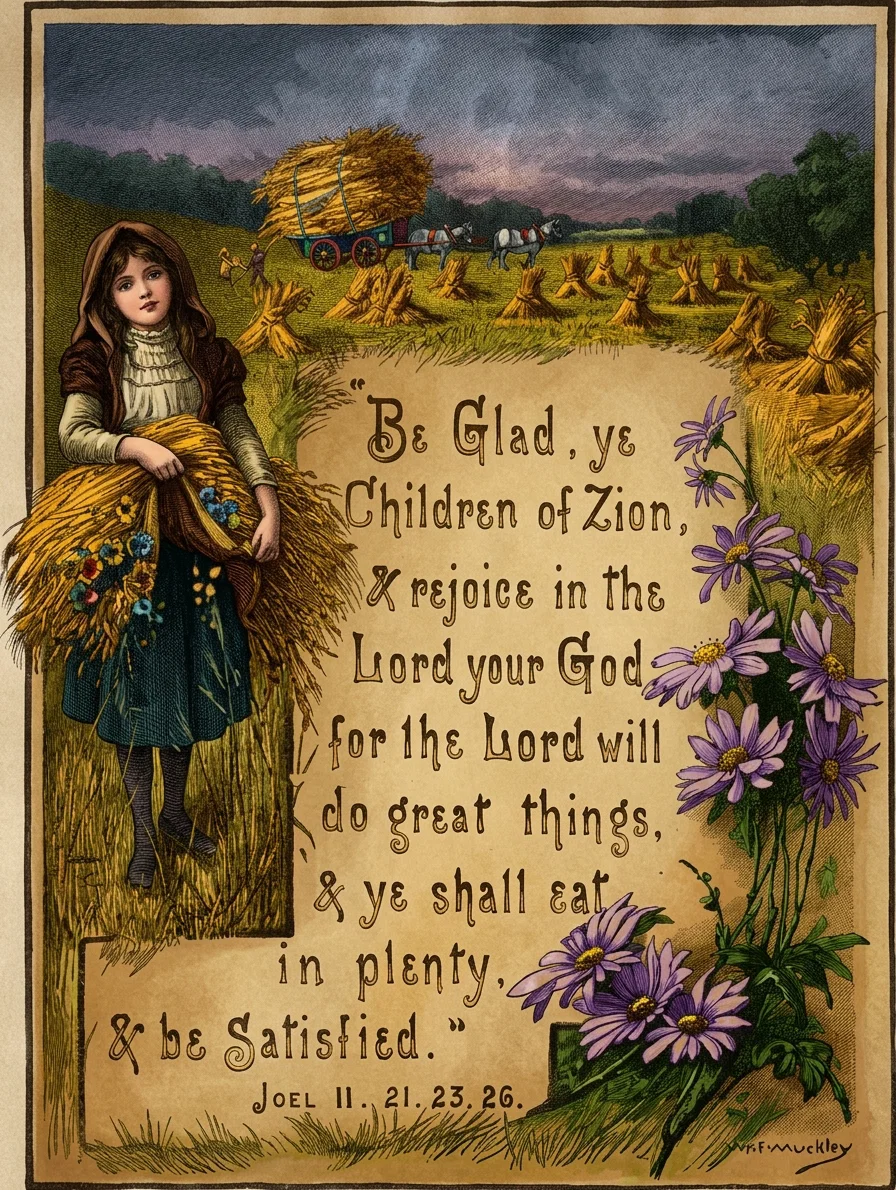
WE are nearing earth’s great harvest time, the time to which our illuminated text applies. Turn to Joel 2. The first verse is a warning that the day of the Lord is at hand, full of trouble, because of earth’s seed-sowing of sin. The following verses name some of the dreadful calamities to visit the earth. Verses 12 to 17 are strong appeals to all God’s people to repent with all the heart. Verses 18 to 27 are God’s promises to His people who heed His admonitions and turn to Him “with fasting, and with weeping, and with mourning.” In verse 23 is the promise of the outpouring of the former and the latter rain. The former rain was poured out upon the early church; the last days will witness the outpouring of both the former rain and the latter rain, the shedding forth of God’s Spirit.
THOSE who sow to righteousness can then “be glad” and “rejoice in the Lord your God.” God “will do great things” for His people if they will but trust in Him. They “shall eat in plenty and be satisfied.” God will multiply the sowing thirtyfold, sixtyfold, a hundred fold. Therefore give thanks to God. “Be glad and rejoice.” “In everything give thanks; for this is the will of God in Christ Jesus concerning you.”

MY GUARDIAN ANGEL.

In earliest hours he took the trust God-given, Guided my footsteps where I could not see; Helpless, he helped, did ever danger threaten, Foreknowing in God's plan a place for me.
Of mighty power, he gently leads me still; In midnight's silent watches, stands he guard; In daily battle, comrade is 'gainst ill, A sympathizer, if I find life hard.
I raise my eyes, and all but see him by; Tho I had wandered blindly, far and long, His voice would ever follow, and still nigh, Bespeaks the right, condemns insidious wrong.
In youth, in prime, or trembling age infirm, Protector, guide, and loving friend is he, A God-sent teacher, that in life's brief term, Schools erring man to live eternally.
And may it be if death shall strike me down When my short course is run, I take the blow Unflinchingly, and so may nobly crown A well-spent, godly life, nor fear to go.
A rich reward, forefound in part, shall be That, tho he sheds a tear, his aid denied With my fast-dimming vision I may see Him smile, as he doth say, “He bravely died.”
College View, Neb. H. A. PEEBLES.

Prayer Will Not Bring Health and Strength to Sustain Us in Continued Transgression

INEFFECTUAL PRAYER, OR PRAYER OF PRESUMPTION. NO. 3.

Prayer Will Not Bring Health and Strength to Sustain Us in Continued Transgression.

“Ye ask, and receive not, because ye ask amiss, that ye may consume it upon your lusts.” James 4:3.
We will but deceive ourselves if we expect God to supply either physical or spiritual strength to be used in continued transgression. Prayer will not bring to us, by means of a miracle, that which God knows will be squandered in persistent wrong-doing. If we presume to squander the energies of mind, soul, and body, and afterwards recognize the error of our way and sincerely repent, our prayers will surely secure the forgiveness of God; but it does not follow that they will secure for us an instantaneous and complete supply of the good blessings of health and strength which have been wantonly wasted.
Is it reasonable for us to expect God to work miracles simply to maintain a reckless expenditure of physical or spiritual energy? We ask and receive not, because we ask amiss, to consume it upon our lusts. Or, as the Lord says by Hosea, “My people are destroyed for lack of knowledge; because thou hast rejected knowledge, I will also reject thee, that thou shalt be no priest to me; seeing thou hast forgotten the law of thy God, I will also forget thy children.” Hosea 4:6. The professed people of God are destroyed for lack of knowledge, and they lack knowledge because they have “forgotten the law of God.”
There shines forth from the laws of Jehovah sufficient light and truth to point out the way of life, and there is the divine promise of peace and health for all who walk therein. The knowledge of truth is life to him who receives it. There is life-giving power in light and truth. Christ is the light of life, and if we would receive His life, we must walk in His light. The laws of soul and body contain truth which, if obeyed and heeded, will bring us into harmony with God, who is the Source of all life, who has “life in Himself.” But if we turn our backs upon this light and truth, and refuse to yield obedience to the divine requirements, in so doing we turn our backs upon life and health. The knowledge of God is life everlasting. To reject Him is death and destruction. “He that turneth away his ear from hearing the law, even his prayer shall be abomination.” Prov. 28:9.
It is unreasonable to expect God to miraculously supply us with health and strength to be used for no better purpose than to antagonize His plans and disobey His laws; for in this He would be working contrary to Himself, and virtually becoming a minister of sin; and a partner to our transgressions. Such a course on the part of God would be equal to confessing that the divine penalties for transgression were arbitrary, unjust, and unnecessary. But as all His judgments are just and righteous altogether, He can not consistently remove the penalty of transgression until the transgression which necessitated its presence is recognized and removed.

Prayer Will Not Avert the Harvest of Persistent Disobedience.

“Thus saith the Lord, Behold, I will bring evil upon them, which they shall not be able to escape; and tho they shall cry unto Me, I will not hearken unto them. Then shall the cities of Judah and inhabitants of Jerusalem go, and cry unto the gods unto whom they offer incense; but they shall not save them at all in the time of their trouble. For according to the number of thy cities were thy gods, O Judah; and according to the number of the streets of Jerusalem have ye set up altars to that shameful thing, even altars to burn incense unto Baal. Therefore pray not thou for this people, neither lift up a cry or prayer for them; for I will not hear them in the time that they cry unto Me for their trouble.” Jer. 11:11-14.
Prayer will not avert the just harvest of persistent disobedience. The idea that man can continue to disobey, and then in some auspicious hour be saved from reaping the harvest he has industriously sown for; that man can in some way sow for thorns and thistles, and after discovering their painful prick betake himself to prayer meeting, and there have God miraculously uproot every prickly briar, is a delusion. If we persist in sowing for disease, the harvest will surely come; and in the day of our calamity, the Lord has admonished His ministers, “therefore pray not for these people, for I will not hear them in the time they cry unto Me for their trouble.” “But,” asks one, “Would you limit God’s healing power?” We are not considering what God can do, but what He does do. Our Father in heaven could heal all the sick people in the world instantly, if He so chose; but probably this would be the very worst thing for His name’s honor and glory, as well as a curse to many who were thus raised up. We can not limit what God can do, but our best judgment of what He will do must be confined to what we actually and really see Him doing, or what He promises to do. In the case of every person who meets with an accident resulting in the loss of a limb, God could easily work a miracle, and cause a new limb to take its place, but whoever saw such a miracle? Would you for a moment question the ability of God to perform such a wonder?—No. But the evidence is sufficient to warrant you in believing that God does not see fit to work in that way. His power is all-sufficient, but His plans and workings are all-directed, not only by the greatness of His power, but also by the perfection of His wisdom. W. S. SADLER.

Benevolence the Source of Happiness.

Wouldst thou from sorrow find a sweet relief? Or is thy heart oppressed with woes untold? Balm wouldst thou gather for corroding grief?— Pour blessings ’round thee like a shower of gold. ’Tis when the rose is wrapped in many a fold, Close to its heart, the worm is wasting there Its life and beauty; not when, all unrolled, Leaf after leaf, its bosom rich and fair, Breathes freely its perfumes throughout the ambient air.
Wake, thou that sleepest in enchanted bowers, Lest these lost years should haunt thee on the night When death is waiting for thy numbered hours To take their swift and everlasting flight! Wake, ere the earth-born charm unnerve thee quite, And be thy thoughts to work divine addressed; Do something—do it soon,—with all thy might; An angel’s wing would droop if long at rest, And God Himself, inactive, were no longer blessed!
Some high or humble enterprise of good Contemplate, till it shall possess thy mind, Become thy study, pastime, rest, and food, And kindle in thy heart a flame refined. Pray heaven for firmness thy whole soul to bind To this thy purpose—to begin, pursue, With thoughts all fixed, and feelings purely kind; Strength to complete, and with delight review, And grace to give the praise where all is ever due.
—Carlos Wilcox.

LABOR, ITS PURPOSE, AND ITS FRUITS.

In the beginning of this world's history, when the creation of things therein had almost reached completion, it was found that there was no one to till the ground. Gen. 2:5. Then man was created and his work was to subdue the earth (Gen. 1:18), and bring it into a good state of cultivation even as was the Garden of Eden, which was given him as an object lesson of the perfection with which things would grow, and the wealth that the land would produce when properly tilled.
Every man's work was to be light and pleasant, but because of the disobedience of him who was given dominion over the earth, he, with all under him, was cursed, and his labor was to be more difficult and severe. He must earn his bread by the sweat of his face; for the earth then brought forth thorns and thistles.
In this sinful world it is a blessing to man to have to work hard, for it is not only the best means to give us good appetites and healthful bodies, but, as “an idle brain is the devil's workshop” to find mischief for idle hands, honest toil will furnish that which will do much to keep us from being gossippers, or busybodies in other men's matters. 1 Thess. 4:11; 2 Thess. 3:12.
The apostle says further, “If any man will not work neither shall he eat;” and the wise man tells us, “He that gathereth by labor shall increase,” for “in all labor there is profit;” and “the labor of the righteous tendeth to life.”
Thus we see that all should work with their own hands; and for these various reasons we may perceive that each of us should earn our necessary means by the sweat of our own face instead of by the sweat of other people's faces; that is, by piling up wealth at the expense of our neighbors, by keeping back by fraud the hire of their labors. James 5:4.
We should procure our means in some honorable and legitimate way. The Holy Scriptures plainly teach that God is displeased with the procuring of means in dishonorable ways. Such means are not acceptable in His sight, but are “an abomination to the Lord.”
Again, after we have earned our money we should not use it to foster and gratify the lusts of the eye and of the flesh, but in the honorable support of our families, maintenance of the poor, and the support of the work of God.
Further, when our brother comes to us to borrow means to procure the necessaries of life, we are commanded thus: “Thou shalt not give him thy money upon usury, nor lend him thy victuals for increase.” Lev. 25:36. See also Deut. 23:19.
Of the things that exist the Lord says “every beast of the forest is Mine, and the cattle upon a thousand hills;” also, “the silver is Mine, and the gold is Mine.” Ps. 40:10; Hag. 2:8. All that we have we receive at His hands. We ourselves are His. 1 Cor. 6:19, 20. Even the power to get wealth is given us by the Lord. So in reality we are only stewards of the Lord's goods, and, as Christians, will render a true stewardship.
One tenth of our increase is His. It is not for us to use, except to render to God as a tithe (Lev. 27:30) for the advancement of His cause on the earth. And, too, only six days has the Lord set apart for us to labor and do our work, while the seventh is a memorial of the rest of Jehovah, and in it we are to worship Him by ceasing from our works and meditating upon Him and His works. Ex. 20:8, 10.
S. H. CARNAHAN.

XVI. CHRISTIAN SCIENCE THEOLOGY.

We have seen that another unnecessary and unwarranted assumption of Christian Science lies in its position that if sin, sickness, and evil are realities, God must be to blame for them.
We do not believe that even a “Scientist” would think it justifiable if he were hanged because his “demonstrations” failed to hold his offspring in the way of righteousness; indeed it is deemed by him an act of bigoted persecution if, because of his neglect of proper medical assistance, his helpless babe is permitted to suffer and finally die. But since a babe racked with pain is simply a delusion, we are not at a loss to see how sympathy can be no part of this divine philosophy, tho it assumes to be Christian.
Altho a votary of this creed would seriously protest against shouldering the opprobrium of being the cause of his child’s disgraceful career or act, when for no other reason than that he is the child’s father, he is so accused; altho loudly denying that the sins of the children should be visited on the fathers in any such manner; when along with this he accepts as a vital plank in his religion that—“If sin, sickness, and death are as real as good, life, and truth, then they must all be from the same source, God being their author,” (“Science and Health,” p. 470, ed., 1900,)—we begin to marvel at his remarkable system of logic. But the whole thing is simplified on page 7. “The metaphysics of Christian Science . . . prove the rule by inversion. For example: there is no pain in truth, and no truth in pain,” etc. How pleasant thus to dispose of the toothache!
All men are animals; hence, all animals are men. Such reasoning is stunning. No! No! say they. You are a victim of unspirituality and of mortal mind. This is the explanation: In this realm of delusion there is an illusion that men are wont to call free will. This belief is a mortal error. Reasoning from this error, we conclude that the actions of the child can not be charged against the parent. But this is all false, for God never made free will. “Science and Health,” pp., 471, 476. “God, or Good, could never make man capable of sin.” Universalists ought to weep tears of joy for this exposition of the Scriptures: “It is the sense of sin which is lost, and not a sinful soul.” Page 477. Is this from a desperado in logic or a desperado in morals?
Man is a mere automaton with no more mind of his own than have the puppets in a Punch-and-Judy show. We credit the reader with discernment enough of his own to see without further comment, that such a vindication of God’s character insults too many of our rational institutions, besides reducing the Bible to nonsense. To expose fully all the false assumptions, fallacies in reasoning, misinterpretations of Scripture, scientific absurdities, and what not, in the text-book of Christian Science, would probably require a book not less in size than Webster’s unabridged dictionary. But we shall now indicate a few of the most glaring.

God.

1. God is all in all. Page 7. A pure assumption which is likewise directly contradicted by the Scriptures. 1 Cor. 15:28.
2. God has no personality in the sense that He is any more in one place than in another. Page 10. This vision of the Lord is quite different from that of an ancient prophet of God. Isaiah says, “I saw also the Lord sitting upon a throne, high and lifted up, and His train filled the temple.” Isa. 6:1. We rather think this latter seer knew something more about it. This temple is a definite place as God is a definite Being. It is the sanctuary in heaven. Heb. 8:2, 3. There are plenty more texts on this point, if our dear Scientist friends really want to know the truth.
They proclaim (p. 493), “We take the Scriptures for our guide to eternal life.” We wish they would.

Man.

A strange nondescript, the infinite reflection of the infinite God, immortal, invisible, eternal, incomprehensible (p. 232), transcendental (p. 197), without mind of his own, no spirit of his own, no soul of his own, no free will of his own, no personality of his own. Poor man! Always has been (this reminds us of Plato and Origen); always will be, can not sin, never sick, could not possibly die.
And these, dear reader, are not our inferences; they are explicit statements of “Science and Health.” Well, we begin to understand what one Christian Science writer means when he says Christian Science “teaches the eternal reality of the one divine mind and the absolute nothingness of everything else.” If he should say the absolute dependency of everything else, we could come nearer to agreeing with him, for “by Him all things consist.” Col. 1:17. He upholds “all things by the word of His power.” Heb. 1:3. “In Him we live, and move, and have our being.” Acts 17:28.
We jot down a few of the teachings of Christian Science concerning man, for the sake of those who have no copy of “Science and Health.”
(a) “There is no finite soul or spirit.” Page 482. Hence, man’s soul or spirit is infinite. Again: “Soul is not corporeal; neither does it belong to a limited mind or limited body.” Page 230. Therefore man is as limitless in body as in soul. “Only by losing the false, finite sense of soul, can we gain the eternal unfolding of Life.”—Id. This approaches the teaching of the swamis.
(b) “Did he [man] originate in nothingness and dust?” Ans. “He was not created from a material basis.” Pages 202, 203. But the Word of God says (Gen. 2:7), “And the Lord God formed man of the dust of the ground, and breathed into his nostrils the breath of life.”
Now notice the strains to which Christian Science is driven in order to maintain its heresy: “It is the false history, in contradistinction to the true.” Page 515. “Is this the truth? or is it a lie, concerning man and God? It must be the latter.” Page 517. “Let God be true, but every man a liar,” saith the Word. “Science and Health” certainly has extraordinary views concerning Biblical inspiration. We do not wonder that its author exclaims, when contemplating her own views,—“Erroneous belief reverses every position of understanding and Truth.” Page 537. We sincerely agree with her for once.
(c) “Man is incapable of sin, sickness, and death.” Page 471. This is one statement of perhaps five hundred of similar import.
We quote from the inspired oracles a text or two of perhaps a thousand of directly opposite import:—
“Thou shalt call his name Jesus; for He shall save His people from their sins.” Matt. 1:21.
“This is a faithful saying, and worthy of all acceptation, that Christ Jesus came into the world to save sinners; of whom I am chief.” 1 Tim. 1:15.
“All [mark the all] have sinned.” Rom. 3:23.
“By one man sin entered into the world, and death by sin; and so death passed upon all men, for that all have sinned.” Rom. 5:12.
So Paul must have been deluded by “mortal mind” when he wrote these words just quoted.
(d) Man has no mind, soul, spirit, will, or substance but God. As this is easily seen from the quotations concerning God and Pantheism made in our first article on this theme, it is unnecessary to give the passages in “Science and Health” that make this application. One will suffice, the others being but amplifications.
“God is supreme Being, the only Life, Substance, and Soul, the only Intelligence of the universe, including man.” Page 225. See also pp., 463, 471, 473.
This makes the “sacred discovery,” as the author of “Science and Health” terms it, (p. 479), so baldly pantheistic, especially when taken in connection with her other statements, namely, that man has eternally pre-existed, can not help but be immortal, is infinite, etc., etc., that, compelled to see the inevitable conclusion, following her peculiar mental trait of getting over a dilemma by denying it, she enters her usual repudiation of the predicament with a “Man is never God.” But the highly attenuated metaphysics necessary to make the distinction, is a “demonstration” of Science that would stagger a Jesuit. It is not surprising, however, that even the same authority should catch some scintillation of the irony of prayer, and be forced by her logic to admit that “petitioning a personal deity is a misapprehension of the source and means of all good and blessedness.” Logical for once.

Free Will.

“God, or Good, could never make men capable of sin.” Page 477; others to the same purpose. We should think the bones of John Calvin must rattle with delight at this iron-bound predestination. They would if “Science and Health” would charitably consign a few souls to inevitable perdition along with its compliments to Calvinism. If it be impossible for man to choose to do right or wrong, which he can not if he has no free will, we wonder what sense there is to this text:—
“And for this cause [because they received not the love of the truth, previous verse] God shall send them strong delusion, that they should believe a lie, that they all might be damned who believe not the truth, but had pleasure in unrighteousness.” 2 Thess. 2:11, 12.
“They hated knowledge, and did not choose the fear of the Lord.” Prov. 1:29.
Joshua lacked spiritual understanding when he called to the people of Israel, “Choose you this day whom ye will serve.” Joshua 24:15. And the people were deluded enough to think they were choosing when they answered, “The Lord our God will we serve, and His voice will we obey.” Verse 24.
The fact is, if Christian Science be true, the Bible is not true. If the Bible is a book written so that the common mind can know the truth, then Christian Science is worse than nothing; it is delusive, soul-destroying error.
J. A. L. DERBY.
Continue reading: THE SECOND ANGEL'S MESSAGE—THE FALL OF BABYLON