Your ShelfYour Projects

Signs of the Times, Vol. 30, No. 19.

BEAR YE ONE ANOTHER'S BURDENS

Signs of the Times

May 11, 1904

Pacific Press Publishing Company · Oakland, California · May 11, 1904

"BEAR YE ONE ANOTHER'S BURDENS."
BY MRS. E. G. WHITE.
GOD has so ordered matters that no man is absolutely independent of his fellow men. He has linked the members of His human family together by the cords of reciprocal dependence. And while every man has his own burden to bear, let him not forget the words, "Bear ye one another's burdens, and so fulfil the law of Christ."
In our dealings with one another, we are to keep in constant exercise the principle of mutual forbearance and helpfulness. Our sympathies are to go out to those around us. We are to be courteous and considerate to all. The poor are to be aided, the sick visited, the sorrowing and the bereaved comforted, the inexperienced counseled, the faint-hearted made more hopeful. All such acts help the hand that helps.
The spirit of helpfulness is to be in our hearts a cultivated, active, energetic spirit, not forced to action, but ever watchful for opportunities to help where help is needed.
Humanity alone is a very poor combination of opposites. Naturally, human beings are self-centered and opinionated. But selfishness disappears from the lives of those who learn the lessons that Christ desires to teach them.
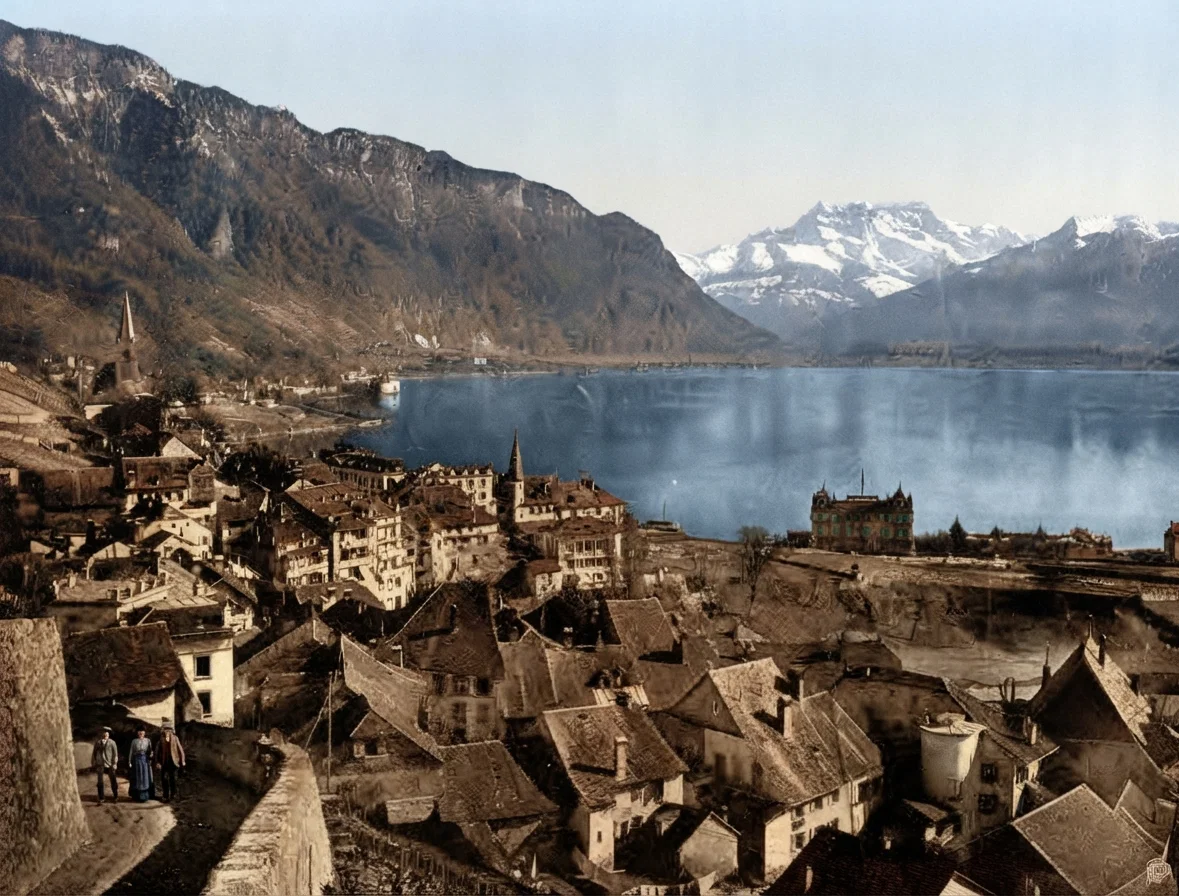
Montreux, on Lake Geneva, Mount Dent du Midi in the Distance.
They become partakers of the divine nature, and Christ lives in them. They regard all men as brethren, with similar aspirations, capacities, temptations, and trials, craving sympathy and needing assistance.
Never are we to humiliate a fellow being. When we see that mistakes have been made, we are to do all in our power to help the ones who have erred, by telling them of our own experience,—how when we made grave mistakes, patience and fellowship, kindness and helpfulness, on the part of our fellow workers, gave us courage and hope.
Harsh judgment is not becoming in those who themselves are continually making mistakes. Remember that you can not read hearts. You do not know the motives which prompted the actions that to you look wrong. Be afraid to disparage character. Let your hearts be sensitive to human need. Men may be brought into places where they need not only the help of kindly words, but the firm grasp of an outstretched hand. Give them the help they need. The time may come when your hands will be upheld by the hands of those to whom you have ministered.
There are those who have inherited peculiar tempers and dispositions. They may be hard to deal with, but, are we faultless? They are not to be disparaged. Their errors are not to be made common property. Christ pities and helps those who err in judgment. He has suffered death for every man, and because of this He has a deep interest in every member of the human family.
A man may be trying to serve God. But temptations from within and without assail him. Satan and his angels urge him to transgress. And perhaps he falls a prey to their temptations. How then do his brethren treat him? Do they speak harsh, cutting words, driving him farther from the Saviour? Let us remember that we are all erring human beings, struggling and toiling, failing in speech and action to represent Christ, falling and rising again, despairing and hoping. Let us beware of treating harshly those who, tho they have yielded to temptation, are like ourselves, the objects of Christ's unchanging love.
The Lord Jesus demands an acknowledgment of the rights of every man. Men's social rights, and their rights as Christians, are to be taken into consideration. They are to be treated with refinement and delicacy, as the sons and daughters of God. This matter is not left to our own choice. The life and lessons of Christ have converted it into an obligation that we must discharge as an act of loyalty to God. The natural impulses of the heart must be changed for impulses of Christ. Feelings of love and good-will must control us.
"Whatsoever ye would that men should do to you, do ye even so to them." "Be kindly affectioned one unto another with brotherly love; in honor preferring one another." "Be ye all of one mind, having compassion one of another, love as brethren, be pitiful, be courteous; not rendering evil for evil, or railing for railing; but contrariwise blessing, knowing that ye are thereunto called, that ye should inherit a blessing."

RECEIVING LIFE AND TRUSTING THE GIVER.

BY WILLIAM COVERT.
DAVID says, "The righteous shall flourish like the palm tree; he shall grow like the cedar in Lebanon." Ps. 92: 12. Every tree that grows depends wholly upon the elements which nature has provided for its sustenance.
Among the trees most remarkable for getting life and keeping it, are the cedars of Lebanon. The cedar can feed where other trees starve, and can flourish under circumstances very unfavorable to growth. Its graceful forms are pleasing to behold, and its evergreen boughs are emblems of immortal life. The drought can not pale their verdant hue nor shut them from the hidden springs. As the cedars are kept by the life provided for them, so may Christians drink from the Fountain of Life, tho it be unseen by human eyes.
Many fail to enjoy what God desires to bestow, because they feel unworthy of the proffered gift. They actually think the promises of God can not be realized by mortals here below. Their own self-abnegation deprives them of heaven's offered bounties.
An impressive illustration of the way in which many refuse to receive the blessings which love provides, is found in the history of Sojourner Truth, a colored woman, who became renowned for her great faith in the Lord. For more than forty years of her early life she had served as a slave in one of the Eastern States. When her freedom was procured, she could not easily comprehend its significance. For a time after her emancipation she was very needy. While in this destitute condition some charitable friends procured for her a pleasant room, and provided it with a comfortable bed. She was then made mistress of the place, and invited to enjoy it as her own home. They supposed that she would most cheerfully accept the comforts proffered. But they were greatly disappointed; for when the hour for retiring came, she lay down under the cozy bed, instead of reposing upon it. She could not believe that such excellent comforts were intended for a person who had been a poor slave. In her former state of life she had probably been used to sleeping on the floor, with a rug for a bed, and so could not readily appropriate the luxurious gift.
Christians often doubt the beneficence of the Redeemer, and refuse to enjoy the blessings which He has freely prepared for them. Like Sojourner Truth, they think it needful still to endure the hard usage of their former master.
But every one rescued from the bondage of sin should fully enjoy the gift of life and citizenship in the divine kingdom. To dwell upon one's own failures, and insist upon wearing the garments of human invention, is to turn away from the life and righteousness of Christ, and be lost at last.

Simply Trusting.

A pleasing instance of a child's trust in its father, and one that gives Christians an impressive picture of how they should cast all their cares upon God, recently occurred among the Alps.
A party, while searching these rugged mountains for wild flowers, discovered a very desirable specimen growing at the base of a precipice five hundred feet below the place where they stood. They had no means at their command by which they could get possession of the flower, tho they coveted it very much.
Upon looking around they discovered a small boy, a shepherd's son, not far away. They approached the child, and offered to give him a dollar if he would permit himself to be let down by a rope over the precipice, to procure the flower. They promised that he should be safely lowered, and then returned to the mountain top, by their own hands.
But the boy refused. They then offered him two dollars, and said they would make the rope perfectly secure, and that, as they were strong and able to assure his safety, he could receive no injury in doing the service. Still he refused. They offered him three dollars, but without avail. Then they offered four, and finally raised the bid to five dollars.
The thoughtful little fellow then requested them to wait until he could see his father about the matter. The father came, and with his own hands made the rope secure about the body of his son. When the travelers wished to assist the father in his hazardous task, the boy refused their help—he wanted only his father's hands to hold the rope.
When he returned in safety with the beautiful flower, and had received the money promised, the men asked why he was afraid to risk himself with the rope in the hands of three men, when he showed no fear while it was held by only one.
He replied that his father had held the rope, and him he knew; but they, the travelers, were strangers to him, and he knew not how much they would expose themselves to save him, if in the event he had been in danger. "But," said he, "I knew my father would have gone over the rock with me, and been killed, rather than let go his hold on the rope."
As this shepherd's boy could, with the fullest confidence, trust himself in the strong hands of his father, while going down into the yawning depths, so should the child of faith yield himself without reserve into the hands of the great Shepherd, who really did give His life for the sheep.
Whoever knows Jesus as fully as this little boy knew his father, will not be afraid to trust Him. They only want to be conscious of the fact that His hand holds the rope upon which hangs their destiny. They, too, like the shepherd's son, will be afraid to trust strangers; but in the hand of Jesus they will fear no evil. With His strength upholding, they can procure the most precious treasures, or even go down into the dark valley: for He will surely bring them up again.

THE PERSONALITY OF GOD.

BY L. D. SANTEE.
THE faith of good men has, in all ages, clung lovingly to the personality of God. Said Chas. H. Spurgeon, "No heart can rest without a personal God." Gladstone, when asked, "What is the greatest hope for the future?" answered, "A living hope in a personal God." Says Professor Garbett ("Infidelity," p. 91), "It is clear that anything that does not possess personality, must be inferior to ourselves." We approach this subject reverently, and yet with confidence, for "those things which are revealed belong unto us and to our children forever." Deut. 29 : 29.
Perhaps one of the most insidious enemies that the Christian religion has to meet, is that belief that considers God as the "life principle in nature." It does not create the prejudice of avowed infidelity, and yet its effects are the same. It is a sort of pantheism. Pantheism, as defined by Webster, is "the universe, as a whole, is God. The doctrine that there is no God but the combined forces and laws which are manifested in the existing universe." Many will discourse of "God, or nature." I wonder if they ever stop to think that all forces and laws are immaterial, inorganic, and, therefore, necessarily unconscious, insensible, and unintelligent. Such is the God that is only a principle. It has neither consciousness, sensibilities, nor intelligence. In sharp contrast with this is the God of the Bible. It isemphatic in declaring that God is a living personal being. In the Scriptures He is called "the living God" (not the life principle) thirty times. In the study of His Word, I read of His head, hair, throne, garment, feet, hands, voice, eyes, ears, face, mouth, heart, form, and person, and in every one of these texts I find the evidence of a personal God.
Well has Bishop Balgarnie remarked, "We are driven to the conclusion that there was a form of God from all eternity, and that man was created in the 'image and likeness of that form divine.'"—Homiletic Review, p. 301. Paul, when speaking of Christ, says He was "the express image of His [God's] person." Heb. 1:3. How could this be true if God is not a person? The Imperial Dictionary: "person: bodily form." It is said of Jesus that He was "in the form of God." Phil. 2:6.
I wish the thought to remain with us, that, without organization, there is no intelligence; without brain, there is no mind. When the record states that "God created man in His own image" (Gen. 1:27), it establishes the personality of God, just as really as that of man. His dwelling-place is also plainly stated. In 1 Kings 8 I read the prayer of Solomon at the dedication of the temple. In verse 30 he petitions, "And hear Thou in heaven Thy dwelling-place; and when Thou hearest, forgive." Again, in Deut. 26:15, Moses prays, "Look down from Thy holy habitation, from heaven, and bless Thy people Israel." One more testimony on this point. The prophet says, "I saw the Lord sitting on His throne, and all the hosts of heaven standing by Him on His right hand and on His left." 1 Kings 22:19. The Saviour taught His disciples to pray, "Our Father which art in heaven." From our study thus far, it is easy to conclude that God is a real, personal being, dwelling in heaven. It is also stated that "Christ sitteth on the right hand of God." Col. 3:1. God gave the sun, and its heat and light ripened the world's harvests. The heathen, in their darkness, believed that the sun was a god, and the system of sun-worship began. I read in Acts 17:25, "He giveth to all life, and breath, and all things." We don't want to make the mistake that the heathen did, and conclude that the life is God; for, like the sun, it is but one of His gifts. His attributes are often spoken of in connection with Himself. Hence, "God is spirit;" "God is love;" "Our God is a consuming fire," etc. We have some of the same attributes, but in an inferior degree. Were He inorganic, and therefore unconscious, we might well ask, as did the heathen, "Where is their God?" Ps. 79:10.
We wish to notice, before concluding this article, His omnipresence. How is it possible for a personal being to be everywhere present? The question is easy, for the Bible answers it. Says David, "Whither shall I go from Thy Spirit?" Ps. 139:7. As the rays of the sun give light over all the earth, so God, by His Spirit, can manifest His power in all parts of His universe without being personally present. Christ speaks of the Spirit of truth that "proceedeth from the Father." John 15:26. By this agency, God can dwell in every heart. Christ, tho His personality is undoubted, can fulfil His promise, "Lo, I am with you alway, even unto the end of the world." Matt. 28:20. May God give us a living faith in the One that has fashioned us in His likeness.

LIGHT AND THE EASTER LILIES.

BY LLEWELLYN A. MORRISON.
God is light, and where He dwelleth Night or darkness can not be; Pure, unsullied light dispelleth Every variant harmony; By its radiance germs have risen From the carnal and the clay,— Burst their bonds, unlocked their prison, Soared into the realms of day.
Every brain may build and brighten The pure ego in the breast; Yet the One who doth enlighten Cometh not alone as Guest, But abideth, Light and Leader, Sanctifying word and deed: Universal Interpleader For all apprehended need.
One with Him—the "Son," most holy, Put His greatness by, and then Came and dwelt among the lowly, Vile and sinful sons of men,— Took their form and nature on Him, Shared their burdens, grief, and pain: All their guilt was laid upon Him— Every bitterness and bane;
In their room and for them dying— Bearing all their curse and blight: Lo! He rose, death's power defying, Winning for them life and light. Through the rent "Veil" floods the glory— Light from central light, above: Easter lilies are a story, Set in white, of Jesus love. Toronto, Canada, 1903.

The Russo-Eastern Question Prophetically and Historically Considered

THE RUSSO-EASTERN QUESTION PROPHETICALLY AND HISTORICALLY CONSIDERED. NO. 2.

BY BRYN MAWR. (Continued.)
[The following exposition of the thirty-eighth and thirty-ninth chapters of Ezekiel is presented for the study of our readers. The writer feels the profound conviction that the views as set forth in the articles which follow are truth. For these views the editors are not responsible. The prophecy is an open one, one about which various opinions exist, and much uncertainty; therefore we give these articles space. Let the prophecy be carefully, prayerfully considered. If there are decided objections, let us hear from you. —ED. S. OF T.]
Gog, in pursuit of his own selfish ends, comes into the land brought "back from the sword." Considered in connection with Eze. 38:11, 12, there is no nation or country which meets the requirements of these scriptures except the United States. The only thing that causes a nation to be mentioned or considered in Holy Writ, is the connection of that nation with the "salt of the earth," God's people.
This country, then, while it was yet "waste places," received God's people from the clutch of the persecutor, and became an asylum where "they dwelt safely," and worshiped God according to the dictates of their own conscience. The prophet also foresaw that the "mountains of Israel" (Isa. 2:2)—places of worship—"always have been [heretofore] waste;" that is, until the "Israel of God [His people] came in." Given over to savage, barbarous idolatry, the country was waste indeed! Isa. 42:15. He foresaw the people of God dwelt safely, till their liberties were again threatened; till the fires of Revolution, forced upon them, broke forth, and the land—America—was brought "back from the sword."
And again he foresaw, after many days—nearly a century later—the same land rescued from the throes of rebellion, for sweet Liberty's sake—truly brought back from the sword.
It was "gathered out of many people;" and again, it is "brought forth out of the nations"—surely a graphic description of the birth of this nation, and most peculiarly true of this nation. And they—"God's people"—"shall dwell safely," for God will move the universe before harm shall come to a single soul that puts his trust in Him. See Psalms 57 and 91; Deut. 33:27-29.
Verses 9-16: "Thou shalt ascend and come like a storm, thou shalt be like a cloud to cover the land, thou, and all thy bands [hordes, R. V.], and many people [allies] with thee.
And thou shalt come from thy place out of the north parts, thou, and many people with thee, all of them riding upon horses, a great company, and a mighty army; and thou shalt come up against My people of Israel, as a cloud to cover the land; it shall be in the latter days, and I will bring thee against My land, that the heathen may know Me, when I shall be sanctified in thee, O Gog, before their eyes."
Verse 15 is an interpretation of verse 9, in that it describes the place from, and the manner in, which he shall come. In verse 9 he "ascends;" in verse 15 he comes out of the uttermost parts of the north—Siberia,—showing plainly that he will bring "his hordes" from the "sides of the north," via Siberia, Alaska, etc., "like a storm," suddenly, with little warning, and with the rapidity and fury of "a storm," "like a cloud to cover the land." A cloud, whatever its size, does not stand still, but covers the land as it moves with the momentum of the storm.
"I will bring thee." God sometimes causes kings, or nations, through their rulers, to do His will (Rev. 17:17), "that the heathen may know Me [See Rev. 14:7], when I shall be sanctified." See Eze. 36:23; 28:25—equivalent to saying, "Before My people Israel, whom thou seekest to destroy, I will be sanctified by thy tardy acknowledgment of My word and power."
Verse 10: "Thus saith the Lord God; It shall also come to pass, that at the same time [in the latter years, or in the time of the end, at that day, R. V.] shall things come into thy mind, and thou shalt think an evil thought" (margin, "conceive a mischievous purpose"). This is an eminently correct description of Russian policy toward the rest of the world, especially of the weaker contiguous nations, or those who act as a bar to her schemes.
Verse 11: "And thou shalt say, I will go up to the land of unwalled villages; I will go to them that are at rest, that dwell safely [margin, "confidently"], all of them dwelling without walls, and having neither bars nor gates." In Ezekiel's day there was no nation that could be distinctively spoken of as a nation of "unwalled villages," nor were any towns, cities, or villages of his time without "walls," "bars," or "gates." Nor is there now any modern nation in any land but can show ruins of defenses—"walls," "bars," and "gates"—save one, and that one, America; or, more definitely, the United States. Of no other nation can it be said—in the same sense—that they are "at rest,"-in peace,-or unmolested,-dwelling "confidently,"-too confidently, perhaps, for real safety; for it is often an American boast that "no five nations could whip her on her own ground." And yet a day of humbling awaits "proud Columbia."
Verse 12: "To take a spoil, and to take a prey; to turn thine hand upon the desolate places that are now inhabited, and upon the people that are gathered out of the nations, which have gotten cattle and goods, that dwell in the midst of the land." Her purpose is to prey upon those so confident of their own strength and prowess, and despoil them of their accumulated wealth. If the prophet were living with us now he could not have given a better description of the great American industries,—"cattle and goods,"—great cattle ranges, with millions of cattle and horses and sheep (all come under the head of cattle), and immense factories producing millions of dollars in goods annually; and the largest mining interests in the world, producing millions in "gold and silver," as mentioned in the next verse. Desolate places;—i. e., when the prophet wrote these things, this country was most desolate; but now, in the day of fulfilment, those places are inhabited. He also gives us another mark of identification for this nation, it is gathered out of all other nations, to being one of the most prominent characteristics of this country; no other nation can successfully lay claim to this distinguishing feature. And this nation, that is gathered out of "all other nations," "dwells in the midst of the land;"—which expression almost exactly describes the geographical position of this country, relative to the whole continent.
Verse 13: "Sheba, and Dedan, and the merchants of Tarshish, with all the young lions thereof, shall say unto thee, Art thou come to take a spoil? hast thou gathered thy company to take a prey? to carry away silver and gold,to take away cattle and goods, to take a great spoil?" Sheba and Dedan, sons of Raamah, originally located in southern Arabia; later their descendants intermingled with the Semitic race, from which sprang the ancient Phoenicians. Sheba signifies "red man," or "turned red." At some time not definitely known, their descendants found their way to this continent, and settled in what is now known as the South American nations, and Mexico; and were conquered later by the Spaniards; and, by forms of worship (idolatry), architecture, and other archeological discoveries ethnologists have connected the American races overthrown by the Spanish in the sixteenth century, with these progenitors.
"Tarshish" was the ancient name of Spain as known to the Hebrews, and Ezekiel undoubtedly saw in the Tarshish of his time the Spain of the fulfilment of his prophecy, for he assuredly wrote only what he saw in the Word. Anciently the merchants were a ruling class as compared with the common people. And the merchant princes of Ezekiel's day are the "Dons" of to-day.
Significant and curious indeed is the fact that when Spain conquered the ancient Americans, she made war upon her own flesh and blood, and she, again commingling with them, later produced the Latin American nations, or "the young lions of Tarshish"—whelps of Spain—that Ezekiel saw were so amazed that they stand aghast at the audacity of Gog (Russia); hence the covert sneer. Another word in regard to the "spoil." The United States is fabulously rich in all the things enumerated above, and many other magnificent industries (Eze. 19:2-3) that would come under the head of a "great spoil," or "indemnity."
In verses 14 and 17 the Lord rebukes Gog with a comparative view of his insignificance and pretensions. "Therefore, . . . in that day when My people Israel dwelleth safely, shalt thou not know it?" We may as well present the fact here that the Israelitish nation is not meant by the expression, "My people Israel," but "My people Israel" contingently "dwelleth safely," at a certain time—"that day,"—in a nation that guarantees religious liberty. And in "that day" Gog comes against that nation "like a storm," to "take a spoil." After "that time" there will be no religious liberty; but it will not matter to God's people; for it is then that the end will have come; and God will deliver His people, every one whose name is written in the "Lamb's book of life." Rev. 21:27.
Verse 17: "Art thou he of whom I have spoken in old time by My servants the prophets of Israel, which prophesied in those days many years [ago] that I would bring thee against them?" It was long ago "spoken" of him, but the time of fulfilment is come, and Russia is identified as Gog of whom the things were spoken. And in the presence of My people the whole world shall acknowledge that "I am the Lord."
Verse 18: "And it shall come to pass at the same time when Gog shall come against the land of Israel, saith the Lord God, that My fury shall come up in My face." One would not be very angry if the anger did not show in the face; and one can not be full of "fury" and not show it in the face, and the Lord uses this familiar simile to show that His wrath is not dormant any longer, but is in action. Undoubtedly this is Ezekiel's view of the "Third" Angel's Message. Rev. 14:10.
Verses 19-23: "For in My jealousy and in the fire of My wrath have I spoken, Surely in that day there shall be a great shaking in the land of Israel; so that the fishes of the sea, and the fowls of the heaven, and the beasts of the field, and all creeping things that creep upon the earth, and all the men that are upon the face of the earth, shall shake at My presence, and the mountains shall be thrown down, and the steep places shall fall, and every wall shall fall to the ground. And I will call for a sword against him [Gog] throughout all My mountains, saith the Lord God; every man's sword shall be against his brother. And I will plead against him [Gog] with pestilence and with blood; and I will rain upon him, and up on his bands, and upon the many people that are with him, an overflowing rain, and great hailstones, fire, and brimstone. Thus will I magnify Myself, and sanctify Myself; and I will be known in the eyes of many nations, and they shall know that I am the Lord."
Beginning at verse 18, having seen that the Lord's anger is the final wrath which ends this world's history, and continuing with verse 19, in which begins a terse, compact description of the seven last plagues (more fully described by John in Revelation 16), the "great shaking in the land of Israel," whatever its "spiritual" application, is too palpably literal to be set aside on that ground, and is applied and explained by the Lord Himself in verse 20. It is evident that the "land of Israel" is the whole earth,—once typified by Palestine, or the Holy Land. The scenes described in verses 20-22 are the visitation of the last plagues and the culmination of the seventh. Verse 21 very amply sets forth the arming and universal engagement of all nations on the field of Armageddon (Rev. 16:16-21), a place of "slaughter," the root meaning of the word being "to cut off." Prov. 2:22; Ps. 37:34; Isa. 11:4; 66:15, 16; Jer. 25:30-33.
The above Scripture references are sufficient to define the nature of the controversy Ezekiel had in view. "Of one blood made He all nations;" so with all nations at war, it will be literally true that "every man's hand shall be against his brother."
Verse 23. In this manner, that is, by the awful events just enumerated, God will show forth His power and glory, and be sanctified by the acknowledgment of all that He is the Lord; for none in whom they trusted is able to deliver them out of His hand. But this acknowledgment of the one true God, and the vindication of His Word, that has so often been rejected and spurned with revilings, comes too late; for the "day of salvation" is over-past. Too late! for the edict of Rev. 22:11 will then be in full force and effect, without a possibility of changing; the great voice of Omnipotence has spoken, "It is done."
(Concluded next week.)

The Seeds of Patronage

"A POLITICIAN is always liberal with the seeds of patronage if you promise him the ripe plums."

SEARCH THE SCRIPTURE

NUMBERS.

THIS book is called "Numbers" because it contains the record of the numbering of the people. The name was given it by the Greek translators of the Old Testament, in producing the Septuagint, about B. C. 300. The Greek name is Arithmoi, from which word comes our term "arithmetic," and, indeed, in this book we have considerable inspired arithmetic. The census of the people was twice taken, once soon after coming out of Egypt, and again just before entering Canaan. The thirty-six chapters of this book very nearly cover the thirty-eight years between these enumerations. It is interesting to compare the two numberings of Israel. The number of adult males in the entire nation had not changed much during the interval, but the numbers of the several tribes had changed considerably, as will be seen by the following table:—
Number Soon after Number Nearly Increase. Decrease.
Leaving Egypt. 40 Years Later.
Reuben, 46,500 43,730 2,770
Simeon, 59,300 22,200 37,100
Gad, 45,650 40,500 5,150
Judah, 74,600 76,500 1,900
Issachar, 54,400 64,300 9,900
Zebulun, 57,400 60,500 3,100
Ephraim, 40,500 32,500 8,000
Manasseh, 32,200 52,700 20,500
Benjamin, 35,400 45,600 10,200
Dan, 62,700 64,400 1,700
Asher, 41,500 53,400 11,900
Naphtali, 53,400 45,400 8,000
Totals 603,550 601,730 59,200 61,020
Many items of interest may be gleaned from a study of this table. The most remarkable decrease is seen in the tribe of Simeon, which shrank almost two-thirds in size. The most pronounced growth is in the tribe of Manasseh, which increased almost two-thirds its former size. If we should look for some explanation of this, we might find it in the words of the patriarch Jacob, in his dying blessing upon his children. Concerning Simeon and Levi, he said they should be divided in Jacob, and scattered in Israel. This was fulfilled in withholding from Levi any tribal division of the territory of the promised land, and scattering the Levites in all the tribes of Israel to perform priestly duties, and we see the fulfilment also in the notable decrease in the tribe of Simeon. The enumerations are found in chapters 1 and 26.
The vital importance of becoming acquainted with the lessons of the book of Numbers, is shown us in 1 Cor. 10:1-11. We see from this that God is not pleased to have us ignorant of this ancient history. Events are mentioned here that the apostle says were written for our admonition upon whom the ends of the world are come, "to the intent we should not lust after evil things, as they also lusted." Five different historical items are given in verses 6-10, in which the people committed serious and gross errors. Of these five, four are recorded in the book of Numbers. If we fail to read and study this book, the consequence will be that we will be liable to commit the same mistakes that Israel did, against which we are warned, and thus be guilty of fatal errors. Let us not risk so much.
Among the topics of deep interest to be found in this book we may mention a few, such as the arrangement of the camp with such regularity (By this we see that God is indeed a God of order, and does not take pleasure in confusion.); the appointment of the seventy elders to assist Moses; the jealousy of Aaron and Miriam toward Moses; the searching of the land of promise by the twelve spies; the evil report of the majority and the good report of Caleb and Joshua; the rebellion of Korah, Dathan, and Abiram; Moses' sin in speaking unadvisably when he smote the rock, and the serious consequences of that mistake, etc. But we must not fail to notice the remarkable history of Balaam, as given in chapters 22-24. Here we have an instance of that condition mentioned by Paul in 1 Cor. 13:2, of a person having the gift of prophecy, and yet not having love. To prove that Balaam gave true predictions, we have only to examine such passages as Num. 23:9, 10; 24:17. To show what his character was, we turn to 2 Peter 2:15, 16; Jude 11; Rev. 2:14. There is an important lesson for us in his history. God is the Author of numbers, the Author of arithmetic.
In Dan. 8:13 (margin) Christ is called "the Numberer of secrets, or, the Wonderful Numberer." And, indeed, what a wonderful numberer He is! "The very hairs of your head are all numbered." Matt. 10:30. "He telleth the number of the stars." Ps. 147:4. "For now Thou numberest my steps." Job 14:16. We need to learn from Him the science of numbering. "So teach us to number our days, that we may apply our hearts unto wisdom." Ps. 90:12. "Lord, make me to know mine end, and the measure of my days, what it is; that I may know how frail I am." Before long it will be said of us, as of the Babylonian monarch, "God hath numbered thy kingdom [or life history], and finished it." Dan. 5:26. But before that decree shall pass, may we learn from God's Word, as a whole, and from the book of Numbers, in particular, what conditions are necessary in order for us to be numbered with the host of Israel when the final census or enumeration is made. "The Lord shall count, when He writeth up the people, that this man was born there. Selah." Ps. 87:6.
"As Moses lifted up the serpent in the wilderness, even so must the Son of Man be lifted up." John 3:14. These words may be considered as furnishing the key-note of the book of Numbers, the central theme around which its other topics cluster, for it is this book that presents to us the interesting account concerning the brazen serpent. The serpent on the pole—Christ on the cross. Wherein lies the analogy? Of the one it was said, "Every one that is bitten, when he looketh upon it, shall live" (Num. 21:8); the Other says, "Look unto Me, and be ye saved, all the ends of the earth" (Isa. 45:22). We can understand why Christ should be represented by the innocent lamb and animals of like nature, but how can He be fitly represented by the serpent, the beast that is the symbol of Satan? We see in this to what degree our Lord descended in order to rescue us. He was "made a curse for us; . . . cursed is every one that hangeth on a tree." Gal. 3:13. "He that is hanged is accursed of God." Deut. 21:23. "He hath made Him to be sin for us, who knew no sin; that we might be made the righteousness of God in Him." 2 Cor. 5:21. Jesus experienced that which Paul said he could wish for himself; accursed for his brethren. Rom. 9:3. Made a curse for us, made sin for us! What a thought! What condescension! How aptly prefigured by the serpent on the pole! But in this, as in many other cases, so many saw only the material representation, and not the real
spiritual truth designed of God for them to consider. Centuries later we find the pious king Hezekiah abolishing the worship of this piece of brass. He "brake in pieces the brazen serpent that Moses had made; for unto those days the children of Israel did burn incense to it." 2 Kings 18:4. A very important lesson for us not to put material types and forms in the place of the real divine presence.
NUMBERS
NUMBERS

A HELP TO THE LOVE OF GOD.

Our Lord gives the answer to a difficulty continually perplexing honest Christians—"How am I to learn to love God? I want to do my duty, but I do not feel as if I loved God." Our Lord gives the answer, "Where your treasure is, there will your heart be also."
Act for God, do and say the things that He wills: direct your thoughts and intentions Godward; and, depend upon it, in the slow process of nature, all that belongs to you—your instincts, your intelligence, your affections, your feelings—will gradually follow along the line of your action. Act for God; you are already showing love to Him, and you will learn to feel it.—Charles Gore.
Continue reading: MEATS THAT ARE GOOD