Your ShelfYour Projects

Signs of the Times, Vol. 37, No. 20.

The Coming King of Glory

Signs of the Times

May 24, 1910

Pacific Press Publishing Association · Mountain View, California · May 24, 1910

The Coming King of Glory

"When the Son of Man shall come in His glory, and all the holy angels with Him, then shall He sit upon the throne of His glory." Matt. 25:31.
"If we died with Him, we shall also live with Him, if we endure, we shall also reign with Him." 2 Tim. 2:11, 12, R. V.
Earthly kings die; our coming King shall reign forever.
"There is a King of glory, Ere long on earth to rise, Sung in prophetic story, Descending from the skies; The Babe of Bethlehem, 'tis He: It is the Man of Calvary,— Not crowned with thorns and gory, But crowned with glory now! Not crowned with thorns to-day, Not mocked and led away, But crowned with everlasting glory now!"
"He cometh, cometh speedy, To save His suffering saints,— Saints groaning, waiting, ready,— And endeth their complaints; With joy they meet Him in the air, And shout the swelling triumph there; No longer poor and needy, But crowned with glory now! Not one’s reviled to-day! None stumble in the way— All crowned with everlasting glory now."

The Coming King of Glory

"When the Son of Man shall come in His glory, and all the holy angels with Him, then shall He sit upon the throne of His glory." Matt. 25:31.
"If we died with Him, we shall also live with Him, if we endure, we shall also reign with Him." 2 Tim. 2:11, 12, R. V.
Earthly kings die; our coming King shall reign forever.
"There is a King of glory, Ere long on earth to rise, Sung in prophetic story, Descending from the skies; The Babe of Bethlehem, 'tis He: It is the Man of Calvary,— Not crowned with thorns and gory, But crowned with glory now! Not crowned with thorns to-day, Not mocked and led away, But crowned with everlasting glory now!"
"He cometh, cometh speedy, To save His suffering saints,— Saints groaning, waiting, ready,— And endeth their complaints; With joy they meet Him in the air, And shout the swelling triumph there; No longer poor and needy, But crowned with glory now! Not one's reviled to-day! None stumble in the way — All crowned with everlasting glory now."

"IF YE WILL INQUIRE, INQUIRE YE."

This Inquirers' Department is conducted for the purpose of helping those who are studying the Bible. The answers are oftentimes only suggestive. They are never to be considered infallible, only as they agree with the infallible Word. The writer who may answer them does not consider that his opinion is infallible. He will simply give the best that he has, and plead with the inquirer to search the Word. Such questions only will be answered as, to the editors, seem to minister to the good of the readers and to the mission of the paper. We can not answer repeatedly in the same volume questions upon the same scripture. The name and address must accompany question, not for publication, but as an evidence of good faith, and that answer may be made by letter if deemed advisable. No letters are answered which do not contain the name of the writer. It is well always to enclose stamp for reply.

3132.— When Our Lord Met with His Disciples

Will you kindly explain on what day of the week our Lord Jesus met with His disciples? John 20:19.
When the disciples themselves met together is very clearly shown. That was the evening of that first day of the week. The first evening of the day began about three o'clock and closed at sunset. Whether our Lord met with them during any part of that three hours is quite questionable indeed; for we read in Luke 24 that two of the disciples went to Emmaus, about seven and one half or eight miles from Jerusalem; that when they reached there they asked Jesus to come in and tarry with them because "the day is far spent." Luke 24:29. He stayed there with them for some time while they prepared their meal and ate it. He then made Himself known to them, and they arose up the same hour and returned to Jerusalem. The day must have been passed when they reached there. Ordinarily they would not walk the eight miles in any less than two or two and one half hours. Jesus accompanied them on the way. They tell their story, and immediately afterward He appears to them. So it would seem to us that when He appeared in their midst and spoke to them as He did, the first day had passed and the second day had already begun. This meeting is also referred to in Mark 16:12-14. The disciples had gathered to this place of meeting not as an appointment, but because this was their regular place of living in Jerusalem, for we learn by Acts 1:13 that they had a common abode. They had simply gone home at the close of that first day; and while there together in a gathering which began before the first day closed, Jesus later met with them.

3135.— Where We Got Our Bible

I would be grateful for a little information respecting the Bible and how we came by it. Is the Catholic claim true that they gave us the Bible? S. H.
1. The Old Testament canon was compiled by Ezra and Nehemiah, and the Jews held it as we have it at the present time.
2. The New Testament may be said to have come to us from the days of the apostles. The Gospels and the Epistles were read by the churches and generally received. There is what is called the Latin fragment published by Muratori in 1740 which gives almost a full list of the New Testament Scriptures from a writer who describes himself as contemporary with Pius, a bishop of Rome about A.D. 150. A similar list may be made out from the Syriac version, which can hardly be later than the second century. Athanasius, who lived between 296 and 373 A.D., enumerates unhesitatingly all the Scriptures of the New Testament as we have them now, and so do the Latin scholars Augustine and Jerome. In the Sinaitic manuscript of the fourth century the New Testament is entire. This was before backsliding had deepened into the great apostasy. Now in Catholic convents, in Catholic libraries, in various forms the books of the Scripture in valuable manuscripts have been preserved, but the origin of those manuscripts we do not owe to the Catholic Church. The preservation of some of these manuscripts in a way we do, just the same as we owe the Old Testament Scriptures to the Jewish people who apostatized from God. In all their gross idolatry, when they were stoning His prophets and even crucifying our Lord, they were still preserving the Scriptures. Yet some of these ancient and valuable manuscripts preserved in convents and libraries have really been unknown to the church as such. Some of them have been found within the last century or so. But when it is said that the Roman Catholic Church gave us our Bible, this is not true. The Bible has been preserved by them, but its origin is not in the church.

3131.— The Wandering Jew

Will you please give me some information in regard to the wandering Jew? L. S.
The term "wandering Jew" is wholly legendary. It appeared for the first time in German literature in a small pamphlet in 1602. Before that time no trace can be found of it in Germany. The pamphlet pretended to be a report of an interview between a bishop and a wandering Jew which took place in Hamburg in 1542. This wandering Jew's name was Ahasuerus. He claimed to be a shoemaker in Jerusalem at the time of Christ. When Jesus was on His way to Golgotha, He passed by the house of this shoemaker, and stopped for a moment leaning against the door-post, when Ahasuerus pushed Him aside and bade Him move on. Jesus said to him, "I will stay here and rest, but thou shalt go on until the last day." From that moment Ahasuerus found rest nowhere. The tale goes on to say that he wandered about from place to place; had been seen in Spain, Germany, and other places.
There is another tradition of it, and that is that a Jew called Kartaphilos, the doorkeeper of the judgment-hall in the service of Pontius Pilate, struck our Lord as he met Him, saying, "Go on faster, Jesus!" whereupon our Lord replied, "I am going, but thou shalt tarry till I come again." This tradition is that he falls into a trance at the end of every hundred years, and wakes up a young man about 30.
There is a third legend which declares that it was Ananias the cobbler who hailed Jesus before the judgment-seat of Pilate, saying, "Faster, Jesus, faster." The last appearance of the wandering Jew was said to be in 1774. Croly in his story has one Salathial, the wandering Jew; and there are other stories beside. It has no basis of fact in connection with it at all, unless it be typical of the race of the Jews themselves, and of the words of the prophet which described them as wanderers among the nations.

3133.— Falling Backward

Will you please explain the meaning of the latter part of Isa. 28:13? Does it mean that in studying according to verse 10 we shall be snared or entrapped?
The verse must be taken with the context. Its local application was to the ten-tribed kingdom. They had turned away from God; their very elders had erred through wine or strong drink and were out of the way. God had given them precept upon precept, line upon line, here a little and there a little, and yet had pointed out the way of rest and assurance; but they had rebelled against all these things, and so rebelling against God were left without excuse. The thought is not that God ensnares them or entraps them, but by hardening their heart against God they place themselves in a way where they will themselves be ensnared by the enemy. How they are ensnared is shown in the following verses. They said, "We have made a covenant with death, and with hell are we at agreement." None of the judgments will touch us. But their very assurance proves their destruction. Just as long as men sin against God, and turn away from His precepts, they go on blindly to their destruction and reveal what is in their hearts.

3134.— Greater than John the Baptist

In Matt. 11:11 it is stated that the least in the kingdom of heaven is greater than John the Baptist. As there can be no less than the least, how can John the Baptist, altho sent of God, be a member of that kingdom at all?
If our querist will read the context and related scriptures, he will see that our Lord has reference to the work which John the Baptist predicted,—the coming and work of our Lord Himself, and the kingdom of grace, which was then greatly augmented by Christ's first advent. The least of those who lived under the wonderful instruction of Jesus and the fuller light and blessings of Christianity, was greater in point of privilege and opportunity than was John. This is all, seemingly, to which it refers. We are told, on the other hand, that there was no prophet greater than John. He had one great privilege, and that was, to be the immediate forerunner of Christ Himself. But that meant also that his own work and influence must dwindle away until it was utterly lost in the greater glory of Christ's work. In his character and in his mission he was great. In his opportunity and his privileges he was small, so that the least of those who listened to Christ and were blessed under His ministration was greater in this respect than was John.

Women’s Role in Christian Service

3137.— W. P. M. L.— 1 Tim. 2:11, 12; 1 Cor. 14:34.— There are some of these admonitions which the apostle gives which pertain to his own time, and to conditions which then obtained but do not now. There are principles, however, involved in the Word, which Christians in all times and ages can take home to their heart. There were customs in the idolatrous world around and in Corinth that it was not proper for women to follow, and at no time should they make themselves boisterous, immodest, arrogant, or assume to lord it over others. These are the things which the apostle condemns. These are principles which ought to obtain now. That the text does not mean that women should not testify for Jesus Christ, should not be employed as teachers in Sabbath-school and in all proper places for the Lord, is shown in various parts of the history of the apostle Paul's labor. Among his associates in the Gospel were Phœbe and Priscilla, and Priscilla was a teacher. The apostle gives instruction in the 11th chapter of First Corinthians as to how women should dress when they prophesied or taught. This has been answered many times in the past. There is no need of borrowing any trouble regarding it. Every truly Christian woman should know her place in the Lord's work, and every truly Christian man ought to be willing to see the Lord's plan operative in the employment of all His children, whether male or female. See Acts 2:17, 18.

3136.— Building a Fire on the Sabbath Day

Kindly say whether the instruction of Ex. 35:3 is still binding. C. R. M.
Evidently the instruction there given had to do with the wanderings in the wilderness wholly. It was a warm land; they needed no fire for comfort. Afterward, when they were settled in Palestine, the case was different. They had all kinds of climate nearly, from the northern snows of Hermon to the warmer section down near Egypt. God is not against His children; He is for them. God does not design to deprive them of that which is necessary for physical well-being. The Sabbath was not made to be a burden, but a blessing. Our Lord interprets it truly when He says, "The Sabbath was made for man," not against him. But the principles that are set forth in Exodus 16 and Isa. 58:13 certainly ought to have a bearing upon its observance by Christians. Just as far as possible, they ought to bake what they can bake and boil what they can boil on time previous, that no unnecessary work be done on that day. All work for the necessities of humanity ought to be minimized in order that there may be more time for the honor and worship of God.

Light-Bearers

By Mrs. E. G. White
THE only light that can illuminate the darkness of a world lying in sin, must come from Christ; and this light is granted to all who will receive it. For, said the great Teacher, "He that followeth Me shall not walk in darkness, but shall have the light of life."
Those who receive the divine radiance are in turn to become light-bearers to the world. Thus our Saviour taught His disciples: "Ye are the light of the world. A city that is set on a hill can not be hid. . . . Let your light so shine before men, that they may see your good works, and glorify your Father which is in heaven."
Religion is not to be held as a precious treasure, jealously hoarded, and enjoyed only by the possessor. True religion can not be thus held; for such a spirit is contrary to the very principle of the Gospel. "Freely ye have received, freely give," are the words of our Master; and again He bids us, "Love one another as I have loved you." If Christ is dwelling in the heart, it is impossible to conceal the light of His presence; it is impossible for that light to grow dim. It will grow brighter and brighter, as day by day the mists of selfishness and sin that envelop the soul are dispelled by its bright beams.
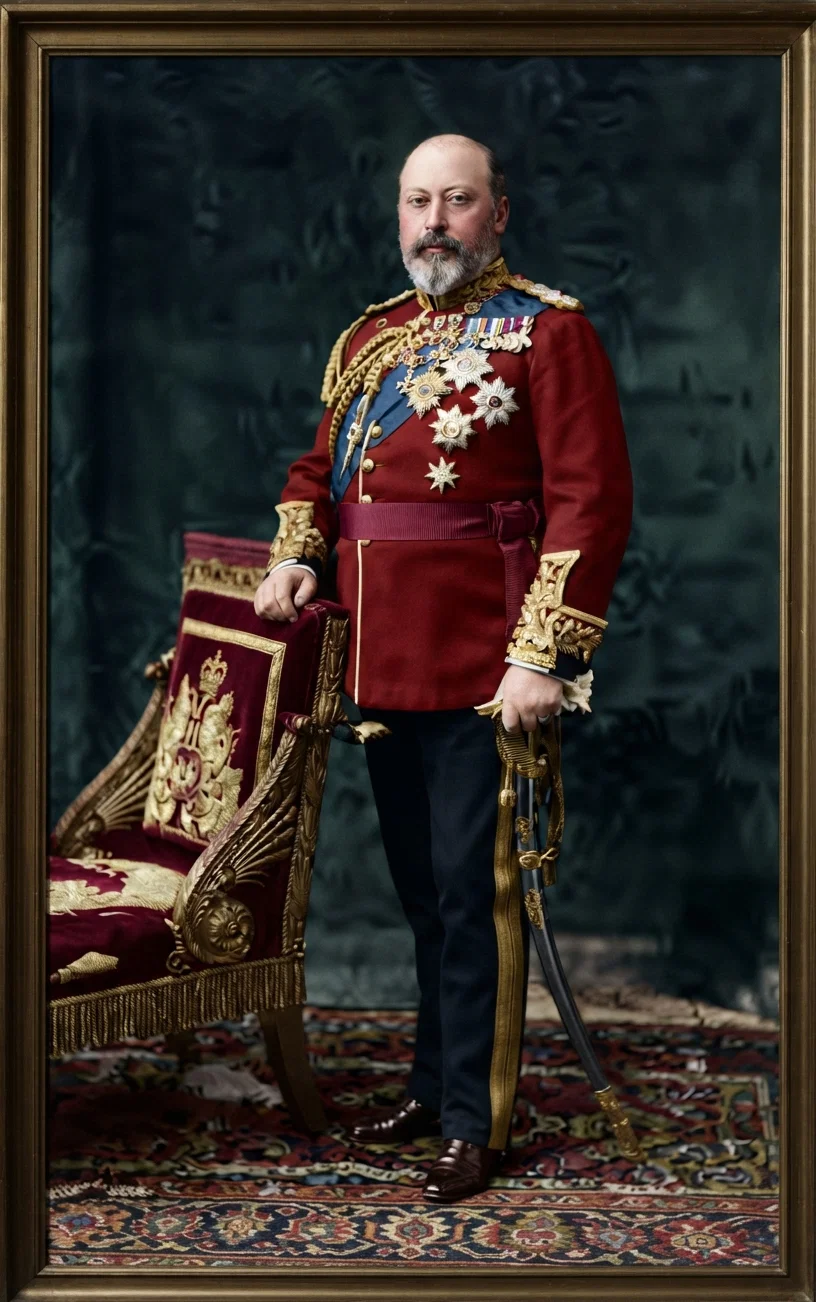
The Late King Edward in State Dress

The Need of Shining Lights

The world lies in darkness. All around us there are souls going down to ruin and death. As Christ sheds the light of His love upon His followers, they are to reflect this light upon others. God's Word declares that the children of this world are wiser in their generation than the children of light. The zeal and steadfastness of the lighthouse keeper, in his efforts to save men from destruction, put to shame the faith and devotion of many a professed Christian.
A story is told of the watchman at Calais lighthouse. He "was boasting of the brilliancy of his lantern, which can be seen ten leagues out at sea, when a visitor said to him:
" 'You speak with enthusiasm, sir, and that is well. I like to hear men tell what they are sure they have and know; but what if one of the lights should chance to go out?'
" 'Never, never! Absurd, impossible!' replied the sensitive watchman, in consternation at the mere supposition of such a thing. 'Why, sir,' he continued, and pointed to the ocean, 'yonder where nothing can be seen, there are ships going by to every port in the world. If, to-night, one of my burners were out, within six months would come a letter, perhaps from India, perhaps from Australia, perhaps from some port I never heard of before,—a letter, saying that on such a night, at such an hour, at such a minute, the light at Calais burned low and dim; that the watchman neglected his post; that vessels were consequently put in jeopardy on the high seas. Ah, sir,' and his face shone with the intensity of his thought, 'sometimes, in the dark nights, and in the stormy weather, I look out upon the sea, and feel as if the eye of the whole world were looking at my light. Go out? Burn dim? That flame flicker low or fail? No, sir, never!'"

Shine for Christ

"Shall Christians, shining for tempted sinners, allow their light to fail? Forever out upon life's billowy sea, are souls we see not, strange sailors in the dark, passing by, struggling, it may be, amid the surges of temptation. Christ is the light, and the Christian is appointed to reflect the light. The ocean is vast, its dangers are many, and the eyes of far-away voyagers are turned toward the lighthouse — the church of Jesus Christ. The church is set to be the light of the world. Are its revolving lamps all trimmed and brightly burning?"
Think of this, professed Christians. A failure to let your light shine, a neglect to obtain heavenly wisdom that you may have light from God, may cause the loss of a soul. What is the life lost at sea, in comparison with the eternal life which may be lost through your unfaithfulness? Can you endure the thought? Can you go on from day to day indifferent and careless, as tho there were no God, no hereafter; as tho you were not Christ's servant; as tho you had no blood-bought privileges? It is of the highest consequence that you stand at your post, like the faithful watchman, that your light may shine out before others. You should be so impressed with the importance of your work, that to the question, "What if your light should go out?" your whole soul would respond, "Never, never! for then souls would be lost!"

"Blessed Are the Poor in Spirit"

Poverty in the usual sense of the term is not desired by any one. Even a godly man of old prayed, "Give me neither poverty nor riches."
But there is a kind of poverty that our Lord commends. It is poverty of spirit. To such is promised the kingdom. Jesus said, "The kingdom of heaven is within you."
The poor in spirit are not necessarily paupers or even members of the poorer class. They may be wealthy, cultured, and educated, or they may be unlearned and unskilled. The Lord said, "Not many mighty, not many noble are called." Their condition of blessedness rests upon their attitude of mind and heart toward spiritual things. They must feel that there is nothing in themselves that can enrich their own life or that of others. If we are poor in spirit, we will look to Christ as the source of all our help and strength. His words are true, "Without Me ye can do nothing." We need to drink deep of the fountain of the water of life.
A little chick bursts its shell. It has no way to feed itself. It is entirely dependent upon its mother. For twelve hours, or for a little longer period of time, it is nourished wholly by the heat and life in the mother hen. Later, when food is given, the mother hen first takes it in her bill, then scatters it down for the young chick, and coaxes it to eat. The chicken depends entirely upon outside help. If it refuses to eat, it dies. If it partakes of the food, then assimilates it, it lives and grows.
So it is with the Christian. We grow by what we feed upon. We can not grow in Christ if we do not feed on Christ. He is the Bread of Life. "Harken diligently unto me," called the prophet; "eat ye that which is good, and let your soul delight itself in fatness."
Z. I. DAVIS. Milford, Mich.

VI. The Spirit's Gifts of Apostleship and Prophecy

By John Orr Corliss
The words "apostle" and "prophet" not only stand in close relation to each other in the New Testament, but several times occur in a single sentence. Eph. 2:20; 3:5; 4:11; 1 Cor. 12:28. This peculiar use of the words is at least an inference that they are not entirely dissimilar. But like every other word in use, each of these has its own particular significance. The unchangeable order in which the two words occur, when used together, should not, however, be overlooked, especially when comparing their origin and obvious intent. The word "apostle," which always leads when the two words are found together, signifies "one sent forth," and this without reference to time. As employed in the New Testament, the English word "prophet" is a simple anglicized original, which means a "public expounder." Stated in a more comprehensive form, it would stand for one who proclaims God's Word, whether past, present, or future.
With this knowledge of the significance of the two words, the reason is plain why the word "apostle" stands first in the order of gifts. The original commission to go into all the world and preach, must cover the intent of both words; but to "go" must certainly precede a public exercise of the gift to "preach." Whoever, therefore goes out in any age, under orders from the Gospel commission, is "one sent forth," just as verily as were the original twelve apostles. This act must be undertaken the same now as then, by any or all, because of the general order of the Lord to all His followers. But upon one's being sent forth, another consideration enters upon the list, which demands settlement. Having been sent forth as a "sheep among wolves," how shall one conduct himself? What shall he say? How shall he fulfil the trust committed to him?

The Heavenly Guide

The prophetic part of the plan enters here to answer these questions, and to provide a message fitted for the occasion. Teach them, says the Saviour, "to observe all things whatsoever I have commanded you." Matt. 28:20. But how may one thus sent forth know the exact limit of these "all things"? The response to this is, "Lo, I am with you alway, even unto the end of the world." This answer is not hard to understand, when one remembers the promise given, that the "Spirit of truth,"—the heavenly witness for both God and Christ,—will be permitted to dwell in every true believer in the Gospel, and teach him all things, even to the restoration of forgotten statements of holy import. John 14:23, 26.
So when the Spirit performs its office work in one's heart, it simply gives him the words of Christ, and so guides him into "all truth," even to the revelation of future developments. John 16:13. Therefore when called before tribunals to answer for his faith, one need not even take concern regarding the answer to be given, but speak that which is suggested at the time; "for it is not ye that speak, but the Holy Spirit." Mark 13:11. The result of such a course has not been left in doubt; for speaking further on this point the Saviour declares, "For I will give you a mouth and wisdom, which all your adversaries shall not be able to gainsay or resist." Luke 21:15.
This is the legitimate work of the Holy Spirit, when permitted to act its part. True, the world knows little about this; but it is none the less true, and would be more generally acknowledged were it not for the almost universal pride and hardness of heart which prevail. The real fact is that anything short of this standard of measurement for the achievement of the Spirit is, to say the least, an underrating of the promised power of Jehovah. It is more than that; it is a misrepresentation of the testimony of Christ, hence is a false witness of His faithfulness to truth.

The Testimony of Jesus

The devoted Paul declared that as Christ was revealed in him, he preached Christ. Any one, without the first glimmer of the Spirit's life within, may preach about Christ; but to preach Christ Himself, the very Son of God, with power, one must, as did the apostle, have Christ uncovered, or displayed in himself, that the listening world may view Christ in the burning words His Spirit may speak through the human instrument. It is in this way alone that all men may be made to see the fellowship of the mysterious working of the Gospel. Eph. 3:9.
A message of the Holy Spirit delivered thus through a man to his fellow man, is no less than the pneuma,—the breathing,—the true Spirit of Christ's Word publicly expounded, and is, therefore, the "testimony of Jesus." That it was not originally designed for this gift of prophecy to be confined to a single person, or to an inconsiderable number of persons, one may gather from the exhortation of the apostle to the church at Corinth. Altho in chapter 14:1 of his first letter to that church, he exhorted all to desire to prophecy; yet further along in his epistle we find at least some of the prophets in that communion contending for the mastery, and some of them desiring to have preeminence over the others. The apostle was therefore obliged to say to them: "Let the prophets speak two or three, and let the other judge. If anything be revealed to another that sitteth by, let the first hold his peace. For ye may all prophesy one by one, that all may learn, and all may be comforted. And the spirits of the prophets are subject to the prophets." 1 Cor. 14:29-32.
From this rebuke we learn that differences of opinion and of intent brought confusion to believers. This spirit grew in the early church, until this precious gift of prophecy was largely lost sight of, and men came to believe that it was designed to cease with the apostolic church. In later stages of the church, however, when reformation was needed, God invariably called leaders for that office who were humble enough to trust His guiding impulse. Such have had need of divine wisdom above others to direct in counsel, and have been permitted to see the safe way, through the inspired wisdom of God's Spirit. This was, and is yet, as necessary as in the days of Israel, when God's professed people seemed lost to holy incitement, and needed the directing voice of God to unite their efforts. Were God to leave His people untutored when overtaken thus by an adverse spirit of carelessness, His course would prove Him subject to wavering impulse, and therefore unreliable as to stability. But the gift of prophecy may now be sadly restricted in the human family, yet we believe that if God should speak audibly to His people now, He would say as of old, I would "that all the Lord's people were prophets, and that the Lord would put His Spirit upon them." Num. 11:29.

Going Home

By Mrs. M. Sollars
GOING home! No word so cheering To weary pilgrim's ear. How with joy my heart grows lighter As the happy time draws near!
Going home to meet the loved ones, Meet my Saviour face to face, Where the sins which grieve my spirit, Never once may find a place.
Earthland, fare thee well forever, Till my Saviour shall restore, And the innocence of Eden Shall return to earth once more.
Messengers of light, speak quickly, Quickly over land and sea; Tell them of the Saviour's coming Soon to make His loved ones free.
Only pilgrims here, and strangers, This is not our happy home. We are seeking for an entrance To a city yet to come.
O, bear up a little longer! All things tell us He is near. These are words like sweetest music Falling softly on my ear.

The Individual

ALMOST everything depends upon the personality of the individual, and comparatively little upon his station. Given sufficient fiery earnestness in the heart and soul of man or woman, that quality outweighs all others. Over and over again I have found in my travels that the real center of momentum was not where it seemed to be—among the highly placed and wealthy. It was to be found in the heart of the man or woman of those who are in dead earnest, who are ready to take no end of trouble, to sacrifice their own means however scanty, their own leisure, and their own convenience, in order to secure the triumph of their cause.—W. T. Stead.

The New Man Is More Important Than New Methods

"The new man is more important than new methods."

The Samaritans—Their Origin

This people who now offer to help in the restoration of the temple, and who claim to be God's people, assert that they have been obeying and worshiping the God of Israel for many years. Who are they? Whence did they come? Years before, Sargon the Assyrian had deported many of the population of Israel, and had sent a colony of non-Israelites to live in the cities of Samaria. We read in 2 Kings 17:24 that "the king of Assyria brought men from Babylon, and from Cuthah, and from Ava, and from Hamath, and from Sepharvaim, and placed them in the cities of Samaria instead of the children of Israel: and they possessed Samaria, and dwelt in the cities thereof." At this time these people, who afterward became what are known as the Samaritans, did not serve the Lord. It is evident that calamities befell them. We read that the Lord sent lions among them, which slew some of them. This superstitious people then sent word to the king of Assyria that they did not understand the God of that land, and that they were meeting with calamities because of the anger of the God of Israel. The report itself shows that they did not regard the God of Israel very different than they would a heathen god. The idea is that there is a God that reigns over this particular part of the country, and who is angry with them, and they wish to know how to appease His anger.
So the king of Assyria ordered one of the priests to be sent to Samaria to live there and teach them "the manner of the God of the land." Accordingly one of the priests went down and lived in Bethel and taught them how they should fear the Lord; but notwithstanding his instructions, every nation made gods of their own and put them in the houses of the high places which the Samaritans had made, every nation in their cities wherein they dwelt.
"Howbeit every nation made gods of their own, and put them in the houses of the high places which the Samaritans had made, every nation in their cities wherein they dwelt." 2 Kings 17:29.
"So they feared the Lord, and made unto themselves of the lowest of them priests of the high places, which sacrificed for them in the houses of the high places. They feared the Lord, and served their own gods, after the manner of the nations whom they carried away from thence." 2 Kings 17:32, 33.
Thus we find the Samaritans an idolatrous people, yet one that feared God—feared Him much as they would a heathen god, afraid of the evil He might do them if they did not perform some outward service to pacify His wrath. It was this people that wished to assist the Jews in the rebuilding of the temple and city, but the Jews were afraid of them.
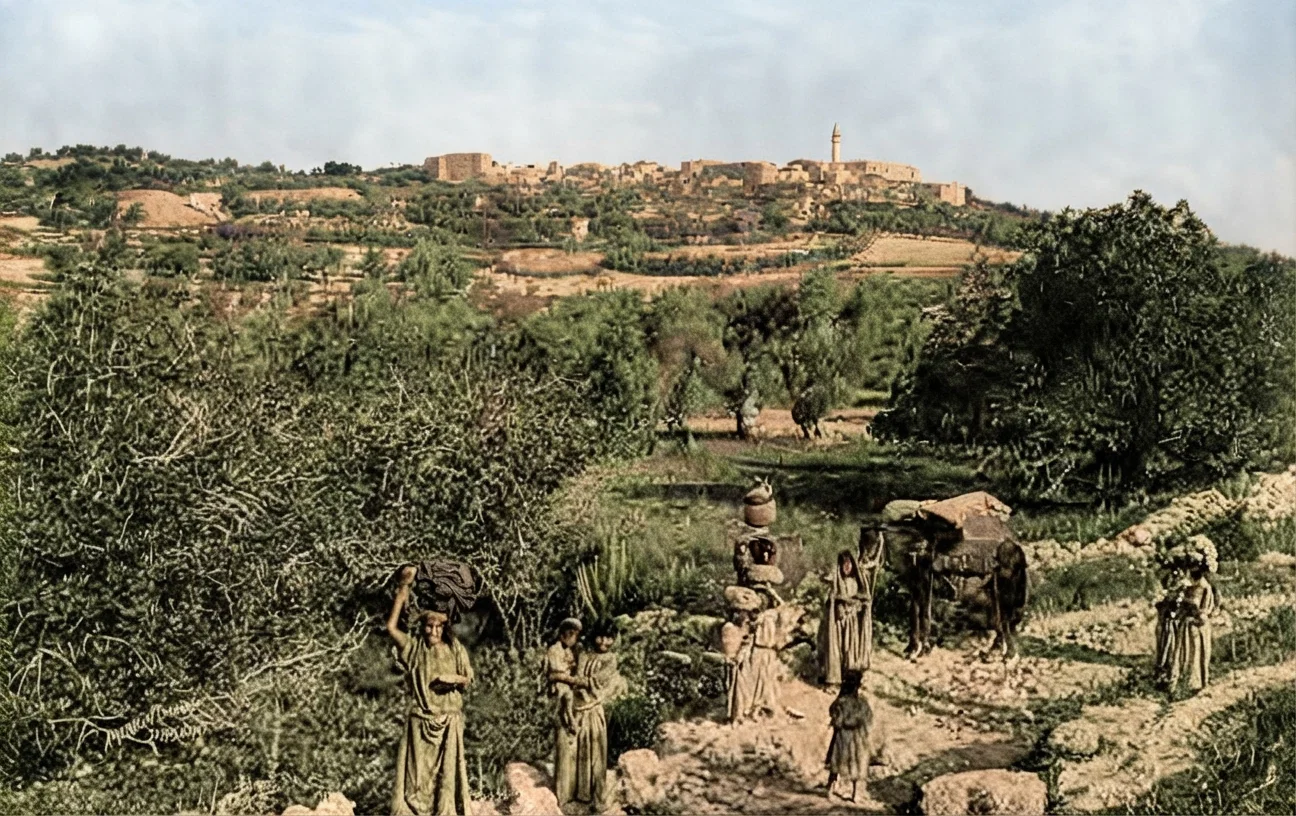
A general view of modern Samaria, now called Sebastiyeh. It is now "a squalid and fanatical Moslem village, in which are evidences of many ruins."

The Jews Refuse Partnership

True to the national spirit which from this time on is to dominate the practises of the Jews, they refused to have anything to do with this people who were anxious to help in the rebuilding and who called themselves the people of God. The answer of the Israelites to them was, "Ye have nothing to do with us to build a house unto our God; but we ourselves together will build unto the Lord God of Israel, as King Cyrus the king of Persia hath commanded us." In their great care not to offend God more by mixing up in any wise with idolatrous worship, the Jews take a stiff, firm stand. Perhaps it was the only safe thing for them to do. For ages they had been contaminated with idolatry, until God had counted the case incurable, and had scattered them to the nations. After seventy years of captivity they had learned the lesson that their only success lay in a reliance upon God. Turning away from idolatry and idolatrous practises, they were firm in their determination not to be contaminated again by the abominations of the heathen. Doubtless it was the only position which they could safely take in obliterating the last vestiges of idolatrous service from the Jewish nation. We know that when Christ came, there was no element of heathen idol worship among them anywhere.

Our Lord and the Samaritans

Altho this is true, it is very unfortunate that the great breach came between the Samaritans and the Jews. We know that this spirit between the two, this wall of tradition, was not in accordance with the mind of God. When Jesus came, we find Him working among the Samaritans, freely having intercourse with them to their uplifting and salvation. He condescended to teach the woman of Samaria at the well; and that event, so beautifully recorded in the Gospel of John, shall never be forgotten where Christ's work is loved and remembered. Thus He began the work of breaking down the partition wall between Jew and Gentile, and preached salvation to all alike. Tho He was a Jew, He mingled freely with the Samaritans, setting at naught the Pharisaic customs of His nation. The stay of Jesus in Samaria was not only a blessing to the people of that country, but a great lesson to the disciples of Christ, who were still under the influence of the Jewish bigotry. They felt that loyalty to their own nation demanded that they cherish enmity toward the Samaritans.
While the Babylonian captivity had cured the Israelites of the worship of graven images, yet to many of the people obedience was prompted by fear rather than love. Their service of God was only actuated by a fear of calamity if they refused to obey. So their motive was selfish, and they rendered outward service to God as a means of attaining to national greatness. Ceasing to become the light of the world which God intended they should be, they shut themselves away from the world in order to escape temptation to idolatry.
God had given instruction through Moses, it is true, and had placed restrictions upon the associations of the Jews with idolaters. But this teaching had been misinterpreted. While it was intended to prevent them from conforming to the practises of the heathen, they had used it in order to build up a wall of separation between Israel and the rest of the world. They came to look upon Jerusalem as their heaven, and they were actually jealous lest the Lord should show mercy to the Gentiles.
In the time of Christ, in the temple at Jerusalem a low wall separated the outer court from all other portions of the sacred building. Upon this wall were inscriptions in different languages giving the information that none but Jews were allowed to pass the boundary. If a Gentile had presumed to enter the inner enclosure he would have desecrated the temple, and his life would have been the forfeit. How different was this from the work of Christ! He who was the originator of the temple and its service, drew the Gentiles to Him by the tie of human sympathy, while His divine grace brought to them the salvation which the Jews had sought to keep from them, and which, sad to say, the Jews themselves rejected.
Repulsed by these severe words of the Jews, bitter animosity sprung up between the two peoples. It was the beginning of trouble for the Israelites.

VII. The Samaritans Hinder the Work

It would seem that the demonstrations of joy were the publication to the people of the surrounding country that the great work of restoration had begun. The very next thing on record in the book of Ezra is that of the people from without coming to the leaders and asking for the privilege of building with them. They claim to be a part of God's people. We read:
"Then they came to Zerubbabel, and to the chief of the fathers, and said unto them, Let us build with you: for we seek your God, as ye do; and we do sacrifice unto Him since the days of Esar-haddon king of Assur, which brought us up hither." Ezra 4: 2.
Continue reading: Out of Babylon to Zion