Pacific Press Publishing Association · Mountain View, California · Aug 6, 1912
"IF YE WILL INQUIRE, INQUIRE YE."
By Editor
This Inquirers' Department is conducted for the purpose of helping those who are studying the Bible. The answers are oftentimes only suggestive. They are never to be considered infallible, only as they agree with the infallible Word. The writer who may answer them does not consider that his opinion is infallible. He will simply give the best that he has, and plead with the inquirer to search the Word. Such questions only will be answered as, to the editors, seem to minister to the good of the readers and to the mission of the paper. We can not answer repeatedly in the same volume questions upon the same scripture. The name and address must accompany question, not for publication, but as an evidence of good faith, and that answer may be made by letter if deemed advisable. No letters are answered which do not contain the name of the writer. It is well always to enclose stamp for reply.
3819 — The Change of the Sabbath
By Editor
In a publication of a Christian paper I find the statement given in answer to the question, "Who changed the Sabbath?" as follows: "First by the authority of the apostles delegated them by the Lord. Matt. 16:19. They kept the first day of the week. Acts 20:7; 1 Cor. 16:1, 2. Says Neander, 'The apostles rejected the Sabbath to avoid the risk of mingling Judaism and Christianity.' And also, secondly, because on that day Christ rose from the dead and appeared no less than five times to His followers. 3. The outpouring of the Holy Ghost on the Day of Pentecost occurred on Sunday." Will you please explain this? F. K.
Space will not permit an extended explanation. We refer our inquirer, and others who are troubled over this, to the following tracts: "Apples of Gold Library," No. 75, "Which Day Do You Keep? and Why?" 76, "Is Sunday the Sabbath?" 77, "The True Seventh Day?" 78, "Historical Facts and Incidents;" also to the pamphlet "The Lord's Day the Test of the Ages," in which all these questions will be clearly answered.
Regarding these statements, there is nothing in Matt. 16:19 to show that the apostles were delegated to do anything else than to teach the Word of God. That text itself ought to be explained by the great commission given in Matthew 28, in which Jesus told His disciples to teach all things whatsoever He had commanded them, but He never commanded any change of the Sabbath, and on the contrary He told us that "not one jot or tittle" of the law could be changed. Matt. 5:17-20; Luke 16:17. So Jeremiah was set over the nations "to pull down, and to destroy, and to throw down, to build, and to plant" (chapter 1:10), but he simply did this by proclaiming God's Word concerning those nations (chapter 18:7-10).
Secondly, we have no record whatsoever that the apostles ever kept the first day of the week as a holy day. Acts 20:7 simply records a night meeting held at the beginning of the first day of the week, and the rest of the day spent in regular secular labor; and 1 Cor. 16:1, 2 does not indicate any gathering whatsoever, but that each man should lay by himself at home, as God had prospered him, whatever money he had on the first day of the week, so that it could be gathered when the apostle came. That the apostles did not reject the Sabbath to avoid the risk of mingling Judaism and Christianity is shown again and again by the labors and teaching of the apostle Paul. In the second chapter of Romans he declares that the Jews had the form of knowledge and of the truth in the law. In Acts 20 he declares that he had kept back nothing that was profitable, but had taught all things that were necessary, had not shunned to declare the whole counsel of God; but nowhere is there any record that he had taught the Ephesian people any change whatsoever in the Sabbath. He could say, as he met the Jews in Rome, as recorded in Acts 28, that he had done nothing whatsoever against the custom of the fathers, and they could say, We have heard no charge against thee,—that is, he had nowhere transgressed the moral law, as the Jews themselves regarded it. James tells us that we are to keep the royal law according to the Scriptures, and whoso offends in one point is guilty of all. See James 2:8-12. And Peter declares (1 Peter 2:20-22) that Christ is made our Example, who did no sin,—that is, Christ kept the law. He is our Example to follow. And John tells us that he who says that he knows God, and keeps not His commandments, is a liar, and the truth is not in him; and continues by saying, "He that saith he abideth in Him ought himself also so to walk, even as He walked." See 1 John 2:4-6.
Neander lived a good many centuries this side of Christ. He has no more knowledge of it than hundreds of others. The very best knowledge, and the only knowledge, of what the apostles did is found in the Scriptures themselves. Jesus did rise from the dead on the first day of the week, and did appear to His disciples several times, but in no case did He tell them that that day was a holy day. He simply appeared to them on that day in order to show them that He was alive and had risen from the dead. As to the outpouring of the Holy Spirit at Pentecost on Sunday, Pentecost was not a place. The Holy Spirit was poured out on Pentecost. It was a fulfilment of a type. The day of the week is not even mentioned, and some good authorities contend that it was the Sabbath day. Others think that it was Sunday. But the Lord passed over one first day in the ten between His ascension and the outpouring of the Spirit, which of itself shows that it was not the first day that was to be honored, but the antitype of Pentecost. There is absolutely nothing in God's Word to indicate that the first day was set apart as a holy day, and very many first-day people acknowledge it. There is but one Bible Sabbath, that instituted and commanded of God and observed by our Lord Jesus Christ.
3821 — Sinning Against the Holy Ghost
Will you kindly explain what Jesus meant in Matt. 12:32, "Whosoever speaketh against the Holy Ghost, it shall not be forgiven him, neither in this world, neither in the world to come"?
There are two great means which the Bible reveals for man's salvation, which God uses for that purpose. The one is set forth as the blood of the covenant, and the other the Spirit of grace. See Heb. 10:29. Through the blood, or sacrifice, of our Lord Jesus Christ, our sins are forgiven. He died for our sins. Through the Spirit of grace we are created anew, born from above, and God's law is written in our heart. He has no other agencies for the salvation of men. When, therefore, man, having the light, turns from the very thing that would save him, there can be no salvation for him. It is not that God is not willing to forgive, but man rejects the very things by which forgiveness and peace and righteousness can come to him. Sin becomes unforgivable because it is unrepentable. If a soul is sinking on the sea, and a life-buoy is thrown him, and he will not grasp it when he can, what help is there for him? He chooses to die. Take, for instance, the experiences of Jesus which called out these words. He had been casting out demons, relieving poor, distressed souls that had been under the bondage of Satan. He had given manifest evidence that the power that He exercised was the mighty, loving power of God. But the Jews said, "He casteth out demons by Beelzebub, the prince of demons." They attributed the work of the Spirit of God to the spirit of evil. See Mark 3:22-30. Note especially the last verse, "Because they said, He hath an unclean spirit."
Now it is possible for one who knows nothing of the working of the Spirit of God to speak against it, or blaspheme it, and still be saved. This seems to have been the case with the apostle Paul, for he declares, "I obtained mercy, because I did it ignorantly in unbelief." 1 Tim. 1:13. But to him who does it in the face of such light as the Jews themselves had, or to one who continually rejects the Spirit of God until the heart becomes hardened, there comes a condition at last that yields no response to the pleadings of the Spirit. The danger does not lie in God's unwillingness to forgive; the danger lies in our putting ourselves in such an attitude toward God that He can not reach us.
It is impossible to take a few passages of Scripture, especially some of the obscure prophecies of the Old Testament, and make them clear in and of themselves. In all the great promises of God, it is well for us to remember what the apostle says in Eph. 3:3-6,—that in time past they did not understand these things as it was revealed later to the apostles and prophets by God's Spirit; and it is only in the light of the clearer later revelations that we may read the prophecies of God to His people in the past. Some of those prophecies were fulfilled to Israel in the restoration of Jerusalem and the return from Babylon. Some of them were dependent upon conditions. See the conditions stated in Jer. 18:7-10, and elsewhere. If Israel complied with the conditions, the promises were theirs. If they failed to comply, certainly they could not ask God to fulfil His part. Some of them, if fulfilled at all, must be fulfilled in harmony with the conditions of the new covenant, in times when all types had passed away. The book of Zechariah contains prophecies of these types. The passage under question points to that time when God's children shall have gained complete victory over all their foes, and the end of sin has come, and the beginning of the reign of righteousness is inaugurated. Other passages tell us of how all the nations shall come up against Jerusalem to fight. Those that are left of all the nations will be God's remnant which He has gathered out, and they will go from year to year to worship the King, the Lord of Hosts. All of those families that will not come up—carrying us back just a little to the time when the invitation was abroad—upon them will not fall the latter rain of God's Spirit. They shall perish. It matters not though they may belong to some great nation, like Egypt, and have received great light, they shall be smitten with the plagues. On the other hand, in God's service in that future time there shall be holiness; even everything that takes part in that service shall be holy. Then in the service of God which shall follow throughout all eternity there shall come in no more corruption. The Canaanites had crept in among the children of Israel. See Ezra and Nehemiah to show how corruption had come into the very service of the temple. But that would be so no more in the glorious reign which lies before. The passage itself shows that the long reign of sin will end, and only those will have part in the reign of righteousness who have met God's conditions.
The passage reads, "And the heaven departed as a scroll when it is rolled together; and every mountain and island were moved out of their places." Manifestly, the atmospheric heaven is referred to. The great convulsions of nature attendant on Christ's second coming seem to affect the atmosphere to an extent hitherto unknown. Just what is meant by that expression nobody can explain. The most terrific convulsions of nature which have taken place do not approach in calamity or majesty or direfulness what will then take place in this earth, with the weight of sin resting upon it and the restraining power of God withdrawn. To those who are then upon the earth it would seem as if everything were swiftly tending to utter and overwhelming destruction.
Our reading includes the last chapter of Habakkuk, Zephaniah, Malachi, and the first two chapters of Matthew, also Psalms 80, 81, 82. Zephaniah was probably contemporary with Habakkuk, preceding him, perhaps, a few years. He prophesied in the days of Josiah, and in that case was also contemporary with Jeremiah. His special burden is the great day of the Lord and the judgments which would come upon the world at that time. These are the more forcibly set forth when we consider the time in which Zephaniah lived, when the judgment of God was about to fall on the Jewish nation. But out of all the sadness and blackness and darkness, he gives us a message of hope, that those who seek God, as set forth in the first part of the second chapter, may sing and be glad of heart in the great day of Jehovah, for then it will be said, "Jehovah thy God is in the midst of thee, a mighty one who will save; He will rejoice over thee with joy; He will rest in His love; He will joy over thee with singing."
Malachi, whose name means "my messenger," prophesied about 400 years before Christ. His name is fitting to his message, for he prophesied of the messenger of Christ, John the Baptist, and of Christ, God's messenger, and also points forward to the great day of the Lord, when Christ shall come the second time.
Matthew is the first of the Gospels in our New Testament, and probably the first written. There has been more or less question in regard to this. There are those who have placed Mark first, then Matthew, then Luke; but it is generally believed now that Luke was about as early as Matthew. But Matthew is placed first. It is not simply a Gospel to the Jews, but it is a Gospel to the world. He especially dwells on our Lord's right to the kingdom, and "the kingdom of heaven" is a favorite expression, not only as pertaining to the gathering out of the subjects for that kingdom, but the everlasting kingdom which Christ will take when He comes the second time. We omit, to shorten our year's reading, the other synoptic Gospels—Mark and Luke.
GOD permits men to manifest their own character, but not work their own will. "The Most High ruleth in the kingdom of men." "He doeth according to His will in the army of heaven, and among the inhabitants of the earth." He uses even the strangest means to accomplish His ways; and His providences, to the thoughtful, reverent soul, are full of surprises.
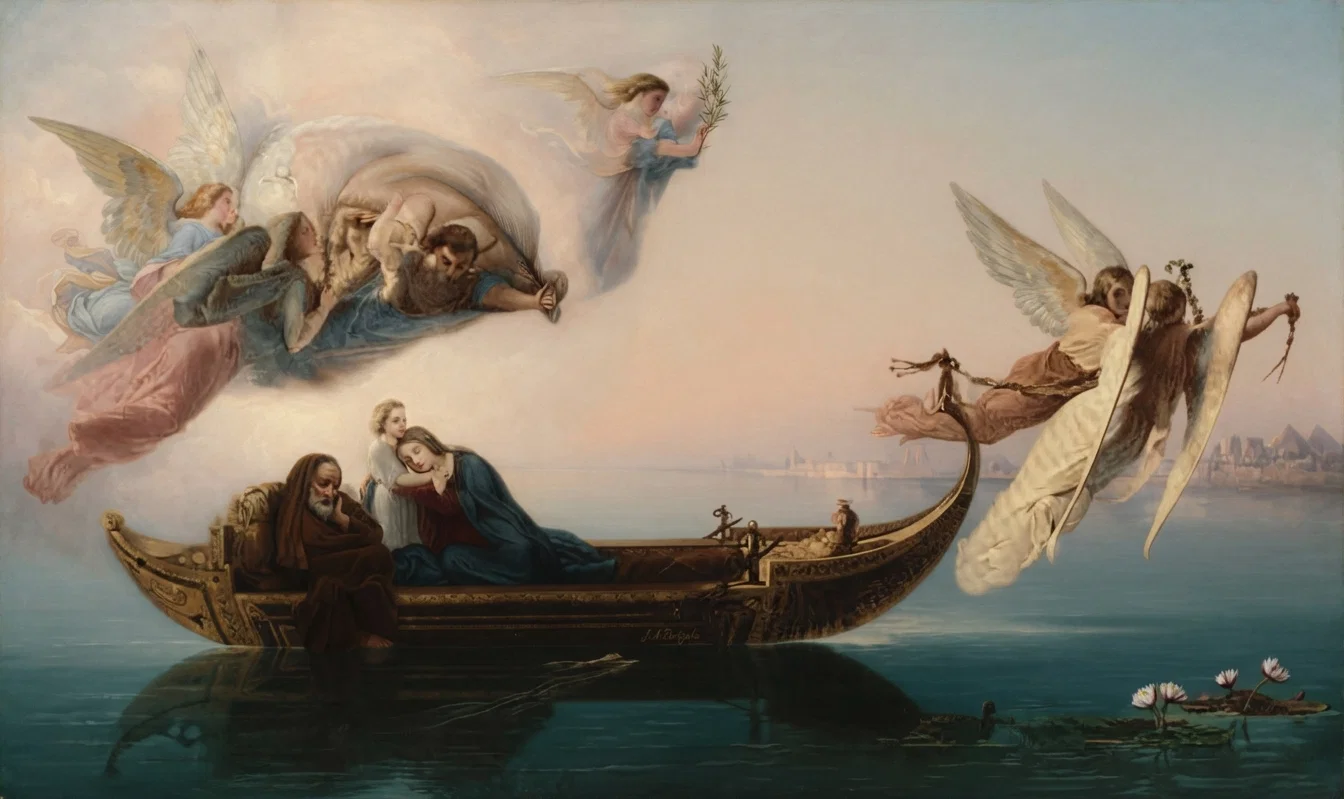
FLIGHT INTO EGYPT
THIS is illustrated in the life of our Lord. He was born of a woman; and the introduction of the Saviour of the world to humanity, that He came to save, was that of a helpless Babe in the manger. His mother must offer for her purification, according to the law, the humble offering of the poorest, two turtle-doves. (See Lev. 12:8 and context.) Yet to this Child bowed alike the humble shepherds of Judea and the wealthy Magi of the East, as well as the shining angels of God. But to Herod, the cruel, the vindictive, the licentious, the beastly, the little Child was a rival; and to the haughty priests and rulers of the Jewish nation His advent made no appeal. The disposition of Herod was such that he could slay a multitude of children in order to make sure of destroying his one Rival, and he an old man, and the Rival a babe!
THE circumstances offered, however, another opportunity for the display of God's providential working. The riches of the East, through the Magi, furnished means to the family, and God sent them to one of the darkest of earth's kingdoms for safety, into a land which had stood for all that is dark and sinful and low and base. There God cared for His Son.
THE artist has pictured the thought beautifully. Yet we may be sure that in no such vessel did the holy family float down Egypt's river. No human eye in Egypt saw such a royal barge divinely propelled and guarded, but just as truly was God's care over the Child. That river represents Egypt, and the course and flow of time during their sojourn in that dark land. Beyond, dim and indistinct, are the monuments of the past, the glory of her kings, the pyramids and the mighty cities. And in that land the anxious father has surcease of care, and the loving mother joys in the study of her first-born Son. Angels of God guided and protected them, even as they are represented in conveying and convoying the little craft in which the father sleeps, and the mother and Child joy in each other's love. So God's care is over all His children. Invisible agencies of God, "angels that excel in strength," work out His own wise counsels, lead through dark places, protect in the midst of dangers, or build invisible walls around His loved ones which all the powers of evil can neither penetrate nor overthrow.
WHEN the time came, God called His Son "out of Egypt." In this, too, there is symbolism. The Son of God came to this world for us, and stood as the representative of humanity, from the helpless babe to the full-grown man, and in Him God calls each and every son "out of Egypt," even as He called that other son fifteen centuries before, referred to in Hosea 11:1. "When Israel was a child, then I loved him, and called My son out of Egypt." But God's son then did not wholly heed that call. He came out of Egypt physically, both he and his, but many left their hearts there, and took with them the unsanctified, overmastering desires for the things of Egypt. Their slogan in the journey to which God called was often "Back to Egypt," instead of "On to Canaan." These unbelieving ones never reached the land of promise. "Their carcasses fell in the wilderness," fit symbols of those who stay in the darkness, unbelief, and sin of the spiritual Egypt of this world. It always means wilderness and death.
God's call then was to everlasting freedom from slavery and sin, Egypt standing for all that was bad, and the Promised Land for all that was good. Said Moses, the man of God, just before Israel crossed the Jordan, “He brought us out . . . that He might bring us in.” Deut. 6: 23. He is the Creator of all men, but He would have His people know that He is their Redeemer as well. And so in giving His holy law through Israel to the world He said, “I am Jehovah thy God, who brought thee out of the land of Egypt, out of the house of bondage.” Ex. 20: 2. It was God’s call to salvation, call to freedom, call to love and obedience and service.4IN Christ Jesus our Lord God calls us out of Egypt. Kind, watchful, merciful has He been to us all our sinning, slavish days; and our dull ear has not heard His voice; our dim eye has not seen the burning bush; our poor, insensate heart has not longed for the holiness. But He calls, and calls to you, sinner, or cold-hearted professor, whoever you are, calls you out of the Egypt of darkness and idolatry, of unbelief and superstition, of stubbornness and rebellion, of slavery and death. He calls you that He may set your feet in the highway of light and truest worship, of faith and truth, of meekness and loyalty, of freedom and life. Your way may lead in strange paths, you may be persecuted for His sake, and stripped of all worldly goods; you may be called to pass through a hostile wilderness filled with deadly serpents, bare of food and moisture. But if you are faithful, His call will be effective, and all His promises will be more than realized in the immortal, transcendent, blessedness of the eternal reign with Christ.
W.
Our Position on the Sabbath Question
By Editor
INASMUCH as the Sunday law agitation has brought into decided prominence, in California especially, the Signs of the Times and the Seventh-day Adventists, who are opposed to Sunday laws, we take this occasion to set before our readers in briefest possible form just what our position is regarding the Sabbath and the Sunday.
This journal holds regarding the Sabbath:
1. That it was instituted, made, and given to man by three distinct acts on the part of the Creator at the very birth of humanity. Gen. 2:2, 3; Mark 2:27.
2. That during the patriarchal ages, archeology and the hints that are given in its very brief history in Genesis show that it was observed by patriarchs and holy men.
3. That it was known at the Exodus, and was among the first things over which Moses appealed to the children of Israel. Ex. 5:5.
4. That the very definite, identical day of God’s institution was pointed out by a threefold weekly miracle, in the fall of the manna, for the period of forty years, so that Israel and future generations could make no mistake as regards the divinely appointed day.
5. That when God gave His moral code from Mount Sinai, the Sabbath was placed in the very heart of the Decalogue, so that it would be impossible to reach it from either before or behind without tearing down the impregnable walls of other great moral commandments; and that placed in the very heart of that law, it reveals as the Giver of the law the Maker of the heavens and the earth, and therefore becomes a seal of the law itself in the revelation that it makes of the Giver.
6. That it was committed to the Israel of God for the nations, and through the true Israel in Jesus Christ to all the generations of the world. See Rom. 9:4, 5.
7. That it was designed ever to keep before the children of men the great Creator of heaven and earth, and therefore was an impregnable wall against idolatry. See Eze. 20:20; Ex. 20:8-11.
8. That it is not only a memorial of God’s creative power (Ps. 111:4), but is also a sign of His power to redeem and sanctify. Ex. 31:13; Eze. 20:12.
9. That the new covenant in Christ Jesus is designed to write that holy law upon the hearts of God’s children, the Sabbath as a constituent part of that law with the rest. Jer. 31:31-34; Heb. 8:8-10.
10. That that covenant was confirmed by the teaching of Christ, showing the integrity and immutability of the law in both teaching and example. Ps. 111:7, 8; Matt. 5:17; Luke 16:17.
11. That that covenant was sealed at His death with the law unchanged in jot or tittle, and therefore made permanent for all time. Heb. 9:16, 17; Gal. 3:15.
12. That that law, confirmed by the teaching, life, and death of our Lord Jesus Christ, of which the Jews themselves had the form, is established in the heart of the Christian by faith. Rom. 2:17-20; 3:31; 8:4.
13. That Jesus our Lord observed the commandments of God in His own life, and lifted the Sabbath from the traditions under which it was buried, and restored it to its primeval simplicity, teaching His disciples to observe it also, according to the commandment of God. Matt. 12:1-12; Luke 4:16; John 15:10; Luke 23:56.
14. That the teaching of His beloved apostle is that those who profess Christ’s name ought to walk also as He walked. 1 John 2:6.
16. That the Scriptures foretold a power to arise which would think to change God’s law. Dan. 7:25.
17. That it would be given into the hand of that power for a certain time, when the veil would be lifted. Dan. 7:25.
18. That in harmony with this prophecy a reform will take place when that period of time is past, in the last days. Isaiah 56 and 58.
19. That God’s remnant people shall be found, in consequence of that reform, keeping all the commandments of God and the faith of Jesus. Rev. 14:12.
20. That that great threefold message developing such a people shall be heralded to all the world. Rev. 14:6-14.
And beyond all the efforts of the people who are especially giving that message to the world there are found individual souls in all parts of the earth who have been called to the same great truth through the study of the Word alone.
They hold regarding Sunday:
1. That its origin as a worship day is purely pagan, the day being dedicated to the sun.
2. That as a pagan day dedicated to the sun, its adoption has been almost universal in the great pagan nations.
3. That it came into the Christian church as a part of the early foretold apostasy, through half-converted heathen.
4. That there is an absence of all Scripture testimony regarding its sacredness or observance as a sacred day.
5. That it was centuries before it was regarded in the church as a Sabbath.
6. That it was never denominated the Lord’s day until 200 A.D., and then by a writer who taught prayers for the dead, birthday honors, etc., for which he declares he had no Scripture authority.
7. That the first law for its observance, human or divine, was by a pagan emperor.
8. That it has been sustained by superstition, by a false application of Scripture, and by civil enactment, ever since, always with damage to the church and a reflection on Protestantism.
9. That Protestants received it from Roman Catholics as a well-worn counterfeit is received, without careful examination.
10. That it has many times been perpetuated in hearts because of the good who have held it aforetime, and because of God’s blessing on faithful hearts and churches in spite of it.
11. That many, in God’s providence, are learning this, and as it does not therefore appeal to men’s consciences, hence the demand for Sunday laws.
12. That to us it would be disloyalty to God to accept an institution, however hoary with age, or hallowed in the church, or enshrined with sacred memories, when it makes void a solemn and constituent part of the law of God written by His own finger, spoken by His own voice, and observed by our blessed Lord.
13. That the Sunday, with all its concatenated interests, is a mark of the power of the Roman Church, and is so held by her, and in that very thing it becomes a mark of apostasy.
14. That the beast power of prophecy throughout the ages is a union of church and state against God and His truth.
15. That Sunday enforced by law, however honest and mistaken its promoters, becomes a mark of that beast power, which that power seeks to enforce upon all within its jurisdiction, and which according to the prophecy must become world-wide.
16. That God gives solemn warning to all the people of the earth against this power, and the reception of its mark of apostasy, that mark set over against the seal of His law, the memorial of His creative power, the sign of His redeeming power, the Sabbath of the Lord.
17. That as to who possesses this mark of the beast, or who will possess it in fullest accord with the beast power and spirit, is not for us to say. That rests wholly with God. It is for us, in loyalty to Him, to preach His Word, to proclaim His message; and therefore, recognizing our own unworth, but trusting wholly in Jesus Christ, “with malice toward none and charity to all,” we give the light as God has given us to see the light, we bear the message as He has given to us to grasp the message, without compromise or parley.
Believing that in the Sabbath question is involved the veracity, not to say infallibility, of Holy Writ, the authority of that Word as against tradition and apostasy, the very existence of Protestantism itself, and the5future of all civil government; believing that we are fortified with an abundance of concurring Scripture testimony, with confirmatory utterances of great theologians, by history ecclesiastical and secular, Catholic and Protestant, and by the mighty, world-stirring events of to-day in the fulfilment of the prophetic Word, we appeal to our brethren, friends, and fellow men in and out of the church to study with us these great questions before they decide. Not for ourselves are we working, but for God. Not for ourselves are we protesting against Sunday laws, but for the greater sake of those mistaken souls who would fasten them upon the nations. The everlasting good tidings of Jesus Christ give greater power and satisfaction and joy than all the world can give. We are anxious that our readers shall share the same joy and blessedness which we have found in Him and in His blessed truth.