It was my privilege to spend Sabbath, January 9, at the Madison school. At the beginning of the Sabbath, Elder A. G. Daniells and I met the teachers and students in their new commodious assembly hall. Their eagerness to hear and our willingness to talk, led to the holding of four meetings in the twenty-four hours of our visit. Elder Daniells spoke that evening and early Sabbath morning, with thrilling interest, upon the world-wide progress of the message. Then he hastened to Nashville, to speak again in the Memorial church. At the forenoon service I spoke on the work that students may do while attending school—as nurses, and as teachers of Bible truth in homes and in Sabbath-schools. In the afternoon the ordinances of humility and fellowship were celebrated, nearly all the students taking part.
Progress
Since our visit in January, 1908, marked changes had taken place in the personnel, the equipment, and the surroundings of the school. Many whom I had met in former years were gone, and there were scores of new faces. On inquiring, I learned that twelve or more of the older students had been drawn from time to time to enter the employ of the Southern conferences and institutions; eight were teaching in foreign fields; and a score or more were connected with the ten schools that have been established during the last two or three years in the needy mountain districts.
Several times I had visited the school when the only assembly room was the large, low-ceiled parlor of the original farmhouse. One year ago the school had outgrown that room, and was using for an assembly room a cottage put up without partitions. During the summer of 1908, Gotzian Hall had been built, and now for the first time the school has found a roomy, comfortable home.
The Water Plant
Central Tennessee is a well-watered country, but occasionally there are severe droughts. The school farm had several wells, but in the driest times the flow of water was scanty. When the school family was small, there was no serious trouble, except the necessity of pumping water from the river for the horses and cattle. But a sanitarium needs a large16and constant supply of good, pure water, and when the plans and location of the sanitarium were settled, it was found that water must be brought from the river, or many cisterns must be built.
After much study it was decided to install a water plant that could be relied upon at all times to furnish an abundant supply, (a) to the sanitarium; (b) to the school boarding-house and all the resident cottages; (c) to the stables and stock-yards; and (d) for the irrigation of the kitchen garden in time of drought.
On one of the highest elevations between the river and the buildings, a forty-three-thousand-gallon tank was put up, constructed of red cypress. From this tank to the river, a distance of thirty-five hundred thirty-six feet, a three-inch supply pipe was laid, and on the river bank a ten-horsepower gasoline engine operates the pump, which is set in a cement casement twenty-six feet below, near the level of the river. From this large tank, water is supplied to the sanitarium, the boarding-house, the cottages, and to smaller supply tanks in the two large pastures.
The Sanitarium
The sanitarium was completed, and was ready for opening as soon as the severe January weather was over. It is a model of simplicity and economy, and is so built that it can be operated for five patients or for twenty-five, on a scale of expense corresponding to the amount of work it has to do.
Dr. Newton Evans is the surgeon and physician-in-chief. He has recently built a cottage and located his family near the sanitarium. He also maintains an office in Nashville, and is teaching in one of the medical colleges there. Dr. Lillian Eshelmann Magan is the house physician. While waiting for the sanitarium to be put up, she has built up quite a practise outside.
With the little sanitarium in full operation, the Madison school can do good work in training medical evangelists for the home and foreign fields.
A Center of Influence
The Madison school promises to be an important factor in our educational work in the South, as a center of influence, a place to which those who are pioneering in hard places can look for counsel and encouragement. Not only are young men and women gathered from the North and given a practical training for service, but when they leave Madison, they are not forgotten, and in times of special need they are sometimes helped to secure necessary assistance.
Just recently an advance step was taken in the inauguration of quarterly conventions. It is now planned that once in three months a convention shall be held at Madison or at Hillcrest or some other accessible place, where the teachers from the hill schools will be invited to come together for a two-days' council. In these councils, teachers will relate their experiences in meeting difficulties, in developing self-support, in doing evangelistic work, in winning the confidence of the people. So far as the students of the Madison school are able to attend, they will gain a valuable education, and the teachers will learn much from one another.
Concerning the convention recently held at Madison, Prof. E. A. Sutherland says:—
“We gave considerable attention to the proper method of using our Sundays in the mission schools. Practically all the teachers are attending Sunday-schools and services, and some of them are planning to hold Sunday-schools in their little schoolhouses. Most of them have Sunday evening meetings. They say they could have meetings every Sunday evening if they had competent help. We are arranging to give them this help. Near Alden's school one of the best families in the neighborhood has just begun to keep the Sabbath. Several have begun to keep the Sabbath at Mulford's school. This is encouraging, and we rejoice greatly that the quiet work is having its effect. The schools are full, and are doing a good work.”
“On Sunday we gave much time and study to the question of self-support. You would have been intensely interested to hear the plans of the leaders of these schools in making their living from the soil.”
“We also spent much time in studying methods of teaching those not of our faith, and had an exchange of experiences from the various teachers. There were twelve in attendance from these schools.”
“Our students were deeply interested in what was said at this meeting. The next meeting will be held at Hillcrest in three months. Our plan is to have a two-days' meeting every quarter. The one that has just been held is the second meeting of this nature.”
A Recent Report
In a letter dated Feb. 26, 1909, Brother Sutherland writes as follows:—
“This winter we are having the best school since we came South. Most of the students are earnest young people who are preparing for work in the Southern field. Several were taken in who were not Christians; these have taken their stand for the truth since entering the school. Nearly all the students are earning their school expenses.”
“We have a great deal of work in connection with the dairy, the school home, and the sanitarium, also building, farming, and clearing the brush off the land. The general round of duties and improvements keeps us very busy. We need two or three more persons in the school who are able to carry heavy responsibilities. The work is quite wearing on some who are here.”
“We are making some headway with the sanitarium. It has been quite a problem to get this enterprise started, but we have faith that God has ordered that it should be established, and that he will in his own way make it a success. We are thankful for one thing, and that is that we are able to conduct it without financial loss. Our patronage has been sufficient thus far to prevent this. A few operations have been performed, and a number of persons have been helped in regaining their health. We have several nurses who are busy all the time. Drs. Evans and Magan are our physicians. They are faithful, and we feel that the Lord has greatly blessed us in giving them to us.”
“One of the most encouraging features of our work is the success that is attending the little mission schools that are being established throughout the country. They appeal to the people. There are about five hundred children and youth attending the schools that have been established here since we left Battle Creek. Several persons have begun to keep the Sabbath during the last year, as the result of these little schools. The schools are just starting. We hope, after a year or two, to see much fruit from them.”
“We are holding meetings among the young people of these communities. Not very long ago I held a meeting at one of our little schools, and there were about two hundred persons present. They listened very attentively to the instruction. The people are more reverential than those in the North. If we approach them in the right way, we can have a strong influence over them. There are many, we believe, who will embrace the third angel's message if we properly present the truth to them.” W. C. WHITE.
Chile
By F. W. Bishop
PUNTA ARENAS, MAGALLANES.—It is now two months since I came to this city. I began canvassing the day after I arrived, and have just finished the town. The times are very bad, many are out of work, and many small stores are selling out; but I sold five hundred pesos' worth of books. It takes three and a half pesos to get one North American dollar. Next week I expect to go into17the country among the colonists. The last few days have been very windy, but generally the weather is pleasant; it is never hot. The summers are long and dry. Recently there has been a big forest fire near the town, several miles of country being burned over. Thousands of carts of wood and some houses have been burned, but the city is safe. I have been thinking that this would be a good place for a family of Sabbath-keepers to be located. A good work could be done.
There is a great country to the south, called the Land of Fire (Tierra del Fuego), where there are gold-mines, and sheep raising is carried on. It contains three hundred twenty-two thousand square miles of territory, and is inhabited by only a few Indians and a few white people.
Patagonia is a new and wild country, but it is being settled by the English, most of whom are in the sheep-raising business. There are many wild animals, and animals with fine furs are found in the southern part of the country. I recently saw a bear skin which was valued at five hundred pesos. The ostrich abounds in all parts of Patagonia, also the llama, a small animal about the size of a year-old calf, which is killed for its skin. There are in the country many hunters of animals; but who will come to hunt men? The Lord says he will send hunters (Jer. 16: 16), so I believe some will come even to the ends of the earth. The best time to come here is in the months of October and November, just after the winter. If any one wishes to write to me about the country, I will be glad to reply. My address is Casilla 7, Pua, Chile, South America. F. W. BISHOP.
Norfolk Island
By S. McCoy
I HAVE much pleasure in forwarding a report of our church here in Norfolk, for the quarter ending Dec. 31, 1908.
Sister Semple, who was with us for some two years, and who, during this period, acted as our church clerk, filling the post faithfully and well, has now returned to her home in Australia, and the office vacated by her has since been filled by the writer.
The tithe offering for this quarter is £7 8s. 11d., as against £2 5s. for the previous quarter. The Sabbath-school donations amount to £2 17s. 2½d., and the Thanksgiving offerings to £6 in cash and 9s. in shells.
The quarterly meeting was held in the church. The repairing of this building has, under the supervision of Brother H. Mitchell, been carried on most satisfactorily, and is a decided improvement to the place. It has given a new impetus to the work, and members have manifested a greater interest in attending the services.
Brother Mitchell is certainly kept busy; on the Sabbath he attends Sabbath-school and church service; on Tuesday evening, the prayer-meeting at Rocky Point, four or five miles from the mission house; on Wednesday evening he holds a meeting either in the church or at some private house in the country; on Thursday evening he conducts a meeting at Cascades, about two miles and a half from the mission house; on Saturday evening he holds a Bible class at the mission; and on Sunday afternoon he leads the young people's meeting in the church. On week days, when he is not visiting, he is hard at work, farming or blacksmithing. He gets very little, and in most instances nothing at all, for his labors. Our brother is ever ready to help those in need, and is loved by all.
After the Sabbath service we went to the seaside, where three of our number were baptized.
S. McCoy.
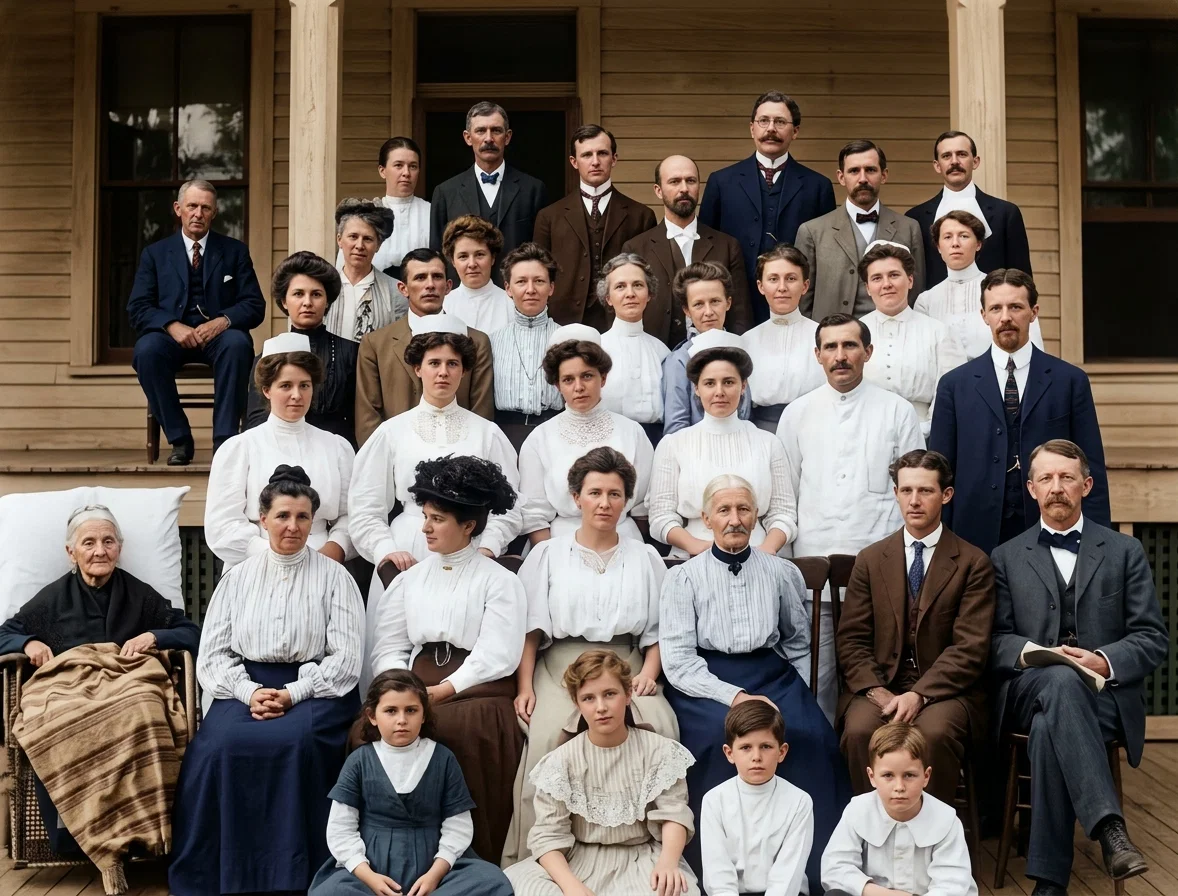
GROUP OF WORKERS AND GUESTS AT THE FLORIDA SANITARIUM
The Florida Sanitarium
By Lydia E. Parmele
THIS institution, located at Orlando, Fla., was opened for the reception of patients Oct. 15, 1908. That day three patients were registered, and the number has constantly increased, until at present its capacity is taxed. To accommodate the increasing patronage, it has been necessary to erect one additional cottage and four tents. At the present writing the property consists of sixty-seven acres of land, one building of twenty-one rooms, six cottages, one tent-house, and four tents, all in use.
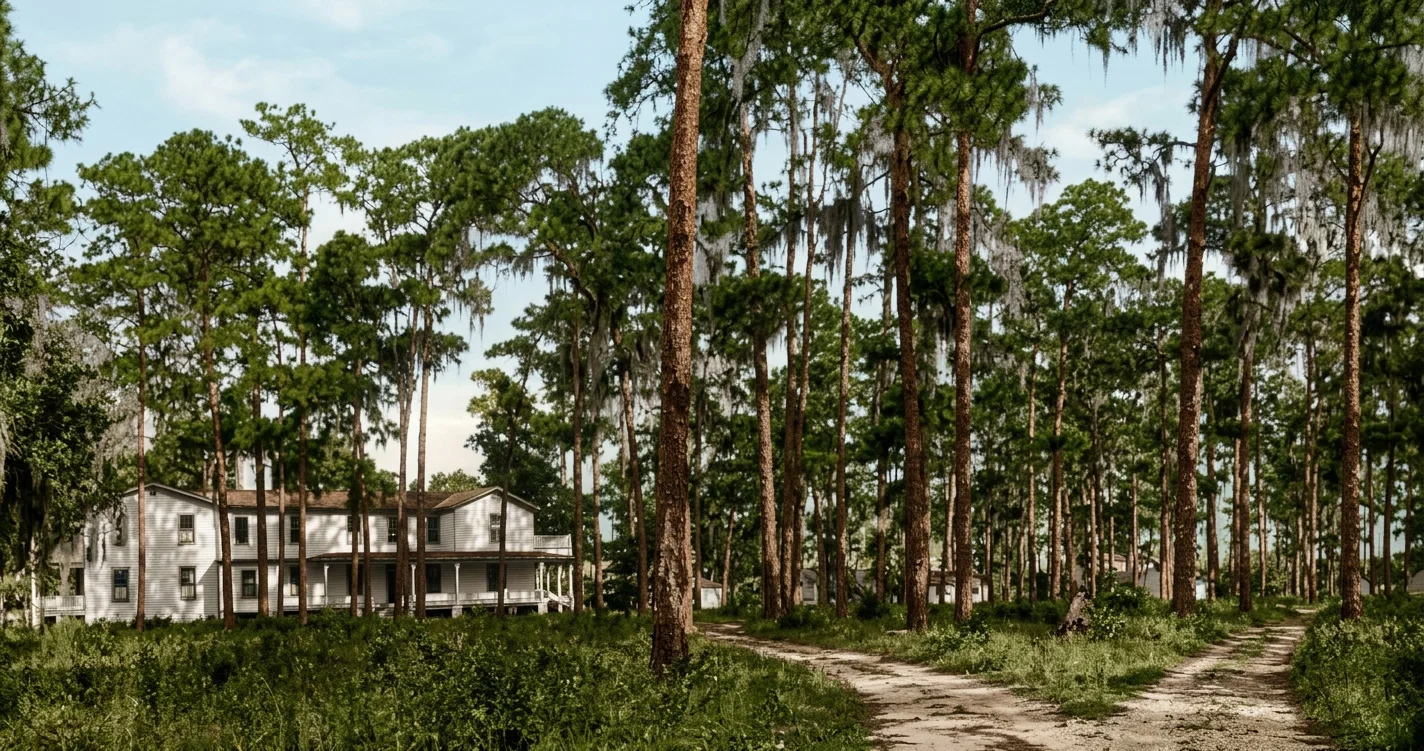
THE FLORIDA SANITARIUM AT ORLANDO
The accompanying illustration shows the main building and a few of the cottages. One very gratifying feature of the work of this institution is the fact that the patronage has been so largely local. Early in January a Catholic family of some prominence, living near Orlando, brought their daughter to the institution for an operation. Owing to the gravity of her condition, they called in the priest to give her the “extreme unction,”—the last sacrament,—before she was placed upon the table. As the patient had been a student at St. Joseph’s School for girls, the “sisters” kept the sanitarium telephone quite busy with inquiries concerning the case. The operation proved remarkably successful, and the patient made a complete recovery. On Sunday, January 17, both the priest and the “mother superior” of St. Joseph’s visited the patient at the sanitarium. Seeing what had been accomplished for her, they became deeply interested in the work of the institution, and provided themselves with sanitarium booklets to give to those needing medical attention. Brethren, can not you do as much as they for our sanitarium? If so, send for a supply of the booklets. They are free.
In the illustration showing the guests and workers, many of our people will recognize familiar faces, among them Elder W. A. Westworth, president of the Southeastern Union Conference, Sister Josephine Gotzian, and Dr. Carolyn Geisel.
This institution stands for the principles of the third angel’s message. We are trying to keep prominently before its patients and guests the special truths for this time. All the profits arising from the operation of the institution go to the Florida Conference to help carry forward the work of God.
When Sister White wrote us, encouraging us to secure this property, and to enter upon the work, she said she hoped it would “become an important center, from which many well-trained medical missionaries would go forth into the unworked parts of the Lord’s vineyard.” This is our aim. We have a class of six in training now, and would be glad to add others to it.
Florida has an excellent climate. Those who have tried both, usually prefer it to California. This gives our sanitarium a great advantage.
Amid the lofty trees, and in rowing on the beautiful lake on the sanitarium premises, the patients can enjoy themselves daily throughout the year. This institution being located in a semitropical climate, fresh fruits and vegetables, grown on the sanitarium premises, can be had daily. Home-grown oranges, pineapples, and bananas are also luxuries that the patients enjoy very much. For preparation for work in tropical climates, the class of work and the location of the Florida sanitarium are admirably adapted. Those interested should address the Florida Sanitarium, Drawer 28, Orlando, Fla.
LYDIA E. PARMELE, M. D.
Our Work in India
By H. J. Jewell
I CAME to Lucknow from Mussoorie November 8, and Brother L. F. Hansen and I put forth our best efforts to get treatment-rooms established in this place; but we were not in time to do much in the way of treatments before January 1; and as practically nothing was known of our medical work, we had to do considerable in the way of circulating health literature, and visiting the people. However, our work soon became well known, and the month of January fully met our expectations; and to the present time the Lord has blessed us with a fair patronage.
There is much prejudice against the work of Seventh-day Adventists; and as the medical work is so closely allied with the rest of the message, it takes time to break down the bulwarks of evil that are being raised against us. We are located in the center of a large community of Christians, and as our work in Mussoorie and other places is well known by some who have attempted to bring it to naught, the same thing is being tried here. There is much bitter feeling, and some are not backward about expressing their thoughts and wishes. We were hardly settled here before evil reports were circulated about our work, and special sermons have been preached for our benefit; but praise the Lord, success is attending our efforts.
We have a good attendance at the hall, and many calls are made for private study. The Lord blessed in our efforts in Mussoorie last summer. A good church was raised up; and until we were compelled to seek a warmer climate for the winter, our Bible workers were kept busy giving instruction on different points of truth.
We are enlarging our borders and setting new stakes. The time of quick work is at hand. Several new stations have been established this winter in widely separated parts of the field, and calls for help have recently been received, but we are unable to respond.
We are awaiting the outcome of the next General Conference with deep interest. While governments are quarreling with one another, and old governments and laws are being set aside, the Lord is opening the way for workers to enter and sow the gospel seed. Surely the time is at hand for us, one and all, to come up to the help of the Lord against the mighty. H. J. JEWELL.
An Interesting Trip in Fiji
By A. G. Stewart
During the last three weeks it has been our privilege to visit the companies of Sabbath-keepers scattered throughout Colo, or the hilly country of Fiji.
Owing to difficulties in climbing the steep hills, only Brother C. H. Parker and the writer, with a few of the students, made this hard but interesting tour. More than once were we led to think of the parable of the shepherd away on the mountain tops in search of the lost sheep.
Colo is a very picturesque country, consisting of high hills covered with luxuriant vegetation. Some parts are not timbered, but are covered with tall reeds and coarse grass. Interspersed throughout these hills are deep gullies, at the bottom of which lie beautiful streams of clear, cool, running water. Coming from under the rocks, it reminds one of the “smitten rock,” where the Israel of God were watered in the wilderness.
The climate in Colo is much cooler than in the coastal districts, and in the cooler months fires are necessary to warm the dwelling-houses.
The natives in this district are a little more crude in their manners than those on the coast, and many of the older ones can neither read nor write. However, they are desirous of improving the privileges which are now possible for them to enjoy, and several of the young people are entering our school at Bureasala.
We visited eleven companies, organized one church, baptized three brethren, and gave instruction concerning church and missionary work. We found the brethren of good courage, and anxious to help in forwarding the work.
One dear old brother, who is almost blind, has been distributing papers and selling books in the surrounding villages. Although he has no one to lead him in these narrow, native paths, he has asked that more books and papers be sent to him, saying, “I intend to stick at it.” Truly an unseen hand is leading this dear old soul.
We were glad of this privilege of speaking to our brethren upon the importance of the school work as a factor in the training of workers; and as a result several young people have decided to enter the school the present year. Pray that the Lord may continue to bless the work in this field.
A. G. STEWART.
W. C. F. WARD
By W. C. F. Ward
Oregon
DURING the month of February I held a series of meetings at Cornelius. The First-day Adventists kindly gave us the use of their meeting-house. About sixteen have accepted the third angel's message; twelve of these are heads of families. We also sold five copies of “Daniel and The Revelation,” besides a large amount of other literature.
W. C. F. WARD
Ecuador
By Wm. W. Wheeler
We are all well, and are greatly surprised to find it so cold here. The heat that would be natural to our location—only one degree south of the equator—is offset by an elevation of 8,435 feet. But we have a stove in our freight, which we expect will arrive this week, and when we have that up, we hope to stop shivering. We are glad we are here, despite the inconveniences, the dreariness of the sand-hills and mountains, and the filth of the town.
How constantly God keeps before us the good to be realized by medical work in all our mission fields! The Review of January 21 speaks on this subject; and we do not wonder that it is so often spoken of, when we see the needs and opportunities of this country. I know that many other places are pressing the same calls upon the Mission Board. For that reason I feel the more in earnest, lest no one should speak for the bodily and spiritually sick unto death here in this field. Let the calls from all fields be constantly pressed till there shall be such a mighty cry that the church-members will hear, and awake, and accept the blessed opportunity to share in the sacrifices and labors of Christ, and know also his blessed rest in the world to come.
Wm. W. Wheeler.
Field Notes
FEBRUARY 27, five persons were baptized at Cincinnati, Ohio.
THREE persons have recently begun to keep the Sabbath at Mecosta, Mich.
As the result of labor put forth at Mendota, Mo., Brother Swap reports three new Sabbath-keepers.
A REPORT from Scottsburg, Ohio, states that four persons have expressed their determination to keep the Sabbath at that place.
BROTHER G. A. HAMILTON, of Modesto, Cal., reports: “Two precious souls have decided to obey the truth, and a number of others are interested.”
AT the close of a four-weeks’ meeting held by Elder A. R. Ogden, eight persons—four adults and four youths—united with the church at Utica, Mo.
DURING the last nine months of 1908 more than one hundred fifty persons accepted the truth under instruction given by the laborers of the Iowa Conference.
A LETTER from Brother H. J. Farman states that there are three new Sabbath-keepers as the result of a series of Bible studies held with a family in Lunenburg, Vt. A few others are interested.
DURING the latter part of February, three new members were added to the Melrose (Cal.) church by baptism, and one to the Oakland church by rebaptism. Others are awaiting baptism at the earliest opportunity.
A CHURCH of thirty-one members was organized at Schenectady, N. Y., on March 14. This company has been developed as the result of two short series of tent-meetings and the efforts of faithful Bible workers in that place.
A RECENT report from Elder J. D. Rice, of Oakland, Cal., contains the following: “In our labors in Richmond and Berkeley during the month just past, we have to report four baptisms, two now awaiting this ordinance; seven in all who have signed the covenant.”
BROTHER JOHN MANUEL, of Iowa, reports that as a result of a twelve-weeks’ trip among the churches in his district, thirteen persons have professed conversion. Eleven of these were from among the young people; the other two were adults, one of whom is keeping the Sabbath for the first time. Twelve of these have joined the church, subject to baptism.
THE following report comes from Brethren John W. Covert and R. C. Horton, of Missouri: “We have held meetings in the Pioneer, Hoag, and Briggs schoolhouses. The interest has been excellent, and the attendance good. Eighteen willing souls have started here to keep the commandments of God and the faith of Jesus. On Sunday, February 28, eleven of these dear ones were buried with Christ in baptism, all heads of families but one. Others will follow in baptism soon. A Sabbath-school of over thirty members has been organized.”
Canvassers’ Summary for February, 1909
Canadian Union Conference
AGENTS
HOURS
ORDERS
1909 VALUE
1908 VALUE
Ontario
5
413
97
$377.50
....
Quebec
2
79
15
57.60
....
Maritime
..
...
...
....
....
Newfoundland
..
...
...
....
....
Totals
7
492
112
435.10
$476.50
Atlantic Union Conference
AGENTS
HOURS
ORDERS
1909 VALUE
1908 VALUE
Central New England
11
767
257
1,003.10
893.80
Southern New England
11
516
106
454.25
66.90
Maine
4
51
16
54.50
95.10
Greater New York
11
653
170
740.85
389.40
Western New York
7
397
94
392.50
347.27
New York
6
389
145
375.20
285.85
Vermont
1
8
5
6.00
116.35
Totals
51
2781
793
3,026.40
2,194.27
Columbia Union Conference
AGENTS
HOURS
ORDERS
1909 VALUE
1908 VALUE
Ohio
18
1563
915
1,526.50
492.80
West Pennsylvania
12
668
268
1,255.70
117.80
New Jersey
12
1130
419
1,044.75
78.00
Eastern Pennsylvania
17
1149
454
950.90
....
West Virginia
6
219
113
362.00
220.20
Chesapeake
9
604
205
318.05
134.95
Virginia
7
205
57
129.95
189.45
Totals
81
5538
2431
5,587.85
1,243.20
Lake Union Conference
AGENTS
HOURS
ORDERS
1909 VALUE
1908 VALUE
North Michigan
7
569
240
608.35
268.65
Southern Illinois
13
759
232
684.15
228.40
Wisconsin
7
657
108
387.65
....
East Michigan
6
631
228
371.10
....
Northern Illinois
2
217
57
178.75
25.50
Indiana
1
64
10
32.00
143.90
West Michigan
..
...
...
....
....
Totals
36
2897
875
2,262.00
666.45
Southern Union Conference
AGENTS
HOURS
ORDERS
1909 VALUE
1908 VALUE
Louisiana
7
583
248
695.95
387.05
Alabama
16
854
222
407.65
36.50
Mississippi
8
732
370
599.15
....
Tennessee River
10
620
290
522.90
192.85
Kentucky
7
327
146
179.90
....
Totals
48
2916
1276
2,405.55
616.40
Southeastern Union Conference
AGENTS
HOURS
ORDERS
1909 VALUE
1908 VALUE
Cumberland
10
644
219
357.40
198.60
Georgia
10
1362
487
1,232.15
1,017.25
North Carolina
8
874
265
473.25
224.10
South Carolina
7
509
371
418.40
867.50
Florida
7
276
132
223.40
3.10
Totals
42
3665
1671
2,704.60
2,310.55
Southwestern Union Conference
AGENTS
HOURS
ORDERS
1909 VALUE
1908 VALUE
Oklahoma
6
354
116
389.40
404.25
Texas
9
163
72
315.50
....
Arkansas
16
765
348
714.95
....
New Mexico
3
261
143
161.00
....
West Texas
1
34
21
77.25
....
Totals
35
1577
700
1,658.10
404.25
Central Union Conference
AGENTS
HOURS
ORDERS
1909 VALUE
1908 VALUE
North Missouri
7
304
94
364.45
445.65
South Missouri
5
269
54
161.40
....
Kansas
6
379
118
366.85
....
Nebraska
..
...
...
....
182.10
East Colorado
..
...
...
....
361.00
West Colorado
7
135
41
167.13
....
Wyoming
..
...
...
....
55.00
Totals
25
1087
307
1,059.83
1,043.75
Pacific Union Conference
AGENTS
HOURS
ORDERS
1909 VALUE
1908 VALUE
Arizona
1
...
...
93.25
....
California-Nevada
..
...
...
....
763.12
Southern California
10
450
198
554.05
....
Utah
..
...
...
....
....
Totals
11
450
198
647.30
763.12
North Pacific Union Conference
AGENTS
HOURS
ORDERS
1909 VALUE
1908 VALUE
Western Washington
6
207
83
305.55
108.05
Western Oregon
..
...
...
....
10.00
Upper Columbia
2
233
71
142.60
20.00
Southern Idaho
2
20
19
31.75
149.25
Montana
1
5
5
10.50
....
Totals
11
465
178
490.40
287.30
Northern Union Conference
AGENTS
HOURS
ORDERS
1909 VALUE
1908 VALUE
Iowa
5
155
47
215.50
200.00
Minnesota
..
...
...
....
....
North Dakota
..
...
...
....
....
South Dakota
..
...
...
....
55.50
Totals
5
155
47
215.50
255.50
Western Canadian Union Conference
AGENTS
HOURS
ORDERS
1909 VALUE
1908 VALUE
Alberta
..
...
...
....
....
British Columbia
..
...
...
....
....
Manitoba
..
...
...
....
....
Saskatchewan
..
...
...
....
....
Totals
..
...
...
....
....
AGENTS
HOURS
ORDERS
1909 VALUE
1908 VALUE
Scandinavian Union Conference
103
7148
11856
5,965.56
2,316.40
Latin Union Conference
7
1180
3205
185.40
301.42
Mexican Mission
5
113
355
327.17
157.10
Russian Union Conference
33
3959
...
970.20
....
German Union Conference
248
...
...
8,311.10
8,401.04
British Union Conference
79
4574
1830
4,646.80
3,326.00
Australasian Union Conference
75
5264
1632
6,455.18
5,429.00
Natal-Transvaal Conference
4
...
200
949.00
....
Cape Colony Conference
3
666
...
445.17
....
Totals, North American union conferences
$20,492.63
$10,261.29
Totals, foreign unions and mission fields
28,255.58
20,205.11
Grand Totals
48,748.21
30,466.40
Comparative Summary
1905
1906
1907
1908
1909
January
$14,000.00
$21,000.00
$26,325.50
$25,929.06
$40,677.05
February
10,000.00
15,000.00
26,369.61
30,466.40
48,748.21
The Summary
By E. R. P.
It has been a fitting cause for great rejoicing among us as a people that the year 1908, a year of perplexities and depression, should prove to be our banner year in the circulation of literature.
A blessed fact, which has always been a fact, notwithstanding the weakness and unbelief of many of God's children, was victoriously re-established. Our faith so easily falters, our eyesight is so short, that we need such experiences to remind us that God still lives and reigns in the affairs of this world.
Statistics for 1908 are not fully made up, but sufficient has been received to show that the distribution of literature during 1908 reached a value fully a quarter of a million dollars above any previous year in the history of this movement. The sales will amount approximately to one million three hundred thousand dollars.
In the light of this fact, it will be interesting to study the summary, and the comparative summary, to see how the work is starting out this year as compared with the last. E. R. P.
An Excellent Record
By Editor
We take pleasure in publishing from time to time individual reports from conferences where good organization, industry, enterprise, and substantial results are shown in our book work.
One of the best reports we have seen this year comes from Ohio. The report, which appears below, is a good one, isn’t it? We heartily congratulate the Ohio Conference on making such a good showing so early in the season.
It will be interesting to leaders in our book work to know that this excellent standing in Ohio was reached by the thorough training of agents from house to house. Up to this time, no institute has been held this year in Ohio. Brother Numbers, the field missionary agent, received a good idea of this method of training at the book men’s convention held in Takoma Park, in December, 1908, and he went straight home to Ohio, and put the idea into practise. We frankly confess to having a special liking for field missionary agents who get ideas, and then put them into practise.
The full report, for the week ending Feb. 26, 1909, is as follows:—
NAME
HOURS
ORDERS
VALUE
W. Weaks
30
10
$30.00
E. Horst
27
7
24.40
C. Van Gorder
45
16
56.75
C. Leach
28
15
43.75
A. Bassler
42½
10
36.50
J. Randolph
40
8
17.45
W. Deuschle
19½
6
18.50
E. Sharp
27
57
57.00
G. Corder
33
26
30.75
G. Corder
36
24
28.25
L. Waters
40
46
49.50
E. Shaw
38
21
32.50
H. Leach
17½
21
10.95
13 agents
423½
267
$436.30
The Publishing Work
Conducted under the auspices of the General Conference Publishing Department.
C. H. JONES - - - - Chairman
E. R. PALMER - - - - Secretary
H. H. HALL - - Assistant Secretary