We often fail by searching far and wide
For what lies close at hand. To serve
our turn
We ask fair wind and favorable tide.
From the dead Danish sculptor let us
learn
To make occasion, not to be denied:
Against the sheer, precipitous mountain-side
Thorwaldsen carved his Lion at Lu-cerne.
— Thomas Bailey Aldrich.
The Teacher an Evangelist
By Ellen G. White
The work of educating our youth as outlined for us in the instruction given of God, is to be sacredly maintained. For this reason we must select as teachers those who will educate in right lines. Said my Instructor: “Let not teachers be chosen to educate and train the youth who will not maintain the simplicity of Christ’s methods. His teachings contained the very essence of sanctified simplicity.”
Those teachers who present matters to the students in an uncertain light are not fitted for the work of educating the youth. No man is qualified for this work unless he is daily learning to speak the words of the Teacher sent from God. Now is the time to sow the gospel seed. The seed we sow must be clean and pure, and that which will produce the choicest fruit. We have no time to lose. The work of our schools is to become more and more in character like the work of Christ. Only the power of the grace of God working on human hearts and minds will make and keep the atmosphere of our schools and churches clean.
There have been teachers in our schools who could pass well in a worldly institution of learning, but who were unfitted for the training of our youth because they were ignorant of the truths of the gospel of Christ. They were unable to bring the simplicity of Christ into their labors. It should be the work of every teacher to present those truths that have called us out to stand as a peculiar people before the world, and which are able to keep us in harmony with heaven’s laws. In the messages that have been sent to us from time to time, we have truths that will accomplish a wonderful work of reform in our characters, if we will give them place. They will prepare us for entrance into the holy city of God. It is our privilege to make continual advancement to a higher grade of Christian living.
I have been instructed to present these things before our teachers. We need to be converted from our faulty lives to the faith of the gospel. Christ’s followers have no need to try to shine. If they will behold constantly the life of Christ, they will be changed in mind and heart, into the same image. Then they will shine without any superficial attempt. The Lord asks for no display of goodness. In the gift of his Son he has made provision that our inward lives may be imbued with the principles of heaven. It is the appropriation of this provision that will lead to a manifestation of Christ to the world. When the people of God experience the new birth, their honesty, their uprightness, their fidelity, their steadfast principles, will unfailingly reveal it. O, what words were spoken to me! What gentleness was recommended through the grace abundantly given. The greatest manifestation that men and women can make of the grace and power of Christ, is made when the natural man becomes partaker of the divine nature, and through the power that the grace of Christ imparts, overcomes the corruptions that are in the world through lust.
Mrs. E. G. WHITE.
Helpless Youths and Useless Men
By William Lee Howard
Are They the Result of False Education?
“Doctor, what is the matter with my son? Is he stupid or lazy? Is he degenerate?”
“Neither stupid nor degenerate, but helpless because he has grown up to eighteen years of age, uninstructed; unskilled in anything that will make for a successful career. He needs educating.”
“But, doctor, he has had the best we could give him; he has just been graduated from the high school.”
“Doubtless; but the curriculum at the American high school gives a certain privileged number of youths—a very small number—a preparation for college entrance. But how about the boy who is to start in business, trade, or industrial occupation? Does he get a four-year course preparatory to his work?”
“You have come to me for professional advice about your son. You say he can find no position that suits him,—nothing to do. He has become indifferent, and has habits which you fear will bring him to no good.”
“Yes, he finds fault with every position I have tried to get for him; says he’s not adapted for the work.”
“What has he been fitted to do?”
“Nothing that I can discover. He says he’ll go to college if I’ll send him. Would you advise me to make the sacrifice?”
“No, no; he needs training, not cultivating. He needs to learn something about living men and methods, not about dead men and past manners. Don’t misunderstand me. I am an ardent advocate of college training,—of the highest possible work along these lines,—but only for scholars, men born to intellectual labor and investigation. . . .”
No Democracy of Brains
“Your son is typical of thousands of helpless youths in this country to-day. He has been unfitted for the work nature intended him to do; not fitted for the work he is capable of doing. To send him to college would only make matters worse, and result in forming habits and acquaintances which would be injurious to his future career; he must be a manual worker; his brain is not made of cells that call for studious application in intellectual work.”
“Yes; I have no wealth to give him.”
“Well, then, why don’t you fathers give your boys an education that will enable them to earn a living? Not all can become lawyers, doctors, or professors; and of many who have tried, I’ve seen the wrecks, moral and physical. When your boy was in the primary school, he built a boat that beat all the others upon the lake. He should, at that period in his developing ideas, have had a start in the use of tools, in the training of the hands and eyes.”
“Yes, that’s true, doctor; the boy wanted to go into a shop, but his mother and sisters—”
“I know all about their ruinous false pride. As a handler of tools, as a skilful boat-builder, he would have been successful; and here is the most important fact,—he would have been mentally contented, physically balanced.”
“What is his present attitude?—Discontented; unable to know what he wants. His eyes and hands have been allowed to go untrained; his mind, instead of being drilled to observe facts and apply their lessons, instead of realizing that man must make for proficiency in some line, or fail as a producer, has been absorbing the merry-go-round ideas of girls.”
“He has no serious ideas of life; has a false pride due to his associations and the doughty smatterings of French and Latin. Of course he won’t go into a carpenter shop in this town now. He feels that such a step would be humiliating. Think of the false ideas he has absorbed! To work with his hands is beneath his social level, so he remains useless and helpless—a parasite.”
“It is from this class we specialists get the dipsomaniac, the despondent, and the useless—the men who go to the dump heap.”
“Whose fault is this?—You fathers’;26every one of you. You send your boy to school—to the public schools—without any care or investigation concerning his tastes, his teachers, or how he is to be made into a useful man. You pay your school tax, and think your duty ends here.”
“When you notice that he is dissatisfied with his school, you pay no attention to his need of advice. When he tells you that he wishes Miss Brown would let him stay in the manual-training room instead of going to that ‘horrid Latin class,’ or says, when he comes home to dinner, ‘I wish I could cut out all the po’try and mush, and learn sumpthin’ I can get onto,’ what do you, fathers, do for him?”
“You tell him his teacher knows best; to do as she tells him. What a back slap at your fatherhood! You frankly admit to your sons that a young woman who sees them only in the class room, understands them, knows their desires and longings and capabilities better than you, the fathers, do.”
“The fault with the public high school is that it was established with the idea that every boy was born mentally equal to his schoolmate; that every boy’s brain was capable of any development under a universal curriculum. It was the impression held by the pedagogues that every boy was made from the same germinal stuff, that all brain cells were capable of the same kind and amount of development; hence a common mold could be used for any and all. Heredity, nationality, environment, prenatal influence, mental strength, and physical vigor were supposedly equal in all.”
“You are a horse dealer. You receive a shipment of horses—young horses to be trained and schooled. You look them over carefully, and try them out in the ring. You pick out the horse that shows by his build and action that he is fitted for the park or hunting-field. Another you put aside as a prospective draft-horse, another as a general utility beast, and so on. Each of these horses needs special training along the line of work it was born to follow, and each is turned over to the instructor proficient in his specialty.”
“What would have been the result if cart-horse, farm-horse, racer, hunter, and circus actor had all been placed in one ring and under one set of training rules?—Ruin of all the good qualities and natural attributes in each horse. We would have our horse markets filled with useless animals—horses no man wanted.”
“The boy is a young animal. Give him training along the lines he was born to follow,—look into his pedigree,—and you will get a contented man and useful citizen. Many a boy who would have been a steady worker in the shafts of a cabinet shop has been goaded to balk and sulk, through the nagging of a teacher who constantly blamed him for not trotting the same speed as a carefully groomed and born trotter.”
What Boys Should Be Taught in School
“We must have schools where boys are taught that a blacksmith is a far better citizen than the political clerk who has a high-school diploma, but is dependent upon the ward boss or saloon proprietor for his sporadic jobs.”
“Many of the high schools will have to throw out of the windows Latin and Greek text-books, their French grammars and ancient histories, English history and poetry—but not the English language, or the way to speak and write it.”
“Last spring I watched, in a small Massachusetts town, the parading of about three hundred boys from an industrial reformatory. These boys were the offcasts of the streets of Boston. They marched behind their own boys’ band. Every lad in that little regiment was being trained along some line of industry which would make him an independent youth when released from school. Carpenters, hand-workers in iron, masons, gardeners, musicians—some form of craftsmanship was their gift from the State.”
“Watching this parade of youthful craftsmen were a large number of boys who attended the high school. Most of them would have to earn a living; many were then a burden to their parents. Some lived four miles from the schools, yet so solicitous was the State that they all should receive an ‘education,’ that every school-day a bus, and in some cases a carriage, was sent to transport these young people to school.”
“At these schools not one of them was getting a course of instruction which would enable him to compete for a living wage with the ‘reform’ boys.”
“Is there not something ludicrous in sending a carriage every school-day in the year for a boy of sixteen who has not an ounce of scholarship in his mental make-up, and not an extra dollar in his or his parents’ pockets, and then pay a teacher to cram some of the humanities into him?”
“True, he may get an hour or so of manual training; but it is not enough to give him an understanding of the dignity of labor, or the necessity of training the eyes and hands. In fact, the slight attention given to this art is conducive to the impression that it is subordinate to a knowledge of history and Latin; and this idea leads to failure—to absolute uselessness. . . .”
“This story of misfits, of uselessness from want of development of the inherent productive powers, is repeated to me hundreds of times a year. I have seen such pitiable wrecks, mental and physical, the results of false instruction and unguided talents, that I ask each father to stop a moment, shut down the desk or get leave of absence from the ship for a while, and look into his boy’s mind; find out what he can do, what he is capable of doing, then send him to be trained along that line, and send God’s blessing with him.”—William Lee Howard, M. D., in the American Magazine for November.
Promise and Performance
By E. C. Jaeger
TEACHERS ought not to indulge in effusiveness of promise. As we can not trust the mere doctrinaire in government administration, so the teacher of many unfulfilled promises can not be trusted in the administration of the schoolroom. Unfulfilled promises and good government never mix. The school sees inconsistency. Children have not yet reached the place where they are content with a complete divorce between promise and performance.
No man can be excused if he does not perform what he has promised, unless for the best and most sufficient reasons. There are times, of course, when matters or our views so change that it would be impossible or highly inadvisable that we should do what in good faith we had promised to do. In that case, an explanation can be made which will not only satisfy the school, but make the pupils admire their teacher for his regard for the right.
As with public official, so with the teacher. He must promise both to himself and to others only what can be performed. He must be far-sighted enough to know what he can perform, or else not make the promise. But what may consistently be promised for the pupils' good, for the pupils' good he must promise, and at all hazards make good.
E. C. JAEGER.
Day by Day
I HEARD a voice at evening softly say,
Bear not thy yesterday into to-morrow,
Nor load this week with last week's
load of sorrow;
Lift all thy burdens as they come, nor
try
To weigh the present with the by
and by.
One step and then another, take thy way,
Live day by day.
Live day by day.
Though autumn leaves are withering
round thy way,
Walk in the sunshine. It is all for
thee.
Push straight ahead, as long as thou
canst see;
Dread not the winter whither thou
mayst go,
But when it comes, be thankful for the
snow.
Onward and upward. Look and smile
and pray;
Live day by day.
—Selected.
Locked in a Closet
A MASSACHUSETTS teacher locked a little boy in a closet for some trifling misbehavior, and forgot him, and he was there twenty hours before he was discovered. The parents were frantic when the boy did not come home. The police department made anxious search for the missing lad; finally the whole community was aroused, and squads of men formed searching parties, and looked for him far and near.
The teacher was much exercised to think that one of her pupils was lost, and talked it over with her fellow teachers without once thinking that she had herself locked the lad in the closet the day before.
The boy’s account of the affair is one of the most tragic on record. The offense was of no earthly account, else the teacher or some other pupil would have recalled the incident. The boy was reading a story-book instead of studying. He did not stop immediately, and so, without one word, she quietly took him by the arm, led him to the closet, shut the door, and turned the key. No one noticed it, and it made no impression on the teacher’s mind. It was in mid-afternoon. The boy was not concerned until he heard the children marching out. He then fully expected to be let out, and made no disturbance until the teacher had gone. She was bridesmaid that evening, and so left as soon as the pupils were gone. Then he was frightened and frantic, and pounded the door, and shouted and cried himself to sleep, and from exhaustion and lack of air slept indefinitely.
The teacher had occasion to go to the closet for some books during the forenoon, and, naturally, almost fainted when she saw the boy asleep. The light and air revived him, fortunately, else the story would be even more tragic.
When will teachers learn that what is a terrible offense in their eyes is trifling to a child, but that what is so trifling to them by way of punishment that they can forget it may be terrible in the life of a child? Such an event as this may be necessary for the awakening of some teachers. That it was not a case of murder is due wholly to the fact that the door did not fit any tighter, and that it did not happen on a Friday.—Selected.
Talk on Discipline
ACTIVITY largely initiated by the pupils, and order which is self-sustaining (to which the class gives intelligent and full obedience), are the ideal to be striven for. But this can not be secured in a day. Rigid discipline is better than none; and freedom can be given only as pupils prove their right to it.
Disorderly, ill-mannered, or impudent conduct must not be tolerated. Teachers who fail to deal promptly and effectively with such cases will be relieved of their classes. No one who is a poor disciplinarian can by any possibility be a good teacher.
The ability to discipline easily is usually dependent upon the ability to teach well. Discipline is also made easier by attending scrupulously to the many small things that make up class conduct. Remember the following points in this connection:—
Do not permit conduct which interferes with the work of the class; no one can regulate disorder. Do not permit pupils to divide their attention between class work and the manipulation of knives, pencils, and the like.
Protect furniture, books, maps, etc., from vandal knives and pencils.
Remember that lack of absolute fidelity in carrying out well-known principles of government in passing pupils to the board, in collecting or distributing materials, and the like, affects the entire conduct and tone of your work; so that these neglected matters cause more worry and fatigue than the whole burden of your work. Have a plan for everything.—Greeley (Colo.) Bulletin.
Manual Training for Our Primary Grades—No. 7
By Mrs. E. M. Long
Sewing
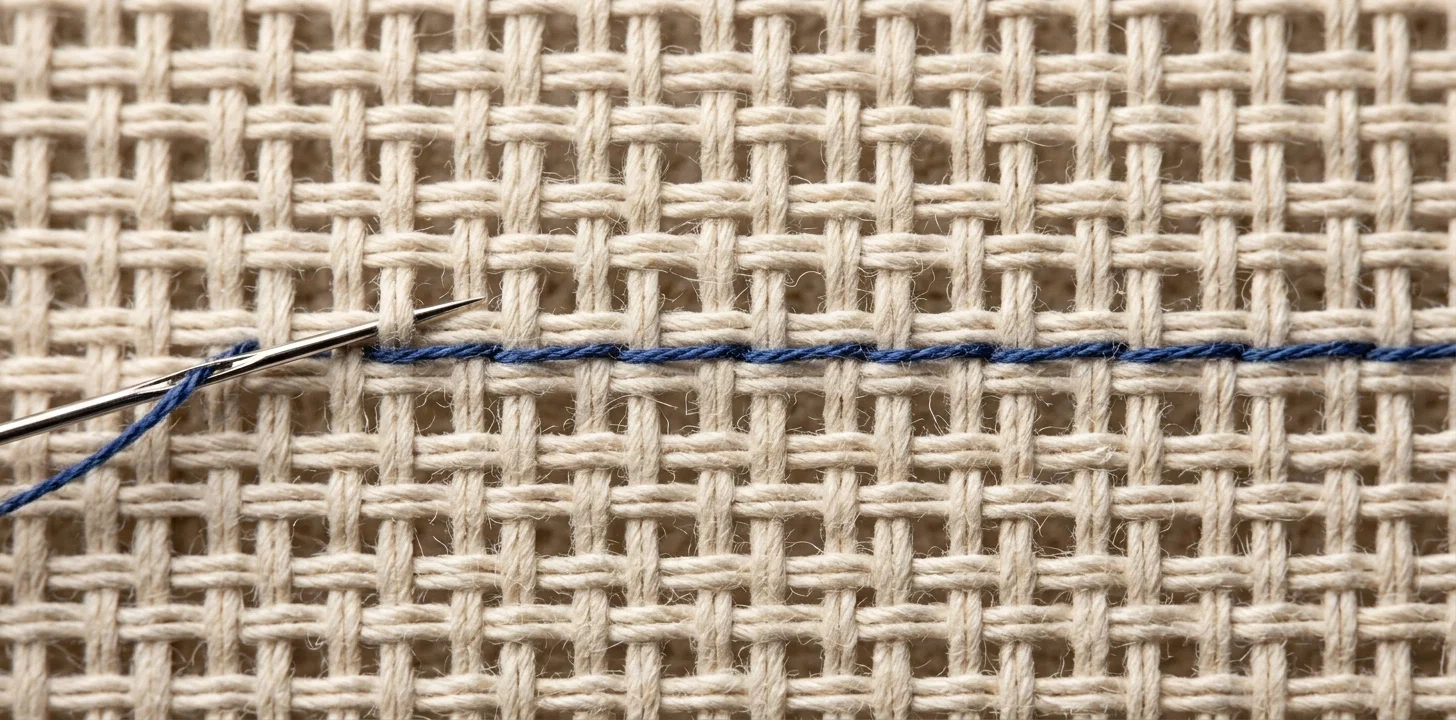
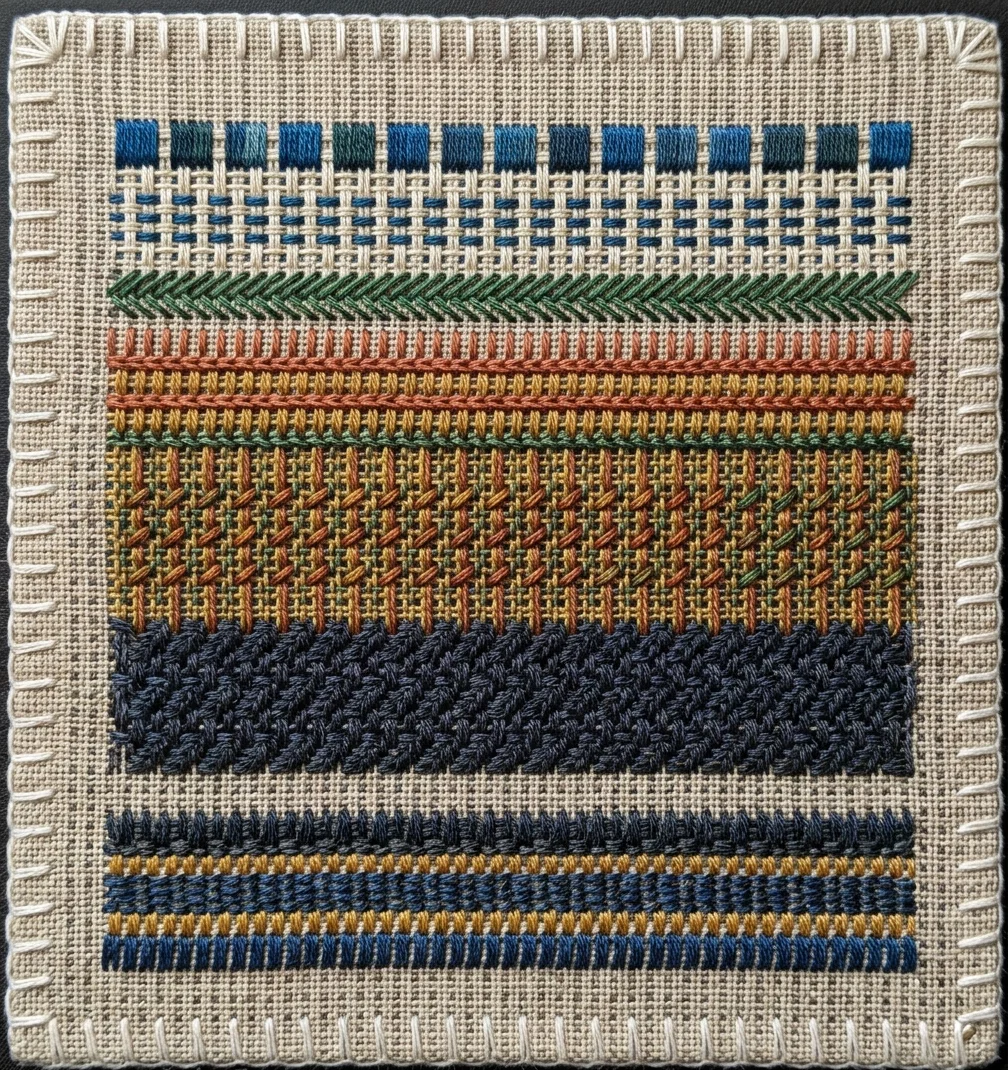
We are now ready to begin the actual work of the first model. With the stripes of the canvas held horizontally, and four double rows of white threads on the upper edge, begin the overcasting near the right-hand corner. The stitches should be two double threads deep and two apart. If when reaching the first or second corner, the stitches do not come out even, a double row of threads may be cut off. Three stitches through each corner will make them correspond with the sides. Should a new thread be needed, tie the two ends together close under the edge of the canvas; lay the ends along the edge on the under side, and take two of the overcasting stitches over them; cut off the remainder. Explain the use of this stitch, which is to keep the cloth from raveling. Illustrate what is meant by raveling.
Overcast around three sides of the canvas; at the third corner unthread the needle, and leave the remaining edge to be done after the rest of the model is finished.
It should be kept constantly in mind that a very important part of the work with this model is to accustom the children to the correct position, to the best way of holding their work, and to the proper use of the thimble. Do not allow one stitch to be taken in any but the proper manner. Great patience and constant watchfulness will be required, but thorough work here will reap its sure reward later.
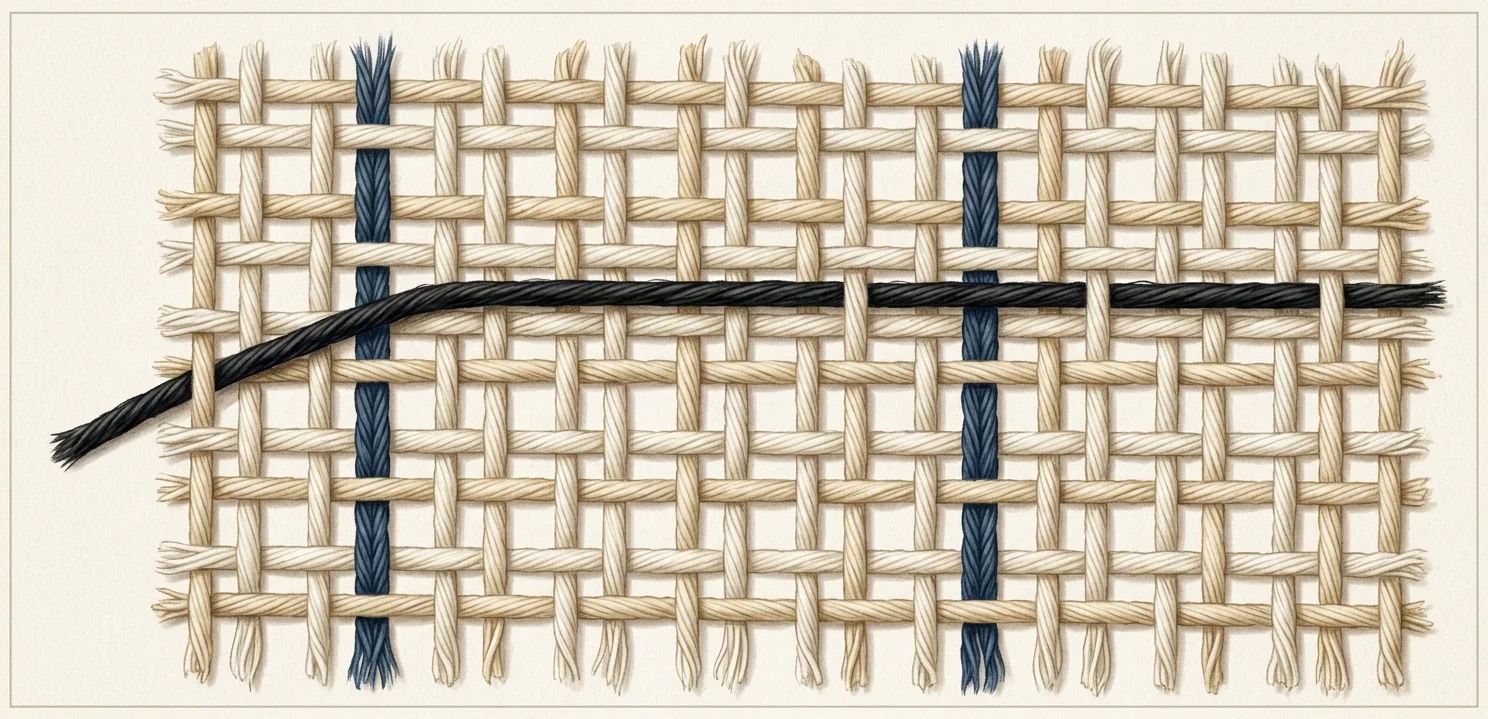
BASTING
The second stitch is basting; its use is to hold the work in place while sewing. With the stripes of the canvas held perpendicularly, pass the needle up from the under side of the canvas in the upper right-hand corner three double threads each way from the overcasting. A good rule in basting is to take up on the needle one half as much cloth as you leave; so, as we leave two double threads, we will take up one. Continue across the canvas; the last stitch will end three double threads from the overcasting on the left. Make three rows of basting, with one double thread between the rows. Let each child start his own third row, the second also if he is able to do so.
The next stitch is running; it is used for work which does not need to be very strong. Suggest and draw out suggestions of different places where running may be used. Begin the running two double threads below the last line of basting. In every case insert the needle from the under side of the canvas. The running stitch is alike on both sides of the cloth, so we pick up one double thread and leave one. This stitch does not come out even with the basting. Make three rows of each stitch, with one double thread between the rows, and two double threads between the different stitches. Before any new stitch is given, ask each child, as he comes to you, to name the stitches he has already had, and give their uses.
The fourth stitch is the backstitch, which is used for work that needs to be very strong. Insert the needle, from the under side, one double thread in advance of where the row begins; this is because with each stitch taken the needle is set back one double thread, and then two double threads are taken up on the needle. The effect on the upper side is the same as machine stitching.
BACKSTITCHING
Be watchful that no mistake escapes notice. It should be considered a mere matter of course that mistakes must be corrected. Pupils will soon learn that there is no question as to that; but it should be the teacher's ambition to lead them to wish to correct their work, rather than to insist that it must be done. Your standard will be theirs, so place it high.
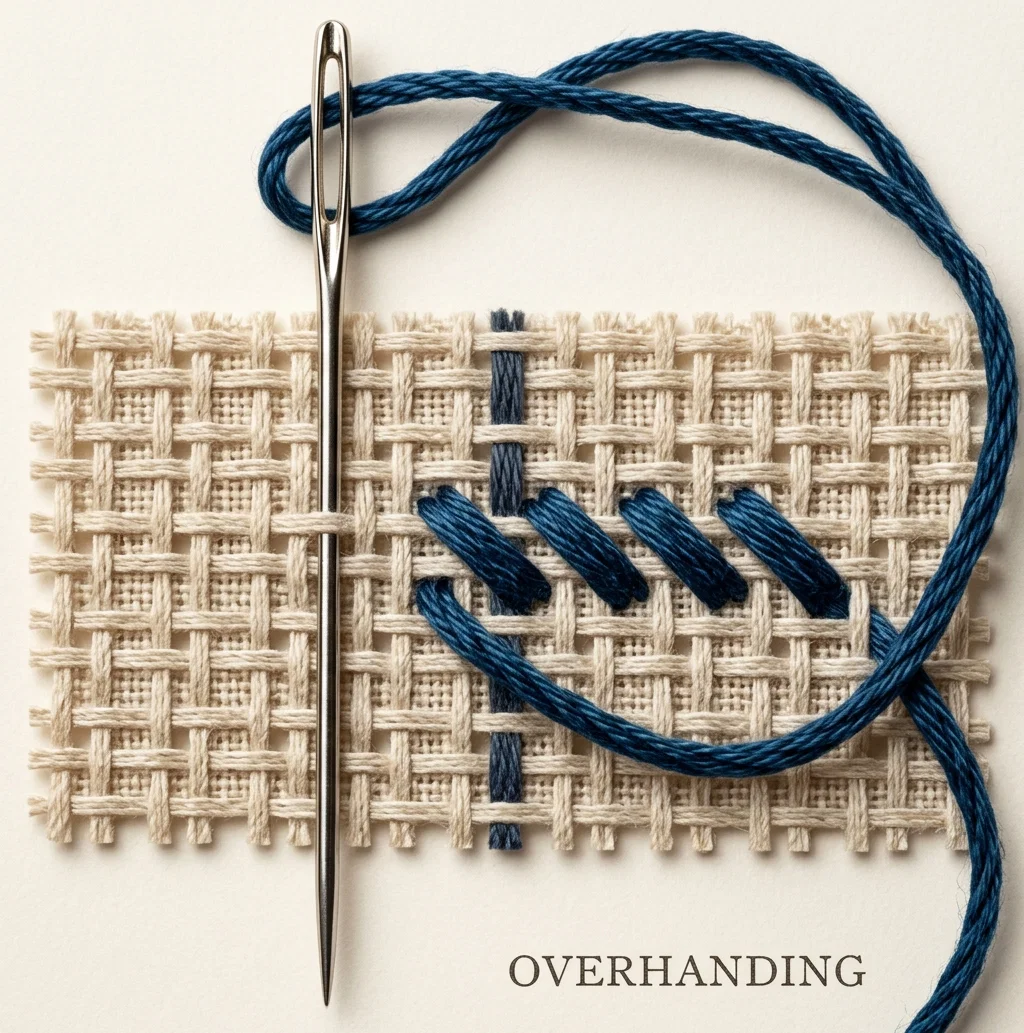
The next stitch is overhanding; it is used to join two selvage edges. Explain the meaning of the word join, and have some selvage edges for illustration. Insert the needle three double threads below the backstitch. The last row of double threads represents two selvage edges of cloth; join them by inserting the needle one double thread above and to the left of the point where it was brought up from the underside, push it straight toward the worker, and take up one double thread. This makes a slanting stitch on the upper side, and a straight one on the under side. In overhanding the needle is always pointed toward the worker.
RUNNING
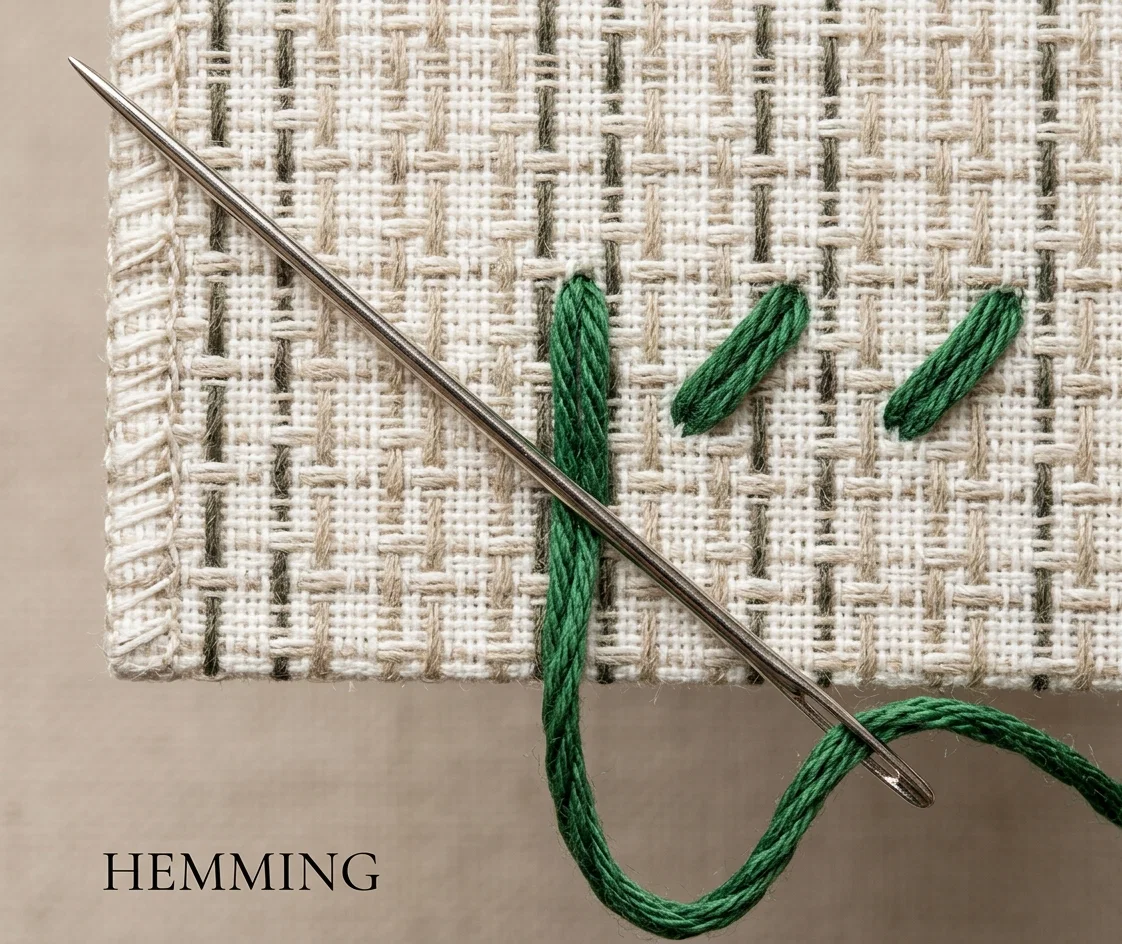
The next stitch is hemming. Explain what a hem is, and ask the children to find one about their clothing. It is a good idea to have a piece of cloth with a basted hem in readiness, and show the children just how the real stitch is taken.
For the stitch on the canvas, insert the needle two double threads below the overhanding. To take the stitch, insert the needle one double thread below and to the left of where it was brought from the under side, push it obliquely under the next double thread to the left and one above. This makes a slanting stitch alike on both sides. It is as near the real hemming stitch as can be made on the canvas. This stitch will come out even with the running, but not with the other stitches.
OVERHANGING
The next stitch is the cross-stitch. It is used for trimming, for sewing patches on underwear, and for fastening seams open. This should be illustrated by a seam which has been cross-stitched open. Unlike the preceding stitches this one is worked from left to right. Insert the needle two double threads below the last line of hemming, but even with the last overhanding stitch. To make the stitch, let the thread lie toward the top of the mat, and insert the needle two double threads to the right and two below; take up on the needle one double thread to the left; for the second stitch let the thread lie toward the bottom of the mat, and insert the needle one double thread to the right and two above, and take up on the needle one double thread to the left. This should be repeated above and below across the canvas. Throw the thread toward the top before taking the lower stitch, and toward the bottom before taking the upper one.
HEMMING
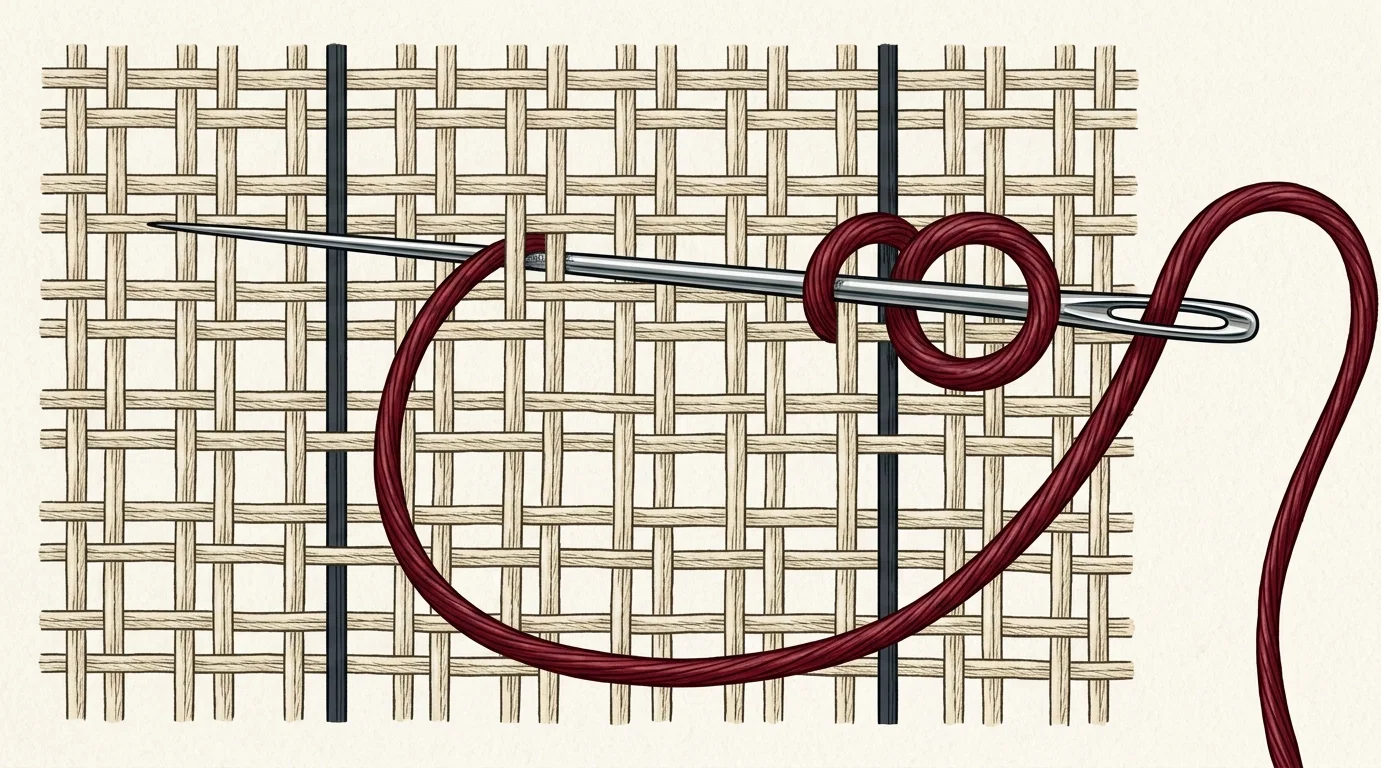
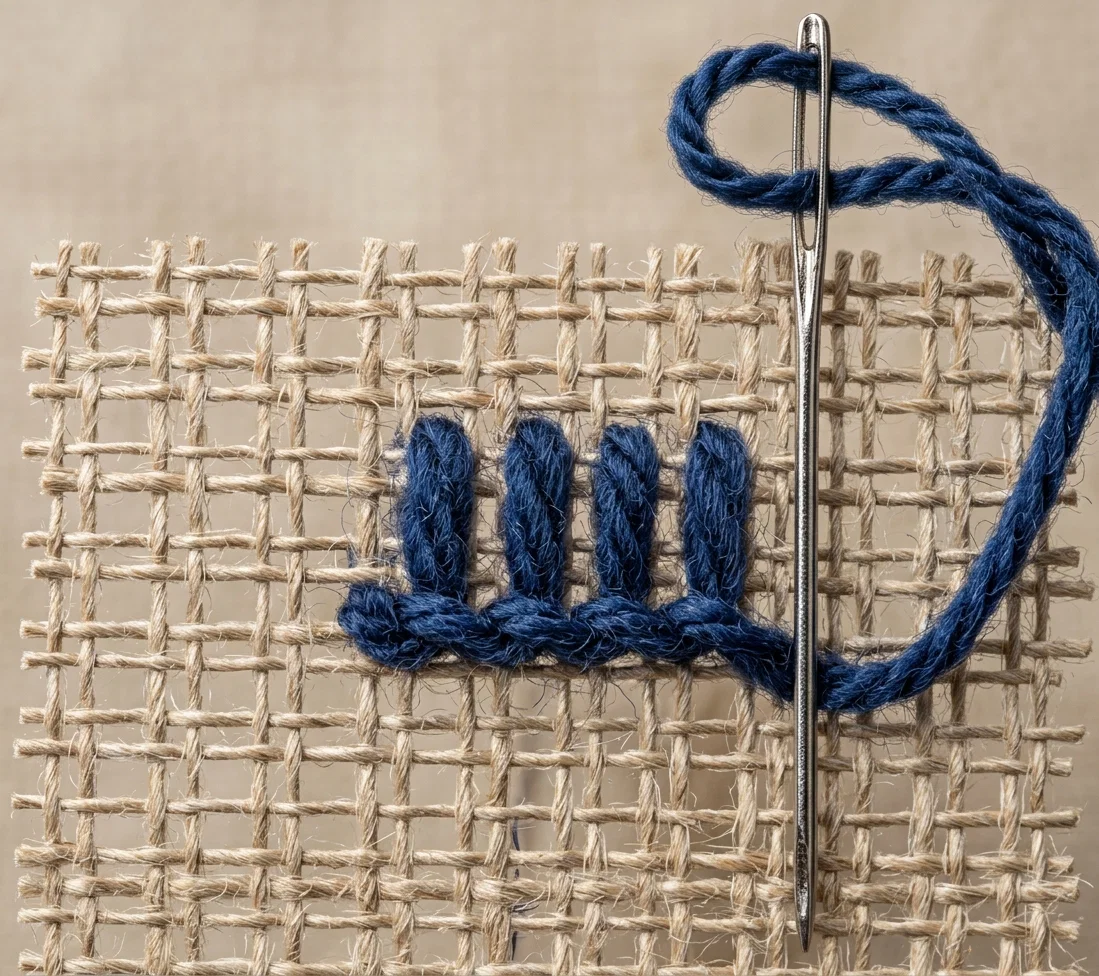
The next and last stitch is called the blanket stitch. It is used as a finish for edges which are too thick to be hemmed. Like the cross-stitch it is worked from left to right. Insert the needle four double threads below the last line of cross-stitch at the left. To take the stitch, insert the needle two double threads above, pass the needle under the two double threads and out the same place as before; draw the thread down toward the bottom, and hold it with the left thumb; take the next stitch the same as the first, one double thread to the right;28draw the needle through the loop formed by holding the thread down. After completing the third row, trim the lower edge of the canvas so that there are five double rows of threads left below, and complete the overcasting; tie the two ends of yarn together and draw under two overcasting loops, stitches on the under side. Expect each child to give name and use of each stitch upon completion of the model. The mat will need pressing, and this the teacher should do before giving it to the child.
CROSS-STITCHING
BLANKET STITCHING
The work of this model will occupy the children for a number of lessons.