MR. CHARLES R. SKINNER, superintendent of public instruction of the State of New York, disapproves of the various movements started to raise money in the public schools for patriotic purposes. To this end he has issued the following statement:—
“The following movements affecting the public schools have come to the attention of the State department of public instruction:—
“First—The building of a war ship by contributions from the schoolboys of the United States, to take the place of the Maine, and to be called the ‘American Boy.’
“Second—A similar movement on the part of the schoolgirls of the country, the war ship to be known as the ‘American Girl.’
“Third—The proposition of the Lafayette memorial commission for the erection of a Lafayette monument in Paris by the youth of the United States.
“Fourth—A national peace jubilee in the schools of the State, as recommended by an association organized in Chicago for this purpose.’
Superintendent Skinner says in reference to these movements:—
“The United States Government is able and willing and ready to build all war ships necessary for the defense of the country.
“While it is fitting that the people of the United States honor the memory of Lafayette, the proposition to ask contributions of the schoolchildren for this purpose is not approved. In nearly all the cities regulations forbid the taking of contributions in the schools for any purpose.
“Furthermore, it is against the spirit of the school laws of the State to charge an admission to any entertainment given in a school building.”
An Archbishop at the Jubilee Ball.
Speaking of the “Jubilee” recently held in Chicago, the Record, of that city, of October 20, remarks:—
“Excepting the President, Archbishop Ireland has been perhaps the most popular guest at the Jubilee. His eloquent speech on Tuesday has been the subject of no end of comment, while his hearty manner and cordial smile have strengthened his hold upon his old friends and won many new ones. Like all the other dignitaries, the archbishop went to the ball, and, of course, was imposed upon by any number of pretty girls. He wrote his autograph along with those of General Miles, General Shafter, and other prominent men, without noticing the character of the paper that was presented for his signature. It would make a decided stir in the College of Cardinals at Rome if some of the engagement cards that were used at the dance last night were submitted to them, and I fear that the holy father would be shocked to see the name of this eminent prelate written in his own hand upon the engagement list of many a Chicago girl for waltzes, two-steps, and other dances which have not usually been included in the accomplishments of ecclesiastics.”
Archbishop Ireland was seeking greater victories than those of a social character; he is playing the desperate game for the winning of the American State to the Roman Church; and who shall say he has not made progress?
Two Reasons.
A Chicago pastor seeking for reasons why men do not more generally go to church on Sunday, received several answers, two of which we give here:—
“A clerk says that Sunday is his only chance for recreation, exercise, a breath of fresh air, and communion with nature. He frankly avows his intention of continuing to spend the day on his wheel. A drummer says in substance: ‘When athletes get together, they talk athletics, artists talk art, politicians talk politics, and they do it as if they meant business.’ He declares that he has seen no similar disposition on the part of Christians to talk religion. They will get enthusiastic over church socials and pink teas, ‘but that seems to be about their limit.’”
From Jerusalem to Egypt
By H. P. H.
JOTTINGS FROM PALESTINE. NO. 15.
From Jerusalem to Egypt.
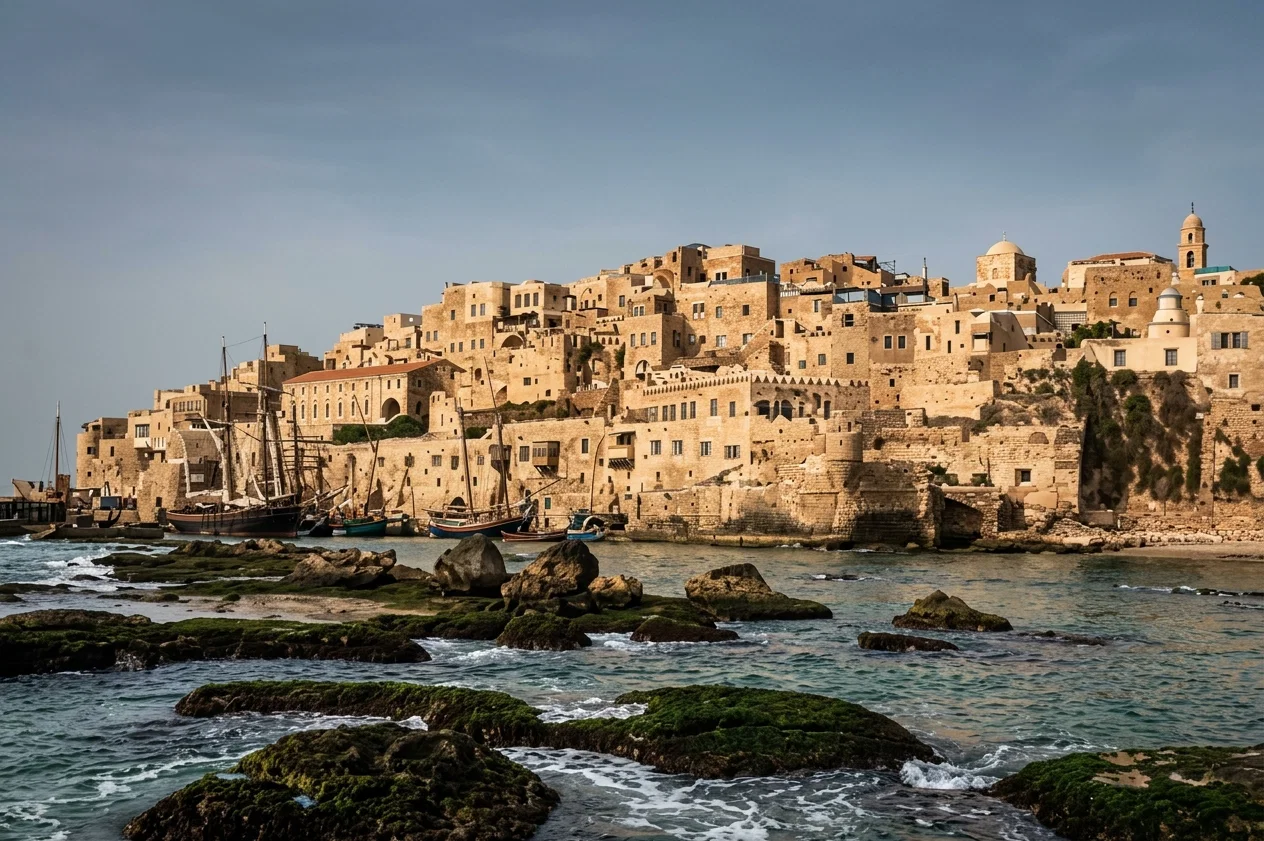
The journey from Jerusalem to Joppa may be made by rail or by carriage, the distance by the former being fifty-four miles and by the latter forty-one miles. Most people go by rail. There is but one train daily each way; the train leaves Jerusalem at 8 A.M. and reaches Joppa at 11:30 A.M. At the time of arrival and departure of trains many people and carriages assemble at the station, presenting a lively scene; at other times the vicinity of the station is as quiet as a country station on the Western prairies. The railway is operated by a French company; but many of the employees are natives.
JOPPA.
The first part of the route is through the rocky, barren hills of Judea; after riding twenty-three miles, we enter the rolling plain which extends north along the sea to Cæsarea, where it ends in the slopes of Mount Carmel. The same plain, extending southward to Egypt, constituted the fertile land of the Philistines. To the north it is called the plain of Sharon, which is celebrated in inspired song for its beauties and its flowers, and which, like the land of the Philistines, was noted for its great fertility.
The first station of any importance is Ramleh, a town of 8,000 inhabitants, which during the Middle Ages once had a population larger than Jerusalem. Two miles farther is Lydda, where Peter healed the paralytic who had kept his bed eight years. “And all that dwelt at Lydda and Saron saw him, and turned to the Lord.” Lydda is now but a small village. Anciently it was situated on the principal caravan route between Syria and Egypt. While Peter was at Lydda, Dorcas died at Joppa. “And forasmuch as Lydda was nigh to Joppa [ten miles], and the disciples had heard that Peter was there, they sent unto him two men, desiring him that he would not delay to come to them.”
This part of the journey is of more interest, the fields being green with verdure and the villages adorned with trees and shrubs. As we near Joppa, the number of trees increases till we reach the large orange and lemon orchards east of the town. These are quite extensive, and extremely prolific. Joppa oranges are large and sweet, and command a good price in the markets of Europe.
Just before reaching Joppa, our train passes the corner of the German Temple colony of Sarona, so called from the Bible Saron. This colony, numbering fifty-one families, has had a harder experience than any of the other Temple colonies; the soil seemed saturated with fever germs, and for many years nearly every child born in the colony soon died. But by tilling and draining the soil, the region has now become tolerably healthful. The colonists are chiefly occupied in the culture of the vine, the raising of grain, and the production of honey. The many flowers on the plain of Sharon make the district specially favorable for apiculture. The honey here has such a deliciously delicate flavor that it is difficult to make one believe that it has not been perfumed.
On reaching the station, we meet a crowd, as at the station at Jerusalem. The Arab porters here are the most impudent of any we have met since leaving Beirut; nothing but iron firmness will enable one to escape imposition. Meeting a Swiss-German hotel-keeper, I am at once at home, and, depositing my luggage, begin a stroll about town. The station is at the north end of town, but a short distance from the sea. Just back of the station is a Jewish colony, consisting of squalid huts amongst the sand banks. Between the station and the sea is an Egyptian colony, comparing quite favorably with the Jewish colony.
Joppa, being about half a mile lower than Jerusalem, is much warmer. At the present time, January 18, it is agreeably warm; most of the inhabitants are barefoot, and have but little clothing. It is now the midst of the orange harvest, and the trees are bending beneath the weight of their abundant yield. The natives are busy gathering and taking to town the fruit, and at the wharf many hands are packing and taking to the ships the oranges, which will soon be in the markets of Europe all the way from Naples to London.
Joppa is situated on a low, rocky promontory extending but a short distance into the sea; and most of the town is situated close to the water’s edge, like the house of Simon the tanner, with whom Peter lodged. The town now has a population of 24,000, half being Mohammedan, a fourth Jews, and a fourth Christians. In the northeastern part of the town is another German Temple colony of forty families, where the principal hotels are located. Among the Germans is a baron who has developed an exceptionally fine garden with a great variety of tropical plants and trees, thus furnishing an illustration of what the land must have been when in its glory.
Joppa is mentioned at the time of the conquest of the land by Joshua; it was to Joppa that Hiram sent the cedars in floats for the temple of Solomon; it was here that Jonah embarked when fleeing from the Lord; here Peter raised Dorcas to life; and it was to this place that Cornelius sent from Cæsarea for Peter, when the Lord prepared Peter for his work among the Gentiles by the vision of the sheet let down from heaven. Tradition still locates the place where the house of Simon the tanner stood. Joppa is of a mixed character, European industries commingling with the Asiatic. Much of the trade is in the hands of Germans, several large steam flouring-mills being prominent among the buildings. As in the days of Samson, the plains of the Philistines produce much grain.
Joppa has no harbor; a reef of rocks jutting a little above the water affords some protection to row-boats; but steamers are obliged to anchor about half a mile out. As about 15,000 pilgrims land here every year, the work of bringing them to shore furnishes a lucrative trade to quite a large number of boatmen. In time of storm, passengers can not land at all; some have passed Joppa three times in succession without being able to land. In rough weather, landing is not only difficult but dangerous; two weeks before I embarked, a boat was capsized and six of the passengers drowned. When it is difficult to land, the boatmen demonstrate what they are capable of in the line of extortion, often demanding twenty times the ordinary price.
The boats usually make the run between Joppa and Port Said during the night. About 4 P.M. I boarded the steamer for Egypt, and as the sun was setting, enjoyed my last view of Palestine; Joppa was just in view to the north,10while to the east extended the broad plain of the Philistines, skirted by the blue hills of Judea; as our steamer kept near the shore, we could see the regions of Ashdod, Gath, and Ekron, the cities of the Philistines to which the ark was successively taken, as the inhabitants were smitten for their impiety. Darkness veiled the shore before we were opposite Gaza, else we could with the naked eye have seen this city, made memorable by the last exploits of Samson.
Next morning in the gray twilight we could see the dim outlines of the shores of Egypt. As the sun rose, the sky was lighted nearly to the zenith with a red, coppery, yet mellow glow, which is peculiar to the desert regions of Egypt, and which constitutes one of the scenic charms of the land of the Pharaohs, Sphinx, and Pyramids. At Port Said, in the wide mouth of the Suez Canal, a forest of masts and smoke-stacks proclaims the extensive traffic of the East and the West which threads its way through the canal. The scene forms a pleasing contrast to the dull, almost deserted regions of Palestine.
We here leave the steamer for the railway, and in a few hours are speeding through the land of Goshen, where the well-irrigated pasture fields, adorned by numerous palms, call to mind the days when the flocks of Israel fed here, and when they escaped the plagues which destroyed the cattle of all that did not heed the Word of God. As we near Cairo, the setting sun again causes the remarkable red glow, and from time to time we catch a glimpse of the Pyramids through openings between the palms which line the Nile. We are soon quartered in the busy Egyptian capital, and, while attending a meeting of the Christian Endeavorers, have the good fortune to meet Mr. Ira D. Sankey, who is visiting Egypt for the health of Mrs. Sankey, and to hear him sing some of the sweet songs of Zion.
H. P. H.
THE PATH OF RIGHTEOUSNESS.
By F. R. Havergal
My Master, they have wronged Thee and Thy love!
They only told me I should find the path
A Via Dolorosa all the way.
Narrow indeed it is. O, why
Should they misrepresent Thy words, and make
“Narrow” synonymous with “very hard”?
For Thou, divinest Wisdom, Thou hast said
Thy ways are ways of pleasantness, and all
Thy paths are peace; and that the path of him
Who wears Thy perfect robe of righteousness
Is as the light that shineth more and more
Unto the perfect day. And Thou hast given
An olden promise, rarely quoted now,
Because it is too bright for our weak faith:
“If they obey and serve Him, they shall spend
Days in prosperity, and they shall spend
Their years in pleasure.”
1 “And he commanded the steward of his house, saying, Fill the men’s sacks with food, as much as they can carry, and put 2 every man’s money in his sack’s mouth. And put my cup, the silver cup, in the sack’s mouth of the youngest, and his corn money. And he did according to the word that Joseph had spoken. 3 As soon as the morning was light, the men were sent 4 away, they and their asses. And when they were gone out of the city, and were not yet far off, Joseph said unto his steward, Up, follow after the men; and when thou dost overtake them, say unto them, Wherefore have ye rewarded evil for good? 5 Is not this it in which my lord drinketh, and whereby he indeed divineth? 6 ye have done evil in so doing. And he overtook them, and he spake unto them these words. 7 And they said unto him, Wherefore speaketh my lord such words as these? God forbid that thy servants should do such a thing. 8 Behold, the money, which we found in our sacks’ mouths, we brought again unto thee out of the land of Canaan; how then should we steal out of thy lord’s house silver or gold? 9 With whomsoever of thy servants it be found, let him die, and we also will be my lord’s bondmen. 10 And he said, Now also let it be according unto your words: he with whom it is found shall be my bondman; and ye shall be blameless. 11 Then they hasted, and took down every man his sack to the ground, and opened every man his sack. 12 And he searched, and began at the eldest, and left at the youngest; and the cup was found in Benjamin’s sack. 13 Then they rent their clothes, and laded every man his ass, and returned to the city. 14 And Judah and his brethren came to Joseph’s house; and he was yet there; and they fell before him on the ground. 15 And Joseph said unto them, What deed is this that ye have done? know ye not that such a man as I can indeed divine? 16 And Judah said, What shall we say unto my lord? what shall we speak? or how shall we clear ourselves? God hath found out the iniquity of thy servants; behold, we are my lord’s bondmen, both we, and he in whose hand the cup is found. 17 And he said, God forbid that I should do so; the man in whose hand the cup is found, he shall be my bondman; but as for you, get you up in peace unto your father.
18 “Then Judah came near unto him, and said, O my lord, let thy servant, I pray thee, speak a word in my lord’s ears, and let not thine anger burn against thy servant; for thou art even as Pharaoh. 19 My lord asked his servants, saying, Have ye a father, or a brother? 20 And we said unto my lord, We have a father, an old man, and a child of his old age, a little one; and his brother is dead, and he alone is left of his mother, and his father loveth him. 21 And thou saidst unto thy servants, Bring him down unto me, that I may set mine eyes upon him. 22 And we said unto my lord, The lad cannot leave his father: for if he should leave his father, his father would die. 23 And thou saidst unto thy servants, Except your youngest brother come down with you, ye shall see my face no more. 24 And it came to pass when we came up unto thy servant my father, we told him the words of my lord. 25 And our father said, Go again, buy us a little food. 26 And we said, We cannot go down: if our youngest brother be with us, then will we go down: for we may not see the man’s face, except our youngest brother be with us. 27 And thy servant my father said unto us, Ye know that my wife bare me two sons; 28 and the one went out from me, and I said, Surely he is torn in pieces; and I have not seen him since: and if ye take this one also from me, and mischief befall him, ye shall bring down my gray hairs with sorrow to the grave. 30 Now therefore when I come to thy servant my father, and the lad be not with us; seeing that his life is bound up in the lad’s life; 31 it shall come to pass, when he seeth that the lad is not with us, that he will die: and thy servants shall bring down the gray hairs of thy servant our father with sorrow to the grave. 32 For thy servant became surety for the lad unto my father, saying, If I bring him not unto thee, then shall1133 I bear the blame to my father for ever. Now therefore, let thy servant, I pray thee, abide instead of the lad a bondman to my lord; and let the lad go up with his brethren. 34 For how shall I go up to my father, and the lad be not with me? lest I see the evil that shall come on my father.
1 “Then Joseph could not refrain himself before all them that stood by him; and he cried, Cause every man to go out from me. And there stood no man with him, while Joseph made himself known unto his brethren. And he wept aloud; and the Egyptians heard, and the house of Pharaoh heard. 2 And Joseph said unto his brethren, I am Joseph; doth my father yet live? And his brethren could not answer him; for they were troubled at his presence. 3 And Joseph said unto his brethren, Come near to me, I pray you. And they came near. And he said, I am Joseph your brother, whom ye sold into Egypt. 4 And now be not grieved, nor angry with yourselves, that ye sold me hither; for God did send me before you to preserve life. 5 For these two years hath the famine been in the land; and there are yet five years, in the which there shall be neither plowing nor harvest. 6 And God sent me before you to preserve you a remnant in the earth, and to save you alive by a great deliverance. 7 So now it was not you that sent me hither, but God; and he hath made me a father to Pharaoh, and lord of all his house, and ruler over all the land of Egypt. 8 Haste ye, and go up to my father, and say unto him, Thus saith thy son Joseph, God hath made me lord of all Egypt; come down unto me, tarry not: 9 and thou shalt dwell in the land of Goshen, and thou shalt be near unto me, thou, and thy children, and thy children’s children, and thy flocks, and thy herds, and all that thou hast; 10 and there will I nourish thee; for there are yet five years of famine; lest thou come to poverty, thou, and thy household, and all that thou hast. 11 And, behold, your eyes see, and the eyes of my brother Benjamin, that it is my mouth that speaketh unto you. 12 And ye shall tell my father of all my glory in Egypt, and of all that ye have seen; and ye shall haste and bring down my father hither. 13 And he fell upon his brother Benjamin’s neck, and wept; and Benjamin wept upon his neck. 14 And he kissed all his brethren, and wept upon them; and after that his brethren talked with him.
15 “And the fame thereof was heard in Pharaoh’s house, saying, Joseph’s brethren are come; and it pleased Pharaoh well, and his servants. 16 And Pharaoh said unto Joseph, Say unto thy brethren, This do ye; lade your beasts, and go, get you unto the land of Canaan; 17 and take your father and your households, and come unto me; and I will give you the good of the land of Egypt, and ye shall eat the fat of the land. 18 Now thou art commanded, this do ye; take you wagons out of the land of Egypt for your little ones, and for your wives, and bring your father, and come. 19 Also regard not your stuff; for the good of all the land of Egypt is yours. 20 And the sons of Israel did so; and Joseph gave them wagons, according to the commandment of Pharaoh, and gave them provision for the way. 21 To all of them he gave each man changes of raiment; but to Benjamin he gave three hundred pieces of silver, and five changes of raiment. 22 And to his father he sent after this manner: ten asses laden with the good things of Egypt, and ten she-asses laden with corn and bread and meat for his father by the way. 23 So he sent his brethren away, and they departed; and he said unto them, See that ye fall not out by the way. 24 And they went up out of Egypt, and came into the land of Canaan unto Jacob their father. 25 And they told him, saying, Joseph is yet alive, and he is ruler over all the land of Egypt. 26 And his heart fainted, for he believed them not. 27 And they told him all the words of Joseph, which he had said unto them: and when he saw the wagons which Joseph had sent to carry him, the spirit of Jacob their father revived: 28 And Israel said, It is enough; Joseph my son is yet alive: I will go and see him before I die.”
SUGGESTIVE QUESTIONS.
(1) What instruction did Joseph now give to his steward? Gen. 44:1, 2. (2) After his brethren were sent away, what accusing message was sent to them? Vs. 3-6. (3) How did they endeavor to show that they were true and honest men? Vs. 7-9. (4) In how far did the steward accept their final proposition? V. 10. (5) What did they immediately do? What were the results? Vs. 11-13. (6) In harmony with what has gone before, what did Joseph feign to know, and how? Vs. 14, 15. Note 1. (7) What did Judah say? and what was Joseph’s reply? Vs. 16, 17. (8) What eloquently touching speech did Judah now make? Vs. 18-34. (9) What effect did it have upon Joseph? Gen. 45:1, 2. (10) What did he first say to them? How did they feel about it? What request did he make? Vs. 3, 4. (11) By what remarkable statement did he now reveal his unbounded faith in the God of Jacob? Vs. 5-8. Note 2. (12) What message did he send to his father? Vs. 9-13. (13) How did he further show his love for his brethren? Vs. 14, 15. (14) What effect did this news concerning Joseph’s brethren have upon Pharaoh and his house? V. 16. See also v. 2. (15) What message did Pharaoh send through Joseph to his brethren? Vs. 17-20. (16) What did Joseph now do for them all? for the ten? for Benjamin? for Israel? With what final injunction did he send them away? Vs. 21-24. (17) When they came home and told Jacob this wonderful story, what effect did it have upon him? Vs. 25, 26. (18) What became of his unbelief and low spirits? When he saw the wagons, what did he say? Vs. 27, 28. (19) What humiliating confession now became necessary on the part of Joseph’s ten brethren? Note 3.
Suggestive Readings.—“Patriarchs and Prophets,” pages 229-232.
NOTE.—“This cup was supposed to possess power of detecting any poisonous substances placed therein. At that day cups of this kind were highly valued as a safeguard against murder by poisoning. . . . ‘What deed is this that ye have done?’ he said; ‘Wot ye not that such a man as I can certainly divine?’ Joseph designed to draw from them acknowledgment of their sin. He had never claimed the power of divination, but was willing to have them believe that he could read the secrets of their lives.”
ADDITIONAL STUDY.
(1) Make an outline of your own and recite this lesson from it. (2) Note the care with which Joseph’s steward obeyed his instructions. (3) Show from this and preceding chapters that God was held in high reverence with both Joseph and his brethren. (4) What do you learn in this lesson of Joseph’s influence? (a) Among his brethren? (b) Among the people of Egypt? (c) Among the nations of the world? (5) At what place did Jacob and his family live during the first two years of this universal famine? (6) Life consists, as with Jacob and his children, of a series of surprises, apparently good or ill. (7) What traits of character in Judah are revealed in this lesson? (8) Make a list of the points in which Joseph’s life represents that of Christ. (9) Joseph’s life is an illustration of the sublime and glorious truth that when Satan seems most successfully to have hidden the light that is burning in the soul loyal to its God, then the flame bursts forth, and the light is lifted up, to be seen both near and afar off, even if it becomes necessary for every nation of the earth to be stricken with famine.
OUR WORK AND WORKERS.
THREE members were added to the church at Alameda, Cal., on the 12th inst.
SEVEN converts are reported by Brethren Henry and Wm. J. Johnson, at Perry, Iowa.
FOUR converts are reported at Sheridan, N. Y., under the labors of Sister Lulu Wightman.
A CHURCH school has been instituted at Huron, South Dakota, with Brother J. D. Barton in charge.
ELDER E. PAYBERG is organizing a school of health in Milwaukee, Wis., and is meeting with good success.
THE General Conference has asked Brother B. G. Wilkinson, of Battle Creek, Mich., to take charge of the work in Manitoba.
FOUR persons were baptized at Elk Point, South Dakota, during a four days’ meeting held by Brother J. H. Rogers.
FOURTEEN have been added to our ranks at Russell, Iowa, through labor of Brother Frank A. Washburn and others.
FIVE candidates were recently baptized in Lake Kenka, near South Putney, N. Y., by Brother W. A. Westworth. Two candidates were baptized at Adams Center by the same minister.
THE autumn class in medical missionary work now being drilled at the Sanitarium in Battle Creek, Mich., numbers about two hundred. The class entered upon regular work on the 3d inst.
A GOOD report comes from the colporter wagon of the Illinois Conference, and Brother Hook, who has charge of it, deems it a means of great good. This means of work in the country will no doubt soon become more extensively used.
NOT only in the office of publication but also in the field it is coming to be more and more recognized as a fact that our million-copies edition of the SIGNS, for January 5, 1899, is not only an immense but an important enterprise. Individual orders are running from 100 to 5,000 copies, aside from tract society orders. The 5,000 individual order is from Brother J. F. Bahler, a Texas laborer.
A CHRISTIAN HELP BAND was recently organized at the South Side (Chicago) church. The pupils of the church school have formed a society for the purpose of soliciting food from the opulent to give to the poor.
IN connection with meetings held in Duquoin, Ill., four have been added to the church, a Christian Help Band has been organized to help the poor and to distribute Gospel literature, and the brethren acknowledge the Spirit of God as their leader and helper.
MEETINGS held at Fish Creek Landing, N. Y., by Brother S. B. Whitney, are giving good results, ten having taken their stand on the Lord’s side. One of these is a man 84 years of age, who has thus demonstrated that the prolongation of his years has not been without a purpose.
MISS MARGUERITE WATERS, who is teaching a church school at Prescott, Wis., writes to The Wisconsin Reporter that fourteen of her pupils are living with her in the rooms in connection with the school. It is conducted on the plan of a private boarding-school, and, altho it has a small beginning, yet it is no doubt a nucleus for a much greater work.
IOWA CONFERENCE recently voted $500 of surplus funds to the Foreign Mission Board, and then Kansas Conference did likewise, adding $500 each to three other enterprises. The proper solution of the money question on the part of Christians, in view of the soon-coming reckoning day, is to “lay up for yourselves treasures in heaven, where neither moth nor rust doth corrupt, and where thieves do not break through nor steal.”
FROM The Gleaner we take this item, showing the sentiment that is being aroused in regard to our quarter-centennial issue: “The time of the regular Sabbath morning service in South Lancaster [Mass.] last Sabbath was devoted to the missionary theme relating to the grand opportunity, already at hand, of preparing the way for the extensive circulation of the quarter-centennial number of the SIGNS OF THE TIMES, soon to be issued.”
THE influence of our Chinese schools in Hawaii is reaching China, and the teachers are being urged to go there. It is said that scarcely a boat leaves the islands for China but bears back some one who has heard more or less of Gospel truth, having attended our schools from four months to two years. There is not a boy in the school but expects to return to China some time. One school is located at Honolulu and one at Hilo, the next largest city in the group.
PROF. C. C. LEWIS, of Keene (Texas) Academy, spent a good part of the vacation in the field. He visited twenty-one churches, delivered forty addresses on the subject of education, rode 500 miles by team, and in other ways endeavored to arouse an interest in educational matters. The Academy News reports that the success of his efforts is shown in a goodly number of new students. Oklahoma Conference has resolved to assist the academy to the extent of $2,000 the coming year. It is expected that the academy will conduct a special school for Christian workers during a period of three months from January 1.
BROTHER G. B. THOMPSON, president of New York Conference, says: “The SIGNS is worthy of our highest endeavors. No better medium exists to reach the people of our populous cities. The Lord is coming; and it is high time that we awake from the stupor which has come upon many of us. Shall we not take hold of this work in earnest, and roll up a large list for our pioneer journal between now and the holidays?” This is worthy the earnest consideration of other conferences as well as New York.
“The Lord is coming! let this be
The herald note of jubilee,
And when we meet, and when we part,
The salutation from the heart.”
AN institute, the primary purpose of which was to consider work in California Conference with the SIGNS, was held last week in this city. However, other matters were considered, and a morning hour was given each day to individual consecration, and especially seeking the Lord for guidance in the work. Besides the conference officers and several laborers, there were present Brethren J. N. Loughborough, A. J. Breed, and Allen Moon, of the General Conference Committee. An interesting feature of the occasion was the resume, by Brother Loughborough, of the opening of the work in California and the establishing of THE SIGNS OF THE TIMES. The meeting as a whole was one of encouragement, as the brethren and sisters sought broader views of the great work of giving the Gospel to the world. A striking feature of the institute was that the brethren and sisters came together without any set plans; they came expecting the Spirit of God to lead out, and with a willingness to follow its leading. The importance of using the SIGNS as a pioneer in our work was emphasized, as the experiences of successful workers in all lines have borne witness to its adaptability to this purpose.
PERIODICALS WANTED.
Mrs. L. A. Holobaugh, Mt. Vernon, Ohio, desires clean copies of the SIGNS for missionary work. Please send post-paid.
BOOKS RECEIVED.
“LINEAR PARALLEL BIBLE,” Authorized and Revised Versions, Students’ Edition, A. J. Holman & Co., Philadelphia, Pa.
“THE MONEY CAPTAIN,” and “A SLAVE TO DUTY AND OTHER WOMEN,” Herbert S. Stone & Co., Chicago.