Signs of the Times, Vol. 35, No. 9.

The Answered Prayer
Earlier text: The Answered Prayer

With Our Inquirers

“If ye will inquire, inquire ye.”
[All questions to this department will be answered which to the editors will seem to minister to the good of the readers and to the mission of the paper. The same question can not be answered repeatedly in the same volume. The name and address must accompany question, not for publication, but as an evidence of good faith, and that answer may be made by letter if deemed advisable. It is well always to enclose a stamp for reply.]

2615.—Condition of Man in Death.

It says in the Bible in one place that when a man dies he remains dead, and then in another place it speaks of Lazarus as being in heaven, and the rich man as being in hell and asking for a drop of water. How do you reconcile these two passages? G. L. M.
There are many passages of Scripture which conclusively show that “the dead know not anything;” that when a man dies his “breath goeth forth, he returneth to his earth, in that very day his thoughts perish.” It is not said that Lazarus is in heaven. The story of the rich man and Lazarus in Luke 16 is a parable, not of something which actually took place, but in which inanimate objects are made to talk and speak in order to convey a useful lesson. This department will not admit of the explanation of that parable; it is too long. If our inquirer will send for a little tract upon that question, “The Rich Man and Lazarus,” by Mrs. E. G. White, he will receive light upon it; or if he has access to “Christ’s Object Lessons” there is one chapter devoted to it, entitled “A Great Gulf Fixed.”

2616.—Ancient Civilization.

What can be the history of the ancient cities that are being unearthed in the southern part of the United States and in Mexico and Central America? Is it possible that they are ruins of cities which existed before the Flood? Could it be possible that Noah lived on this side of the earth before the Flood, that the ark floated across the Atlantic during the time of the Flood, landing on the Eastern hemisphere? C. K.
It has been about four thousand years since the Flood. That is time for the building and ruin of large empires and cities. Take for instance those lands the history of which has come down to us, Babylon and Assyria, Tyre, Persia, Media, Egypt. All of them built great cities, erected magnificent buildings, but generation after generation, and civilization after civilization have succeeded. The ruins are still there, some of them grand and magnificent. There has been time for such civilization to exist in America and pass away. It has been generally supposed that America was settled from Asia, by way of Bering Strait.

2617.—Sea and Waves Roaring.

Luke 21: 25 speaks of the sea and waves roaring. What is meant by these words? Have not the sea and the waves always roared? C. K.
Not in the sense of the prophecy. It indicates that they will be fearfully disturbed, so much so that the hearts of men will fail for fear. It would indicate that there would be increasing storms and increasing troubles. All nature would be responsive to the increased load of sin.

2618.—Preaching on the Streets.

(1) Should not Seventh-day Adventists preach the great threefold message on the street corners? (2) If there be no pastor, could a layman properly lead such a movement? S.
(1) Yes, if the Lord has called them so to do. He may call some to do this work, and bless them in the doing of it. He certainly will not call all to do it. Some may wish to do it who are not called, simply because somebody else is holding street meetings. Such feelings are not a safe guide. It requires special qualifications to be a successful street evangelist; and one ought not to undertake such a work unless he knows that God desires him to do it and will be with him. (2) If God calls a layman to do that work, let the layman respond to that call in the strength of God, and labor in all love and humility, not to argue, but to win souls to Christ and salvation.

2619.—Rev. 2: 9.

Please explain the 9th verse of chapter 2 of the Revelation. E. C.
We do not know what our inquirer asks for in the verse. The Lord says to the church of Smyrna: “I know thy works, and tribulation, and poverty.” These were their temporal conditions. “But thou art rich,” that is, rich in faith. He also declares, “I know the blasphemy of them which say they are Jews,” true Jews, true believers in Christ the Jew, the Lion of the Tribe of Judah, but “are not,” have no living connection with Him, “but are the synagog of Satan.” That is, instead of belonging to the synagog, or church, or congregation, of the Lord, they belong to the congregation of the evil one. Such has ever been the case all through the time of human probation.

Suggestive Notes.

Our Old Testament readings for the first three days include the book of Lamentations, supposed to have been written by Jeremiah. In the Hebrew Bible it stands among what is called “The Hagiographa,” or “Holy Writings,” between Ruth and Ecclesiastes. It consists of five separate poems, the first four acrostic in construction, each line beginning with a letter of the Hebrew alphabet. They are songs of mourning over the destruction of the temple, the cessation of the worship of Jehovah, the condition of the people of Jerusalem. After reading 2 Chronicles and Jeremiah, one can feel somewhat of the depth expressed in the Lamentations, of the sorrow which possessed the devout Jews. After once reaching the glory that was manifest in the days of Solomon, and then realizing the wretchedness of their lot under the Babylonian captivity, truly Jerusalem could say, “Look and see if there is any sorrow like my sorrow.” Rather the question ought to have been, Look and see if there is any sin like my sin; for Jerusalem’s sorrow and trouble was the result of Jerusalem’s sin.
The last four days of the week cover the first ten chapters of Ezekiel, another book with a priest for its author. The name Ezekiel means “God strengthens.” He was among the captives whom Nebuchadnezzar carried away under the reign of Jehoiakim, in B.C. 597, and settled near the river Chebar. His prophetic work extended over about twenty-two years. The book is strikingly rich in lessons concerning conduct and spiritual experiences. The first and the tenth chapters present before us a great symbolical view of God’s working among the nations. It has been said that the living creatures which Ezekiel saw were the living throne of God, but it is well to note that these living creatures are said to be upon the earth, and connected with the earth; that the great firmament was over their heads, and above was the throne of the Almighty. Rather, is it not more reasonable to suppose that these living creatures or cherubim represent the great companies of living agencies which God is using in His work; and that the formation of these companies was in the forms of the living creatures which Ezekiel saw, the man, the lion, the ox, the eagle, representing wisdom and strength and patience and glory? It is well to note, too, that these forms, to a greater or less extent, were especially manifest in Assyria, Babylon, and Egypt. We have the man-headed lion, the lion-headed ox, etc. Earthly powers sought to control the affairs of earth, but only imperfectly, like their graven images. But God controls all heavenly agencies and through these all earthly agencies, and tho they seem to be utter confusion to us, wheels within wheels, He guides them all safely to His own purposes; “even the wrath of man shall praise Him.”
Our New Testament readings cover Acts 9 to 16. Among these events we call the attention of our band to two great truths which stand out among the others.
1. God’s use of human agencies. The angel which came to Cornelius could have told Cornelius the way of life, yet this is not God’s plan. He sends Cornelius to a member of His own church, Peter. God’s army above always cooperates with God’s children below. It has been said that not one soul is born into His kingdom but what there is travail on the part of some other soul. In the great day of God, sower and reaper will rejoice together, and we shall see how through various agencies the Lord has brought His children home so that neither any one man nor any one angel shall say, This soul is here because of my labor.
2. Chapter 15 gives the record of the first council that was held among the disciples. This was not of the character of the councils which followed in later ages. It was a meeting together to seek God and to come to a better understanding over questions wherein they differed. It was not held at Rome, but at Jerusalem, and the one who presided at that council was not Peter, but James.
Our Bible Band
Our Bible Band

Schedule for Week Ending Oct. 10, 1908.

Sunday Oct. 4 Lam. 1, 2 Acts 9
Monday “ 5 “ 3, 4 “ 10
Tuesday “ 6 “ 5 “ 11, 12
Wednesday “ 7 Eze. 1, 2 “ 13
Thursday “ 8 “ 3, 4 “ 14
Friday “ 9 “ 5, 6 “ 15
Sabbath “ 10 “ 7-10 “ 16

Unidentified Item

Printing in Chinese

By H. W. Miller, M.D.
In a Chinese printing-office between six and seven thousand characters are required in each font. The type is distributed in as many separate compartments in the type-cases. In some type-rooms the type-cases are arranged in a semi-circle so as to save the type-setter as much walking as possible. But in small printing-offices where but one font of the same kind can be afforded, they are placed in a straight row so that two or more type-pickers can work at the same time. As in the English type, we have some letters as "e" and "i" that are used much more frequently than other letters, "q" and "z" for instance, so in the Chinese we have some characters that are of much greater frequency than others. In a complete font of type, we have four hundred of the most common characters. It will be remembered that each character is a word. Out of a font of seven thousand characters, at least five thousand would not have more than eight of one kind, as of the less common characters we have but eight each. The five hundred most frequently used characters are placed in adjoining sections in one type-case, and their position must be memorized by the type-pickers. Then the remaining six thousand or more characters are arranged according to the radicals, and the type-picker finds them by following the radical index the same as he would in the dictionary.

"Type-Pickers."

They call the men that gather the type type-pickers instead of type-setters, since it is not practical to set up the matter ready for print as the characters are found, for it is necessary to put in the punctuation after the characters are all gathered together. The styles of type are known as No. 2, which is the larger; No. 4, the medium, and No. 6, the small. There is still a smaller size than the No. 6, and still a larger than the No. 2, and also a No. 3 between the No. 2 and No. 4, and a No. 5 between the No. 4 and No. 6. So it will be seen that to carry a full stock of Chinese type, seven different fonts of seven thousand characters each are required, making a total of forty-nine thousand different characters. This accounts for the large size of the compositor’s room in a Chinese printing-office.
Formerly, as in the Hebrew language, there was no punctuation used, but now punctuation is indicated by a small circle at the end of a sentence and a comma to separate the clauses. After the type-picker has gathered all the type for the manuscript, it is placed in the hands of the compositor, who makes it up in the right lengths for the form and sets in the punctuation. Since Chinese is always printed vertically, he sets the type in rows from right to left. The end of a paragraph is indicated by a large circle, or the end of that line may be left blank as in English and the next paragraph begun at the top. Where it is desired to indicate respect, it is customary to leave a space just before the name, if the name appears in the context; or if the name is at the beginning, it should be from two to three characters higher on the page than any other part of the context; therefore, it is necessary sometimes, to give emphasis to a name, to make all the lines on the rest of the page two characters short, in order to give prominence to this name or title.
Even with a complete font of type, where the most common characters number four or five hundred, it will be seen that but a few pages of text could be set up at a time without exhausting some of the characters of the font. So one of the first requisites of a Chinese printing-office is a foundry where not only stereoplates can be made, but more preferably electroplates, of all the printed matter. But printing-offices of any capacity usually have type-casting machines and a full set of matrices for casting their own type. The latter is something that an American press seldom, if ever, installs, and only the larger of the printing-houses require the electro- or the stereoplating.
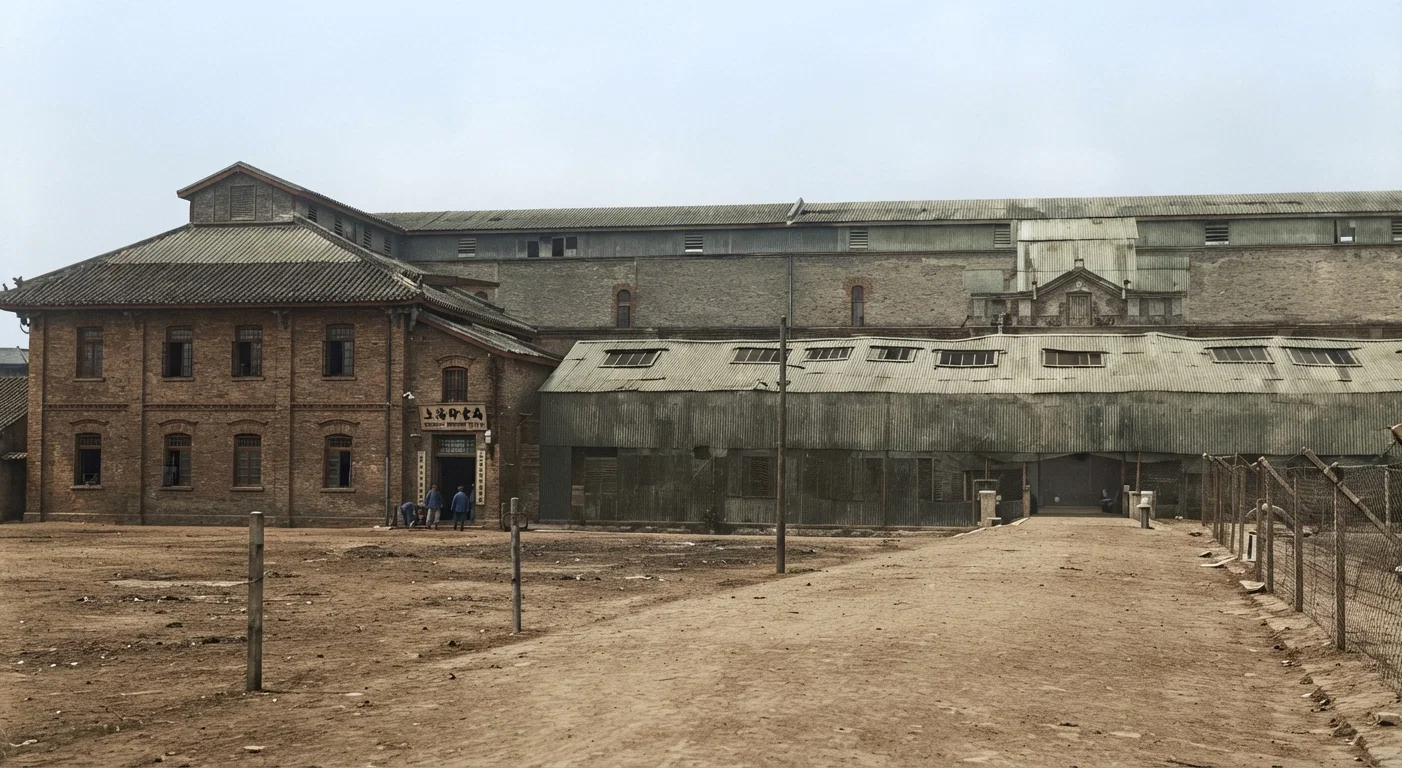
Native Chinese Printing-Office, Shanghai, China, showing about one third of the building.

Few Illustrations.

One drawback in the printing of Chinese books in the past has been the unfortunate neglect of illustrating, due largely to the fact that facilities were not at hand with which this could readily be done. Almost all the illustrating had to be done by the process of lithographing, by transferring the picture to the surface of a smooth stone and then printing from this. This method of illustrating has been used for several decades in China, but only of late have there been photoengraving-plants in the East. In the near future we hope to be able to secure illustrations from photoengraving-plants here. Some illustrations used in the past have been those cut from wood, so necessarily they would be very coarse.
The method of binding books in China varies considerably from that used in other countries, since the Chinese seldom use the cardboard or cloth binding, but the bindings are made by folding a piece of stiff paper; and on the side of the book, which would correspond to the back of an English book, would be found the title. The leaves of the book are printed on only one side of the paper; the blank side of the paper is folded inward so that the line on which the paper is folded forms the margin of the page. In the center of the page as it is printed is a little index showing the place to fold the sheet. These pages are folded exactly at this point by women and children in the Chinese bindery just as fast as they can reach out their hands to pick up the separate sheets. They get so expert at this that a machine could hardly be expected to do the same kind of work faster. Then the pages are collected; and instead of getting the margins of the pages even by cutting them they are beaten down on a plain surface until the pages are all even, when they are stuck together by an awl being pushed through the back of the book and afterward secured by a paper plug. The paper is then trimmed at the top, bottom, and back, and stitched together. It is not done with a modern paper-cutter, but by a native who simply takes a circular knife, presses the books together with his foot, uses a wooden gauge at the top to indicate the size, oils his knife by touching the edge to a candle, and by a few sweeps trims the edges of a pile of books about a foot high. They are cut as neat and clean as it would be possible to do with the ordinary paper-cutter.
After all, the greatest difficulties in the process of making books in China are met by the proof-reader, owing to the great similarity of so many characters in the Chinese language; some of them differing in the length of one line or the addition of a dot. Nothing less than ability to write all the different characters used and a trained eye to readily recognize the difference between characters so similar, will enable one to do this line of work successfully.

Chinese Adaptability.

The natives take well to the art of printing. In a very short time, by carefulness with them, they can carry a large part of the responsibility of the work. It will be found that a Chinese compositor can set up a page of Chinese and correct it ready for press even in a shorter time than an English compositor can do the same amount of work with the English, except with a linotype. Such a thing as a linotype in the Chinese would be an impossibility so far as we can see now. As yet there has never been a typewriter made that was at all practical, and the two or three attempts ever made toward making one were for curiosity.
In this world have been perfected remarkable agencies for disseminating knowledge;

Concentrated and Concentrating Wealth

THE leading article in our next issue (the October Special) will be on the subject of Finance. Carefully prepared statistics will be given showing the rapid concentration of wealth into the hands of a few men who are able to control all the great industries and commodities of the country. This is creating a feeling of dissatisfaction and unrest among the masses, and the article will show that this state of things will naturally lead to the conditions spoken of by the apostle James:
Go to now, ye rich men, weep and howl for your miseries that shall come upon you. Your riches are corrupted, and your garments are motheaten. Your gold and silver is cankered: and the rust of them shall be a witness against you, and shall eat your flesh as it were fire. Ye have heaped treasure together for the last days. James 5: 1-3.
This question of finance is one of the most perplexing and difficult problems before the world to-day, and it is one in which nearly every person is interested. Just one year ago a financial crisis came upon this country like a thunderbolt out of a clear sky. It was wholly unexpected. There was no good reason for it, nevertheless it came; and some are now predicting a still greater crash in the near future. The student of prophecy knows exactly what these things mean, and it is his duty to tell it to others.
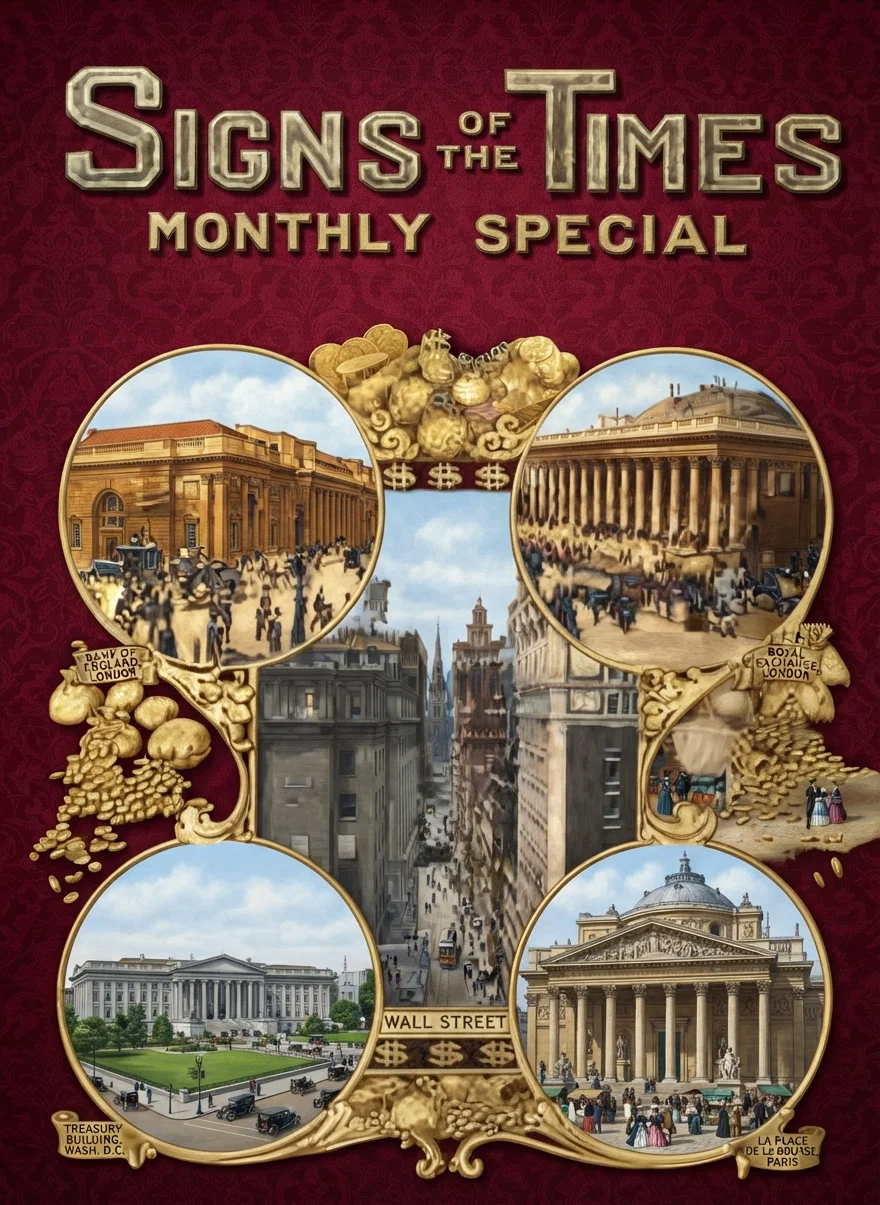
The cover design will be very attractive, showing the five great money centers of the world; namely: Wall Street, New York; Bank of England, London; La Place de la Bourse, Paris; Treasury Building, Washington, D. C., and the Royal Exchange, London, England.
The first article in the journal, as usual, will be "Notes on Current Topics," taking up and commenting on the most important events in the social, political, and religious worlds, showing the bearing they have on the fulfilment of prophecy.
This will be followed by editorial articles on practical Biblical themes to encourage honest investigation and Christian living.
The other regular departments of the journal will be unusually strong. Contributors who are specialists in their lines have been secured to write on themes of living interest and moment to all thinking people.
The October Special, dealing with the question of finance as it does, and coming right before the presidential election, will doubtless meet with a ready sale. It will contain 64 pages, the same as previous specials, and will be ready to mail September 15. Let the orders come in early.
In fact, the developments which take place simultaneously in all parts of the world are to be looked at with wonder, since the intent overshadowing them all is that of preparing a people to meet their God. To what use can money better be placed than to that of more enlightenment for those in the darkness of heathenism, a knowledge of the Creator who is merciful and holds out to mankind a Gospel that has in it the power unto salvation to all who believe, both to the Jew and the Gentile.
Facsimile of Cover Page for the October Monthly Special.

A Lesson for the Church To-day.

FOLLOWING is the lesson which the historian of the Reformation, D'Aubigne, draws from the death of Zwingli and the defeat of the Swiss Reformers at Cappel. In it is a lesson for Protestants now:
"Thus the Reformation, that had deviated from the right path, was driven back by the very violence of the blow into its primitive course, having no other power than the word of God. An inconceivable infatuation had taken possession of the friends of the Bible. They had forgotten that our warfare is not carnal; and they had appealed to arms and to battle. Our God reigns; He punishes the churches and the people who turn from His ways.
"We have thus taken a few stones, and piled them as a monument on the battlefield of Cappel, in order to remind the church of the great lesson which this terrible catastrophe teaches. As we bid farewell to this sad scene, we inscribe on these monumental stones, on the one side, these words from God's Book:
" 'SOME TRUST IN CHARIOTS, AND SOME IN HORSES; BUT WE WILL REMEMBER THE NAME OF THE LORD OUR GOD. THEY ARE BROUGHT DOWN AND FALLEN; BUT WE ARE RISEN AND STAND UPRIGHT.'
"And on the other, this declaration of the Head of the church:
" 'MY KINGDOM IS NOT OF THIS WORLD.'
"If from the ashes of the martyrs at Cappel a voice could be heard, it would be these very words of the Bible that these noble confessors would address, after three centuries, to the Christians of our days: That the church has no other king than Jesus Christ; that she ought not to meddle with the policy of the world, derive from it her inspiration, and call for its swords, its prisons, its treasures; that she will conquer by the spiritual powers which God has deposited in her bosom, and, above all, by the reign of her adorable Head; that she must not expect upon earth thrones and mortal triumphs; but that her march is like that of her King, from the manger to the cross, and from the cross to the crown; such is the lesson to be read in the blood-stained page that has crept into our simple and evangelical narrative."

Mother's Work.

BAKING, stewing, and brewing, Roasting, frying, and boiling, Sweeping, dusting, and cleaning, Washing, starching, and ironing, Ripping, turning, and mending, Cutting, basting, and stitching, Making the old like new: Shoe-strings to lace, Faces to wash, Buttons to sew, And the like of such; Stockings to darn While the children play, Stories to tell, Tears wipe away, Making them happy The livelong day; It is ever thus from morn till night; Who says that a mother's work is light?
At evening, four Little forms in white; Prayers all said, And the last good night, Tucking them safe In each downy bed, Silently asking O'er each little head That the dear Father In heaven will keep Safe all my darlings, Awake or asleep. Then I think the old adage true ever will prove: "It is easy to labor for those that we love."
Ah, me! dear me! I often say, As I hang the tumbled clothes away; And the tear-drops start, While my burdened heart Aches for the mother across the way. Where, O, where, are Her nestlings flown? All, all are gone, Save one alone! Folded their garments With tenderest care, Unpressed the pillow And vacant the chair. No ribbons to tie, No faces to wash, No hair all awry; No merry voices To hush into rest; But He knoweth best! But, ah! the heart-anguish; the tears that fall! This mother's work is the hardest of all! —Selected.

The Nature of Real Grief

“That affliction is misnamed grief that can express itself to any one. Real grief is dumb or speaks in the silent eloquence of tears, groans or breaking heart-strings. A plaintive sorrow is a sham, an eloquent grief is a counterfeit. The genuine is secretive, shy, wordless, and feels the worse at being recognized and consoled.”

WANTED AT ONCE.

Twenty first-class, consecrated, conscientious, Christian graduate lady nurses. Permanent position for those who take an interest in their work. Address in own handwriting. Long Beach Sanitarium, Long Beach, Cal.

Unrest and Discontent

Unrest and Discontent.—Society is in a state of unrest and discontent all over the world. There is pronounced discontent and class struggle in Russia, India, Japan, China, France, Germany, England, the United States, and in almost all other parts of the world. This discontent is occasioned in most instances by a settled conviction that there are a few individuals who are favored above all their fellows; that the rich have all of the advantages and the blessings, and that the poor are being ground down more and more.
We may say that there is no occasion for this sentiment; we may say that the poor could better their conditions if they would only put forth the proper energy; but saying these things does not change the fact that the turmoil of feeling is there and is growing stronger and stronger all the time.
This is an age of gigantic organizations; not merely are there financial organizations, represented by the great corporations and trusts, but there are social organizations, represented by the powerful labor unions which are forming in all parts of the world. The telegraph, steamship, and railroad afford a splendid opportunity for uniting these discontented forces and bringing them into concerted action in all parts of the world. Master hands are reaching out for this purpose. The common observer everywhere admits that the clash must come sooner or later, and when it does come, it bids fair to be world-wide. The study of what will be the outcome of all of this becomes an exceedingly important and an intensely interesting one.

*

Sunday and the Saloon Element in Kansas City.—Something like a year ago, Judge Wallace, of Kansas City, Mo., set out on a campaign to enforce the Sunday statutes of his city. He caused more than three thousand indictments to be returned against Sunday-law violators by the grand jury that he kept in power. He made a strong campaign to be continued in political power, and the great issue that he presented before the people was that of Sunday-law enforcement.
On one Sunday, by prearrangement, it was stated that something over fifteen hundred pulpits presented the claims of Judge Wallace for the votes of the people, but he was defeated at the primaries, and after the November election, will be retired to private life. It is stated that as soon as the judge was defeated, the theaters, pool-rooms, saloons, and other like houses, were thrown wide open in defiance of the law, believing that they had gained a decisive victory.
The principal difficulty with Judge Wallace's work is the fundamentally wrong principle of all Sunday legislation. It makes it a misdemeanor to do a thing on Sunday that is permitted on the other days of the week. If the saloon is allowed to run wide open on six days, and is closed only on Sunday, it is there just the same to do its wicked work, and will debauch the community just as much, if not more, by being allowed to operate under this sanction of law.
The facts in regard to what the saloon is doing in the way of filling our almshouses, our insane asylums, our penitentiaries, swelling our list of murderers, and all the rest of the crimes and evils of the day, are a sufficient reason why it should be outlawed on every day in the week. This is the only consistent ground that Christian people should ever think of taking.
Nothing is gained for temperance by closing the saloon on Sunday. All that is gained by Sunday laws is to settle by the civil state a religious question. It causes the state to say that Sunday is the Sabbath, when there is a constantly increasing number of honest and sincere individuals who believe the teaching of God's word that the seventh day, or Saturday, and not the first day, or Sunday, is the Sabbath of the Bible.

*

The Word Like as a Fire.—God's instruction is: "The prophet that hath a dream, let him tell a dream; and he that hath My word, let him speak My word faithfully. What is the chaff to the wheat? saith the Lord. Is not My word like as a fire? saith the Lord; like a hammer that breaketh the rock in pieces?" Jer. 23: 28, 29. God's word must be upheld and urged upon the people of this generation as never before. God's word has the power in it to melt, as does a fire, every particle of evil out of the character, and purge it away from us; also like a hammer, it will break in pieces the stony heart of unbelief and wrongdoing, if it is only given an opportunity to act upon the mind. The world in general, and Christian people in particular, do not realize the actual life-giving strength and power that make up the sum and substance of all of God's words. If we realized the importance of this word as we should, it would be more closely studied, more deeply enjoyed, and more faithfully lived.

*

Result of Hearing the Word.—The Master says: "He that hath My word, and believeth on Him that sent Me, hath everlasting life, and shall not come into condemnation; but is passed from death unto life." John 5: 24. This is a positive promise. This is a word of life and power. This is a word from Him who "spake as never man spake."

*

His Presence.—While in the midst of one of his most difficult experiences, the Lord promised Moses: "My presence shall go with thee, and I will give thee rest," and Moses responded: "If Thy presence go not with me, carry us not up hence." Ex. 33: 14, 15. Moses' intimate association with the Lord was the secret of his power. He had power in his own life; he had power among the people with whom he associated. He has had power with every generation that has lived from his time to the present. The words that the Lord gave to the world through Moses are living and acting to-day. God proclaims Himself as being no respecter of persons, and that being the case, it is just as much the privilege of the individual to-day to have the presence of the Lord with him so that he may have a life of power, as it was for Moses in the day in which he lived.

*

Showing Himself Strong.—The Lord desires to manifest His infinite strength in behalf of human weakness. Hear His inspiring words upon this point: "For the eyes of the Lord run to and fro throughout the whole earth, to show Himself strong in the behalf of them whose heart is perfect toward Him." 2 Chron. 16: 9. The Lord is seeking ever to win hearts to be perfect toward Him, and then His eyes are ever over them. Not that He may act the detective in discovering them in wrong-doing, but that He may show Himself strong in their behalf to preserve them from every evil deed. What an inspiration, what a blessed thought, what a citadel of power is this wonderful declaration of the Scriptures of truth! Another scripture is to the same effect: "For David speaketh concerning Him, I foresaw the Lord always before my face, for He is on my right hand, that I should not be moved." Acts 2: 25. God stands by us to establish us in righteousness, to keep us by the influence of His uplifting presence, to protect us by His mighty power.

*

Worshiping the Creator.—We are exhorted to "worship Him that made heaven, and earth, and the sea, and the fountains of waters." God designs that we shall meditate upon His power; that we shall frequently reflect upon the significance of all the great worlds that are about us in space; that we shall think upon this mighty world upon which we ourselves live; and as we study the great things that God has created, and think of the infinite power required to keep them moving harmoniously, we are encouraged to believe that He is able to perform all of His promises in our behalf. We are made to know that He can cleanse us from all sin, and that He is able to give us everlasting life. "Harken unto Me, O Jacob, and Israel My called; I am He; I am the first, I also am the last. Yea, My hand hath laid the foundation of the earth, and My right hand hath spread out the heavens: when I call unto them, they stand up together." Isa. 48: 12. As you read your Bible, observe how frequently God calls attention to the fact that He is the mighty Creator of the earth and the planetary heavens. He desires that His children shall meditate upon His infinite ability and power. We must learn to intelligently worship the great Creator.

You have reached the end of this edition.

Signs of the Times · Sep 30, 1908