Your ShelfYour Projects

Review and Herald, Vol. 88, No. 33.

God Is Over All

Review and Herald

Aug 17, 1911

Review and Herald Publishing Association · Takoma Park Station, Washington, D.C. · Aug 17, 1911

God Is Over All

Worthie Harris Holden
ABOVE the clouds the stars shine on, And God is over all; No life escapes His watchful eye, Nor any sparrow-fall.
Though mists obscure His loving face, And loud the thunders roll, No might can sever from His care The humble, trusting soul.
O, when we rest upon His love And know His faithfulness, No storm can bid us doubt His grace, Nor grievous ill distress!
Beyond the clouds the stars shine on, Upheld eternally By Him who ruleth them and thee With loving constancy.

A LIVE WIRE

Touch a real live wire anywhere along its entire length, and there is a sharp reminder that it is charged with an active current. So with this book—open it anywhere at random, and there is that confronts the eye which leads to a continuous reading of it.
“Boy Wanted,” by Nixon Waterman, is a live-wire book for live-wire boys—boys who want to be something and to do something. Its arrangement is unique and pleasing. 134 pages, handsomely bound, and illustrated with full-page plates.
Price - - - $1.25

A Book for Your Girl

If you would cultivate the finer sentiments and mold the higher ideals in the mind of your daughter, your pupil, or your girl friend, place this book in her hands.

Happy School Days

By Margaret E. Sangster
No one who is familiar with this author's writings will require assurance of the excellence of this new gem from her pen, nor question that the book, once placed in the hands of a girl, will be read thoroughly with both interest and profit.
Two hundred seventy-one pages, handsomely bound, and in a neat gift box.
Price - - - $1.25

Review and Herald Publishing Association

Washington, D. C.
“World-Wide Symposium” Number of

LIBERTY NOW READY

Profusely Illustrated; Discusses 26 Subjects of Interest to Every Lover of Freedom
Religious liberty conditions vividly described by our correspondents in England, Germany, Switzerland, Italy, Argentina, Austria, Portugal, Finland, China, Russia, and Sweden. These eleven articles are well worth one dollar. In fact, the speech of Mayor Nathan, of Rome, Italy, the Pope's reply, and his reply to the Pope's rejoinder, is regularly sold at fifty cents a copy. Present status of the Johnston Sunday Bill, now before Congress—an article of vital importance to every loyal American citizen.

“Liberty” Agents Wanted Everywhere!

Since 1908, our army of “Liberty” agents has been increased to 1,242. More recruits are wanted everywhere! This magazine sells well. It appeals to the common people as well as to the professional classes. One of our lady agents in California sold 333 copies in one day, as follows: 140 in Grass Valley; 150 in Nevada City (in 2 1-2 hours); 42 in Colfax. She would have sold more had she not been obliged to travel so much. On four different days she sold 223, 269, and 333 copies respectively—a total of 1,082 copies. During another period of seven days she sold 1,150 copies, at a net profit of $64.92, or $9.27 a day.
Send $1.00 for 20—To get money back, sell 10—Profit on 20, $1.00 Send $2.00 for 50—To get money back, sell 20—Profit on 50, $3.00 Send $4.00 for 100—To get money back, sell 40—Profit on 100, $6.00
One year, 25 cents; single copy, 10 cents; 5 to 40 copies, 5 cents a copy; 50 or more copies, 4 cents a copy.

SEND ALL ORDERS THROUGH YOUR CONFERENCE TRACT SOCIETY
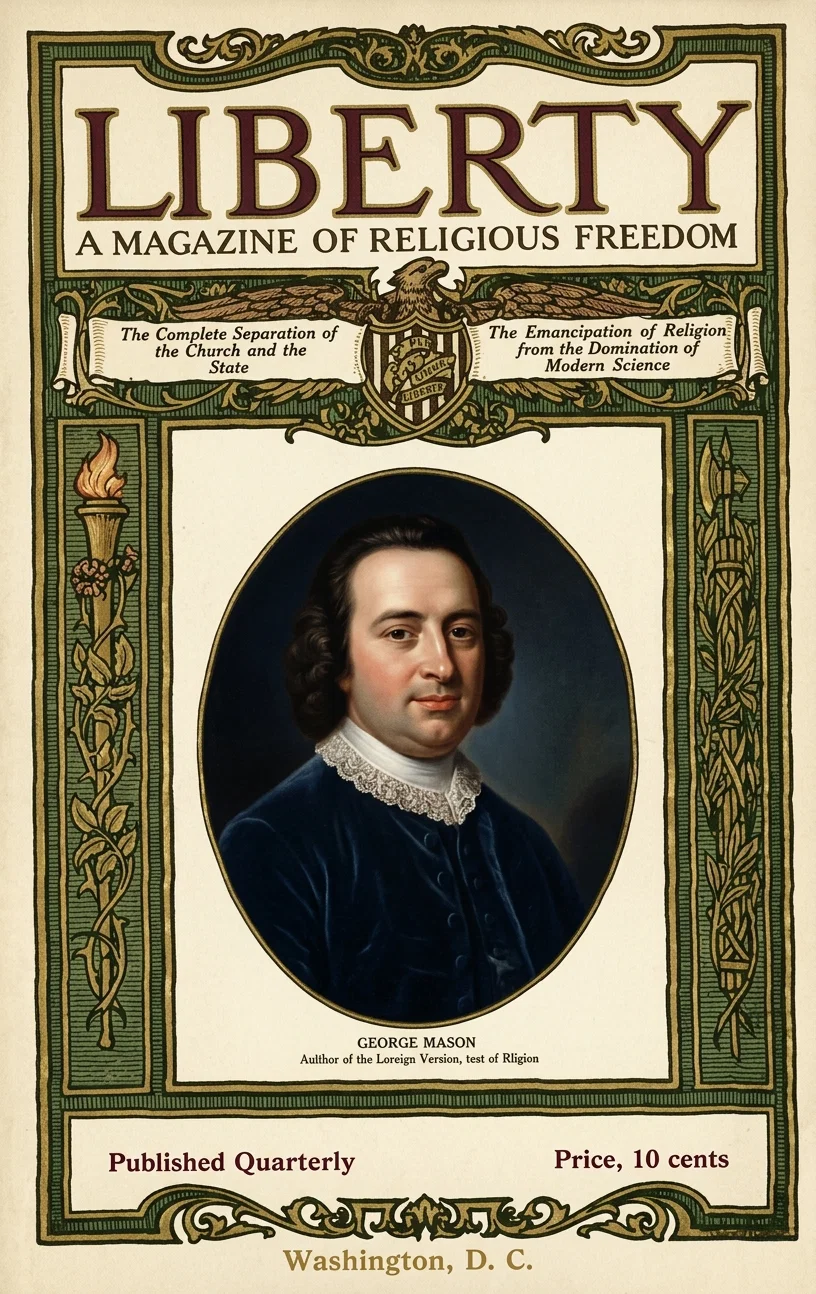
Cover design beautifully printed in two colors
Help us to reach 19,977,820 public-school pupils and college students through their 534,450 teachers and instructors. Send $1.50 for mailing “Liberty” for one year to 10 of these teachers. Single copies mailed to 5 or more addresses, 5 cents each.

The Sabbath

ELIZA H. MORTON
The Sabbath — day of rest — My heart inspires With holy thoughts and high, Intense desires,—
Desires to know my God, My dearest Friend, The One who’ll e’er be true Until the end;
To know more fully here Eternal love. My heart cries out for thee, Jesus above.
The Sabbath, emblem sweet Of Christ to me; In him I stand complete; He’ll make me free,
Yea, free from sordid things That vex and pain; How small they seem compared With Jesus’ reign!
Portland, Maine.

Early Beginnings

Many Voices—No. 1

Early Beginnings

GEO. I. BUTLER
The Spirit of God unifies and solidifies. It gives us comfort, and helps us to love one another more than we otherwise should. It leads to union, tending to produce one united body. It is Satan’s forte to create suspicion, to divide, to separate, to scatter, and to break down all love and union. After the great disappointment in 1844, the Adventist body, some fifty thousand strong, was rent by divisions, till its influence as a religious body largely ceased.
This Seventh-day Adventist movement, starting in weakness and obscurity, with the heavy cross, of an unpopular Sabbath, soon began to gather converts, making a steady and marvelous growth, doubling in numbers every decade, till now it stands a united people, a hundred thousand strong, and its influence and missionary efforts reach to earth’s remotest bounds.
It is doubtful if any religious movement ever had greater difficulties to confront or greater opposition to meet. In our early history, wherever we made a deep impression on the public mind, the professional debaters of the other denominations presented themselves, demanding debates. As a denomination, we have never felt that debates were desirable as a means of propagating the truth, and have as a rule sought to avoid them. The truths of our message are so clear and plain that we have no reason to fear opposition. Our cause has gathered great momentum during recent years, and our progress is more and more rapid. Our opponents have come to know that in Bible arguments we are strong, and they are weak. The popular denominations are not making converts from Seventh-day Adventists; but many honest souls are drawing away from them to us, and they know not how to hinder the process.
Our dangers of losses of membership come from an entirely different direction. In that remarkable little volume, “Early Writings,” written for the benefit of our people near the beginning of our work and still widely circulated, much is said about the “shaking time,” a condition which would be more or less manifest throughout the history of this cause, but especially as we draw near the end of our work.
This shaking time is but another illustration of our Saviour’s parable of the sower who went forth to sow the seeds of truth. Four classes are presented,—the wayside, stony-ground, thorny-ground, and good-ground hearers. The word made little or no impression on the first class; the second class were impressed and quite zealous at first, but soon, for lack of endurance, gave up. The thorny-ground hearers received the seeds of truth, but other growths choked the springing seed, so it brought no fruit to perfection. Love of the world, love of pleasure, in short, greater love for something else than Christ and the salvation of their fellow men forbade the production of fruit. The good-ground hearers received the seed into sincere and honest hearts, and brought forth fruit, some thirty, some sixty, and some an hundred-fold. So it will be in this cause. All will be tested and tried. The first three classes will make an utter failure. Some will drop out by the way, going back to the world, as many did in the days of Jesus and his disciples. Christ said to his apostles, “Will ye also go away?” Peter nobly answered, “Lord, to whom shall we go? thou hast the words of eternal life.”
The writer believes this message was started right, that God raised up persons who laid the foundations of this work on a solid basis. The Word of God was the rock upon which it was founded. God witnessed to it by his Spirit. The promised gifts of the Spirit were manifest at its very commencement. Elder J. N. Andrews, one of the noble band of men who helped in laying the foundation of this cause, once remarked to me, when I was young in experience and naturally unbelieving, that he had watched matters very closely and had never in a single instance, when positions had been taken carefully and prayerfully in this message, seen it necessary to change or discard a vital doctrine. The old landmarks have stood the test for sixty years or more. We do not mean to say that additional light has not been given from time to time, but as a people we have not had to suffer the shame of casting aside great principles which we had believed. The doctrines taught by Seventh-day Adventists stand like the solid rock in the mighty current.
But we have been taught that before the end there would be “many voices” leading away from this truth. These voices would not come from outside unbelievers or the popular churches. They would come from those once of us, but not now with us, from those who had gone off on some side track, teaching some “new light,” but really differing from the old message of sixty years’ standing. These old doctrines have stood the test of opposition triumphantly. Are they now to be undermined and suspicion thrown upon them by specious arguments, advocated with some degree of plausibility and labeled “New Light,”till old believers who have stood stanchly for years begin to question the very foundations of our faith?—God forbid. “The foundation of God standeth sure, having this seal, The Lord knoweth them that are his.” It is reasonable to question whether those who are thus engaged are working for God. How can they be while they are undermining the faith of believers in God’s eternal truth? Various voices are already being heard, and others may be expected.

Apollos at Corinth

MRS. E. G. WHITE
After leaving Corinth, Paul's next scene of labor was Ephesus. He was on his way to Jerusalem, to attend an approaching festival; and his stay at Ephesus was necessarily brief. He reasoned with the Jews in the synagogue, and so favorable was the impression made upon them that they entreated him to continue his labors among them. His plan to visit Jerusalem prevented him from tarrying then, but he promised to return to them, “if God will.” Aquila and Priscilla had accompanied him to Ephesus, and he left them there to carry on the work that he had begun.
It was at this time that “a certain Jew named Apollos, born at Alexandria, an eloquent man, and mighty in the Scriptures, came to Ephesus.” He had heard the preaching of John the Baptist, had received the baptism of repentance, and was a living witness that the work of the prophet had not been in vain. The Scripture record of Apollos is that he “was instructed in the way of the Lord; and being fervent in the spirit, he spake and taught diligently the things of the Lord, knowing only the baptism of John.”
While in Ephesus, Apollos “began to speak boldly in the synagogue.” Among his hearers were Aquila and Priscilla, who, perceiving that he had not yet received the full light of the gospel, “took him unto them, and expounded unto him the way of God more perfectly.” Through their teaching he obtained a clearer understanding of the Scriptures, and became one of the ablest advocates of the Christian faith.
Apollos was desirous of going on into Achaia, and the brethren at Ephesus “wrote, exhorting the disciples to receive him” as a teacher in full harmony with the church of Christ. He went to Corinth, where, in public labor and from house to house, “he mightily convinced the Jews, . . . showing by the Scriptures that Jesus was Christ.” Paul had planted the seed of truth; Apollos now watered it. The success that attended Apollos in preaching the gospel led some of the believers to exalt his labors above those of Paul. This comparison of man with man brought into the church a party spirit that threatened to hinder greatly the progress of the gospel.
During the year and a half that Paul had spent in Corinth, he had purposely presented the gospel in its simplicity. “Not with excellency of speech or of wisdom,” had he come to the Corinthians; but with fear and trembling, and “in demonstration of the Spirit and of power,” had he declared “the testimony of God,” that their “faith should not stand in the wisdom of men, but in the power of God.”
Paul had necessarily adapted his manner of teaching to the condition of the church. “I, brethren, could not speak unto you as unto spiritual,” he afterward explained to them, “but as unto carnal, even as unto babes in Christ. I have fed you with milk, and not with meat: for hitherto ye were not able to bear it, neither yet now are ye able.” Many of the Corinthian believers had been slow to learn the lessons that he was endeavoring to teach them. Their advancement in spiritual knowledge had not been proportionate to their privileges and opportunities. When they should have been far advanced in Christian experience, and able to comprehend and to practise the deeper truths of the Word, they were standing where the disciples stood when Christ said to them, “I have yet many things to say unto you, but ye can not bear them now.” Jealousy, evil-surmising, and accusation had closed the hearts of many of the Corinthian believers against the full working of the Holy Spirit, which “searcheth all things, yea, the deep things of God.” However wise they might be in worldly knowledge, they were but babes in the knowledge of Christ.
It had been Paul's work to instruct the Corinthian converts in the rudiments, the very alphabet, of the Christian faith. He had been obliged to instruct them as those who were ignorant of the operations of divine power upon the heart. At that time they were unable to comprehend the mysteries of salvation; for “the natural man receiveth not the things of the Spirit of God: for they are foolishness unto him: neither can he know them, because they are spiritually discerned.” Paul had endeavored to sow the seed, which others must water. Those who followed him must carry forward the work from the point where he had left it, giving spiritual light and knowledge in due season, as the church was able to bear it.
When the apostle took up his work in Corinth, he realized that he must introduce most carefully the great truths he wished to teach. He knew that among his hearers would be proud believers in human theories, and exponents of false systems of worship, who were groping with blind eyes, hoping to find in the book of nature theories that would contradict the reality of the spiritual and immortal life as revealed in the Scriptures. He also knew that critics would endeavor to controvert the Christian interpretation of the revealed Word, and that skeptics would treat the gospel of Christ with scoffing and derision.
As he endeavored to lead souls to the foot of the cross, Paul had not ventured to rebuke, directly, those who were licentious, or to show how heinous was their sin in the sight of a holy God. Rather he had set before them the true object of life, and had tried to impress upon their minds the lessons of the divine Teacher, which, if received, would lift them from worldliness and sin to purity and righteousness. He had dwelt especially upon practical godliness, and the holiness to which those must attain who shall be accounted worthy of a place in God's kingdom. He had longed to see the light of the gospel of Christ piercing the darkness of their minds, that they might see how offensive in the sight of God were their immoral practices. Therefore the burden of his teaching among them had been Christ, and him crucified. He sought to show them that their most earnest study and greatest joy must be the wonderful truth of salvation through repentance toward God and faith in the Lord Jesus Christ.
The philosopher turns aside from the light of salvation, because it puts his proud theories to shame; the worldling refuses to receive it, because it would separate him from his earthly idols. Paul saw that the character of Christ must be understood before men could love him, or view the cross with the eye of faith. Here must begin that study which shall be the science and the song of the redeemed through all eternity. In the light of the cross alone can the true value of the human soul be estimated.
The refining influence of the grace of God changes the natural disposition of man. Heaven would not be desirable to the carnal-minded; their natural, unsanctified hearts would feel no attraction toward that pure and holy place; and if it were possible for them to enter, they would find there nothing congenial. The propensities that control the natural heart must be subdued by the grace of Christ before fallen man is fitted to enter heaven, and enjoy the society of the pure, holy angels. When man dies to sin, and is quickened to life in Christ, divine love fills his heart; his understanding is sanctified; he drinks from an inexhaustible fountain of joy and knowledge; and the light of an eternal day shines upon his path, for with him continually is the light of life.
Paul had sought to impress upon the minds of his Corinthian brethren the fact that he and the ministers associated with him were but men, commissioned by God to teach the truth; that they were all engaged in the same work; and that they were alike dependent upon God for the success of their labors. The discussion that had arisen in the church regarding the relative merits of different ministers was not in the order of God, but was the result of cherishing the attributes of the natural heart. “While one saith, I am of Paul; and another, I am of Apollos; are ye not carnal? What then is Paul, and who is Apollos, but ministers by whom ye believed, even as the Lord gave to every man? I have planted, Apollos watered; but God gave the increase. So then neither is he that planteth anything, neither he that waterethbut God that giveth the increase.”
It was Paul who had first preached the gospel in Corinth, and who had organized the church there. This was the work that the Lord had assigned him. Later, by God's direction, other workers were brought in, to stand in their lot and place. The seed sown must be watered, and this Apollos was to do. He followed Paul in his work, to give further instruction, and to help the seed sown to develop. He won his way to the hearts of the people; but it was God who gave the increase. It is not human but divine power that works transformation of character. Those who plant and those who water, do not cause the growth of the seed; they work under God, as his appointed agencies, cooperating with him in his work. To the Master Worker belong the honor and glory that come with success.
(To be concluded)

Papal Designs Upon It

Tracings of the Prophetic Gift—No. 15

Papal Designs Upon It

J. O. CORLISS
In order to lay claim to being God’s prophetic mouthpiece to men, the Papacy has dug deep for its foundation. It enters into the real, true need of an audible voice by which to direct men in the path of virtue. Its reasons for the maintenance of the prophetic gift can not fail to meet the approval of sensible minds.
It then moves forward step by step through a maze of inductions until it has landed itself upon the pinnacle of prophetic insight, and consequent spiritual dictation for the entire world. But we shall proceed to show these advances in their due order.
In his work entitled “Present Position of Catholics in England,” page 321, Cardinal Newman says that Scripture, “though written under a supernatural guidance, is, from the nature of the case, from the defect of human language and the infirmity of the recipient, unable by itself to convey the real mind of its writers to all who read it. Instead of its forcing its meaning upon the reader, the reader forces his own meaning upon it, colors it with his own thoughts, and distorts it to his purposes; so that something is evidently needed besides it, such as the teaching of the church, to protect it from the false private judgment of the individual.”
While the right of private judgment in applying Scripture is condemned in the cardinal’s statement, there is far greater danger when an uninspired individual assumes to explain the meaning of these Scriptures for the whole world. But the Papacy has provided against this suggestion.
In “Newman’s Sermons to Mixed Congregations,” page 146, the author, in speaking of the days of the apostles, says, “Christians were bound to take without doubting all that the apostles declared to be revealed.”
In this statement the author endeavors to lay the foundation for the infallible authority of the teaching of his church. For as the people had no other evidence for faith in the revelations of the apostles but their bare word, so now, whatever the church says should be received without further research. This is on the assumption that every individual judgment must yield to the assertions of those specially called to deliver God’s message, otherwise nothing would be received except what might be proved through private discernment.
The cardinal then goes on to reason out the righteousness of such a course. He says, on page 147: “Either the apostles were from God, or they were not; if they were, everything was to be believed; if they were not, there was nothing to believe.” It is plain from this reasoning that he means to teach that it is not for one to decide the truth or error of what is taught, but the duty of each is to decide whether the teacher is from God, or not. If the decision is that he is from God, it must follow that he can not err, so whatever he teaches is to be received without question. This is what the cardinal defines as faith in God and the revelation of his will to man.
But even this point will be speciously fortified by the cardinal, as we proceed. The author justifies his conclusion from a statement by Paul wherein he thanks God that the Thessalonian church received what he brought to them as the “word of God,” rather than the word of men. 1 Thess. 2:13. This is backed up by another quotation in chapter 4:8, which declares that “he therefore that despiseth, despiseth not man, but God, who hath also given unto us his Holy Spirit.”
This is all true when one affects to despise the genuine word of God, given through an inspired apostle or prophet. But this same scripture does not distinctly point out the person or party to be so highly honored of God. The alleged proof that the Papacy holds such a position has not thus far been brought forward. There is, however, a point in this worth noticing, since it is the ground on which the Bible is ruled out of reach of the common people.
The cardinal says, on pages 162, 163: “You will sometimes hear of Catholics falling away, who will tell you it arose from reading the Scriptures, which opened their eyes to the unscripturalness, so they speak, of the church of the living God. No; Scripture did not make them disbelieve: (impossible!) they disbelieved when they opened the Bible. They opened it in an unbelieving spirit, and for an unbelieving purpose; they would not have opened it, had they not anticipated—I might say hoped—that they might find things there inconsistent with Catholic teaching. . . . This, then, is the direct and obvious reason why the church can not allow her children the liberty of doubting the truth of her word. . . . Let a man cease to examine, or cease to call himself her child.”
The Papacy forbids the Bible to her lay members on the ground that to read it is to search for what the church has not told them, and this is doubt. The claim is that the sole desire in this prohibition is to preserve faith in God’s living representative on the earth. The cardinal justifies this procedure as a matter of maternal love, calling it “the cords of Adam” that “bind him to the holy church.” See page 165.
He cites as proof of the correctness of this position the fact that the prophet Elisha, after reporting the translation of Elijah, forbade the people to institute a search to ascertain whether the prophet had spoken truly. He adds, significantly: “It is thus that the church ever forbids inquiry in those who already acknowledge her authority; but if they will inquire, she can not hinder it; but they sin in so doing.”—Pages 170, 171.
It may be asked, On what basis can the Papacy induce intelligent men to yield themselves so implicitly to its decrees?—On the same ground, it may be answered, that God required his people of old to obey the voice of the prophet. Thus we have the instruction: “Believe in the Lord your God, so shall ye be established; believe his prophets, so shall ye prosper.” 2 Chron. 20:20. Cardinal Newman reasoned thus: “You know there is a God, you know your own ignorance of him. . . . A revelationwould be the greatest possible boon which could be vouchsafed to you.” Then, as if the generally accepted theory were impossible, he exclaims: “A spiritual being abandoned by its Creator! . . . Evidence that God has spoken you must have, else were you a prey to imposture.”
But how, in what way, does the Papacy teach that God speaks to his people? The cardinal continues: “You see the question lies between the church and no divine messenger at all; there is no revelation given us, unless she is the organ of it. Your anticipation has failed, your probability has been falsified, if she is not the prophet of God.”
This is a bold claim, if nothing more. But the cardinal will proceed, as he believes, to fasten this claim upon the world.
He brings forward other churches than his own, and states that of them which can not be gainsaid. Of them he says: “You would exercise your judgment and criticism on what they said, and would never think of taking their word as decisive; they are in no sense prophets, oracles, or judges of supernatural truth; and the contrast between them and the Catholic Church is a preliminary evidence in her favor.”—Page 208.
It is a pity that in rejecting the prophetic gift the professed churches of Christ have placed themselves where so much criticism of their spiritual standing is true. It has but opened the way for this church, with so blurred a history, to make a claim for herself that the others should have always maintained by de facto evidence. The cardinal, however, maintains his contention in the following definition of a prophet, and his application of the same:—
“A prophet is one who comes from God, who speaks with authority, who is ever one and the same, who is precise and decisive in his statements, who is equal to successive difficulties, and can smite and overthrow error. Such has the Catholic Church shown herself in her history; such is she at this day. She alone has the divine spell of controlling the reason of man, and of eliciting faith in her word from high and low, educated and ignorant, restless and dull-minded.”
Mountain View, Cal.

Knowledge of God

J. L. SHULER
TEXT, Job 22:21. The Lord wants us to know him. Hosea 6:6.

Why Know God?

  1. The knowledge of God is the greatest of all knowledge. Jer. 9:23, 24.
  2. It gives eternal life. John 17:3.
  3. It cleanses from defilement. 2 Peter 2:20.
  4. It gives power to do. Dan. 11:32.
  5. Knowledge of the Holy is understanding. Prov. 9:10.
  6. It gives an abundance of peace. 2 Peter 1:2.

How May I Know God?

  1. By studying his Word. John 5:39.
  2. By studying his dealings with men.
  3. By his works. Rom. 1:19, 20.
  4. By the revelation of Jesus Christ. Matt. 11:27; John 8:19.
  5. By being in earnest. Hosea 6:3; Prov. 2:4, 5.
  6. By having him in us. John 14:17, 23.
  7. With the Spirit's help. John 16:14.
  8. Power to know him is from God. Jer. 24:7.
There is a class of people who profess to know God, but in works deny him. Titus 1:16.
How do we know who knows God? 1 John 4:7, 8; 2:3, 4.
How do we know that he is the Lord? Eze. 20:12.
Our duty. 1 Cor. 15:34.
Bible names for those who know not God. Jer. 10:25; 1 Thess. 4:5.
What will happen to them at Christ's coming? 2 Thess. 1:8.
What will those say who know God? Isa. 25:9.

The Betrayal

L. E. SUFFICool
“And Judas also, which betrayed him, knew the place: for Jesus oftimes resorted thither with his disciples.” John 18:2. By prayer our High Priest consecrates himself as the great sacrifice to God the Father. He is bent on nothing so much as completing his sacrifice. Accordingly, “when Jesus had spoken these words, he went forth with his disciples over the brook Kedron, where was a garden, into the which he entered, and his disciples.” From the gate of the city, a slight declivity conducts to the brook Kedron, which Jesus now crosses, even as his father David had crossed it a thousand years before, in bitterness of spirit, flying from persecution and treachery. Of all the disciples, the evangelist John alone makes mention of this stream, perhaps to guide the reader to the typical bearing of that ancient history. Read 2 Sam. 15:23-30.
We would not infer that by the act of withdrawing from the city our divine Lord was seeking to avoid his enemies. Rather, well knowing that his hour is come, he repairs to this accustomed haunt in humble submission to his Father’s will. The beloved disciple mentions the fact that Judas “knew the place;” this he does not only to prepare us for the apprehension which immediately follows, but to reveal the interesting circumstance that the garden of Gethsemane was a favorite resort of the Saviour and his disciples during the time of their sojourn in Jerusalem. Though his nights were spent in Bethany, the early hours of the evening may have been passed in converse or prayer beneath the cedars of Gethsemane. How it must have aggravated the bitterness of the hour, that Judas should avail himself of the knowledge which his discipleship supplied to betray our Saviour.
How terrible! Here where they oftentimes sat in “sweet counsel,”—here where the Master taught him to pray,—the traitor comes now to apprehend him. From the writings of the other apostles we gather that he chose the very hour of prayer itself as the most certain for the execution of his purpose. Behold the terrible indignity which was thus offered the Creator of the universe, he who to-day is the brightness of the Father’s glory and the “express image of his person”! Who knows to what depths Satan will lead the soul that departs from the side of the divine Son? Let the daily prayer of the heart be—“Closer to thee, my Father, draw me, I long for thine embrace.”
Hagerstown, Md.

Faith Pleases God

E. K. SLADE
It is recorded in history that once, when a criminal was about to be executed, a prince was present, having charge of the execution. As the criminal's head was placed upon the block, the prince asked him if there was any request that he would like to make. The criminal immediately responded, “Yes, I would like a glass of water.” At the command of the prince the water was immediately given to him. As soon as he had received it, he endeavored to place the glass to his lips, but his hand trembled so badly that it seemed impossible for him to do so. The prince was greatly touched by the scene, and was moved to say, “Do not fear; your life will be spared until you have drunk the water.” These words were quickly caught by the doomed man, and he immediately dashed the water to the ground. It was impossible to gather it up again. He took the prince at his word, and the prince was true to that word.
The criminal deserved to die. The prince knew well that according to the law the man should be put to death. The condemned man understood the authority of the prince, and dared to believe that he would be true to the promise he had made. Notwithstanding the justice of the punishment from which the criminal was delivered, the prince was greatly pleased with such implicit confidence in his word;
There are many who are doubting and delaying to take God at his word, which they are privileged to do and be set free. To receive pardon and to be delivered from punishment without the performance of penance, or without in some way paying for the precious gift, seems too good to be true. Some are tempted to feel that to believe or dare to hope for so much would be displeasing to God, not knowing that it is impossible for us to please him without just such faith as this. For us to doubt the most precious promises made to the doomed sinner is a reproach and an insult to God; but he is pleased to have us hope in his mercy, believing his promises and claiming deliverance.
Holly, Mich.

If We Knew

If we knew, when walking thoughtless Through the crowded, dusty way, That some pearl of wondrous whiteness Close beside our pathway lay, We would pause when now we hasten, We would oftener look around, Lest our careless feet should trample Some rare jewel in the ground.
If we knew what forms were fainting For the shade which we should fling, If we guessed what lips were parching For the water we should bring, We would hasten with eager footsteps, We would work in storm and calm, Bearing cups of cooling water, Planting rows of shading palm.
If we knew what feet were weary, Through the weary nights and days, Sighing still amid their toiling For some word of hope and praise, Buds of balm and leaves of laurels We would place in every hand; Little deeds with pleasant meanings Hungry hearts can understand.
If we knew what feet were weary, Climbing up the hills of pain, By the world cast out as evil, Like old Judah’s Magdalene, We no more would dare to scorn them With our foolish fear and pride, Wrapping close our robes around us, Passing on the other side.
If we knew when friends around us Closely press to say “Good-by,” Which among the lips that kiss us First beneath the flowers would lie, While, like rain upon their faces, Fall our bitter, blinding tears, Tender words of love eternal We would whisper in their ears.
If we knew what hands were rearing Massive structures on the sand, Planting Upas for a shade-tree, To protect their palace grand, We would point to many a venture, Fair and stately as their own, Shining fragments,—dome and turret,— Which the winds had overblown.
—Ellen M. H. Gates.
Continue reading: The Spirit of Apostasy