Pacific Press Publishing Association · Mountain View, California · Nov 19, 1912
"IF YE WILL INQUIRE, INQUIRE YE."
By Editor
This Inquirers' Department is conducted for the purpose of helping those who are studying the Bible. The answers are oftentimes only suggestive. They are never to be considered infallible, only as they agree with the infallible Word. The writer who may answer them does not consider that his opinion is infallible. He will simply give the best that he has, and plead with the inquirer to search the Word. Such questions only will be answered as, to the editors, seem to minister to the good of the readers and to the mission of the paper. We can not answer repeatedly in the same volume questions upon the same scripture. The name and address must accompany question, not for publication, but as an evidence of good faith, and that answer may be made by letter if deemed advisable. No letters are answered which do not contain the name of the writer. It is well always to enclose stamp for reply.
How can it be proved that the world was created in six twenty-four hour days from the Bible? And also prove that the world was not created in six long, indefinite periods of time.
W. H. G.
The Bible does not use the word "create" regarding the six days' work. The word used for that invariably is "made." We are told that "in the beginning God created the heaven and the earth," but "in six days the Lord made heaven and earth." But we presume that it is regarding these six days mentioned in Genesis 1 that our correspondent raises the question. And the only way we have of proving it from the Bible is to take just what the Bible says. The Bible says that the world was made in six days. It does not in any way, so far as simple human language is concerned, discriminate between these days and other days. Each one of these days was composed of a light part and a dark part—the evening and the morning—just the same as all the other days of the Bible. Those six days fitted the earth for the abode of man. God could have made it all in one day. He could have done it in long, indefinite periods; but He did not do it in one day, nor did He take long, indefinite periods. He could have done it all in one hour—the Infinite could; but He did not do it in that way. He took just six days of morning and evening, six days of twenty-four hours each—for if the language means anything, it means this—in the fitting of earth for the home of man. These days after the sun appeared were days that were measured by the sun, for the sun was to rule the day. Not only that, but these days are designated by numeral adjectives, as "day one," "day the second," "day the third," "day the fourth," which would make them definite days. One of the latest Biblical works which we have is "The Companion Bible," only three parts of which have been issued to the present time. It is published by Henry Frowde, the Oxford University Press, which prints the Oxford Bibles. It has this note regarding the days: "Evening . . . morning, put for a full day. The beginning and the end of anything is put for the whole of it. Compare Eccl. 3:11; 10:13; 11:6; Ps. 92:2; Isa. 41:4; 44:6; 48:12; Rev. 1:8, 11, 17; 2:8; 21:6; 22:13. . . . First day, equivalent to 'day one.' The word 'day' may refer to a prolonged period when used without any qualifying words, but when qualified with a numeral (cardinal or ordinal), it is defined and limited by it to a day of twenty-four hours. It is further limited here by its boundaries, evening and morning, as well as by the seventh day. Compare Ex. 20:9, 11. See Appendix 11." Appendix 11 says: "The word 'day,' when used without any limiting words, may refer to a long or prolonged period; as 'the day of grace,' 'the day of visitation,' 'the day of salvation,' 'the day of judgment,' 'the day of the Lord,' 'man's day,' etc. But when the word 'day' is used with a numeral (cardinal or ordinal), as 'one,' 'two,' 'three,' etc., or 'first,' 'second,' 'third,' etc., 'evening and morning' (Genesis 1), or the 'seventh day' (Ex. 20:9, 11), etc., it is defined, limited, and restricted to an ordinary day of twenty-four hours." When the instruction was given to the Hebrews, as recorded in the 16th chapter of Exodus, it must have been understood by them as a day of twenty-four hours, and so also when the commandment was spoken from Mount Sinai, and the fall of the manna confirmed all of this. The commandment was in harmony with the institution of the Sabbath. Everything in Biblical language indicates that the days of Genesis 1 were days of twenty-four hours. If this be not the case, then language is meaningless. Genesis 1 sets aside all theories of evolution. If we are not to accept that, there is no reason why we should accept Jesus, for Jesus Himself places His own approbation upon the writings of Moses. He declares to the Jews, "Had ye believed Moses, ye would have believed Me: for he wrote of Me. But if ye believe not his writings, how shall ye believe My words?"
The whole story of creation is beautiful and consistent. The very beginning of the race is beautiful and consistent, and God has left the record of the might and power of His creation and transformation in His Word to encourage every soul who needs creative power to make him anew, the new creation in Christ Jesus. The beginning of that work for this earth in that wonderful week was the calling of light in the place where darkness existed. So we read in the bringing of light to the poor sinner a reference to that: "Seeing it is God, that said, Light shall shine out of darkness, who shined in our hearts, to give the light of the knowledge of the glory of God in the face of Jesus Christ." 2 Cor. 4:6. The devout soul will find hope in the fact that when God spoke, it was done; that when God said, "Let there be," there was. It will be an assurance to him that all the promises that God has made concerning the renewing and regenerating of the poor, sinful heart are all possible in Him.
3916 — The Catholic Bible
By Editor
Is the Catholic Bible an older and better translation than ours? Are the additional books in that Bible inspired?
Inquirer.
The Catholic Bible is sometimes called the Douay Version. In 1582 the Reims Version of the New Testament was translated at Reims, the Old Testament at the same time, but printed at Douay in 1609, 1610. In 1611 appeared what is commonly called the Authorized Version, but previous to the Douay Version were the translations of Wyclif, and Tyndale, and Coverdale, and Matthew, and Taverner,—the Great Bible, the Geneva Bible, and the Bishops' Bible. No, it is not a better translation. It is not a translation from the original Greek, but from the Latin Vulgate,—a translation from a translation. The additional books in the Douay Version were not in the ancient Hebrew collection, nor even in the earliest editions of the Vulgate, and they were considered as uncanonical books by the early fathers in the Christian church. Then their doctrines indicate that that is the case also. If one will read them, and compare them with the other Scriptures, he will certainly find reasons sufficient to set them aside, even as they were set aside by the early Christians, and by the Jews themselves, as Apocryphal writings.
3914—The Passover Supper, or a New Supper
As recorded in the 13th chapter of John, did Christ really eat the Jewish Passover with His disciples, or did He institute a new supper to be perpetuated in this dispensation until fulfilled in the kingdom of God? D. N. W.
Both. Jesus not only ate the Passover, but He instituted a new supper. These are both indicated in Luke 22:14: "And when the hour was come, He sat down, and the apostles with Him. And He said unto them, With desire I have desired to eat this Passover with you before I suffer." Then follow His words at that supper. The account of the Passover continues to verse 18, inclusive. Then follows the institution of the Lord's Supper after the Passover: "And He took bread, and when He had given thanks, He brake it, and gave to them, saying, This is My body which is given for you: this do in remembrance of Me. And the cup in like manner after supper [that is, after the Passover supper], saying, This cup is the new covenant in My blood, even that which is poured out for you." And the apostle Paul, in the 11th chapter of 1 Corinthians, verses 23 to 26, shows us clearly that this was to be perpetuated until Christ should come again.
3915—The Head of the Church Then
By Editor
I read that Constantine signed an edict enjoining the cities of the Roman Empire to refrain from work on Sunday in 321 A.D.; and in 364 A.D., at the Council of Laodicea, it was decided not to Judaize, and also to keep Sunday. Kindly inform me who was at the head of the church at that time, if it is known if there was a pope or not.
The Roman Church claims popes all the way back to Peter; but we would hardly believe that the early fathers in the church would call themselves popes of Rome, or designate the bishop of Rome as the head of the church. In fact, in the early centuries the bishop of Rome was considered to be simply one of the bishops in the church, as was the bishop of Alexandria, the bishop of Ephesus, the bishop of Jerusalem, the bishop of Constantinople, etc. According to the Roman Catholic claim, the pope of Rome from 314 to 335 was Sylvester, and at the time of 364 was Liberius. The head of the church in 321 was Constantine, who arrogated that authority to himself, and who molded the church after the model of the Roman Empire to a great extent.
3917 — Shall Never Die
By Editor
Will you please tell me in your "Question Corner" what Jesus meant by saying, "He that believeth on Me shall never die"?
The passage is found in John 11:25. To understand the text, use the context. Verse 24 reads, "Martha saith unto Him, I know that he shall rise again in the resurrection at the last day." The response of Jesus was to that remark of Martha's. Jesus said to her, "I am the resurrection, and the life: he that believeth on Me, tho he die, yet shall he live [that is, at the last day]; and whosoever liveth and believeth on Me [at the last day] shall never die." He wanted to impress upon her that the resurrection and the life were in Him, and that He was the one who would bring them to life then, and as He had power to bring them to life then, He would have power to bring her brother to life before the last day should come. God's children fall asleep, and will, until death shall be swallowed up in immortality. But while they do, their life is hid with Christ in God, but "when Christ, who is our life, shall appear," then shall they also "appear with Him in glory." See Col. 3:1-4.
In our first day's reading we conclude Ephesians 5 and 6, filled with practical instruction. Then follow 1 and 2 Timothy. 1 Timothy was probably written in about the year 65, and 2 Timothy the year following. They were instruction by the apostle Paul to his own "son in the faith," Timothy, who was himself a minister of God, and through Timothy to all Christian ministers in all ages to follow. The principles contained in these two books, if followed by the minister of Christ, would well fit him for noble work for souls. In fact, it is marvelous, the amount of instruction that is packed in these two little epistles. They are inspirations to true manhood and to loyalty to God. They also emphasize the second coming of Christ. In the last of these letters the apostle's death was just at hand, and he wrote with the headsman already in view.
The last day of the week has for its lesson the first two chapters of Hebrews, a general epistle written in about A.D. 63. The writer of the epistle is not known. It is generally spoken of as the epistle of Paul, but while Paul takes special pains in other epistles to let us know that he did not receive the gospel by men, or through men, the writer of the epistle to the Hebrews tells us that it was "confirmed unto us by them that heard." It does not bear the characteristics, in either its beginning or ending, of the epistles of the apostle. Some have thought it was written by Barnabas, and others by Apollos, and still later it has been contended that it was written by Priscilla. However this may be, it matters little. It is not the writer, but the substance of the epistle, which is needed by the Christian church. The first chapter presents before us the exceeding majesty of the Son of God, far above all creatures, Himself the Creator; and the second chapter, His humiliation in our behalf, becoming one with the human family in order that He might save them. These two chapters are supplemented by Psalms 117 and 118,—a sweet little psalm of praise and a psalm of thanksgiving for Jehovah's saving goodness.
Signs of the Times
"Even as we have been approved of God to be entrusted with the Gospel, so we speak; not as pleasing men, but God, who proveth our hearts."
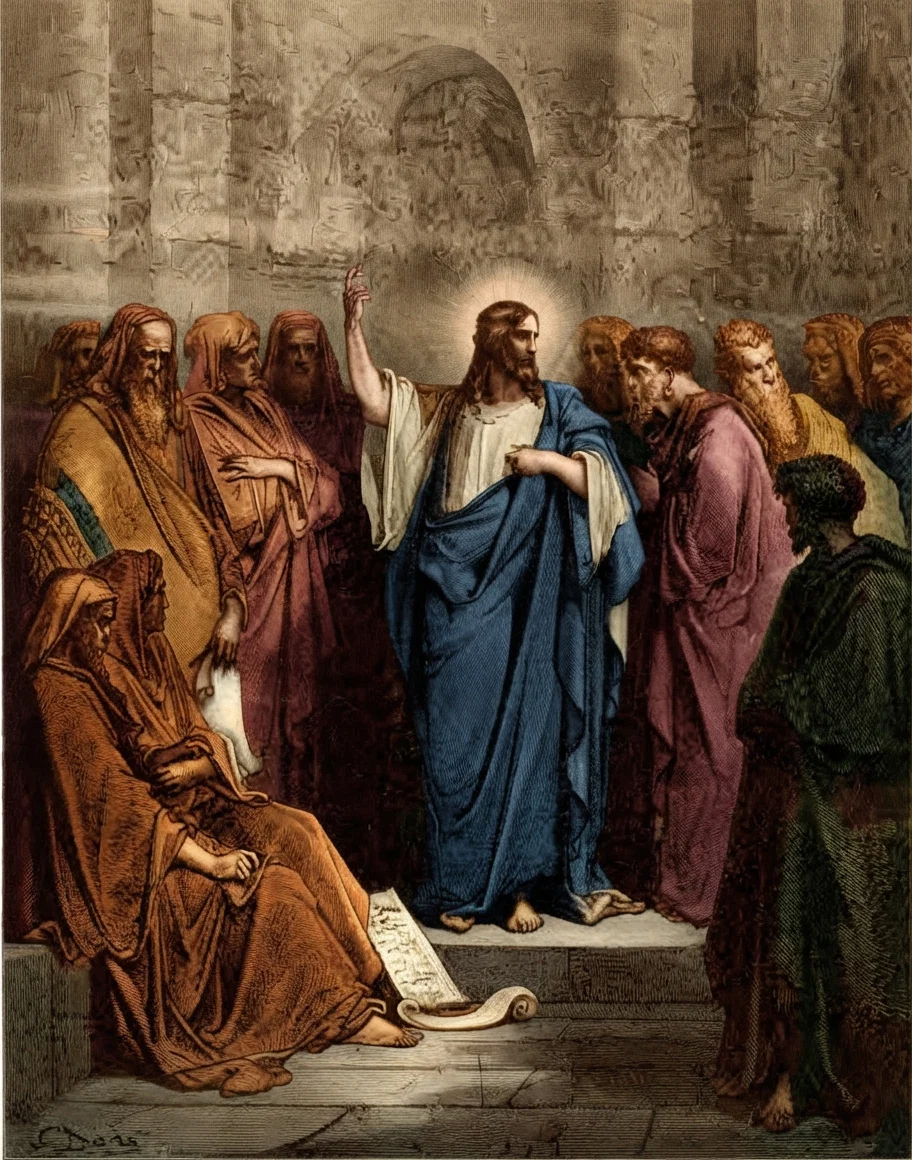
AFTER the record of the call of the fishers of men, Jesus went to Capernaum, the city in and around which much of the earthly ministry of our Lord centered. Here people listened to His wonderful teaching, here they witnessed His holy life, here they beheld His wonderful works. No wonder that the rejection of all this brought the busy, bustling city low, "as one speaketh out of the ground," until its very site was disputed. Turning from the word of life brings ruin, even in this sphere. See the words of our Lord in Matt. 11:23.
THE incident of our lesson occurred on the Sabbath day in the synagog. Jesus observed the Sabbath; it was customary for Him to attend services at the synagog. Luke 4:16. In all His life was manifest perfect obedience to the Father. In working out salvation for us, He became our perfect example. He said, "I have kept My Father's commandments, and abide in His love." His beloved disciple declares, "He that saith he abideth in Him ought himself also to walk even as He walked." He was living God's life in human form.
HE taught in the synagog, as many teachers and scholars were privileged to do after the lesson of the day. Wonderful was His teaching to the astonished people, who had listened from Sabbath to Sabbath, through many years, to the traditions of the elders, the learning of the scribes, the subtle sophistry of lawyers, the disputations of Pharisee and Sadducee, all of which left the mind bewildered and the soul unfed. People had come to the synagog for refreshing, as a company on a thirsty desert to a river, but the hoped-for river was a mirage, the expected bread was chaff.
BUT Jesus fed them. He taught as one having authority, and not as the scribes. He came direct from One who sent Him, with a clear, definite message. He had come from God's presence, and His words were Spirit-filled. He had met man's temptations, and conquered, and His heart burned with eager desire to save the tempted. He was incarnate Love longing to save.
THERE was another one interested, the prince of darkness. He must thwart the ministry of Jesus if possible. Not being able to seduce by his temptations the Man of Nazareth, he would harass and discourage Him; so he projected into the blessed Sabbath service a poor human possessed of an unclean spirit, a demoniac. Men do not believe in the devil now, do not believe that there is an active, malignant foe. They prefer to believe that he does not exist. And this pleases the devil also, for men to believe this; he can better deceive them. But if we believe the Bible, there can be no doubt of the old historic belief. There is a devil. He has his angels, or demons. Once he was an angel of light; and when he fell, his angels fell with him. He is the deceiver of the whole world. He comes at times as an angel of light. His demons also come, sometimes as angels of light, sometimes as spirits of dead friends. Some come as low, bestial, violent intelligences which possess the souls and bodies of poor humans, causing insanity, depravity, violence. It was an unclean spirit which possessed the poor, half insane man at Capernaum. And there were many others such in Palestine at that day, even as there are in the world at this day.
IN THE SYNAGOG AT CAPERNAUM
WE may well believe that as the demoniac came into the presence of Christ, his poor enslaved mind longed for deliverance, and sought to cry out for it. And we may well believe, also, that the controlling demon used the human organs of speech directly contrary to his victim's desire. The record says, "And he cried out, saying, What have we to do with Thee, Jesus Thou Nazarene? art Thou come to destroy us? I know Thee who Thou art, the Holy One of God." The demon did know, and the whole host of them had known that the Holy One of God was in the earth from the time the holy Child was born in Bethlehem. They had been told, doubtless, of His blameless boyhood, His progressive youth, of His baptism in the Jordan, God's approval from heaven, of the temptation in the wilderness, and the defeat of their prince Diabolus. They had been deputed to harass, annoy, counterwork, Jesus and His plans, and the unclean demon at Capernaum was a part of the devil's plan. But the demon knew, also, that if Christ were victorious, a certain judgment-day was coming, and its consequent destruction. Hence the question to Jesus, "Art Thou come to destroy us? We have naught to do with Thee. Let us alone." Even so talk men, and turn from their Deliverer.
BUT behind the voice of the unclean demon, Jesus heard the heart-cry of the poor victim for deliverance, He saw his pitiable plight, He knew his abject and terrible bondage. He saw, in the pitiable insane wreck before Him, the millions of other human wrecks, made so by the enemy because of their yielding to his leading. He would work this miracle, He would deliver this soul, that all thus bound in all the future might have hope. Therefore He responded, to the mad shriek of the demon, "Hold thy peace, and come out of him," and with a final effort to destroy, "the unclean spirit, tearing him ["convulsing," throwing him down, margin and Luke], and crying with4a loud voice, came out of him," doing him no harm. From the body and mind which belonged to the Son of God, He cast out the usurper, and the same word restored the ruined house, and placed mind and will again in control.
THE people were amazed. "A new teaching!" they exclaimed. "Why, this Man even commands evil spirits, and they obey! He commands with authority." He went through no formula of ancient mystic lore, He spoke no unknown words in a mysterious way; but His speech was simple and clear. The simplest auditor understood its import. He neither vociferated nor shouted, but behind the clearly spoken word there was the will and the power of the Infinite. Before it demons trembled and fled. Sin was cleansed away, soul and body were healed.
O SOUL, you who are bound by the chains which some demon of uncleanness, dissipation, or malice, or violence, has welded upon you, there is hope for you. You despise your own weakness, you hate the chains, you get some glimpses of the sordid sinfulness of it all, you know that in some way you are responsible, and therefore deserve your lot, and you go on, in despair, into ruin. Your life is unclean in imagination, and you know it. You tell untruths, you seek to deceive your fellows, and the demons deceive you into believing that you do deceive others; but the discerning despise your falsity of life, see the hollowness of your profession. You are under the control of a lying demon, and often falsify when it would be to your temporary advantage, as well as your eternal, to speak the truth. You have a violent temper, you fly into a rage at a word, and speak acridly, acidly, bitterly. You try to excuse by sickness, or nerves, or nature, yet you know it is wrong. The demon of violence possesses you. Perhaps you may not be given to violent outbreaks, but you hold malice against those who you think have wronged you. You hate them. You would at least not sorrow if ill should overtake them. You would like to "get even." You are controlled by a malicious demon. You may be under the power of the demon of appetite, or pleasure, which leads you to dance and laugh and dissipate the hours, involved in which are the issues of life and death. You may be a worshiper of mammon, giving soul and body to the getting of gold which perishes.
DO YOU, one and all, not wish to be free, free from the demons which drive to despair and destruction, which goad to depravity and death, which shut the soul from wisdom and knowledge, from glory and peace, from love and light eternal? There is freedom for you in Christ Jesus. One word from the Master in response to your all-absorbing heart-cry will bring deliverance and break your chains. Will you not, with all your heart and soul, utter it,—utter it even in the most abject attitude of cursed bondage, and believe He will hear? You have been in the possession of the thief; now the rightful Master has come, and He says to you, "The thief cometh not, but for to steal, and to kill, and to destroy; I am come that they might have life, and that they might have it more abundantly." Let the Lifegiver into your soul, and make it pure, make it free; for "if the Son therefore shall make you free, ye shall be free indeed."
Power Is Eternal
“For from the creation of the world His invisible things, even His eternal power and divinity, are plainly seen, being perceived by means of the things that are made: so that they are without excuse.” Rom. 1:20, Dean Alford’s Translation.
UR text affirms that power is eternal. “Even His eternal power,” are the words of the scripture. Two thousand years ago God, through the apostle Paul, in the words of the text, taught the doctrine of the eternity of power.
Power does not waste. Power does not fail. Without suffering from fatigue, it moves on through the wide stretches of space from world to world, moving with a speed almost incredible, and that never slackens or fails. No power is ever lost. It is active forever. Power is eternal.
Such is the view given in the scripture. Does science confirm the words of this wonderful text? Science that tends to act independent of all restraint; science that holds as its adherents men of all forms of faith and many of no faith at all; science that views only a small fence corner, so to speak, of God’s wide domains; science that studies wholly the material world, and that will not receive the Word of inspiration as its guide,—what says science on this important question?
Follow us patiently for a little way, and we will trace the argument.
Take a few simple illustrations. If you rub your finger briskly to and fro upon any surface, say of cloth or wood, you will feel a sensation of warmth. The muscular energy has been changed into heat energy.
If you rub briskly over a cloth or wooden surface a smooth, light piece of metal, such as a button or a thin key, it will soon become warm and even quite hot to the touch. This is another example of muscular energy of motion being changed into heat energy.
Place a lump of lead upon an anvil and strike a blow with a heavy hammer. The lump will be crushed out of shape, and you will find, on picking it up, that it is quite warm. Motion has thus been changed into heat. Not all the energy has been thus transformed, it is true; for part remains in the rebounding hammer, and part is transferred to the anvil, setting it in slight motion. And some of the energy is changed also into the energy of vibration, called sound.
We often speak of some of these forms of energy as being wasted or lost; but strictly this is not true. It is merely unavailable or lost to the purpose in view. Examples of unavailable energy are quite common.
A saw used to cut wood or metal becomes warm or even hot; a drill or gimlet may become so heated while in use as to destroy the temper; a file heats when cutting a piece of metal. An axle must be oiled to prevent this “loss” of energy which is in the form of unavailable heat.
To show that this heat is not lost, it is necessary to show the distinction between kinetic and potential energy.
Place a stone on the floor before you. It is devoid of energy, powerless to do work. Now take the stone from the floor and place it on a shelf near the ceiling. Looking at it lying motionless on the shelf, it seems as devoid of energy as when it lay upon the floor. But is it as powerless as it was before? Let us see.
Attach one end of a cord to it, and, passing the cord over a pulley, wind it around the shaft connected with a coffee-mill, sewing-machine, or other convenient machine. Suddenly push the stone from the shelf. As it falls, it sets in motion the machinery, and you thus do work with the power given to the machinery by the stone.
Thus we see that the work done upon the stone in raising it to the shelf was not lost; the stone pays it back while descending. In this we find an important difference between the stone when on the floor and when on the shelf. In the first place, it is powerless to do work; in the second, it can do work. In both places it is motionless; but when on the shelf, it has an advantage, and this advantage it gets through its position. But it secured this advantage by having work done upon it when you raised it to the shelf. In the stone lying motionless on the shelf, there exists a power to do work as real as that in the stone when falling.
From this fact, we perceive that energy may exist as actual motion, as when the stone was falling; or it may exist in a stored up condition when lying on the shelf. In the first place it is called kinetic, or moving, energy; and in the second case it is called potential, or possible, energy, or energy of position.
We are all accustomed to forming potential, or stored up, energy. It is as much a habit with us as it is to store up vegetables in the fall. We store up energy—that is, form potential energy—when we wind up the spring or weight of a watch or clock, to be given out slowly as kinetic energy in the movements of the machinery. We store potential energy when we bend the bow, and the flying arrow is an example of kinetic energy.
Take, as further example, a lump of coal. A certain amount of potential energy resides in this mass of black coal, called the force of chemical affinity, or briefly, chemism. Burn the coal. The carbon and hydrogen of the coal unite with the oxygen of the atmosphere, and the chemism of the coal is satisfied, but the energy appears as heat and light.
If the coal has been burned beneath a steam-boiler, the heat passes to the water and expands it, converting it into steam, and the potential energy of the coal is thus converted into the expansive power of steam. The steam, expanding, forces itself into the cylinder of the engine and against the piston-head. Under this pressure, the piston is driven forward, causing the wheel of the locomotive to revolve. Thus the potential energy of the coal is, through the expansive power of the steam, made manifest in the motion of the train.
Now the moving train, in forcing its way along the track, is constantly losing its moving power because of the friction and resistance it encounters. But the energy thus consumed is not lost; it is merely unavailable. If we could follow it, we should find it reappearing somewhere either as heat or as potential energy.
When the engineer opens a certain valve, some of the expansive power of the steam, through the agency of a small contrivance, causes a vibration of the air, and the result5to the ear is a shrill whistle. If the brakeman applies the brakes, the train after a few moments comes to a rest. Its motion ceases, but the energy which caused it is not lost. This motion has been transformed into heat, which has passed to the wheel and the brake, to be dissipated at last to the air.
Let us come back again to the lump of coal. This time we will apply the potential energy of the coal in a different direction. Instead of burning the coal under the boiler of a locomotive, we will heat it in a smelting-furnace in contact with roasted zinc ore.
Coal, when heated to the igniting point, has a strong affinity for oxygen; but in the furnace, the coal is shut away from the oxygen of the atmosphere. However, the zinc ore is a compound of zinc and oxygen; consequently, the coal, to satisfy its strong affinity for this gas, seizes the oxygen, and thereby sets the zinc free. The potential energy of the coal is now satisfied, and hence gone from the coal; but it is not lost. It is now potential in the zinc. That is, the potential energy of the coal is now the potential energy of the zinc.
If we dissolve the zinc in dilute sulfuric acid, the chemical affinity of the zinc for the acid will be satisfied; but if this has been done under the right conditions, we have as a result an electric current.
Coil the connected wires of this electric battery around a small bar of soft iron. We thereby cause the electric current to flow in spiral lines about the bar of iron. The energy of the zinc, which seemed to be lost, we now find in the attractive force of an electromagnet.
If next we connect with our electro-magnet appropriate machinery, we have what is popularly called a dynamo; and the energy now appears as an electric current, capable of running light machinery.
Or we may connect our zinc and sulfuric acid battery with the proper telegraphic appliances and thousands of miles of telegraph-wire, and the energy of the zinc, as an electric current, will cause the wire to throb with the impulses and emotions of a human soul. Almost annihilating time and space, we send our message of weal or wo to some far distant city. What was once but the imprisoned power of coal or zinc has become the winged power of the electric telegraph.
Thus, and in many other ways, energy may be transferred from one mass to another. By simply changing the mode of application, the power appears under entirely different manifestations, to produce a different class of phenomena.
We may test the truth of this principle by exact measurements; but we will find, in all these transfers of energy from mass to mass and from one sort of energy to another, that there has been absolutely no loss of power whatever. Scientists have found this to be a law to which there are no exceptions.
'No portion of energy is ever lost or destroyed. The total quantity of energy in the universe appears to be constant.'—Appleton's Physics.
'Energy can in no way be either created or destroyed; the total amount of energy never changes; it is always conserved. This is a fundamental principle of all science, and is known as the conservation of energy.'—Andrews and Howland's Physics.
'When one form of energy disappears, an exact equivalent of another form always takes its place, so that the sum total of energy is unchanged.'—Gage's Physics.
'All natural phenomena are the manifestations of the same omnipresent energy, which is transferred from one portion of matter to another without loss. The sum total of all the active [kinetic] and latent [potential] energies in the universe is constant and invariable. In other words, power is indestructible.'—Prof. Josiah P. Cooke.
All these statements are equivalent to saying that power is eternal. If 'power is indestructible,' if it is never lost, if 'it is always conserved,' it is manifestly, as the text says, everlasting; power is eternal.
Thus does science impartially and unintentionally confirm the truth of the Word. Men who had no idea of corroborating the Word; men who had no faith in the Word; men who worked along scientific lines all in ignorance of this truth of the Word,—these men—please note the fact—without knowing that they were doing so, confirm the Word.
Two thousand years ago, our text declared the eternity of power; and now, after years of patient toil and investigation, scientists declare with emphasis the same essential truth; and, furthermore, they have rested the whole science of physics upon this principle, making it a foundation corner-stone.
There is no mistake; God's power is eternal, and men acknowledge the fact.
Power is invisible; so is its Author.
Power is infinite; so is its Author.
Power is eternal; so is its Author.
At this point let us sum up our argument. The Word speaks of a revealed power, and the field of science shows this power forth. The Word states that this power is invisible; and science confirms the fact. The Word affirms that this power is eternal; and science supports this truth.
But the Word further declares that this invisible, eternal power is of God; and upon this point science must also present her testimony. R.