JOE came home with his clothes, and even his little curls, all wringing wet. "Just knew the ice wasn't strong 'nough," he grumbled.
"Then why did you slide?" asked auntie.
"Cause all the other boys did," said Joe, "so I had to, or they'd laugh."
His auntie gave him dry clothes, set him down behind the stove and made him drink hot ginger tea. Then she told him a story:-
"When I was a little girl, Joe, my father had a great flock of sheep. They were queer things. Where one went, all the rest followed. One day a big ram found a big gap in the fence, and he thought it would be fun to see what was in the other field. So in he jumped, without looking where he was going, and down he tumbled to the bottom of an old dry well, where father used to throw stones and rubbish.
The next sheep never stopped to see what had become of him, but jumped right after, and the next, and the next, and the next, altho father tried to drive them back, and Watch, the old sheep dog, barked his very loudest. But they just kept on jumping and jumping, till the well was full. Then father had to pull them out as best he could, and the sheep at the bottom of the well were almost smothered to death."
"My, what silly fellows!" exclaimed Joe. Then he looked up at his aunt and laughed.—Youth's Companion.
FORGIVENESS.
By A. C. Fay
"Forgive us our debts, as we forgive our debtors."
FORGIVE us, Lord, as we forgive.
The heart outcries: "How live
When brothers wrong us sore
Nor care for pardon any more?
How, Lord, can we forgive, when foe
Seeks not to ameliorate our woe?"
"O soul! search deep thine inmost heart,
If grace and pardon form a part.
"Doth Christ forgive, and then withdraw
His care and love and law,
Tho hard the heart, or cold,
When man to sin is sadly sold?"
"Divine Lord, no. But man—
Finite—if true, what shall he do?"
"Lead him, thy brother fellow man,
To act his part—if finite can—
"Reprove, rebuke, exhort in tone
Gentle, with him alone;
Failing, seek aid with witness friend,
That this, thy gracious end,
Frustrate not; and sinning soul, toss'd
In evil, thus be lost,
Nor touched his heart with offered love
Shined down as light from heaven above.
"'Tis not enough?—Thy Pattern take
Once more; nor Him forsake.
'Father, forgive,' He cried.
They heeded not. Christ Jesus died;
And in His steps have martyrs trod,
Till, 'neath the throne of God,
Triumphant cry, 'How long
Ere man shall joy in angels' song?—"
"'Shall hear, upon this groaning earth,
Song sung at Jesus' birth?—
Till thrones and judgments set,
To rule where ill's incarnate yet?'
'Father, forgive!' thy Pattern cried,
When dying, crucified.
Forgive like Him they nailed,
While at Him sinners scoffed and railed."
"Ah, Lord! is there not end somewhere—
Endurance ceasing there
To be a virtuous mean—
This side Death's darksome stream?"
"Thy yoke is eased, thy bonds made light—
Forgiveness is thy might
Tho fellow man continue wrong—
'Tis source in heaven of the 'new song.'"
Still shines the sun and weeps the world,
While love floats free or furled.
Relentless foe in hate
Sends poison'd darts that winged fate
Returns sevenfold,
While God returns choice gold
Of joy in larger mead to meek
Who plenteous pardon grant and seek.
—A. C. Fay.
MOUSE-POWER MILLS.
DAVID HATTON, a Scotchman, who lived early in the last century, says in an old pamphlet that recently came to light: "In the summer of the year 1812 I had occasion to be in Perth, and, when inspecting the toys and trinkets that were manufactured by the French prisoners in the depot there, my attention was involuntarily attracted by a little toy house with a wheel in the gable of it, which was running rapidly round, impelled by the insignificant gravity of a common house mouse. For a shilling I purchased house, mouse, and wheel. Inclosing it in a handkerchief, on my journey homeward I was compelled to contemplate its favorite amusement. But how to apply half-ounce power, which is the weight of a mouse, to a useful purpose, was a difficulty. At length the manufacturing of sewing thread seemed the most practicable." So he began the production of thread by mouse power.
Hatton had one mouse that ran eighteen miles a day. He proved that an ordinary mouse could run ten and a half miles on an average. A half-penny's worth of oatmeal was sufficient for its support for thirty-five days, during which it ran 736 miles. He had two mice constantly employed in the making of sewing thread for more than a year. The mouse thread-mill was so constructed that the common mouse was enabled to make atonement to society for past offenses by twisting, twining, and reeling from 100 to 120 threads a day, Sundays not excepted. A half-penny's worth of oatmeal served one of these thread-mill workers for the long period of five weeks. In that time it made 3,350 threads of twenty-five inches.
As 2 cents was paid to women for every hank of thread made in the ordinary way, the mouse, at that rate, earned $1.80 a year. Take 12 cents off for board, and, allowing 24 cents for machinery, there was a clear yearly profit from each mouse of $1.44. Hatton firmly intended to apply for the loan of the old, empty cathedral in Dunfermline, which would have held, he calculated, 10,000 mouse mills, sufficient room being left for keepers and some hundreds of spectators. Death, however, overtook the inventor before his project could be carried out.—Chicago News.
HE SOLD LIGHTHOUSES.
[From Success.]
Four traveling men were seated in the smoking compartment of a Pullman, being whirled through a western state. The condition of trade formed the subject of conversation, and three of them confessed, dubiously shaking their heads, that they had not sold a bill of goods for a week. "Well, I haven't made a sale for two months," said the fourth man, with a smile. "And your people keep you on?" asked one of his companions. The fourth man nodded. "What are you selling?" broke in another. "Lighthouses!" said the fourth man.
The speaker was F. Hopkinson Smith, best known to the public as an artist, author, and playwright. Painting and authorship, however, are diversions with Mr. Smith,—the planning and building of lighthouses being his serious task. No business man in America works harder than he over dry details and calculations, and in the summing up of what he has accomplished in his life work he says the most satisfactory achievement to him has been the construction of Race Rock Lighthouse, in New London Harbor. Its construction involved a six years' battle with the elements, a continuous fight between sea and man, and no one can wonder that Mr. Smith takes pardonable pride in its successful issue. "The mastery of Race Rock," he says, "helped and strengthened me, and showed me the wisdom of depending upon myself."
THE HYDROSCOPE.
An Instrument for Seeing Down through the Ocean’s Depths.
It appears to be simple enough, this wonderful instrument, as described by Dr. C. Libertacrio, in an article, “To Spy Out the Sea Bed,” in the January Pearson’s. “So far as one can see, it consists of a long tube, fitted with various optical instruments at the end. The secret of the instrument lies within—in the mechanism that gives it the power.
“When the instrument is fitted to a ship, an image of the water and the things therein beneath the ship can be thrown onto a screen on deck, so that a number of people at one time can see what is going on in the water beneath them. So the hydroscope, among its minor benefits, will give a new amusement to ocean travelers. The instrument, moreover, can be so adjusted that it will reflect not only objects lying beneath it, but those around and above, thus enabling a captain to keep an eye on the keel of his ship, or to examine the keel in case of accident, while steaming at full speed.
“Cavaliere Pino is confident that his instrument is powerful enough to enable him to peer into the deepest depths of the sea. In case the water should prove too dense, however, and for use at night-time, he has devised a new form of electric lamp, which will throw shafts of light to practically any depth.”
HABITS.
NED was watching grandpa put on his shoes. "Why do you turn 'em over to shake 'em before you put 'em on?" he asked.
"Did I?" said grandpa.
"Why, yes, you did; but I didn't see anything come out. I have to shake the sand out of my shoes 'most every morning."
Grandpa laughed. "I didn't notice that I shook my shoes, Ned; but I got in the habit of shaking my shoes every time before putting them on when I was in India."
"Why did you do it there?"
"To shake out scorpions or centipedes or other vermin that might be hidden in them."
"But you don't need to do it here, for we don't have such things."
"I know; but I formed the habit, and now I do it without thinking."
"Habit is a queer thing, isn't it?" said Ned.
"It's a very strong thing," said grandpa, "remember that, my boy. A habit is a chain that grows stronger every day, and it seems as if a bad habit grows strong faster than a good one. If you want to have good habits when you are old, form them while you are young, and let them be growing strong all the while you live."—Mayflower.
A PROHIBITION COUNTY.
ILLINOIS.—Edwards County has not had a saloon for five years. There is not an almshouse or "poor-farm" in the county, and the tax rate is less than in any other county in the state. There is $11,000 cash in the treasury. A new court-house has just been built and paid for. Not a criminal case has been tried for years. It is thirty years since the county has sent a man to the penitentiary. The many public improvements are derived from ordinary sources of revenue. Vermillion County, on the contrary, has over one hundred saloons, and, as a legitimate consequence, has a well-filled poorhouse, a crowded jail, an empty treasury, and debts. The asylums, reformatory, and penitentiary all come in for their share in the representation.—The Searchlight.
To Preserve the Teeth.
To preserve and beautify the teeth use the following solution daily: Dissolve two ounces of borax in three pints of water; before this is quite cold, add thereto one teaspoonful of tincture of myrrh, and one teaspoonful of spirits of camphor; bottle the mixture for use. One wineglassful of the solution added to half a pint of tepid water is sufficient for each application. This not only produces a pearl-like whiteness, but arrests decay, and induces healthy action in the gums, besides extirpating tartarous adhesion.
Missions in Tibet
By Bishop B. La Trobe
TIBETAN MISSIONS AND THE BRITISH ADVANCE TOWARD LHASA.
[By Bishop B. La Trobe, Missionary of the Moravian Church.]
THE eyes of many are now turned toward Tibet, for a British commission has entered the “Great Closed Land,” with a view of negotiating a treaty for an open door. If the hermit nation can be induced to open her gates to commerce, she may receive also the greater boon which the Christian Church has long been eager to give her. When the Gospel gains a foothold in this stronghold of Buddhism, it will be the greatest event thus far in the history of the land.
Sikkim is a little native state, three hundred and fifty miles north of Calcutta, which juts up into Tibet, between the two independent countries, Nepal and Bhutan. In 1887 trouble began by the Tibetans entering Sikkim. Remonstrances on the part of the Indian government, which has a protectorate over Sikkim, were unheeded. The Tibetans assumed a very threatening attitude, and caused much annoyance to the Sikkimese. At last active measures were taken, and a military expedition was sent which drove the Tibetans back into their own country.
The political negotiations which followed were extremely slow, but after much delay Chinese officers (Tibet is tributary to China) met the Indian commissioners, the boundary was settled, and pillars were erected to mark the border line. No sooner, however, did the Boundary Commission turn their backs than the Tibetans destroyed these pillars. The Chinese declared that they could not manage these wild Tibetans, and the Tibetan authorities said they also were powerless.
Meanwhile Lord Curzon, the Viceroy of India, has been watching the policy of Russia in central Asia. One feature of this has been the presence at Lhasa for a year or more of a Russian political agent, a Buddhist from the district of Lake Baikal.
With much patience the Indian officials have sought every means of coming to an understanding with the proper authorities. It is only after using every other method that at last Colonel Younghusband, a man of mature judgment and of wide experience in central Asian affairs, and Mr. Claude White, an officer with intimate local knowledge, were sent to parley with the Tibetans and Chinese. For their safety and the prestige of Great Britain it was necessary that a sufficient guard should accompany them. A force of three thousand men, under Colonel Macdonald, has joined the three hundred men with Colonel Younghusband in the advance to Gyangtse, ninety miles toward Lhasa. We hope that the Lamas will be wise enough to listen to counsels of reason and peace; for sooner or later the barriers, which the fears of the Tibetans have erected around their mysterious capital, must fall.
This expedition will probably have little effect on the Moravian mission in the western Himalayas. The missionaries have the confidence of the Tibetans on both sides of the border. Poo, the most westerly Moravian station, is only two days' march from the frontier village of Shipke. So far into Tibet the missionaries frequently have been, and the villagers know that they have no intention of forcing their way beyond. The penalty for this would be cruel punishments inflicted by the Tibetan authorities on the inhabitants of Shipke for allowing a European to penetrate into the country.
When I went up the Sutlej Valley in 1901, the Tibetans set a watch at the frontier; but that guard never saw the visitor from Europe, whose visitation of all our Himalayan stations involved mountain travel of nine hundred miles without an attempt to penetrate into Chinese Tibet.
Indirectly the political situation in the East has already had the effect of bringing up the chief engineer from Simla to inspect the Hindustan-Tibet Road. The nearer the frontier, the more difficult and dangerous is this narrow bridle-path, which winds along the face of the cliffs, often at tremendous heights above the great roaring river. A thorough repair would be an immense boon to the missionaries at Chini, and especially Poo.
Altho the stations are so near the frontier of Chinese Tibet, they are fully eight hundred miles from the scene of the present British advance toward Lhasa. Native traders and travelers go to Lhasa, both from Leh up the Indus, and past Poo up the Sutlej; but they have to pass over the lofty plateaus, whose population grows more and more scattered the higher they mount. Beyond Shipke there are not many villages permanently inhabited, and the traveler only finds groups of tents. Gartok ("the highest camp") is an important center in summer, but in winter no one is to be found there. The inhabitants go down to a village which lies one thousand feet lower.
Nevertheless, more than twenty thousand Tibetan Buddhists are settled around the mission stations in Lesser Tibet. The number to be reached from there would be greatly increased if the treaty should be made to permit missionaries to freely pass over the frontier. All along the natives have crossed that border, and many have come under the influence of the mission.
If an entrance into Tibet proper be gained for Christian workers who have been waiting for it at Darjeeling, we will rejoice. Whoever may be privileged to carry the Gospel into the heart of Tibet will use the grammar and dictionary prepared by the Moravian missionary Jaeschke. His Tibetan New Testament was translated, not into a local western dialect, but into the book language intelligible throughout Tibet. A revision of this New Testament by a committee at Darjeeling has recently been published by the Bible Society. Portions of the Old Testament, translated into Tibetan mainly by Redslob, have long been in use in a lithographed edition, and we hope that these will soon be printed by the British and Foreign Bible Society.—Moravian Missions.
FROM SCOTLAND.
By Alexander Ritchie
EDITOR SIGNS OF THE TIMES: A short time ago I received two rolls of the “Capital and Labor” number of the SIGNS, at Kirkcaldy, N. B.
I do not know whether these were sent me from the office, or whether some other friends ordered them sent. I only know I got them safely, and that they just went around those who were present at the Sabbath service of our new company of believers at Kirkcaldy. I know when I explained the history of the SIGNS and the conditions which brought the “Capital and Labor” issue into existence, that the papers were eagerly accepted as a peculiar treasure. Whoever sent them, I wish to thank you very, very much for your kind thoughtfulness. These little remembrances sweeten the cup of life, and illumine memory's halls.
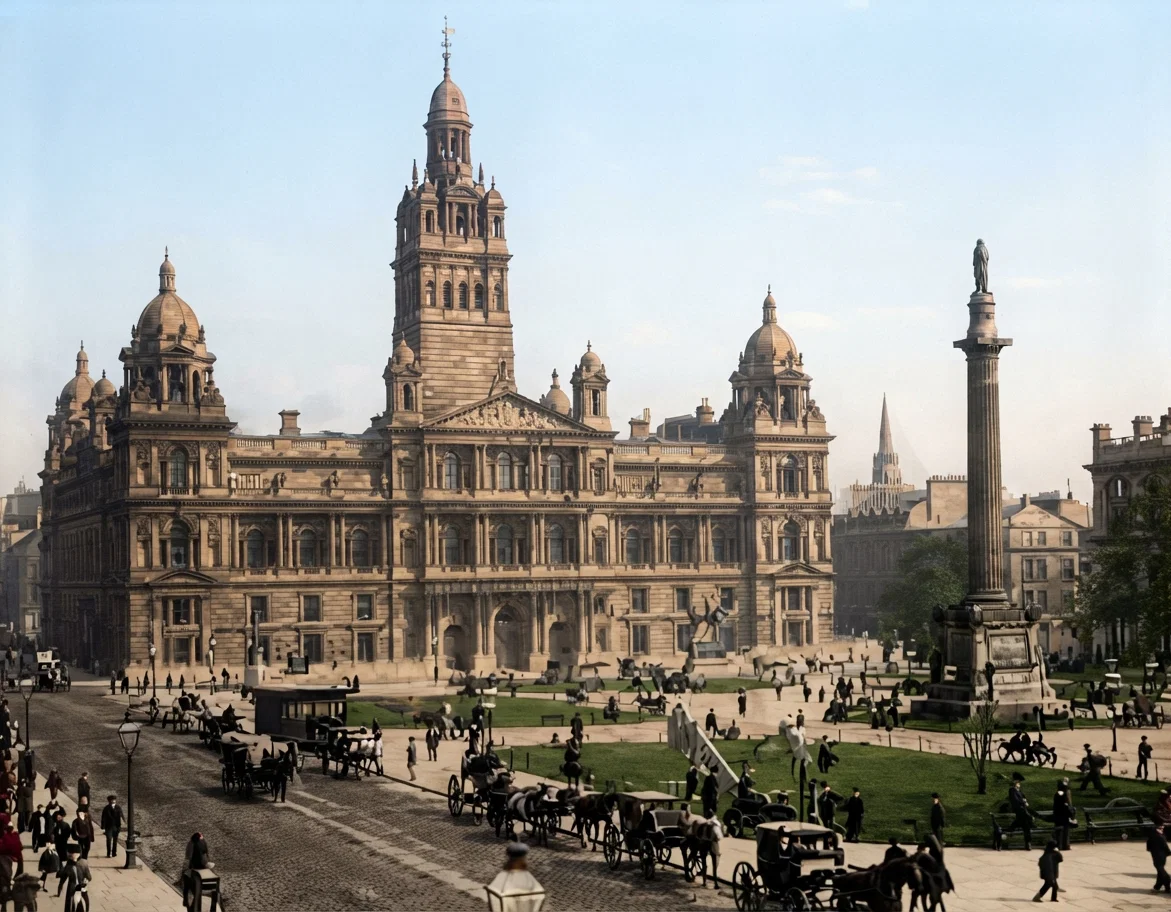
St. George's Square, Glasgow, Scotland.
The Lord is blessing us over here in “Bonnie Scotland.” It fires one's soul to be as true as steel, to see martyrs' graves and martyrs' monuments here and there, all round the country. These men died to uphold the authority of the divine Word. They walked in the light they had; but how much greater is the light committed to our care. Let us be faithful even unto death. There is a famous regiment in this country whose motto is “Death or Glory,” and they are called the “Death or Glory Boys.” But our motto far exceeds theirs in every way, while fighting the battles of the Lord; for is it not death and glory, if need be? Whether we live or die, we are the Lord's, and heirs with Him of eternal glory.
The work in Scotland is going forward to victory, and from all parts of the earth we hear the distant booming of the enemy's guns, which betokens the opening skirmishes of that last great battle, which will bring total annihilation to all the hosts of evil. Remember Scotland in your prayers.
Your brother in service,
ALEXANDER RITCHIE.
MISSIONS
WAITING FOR THE MORNING.
THERE is no roof in all the world, of palace or of cot, That hideth not some burdened heart, nigh breaking for its lot; The earth is sunk in pain and tears, and closer draws the gloom; And balm for cure there can be none till Christ the Lord shall come.
O morn, when, like a summer bird, my spirit shall go free, When I shall see thee as thou art, and be, my God, like Thee! Like Thee, like Thee! all spotless white—this heart, this will, as Thine! O love of God, O blood of Christ, O grace and power divine!
My Saviour, who doth know the thirst the longing spirit feels— O Bridegroom, now so long afar, why stay Thy chariot wheels? Were ever eyes so dim with grief, breasts so oppressed with care? Did ever hearts so yearn to catch Thy whisper from the air?
Thou lonely one, lift up thy head, array thee for the feast; He that hath tarried long is near—the glow is in the east! O Morning Star, so soon to lead Thy chosen one away! O Sun of Righteousness, bring in the everlasting day!
—Selected.
A Woman's Tears
“A WOMAN can say more with a few tears than a man can express in a book.”
THE FOREIGNER IN AMERICA.
By Samuel McBride
[Rev. Samuel McBride, D. D., in Converted Catholic.]
THE conditions that prevail in this land to-day are without a parallel in history. Never since God started the human race in the earth has there been such a mixing of races of peoples. To the United States they have come from every nation under heaven. The Sun is authority for the statement that sixty-three languages are spoken in New York City. And they are coming to-day in unprecedented numbers. The tide of immigration does not seem to have reached the flood. All records are being broken. Last year 915,000 came, including those from Canada; more than 500,000 of the total was from Italy, Austria, Hungary, and Russia. Large numbers of these are illiterate, and the vast majority of them utterly ignorant of the Gospel of Jesus Christ. The incoming of these unchristianized hordes is a serious matter, whether looked upon from the standpoint of patriotism or piety. They are a menace to our country. The stream of humanity that flowed down from northern Europe and destroyed the Roman Empire was a rivulet compared with the stream that is flowing in upon us. The issue, as has been stated, is evangelization or demoralization.
Their coming makes this the greatest field on earth, and imposes on the Christians of this land immense obligations. I believe God is in this movement, and that He is saying to His people: "I am sending the heathen to your very doors. Give them the Gospel of My grace." The divine purpose seems to be to evangelize the world through America. It is our plain duty, as well as our exalted privilege, to give these people the Gospel in their own tongue. In their own countries they are practically unreachable. There is something here, whether in the political conditions or in the air we breathe, I can not say, but there is something that makes a man begin to broaden as soon as his heel strikes American soil. His point of view changes immediately.
OUR WORK AND WORKERS.
By Editor
THE Lake Union Conference is to be held at Berrien Springs, Mich., May 17-27.
THE baptism of two candidates at Little Rock, Ark., by the local elder of the church, is noted in the Union Record.
THE Southern Illinois Herald says that the church at Decatur "numbers twenty-two in good standing, all women and youth."
ON the 26th ult., a church of nineteen members was organized at Farmington, Ill., by Brethren J. M. Rees and M. G. Huffman.
A church of sixteen members was organized at Peru, Ind., March 20, by Brother W. J. Stone, president of the conference.
THE labors of Brother E. Chase, near Langdon, N. D., have called out four more Sabbath keepers. The company now numbers about thirty.
A REPORT in the Minnesota Worker, from Brother L. H. Christian, notes the baptism of thirty-three persons in connection with his work in Denmark during the past winter.
FIFTY thousand prison cells in this country will be visited by copies of the April number of the Life Boat. These ought to make some impression for good, and no doubt they will.
BROTHER H. R. JOHNSON, of Wisconsin Conference, has been on a visit of several weeks to the Pacific Coast, and has been a caller at this office, where his son is engaged in labor.
A FORMER preacher among the free Lutherans of Norway has recently accepted the Adventist faith in Brooklyn, N. Y., and contemplates a preparation for carrying the truth to his former countrymen.
WRITING from Cripple Creek, Colo., Brother C. H. Bates says: "Five were baptized here February 14 and two on March 6. Others have accepted the Sabbath of the Lord who have not yet been baptized."
WRITING from Ivy, Idaho, Brother F. D. Starr says: "March 27 I had the privilege of baptizing three young people here about eighteen years of age. These, with three others, united with the Troy church."
THE Avondale School, Cooranbong, N. S. W., is designed for a missionary school, and Brother J. E. Fulton, in the Union Conference Record, notes that at a recent baptismal service, eleven candidates received the ordinance.
THE Review states that on Christmas night, by the light of a lantern, Brother B. G. Wilkinson baptized three candidates in a stream in eastern France. Three others were soon to follow in the ordinance as a result of the week of prayer meetings.
WE recently noted the call of Prof. W. A. Colcord, of College View, Neb., to Washington, D. C., to engage in religious liberty work. Later we learned that Brother Allen Moon, president of Northern Illinois Conference, has also been requested to engage in that line of work. Both these brethren are well fitted by long experience for such labor.
ONE of the recommendations of the late Central Union Conference was that Brother A. C. Anderson, of Nebraska, go to the new province of Alberta, Canada, to engage in labor among the Scandinavians. There are now between fifty and sixty thousand of this class of people in that province, and a continued heavy influx from Scandinavian countries.
OUR able contemporary, the Southern Watchman, announces a special issue in the early part of May, treating upon the general topic of the second coming of Christ. Following are some of the special subjects to be considered: The Eastern Question; Among the Nations; War Preparation; In the Heavens; Money Problems; Troublous Times and Capital and Labor; A Message of Warning; Three Messages of Revelation 14; Can the Revelation Be Understood? The Seventh Trumpet; The Book of Daniel; The Saviour's Testimony; Manner of Christ's Coming; Present Truth; The Judgment; The Resurrection Morning; How Does the Second Advent Affect the Wicked? The Thousand Years. Price, 5 cents per copy; 5 to 24 copies, to one address, 4 cents; 25 or more copies, 3 cents. Order of your tract society, or direct from the office of publication, 1025 Jefferson Street, Nashville, Tenn.
A MAD COUNTESS.
Not many years ago there lived in Holstein, in the northland of Europe, a young girl of aristocratic family, who became an intimate friend of the princesses of Denmark. One of these princesses became Empress of Russia; another is the Princess of Wales.
The court of Denmark has been remarkable for its simplicity and genuineness, and our young friend, the Countess Schimmelmann, was stimulated to a noble life by the lovely daughters of the Danish king. As she grew older, she determined when she should come into her inheritance to consecrate herself to the service of the needy.
After having been maid of honor to the Empress Augusta, of Germany, she resigned her position and went back to her own Baltic shores. As in all sea-coast countries, there on the Baltic the fishermen were poor. Perhaps no other class of men undergo greater dangers and hardships for less return than do the toilers of the sea. To these fishermen of the cold northern shores the countess determined to devote her life.
She began to patrol the stormy coasts of the Baltic in her yacht, and soon she came to know almost every fisherman's family for many miles along the coast, and whenever she found them in need of food she fed them. If salt or nets were wanting, these she supplied. She carried medicines where no doctor could ever visit. She founded sailors' homes and temperance lodges, and wherever a brutal man was the terror of his village or community, she labored with him to make him a respectable citizen.
In this way she redeemed many a soul and saved many a home from destitution and destruction. Never, in all her experiences of court life, had the young countess been so happy as when carrying relief to the sick in body or in soul in the teeth of a gale at sea.
But one day she was arrested and hurried to a madhouse. The charge brought by her relatives was that she was using up her private fortune on poor, undeserving wretches, and neglecting her social duties. When had a Schimmelmann been guilty of helping his fellow men at his own great cost? The countess must be mad.
She was imprisoned in an asylum for some time, and it was universally believed that her detention was a necessity.
At last the authorities discovered that the countess' estate was being mismanaged. An investigation was made, the wronged woman was examined, doctors pronounced her sane, and she was speedily restored to her estate and to the world. Not long ago she visited England, and the Princess of Wales, her old friend, brought confusion upon the Danish lady's enemies by giving her a formal reception, the greatest honor that can be granted to social aspirants, and a public endorsement of the countess and her noble work.
What a romance, what a victory, such a life portrays! The court, the fisherman's hut, the narrow cell, each played its part in the formation of a rare and beautiful character, that became a blessing to the world.
The "madness," which finds expression in deeds of beneficence and love, which ennobles and enriches every life it touches, is so truly a "divine madness" that the best and sanest of us might well covet and strive for it.—Youth's Companion.
THE HEATHEN.
By Editor
THE present difficulty between Russia and Japan has caused many readers, no doubt, to puzzle themselves as to the direction in which they should give their sympathy, whether to Russia or to Japan. Russia is considered a Christian nation, where the Greek Catholic Church is established by law. Japan is known to be a heathen nation. Some readers suppose that if Russia should gain the upper hand, Christianity is thereby furthered. This is an error. Russia is not open to missionaries, nor to the true Gospel of Jesus Christ. Japan is open to missionaries.
We may as well open our eyes to the fact that there is a Christianity which is not Christian. A Christianity that persecutes Finland, that seizes the property of the Armenian Church in Russia, that massacres the Jews because of their religion, is not a Christianity that we wish established in any part of the world.
It may be stated that in America we have lynchings. But the lynchings are for crime, whereas the massacres in Russia are because of religion.
We have missionaries in Japan, but in vain would we try to send one into Russia.
But heathenism itself is sin. It indicates that a race has wandered from God. It is debased and degraded. It has abandoned the doctrine and worship of the one true God, bowing down to false gods, and adopting the sins of man-made gods, until the nation itself is morally corrupted. In Japan vice, loathsome vice, is common. . . . We should Christianize the heathen, and we should have no hesitation in sending missionaries into so-called Christian lands, where the type of the religion is only heathenized Christianity. Russia is a nation of that kind.—Herald of Gospel Liberty.
JAPAN.
THE following figures relative to missions in Japan will be of interest at this time. The Rev. H. Loomis, a missionary in Japan, states there are 757 Protestant missionaries in that country, and 42,461 converts. By way of comparison we may remind our readers that "Whittaker" returns the population of the Japanese Empire at 44,000,000, so that the Protestant Christians are as one to nine hundred. The English and American Church Missions, incorporated into the Nippon Sei Kokwai, or Church of Japan, have 7,976 members, or about one-sixth of the whole.
It is interesting to note that the first Japanese convert was baptized only thirty-six years ago, and the first Japanese congregation, of nine members, was organized so recently as twenty-nine years ago.—Church Missionary.
INFORMATION
Concerning P. A. Henderson, who twelve years ago was living in Oakland, Cal., is desired by his sister, Mrs. R. A. Freeze, West Plains, Mo., or Mrs. Ada F. Wellman, 4341 Woodland Avenue, Kansas City, Mo.
S. C. White Leghorn Eggs
Eggs for hatching, S. C. White Leghorns; free range on farm; 15 for $1.00. Ida Klein, Berea, Stafford Co., Va.
WANTED FOR MISSIONARY WORK.
(Always prepay postage.)
LATE copies of the Signs, Instructor, Good Health, Pacific Health Journal, Life Boat, and Our Little Friend. Address Mrs. Cora B. Findlay, Box 133, Ashland, Ore.
Signs, Good Health, Our Little Friend, and Life Boat. Address, J. H. Robison, Braidentown, Fla.
Philadelphia and Laodicea
THE SABBATH SCHOOL INTERNATIONAL SERIES
LESSON V.—THE SEVEN CHURCHES—PHILADELPHIA AND LAODICEA.
(Study for Sabbath, April 30.)
QUESTIONS.
1. What church of Asia is used to represent the very last stage of Christ's church on earth? Rev. 3:14. Note 1.
2. Through what experience must believers in the last generation pass? Verses 10; 11; 2 Thess. 2:9, 10; Rev. 12:17. Note 2.
3. What is the promise to the overcomer in the message to Philadelphia? Rev. 3:12.
10. How shall this experience come?—By the surrender to the love of Jesus as the needy, common sinners that we are. 1 Tim. 1:15; 1 John 1:8, 9.
11. What encouragement is in the reproof itself? Rev. 3:19.
12. Must the sinner search far to find the Saviour? Verse 20, first part.
13. What is the needy soul to do?—Only to hear, open the heart's door; no longer hold it shut. Verse 20; John 14:23.
"Yes, I'll open this proud heart's door;
Yes, I'll let Him in.
Gladly I'll welcome Him evermore;
O, yes, I'll let Him in.
Blessed Saviour, abide with me,
Cares and trials will lighter be;
I am safe if I'm only with Thee;
O blessed Lord, come in."
14. What does Christ long to do? Rev. 3:20, last part. Note 4.
15. What is the final promise and exhortation? Verses 21, 22.
Note that all the promises and warnings and lessons of the messages to the seven churches come to those in the last days, with the solemn call to hear what the Spirit saith unto the churches. Truly last-day professors and unbelievers are left without excuse. "What could have been done more to My vineyard, that I have not done in it?" Isa. 5:4.
NOTES.
1. Laodicea signifies a "judging of the people." From 1844 to the close of probation is the hour of God's judgment. After this work of judging the people, the Lord will come. The message to the world in this judgment hour is the threefold message of Rev. 14:6-12, the commandments of God, and the faith of Jesus, which has brought out this Seventh-day Adventist people.
2. It is evident that the last two periods of the church—Philadelphia and Laodicea—cover one and the same generation. The rise of the Advent movement and the special message of preparation for the end was a signal that the opening years of the closing generation had been reached, to whom was due God's final warning. Believers who came in during the Philadelphian experience, such as live to the coming of the Lord, pass through the Laodicean period. The final trials and experiences of the last-day church are therefore described in the message to Philadelphia, while the special perils to the waiting church in the last generation are pointed out in the Laodicean message. The time of the Laodicean message is one of drowsiness and peril, and the burden of the message is to escape from the Laodicean condition.
3. The title "Amen" suggests the final word to the churches, the faithful witness that can not spare; for now the church must be made clean and pure to meet the Lord. It must return to the first love and first works, to the primitive purity of the first stage of Ephesus, and maintain constantly to the end that blessed experience enjoyed in the brief stage of the Philadelphia church, in which believers, joined in fellowship, waited for the appearing of the Saviour. Eph. 5:27; Rev. 14:5.
4. He will take our sin and give His righteousness. 2 Cor. 5:21. He longs to share our trials and share with us His triumphs.