Your ShelfYour Projects

Signs of the Times, Vol. 19, No. 14.

CHRIST THE WAY

Signs of the Times

Feb 6, 1893

Pacific Press Publishing Company · Oakland, California · Feb 6, 1893

CHRIST THE WAY.

THE Bible reveals, what every man at some time in his life, at least, is conscious of, that mankind are sinners. “All have sinned, and come short of the glory of God.” Rom. 3:23. “There is none righteous, no, not one.” “They are all gone out of the way, they are together become unprofitable; there is none that doeth good, no, not one.” “The way of peace have they not known.” Rom. 3:10, 12, 17.
These are a few of the many expressions which show man’s condition before God. “Sin,” say the Scriptures, “is the transgression of the law.” 1 John 3:4. Says Paul, “I had not known sin, but by the law.” Rom. 7:7. “All unrighteousness is sin,” is another declaration of God’s word; while another scripture declares that “all thy [God’s] commandments are righteousness.” “Thy righteousness is an everlasting righteousness, and thy law is the truth.” Ps. 119:172, 142. As God’s commandments, his holy law, is the expression of his righteousness, of all righteousness, and as all sin, or unrighteousness, is the transgression of that law, and as man in sinning has gone out of the way, therefore the law of God was that way in which man should have walked, and in which he would have found peace. This also is shown by Rom. 3:19, in immediate connection with the texts already quoted: “Now we know that what things soever the law saith, it saith to them who are under the law; that every mouth may be stopped, and all the world may become guilty before God.”
This is man’s condition. He is out of the highway of holiness; he is in the byways of sin, and there is no exception. This does not mean that all are positively wicked in their acts, but all are sinners; and being sinners, they cannot of themselves do good. Their best service comes short of God’s righteousness. Their way is the way of sin, and sin ends in death. James 1:15. Not only has man sinned, but in himself he must continue in sin. He cannot rise above the weakness of sinful flesh, to which he is bound. See Rom. 7:14–23; 8:3. It is just as impossible for man of himself to rise above this condition as it is for him to raise himself by lifting on his boot straps, or to fly.
But right here God’s goodness is revealed. Man is responsible for his sin; God will proffer him the free gift of righteousness. The eternal Son of God leaves his lofty throne, empties himself of his transcendent glory, and takes upon himself the form of a servant, that he might help man, that he might do for man what man could not do for himself. See Phil. 2:5–8, Revised Version. “For what the law could not do, in that it was weak through the flesh, God [did by] sending his own Son in the likeness of sinful flesh, and for sin, condemned sin in the flesh; that the righteousness of the law might be fulfilled in us.” Rom. 8:3, 4.
Christ having emptied himself of all his glory, God filled him with his fullness, so that when Jesus Christ was in this world, he did not show forth himself, but the Father. It was the Father’s love, it was the Father’s righteousness, it was the Father’s doctrine, as Jesus declared over and over again. “God was in Christ, reconciling the world unto himself.” This does not mean that Christ’s offering or sacrifice was not free; for “he gave himself” for the world, that thus God might work through him. It pleased Christ to empty himself (Phil. 2:5–7), and it pleased the Father that in Christ should all the fullness dwell (Col. 1:19). Of course this fullness includes the righteousness of God. Jesus was made sin for us, that we might be made the righteousness of God in him (2 Cor. 5:21); that we might be made complete in him by his fullness (Col. 2:9, 10). “Who of God is made unto us wisdom, and righteousness, and sanctification, and redemption.” 1 Cor. 1:30.
How is this righteousness obtained?—Simply by faith, no more no less. “But now the righteousness of God without the law is manifested, being witnessed by the law and the prophets; even the righteousness of God which is by faith of Jesus Christ unto all and upon all them that believe; for there is no difference.” Rom. 3:21, 22. Two points we especially note here as proved by this text: (1) The righteousness given to all by faith; and (2) it is the same righteousness taught as in the law, because the law testifies or witnesses to it. The sinner thus accepting of Christ by faith is complete in the fullness which is in Christ. Col. 2:9, 10. Having faith in God, he yields all to God; he shows that faith to the world by being baptized into Christ, and thus showing forth the inward union that faith and the Spirit of God has made by the ceremony of baptism, the marriage ceremony between the believer and Christ. “For as many of you as have been baptized into Christ have put on Christ.” Gal. 3:27. By the power of God we are lifted from the world of sin, and “created in Christ Jesus unto good works.” Eph. 2:10. These good works have been wrought out in Christ, who overcame all that we might overcome, who was made like man, tempted as man, and overcame for us that we might overcome in him. And in Christ is in the way from which man departed; for man departed “out of the way” of righteousness, but in Christ he finds that righteousness in all its fullness, and finding that righteousness he also finds the peace. Rom. 5:1.
It is because of this that Jesus, in speaking of the blessed eternal home to come and how it may be reached, says, “I am the way.” John 14:6. Says Paul: “As ye have therefore received Christ Jesus the Lord, so walk ye in him.” Col. 2:6. In him we are to walk. His perfections include all fullness. In all the breadth and depth and height of the way of righteousness Christ fills all. We are to develop a character in that fullness. Our deed may come short of the fullness, but faith lays hold of the fullness, and the fullness completes the deed.
Christ is not the Way for a little while, he is the Way all the way. From the first step heavenward till our feet stand on the celestial shore, no more to wander on the barren deserts of sin, or to press the sometimes weary way of earthly pilgrimage, Christ is the Way. He is with us in the sore heart-breaking repentance, in the humble confession of sin, in the pruning of superfluous growths, in the persecutions, the trials, in the blessed joys of glad companionship—everywhere, at all times, Christ is there. He is the Alpha and the Omega, the whole alphabet of our earthly education for the better world. He is the Beginner and Finisher of our faith. He is Saviour, Master, Friend, Father. It is all summed up in the words, “I am the Way.” Reader, will you not walk in this way?

Editorial.

“All Scripture is given by inspiration of God, and is profitable.”—2 Tim. 3:16.
THE experience of many ages proves that men may be ready to fight to the death, and to persecute without pity, for a religion whose creed they do not understand, and whose precepts they habitually disobey.—Lord Macaulay.
GOD'S promises are as sure as his throne; so are his precepts. His honor is at stake in both. If we depend on the former, ought we not consistently to regard, to submit, to the latter? To claim to believe God's promises and not his precepts is not faith; it is the rankest presumption. He who thinks that he trusts one, and does not yield to the other, will find his hope but a rope of sand. Faith in God regards both promise and precept.
IT would now look as though America was honored with a permanent pope lieutenant. The newspapers state that it has been authoritatively given out that Pope Leo XIII. had decided to establish a permanent apostolic delegation here, with Satolli as the first delegate. And America is rejoiced to know that she is so honored, we suppose; at least, it has been reported that M. Satolli was shown special favor by the government when he came. The Papacy is a political power which the great parties cannot ignore with safety, and the Papacy knows it as well as they.
CHRIST is coming again in his own personal presence. He went away long centuries ago after a brief sojourn on this sinful earth. Men and women loved him then. Little children smiled in his presence. From heavy hearts rolled heavy burdens of sin and woe. Into mourning homes he carries notes of gladness. To the vile leper he brought cleansing. To the dead he brought life. The darkness of error was dissipated before the warm light of the truths he spake. He loved man, and he showed how much by leaving all that was his, and dying for him he created. He went away personally. His Spirit has been present, and has brought joy, and light, and gladness, and healing, blessing, like the Master, wherever it has been received. But Jesus in his personal presence, in his glorified beauty, in his transcendent majesty, in his infinite love, is coming again. Reader, are you glad? Do you wish to meet him? Is he your Saviour?
Come.—God is infinite in every perfection, possessing in himself all the riches of the universe; and all these infinite perfections he offers to man and asks him to be a partaker of them. All the hoarded love of eternity vibrates in the blessed invitation: “And the Spirit and the bride say, Come. And let him that heareth say, Come. And let him that is athirst come. And whosoever will, let him take of the water of life freely.”—Rev. 22:17. And this is but the responsive, living echo of the voice from the four living ones which constitute God's throne, “Come,” “Come,” “Come,” “Come.”—Rev. 6:1, 3, 5, 7, Revised Version. Jesus said, “Come unto me, all ye that labor and are heavy laden, and I will give you rest.” Dear sinner, why not come now?

The Papacy and Russia

A CABLEGRAM from Rome, dated January 8, conveys the following intelligence:—
Rome, January 8.—The friendly relations between the Papacy and Russia are more intimate than ever. The pope has caused instructions to be sent to the Polish hierarchy not to encourage any opposition to Russia. The pope is convinced that the new year brings a decisive crisis on the continent. His address to the cardinals reflects his keen preoccupation with the political situation and he holds himself ready to make an appeal to the nations when the day of complications shall come. He is finishing at this moment an encyclical on the perils of the situation in Europe.
Leo XIII. is playing a deep game for the religious control of Europe, and each move that is made upon the great political chessboard is in his favor. How long will it be ere Babylon will say, "I sit a queen, and am no widow, and shall see no sorrow"? In other words, How long will it be ere the Papacy is again made the censor of morals and corrector of heretics? Prophecy declares it will come, and the logic of events is conclusive in that direction.

THE TWO-HORNED BEAST.

In another column will be found an article on the “Three Messages of Rev. 14:6-14,” which enters into a consideration of the beast symbols of Revelation 13. The first, the composite beast, is a symbol of Rome under the Papacy. The second is, we believe, a symbol of this government as argued and proved, we believe, in the article above mentioned. We wish to notice two specifications, but lightly touched upon by Elder Whitney, as positive proof of the identification of the country symbolized, and of the future character of the government. We ask the reader to give our remarks a careful consideration.
It is said of the second beast of Revelation 13 that “he had two horns like a lamb, and he spake as a dragon.” Verse 11. As this is a symbolic prophecy, the horns, the lamb, the dragon, the speaking, are all symbolical, and to be explained by the Scriptures elsewhere.
1. The horns. Horn in Scripture is a symbol of honored exaltation. On this point we refer to what is said on this in the article we referred to in the beginning. We believe that they here represent those principles embodied in this government which have raised this nation to its height of power, influence, and grandeur now seen.
2. The lamb. All through the Scriptures the lamb, as a type, is used to symbolize the Lamb of God, the Lord Jesus Christ. This is its use in Rev. 5:6, where it is represented as having seven horns, indicating absolute perfection of all good principles. The principles symbolized by the horns of the beast must be such principles as are manifest in the teaching and work of Christ while in this world; for it was here that he was manifest as the Lamb of God. John 1:29.
3. The dragon. The dragon is primarily a symbol of Satan. See Rev. 12:9; 20:2. He is presented before us in Revelation 12 as existing under seven heads, showing him to be the instigator of all religious persecutions through the civil powers of earth. In verse 13 it is stated that the dragon “persecuted the woman,” the church. He did this through the persecuting decrees of Papal Rome.
4. To speak as a dragon would be to promulgate persecuting laws against the people of God. That this is the case is shown by the last part of Revelation 13. This beast “causes” people to worship an apostate power under heavy penalties.
The meaning of these symbols being made plain in a general way, let us now inquire what two principles peculiar to the Christian religion alone are peculiar to this government alone? and are these two principles such as would be likely to exalt and advance the government? Without taking time to canvass the great religions of the world, we will come to the reply at once. There are two principles in the religion of Christ which won to its support those who loved justice and equity, which we find in none of the other great religions of the world.
The first of these principles is the equality of man. It is thus stated in the Scriptures:—
“There is no respect of persons with God.” Rom. 2:11.
“God that made the world and all things therein, hath made of one blood all nations of men for to dwell on all the face of the earth.” Acts 17:24-26.
This same principle was to hold good in the Christian church:—
“But be not ye called rabbi; for one is your Master, even Christ; and all ye are brethren.” Matt. 23:8.
The second great principle vouchsafed to men by Christian ethics, so far as interference of man is concerned, is the right and privilege of every man to worship God, or not to worship, how or when he will, providing he does not interfere with the equal rights of his fellow-men. This principle may be termed religious liberty. The gospel of Christ compels no one. It is not “Thou shalt,” or “Thou shalt not.” Its language is, “Whosoever will” “let him come.” Rev. 22:17. Listen to a chosen servant of the King of heaven:—
“Now then we are ambassadors for Christ, as though God did BESEECH you by us; we PRAY [entreat] you in Christ’s stead, be ye reconciled to God.” “Knowing therefore the terror of the Lord, we PERSUADE men.” 2 Cor. 5:20, 11.
When James and John would call down fire from heaven, as did Elijah, upon the disrespectful Samaritans who would not receive Christ, Jesus rebuked them with, “Ye know not what manner of spirit ye are of. For the Son of Man is not come to destroy men’s lives, but to save them.” Luke 9:55, 56.
And that resolute apostle who was once so ready to use carnal weapons, writes, “Dearly beloved, I beseech you as strangers and pilgrims, abstain from fleshly lusts.” 1 Peter 2:11. “Neither as being lords over God’s heritage.” 1 Peter 5:3. How vastly different from the spirit and utterances of the great apostate church which claims Peter as its head! “Not that we have dominion [lordship] over your faith,” says Paul, “but are helpers of your joy; for by faith ye stand.” How vastly different from this is the language and practice of those “lords spiritual” who claim to be the direct successors of Peter and Paul.
Look on all the great religions of the past, pagan or Jewish, Mohammedan or so-called Christian (papal), and in not one do we find these two particulars. The curse of caste, the creation of offices, a haughty, imperious, and ambitious hierarchy, religious dogmas enforced by legislative enactment or royal edict, one or all are present in all false religions, in all perverted powers of the Christian religion.
Both of these principles of divine origin are embodied in the charters of our liberties in this nation so far as they can be embodied in an earthly government. The first principle, the equality of man, is found in that document which sounded the birth note of America’s freedom and which made Americans civilly free men:—
We hold these truths to be self-evident, that all men are created equal; that they are endowed by their Creator with certain inalienable rights; that among these are life, liberty, and the pursuit of happiness.—Declaration of Independence.
The second principle, religious liberty, is embodied in the word “liberty” in theDeclaration of Independence, for true liberty comprises religious liberty. But our forefathers builded more surely than this. The first amendment to the Constitution of the United States reads:—
Congress shall make no laws respecting an establishment of religion, or prohibiting the free exercise thereof.
Thus, in the fundamental law of this government, man’s freedom to worship or not to worship God, or his conceptions of God, were preserved and protected intact. We know of no other government of any note in all the world which holds these principles. There are republics, like Switzerland and France, but they have their state religion, supported by many to whom it is an intolerable burden. The United States Government is unique in this respect, and these principles have been the magnetic power which has drawn to our shores from the intolerant and autocratic governments of the Old World the persecuted and oppressed millions. They found here religion “without a pope, and a State without a king,” and the consequent privilege of worshiping God according to their own consciences and understanding of God’s word.
Thus the lamb-like horns furnish a positive means of locating the government symbolized beyond the shadow of a doubt, and also reveal the character of those principles which have given it greatness. The disavowal of these principles, and the dragon voice, will be further considered in the future. Will our readers give attention to these things?

THE THREE MESSAGES OF REV. 14:6-14.

BY ELDER E. W. WHITNEY.

No. 6. Special Features Applicable to the United States.
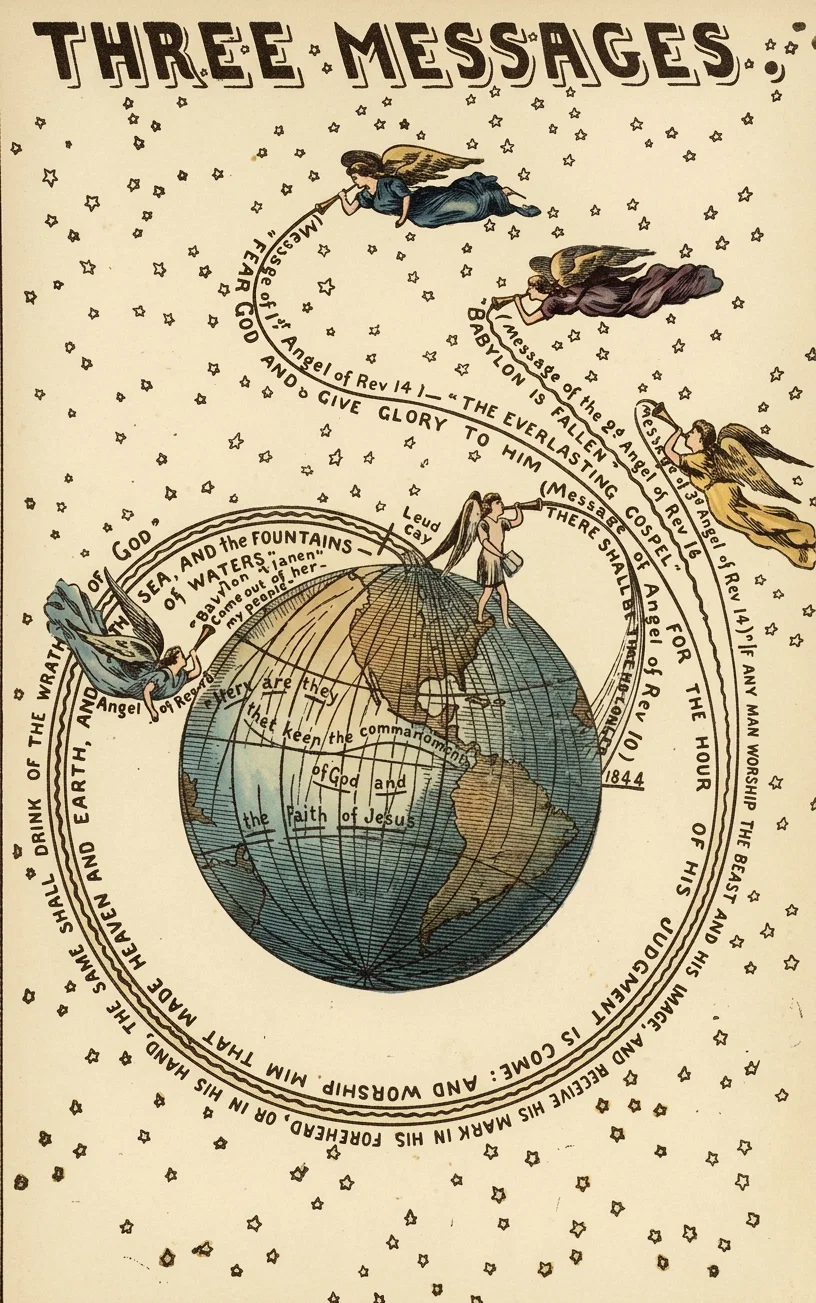
WHILE these messages are world-wide in their nature and design, it is evident from a careful study of them in connection with the prophecy of chapter 13 that this country occupies a conspicuous place, and performs an important though unenviable part, in the great closing conflict between true and false worship brought to view by them. The necessary limit of these articles forbids anything more than a very brief consideration of this interesting feature of the subject, yet something seems necessary. (For a fuller presentation, the reader is referred to works published by Review and Herald, Battle Creek, Michigan, and Pacific Press, Oakland, California,—"The Marvel of Nations," by Uriah Smith, and "The Two Republics," by A. T. Jones.)
The angel of chapter 10 while delivering his message stood with one foot upon the sea, and the other upon the earth. It has been suggested that this is expressive of the extent to which that proclamation was given, yet it is a fact that in this country the movement was more fully developed in all its features, attracting more attention, and awakening more general interest than in any other part of the world. It must be remembered in this connection that that proclamation was the introduction of the First Angel's Message, consequently that message began to be sounded forth to the world from this country. The same may be said of the second; while in the third are found expressions which, when understood, connect the responsibility of the conflict which it portrays and its consequences directly with the United States in a striking manner.
The worship of the image of the beast is mentioned in connection with beast worship, as equally hateful to God, and as bringing upon those who practice it the same punishment. The beast has already been defined to be the Papacy. The prominent evil characteristics of the beast being the assumption of authority in spiritual matters, above even that of God himself, and the demand that his authority shall be enforced through the civil law, the law of the State, an image to the beast, whose worship should be equally hateful to God, would of necessity possess the same characteristics. Reference has also been made to the statement in chapter 13 that a certain beast which succeeds the papal beast should make an image to him, exercise all his power, and cause the earth and them that dwell in it to worship him and his image. This is accomplished through "great wonders" which he had power to perform, and by which he deceives them that dwell upon the earth.
Beasts in prophetic language represent kingdoms or nations, as the lion, the bear, the leopard, and the "terrible" beast described by Daniel in chapter 7 are prophetic representations of the great universal kingdoms of Babylon, Media and Persia, Grecia, and Rome. Analogy requires that this second beast, described in Revelation 13, should represent some nation. The only question upon which there can reasonably be any difference of opinion is what nation is represented. Two important reasons for the prophetic mention of a nation are: First, its importance among the nations of the earth, and, secondly, its connection in any way with the people and work of God. Both of these are eminently valid in the case of the United States. Therefore we naturally expect that it is thus noticed somewhere in the prophetic word. Here we have a symbolic beast without a nation to which to apply it (as all other nations of prominence in the above particulars are covered by other symbols) unless it be the United States; and we have a nation, eminently conspicuous in the above particulars, without a symbol to fit it unless it be this one. Thus the statements in the prophecy, compared with historical facts, point clearly to the United States as the nation here represented.
The first beast was seen by John coming up out of the sea (verse 1), the same as were the four referred to above, by Daniel. In fact, it is evidently identical with the fourth beast of Daniel's prophecy (compare descriptions here and in Daniel 7) except that fuller details are given here. As Rome conquered the world so far as then known, and thus the territory and subjects of preceding kingdoms entered into it as components, so this beast is said to possess parts of those preceding it, as given by Daniel, showing a direct connection between this prophecy and that of Daniel 7: "And the beast which I saw was like unto a leopard, and his feet were as the feet of a bear, and his mouth as the mouth of a lion." Rev. 13: 2. The term "sea" used symbolically, as in the present case, represents "peoples, and multitudes, and nations, and tongues." See Rev. 17: 1, 15. Ordinarily new nations are brought forth from these "multitudes," "peoples," and "tongues" through war and strife, symbolized by "winds" blowing upon the sea (compare Jer. 25: 31-33 and Dan. 7: 2), causing the overthrow of some and the establishment of others upon their ruin. But in the case of this beast in the prophecy, and this nation in history, it is different. The prophecy says, "And I beheld another beast coming up out of the earth," not from the "sea." Now if the "sea" represents "peoples, and multitudes, and nations, and tongues," the "earth" should represent territory previously unoccupied by other nations, which is certainly true of the territory of this country previous to its becoming a nation.The time also at which John sees this beast coming up is applicable to this nation, while it is not to any other of any particular note. He sees him coming up just as he sees the first beast, the Papacy, "go into captivity," as mentioned in the preceding verse. This can refer to nothing else than the taking away of the temporal power of the Papacy by the French in 1798, at which time the United States could truly be said to be "coming up." Another point of identification is this beast is said to have "two horns like a lamb." A horn is a symbol of that in which the power of the nation is vested or manifested. In a monarchy it may represent the king or emperor, but in a republic it must represent that which gives to it power to build up itself. It is in fact the symbol of whatever constitutes the nation's aggressive strength. It may be a principle. It is noticeable that the two horns upon this beast are spoken of as "horns like a lamb," expressive of innocence and mildness. They are without crowns, as those upon beasts representing kingdoms are said to have (see Rev. 13:1), suggestive of the fact that the government represented is not one ruled by a king or emperor. The two leading principles in this government upon which the government is based, and which have placed it above, in many respects, every other nation, making it the home of the wronged and oppressed of every land, are, as expressed by another: "First, that government is of the people; and, second, that government is of right entirely separate from religion." To these principles explicit expression is given in the Declaration of Independence and in the Constitution of the United States.
Evidence might be multiplied to show that the prophecy applies to this nation; but more seems unnecessary only as it is brought to view in a brief consideration of the work of this beast.
While he has "two horns like a lamb," expressive of Christlikeness in principle, as the lamb is a symbol of Christ, yet he is said to "speak as a dragon." The dragon in this prophecy primarily is a symbol of Satan (see chapter 12:9, 17). We have, then, the representation of a government professedly based upon pure, Christlike principles, but when raised to the position of great power (for "he exerciseth all the power of the first beast before him"), speaking and acting in the spirit of Satan. This he does through the image which he causes to be made to the first beast. Now as the first beast was a persecuting power, punishing by torture and death those who would not conform to his requirements, so the living image of such a power will have the spirit to do the same.
More than forty years ago Seventh-day Adventists, basing their prediction upon this prophecy, published to the world that there would yet be seen in this country, in spite of the pure principles of civil rights and religious freedom vouchsafed in the Declaration and Constitution, a virtual union of Church and State, bringing with it religious persecution; and that it would come principally in the enforcement of the observance of the first day of the week, Sunday, as the Sabbath, which, as has been shown, when so enforced, would constitute the sign or mark of the beast.
At that time there was not the least indication of such a movement in the government, nor even in the religious denominations of the land. To-day we see not only the indications but the movement itself well advanced in all parts of the country. In fact, the spirit of persecution for conscience' sake is already manifesting itself, as witnessed by numerous arrests, convictions, and imprisonments in Arkansas, Tennessee, and other States, the decisions being sustained by the higher courts of this country; and for what?—Simply because men choose to quietly exercise the God-given and constitutional right of worshiping according to the dictates of their own consciences. And in what particular?—Why, they work six days, as God has commanded, and rest the seventh, as he has also commanded. (Read the commandment, Ex. 20:8-11.)
In the very face of these facts, proving as they do that the spirit of persecution is surely rising even in this land of professed liberty of conscience, there is at this time such a clamor for Sunday legislation as was never before known, as evidenced in the late agitation over and the securing of legislation closing the World's Fair on Sunday, and similar questions in various quarters. Let the reader mark it well, and take warning that religious legislation, as all history proves, means religious persecution.
"I saw another angel fly in the midst of heaven." "And there followed another angel . . . And the third angel followed them" Rev. 14:6, 8, 9.

NOTES UPON THE ILLUSTRATION.

1. THE first message begins previous to 1844, announcing the hour of judgment, but continues to the coming of Christ, proclaiming the gospel and the worship of the true God (the commandments) as the basis of the following messages. 2. Simultaneously with the opening of the first message, and as a special feature of its introduction, it is joined by the message of the angel of chapter 10, which continues to 1844 and ceases. 3. Subsequent to 1844 the truths of the first message became more fully understood and preached, though generally rejected, and as a consequence it is joined by the second message, proclaiming the fall of Babylon, which also continues to the end. 4. Later the two are joined by the third, warning against the worship of "the beast" and his image and the reception of his mark, and also continues to the end. 5. Just before the end of gospel work the three are joined by the message of chapter 18, announcing the complete fall of Babylon, and calling upon God's people to come out of her because of her sins. This in effect produces a loud, earnest, and extended giving of all three messages combined, resulting in the lighting of the earth with all truth, and the development of a company keeping all the commandments of God and the faith of Jesus, and fully prepared to meet Christ when he appears in the clouds of heaven.
Associations of different names are rapidly forming and extending their work over the entire country, with the one object in view of securing legislation upon this question of Sunday observance which shall force the conscience and compel all to bow in homage to this one institution of Sunday, which is purely an institution of the Papacy and absolutely without scriptural authority. As an evidence of the present sentiment in favor of such a union of Church and State in this country, I quote a statement of the Rev. Charles Ferguson, of Syracuse, N. Y., before a ministers' meeting of that city, and reported in the Syracuse Evening News of June 13, 1892. Similar utterances might be quoted from others in high position, but this will suffice as a sample. He says:—
I believe in one organic church for the future, the great American Church, of which the president of the United States shall be the acknowledged head, which shall take hold of every phase of American life.
Thus this noble government, which has stood as a beacon light upon the shore to all the nations of the earth which make up the "great sea," which has led in the grand cause of equal rights and religious freedom, has, by permitting itself to legislate in the interests of the papal power, which "opposeth and exalteth itself above all that is called God," dimmed its light forever, corrupted its God-given power and influence over the nations of the earth, and, in continuing this course, will become the masterpiece of Satan's agencies for leading the world in a worship which will bring upon it the unmixed wrath of God,—temporal and eternal destruction.
Because of this understanding of the prophecy Seventh-day Adventists have for these many years been calling the attention of the people to the worship of the true God as expressed in the First Angel's Message, trying to arouse them to a sense of the moral and spiritual apostasy so prevalent in the religious world to-day, as indicated by the second, and warning against the observance of that which, when the issue is fully before the people, will constitute the worship of the beast and his image and the reception of his mark, as plainly brought to view by the third. And the indications now are that soon the angel of the eighteenth chapter will unite his voice and strength with the three in the more distinct and startling announcement of the second: "Babylon the great is fallen, is fallen, and is become the habitation of devils, and the hold of every foul spirit, and a cage of every unclean and hateful bird," etc., when the earth will become lightened with his glory, and the voice from heaven will be heard saying, "Come out of her, my people, that ye be not partakers of her sins, and that ye receive not of her plagues." This separation will fully develop the company of whom it is said in verse 12 of chapter 14, "Here is the patience of the saints; here are they that keep the commandments of God, and the faith of Jesus."
When the conflict is over, there will be but two classes,—commandment keepers, worshipers of the true God, and beast worshipers, those who bow to the authority of the beast in the observance of the rival institution to the true Sabbath. It should be remembered that the mark of the beast may be received either in the forehead or in the hand, while the seal of God can only be received in the forehead. Conformity to the law of God, to be acceptable, must be from the heart, while even an outward conformity to that which is opposed to his law is fatal, especially in such a crisis as the one before us. Dear reader, in which company will you be found?

What Does It Mean?

Supreme Courts of States and nation seem to be taking their cue of justice from the Dark Ages, despite the Constitution and common custom. The Supreme Court of Pennsylvania has confirmed, by a recent decision, an old blue law of 1794, relative to the publication of newspapers on Sunday.
The recent lottery decision of the Supreme Court of the United States has, by two recent decisions, blotted out the First Amendment to the Constitution, establishing the religion of the nation, and dealing a blow at the freedom of the press. Of course, they hold that the Constitution stands intact, but it does not now mean what it has always been supposed to mean. What does it mean? But more of this in our next.

Churches and Sunday Theater Laws

REV. FRANK DIXON, of this city, as reported by the Morning Times of January 16, has the following on the question of closing the theaters on Sunday night by law:—
What right indeed have the churches to combine to close the theaters? No more than the theaters have to combine to close the churches. Suppose there should be such a movement started. Would we not become indignant to the very center? Would we not fight the war out with all our might and strength and resources, without yielding? Then why should we attempt to gain our ends with the same means which would cause such indignation if used against ourselves. We have no right, no moral right, to do so.
God has given no such right. His ministers, his people, his church, are ministers of the gospel of peace, not of law. That, we mean, is the Bible plan. The great apostate church, "the mystery of iniquity," we are aware, reversed that plan, and modern churches are still drinking of the wine of fornication, but "the mystery of God" is still the gospel of Christ, backed by the power of God, not to coerce men, but to win them by love.

ON WHICH SIDE THOU?

Once to every man and nation comes the moment to decide, In the strife of Truth with Falsehood, for the good or evil side; Some great cause, God's new Messiah, offering each the bloom or blight, Parts the goats upon the left hand and the sheep upon the right, And the choice goes by forever 'twixt that darkness and that light. Hast thou chosen, O my people, on whose party thou shalt stand, Ere the Doom from its worn sandals shakes the dust against our land? Though the cause of evil prosper, yet 'tis Truth alone is strong, And, albeit she wander outcast now, I see around her throng Troops of beautiful tall angels, to enshield her from all wrong. —Lowell.

The Christian Course and Thorns

If the Christian course had been meant for a path of roses, would the life of the Author of Christianity have been a path strewed with thorns?—H. More.
Continue reading: BLESSINGS OF BIBLE STUDY