Pacific Press Publishing Company · OAKLAND, CALIFORNIA · Jun 7, 1899
CORNELIUS.
By T.
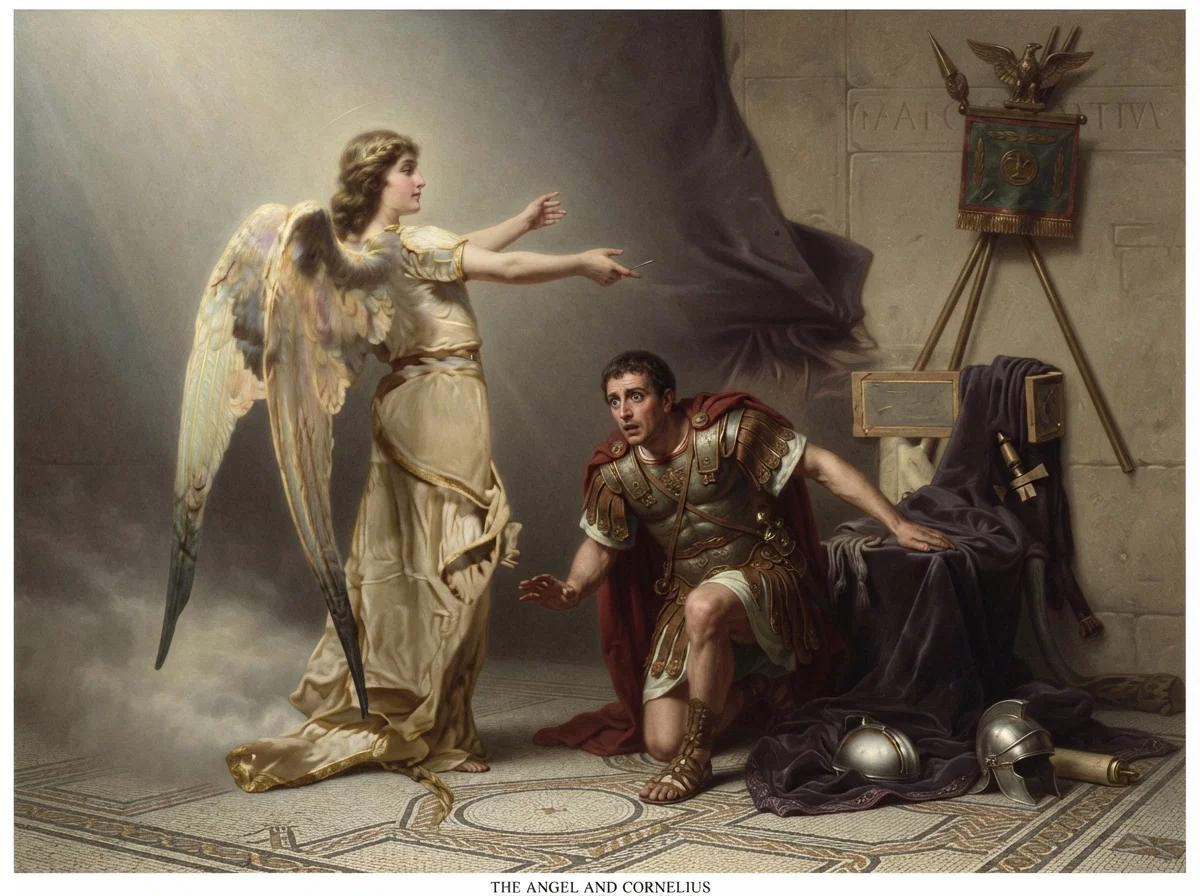
"THERE was a certain man in Cæsarea called Cornelius, a centurion of the band called the Italian band, a devout man, and one that feared God with all his house, which gave much alms to the people, and prayed to God alway. He saw in a vision, evidently about the ninth hour of the day, an angel of God coming in to him, and saying unto him, Cornelius. And when he looked on him, he was afraid, and said, What is it, Lord? And he said unto him, thy prayers and thine alms are come up for a memorial before God. And now send men to Joppa, and call for one Simon, whose surname is Peter; he lodgeth with one Simon a tanner, whose house is by the seaside; he shall tell thee what thou oughtest to do." Acts 10:1-6.
The foregoing scripture shows in a marked manner how carefully our heavenly Father regards each one of His creatures. When the angel was sent to the Roman centurion he addressed him at once by his name, Cornelius. This shows that God did not regard him merely as one among many thousands of men, without having any particular or definite knowledge of him. The Lord knew him personally, He knew his individual name. And when the angel was commissioned to make this visit he was not told to go merely to some man down there in Cæsarea who seemed to want something, but he was told to go and see Cornelius. The angel knew just where to go, and just whom to address when he got there.
THE ANGEL AND CORNELIUS.
When the angel spoke to Cornelius he told him, "Thy prayers and thine alms are come up for a memorial before God." Cornelius was known in heaven. And he was known, not to the angels only, but God Himself knew him. His prayers had reached to the throne of the Infinite. And He summoned an angel and told him to go at once down to Cæsarea and carry this message to "Cornelius."
"Every good gift and every perfect gift is from above, and cometh down from the Father of lights, with whom is no variableness neither shadow of turning." James 1:17. There is no "variableness" with our God, neither is there any "shadow of turning." He knows you just as literally and just as personally as He knew Cornelius. And if you will but turn to
Him as He calls you, He will send you just the help you need, the same as He did for Cornelius.
But there is much more in this scripture quoted from Acts to show how definitely our heavenly Father knows us. The angel was instructed by the Lord to tell Cornelius to "send men to Joppa, and call for one Simon, whose surname is Peter." How perfectly and minutely the Lord knows men and their affairs. Peter was an apostle, traveling about from place to place all the time. And the Lord knew just where he was stopping at that particular time. He was over there at Joppa. And then his whole name was familiar. It was not simply2Peter, nor just Simon, but it was "Simon, whose surname is Peter."
The record goes on to make things still clearer and more definite, thus showing what complete records are kept in heaven in regard to the affairs of men. Joppa was a seaport town, and there were many houses there, and Peter being only a transient in the place, it would not be very well known just where he was lodging. So the angel told Cornelius that his men would find Simon Peter lodging "with one Simon, a tanner, whose house is by the seaside." "Simon, a tanner"—thus the Lord even knows what occupation we follow, as well as knowing our names. And then He tells just where our homes are located.
Thus it is clear that our names, our homes, and even our occupations are all familiar to the heavenly Father and to the angels that do His bidding.
"Sing, O heavens; and be joyful, O earth; and break forth into singing, O mountains; for the Lord hath comforted His people, and will have mercy upon His afflicted. But Zion said, The Lord hath forsaken me, and my Lord hath forgotten me." Isa. 49:13, 14. Yes, that is just what multitudes are saying. Regardless of the fact that our Father in heaven has taken such particular pains to show us that He carefully and particularly looks after each one, yet we are prone to say, "my Lord hath forgotten me."
But hear the Lord's gracious and touching reply to this charge that is made against Him: "Can a women forget her sucking child, that she should not have compassion on the son of her womb? Yea, they may forget, yet will I not forget thee. Behold I have graven thee upon the palms of my hands; thy walls are continually before me." Isa. 49:15, 16.
What consolation the Word of God gives! Heaven comes a little nearer every time we review the scriptures that tell us how particular the Lord is to know each one of us personally, and definitely, and minutely. We can rely upon such a devoted Father all the time. It is impossible for Him to fail us. He loves us too much to neglect us, even in the remotest and most insignificant matters. T.
WORK OF SALVATION.
By Hattie Cummings
"Work out your own salvation with fear and trembling; for it is God which worketh in you both to will and to do of His good pleasure." Phil. 2:12, 13.
In working out our salvation, God has given us a perfect example in the life of Jesus. When solving a problem in arithmetic, we constantly consult the example which has been worked out for us at the head of the lesson, and learn to apply the principle of the lesson. So, in Christ, the Lord has given us a pattern of perfect salvation, and each day we are to look to Jesus, learning the principles which governed Him while upon earth, and how to apply them to our daily lives.
Christ has told us that without Him we can do nothing, yet here we are instructed to work out our own salvation. But the reason is given in the next verse, which says that God "worketh in you both to will and to do of His good pleasure." Our working out is wholly dependent upon His working in us, and He does this for every one who yields to His will. 1 Tim. 2:4; John 1:16.
Our Saviour said, "I can of Mine own self do nothing;" "The Father that dwelleth in Me, He doth the works." This was made possible by His constantly saying, "Not My will, but Thine be done." The Father was glorified in the Son.
We are admonished not to be wise in our own conceits, not to be "high-minded, but fear," for by faith ye stand. And this working out of our salvation is to be done with fear and trembling. But this fear is not that which will cause us to be full of anxiety and suspense, as if in bondage to a stern, exacting master. This is the very opposite of the faith which "worketh by love, and purifies the soul;" which recognizes God’s great love, and yields all to His wise and gracious dealings. Our great danger is in rising above this humble walk with God, and not looking to Him wholly for directions.
The fear which we must entertain is the fear of doing evil. It is that which causes us to be very careful lest we grieve His love, and cause Him sorrow. For it is by the fear of the Lord that we depart from iniquity. Prov. 16:6; 3:5-7. We have the promise, "Commit thy way unto the Lord; trust also in Him, and He shall bring it to pass. And He shall bring forth thy righteousness as the light, and thy judgment as the noonday." Ps. 37:5, 6. And in this God will be glorified.
HATTIE CUMMINGS.
Port Huron, Mich.
“WHY HALT YE BETWEEN TWO OPINIONS?”
By Ellen G. White
“IF any man have not the Spirit of Christ, he is none of His.” Those who have set before them in clear lines the self-sacrifice and self-denial of Jesus, His life of shame and suffering, His reproach, rejection, and crucifixion, and yet refuse to open their hearts to Him, altho He says, “Behold, I stand at the door, and knock; if any man hear My voice, and open the door, I will come in to him, and sup with him, and he with Me,” commit great sin. How great is the magnitude of sin of those who have had Jesus set before them, who have been warned and entreated, and yet pass on their way, following the imagination of their own hearts, and saying, “I will wait for a more convenient season to exercise repentance toward God and faith toward the Lord Jesus Christ”!
I am deeply moved in behalf of those who are putting off the time of surrender to Jesus, and yet I know that my interest is very feeble in comparison with His who knows the value of your souls; for He paid the price of the soul’s redemption with His own blood. In earnest love for your soul, He is waiting for you to decide to throw off the yoke of Satan, and take His yoke, which is easy, and His burden which is light. There is nothing too precious for us to give to Jesus. Jesus has purchased wife, husband, and children at infinite cost, and tho it is right for us to love those whom God has given us, yet God is ever to hold our supreme affection. Your attitude toward God and the truth has a decided influence upon your family, and the atmosphere that surrounds your soul will affect them in every way. If you are bestowing your affections upon the things of this world, the atmosphere which surrounds your soul will be of a malarious character, that will be death to spirituality, and will weaken hope and faith in God. Satan will cast his hellish shadow over your soul, and lead you captive at his will, unless you give yourself without reserve to Christ.
Christ has purchased all your capabilities and talents. Why not give Him that which is His own? Your intellect is God’s property, made to be used for His service and glory. Your affections belong to God, and He demands them as His right. Give Him your talents, your best and sharpest thoughts; for they are the purchase of His own blood. He has intrusted them to you as His children. Give all back to him. Seek in earnest prayer for His blessing upon them, and surrender to Him husband, wife, children, and your all. Dedicate yourself to His service in a precious offering; and as you give all to Jesus, your heaven will begin upon earth; for as long as you keep all on the altar, Christ is yours, heaven is yours, eternal life is yours. All things are yours, and ye are Christ’s and Christ is God’s. Surely the God of heaven could give no greater proof that He longs for your salvation than the proof He has given in the gift of His only-begotten Son.
The free gift of grace is yours; will you by faith accept it? Your surrender to God must be as free and complete as has the offering of Christ been free and complete for you. Then you will be accepted of God in every work you do, in every prayer you offer. Hesitate no longer. “How long halt ye between two opinions? if the Lord be God, follow Him; but if Baal, then follow him.” In the face of present and acknowledged duty, make no delay to meet the demand of God; for if you do, the light you have will become darkness. The mind and judgment will become perverted; for when precious opportunities are neglected, blessings unappreciated and unimproved, all good purposes become weakened, and there is less strength to resist temptation to commit presumptuous sins. The ties of worldly influence are subtle and strong, and can be severed only through the power of the grace of Christ. Make it your purpose to break away from every influence and habit, to give up every practise that weakens spirituality, and sunder every tie that binds you to Satanic agencies.
Christ says: “Follow Me:” “I am the way, the truth, and the life.” “He that followeth Me shall not walk in darkness, but shall have the light of life.”
The Word of God should be your study, and if your heart is susceptible to the influence of the truth, you will find in the Bible instruction that will be a sure guide to your soul from darkness to light, from unbelief to faith. “Be not unequally yoked together with unbelievers; for what fellowship hath righteousness with unrighteousness? and what communion hath light with darkness? and what concord hath Christ with Belial? or what part hath he that believeth with an infidel? and what agreement hath the temple of God with idols? for ye are the temple of the living God; as God hath said, I will dwell in them, and walk in them;3and I will be their God, and they shall be My people. Wherefore come out from among them, and be ye separate, saith the Lord, and touch not the unclean thing; and I will receive you, and will be a Father unto you, and ye shall be My sons and daughters, saith the Lord Almighty.”
The more our faith fastens and holds to Christ, the more peace we shall have. Faith grows by exercise; and God’s rule is one day at a time. Day by day we are to go on, doing the work for each day, conscious that we are working in the sight of angels, cherubim, and seraphim, in the sight of God and of Jesus Christ. Ye are a spectacle unto the world, to angels, and to men. We should pray, “Give us this day our daily bread.” As our day is, so our strength will be. We are to be constantly looking unto Jesus, the author and finisher of our faith; and if we live thus in dependence upon Him, the Holy Spirit will bring to our remembrance all things whatsoever He has spoken unto us, and will sanctify every faculty, and keep us reminded of our daily and hourly dependence upon our heavenly Father’s care, wisdom, love, and guardianship. When we are thus minded, we have the spirit of a little child, the spirit that Jesus said His followers must possess in order to enter His kingdom. As a little child we are to trust in our heavenly Father. When this is our spirit, we can more easily discern the temptations of Satan; for we are constantly drawing nigh to God. The feeling of self-sufficiency, that works the ruin of so many souls, has no atmosphere in which to flourish.
“Seek ye first the kingdom of God and His righteousness, and all these things shall be added unto you.” This precious promise is from One who means every word He speaks. Then why are we fearful, distrustful, unbelieving? Let us go on, doing our duty with an eye single to His glory, filling up our time, working out God’s plan as in the sight of an invisible world.
MRS. E. G. WHITE.
ECCE HOMO.
By Hart Hall
“BEHOLD the man,” Roman ruler cried, to those
Who, fierce and frenzied, sought to crucify
The Christ. Serene and calm before His foes
He stood. His loving hands were bound, and by
The thorns His brow was torn; and o’er His form
A purple robe, a sign of kingly might.
In pity Pilate fain would quell the storm,
By stern appeal to justice, and to right.
Behold the man hate nailed upon the tree,
On either side a thief, degraded, low,
His garments parted by the guards, while He
Was praying for the scoffing mob below.
The sun, aghast, will not behold the scene;
So darkness palls the rugged mountain side;
And God, in mercy will not intervene,
So Christ, the Saviour, cried aloud and died.
Sinner, behold the man who met this shame
That thou might from thy sins be clean and free,
And find redemption through His blessed name,
And by His righteousness be pure as He;
If from thy evil thoughts and deeds thou’lt turn,
And seek His mercy, yea, and find His love,
Not one petition will He ever spurn,
But pleads with God in thy behalf above.
HART HALL.
Williams, Cal.
“THE NUMBER OF HIS NAME.”
By H. F. Ketring
“AND I saw as it were a sea of glass mingled with fire; and them that had gotten the victory over the beast, and over his image, and over his mark, and over the number of His name, stand on the sea of glass, having the harps of God.” “Here is wisdom. Let him that hath understanding count the number of the beast; for it is the number of a man; and his number is six hundred threescore and six.” Rev. 15:2; 13:18.
The Lord evidently wants us to know what is meant by this number, for He says, “Let him that hath understanding count the number.” Where is there to be found a man bearing the number 666? The pope bears the following title: “Vicarius Filii Dei,” “Vicegerent of the Son of God, or Vicar of Christ.” If from this Latin inscription we take the Roman numerals: V, I, C, I, U(V), I, L, I, I, D, I (A, R, S, F, and E are not numerals), and give them their proper value, we have as follows:—
V = 5
I = 1
C = 100
I = 1
V(U) = 5
I = 1
L = 50
I = 1
I = 1
D = 500
I = 1
——
666
Here is the exact number given in the prophecy.
Now what does this number, as it is worn by the Roman pontiff indicate?—Simply this, that he assumes the prerogative of God. He, as head of the church, not only claims the power to forgive sins, but after he has forgiven the sinner, he gives him laws and “precepts” of his own institution. He says that if men will obey these laws, they shall be saved; but if they disregard them they will receive the recompense due to sinners. But all this would be of little consequence were it not for that most necessary prerogative, infallibility. For “without infallibility we could never be sure of our faith.”
This claim of infallibility, as officially taught and defined, is:—
That the Roman pontiff, when he speaks Ex Cathedra; that is, when, discharging the office of pastor and teacher of all Christians, by reason of his supreme apostolic authority, he defines a doctrine regarding faith or morals to be held by the whole church, he, by the divine assistance promised to him in Peter, possesses that infallibility with which the divine Redeemer willed that His church should be endowed in defining doctrines of faith or morals. . . . Consequently, Catholics believe that the pope is infallible when he teaches the faithful Ex Cathedra, that is, from the Chair of St. Peter, in matters of faith or morals.
So infallibility does not attach to him as a man, nor even as a pope; but he can exercise this prerogative only when he acts in his official capacity as “teacher of all Christians,” regarding a doctrine of “faith or morals.” That is, when he speaks on any other subject, such as “astronomy” or “geology” or “purely political questions,” no such infallibility attaches. But it is evident that he can decide what is a doctrine of faith or morals. That we have correctly analyzed this claim is seen from the following statement made by Cardinal Gibbons:—
Bear in mind, also, that this divine assistance that makes him infallible is guaranteed to the pope, not in his capacity as a private teacher, but only in his official capacity, when he judges of faith and morals as head of the church. . . . What, then, is the real doctrine of infallibility? It simply means that the pope, as successor of St. Peter, prince of the apostles, by virtue of the promise of Jesus Christ, is preserved from error of judgment when he promulgates to the church a decision on faith or morals.
We have seen that infallibility attaches to the Roman pontiff only as he occupies the “Chair of St. Peter.” Thus infallibility, instead of being in the pope as a man, is in the seat or “Chair of St. Peter,” and the pope has it only as he speaks from that chair.
But how does it come to be in the “chair of St. Peter”?—It was placed there by a vote of 363 bishops, archbishops, and cardinals against two. Notwithstanding the fact that these men were as destitute of infallibility as was the pope himself, yet by their vote that prerogative was conferred upon him as he should occupy that “chair.”
His assumed infallibility is the climax of all that he is represented as claiming in the number 666 of the prophecy, and is it not evident then that the number 666 represents his assumption of infallibility, a prerogative conferred upon him by those 363 bishops, archbishops, and cardinals? But the pope is no more responsible for bearing that number than are those who voted it upon him, since if “they which commit such things are worthy of death,” so are they also who “not only do the same, but consent with them that do them.” Rom. 1, 32, margin. Since by making that blasphemous claim the pope receives that number, and is judged for bearing it, those who voted it upon him receive the same number, and are judged accordingly.
Then, too, each pope must be elected from among the cardinals, by the vote of the cardinals. Each successive pope elected by the cardinals, bears the same number, as also do the cardinals who elect him to that position, since they are equally responsible with him.
It is a well-known fact—too well-known to need any proof here—that in nearly all the States, and in the United States, there is to be found the very essence of the principle of infallibility. The fact is also familiar, that among the people of the United States the idea of a large majority is that the authority of the civil magistrate reaches even to the control of the religious observances of the people. That this is true is proved by the fact that with scarcely a word of remonstrance, this nation is declared by the Supreme Court to be a “Christian nation,” and this people a “religious people;” which declaration is based upon the “religious nature” of the laws of the United States, among them the “laws respecting the observance of the Sabbath.” Not only this, but Congress has decided for the people that the Sabbath of the fourth commandment is “the first day of the week, commonly called Sunday,” and this sabbath (Sunday) is enforced upon the people. Not only do the large majority of the people consent that this is power rightfully and legitimately exercised, but thousands demand that such laws be enforced.
It is evident that such power is derived wholly from the seat which the official occupies, and can be exercised only in his official capacity. Yesterday the assumption of any such authority would have been resented as the basest kind of impudence, but to-day it is admitted to be right and proper. Whence the change?—O, yesterday he was a man like other men, and as destitute of any such power; but like the other pope, he was elected to occupy the seat from which such authority is expected.
The extreme danger of the State meddling with religion was seen by the founders of this commonwealth. In the treaty made with Tripoli, it was declared that “the government of the United States of America is not, in any sense, founded on the Christian religion.” This treaty was framed by an ex-Congregational clergyman and signed by President Washington.
Our fathers who made the nation, those able defenders of the rights of the people, declared: “It is impossible for the magistrate to adjudge the right of preference between the various sects which profess the Christian faith, without erecting a claim to infallibility, which would lead us back to the Church of Rome.” But it is an indisputable fact that the magistrates have adjudged “the right of preference between the various sects which profess the Christian faith,” and just as surely “a claim to infallibility” has been erected, which is leading us “back to the Church of Rome.” And so evident is this that Catholic leaders see it, and to-day are endeavoring to prove to Protestants the doctrine of papal infallibility, by citing this very action on the part of the magistrates. And whether or not they by word claim infallibility, the fact remains unchanged, since by act they claim it. For what purpose are the church people demanding the exercise of such power, and the enforcement of such laws, and for what purpose are the civil officers yielding to these demands? Let them answer for themselves:—
The National Reform Association does not aim at the individual, but at the nation. Its specific purpose is to bring the whole people, not as so many individuals, but as one organized body, being a living, active, moral person, to confess the Lord Jesus Christ as king.—Christian Statesman, Feb. 4, 1895.4In this statement from the prime movers in this work, their avowed purpose is declared to be the salvation of the nation; and to accomplish this end, they demand the enactment and enforcement of religious laws. But without an infallible lawgiver, salvation, as a result of obedience to the law, is impossible. Hence the confession of their purpose accuses them of claiming infallibility. So, even if they do not in word lay claim to infallibility, they do in deed. And if the pope of Rome received the prophetic number because of his blasphemous claim of infallibility, which is the embodiment of all his other claims, do not the rulers in the United States receive the same number by exercising the same prerogative?
Again, if those cardinals received the number of the beast by electing one of their number to the place where he would receive it, do not the people of the United States receive it also by casting the ballot which places it upon one whom they elect?
The prophecy declares that so great will be the pressure brought to bear upon God's people “that no man might buy or sell, save he that had the mark, or the name of the beast, or the number of his name.” While the feeling on this subject has not risen to the height where all who will not exercise their franchise by voting are boycotted, yet a movement is on foot, which, when developed, will “outlaw” all who will not receive the “number of his name” by casting the ballot. Rev. J. H. Prugh, of Pittsburg, Pa., says:—
A Christian should not divorce his religion from his politics. It is bad enough to vote wrongly. It is worse not to vote at all. Christian citizens should be deeply interested in politics, and should go to the primaries, to the polls, and to the political conventions as regularly and as religiously as they go to church.—St. Louis Weekly Globe-Democrat, Sept. 8, 1896.
Rev. Geo. E. Reed, of Carlisle, Pa., says:—
Man owes to the State active participation in practical political affairs. To be a political indifferentist is to be a political criminal.—Id.
Just as they are enforcing the “mark of the beast” (Sunday as a legal sabbath, a mark of authority) upon the people; just so will they enforce the “number of his name” upon them by compelling participation (contrary to conscience) in political affairs.
SAFETY.
By C. F. Ladd
ONE of our great American artists has painted a picture of the crucifixion. It is a small painting, and yet so full of sadness and sorrow!
There, nailed to the cruel cross, is the suffering Saviour. The clouds are dark and low and the rain is beating down. From the hands and side drips the blood. An awful look of agony and anguish is upon the Master's face. Under one of the outstretched arms a half dozen little birds are gathered. They have come seeking a refuge from the pitiless storm that beats down, and there they have found it.
Dear reader, there you and I may find a safe refuge from the storms of sin. Under the everlasting arms there is peace and safety. Flee from your dangers; accept this place of refuge, so freely offered. Come now, while you may. Those arms were outstretched for you. That blood was shed, that life was given, that you might enter into eternal rest under the everlasting arms. C. F. LADD.
"WHAT ACCUSATION BRING YE AGAINST THIS MAN?"
COMMENTING on this inquiry of Pilate to the Sanhedrin, Dr. Alexander McLaren, in the S. S. Times, gives us this good Christian doctrine, which those religionists who are now clamoring for State aid would do well to heed:—
Whether or not Pilate knew that his question was embarrassing, the rulers felt it so. Why did they not wish to formulate a charge? Partly from pride. They hugged the delusion that their court was competent to condemn, and wanted, as we all often do, to shut their eyes to a plain fact, as if ignoring it annihilated it. Partly because the charge on which they had condemned Jesus—that of blasphemy in calling Himself the Son of God—was not a crime known to Roman law, and to allege it would probably have ended in the whole matter being scornfully dismissed. So they stood on their dignity, and tried to bluster. "We have condemned Him; that is enough. We look to you to carry out the sentence at our bidding." So the "ecclesiastical authority" has often said to the "secular arm" since then, and unfortunately the civil authority has not always been as wise as Pilate was.
He saw an opening to get rid of the whole matter, and, with just a faint flavor of irony, suggests, that, as they have "a law,"—which he, no doubt, thought of as a very barbarous code,—they had better go by it, and punish as well as condemn. The sarcastic proposal compelled them to acknowledge their subjection. Pilate had given the reins the least touch, but enough to make them feel the bit; and, tho it went sore against the grain, they will own their master rather than lose their victim. So their reluctant lips say, "It is not lawful for us." Pilate has brought them on their knees at last, and they forget their dignity, and own the truth. Malicious hatred will eat any amount of dirt and humiliation to gain its ends, especially if it calls itself religious zeal.
And in the same lesson, in Christ's answer to Pilate: "My kingdom is not of this world; if My kingdom were of this world, then would My servants fight, that I should not be delivered to the Jews; but now is My kingdom not from hence," Dr. McLaren writes as follows:—
Our Lord's double answer claims a kingdom, but first shows what it is not, and then what it is. It is "not of this world," tho it is in this world, being established and developed here, but having nothing in common with earthly dominions, nor being advanced by their weapons or methods. Pilate could convince himself that His "kingdom" bore no menace to Rome, from the fact that no resistance had been offered to Christ's capture. But the principle goes far beyond their immediate application. It forbids Christ's servants to assimilate His kingdom to the world or to use its powers as the means for the kingdom's advancement. The history of the church has sadly proved how hard it is for Christian men to learn the lesson, and how fatal to the energy and purity of the church the forgetfulness of it has been. The temptation to such organized assimilation besets all organized Christianity, and is as strong to-day as when Constantine gave the church the paralyzing gift of "establishing" it as a kingdom "of this world."
WHERE HELL IS.
A YOUNG man who was converted during special evangelistic meetings held in a mining village, desirous of doing something for God, bought some tracts. He was distributing these books one day when he met some of his old companions, who derided him as he spoke to them of Jesus.
"Here," said one of the old companions, "can you tell me where hell is?"
After a moment's hesitation, the young man looked up and said, "Yes; it's at the end of a Christless life."—Selected.
LIFT HIM UP.
By Hope Onslow
Lift Him up, creation's Author,
He who spoke the worlds in space,
He whose word upholds the planets,
Neath the glory of His face.
As the matchless Master-artist
Who has tinted flower and skies,
Who has filled the earth with beauty,
Lift Him up before our eyes.
Lift Him up; for His outgoings
As the morning shall unfold,
With a hint of coming glory,
Ere the shining of the gold.
As the morning's rose and purple
Flushes softly in the east,
So there comes the premonition
Of the coming of our Priest.
Lift Him up, His throne's uplifted,
And as "terrible crystal" shines,
And His train fills all the temple
With a glory none divines.
In the Father's bosom dwelling,
Loved as One of infinite worth,
Yet He left adoring angels
For the anguish-paths of earth.
For His love for us, O wonder!
Heaven could not His feet retain.
He must come to dwell with mourners
In their fallen state of pain.
Step by step in wo and sorrow,
Down humiliation's path,
Trod the Matchless, with bare bosom,
For sin's anguish and hate's wrath.
Sightless eyes received their vision,
Sick and poor and lost had part
In His gracious ministration;
For He healed the broken heart,
Took the children to His bosom,
Toiled among the poor and low,
Left a path of shining footprints
In the way our feet should go.
Through Gethsemane's night of anguish
Lo, behold Him weep in blood,
As He stays by infinite loving
Hell's black overpowering flood.
There to save the fallen creature,
He must drain the bitter cup.
To the dregs He drank the chalice.
Shall we then not lift Him up?
Lift Him up; for He was lifted
On the cross of Calvary.
Shame and spitting were His portion,
Curse and bitter mockery.
Heaven's joy and heaven's glory
Met such shame for thee and me.
Can we then withhold the story
Of the Lamb of Calvary?
Lift Him up, and He has promised,
That if lifted He will draw.
Heaven and earth shall feel the magnet,—
Feel the influence of love's law.
He who lifts Him up mid mortals—
Lifts Him up in love alone—
Shall be robed and crowned in heaven,
And shall share His lifted throne.
Hope Onslow.
A WRONG PRINCIPLE.
By Editor
IN speaking of the effort to patch up the strike in Buffalo by appealing to a Roman Catholic bishop to arbitrate between the parties, the Omaha American well remarks:—
There is a principle underlying this attempt to have a Roman Catholic bishop settle a difficulty between an employer and his men which should not be permitted to rear itself on American soil. It is the principle of ecclesiastical power being better able to cope with bands of law-defying men than the civil power. The same claim was put forth prior to or during the Rebellion, and the grand patriots who were at the head of our national government denied the charge and crushed the principle.
Yet, with that persistency and that adroitness, of which the prelates of Rome are such masters, the question has been resolved into such a character that both capital and labor seek the protection of a representative of a foreign and a despotic power; ignoring the avenue duly constituted for the redress for injuries and the protection of property interests. And this brings the State institutions for judicial inquiry into disrepute and elevates and exalts in the minds of the people an ecclesiastical official of an organization which has been man's relentless enemy and capital and power's willing tool for twelve hundred and sixty years.
In addition to this feature we see another objection. In time the laborers will become the vassals of the prelate, and the prelate will be the paid agent of the corporations, as they were often proved to be in the miners' strike in Pennsylvania a few years ago. And it is as much in the interests of the laborers—tho they may be Roman Catholics—as of the government that we declare against ecclesiastics entering a sphere that should be under the civil arm of government.