THE twenty-three hundred days is a prophetic period connected with the prophecy of Daniel 8. Verse 14 reads as follows: “And he said unto me, Unto two thousand and three hundred days; then shall the sanctuary be cleansed.” This is an answer to the question recorded in the previous verse, namely, “How long shall be the vision concerning the daily sacrifice, and the transgression of desolation, to give both the sanctuary and the host to be trodden under foot?” That is, How long will earthly powers oppose God’s work and worship, and oppress His people?
This prophetic period, the longest found in the Bible, reaches to the cleansing of the sanctuary, the closing service of our great High Priest in behalf of God’s people.
When Does It Begin?
To be a revelation to us, we must be able to ascertain when this period begins and ends. Let us study the context to see what instruction is given concerning it. We find it connected with symbolic prophecy. A ram, a goat, and a little horn are shown to Daniel in vision, as symbols of earthly powers. Dan. 8:1-12. The angel Gabriel, by divine command, explained to Daniel that they represented Media and Persia, Greece, and the kingdom which succeeded Greece, which all students of history know to be Rome. Verses 16-25. This explanation was clear and easily understood.
Not Understood.
Then Gabriel said: “And the vision of the evening and the morning which was told is true; wherefore shut thou up the vision; for it shall be for many days.” Verse 26. What vision was this? By comparing the marginal reading of verse 14 with this, we find that it refers to the vision of the twenty-three hundred days, or twenty-three hundred evenings and mornings, and in the American Standard Revised Version, both verses 14 and 26 have “evenings and mornings,” a Hebraism for day. See Gen. 1:5, 8. Hence, when Gabriel declares that the vision of the evenings and mornings is true, he has direct reference to the vision of the twenty-three hundred days (“evenings and mornings”) of verse 14. He had explained the symbols of the ram, the goat, and the little horn, and Daniel “fainted and was sick certain days.” The time had not yet been explained, hence Daniel said, “I was astonished at the vision, but none understood it.” Verse 27. Here he referred to the vision of the evenings and the mornings of the previous verse.
Was the Vision Explained?
Did Gabriel obey the command to make Daniel “understand the vision”? Verse 16. The chapter closes with the statement that “none understood it.” Verse 27. We can not believe that Gabriel failed to explain it. We would naturally expect to find an explanation in the next chapter. In the first nineteen verses we read of Daniel’s studying the prophecy of Jeremiah concerning the seventy years’ captivity, and his earnest prayer, with humble confession, that Jerusalem might be restored and the sanctuary service might be revived. See verses 2-5 and 16-19. God’s people were then in captivity at Babylon, Jerusalem was desolate, and the sanctuary had been destroyed. In answer to his fervent prayer, Gabriel came with words of comfort and encouragement, saying, “I am now come forth to give thee skill and understanding. At the beginning of thy supplications the commandment came forth, and I am come to show thee; for thou art greatly beloved; therefore understand the matter, and consider the vision.” Verses 22, 23.
The Time Explained.
Gabriel begins his explanation with these words: “Seventy weeks are determined upon thy people and upon thy holy city, to finish the transgression, and to make an end of sins, and to make reconciliation for iniquity, and to bring in everlasting righteousness, and to seal up the vision and prophecy, and to anoint the Most Holy.”
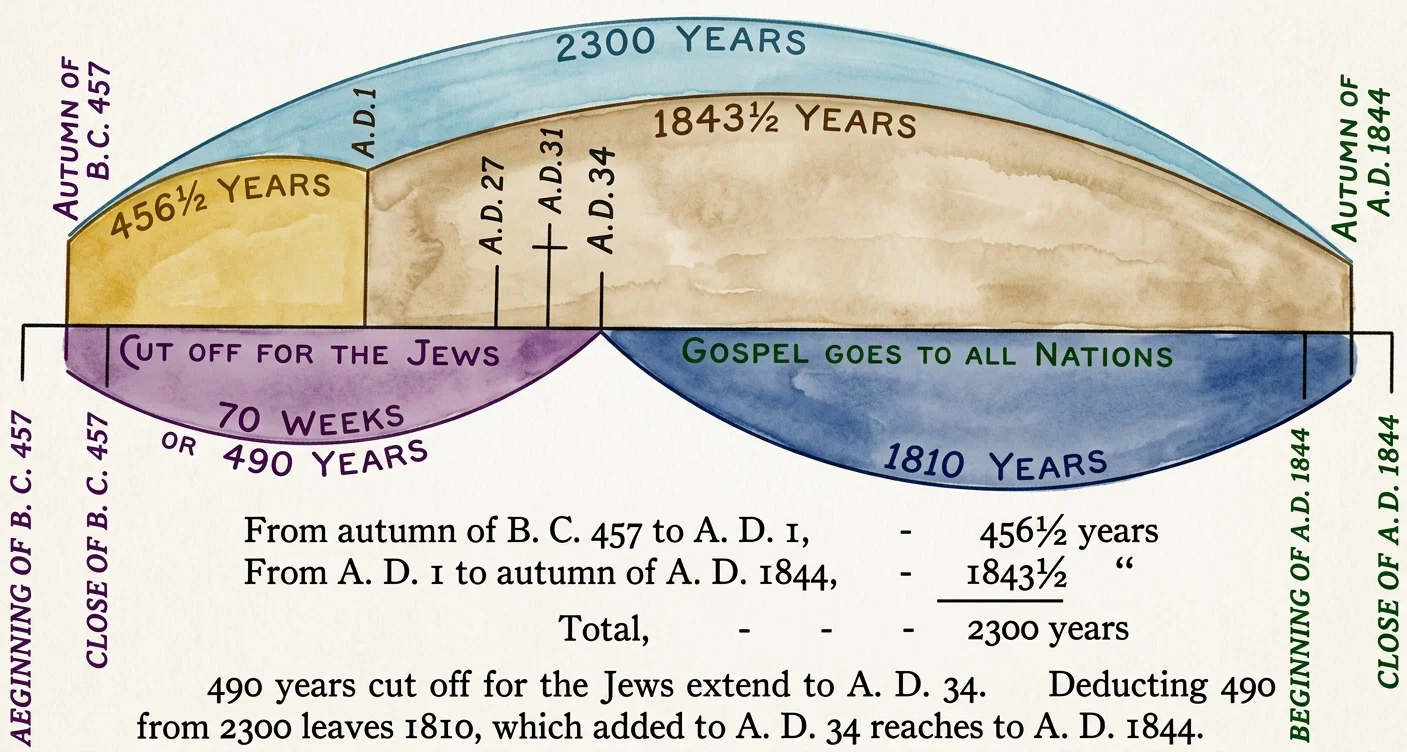
No. 4. DIAGRAM OF THE 2300 DAYS. (Symbolic Time.)
In other words, seventy weeks of the two thousand and three hundred days are appointed, or given particularly to the Jewish people and to Jerusalem, till they should fill up the cup of their iniquity, and Christ should come and make reconciliation for iniquity by His death, and bring in an example of everlasting righteousness by His spotless life. The seventy weeks would also serve as a measuring rod for the twenty-three hundred days, which would seal up, or make sure, the vision and prophecy; that is, would approve and confirm, or make sure, the correct application of the time, and would thus forbid and expose every false theory concerning it. Seal is often used in this sense. See Dan. 6:17; Matt. 27:65, 66.
The seventy weeks would also reach to the time when the Most Holy would be anointed. Before the service in the earthy sanctuary began, it was to be anointed with oil. Ex. 40:9. Jesus began His ministry in the heavenly sanctuary when He ascended. Heb. 8:1, 2. Therefore the anointing of that sanctuary preparatory to His service in it must have been just prior to that service, as in the type.
When the Days Began.
As yet we have not been informed when the seventy weeks, the first great division of the two thousand three hundred days, would begin. The next verse, however, names the event which marks its commencement. Gabriel says: “Know therefore and understand, that from the going forth of the commandment to restore and to build Jerusalem, unto the Messiah the Prince, shall be seven weeks and threescore and two weeks; the street shall be built again, and the wall, even in troublous times. And after threescore and two weeks shall Messiah be cut off, but not for Himself. . . . And He shall confirm the covenant with many for one week; and in the midst of the week He shall cause the sacrifice and the oblation to cease.” Verses 25-27.
In these verses we have several important truths revealed.
1. The commandment to restore and build Jerusalem is the event which marks the commencement of the seventy weeks and therefore of the twenty-three hundred days of which it forms a part, and is the key.
2. The seventy weeks is divided into three parts, namely: (a) Seven weeks, (b) Three score and two weeks, (c) One week. Seven weeks were allotted to the building of the city. Sixty-two weeks more would reach to Messiah the Prince. Verse 25. The last week of the seventy would be devoted to confirming the covenant. And in the midst, or middle of the week, “He shall cause the sacrifice and the oblation to cease.” This He did by His offering on Calvary, which superseded all the typical service and offerings of the Jewish dispensation.
The Date of the Commandment.
Do the Scriptures give the date of the commandment to restore and to build Jerusalem?—They surely do. If they do not, these scriptures can not be understood, and are, therefore, unprofitable. But Jesus said7of Daniel’s prophecy, “Whoso readeth let him understand.” Matt. 24:15. In Ezra 6:14 we find this statement: “And they builded and finished it, according to the commandment of the God of Israel, and according to the commandment of Cyrus, and Darius, and Artaxerxes king of Persia.” Three decrees were issued by the kings of Persia. Taken together they constituted the commandment of God to restore and to build Jerusalem. The first was issued by Cyrus in 536 B.C. Ezra 1:1-4. The second was issued by Darius in 519 B.C. Ezra 6:1-10. The third by Artaxerxes in 457 B.C. Ezra 7:6-26. The last one was fuller in its scope, and greater in its powers than the first two, and thus filled out what was lacking in the others, and made full and complete the commandment to restore and to build Jerusalem.
The seventh year of Artaxerxes, in which the last decree was issued (Ezra 7:7-13), was 457 B.C. This is one of the best established dates in ancient history, and is proved correct by the concurrent agreement of more than twenty eclipses.
Let us now use our measuring-rod, the seventy weeks, and see if the events and dates coincide. It must be remembered that the time we are studying is prophetic, or symbolic time, being used in symbolic prophecy. A day when used as a symbol represents a literal year. This is the Lord’s instruction. See Num. 14:34; Eze. 4:3-6. This is so clear and definite that Bible scholars and commentators generally accept and adopt this plan of reckoning.
The Time Is Fulfilled.
Beginning 457 B.C., the first seven weeks (49 prophetic days or 49 literal years) would reach to 408 B.C., when the street and wall were finished. This work began in the autumn of 457 B.C., doubtless about the seventh month, as they did not reach Jerusalem till the fifth month. Ezra 7:8. Sixty-two weeks (434 symbolic days, or 434 years) would extend to the autumn of 27 A.D., when Messiah the Prince was to be manifested. This occurred at that time when He was baptized, in exact fulfilment of the prophecy. See John 1:29-34; Matt. 3:13-17; Acts 10:38. “Messiah” means “the Anointed.” Jesus was anointed by the descent of the Holy Spirit upon Him at His baptism, and He went forth preaching, “The time is fulfilled.” Mark 1:9-15. What time?—Evidently the prophetic time of Daniel 9:25, that was to reach to Messiah the Prince.
During the last week the Messiah was to confirm the covenant with many for one week. This He did in person during the first half of that week till He was crucified in the spring of 31 A.D. This work was carried forward by His representatives, the apostles, during the remainder of the seventieth week, which ended in the autumn of 34 A.D. During this week the Gospel was carried especially to the Jewish people, and thousands accepted it. In the very last part of the seventieth week, Stephen was martyred, the Jewish Sanhedrin formally rejected the Gospel, and Paul, the great apostle to the Gentiles, was called. See Acts 7 and 8. From this time, A.D. 34, the believers went among the Gentiles preaching the word. See Acts 8:4, 5; 10:1-6, 44-47; 13:45, 46.
When the 2,300 Days Close.
The seventy weeks, or 490 years, ended, therefore, in the autumn of A.D. 34. How many more years remain of the 2,300? By deducting 490 from 2,300 we have 1,810. Then adding this to 34 A.D. gives 1844 A.D. the date for the end of the 2,300 days of Dan. 8:14. See diagram. How clear, plain, and harmonious all these dates are. The seventy weeks with its various divisions, and the events which mark them, is a measuring-rod that tests their accuracy, and proves that 457 B.C. is the correct date for the beginning of the 2,300 days, and proves every other date wrong.
Truly it seals, or makes sure, “the vision and prophecy” (Dan. 9:24); and we are enabled to know when the Saviour begins His closing work in the most holy place of the heavenly sanctuary. How solemn and momentous the truth that the hour of God’s “judgment is come,” and soon its decisions will be rendered. How shall we stand in the judgment? May we so seek His face and believe His word that Jesus may confess our names before His Father (Rev. 3:5), and that our sins may be blotted out. Acts 3:19, 20.
The Judgment Work
By E. J. Hibbard
By E. J. Hibbard
UNIT
“The times of ignorance therefore God overlooked; but now He commandeth men that they should all everywhere repent; inasmuch as HE HATH APPOINTED A DAY IN WHICH HE WILL JUDGE THE WORLD in righteousness by the Man whom He hath ordained; whereof He hath given assurance unto all men, in that He hath raised Him from the dead.” Acts 17:30, 31.
THIS, from Paul's sermon to the men of Athens, deals with the fact and time of God's judgment, and some of the reasons therefor.
God will judge the world. He will judge the world in righteousness. He will judge it by that Man whom He hath ordained. Full assurance of this is given in the fact of raising “that Man” from the dead.
The Day Appointed.
Moreover, God had before that time “appointed” the day of judgment; the judgment day, or time, being itself then future. God “hath appointed a day in the which He will judge the world.”
The beginning of God's judgment has to do with “the house of God,” the people that profess His name; for, when “the end of all things is at hand” (1 Peter 4:7), and before that end has actually come, Peter says, “The time is come that judgment must begin at the house of God; and if it first begin at us, what shall the end be of them that obey not the Gospel of God?”
To them that obey not the Gospel of God there is also a time, a place, and a standard of judgment, the outcome of which we dread to contemplate: “What shall the end be of them that obey not the Gospel of God? And if the righteous scarcely be saved, where shall the ungodly and the sinner appear?” O, sinner, the heart of infinite love yearneth over thee. Turn from thy sins while mercy lingers.
The Judgment before the End of the World.
But we are considering the judgment of, God's final settlement with, them who profess to be His. It begins before the end of all things and when that end is “at hand.”
“I beheld till thrones were placed, and one that was Ancient of Days did sit; His raiment was white as snow, and the hair of His head like pure wool; His throne was fiery flames, and the wheels thereof burning fire. A fiery stream issued and came forth from before Him; thousands of thousands ministered unto Him, and ten thousand times ten thousand stood before Him; the judgment was set, and the books were opened.” Dan. 7:9, 10, R.V.
That this most solemn scene takes place while men on earth are about their ordinary affairs is apparent in the next verse: “I beheld at that time because of the voice of the great words which the horn spake; I beheld even till the beast was slain, and its body destroyed, and it was given to be burned with fire.”
Previous studies have shown this “beast” to be a symbol of Rome; the “horn” a symbol of the Papacy. While, therefore, “the Ancient of Days” is solemnly judging all Christendom “at that time,” and just before the whole beast, both body and dominion is cast into the burning flame, he utters words so astounding that the prophet's attention is called from heavenly scenes to those of earth.
Probably the greatest, the most boastful claim ever made by the Papacy was that of the infallibility of the popes. Under Pius IX, in A.D. 1870, this most blasphemous assumption was made and heralded to the world.
Began in 1844.
The Ancient of Days began His judgment in 1844 A.D. This is apparent to any reasonable mind as he reads the articles on the sanctuary and the 2,300 days. We are now sixty-three years this side of that time.
But assuming that some honest soul could not at first comprehend this fact, the same must see that the limit of blasphemies is reached in the declaration of papal infallibility, and that God's Book says these “great words” will be spoken during the time of God's judgment.
Proclaimed thruout the World.
And yet further, the Book declares that when the time of God's judgment arrives, that fact will be heralded to every nation and people of the whole wide world. Could this be done unless Scripture somewhere and somehow revealed the time?—Certainly not.
These are the words: “And I saw another angel fly in the midst of heaven, having the everlasting Gospel to preach unto them that dwell on the earth, and to every nation, and kindred, and tongue, and people, saying with a loud voice, Fear God, and give glory to Him, FOR THE HOUR OF HIS JUDGMENT IS COME; and worship Him that made heaven, and earth, and the sea, and the fountains of waters.” Rev. 14:6, 7.
About ten or eleven years before 1844, men began to proclaim this event as coming about that time. Immediately after that date, other faithful Christians sought out the sanctuary truth as connected with the prophetic period ending in 1844. Thus, before and since that date the whole world has been told that Jehovah's judgment began with the house of God in the year of our Lord 1844.
Following this world-wide message, John, in Revelation 14:8-12, notes two other world-wide proclamations. Following the third in the series, our Lord appears in the clouds of heaven to reap the harvest of the earth. Verse 14.
Probation in the Judgment Day.
The fact that a warning is given in each of the two messages which follow the announcement of the hour of God's judgment come, and that hope is given to all who heed the warning, is evidence sure and positive that probation's hours still linger until those announcements have done their work. So it is that while people are about their ordinary pursuits God calls a halt, “The hour of His judgment is come.”
Supreme Sentence! No Appeal.
From that judgment there is no appeal. The Judge can not be bribed; the witnesses are all reliable and true. Of these there are ten thousand times ten thousand, and thousands of thousands. The witnesses are angels (Compare Dan. 7:10 with Rev. 5:11). Even our Advocate, the Lord and Saviour, is also “the faithful and true Witness” (Rev. 3:14). And there is no possibility of escaping the issue.
Precious hope, however, is offered us in the fact that the hour of God's judgment come is proclaimed to be “the everlasting Gospel.” And, the Gospel “is the power of God unto salvation to every one that believeth.” Rom. 1:16.
Note the fact: “The hour of His judgment is come.” That truth is the power of God unto salvation to every one who believes it, and acts upon it. It must be so, else it is not the everlasting Gospel. But the scripture announcing it says it is the everlasting Gospel.
“Yet forty days, and Nineveh shall be overthrown,” was the Gospel to that city, as proclaimed by Jonah. “So the people of Nineveh believed God, and proclaimed a fast, and put on sackcloth. . . . And God saw their works, that they turned from their evil way; and God repented of the evil that He had said that He would do unto them; and He did it not.” Jonah 3:5-10.
The Men of Nineveh.
Said Jesus, “The men of Nineveh shall rise in judgment with this generation, and shall condemn it; because they repented at the preaching of Jonah; and, behold, a greater than Jonah is here.” Matt. 12:41.
Shall the men of Nineveh rise in judgment with this present generation, and condemn it also? Shall the array of evidence presented8to us in the absolute fulfilment of half a hundred lines of prophecy fail to convince us that the end of all things is at hand? that the hour of His judgment is come?
“The judgment was set and the books were opened” (Dan. 7: 10), “and the dead were judged out of those things which were written in the books, according to their works.” Rev. 20: 12.
Thus the men of Nineveh, the Jews who rejected the message for their day, and the dead of all the ages will come in review before God as the opened books reveal the records of their lives—even “every secret thing.” Eccl. 12:14. And, “As many as have sinned in the law, shall be judged by the law, . . . in the day when God shall judge the secrets of men, by Jesus Christ, according to My Gospel.” Rom. 2: 12-16. In Thy Father's judgment, Lord Jesus, plead our cause.
The Blotting Out of Sin.
INSTRUCTING his hearers as to their part in salvation, the apostle Peter thus speaks:
“Repent ye therefore, and turn again, that your sins may be blotted out, that so there may come seasons of refreshing from the presence of the Lord; and that He may send the Christ who hath been appointed for you, even Jesus: whom the heaven must receive until the times of restoration of all things, whereof God spake by the mouth of His holy prophets that have been from of old.” Acts 3: 19-21, A.R.V.
It is not our purpose to discuss in this article the plan of salvation as revealed in the sanctuary. This has been done in other articles in this issue and our last. Suffice to say that Jesus is our great High Priest in the sanctuary above; that in the records of that temple are records of the lives of men with their deeds of good or ill; that it is the object of Christ’s love, sacrifice, and ministration to lead men so to repent of their sins that all these sins may be forgiven; not only that the sins may be forgiven, but the record of them blotted out in the great judgment day, showing that they have been faithful to the end.
Forgiveness is always granted whenever the repentant sinner comes and confesses his sin. Faith lays hold of the righteousness of God in Jesus Christ, and God accepts that sinner in the Beloved. But the record remains, tho the sin is forgiven, till the time of the judgment. The believer whose name was entered in the book of life, who may have run well for a season, and then yielded to sin, has his name blotted from the book of life. Rev. 3: 5. The soul who has persevered unto the end will have every record of his evil deeds blotted out.
But there is to each individual soul a more important consideration than this. The work of Christ in heaven is for His people upon the earth. The blotting of a name from the book of life is no arbitrary act of God; the soul whose name is blotted out has himself decided it. He by loving sin has counted himself unworthy of everlasting life. So also when the sins of men in the last generation are blotted out of the book of God, it will be but the record that these sins have been blotted out of their own lives, that no more are they loved or cherished in the life, that victory over them is assured.
Jesus declared, just prior to Gethsemane, “The prince of the world [the devil] cometh; and he hath nothing in Me.” John 14: 30. Jesus had met successfully every assault of the enemy, and had come off victorious. The victory within had been won. Let Satan make his fiercest assaults till the weakness of the human Son of God would plead for deliverance from the bitter cup, yet above all the shrinking of the flesh from the awful suffering arose the prayer, “Nevertheless not what I will, but what Thou wilt.” Mark 14: 36.
For this disposition, this heart, this mind, God’s children need to pray. Not for this mind when the temptation is not, but when it is fiercest,—when covetousness and avarice demand the best of a trade, the shading of a statement in our own favor; when foul passion is clamoring for indulgence; when the impatient word rises hot to the lips; when allegiance to God falters before the demands of society, fashion, the world, pride, pleasure, selfishness; when all the demons of hell would lure us to pleasing sensual indulgence, lull us to the slumber of death, or goad us to rebellion,—then by the mighty power of God’s Spirit we must put to death every response of self to the tempter, and let God write upon the cleansed fleshly heart the principles of His holy law, blotting out the sin by the power of His righteousness.
Then?—then shall come “seasons of refreshing from the presence of the Lord.” When God’s Spirit is working day by day the mightiest of miracles in our own heart—its regeneration from sin—we shall walk so humbly before Him that He can entrust us with greater power and skill and wisdom in working for Him. Then shall we be ready to welcome Jesus Christ at His coming.
The Decalogue in Heaven.
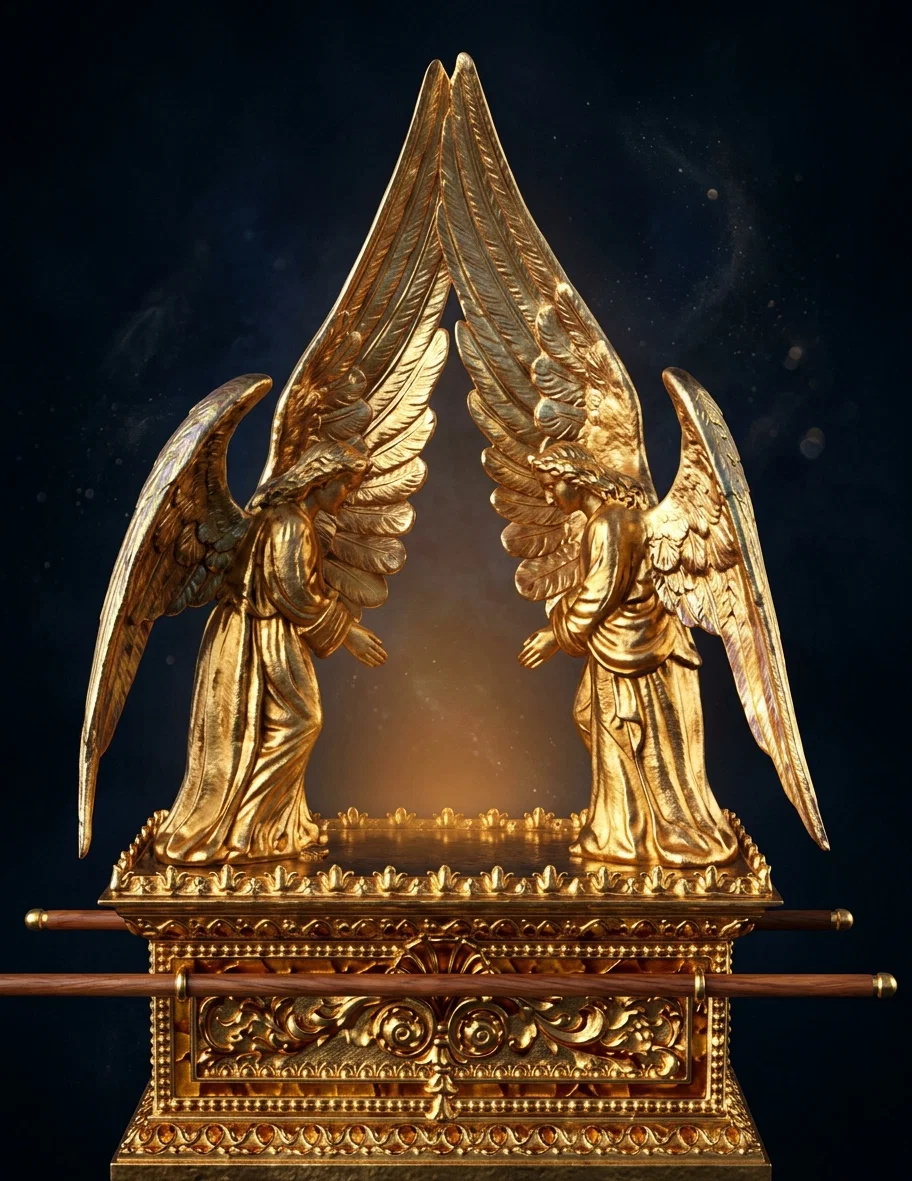
In connection with the presentation of the sanctuary question it is shown from the scriptures of truth that the sanctuary on earth was only a type or shadow of the real sanctuary that is in heaven; in this shadow upon earth there was the holy and the most holy places; and in the most holy place was the ark that contained the law of God, the Ten Commandments engraven on the enduring tables of stone. And furthermore the engraving was done by the finger of God Himself.
In describing the sublime and solemn scenes of the final judgment of the great day of Jehovah one scripture says:
“There was opened the temple of God that is in heaven; and there was seen in His temple the ark of His covenant; and there followed lightnings, and voices, and thunders, and an earthquake, and great hail.” Rev. 11: 19.
The verse immediately preceding the foregoing quotation tells of “the time of the dead to be judged,” showing that the judgment scenes were passing before the prophet’s mind. And right while viewing these judgment scenes, his attention is attracted to the temple in heaven, and the “ark” of God’s “covenant” in that temple.
As already shown in these sanctuary studies, the High Priest went into the most holy place of the typical or earthly sanctuary but once a year—on the great day of atonement. This day of atonement was for the typical blotting out of sins, and was consequently a type of the final judgment day, when the real blotting out of sin takes place in the holy of holies of the true tabernacle that is in heaven.
It is significant that in connection with the judgment scenes the prophet was permitted to behold, he was allowed to see inside the temple and to view the ark of God’s testament that contains the original of the Ten Commandments. These commandments that the wise man says contain the whole duty of man, these commandments that the psalmist says were inscribed in the heart of the Master as He came to earth to do His Father’s will among sinful men, these commandments that are so infinite in spiritual breadth and meaning, are the standard by which every man is to be tried.
Since, then, it is such a plain Bible doctrine that the Ten Commandments are the standard to which every life must come in the great judgment day, is it not essential that every one of us should carefully examine the divine law to see just what it says? We should study every one of its precepts carefully, asking God to give us the divine enlightenment that will enable us to see the depth of the spirituality that His law possesses.
That law, as recorded on the tables of stone and as it was in the ark of the covenant of the earthly sanctuary, reads as follows:
“Thou shalt have no other gods before Me.“Thou shalt not make unto thee a graven image, nor any likeness of anything that is in heaven above, or that is in the earth beneath, or that is in the water under the earth: thou shalt not bow down thyself unto them, nor serve them; for I Jehovah thy God am a jealous God, visiting the iniquity of the fathers upon the children upon the third and upon the fourth generation of them that hate Me, and showing loving-kindness unto thousands of them that love Me, and keep My commandments.“Thou shalt not take the name of Jehovah thy God in vain; for Jehovah will not hold him guiltless that taketh His name in vain.“Remember the Sabbath day, to keep it holy. Six days shalt thou labor, and do all thy work; but the seventh day is a Sabbath unto Jehovah thy God; in it thou shalt not do any work, thou, nor thy son, nor thy daughter, thy man servant, nor thy maid servant, nor thy cattle, nor thy stranger that is within thy gates; for in six days Jehovah made heaven and earth, the sea, and all that in them is, and rested the seventh day; wherefore Jehovah blessed the Sabbath day, and hallowed it.“Honor thy father and thy mother, that thy days may be long in the land which Jehovah thy God giveth thee.“Thou shalt not kill.“Thou shalt not commit adultery.“Thou shalt not steal.“Thou shalt not bear false witness against thy neighbor.“Thou shalt not covet thy neighbor’s house, thou shalt not covet thy neighbor’s wife, nor his man servant, nor his maid servant, nor his ox, nor his ass, nor anything that is thy neighbor’s.” Ex. 20: 3-17.
These commandments will reveal every secret of the life in the great judgment day. For doth not the word say:
“This is the end of the matter; all hath been heard: Fear God, and keep His commandments; for this is the whole duty of man. For God will bring every work into judgment, with every hidden thing, whether it be good, or whether it be evil.” Eccl. 12: 13, 14.
God Himself “will bring” into the judgment “every work” “with every hidden thing,” and all will be tested by the commandments that contain the whole duty of man. Each commandment should be studied carefully by itself, and the question should be conscientiously asked as each is studied, Is my life in harmony with that law? Am I doing what that command says?
Knowing the great importance of the law9of God and that it is to be the rule by which men’s lives are judged before the tribunal of the Great King, Satan has ever tried to pervert that law. He has tried to have its precepts changed or made of none effect thru the traditions and practises of men. Hence the greater necessity of studying each commandment closely to see if we are living in harmony with what it says. It will not do for us to take what men may say in regard to God’s law and make these human sayings our guide. We must take the law as God gave it and as Christ and prophet and apostle taught it, and not as it may be perverted by the ideas and sayings of men.
Man has no right to change or set aside the law of God or any of its parts. It is the rule in the judgment, and we must meet it just as it reads in the Book of books.
Our King-Priest.
Every high priest after the order of Aaron was a type, but not a perfect type, of Christ. They were imperfect shadows of a perfect substance.
They were sinful men, who must first offer for themselves before they offered for the people. Heb. 5: 1-3.
Jesus Christ in the days of His flesh passed thru the severe conflict, and with strong crying and tears to God became a perfect offering and priest for God’s children, “holy, guileless, undefiled, separated from sinners.” Heb. 5: 6-9; 7: 26.
The priests of Aaron offered many times the same sacrifices, which could not take away sin. Heb. 10: 1-4.
Jesus Christ offered Himself “once for all,” an effectual offering for the sinner. Heb. 7: 27.
The priests of Aaron were many, because they were dying, mortal men. Heb. 7: 23.
Jesus Christ continues ever a Priest and Saviour “to the uttermost” for all who trust Him. Heb. 7: 23-25.
The seed of Aaron were made priests after “the law of a carnal commandment.” Heb. 7: 16.
Jesus Christ became a priest because He was a Son, by the word of God’s oath, and “after the power of an endless life.” Heb. 5: 5, 6, 10; 7: 21.
The men of Aaron’s house must, according to the law, always be of the same tribe, that of Levi.
Jesus came of the tribe of Judah, necessitating a change of the Levitical law regulating the priesthood. Heb. 7: 11-14.
These are the more striking differences. On the other hand, each high priest of Aaron’s family in his offerings, in the yearly round of service, typified Christ in His complete service—“once for all.”
There was another type of Christ—Melchizedek, who in both character and office was a type of our great High Priest. The word Melchizedek comes from two words, melek meaning “king,” and zedek, “right,” or righteousness. Christ conquered all sin. As peace comes by righteousness, He was also King of Salem—King of Peace. Christ therefore is King-Priest, reigning on the throne of His Father. Rev. 3: 21. To that position God called Him: “Jehovah saith unto my Lord, Sit Thou at My right hand, until I make Thine enemies Thy footstool.” Ps. 110: 1. There Christ has sat as priest since He ascended. Eph. 1: 20; Heb. 8: 1.
While there, on the throne of grace, He is gathering out spiritual stones for God’s great spiritual temple. Zech. 6: 12, 13; Eph. 2: 19-22.
When Christ’s work is ended as priest, when the last sinner is gathered home, the last prayer offered, Christ will leave His mediatorial seat, human destiny will be fixed forever, and soon He will come to take His own throne—the throne and dominion of David, embracing the whole earth renewed—and reign thereon forever. Rev. 3: 21; Matt. 25: 31. This is beautifully set forth in 1 Cor. 15: 24-28, which we paraphrase in brackets:
“Then cometh the end [of the Gospel age, Christ’s priesthood, Matt. 28: 20], when He [the Son] shall deliver up the kingdom [of grace, Heb. 4: 16] to God, even the Father; when He [the Father] shall have abolished all rule and all authority and power. For He [the Son] must reign [on the throne of grace as priest, Heb. 8: 1; Rev. 3: 21], till He [the Father] hath put all enemies under His [the Son’s] feet [as He promised, Ps. 110: 1]. The last enemy that shall be abolished is death. For, He [the Father] put all things [in purpose and promise] in subjection under His [the Son’s] feet. But when He saith, All things are put in subjection, it is evident that He [the Father] is excepted who did subject all things unto Him [the Son]. And when all things have been subjected unto Him [the Son], then shall the Son also Himself be subjected to Him [the Father] that did subject all things unto Him [the Son], that God may be all in all.”
The priest-reign of Christ will be ended just before He comes. His own reign will begin when He comes; for a thousand years He will reign in the New Jerusalem on high; for eternity, after the thousand years, in the glorious earth made new.
Dear soul, our High Priest is able to bring us there. He “ever liveth.” He will help us “all the way.”
Days as Our Autobiography
“We live by days. They are the leaves folded back each night in the great volume that we write. They are our autobiography. Each day takes us, not newly, but as a tale continued. It finds us where yesterday left us.”