Pacific Press Publishing Company · Oakland, California · Sep 1, 1898
GETHSEMANE
By T.
“And they came to a place which was named Gethsemane; and He saith to His disciples, Sit ye here, while I shall pray.” Mark 14:32.
“And He was withdrawn from them about a stone’s cast, and kneeled down, and prayed, saying, Father, if Thou be willing, remove this cup from Me; nevertheless not My will, but Thine, be done. And there appeared an angel unto Him from heaven, strengthening Him. And being in an agony He prayed more earnestly; and His sweat was as it were great drops of blood falling down to the ground. And when He rose up from prayer, and was come to His disciples, He found them sleeping for sorrow, and said unto them, Why sleep ye? rise and pray, lest ye enter into temptation.” Luke 22:41-46.
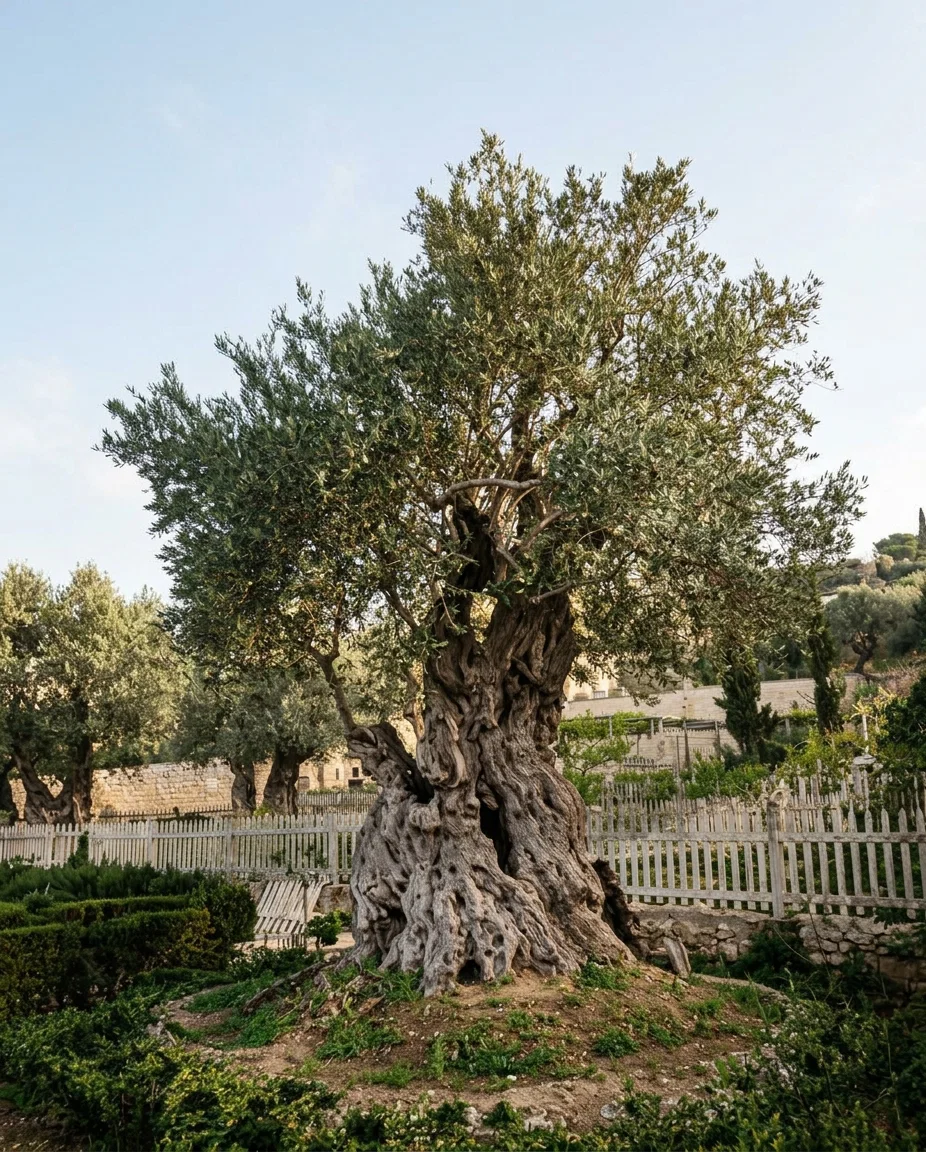
OLIVE TREE IN GETHSEMANE.
The inspired description of the suffering of the Master in Gethsemane is sufficient, if one allows himself to consider it, to tender the heart and fill it with an undying love for Him who was willing to endure such agony on our account. Not a single pang that swept in upon the soul of the great Sufferer was occasioned by anything that pertained to Himself. All the throbbings of that wo, all that sorrow, all that bitter distress, all that indescribable storm of mental anguish, in the which every emotion of the mind was rolling great tides of grief in upon His sympathetic heart, yes, all was for some one else; not a single bit of it for Himself.
But why would He do it? Why would He endure such grief on another’s behalf?—One simple word is the answer,—love, love alone was the cause of it; love, and love divine, in which there is no selfish thought, no self-centered emotion; love, heaven-born love, that finds its only joy in loving another and seeking another’s happiness.
Is there a sinner who doubts that Christ loves him? Then let him view the scenes of Gethsemane. Let him witness the agony of the Son of God as His heart of divine love is there being torn with grief. Are you impressed by that grief, that rending sorrow, that suffering that reached to the very lowest depths of all that is comprehended in despair? Then know that Jesus suffered it all, yes, all!all! and all because He loves you.
“Sing, O heavens; and be joyful, O earth; and break forth into singing, O mountains; for the Lord hath comforted His people, and will have mercy upon His afflicted. But Zion said, The Lord hath forsaken me, and my Lord hath forgotten me. Can a woman forget her sucking child, that she should not have compassion on the son of her womb? yea, they may forget, yet will I not forget thee. Behold, I have graven thee upon the palms of My hands; thy walls are continually before Me.” Isa. 49: 13-16.
Yes, even Zion, the professed church herself, is sometimes tempted to say, “The Lord hath forsaken me, and my Lord hath forgotten me.” And the open sinner is almost sure to say within himself as he finds his heart drawing toward the Lord, “I am too sinful; the Master can not receive me.” But listen to the Lord’s impressive answer: “Can a woman forget her sucking child, that she should not have compassion on the son of her womb? yea, they may forget, yet will I not forget thee. Behold, I have graven thee upon the palms of My hands; thy walls are continually before Me.”
Can you conceive of a love that could be tenderer than that of a true mother? Can you imagine one who would be more attentive than the fond mother who is devotedly guarding her offspring? “Yea, they may forget.” In a moment of extreme weariness the mother may fall asleep and for a little while expose her guarded treasure to peril. But the Lord says, “I will not forget thee.” No, the Father in heaven can not forget us, for He says, “Behold, I have graven thee upon the palms of My hands; thy walls are continually before Me.” What precious assurances to us defiled sinners are these priceless promises of our Lord and Saviour!
Did you ever witness the disconsolate expressions of grief as a devoted mother wept at the death-bed of her child? The thought that her darling can never speak to her again; that those blanched cheeks will crimson no more with the flush of buoyant youth; that her eyes can not now be greeted with the mirthful expressions of that childish face; her ear will listen in vain for those romping footfalls that have so often started every impulse of her heart into thrills of joy—O, that indescribable grief! Only a mother’s heart as she is stepping into these deep waters can fathom their depths of crushing sorrow and blighting sadness. She alone can tell of the pain when her heart-strings were breaking. She alone can tell of the withering blasts of anguish that racked and shook her heart, well nigh to breaking.
And yet in the greatest depths of this mother’s grief, the keener pangs of despair are driven back before the Lord’s promise of the2resurrection of the dead. She says within herself: “My child will rise again. ’Tis sad to part, but there is a grand reunion time ahead. My Lord is coming, and He has promised me that ‘all that are in the graves shall hear His voice, and shall come forth.’” And so her sorrow is softened and assuaged.
But not so with the Master as His heart was broken and crushed and ground with grief in Gethsemane. He was not in agony and despair because of His own approaching suffering on the cross. His heart was too completely unselfish to think of that. No, He was standing at the death-bed of the whole race. The face of this one and that one and the other one was rising before him. He loved them with an everlasting love. O, He loved them with a love that was divinely deeper and more constant, and that was more affectionately and tenderly woven into his heart and soul, than the love of mother. The expansive heavens can not fathom it. The eternal ages can not reach to the ends of it.
Now, sinner, will you listen? That anguish in Gethsemane was occasioned by the fact that after divine love has done all that such tender love can invent to win you from sin, and turn your feet into the ways of joy and righteousness, you still refuse. The despair and suffering of the Master on that memorable night in the garden, was all because He saw so many of those for whom He had devoted His life, going down into the jaws of eternal death. He had done all that He could to redeem them, but still they would not turn. And so that heart, that was tenderer than a mother’s, is feeling all the cutting anguish of despair as He sees those He loves so dearly, leaping out into the midnight gloom of irredeemable destruction.
“And being in an agony He prayed more earnestly; and His sweat was as it were great drops of blood falling down to the ground.” The rigors of death are upon the Son of God; He is dying there in the garden. He finished His life on the cross, it is true. But it was in Gethsemane where the bitterest wo was felt, and the cup of the bitterest anguish was drunk. And, O, the infinite depths of the suffering that would cause the Man of Calvary to sweat the life-blood itself! Can there be any doubt that He loves you and me? If such a doubt is still lingering in your mind, then go to Gethsemane. There behold the Lamb of God. Behold Him in His agony, and remember that it is the expression of divine, despairing love; the Master is tossing amid those throes that finally break His heart when His own loved ones nail Him to the cross.
All this suffering was pressed down upon the Son of God by those who will not yield to His tender and merciful entreaties. And instead of halting and stumbling, while Satan tempts you to think that the divine Father has no care for you, lift up your eyes and view Gethsemane. “Behold, what manner of love the Father hath bestowed upon us, that we should be called the sons of God.” T.
WHICH DAY DO YOU KEEP? AND WHY?
By C. H. Bliss
THIS is a very important question. Which day, the seventh or the first? You may say there is no difference. But in this you contradict the Bible. It specifies one day as the seventh. See Gen. 2:2, 3. God rested on this day, and blessed this day, and sanctified it, or set it apart for a holy use. This was a special day, as you must admit, and He did not do this to any day and no one in particular. Again Mark says that Christ arose from the dead on the first day of the week. See Mark 16:9. This was a definite day, as you will admit, and is called the first day in distinction from the seventh.
Now, dear reader, do you keep this first day instead of the seventh? If you do, why? Christ kept the seventh day. See Luke 4:16. Can you follow Christ and keep another day which He has not commanded to be kept? The disciples kept the seventh day. See Luke 23:56; Acts 13:42, 43; 18:2, 4, 11. Now in keeping the first day instead of the seventh you follow the traditions and commandments of men, and by it you make void one of the commandments of God. Reader, which day do you keep? and why? C. H. BLISS.
Warden, Ill., July 9, 1897.
THE FIRST COMMANDMENT.
By J. W. Watt
“I am the Lord thy God, which have brought thee out of the land of Egypt, out of the house of bondage. Thou shalt have no other gods before Me.”
The first great principle of righteousness brought to view in this commandment is the relation of God’s intelligent creatures to what is here called Egypt. Many see in this statement only a reference to the literal land of Egypt, but there is a much deeper meaning than that. The literal is a representation of the spiritual. What, then, is the real truth that we should learn from this?
Egypt is a representation of the darkness and character of sin. As Israel was delivered from the literal bondage of Egypt, by the direct power of God, so must every soul who is to be saved in the kingdom of God be delivered from the darkness and the bondage of sin.
As literal Egypt was full of idols, so our hearts have been filled with worldliness and selfishness, and while in sin we must acknowledge that we have worshiped self and the many things of the world. Sin brings one into the most cruel bondage. Jesus said to the Jews, “The truth shall make you free,” but they said, “We are Abraham’s seed, and were never in bondage to any man.” Christ then said to them plainly, “Whosoever committeth sin is the servant of sin.” John 8:32–34. This makes the matter very clear—a man that is in sin is in darkness and servitude, from which he must be delivered before he can serve God, for no one can make a success of serving two masters. This deliverance is also represented in the Scriptures as coming out of darkness into light.
“I am the light of the world; he that followeth Me shall not walk in darkness, but shall have the light of life.” John 8:12. Thus we see that the soul must be brought from the darkness of sin and death to the glorious light of life and salvation; and the same power that was necessary to bring literal Israel out of literal Egypt is necessary to bring spiritual Israel out of the spiritual darkness into which sin has brought them. As literal Israel had no power to deliver themselves from literal bondage, so we have no power to deliver ourselves from sin; this deliverance must be wrought by the power of God. As literal Israel was made to feel their need of help and cried for deliverance, even so must those in sin be made to feel their utter helplessness and to cry unto God for deliverance. God heard the cry of His people then and delivered them, and He will just as willingly listen to the cry of one who is in the bondage of sin, and work out for him a wondrous deliverance. Not until we have thus been delivered from sin are we prepared to enter upon the keeping of the holy law of God, which is in character like its Author. Therefore no unconverted man or woman can keep the commandments of God; they must first be converted, soul, body, and mind.
“Which Have.”
Before God makes known what Israel should do, He calls attention to what He has done for them. “I am the Lord thy God, which have brought thee out of the land of Egypt.” God had done great things for that people; He had shown His great love for them; therefore He had a perfect right to make a demand of them that they should now show their appreciation of His love and goodness by obeying what He said. The same is true of every soul who has been delivered from the bondage of sin, and such ones will delight to walk in the way of life, and will be only glad to have God point out to them the way.
“No Other Gods.”
“Thou shalt have no other gods before Me.” Having seen what it means to prepare to keep the commandments of God, now we shall try to understand what it is to actually keep them. To have no other gods but the Lord would be to entirely consecrate one’s self to Him, without any reserve. Having left the pathway of sin and unrighteousness, we turn unto God and render unto Him perfect obedience in all things so far as it is possible for us to understand what the will of God is. God being the God of love, we can trust all our interests in His hands, knowing that One who loves us so much will lead us to do or say nothing only that which is for our best good.
Jesus was asked at one time what was the first commandment, and His reply was: “Thou shalt love the Lord thy God with all thy heart, and with all thy soul, and with all thy mind. This is the first and great commandment.” Matt. 22:37, 38. How could one who has learned to know God do anything else but just love Him with all the heart? He is a lovable One, and the more one learns of Him, the stronger and more perfect will his love to God be. All the powers of affection will be given to God. “Soul” in the above text signifies the physical man. Hence all the powers of the body must be given to God. Whatever our occupation in life, but one great object should be kept in view, and that is to glorify God. The mind, the intellectual part of man, is also to be given to God. All our attainments in this line should enable us to more perfectly glorify God.
We now see that to keep the first commandment we must consecrate ourselves entirely to God, giving to Him every power of our being. Let us study for a time how we may violate this commandment. The one who loves God with all his heart will also love his fellow-men, whom God has created. We learn from Rom. 5:5 that “the love of God is shed abroad in our hearts by the Holy Ghost which is given unto us.” Notice, this scripture does not say that love for God is shed abroad in our hearts, but the “love of God.” It is the same kind of love which God Himself possesses,—the love of God.
Now we can see that one who has this love in his heart can no more hate his fellow-men than God can hate them; but God loves all men, even sinners. Had this principle always been understood by God’s people, there never could have been a church trial or difficulty in this world; and when professed Christians learn what it means to keep the first commandment, all difficulties among brethren will be at an end, and love will reign supreme in every heart (the love of God).
Again, when we love God with all the heart, all pride will be gone from the heart, and we shall meet the mind of God in matters of dress; no unnecessary personal adornment will be seen among those who keep the first commandment. The light God has given upon this subject will3be strictly followed by all who truly love Him with all the heart.
All self-exaltation will be put away from the one who has received this love in his heart, and he will be ready and willing to work in any place where the Lord may call him to work, let that place be ever so difficult. No disposition will be seen to exalt self or seek for the highest place, but each will “esteem other better than themselves.”
O, what peace and joy and divine harmony will be seen among the people of God when all learn to keep the first precept of His law! The man who loves God with all his heart will not be striving for this world’s riches in order to hoard them for selfish use; he will have but one desire in acquiring wealth, and that will be to glorify God. Therefore he will be ready and even anxious to aid the cause of God with his money, and will do so to the utmost of his ability. How can he do otherwise if he loves God with all his heart?
To keep the first commandment, we must transfer all our interests from earth to heaven; we must show by every act of life that this world is not our home. So long as any worldly thing stands between us and any known duty to God, we are not wholly the Lord’s, and He can not accept us as His children. “Thou shalt have no other gods before Me.”
J. W. WATT.
BIBLE USES OF THE WORD “DISPENSATION.”
By G. T. Wilson
Much controversy arises over the use of unscriptural terms.
The terms patriarchal and Mosaic dispensations can not be found in the Bible. That the Gospel dispensation is different this side of the cross from what it was before, is not taught in the Scriptures. The word “dispensation” is used only four times in the Bible.
Paul says, “A dispensation of the Gospel is committed unto me.” 1 Cor. 9:17. The Revised Version renders it, “I have a stewardship intrusted to me.” I will quote the texts where the word is found in the Authorized Version and the Revised Version, the one under the other, defining them by the letters A.V. and R.V.:—
A.V. “A dispensation of the Gospel is committed unto me.” 1 Cor. 9:17.
R.V. “I have a stewardship intrusted to me.” 1 Cor. 9:17.
A.V. “Dispensation of the grace of God.” Eph. 3:2.
R.V. “Dispensation of that grace of God” (margin, “stewardship”). Eph. 3:2.
R.V. “Dispensation of God,” etc. Col. 1:25 (margin, “stewardship”).
A.V. “The dispensation of the fulness of times,” etc. Eph. 1:10.
R.V. “A dispensation of the fulness of the times,” etc. Eph. 1:10.
In the A.V. in Eph. 3:9 we have the expression, “the fellowship of the mystery,” which in the R.V. is rendered “dispensation” instead of fellowship. The definition of “dispensation” is, according to Young’s Concordance, “dispensation, law, or arrangement of a house.”
These are all the uses of the word in either version referred to above, and are never used in the limited sense of patriarchal, Mosaic, or law dispensation, but always in the sense of the dispensation of the grace of God in the Gospel of Christ.
As a minister of Christ, Paul had the work assigned him of dispensing of God’s grace to sinners, or, as the Revised Version renders it, “a stewardship” committed to him. So had all the disciples of our Lord. And so have all the followers of our Saviour, tho in a lesser degree, perhaps, as Peter shows in 1 Peter 4:10, 11: “As every man hath received the gift, even so minister the same one to another, as good stewards of the manifold grace of God. If any man speak, let him speak as the oracles of God; if any man minister, let him do it as of the ability which God giveth; that God in all things may be glorified through Jesus Christ,” etc.
The dispensation of grace has continued from the days of Adam to the present time, and will continue while the good tidings of salvation shall be sounded to fallen man. Do we feel individually the importance of our “stewardship” of divine grace to our fellow-men? It is a blessed work which God has intrusted us with in the Gospel of Christ. G. T. WILSON.
Avondale, Cooranbong, N. S. W.
CHRIST AS A TEACHER.
By Mrs. A. E. Daniels
THIS is a subject which should be studied deeply and reverently by every child of God; for in studying Christ as a Teacher we instinctively study His teachings. Upon the teachings of Christ is Christianity founded, and without them we should not have material with which to construct our Christian character.
Not only did Christ teach those with whom He was associated in this life, but, thanks be unto God, through His holy Word those divine precepts and that perfect example have come down to us, and to-day they stand out as boldly as tho our Lord were living among us in the flesh. He speaks to us by the Spirit as distinctly as tho it were the human voice of the Lord saying, “I am the Way, the Truth, and the Life.”
Christ taught in a twofold manner. Not only did He “speak as never man spake,” and the people “were astonished at His doctrine; for His word was with power,” but by His life He so beautifully exemplified His precepts that when we compare His words with the way in which He fulfilled them in deed, they blend harmoniously into one grand lesson. From His teachings and living we are to mold our lives. Thus He teaches us to be not only hearers of the Word but doers as well.
If we consider Christ as a teacher in word only, we should have to begin at His baptism by John when He was thirty years old. But by His birth He became a Teacher of some of the grandest lessons of His life. Did He not by simply coming into the world teach us of the great love of the Father for us? Thus He proclaimed in deed what He afterward taught by word: “For God so loved the world, that He gave His only-begotten Son; that whosoever believeth in Him should not perish, but have everlasting life.” His birth also teaches of His perfect obedience to the will of the Father, and that that obedience was prompted by love, thus proving the truthfulness of the teaching, “That the world may know that I love the Father; and as the Father gave Me commandment, even so I do.”
Likewise at His birth as well as by His life He became the only perfect Example of self-sacrifice the world has ever received. Leaving the grandeur and splendors of heaven, that glorious kingdom where He received the adoration and ministration of angels and shared the glory of the Father, He came in the flesh to this sin-cursed earth, knowing that He should be despised and rejected of men, should suffer and die, that poor, fallen man might be redeemed. His life from the cradle to the tomb was one long-continued teaching of self-sacrifice. Well might He say to us after having given Himself for us, “If any man will come after Me, let him deny himself, and take up his cross, and follow Me.”
Christ was a very humble Teacher, seeking neither position wealth, nor fame. At His birth and by His life He taught us humility; He who could have come with far greater splendor than any king of earth possessed, chose for His first shelter a stable, for His first bed a manger, for His companions the poor and lowly, and thus exemplified His teaching, “He that is greatest among you shall be your servant,” and “he that shall humble himself shall be exalted.”
Another beautiful illustration of His humility is shown us in His baptism by John. John said, “I have need to be baptized of Thee, and comest Thou to Me? And Jesus answering said unto him, Suffer it to be so now; for thus it becometh us to fulfil all righteousness.” Is there any wonder that the Father rewarded such humble obedience by proclaiming with His own voice from heaven, “This is My beloved Son, in whom I am well pleased”?
How beautifully are we taught to resist temptation by His forty days’ fast in the wilderness! Well may we exclaim with Paul, “We have not an High Priest which can not be touched with the feeling of our infirmities; but was in all points tempted like as we are, yet without sin.”
Christ was a constant and faithful Teacher. After His temptation in the wilderness, He began His career as a public teacher and preacher. When they sought His life because of His teachings in one city, He fled to another. Whenever and wherever opportunity presented itself, in public or in private, He taught. To the multitude was delivered that grand, wonderful Sermon on the Mount, in which He proclaimed so many blessings on the faithful, and exhorted to good works; He instructed Nicodemus alone by night, and everywhere His loved disciples fed on His gracious words; “and He taught daily in the temple.”
He was a patient Teacher. With what patience He explained to His disciples the parables which their closed ears could not understand! “And beginning at Moses and all the prophets, He expounded unto them in all the Scriptures the things concerning Himself.” We can clearly see the golden thread of patience running all through His life and teachings. What548a loving teacher! and what a tender care He showed for His pupils! When the multitudes followed to hear Him, He “was moved with compassion toward them,” and He healed their sick. And when they continued with Him, He had compassion on them and fed them. How lovingly He taught us to rejoice with them that do rejoice, and weep with them that weep, by rejoicing with His disciples and by weeping at the grave of Lazarus! How His great heart yearned over Jerusalem as He prophesied of its destruction! And His love for us is shown in that “the Lord hath laid on Him the iniquity of us all,” and “by His stripes we are healed.”
He was “no respecter of persons,” but presented the same truths to rich and poor, high and low, learned and unlearned, alike, thus proving that “there is no difference,” and “all have sinned and come short of the glory of God.”
One of Christ’s favorite methods of teaching was by parables or allegories, from which morals were drawn. How simply and yet how truthfully did He portray the presenting of the Word, and the way in which it would be received, by the parables of the sower and the seed; then, how the work of Satan is accomplished, by the sowing of the tares among the wheat; the spreading of the kingdom, by leaven hid in the meal; the value of eternal life, by the pearl of great price. His object lessons from nature showed God’s care for His children by referring to the ravens that are fed; the lilies of the field that are clothed; and the mystery of the working of God’s Spirit in the heart of man, by the blowing of the wind.
He taught with a force that everywhere had its effect in the hearts of His hearers. “He taught them as one that had authority, and not as the scribes.” And “the people were astonished at His doctrine,” and were forced to exclaim, “Whence hath this Man this wisdom, and these mighty works?”
Jesus often proved the truth of His teachings by the miracles and wonderful works which were given Him of God to do. While God gave Him these wonderful works, yet was He meek, and continually in word and life taught meekness. Some even deny His divinity because He called Himself the Son of man; but who can read of His crucifixion and resurrection and doubt that He was also divine? Darkness covered the land for three hours. “The veil of the temple was rent in twain; . . . and the earth did quake, and the rocks rent; and the graves were opened; and many of the bodies of the saints which slept arose, and came out of the graves after His resurrection, and went into the holy city, and appeared unto many.”
No, we must exclaim with the centurion, “Truly this was the Son of God.” He was the Christ, teaching us meekness, love, and obedience, obedience unto death, even the death of the cross. Let us then, dear readers, continue our studies of Christ as a teacher. Study to obey His teachings. Let us “grow in grace, and in the knowledge of our Lord and Saviour Jesus Christ.” Let us tell others of Him, praying that the time may speedily come which has been promised, when “the earth shall be filled with the knowledge of the glory of the Lord, as the waters cover the sea.”
MRS. A. E. DANIELS.
St. Louis, Mo.
THOU ART, O GOD.
By Mrs. Lombard
[“The day is Thine, the night also is Thine; Thou hast prepared the light and the sun. Thou hast set all the borders of the earth; Thou hast made summer and winter.” Ps. 74:16, 17.]
THOU art, O God, the life and light
Of all this wond'rous world we see;
Its glow by day, its smiles by night,
Are but reflections caught from Thee.
Where'er we turn, Thy glories shine,
And all things fair and bright are Thine.
When day, with farewell beam, delays
Among the op'ning clouds of even,
And we can almost think we gaze
Through golden vistas into heaven,
Those hues that mark the sun's decline,
So soft, so radiant, Lord, are Thine.
When night, with wings of starry gloom,
O'ershadows all the earth and skies,
Like some dark, beauteous bird, whose plume
Is sparkling with unnumber'd eyes,
That sacred gloom, those fires divine,
So grand, so countless, Lord, are Thine.
When youthful spring around us breathes,
Thy Spirit warms her fragrant sigh;
And ev'ry flower the summer wreathes
Is born beneath that kindling eye.
Where'er we turn, Thy glories shine,
And all things fair and bright are Thine.
MRS. LOMBARD.
DISHONEST TEACHERS.
By J. C. Nichols
WHAT would you think of a high school teacher going before a class in mathematics and telling it that we are no longer required to learn the multiplication table; it is abolished, and we have no further use for it?
How long would such imposition be tolerated?
And how about him who teaches that we are no longer required to keep the Ten Commandments; that they are abolished, and we have no further use for them? The estimate of that man as a teacher is given in the fifth chapter of Matthew, nineteenth verse.