Your ShelfYour Projects

Signs of the Times, Vol. 31, No. 36.

A SONG OF MOSES

Signs of the Times

Sep 6, 1905

Pacific Press Publishing Company · MOUNTAIN VIEW, CALIFORNIA · Sep 6, 1905

A SONG OF MOSES

"Give ear, ye heavens, and I will speak; and let the earth hear the words of my mouth. My doctrine shall drop as the rain; my speech shall distil as the dew, as the small rain upon the tender grass, and as the showers upon the herb. For I will proclaim the name of Jehovah; ascribe ye greatness unto our God. The Rock, His work is perfect; for all His ways are justice; a God of faithfulness and without iniquity, just and right is He. They have dealt corruptly with Him, they are not His children, it is their blemish; they are a perverse and crooked generation. Do ye thus requite Jehovah, O foolish people and unwise? Is not He thy Father that hath bought thee? He hath made thee, and established thee."
"For Jehovah's portion is His people; Jacob is the lot of His inheritance. He found him in a desert land, and in the waste howling wilderness; He compassed him about, He cared for him, He kept him as the apple of His eye. As an eagle that stirreth up her nest, that fluttereth over her young, He spread abroad His wings, He took them, He bare them on His pinions. Jehovah alone did lead him, and there was no foreign god with him." Deut. 32:1-6, 9-12.

More About the Missionary Campaign

NOR is the Pacific Coast going to be left out of this blessed Missionary Campaign. Already our forces are wheeling into line for the conflict; and while to some of our number the heights to be gained by its first battle look almost insurmountable, we are praying, and we believe that, like the servant of Elisha of old, they may behold the "horses and chariots of fire 'round about'" them, and by beholding they will be assured of victory.
Our Missionary Campaign Committee have gotten out a missionary bulletin, on the last page of which they make the following appeal:
To Those Bearing Responsibilities in the Pacific Union Conference,—
Dear Brethren and Sisters:
From the preceding pages you will notice that we have come to the time of the great Missionary Campaign, planned for by the last General Conference. This means that definite responsibilities must be placed upon men and women in the home churches. In the words of counsel given to Moses, "Moreover thou shalt provide out of all people able men, such as fear God, men of truth, hating covetousness; and place such over them, to be rulers of thousands, and rulers of hundreds, rulers of fifties, and rulers of tens." You, Brother Church Elder, you, Sister Church Librarian, you, Brother Sabbath-school Superintendent, and you, Brother or Sister Sabbath-school Teacher, have been selected by virtue of your position in church or Sabbath-school as a leader, and now the Lord appeals to you to unite your forces and march forward.
There are three definite victories to be gained during the next four weeks. Listen to them.
1. The placing of the Review and Herald in every Sabbath-keeping family.
2. The purchase of at least a pound of the Signs of the Times Leaflets by every Seventh-day Adventist, to be used during the remainder of the Campaign.
3. The training of thousands, through this great missionary movement, to become PERMANENT WORKERS in the Lord's whitening harvest fields.
These are simple, definite steps. As leaders of our hundreds, fifties, or tens, let us take these steps now. Let this be a movement without a rear column.
Yours in the work,
H. H. Hall A. J. S. Bourdeau M. C. Wilcox E. R. Palmer Geo. W. Pettit W. V. Sample
Missionary Campaign Committee, Pacific Union Conference.
We believe the above appeal will be generally heeded, and hope the circulation of the bulletin containing it will bring hope and inspiration to our people everywhere.
Copies may be obtained by addressing our Secretary, Mr. A. J. S. Bourdeau, Mountain View, Cal.
"But as we were allowed of God to be put in trust with the Gospel, even so we speak; not as pleasing men, but God, which trieth our hearts."

CO-OPERATION CORNER.

ELD. W. A. SPICER, in his report of the New York City camp-meeting made these statements:
The Lord can make ways where there are no ways, and He is showing our friends in this city of apartment-houses the way to get to the people. It is a matter of the utmost importance for face-to-face and house-to-house effort in the work in which all the believers can join. It would be a blessing indeed, if somebody had a few hundred dollars or even a thousand, for this conference to use in a special campaign with the SIGNS to be followed by systematic effort with other literature and Bible work. Somehow this truth is to go right through these long-barred gates, and the workers are full of faith that the time has come, and that they have found the way of victory.
One of his readers sends us to-day $25 towards the thousand, and this enables us to send twenty-eight copies of the SIGNS a whole year to that needy field. Are there others who wish to assist in a similar way?
Address SIGNS OF THE TIMES, Mountain View, Cal.

SPECIAL TERMS.

1. One new yearly subscription and one renewal, or two new yearly subscriptions, sent at one time, $2.50.
2. Two new yearly subscriptions and one renewal, or three new yearly subscriptions, sent at one time, $3.25.
3. Three new yearly subscriptions and one renewal, or four new yearly subscriptions, sent at one time, $4.00. Sample copies sent on application.

TO OUR PATRONS.

Please be careful to write all names of persons and places plainly.
Send money by Post-office Money Order, Express Order, or Bank Draft on New York, Chicago, or San Francisco.
Orders and Drafts should be made payable to the Pacific Press Publishing Co.
Paper money or silver should be sent in a registered letter.
Registered mail is safe. Unregistered mail is at the risk of the sender.
Postage-stamps in five or ten cent denominations will be accepted for small amounts.
The address label on your paper will indicate the time to which your subscription is paid. In case of non-receipt of papers, or any other irregularity, please notify us immediately.
When subscriptions expire, no more papers are sent to the party except by special arrangement.
You are requested to watch the date on your label, and renew early, and save the loss of papers. We can not always furnish missing numbers.
When requesting change of address, be sure to give both old and new addresses.
Important.—If you order SIGNS, Our Little Friend, books, etc., at the same time, use a separate sheet of paper for each. If this request is complied with, it will materially assist in the prompt and accurate despatch of the business.
When writing to the editor, be sure to use a separate sheet of paper.

XVIII. A CROWNING MIRACLE.

Friends of Jesus.—One of the most wonderful miracles of our Lord is recorded in John 11. We have not space to give the story as it is given there, we can only bring out some of the most striking lessons for our comfort and edification. First we are introduced to the friends of Jesus, a young man named Lazarus, who lived in the village of Nazareth with his sisters, Mary and Martha. It was a place where Jesus often stopped in His journeys to Jerusalem, and there He found true hospitality in both heart and home. These souls so dear to Him, and to whom He was so dear, had received of His teaching, and doubtless all were devoted disciples.
Sickness.—In the last year of Jesus' ministry Lazarus was taken sick. His sisters sent the news to Jesus, "Behold, he whom Thou lovest is sick." He listened to the message, remarking that the sickness was not unto death, but went on with His work for two whole days,—a strange thing for a warm friend to do, a very strange thing for an earthly physician to do; but the Master of life knew the disease, knew the remedy, and knew His mission, and while God called Him to remain there He must remain, however seemingly urgent the call elsewhere. At the end of two days He called His disciples together and said unto them, Let us go into Judea again. But they said, Why should we go there, when the Jews seek to kill Thee? He replied, "Our friend Lazarus is fallen asleep; but I go, that I may wake him out of sleep." They say unto Him, "Lord, if he is fallen asleep, he will recover"—one of the blessed means that God always has for restoring the sick. Jesus then told them that Lazarus was dead. He seems to have died about the time of the reception of the message from the sisters, for the subsequent narrative informs us that he had been four days dead when Jesus reached there. It certainly could not have taken him more than two days to go there, so that by the time the message from the sisters reached the Master their brother was dead. To relieve the misunderstanding of the disciples, Jesus plainly said, "Lazarus is dead," and then told them that He was glad that he was dead that this sickness should be for the glory of God.
At Bethany.—On reaching Bethany He found that Lazarus had been entombed four days. The sisters were still mourning, many friends were at the house to console them.
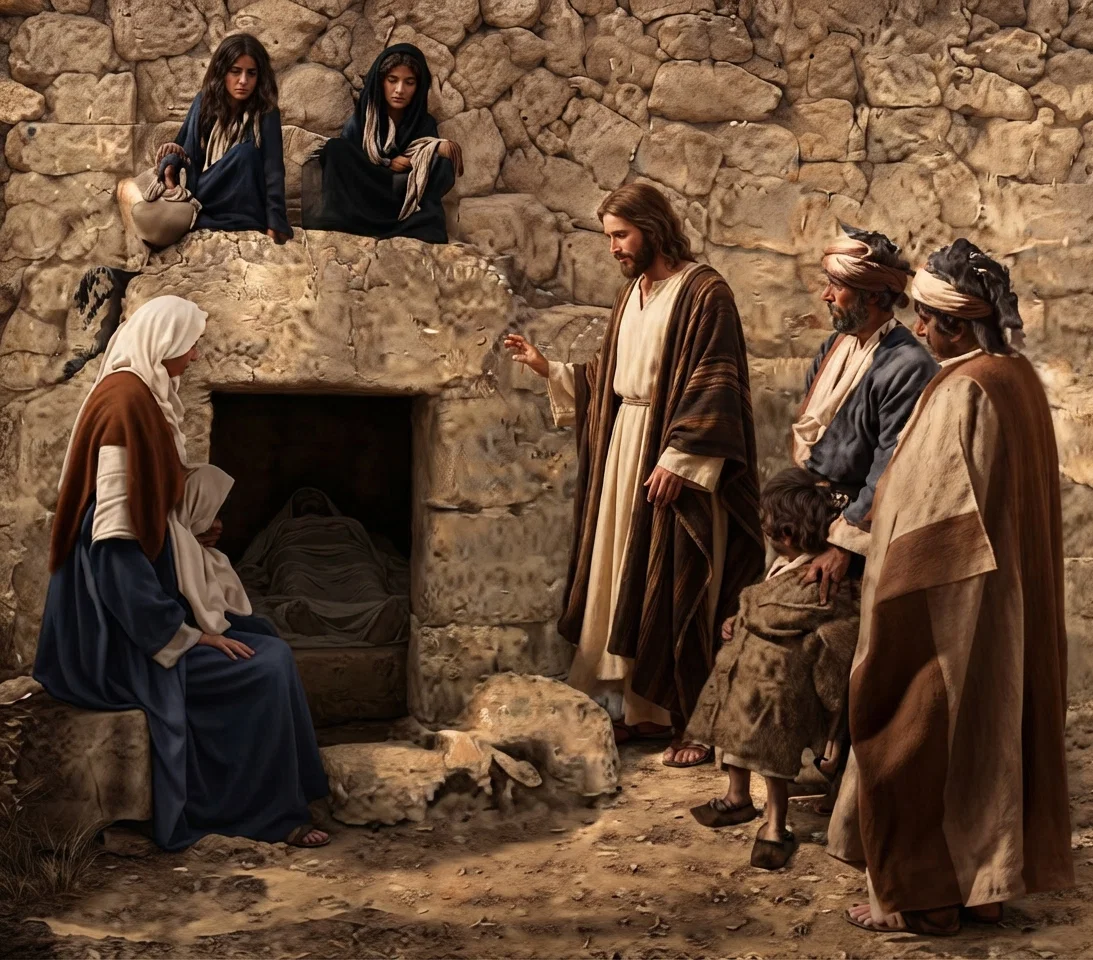
THE GRAVE OF LAZARUS.
Messengers came in and told them that the Lord was coming. Martha ran to meet Him with the words, "Lord, if Thou hadst been here, my brother had not died. And even now I know that whatsoever Thou shalt ask of God, God will give Thee." Jesus replied, "Thy brother shall rise again." Martha's response clearly shows that she did not believe that her brother still lived, did not believe that he had gone to some other sphere of happiness, and that only his dust remained in the grave. She replied, "I know that he shall rise again in the resurrection at the last day." And then Jesus brought before her the one necessary thing, the very core of Christianity, the personal Christ, "I am the Resurrection, and the Life; he that believeth on Me, tho he die, yet shall He live; and whosoever liveth and believeth on Me [at that day] shall never die. Believest thou this?" She saith unto Him, "Yea, Lord; I have believed that Thou art the Christ, the Son of God."
"Jesus Wept."—And then she went away and called her sister secretly and said, "The Master is come, and calleth for thee." What a blessed message it was to the sorrowing heart, and how eagerly she went to Him who had cleansed her from her sins! but she greeted Him with the same words as did Martha, that which had doubtless been expressed many times each to the other, "Lord, if Thou hadst been here my brother had not died." And then she wept, and the Jews who came with her also wept, till the heart of the Master was itself moved, and He groaned in spirit and was troubled, and asked, "Where have ye laid him?" They led Him to the sepulcher, and there "Jesus wept." Why did He weep? He knew that He who there slept, His friend, would soon rise, He knew that the sorrow of those persons would soon be assuaged, and their hearts comforted, but He saw in those weeping sisters and those mourning friends the bereaved and mourning ones of all generations to come, and His great heart of love and pity could but weep with those who wept.
At the Sepulcher.—Still groaning in Himself He came to the tomb. The margin reads, "moved with indignation in Himself." He saw in that death the great enemy, sin. It is the blasting, blighting curse of all the ages of time; the death of the fair, the true, the good, the pure, was sin's work, and to be laid to sin's charge; and despite the sadness and sorrow, His heart was indignant against it. Would God that all the mourning race might see the cause of disease and death upon the world. How much sooner would they findthe remedy and seek the true Physician.
The tomb was in a cave, a stone was placed at its mouth. Jesus said, "Take ye away the stone." Practical, matter-of-fact Martha, still not realizing the meaning of the words which Jesus had spoken to her, could not believe that her brother was to arise, and she mildly protested, "Lord, by this time the body decayeth; for he hath been dead four days," and her words were doubtless true. But Jesus merely reminded her, "Said I not unto thee, that, if thou believest, thou shouldest see the glory of God?" They rolled away the stone. He turned His eyes heavenward and said, "Father, I thank Thee that Thou heardest Me. And I knew that Thou hearest Me always; but because of the multitude that standeth around I said it, that they may believe that Thou didst send Me." And then, with a loud voice, which pierces the ears of the dead, sends the life-blood through every artery, and wakes the whole man, He cries, "Lazarus, come forth." And he that was dead came forth, bound hand and foot with grave-clothes, and his face was bound about with a napkin. Jesus saith unto them, "Loose him, and let him go." And he went forth whole in body and soul. And yet the hearts of that nation in the very midst of whom such a mighty miracle had been wrought sought to take the life of not only Him who wrought the miracle, but of him upon whom the miracle had been wrought, in order that nothing might stand in the way of their own self-seeking honor and exaltation.
What Is the Lesson?—First, it is that the same Jesus lives to-day, and is just as able to strike from the hearts and lives of those who are enshackled and enslaved by sin the mighty fetters that bind them as He was to break the bonds of sin which held Lazarus in death. He would be life, eternal life, now, to every believer, giving present power over present sin. Secondly, He asks us to do all in our power to make way for the life which He would place within us. There are hearts before whose doors stones of prejudice and selfishness in all their various forms have been placed. He would have us remove the stone. And there are those to whom Christ has spoken pardon and peace who have been given new life by His word, yet who are still bound by various ties of earth, even as was Lazarus with his grave-clothes, and the Lord tells us to let them go free. Put away the sins. If we will meet all that He requires of us on our part we will find in Him now the resurrection and the life to call from the graves of lust, of love of the world, of selfishness, of error, our own selfish hearts and make us new creatures in Christ Jesus. More than this, we may die, the grave may cover us, and we may molder to dust; but the voice of the Son of God will call to the loved ones, and they that hear shall live.

THE LAW AND THE JUDGMENT.

The Conclusion of the Whole Matter.

THE last great contest between truth and error in this world comes over the keeping of God's holy law. A power is pointed out in prophecy which would think to change times and the law (Dan. 7:25), the law of God. The Lord also points out to us through the Revelation that this power would carry on its war against the law of God and those who keep it, down to the very end of the world; but even there God's faithful would be found loyally keeping that same law, in the face of the very threat of death, and that threat coming from a power to which all the rest of the world had bowed down and done homage.
The advance of that rebellious power has been contested all along the way down through the ages by God's faithful ones. So it is with the most intense wrath that Satan views this little company (Rev. 14:12) that has successfully resisted all his deceptions and all his threats. Nevertheless, there they stand, a little company, but, through the grace of God, firm as the everlasting hills. The keeping of the commandments of God is the badge of their faith and loyalty; and at the same time, they are God's only witnesses in this world. It is the most exalted position that any company of men and women was ever called upon to occupy. With the whole world against them, they stand for the Sabbath given in Eden, and the law thundered from Sinai; and because they do, they are esteemed worthy to enter in through the gates into the city, and come again to that tree of life which our first parents were denied because of sin. See Rev. 22:14.
That law was given as a test of righteousness. Man's attitude toward that law proves the condition of the heart. The Lord says, "Harken unto Me, ye that know righteousness, the people in whose heart is My law." So Christ, who is our righteousness, says of Himself, "Thy law is within My heart." That law will put to the test every life that comes within its searchlight rays—and there are none who can escape. It blows the chaff from the wheat; it points out every particle of dross in the crucible of human character; it tells who are worthy to stand at the right hand of God, and who are not; who have won eternal life, and who have lost it. It is God's one great test of who are worthy to dwell in the light of His presence, where is fulness of joy forevermore.
Obedience to the law of God is a requisite of true holiness. God designed that Israel should stand before Him as a nation forever, holy in the sight of God and man, a light to the world to draw into the fold of heaven men out of every tribe and kindred under the sky. But He says of that nation: "For they would not walk in His ways, neither were they obedient unto His law. Therefore He hath poured upon him the fury of His anger." Isa. 42:24. It is the obedient children who possess holiness (1 Peter 1:13-16), and that is exemplified pre-eminently in the life of Christ, the Holiestof the holy, who "learned obedience by the things which He suffered." As we are to walk in the path marked out for us by Him, it is folly for us to expect holiness imputed to us while we do despite to that law which was the test of His holiness.
Our attitude toward the law of God is the test of our love for Him. In every age men have professed themselves lovers of God while walking at variance with His holy law; but John, writing with the pen of inspiration, declares: "This is the love of God, that we keep His commandments." Immediately, as if foreseeing that men would call the commandments a yoke of bondage, he adds, "and His commandments are not grievous." 1 John 5:3. There is the test—a divinely appointed one; and every man and woman can apply it to themselves. Do we profess to love God? Then look at the law of God, and see if we are following out its precepts—not four, or six, or even nine, but all of them. If we have found ourselves declaring that "the law is no more binding upon men;" that "the law was abolished;" and so have found delight in what the law forbade, in direct opposition to the example of Him who said, "I delight to do Thy will, O My God, yea, Thy law is within My heart"—then we may know that the spirit of our direction has been a spirit at enmity with God; for He says: "The carnal mind is enmity against God; for it is not subject to the law of God, neither indeed can be." Rom. 8:7. But enmity, rebellion, can not inherit the home of God; that would bring the reign of sin a second time into the universe, and that God declares shall not be. That the keeping of God's commandments is the seal of our fitness for eternal life is shown in these words of Christ: "If ye keep My commandments, ye shall abide in My love; even as I have kept My Father's commandments, and abide in His love." John 15:10. In that perfect submission to the will of God is our example; that is the test of our love of God.
Now, "let us hear the conclusion of the whole matter: Fear God, and keep His commandments; for this is the whole duty of man. For God shall bring every work into judgment, with every secret thing, whether it be good, or whether it be evil." Eccl. 12:13, 14. Is it a coincidence that the keeping of the commandments should be linked thus with the idea of judgment? If so, it is a divine coincidence. It is, as the Preacher declared, the summing up of the whole matter. When our lives are ended, we are judged according to our attitude toward the government of God as expressed in His law; we stand before the tribunal of the Infinite; we are at the bar of destiny. If we have maligned that law; if we have declared it abolished, and acted as if it were; if we have hid in our hearts an enmity toward that law, instead of a delight to keep its precepts; then how can we expect it to do other than condemn us, and rule us unworthy of eternal life? But, if we have followed our Saviour's example, have learned to take delight in doing God's will, in keeping His law, have sought to bring ourselves into harmony with its precepts, and have sought the pardoning grace of Christ wherein we have failed to meet all its requirements, then will the mantle of the righteousness of Jesus Christ be thrown over and around us, and His obedience will stand in the place of our failure, and we will then hear from the lips of the Father the "Well done, good and faithful servant; enter thou into the joy of thy Lord."

SUGGESTIVE PROPOSITIONS ON THE PRIESTHOOD OF CHRIST.

Essentials of the Melchizedek Priesthood.

V. An Endless Life.

ANOTHER essential of the Melchizedek priesthood is an endless life. The Levitical priests were made "after the law of the carnal [fleshly] commandment." The priests were men who died. However righteous and able one might be, like Jehoiada of old, he could help men only for a little while, during his life. Then he gave way to a successor. That successor might be a wicked man, as many of the Aaronic priests were, and as many of the self-appointed or man-made priests have been since. "And they indeed have been made priests in number, because that by death they are hindered from continuing." Heb. 7:16, 23. The sinner may have found of one a friend; the weak man may have found in one a strength, a staff, a stay; the rash man may have found in one wisdom; but when the good priest, the strong priest, or the wise priest, died, the friendship, the strength, the wisdom, died also.
Not so with the priest after the order of Melchizedek. It was said of Christ that His priesthood was "after the power of an endless ["indissoluble"] life, for it is witnessed of Him, Thou art a priest forever after the order of Melchizedek." Heb. 7:16, 17. The endless, the indissoluble, life, is an essential of that priesthood. Therefore it is said of the Melchizedek whom Abraham met, and it is true of every other Melchizedek, that so far as the human is concerned, he is without father, without mother, having no "beginning of days," a full-grown father-priest in the very beginning, direct from the hand of God.
What hope and strength of comfort is there in this. "For the law [which made the Levitical priests, Heb. 1:12] made nothing perfect," but the bringing in of the "better hope" in the priesthood of the endless life does make perfect, "because He abideth forever," and "hath His priesthood unchangeable. Wherefore also He is able to save to the uttermost ["completely," in quantity and quality and time] them that draw near unto God through Him, seeing He ever liveth to make intercession for them. For such a high priest [after the order of Melchizedek] became us, holy, guileless, undefiled, separate from sinners, and made higher than the heavens; who needeth not daily, like those high priests, to offer up sacrifices, first for His own sins, and then for the sins of the people; for this He did once for all, when He offered up Himself. For the law appointeth men high priests, having infirmity; but the word of the oath, which was after the law, appointeth a Son, perfected forevermore." Heb. 7:24-28, A. R. V.
The priest after the law could transmit to his son no higher life than he himself possessed, a mortal life. He could give to the people not even this life; but one Melchizedek priest can transmit, and does transmit to all His sons (and if we receive Him we are sons, John 1:12; 1 John 1:1-3), the everlasting life, which in righteousness becomes the "indissoluble" life, and so makes them under Him "kings and priests unto God and His Father; to Him be glory and dominion forever and ever." Rev. 1:7.
(To be Continued.)

Reforms Begin in the Heart

"The reforms that reach the uttermost places rise in the heart."

The Right Requires Action

“THE day of the right will not be brought about by dreaming about it.”

Making Friends of Men

“He who would destroy the foes of men must know how to make friends of men.”

CHOOSING, AND CHOOSING RIGHT.

THERE is no such thing as an independent man, altho men are prone to boast of their independence. The injunction of the Scripture, “Choose you this day whom ye will serve” (Joshua 24:15), is a direct reminder that every one is a servant of some one, whether he be willing to acknowledge it or not. Not only so, but it implies that every one must serve one of two particular masters—either God or the adversary of God.
The chief adversary of God is Satan, and his service has a great variety of deceptive phases. There is variety, and apparently conflicting variety, in the schemes devised by the adversary for alluring men away from the service of God. In following these devices many people are led to believe that they are serving God. Some are deluded with the idea that they are simply serving their own best interests, ignoring both God and Satan, believing in neither. But self-serving is a very effective service of Satan—one very acceptable to him, because it ignores dependence upon God, and therefore does not recognize obligation to Him.
There is no getting away from the fact that every thought, word, and deed is a service of either God or Satan. God has set up His standard in very plain terms. He does not aim to deceive men. He gives His Word, and gives His Spirit to make it plain. His will is briefly comprehended in His law of Ten Commandments, which embraces every principle in life; and the ability to walk in the light of this truth comes through faith in Christ.
Satan works all manner of cunning devices to turn men away from the law of God, and however, wherever, and whenever he can cause them to deviate from the way God has marked out, he has them engaged in his own evil service. Christ is the way that God has set before us all, and He kept the commandments of God. The service of God is along the line of “the commandments of God, and the faith of Jesus;” and whosoever is not in this way is against God.
Therefore, knowing that we are not, and can not be, independent, it is important that we choose whom we will serve. It is more important that we choose to serve God, and that we make the choice emphatic by choosing to serve Him in His own way; for this is the way of life, and at His right hand are “pleasures for evermore.” He not only urges us to choose this day whom we will serve, but He is particularly anxious for us to choose the service that will secure for us eternal life.
God made all things for His own pleasure (Rev. 4:11), but He has no pleasure in them who choose the way of death. Eze. 18:23; 33:11; Heb. 10:38. “The Lord taketh pleasure in His people; He will beautify the meek with salvation.” Ps. 149:4.
The Lord knows what is best for His people, and He knows that no good can come to those who will not choose to be His people.
Their fate is plainly set forth in Ps. 37:9, 10, 20, 38; also in Revelation 20. He would “have all men to be saved” (1 Tim. 2:4); therefore He would have all to become members of His family. “I have set before you life and death, blessing and cursing; therefore choose life, that both thou and thy seed may live.” Deut. 30:19. “Choose you this day,” and “choose life.”
G.

Question Corner

1712.—False Religion. Matt. 7:22.
Please explain Matt. 7:22, 23, with Mark 9:39. Is there not a contradiction? K.
The first text simply shows that the last days will reveal the hypocrite and the false wonder-worker. Not signs then, but character, will avail. The second text points this lesson, that no disciple of Christ has been set as judge. It was not the business of the disciples to command or prohibit what should be done by others in Christ's name. Another question is asked on “1 Cor. 29.” We do not know to which of seven chapters it refers.
1713.—Absent from the Body, etc. 2 Cor. 5:6-9.
What does Paul mean in 2 Cor. 5:6-9, and Phil. 1:21-23? L. E. D.
1. We see no light in that theory which makes this passage pertain wholly to this world and the changes that take place in conversion.
2. Note the condition presented in verses 1-9; for the passage is one: (a) “the earthly house,” “in this,” “in this tabernacle,” “mortality,” “at home in the body,” “absent from the Lord,” are expressions which refer to Christians in this earthly life. (b) “Found naked,” “unclothed,” refer to a state or condition in death. (c) “A building of God,” “house not made with hands,” “clothed upon,” “being clothed,” “house which is from heaven,” “swallowed up of life,” “absent from the body” (from the mortal state), “present with the Lord,” refer to the condition of immortality which awaits the people of God. Compare with Rom. 8:23. What Paul longed and groaned for in Romans he did in Corinthians. He wanted a better condition than mortality here gave; but that was not death. He did not wish to be naked or unclothed; he wanted mortality to be swallowed up of life; in the resurrection and the gift of immortality at Christ's coming.
The same three conditions are set forth in the second scripture: to live or to die, or the departing and being with Christ. Paul did not know which to choose—life or death. In either way God would get glory. But Paul did have choice of another thing, namely, to go to Christ, to be translated, to be with Him. This was “far better” than the other two things. The word rendered “departing” is in Luke 12:36, rendered “return.” The comfort offered to mortals is through the resurrection or translation. 1 Thess. 4:13-18.
1714.—Every Eye Shall See Him.
If this earth is round like a globe, how can every eye behold Christ as He comes in the clouds at the second advent? A SUBSCRIBER.
Does not the earth revolve? If the Lord Jesus should first appear as directly overhead, it would only take twenty-four hours for all the longitudes of earth to see him. In that fearful day the earth may revolve more rapidly at the will of her Maker; and angels will gather the elect.
1715.—The Bottomless Pit.
It has been said that the term “bottomless pit” of Rev. 9:1 refers “to the unknown wastes of the Arabian desert.” Why should it not refer to the Arabian desert in Rev. 20:3, instead of to the entire earth? A. S.
We do not know that it does so refer in Rev. 9:1. The original term, abussos, “the deep” (Gen. 1:2, Septuagint), refers to the earth in its condition of chaos, and the term in Rev. 20:3, to the earth as it will be when sin has finished its work, and chaos comes again (Jer. 4:23-25; Isa. 24:1-5). Does not abyss in that highly figurative prophecy of the trumpets refer to the very elements of hell which reduce the earth to chaos? The one is a type of the other.

A WORLD-WIDE SIGN.

In a recent report by the Massachusetts Insurance Commissioner, there occurs this significant allusion:
On the whole, how serenely and beautifully, to all outward appearances, has the business of life insurance by old line companies been progressing for the past twenty-five years. Money has been rolling into their treasuries in broad streams. Some have become exceedingly rich and powerful. Look at the results: Four hundred million assets held by a single company, and a surplus of eighty millions; and over one billion by three companies almost within earshot of each other in a single city.
This same report notes the many other vast aggregations of wealth in the hands of a comparatively few manipulators. Thus men of all classes witness and comment upon the heaping together of treasures, and the wickedness and unrest connected therewith; but only one here and there seems to realize that God has long ago pointed to this very condition as a sign of the "last days," an unfailing evidence that "the coming of the Lord draweth nigh." These things were written by inspiration of God, for the very purpose that, when men should see the predicted conditions, they might know that probation was about to end, and be warned, and prepare to meet their God in the judgment.
Shall the plain warning be in vain? It verily seems as tho it would; for this also was foretold by our Lord, and the conditions in the time of Noah and of Lot are given as illustrations. Luke 17:26-30. Men see the sign plainly manifested on all hands, yet deliberately ignore the momentous event which the sign was given to impress upon their minds.
Men of all classes are endeavoring to obliterate the sign—some by counter schemes of a like nature, some by political maneuvering, others by onslaught of religious tirade, and still others, as foretold by the prophecy, through acts of violence. Would it not be better to heed the divine warning, and prepare for the meaning of these things? The menace of mere human indignation will not better the situation; for many of the professed reformers stand ready to do the same things they condemn, whenever opportunity offers.
Surely those who profess to believe God's Word will be without excuse if they fail to benefit by the striking events so conspicuous in the world, if they fail to "discern the signs of the times." Instead of endeavoring to combat current political and business corruptions in the futile strength of some ways of the world, it is better to follow the counsel of the divine Word: "Be patient therefore, brethren, unto the coming of the Lord. . . . Stablish your hearts; for the coming of the Lord draweth nigh." James 5:7, 8. The Lord's message for to-day is the proclamation of the "Gospel of the kingdom," of the near approach of which the ever-increasing corruptions in every department of life are a specific world-wide sign given by the Lord Himself. For this very reason now is a most appropriate time to carry the message to all parts of the world. G.
Continue reading: SUNDAY LAWS AGAINST RELIGIOUS LIBERTY