ON a recent visit to Switzerland I had the privilege of whiling away several delightful hours in a trip on the blue waters of Lake Leman, and, at the end of the journey, to find myself in the picturesque city of Geneva.
No one that may have the opportunity of visiting the historic city of Geneva can fail to be struck by its beauty of situation, its charming surroundings. And its association with the name of Calvin and the Reformation will ever endear it to the hearts of all lovers of religious liberty. We were also afforded the privilege of entering the great cathedral and of seeing the very pulpit from which Calvin dealt those mighty blows of the Reformation that resounded until their echo was heard in the very halls of the Vatican. And, while standing there, I thought of the great need that exists at the present time of a Heaven-born Reformation. For, after all, the days of Calvin and Luther can hardly be paragoned by those that shall immediately precede the coming of Christ in the clouds of heaven. And if it took mighty and drastic measures to break the spell of Rome, and to emerge from the mire of Catholic superstition, what will be the sublime requirements necessary to pass through the stormy scenes of the last days, and to meet with serenity the blazing splendor of the last great day? But while we are generally accustomed to speak of the bright and victorious side of the Reformation, yet, at this writing, my province will be to call attention to one of its dark blots.
As the sun was mirroring its last rays in the sparkling waters of Lake Geneva, I stole out to the outskirts of the city to catch a glimpse of an object that, for me, had a peculiar interest. It was only a ragged, unhewn rock, but upon its rough surface had been engraved several very significant words. It marks the spot where Michel Servetus was burned at the stake (at the instigation of Calvin). Michel Servetus was a Spanish physician of great genius, learning, eloquence, pertinacity, and courage, who wrote quite extensively on religious subjects in the sixteenth century. He differed so widely in his views from the other reformers, that he became a leader of a movement of his own. While at Vienna, he was apprehended and tried for heresy by the Inquisition; the charge being based upon extracts taken from his last published work. But while the Inquisition was gathering evidence against him, he managed to escape to Geneva, where he lay concealed four weeks, waiting an opportunity to proceed into Italy. But, just as he was boarding a boat to depart, he was discovered by Calvin himself, who notified the authorities, and he was immediately arrested. Calvin's own secretary took the part of the accuser at the trial, and Calvin himself is supposed to have framed the articles of the charge. He was here again tried for heresy based upon his writings. Calvin was present at the trial, and explained to the court in what consisted the heretical teachings of Servetus.
As the outcome of this trial Servetus was convicted of heresy and blasphemy, and was sentenced to be burned at the stake the following day. Calvin and some of the other ministers of Geneva pleaded for a milder death, but the court would not yield. Accordingly, on the day following, chained to a stake, and seated upon a block he perished in the flames that were in truth the flames of persecution.
Upon this very spot where he was burned has been erected the monument that I have mentioned above. While many attempts have been made to justify the action of Calvin in the case of Servetus, it still remains a dark blot upon his history. Consequently about a year ago the people of Geneva erected this memorial, not as a means of exculpating the martyrdom of Servetus, but as an expiation of the crime, as the following words, inscribed upon the monument, will show:
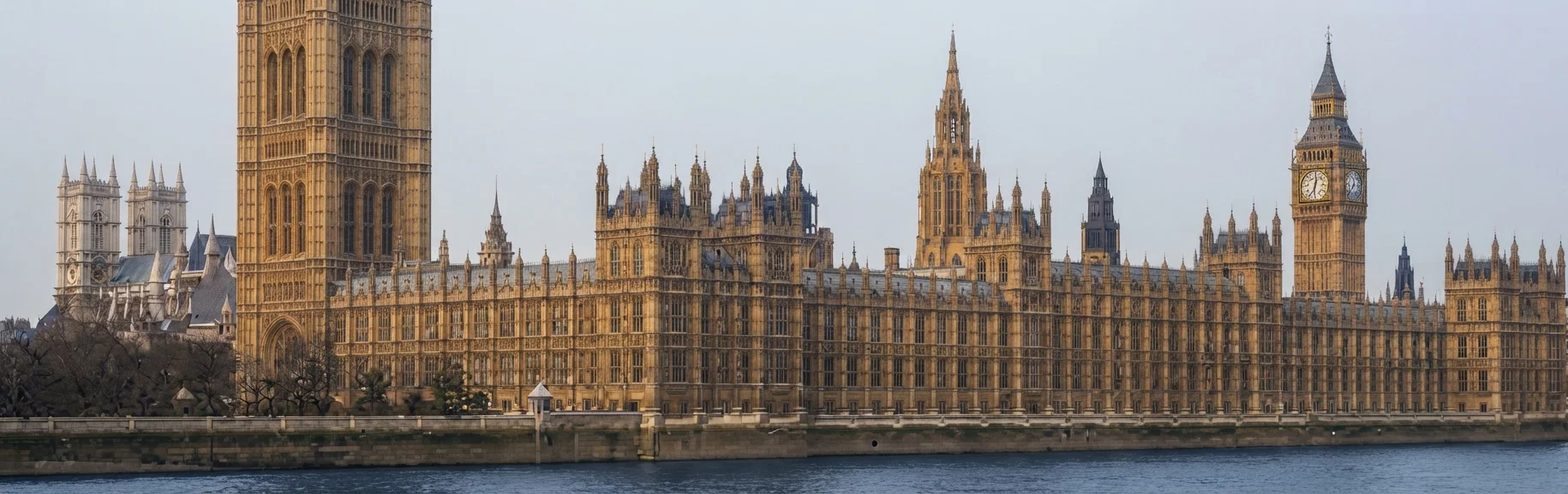
The British Parliament Buildings.
While we are the respectful and grateful children of Calvin, our great reformer, yet we condemn an error which was the one of his age; and, being firmly attached to the liberty of conscience according to the true principles of the Reformation and of the Gospel, have erected this expiatory monument.
While monuments do not wash away guilt, yet in this memorial the Protestants of Geneva have been willing to recognize the action of Calvin toward Servetus as a mistake, and to expiate it by a public acknowledgment engraven in stone. But where are the monuments of expiation erected by the Church of Rome to atone for the blood of the millions of martyrs that have suffered the most cruel deaths under their hand? We look for them in vain. For the Church of Rome rather glories in her bloody work, and those counted as heretics in the past are still branded by this infamous title. Rome does not attempt to atone or expiate her crimes, but is true to the Bible prediction which says: 'I gave her space to repent of her fornication; and she repented not.'
CHAS. T. EVERSON.
OUR LONDON LETTER.
By M. E. Olsen
(From Our Own Correspondent.)
England and France.
WERE we asked to name the most noteworthy event in British politics for some years past, it would have to be the Entente Cordiale between England and France, which has been so effusively celebrated during the past summer, first in the reception of the English fleet at Brest, and more recently in the splendid welcome extended to the French fleet at Portsmouth, and to its officers at various banquets in London. The rapprochement is the more significant because it represents the drawing together of two people of strongly-contrasting national characters, and between whom there has usually been a great deal of mutual suspicion, if not active hatred and jealousy, even in times of peace. During the late South African War, it was not uncommon for Englishmen to be hooted at in the streets of Paris, while the leading papers on both sides were very uncomplimentary.
Now all is changed. Indeed it would be hard to do justice to the heartiness of the welcome which England has given the French admiral and his men. Not only were they fêted on a truly magnificent scale in Portsmouth, but they must needs come up to London, where the Lord Mayor entertains them in all the splendors of ancient state at the Guildhall, while Parliament gives an elaborate banquet in the historic Westminster Hall. The extreme cordiality of the speeches on both sides, the almost frantic efforts of the masses of the people to show their good-will, and the effusive tributes of the country's press, have been truly striking. The English people are usually taken to be an undemonstrative people but they have given the lie to their reputation in the last few weeks. If England and France had become the contracting parties in a formal alliance, offensive and defensive, its peoples could hardly have celebrated the fact with greater pomp or ceremony, and surely not with more heartiness, than has accompanied the ratifying of the Entente Cordiale.
Its Meaning.
What does it all mean? How will this warm affection which England has suddenly conceived for her cross-channel neighbor affect the balance of power in Europe? The Triple Alliance has been practically a dead letter for some years; now the Dual Alliance, or more properly, the Franco-Russian understanding, seems destined to a similar fate. England is emerging from her "splendid isolation." Her new treaty with Japan has not yet been made public, but there are whispers that it contains provisions for Japanese aid in the defense of India, and it is known to be on broader and more inclusive lines than the first.
The Entente Cordiale brings England into friendly relations with her old enemy, France, and necessarily breaks the force of the latter's understanding with Russia. Does it mean peace or war, this new shuffling of figures on the European chess board? The answer is not easily given at this stage. Certain it is, however, that Germany, who by reason of her colonizing projects and aspiration for power at7sea, is England's real rival, does not look on with any too friendly eyes. It is not helpful to the maintenance of peace between the two countries, either, that the press on both sides is much given to evil surmising, and quickly seizes upon, and makes capital of, every little circumstance that might seem to bear an unfriendly aspect. Thus the Kaiser's meeting with the Czar in the Baltic was regarded with much suspicion in this country, while the subsequent cruise of the British fleet in the Baltic greatly incensed a considerable section of the German press. With these things as they are, and Russia, cut off from the realizations of her ambitions in the far East, looking with longing eyes on England's Indian possessions, the facts do not warrant the prophesying of a new era of peace and good-will among the nations, even tho peace between Russia and Japan has fortunately been concluded.
Work of Parliament.
Parliament rose for its summer and autumn recess about the middle of August. The session is generally acknowledged to have been a barren one, only a fraction of the legislation foreshadowed by the king's speech having been accomplished. The Government bill for a redistribution of Parliamentary seats was not satisfactory even to its own members, and was therefore dropped. A bill to restrict the immigration of undesirable aliens was carried in the face of vigorous opposition on the part of the Liberals. The Scottish Church dilemma was disposed of by a bill giving the "Wee Frees," as the original Free Church is called, as much of the property turned over to them by the decision of the House of Lords as they can occupy, the remainder to revert to the United Free Church, which is by far the larger body.
One of the major bills brought before the House was a measure intended to provide relief work for honest, industrious workingmen in times when ordinary employment failed. This bill met with a good deal of opposition even amongst the Labor members, who believed that the carrying out of its provisions would throw a heavy burden of taxes on the labor classes as a whole, with the possible result of helping only a very few really worthy cases, and encouraging many others to habits of slackness and irresponsibility. The bill finally passed, but not till so far stripped of most of its essential features as to be hardly recognizable.
Deplorable Condition of Working-Classes.
Right here it may be said that the real conditions of the lower working classes in Great Britain is most deplorable. The misery, wretchedness, and squalor prevailing in their homes are such as one would scarcely believe could exist in a country on the whole so rich and prosperous as Great Britain is known to be. It is, of course, due in part to drink, but has also been brought on very largely by wrong industrial conditions, for which the rich are responsible. Signs are not wanting that these downtrodden members of society are beginning to awake to their wrongs. In Manchester a few weeks ago there were some serious riots of starving people, while London has been the frequent witness of pathetic demonstrations on the part of the "out-of works." Some of these phases of the labor question will have to be dealt with more fully in another letter.
A Sunday-Law Failure.
One of the minor bills which failed to pass was one, originating in the House of Lords, for the more strict observance of Sunday as a day of rest. Altho dropped for the present this question is likely to come up again, and perhaps in a modified form, to pass into law. Certain it is that a very considerable number of the shop-keepers are strongly committed to Sunday-closing, and about the only thing lacking is a united movement on the part of the clergy such as that which has given such power to the Sunday-law movement in certain parts of the United States.
National Deterioration.
A very significant meeting was held at the Mansion House a few weeks ago, at which the Lord Mayor of London presided, and addresses were given by the Lord Bishop of Ripon, the Lord Chief Justice, several prominent members of Parliament, and leading lights of the medical profession. The subject under consideration was the nation's health. It was the unanimous conviction of the distinguished speakers that the present conditions of life, in our large cities especially, are decidedly adverse to health and normal development, and that immediate measures ought to be taken to secure better industrial conditions, and more widespread enlightenment of the masses in regard to the proper care of the body.
Sir James Crichton-Browne, M.D., the distinguished specialist in nervous diseases, spoke very strongly in regard to national physical deterioration. He said in part:
If any one has any doubt as to the ravages and the existence on a large scale of physical deterioration, I would recommend him or her to consult a report on the social condition of Dundee published within the last three months. That report is a very startling human document, and justifies the remark of the committee of influential citizens responsible for it, that it reveals a very serious state of things, deserving the anxious consideration of all thoughtful persons. I am not going to trouble you with the details of that report, but I should like to say that it sets forth the results of the minute examination of 1,000 children in Dundee in elementary schools, proceeding on the lines already followed at Glasgow, Edinburgh, and Aberdeen, but carrying the investigation further, and carrying it out with minute and scrupulous care. We all expected to be told that amongst the school children decay of the teeth or caries, is all but universal; that as many as 33 per cent. of them suffer from defects of vision requiring correction by spectacles; that as many as 43 per cent. suffer from deafness, enlarged tonsils, adenoids; but it was beyond expectation to discover that of these young children attending school, as many as 19 per cent. suffer from disease of the glands, almost always of a tubercular nature, that as many as 5 per cent. suffer from disease of the bones, that as many as 9 per cent. suffer from disease of the lungs, and what is more astonishing, that 7 1/2 per cent. suffer from disease of the heart, while a much large number show a flabbiness and weakness of that organ, the effects of underfeeding or of over-exertion. Positively, after reading this report, one asks in painful astonishment, "Is the whole mass rotten, and is there one perfectly sound, healthy child left?"
It is to be hoped that facts such as these will have some weight with the easy-going optimists who have asserted, on the evolutionary hypothesis, that the race is gradually improving in physique as well as in mental endowment, and have pointed to our enormous industrial development by way of proof. Sad to say, the tendency is ever downward; and only by earnest, whole-hearted effort, and the divine help, can any individual make progress upward.
BIGOTED SABBATARIANISM IN MARYLAND.
MARYLAND was the first European colony on the American continent to proclaim religious toleration, but it seems that the Maryland of to-day has still something to learn in regard to the free exercise of religious belief. Recently twenty-two men and nine women were arrested in Baltimore for violating the Sabbath. They were working in a tailoring establishment where they could not be seen from the street and were in nowise disturbing any one. The proprietors of the place informed the police judge that they and their employees were Jews and were taught by their religion that it was sinful to work on Saturday, the Jewish Sabbath. As they could not afford to remain idle two days in the week, they rested and attended to their religious devotions on Saturday, but worked on Sunday. However, they shut themselves in and took every precaution not to offend the sensibilities of their Christian neighbors. Nevertheless they were fined $5.00 each and warned that the laws of Maryland forbade working on Sunday and that a second infraction of them would be more severely punished.
The same day these people were arrested many thousands of people in Baltimore attended a baseball game. The players were hired for the occasion and were working for gain just as much as were those poor Jewish tailors. Newspapers were printed and sold on the streets on the same Sunday. The street-cars ran, and men worked in the hotels and around the railroad yards. Surely their offense—if any were committed—was as great as that of the little band of Hebrews quietly sewing in the upper story of a building. The latter were observing the spirit of the law forbidding Sabbath desecration, and no one can say their example was harmful to the community in any way. They abstained from labor and worshiped God on the day appointed by their religion, and should not have been molested. The law which requires them to outwardly conform to the teachings of another faith, under penalty of losing a day's labor each week or desecrating their own Sabbath, is a harsh and unfeeling one. Maryland should either amend her laws or administer them in a more enlightened spirit.
—Tribune, Oakland, Cal.
"HYPNOTISM IN COURTS."
By Editor
IN our issue of August 23 we printed an article with the above heading, and the following subheading: "The Devil to Be a Helper in Reform." We quoted a news despatch from Denver, dated July 28, stating that Judge Lindsey of the Juvenile Court had announced his intention of practising hypnotism so that he could better deal with the children. We stated in that article:
It is well known that a person who has been once hypnotized more readily yields to its influence the next time, and still more easily the next time. The power to resist the influence is finally destroyed, and the soul is left a derelict on the sea of irresponsible mentality. And all such will be used by the chief hypnotist in all this world,—the devil; men may subject souls to their own will by its influence with the best of motives, and by that very means they are weakening that soul's will, they are destroying its resisting power, and are rendering him a much easier prey to the master of hypnotism,—the devil. And therefore he who is using this means,—be he judge or physician or teacher or minister—is acting, tho unconscious to himself, as an agent of the devil. If that is the method of this Denver court, whatever its temporary results, it will reap a fearful harvest in the judgment.
We are glad to know that the report on which our remarks were based was false, and that Judge Lindsey did not say any such thing. He thus writes us under date of September 15:
EDITOR SIGNS OF THE TIMES,
Mountain View, Cal.
Dear Sir: I thank you for sending me the SIGNS OF THE TIMES of August 23, containing your editorial regarding the alleged practise of hypnotism in this court. You may rest assured that the story was nothing but a fake affair, and has been a source of much annoyance to me. . . .
I wish to thank you for your encouraging words in the past, and I am glad to know that we do not differ on the subject of your recent editorial.
Sincerely yours,
BEN B. LINDSEY.
We are glad to correct the mistake. We take occasion to express again our wishes for the greatest success to Judge Lindsey in the work that he is doing for the erring youth.
THE MORPHINE HABIT WITH MEDICAL MEN.
IN a work on the morphine habit, lately published in Paris, much interesting information is given concerning morphinism and morphinomania, some of which will be new to most of our readers. It is stated that Germany, France, and the United States are the countries in which the vice is most widespread, but that it has its victims in Russia, Sweden, and Turkey, and that even in the extreme East morphine as a narcotic is said to be supplanting opium. Statistics are furnished of one thousand cases, collected from all parts of the world—six hundred and fifty men and three hundred and fifty women. These statistics show that of the male morphinists the medical profession supplies the largest number, 40 per cent. Men of leisure come next, with 15 per cent.; then merchants, 8 per cent.; while peasants, clergymen, and politicians occupy the lowest positions on the list. Women of means are the most numerous class among the females, 43 per cent.; followed by wives of medical men, 10 per cent. In Germany there are entire villages whose inhabitants are addicted to the use of the drug, but the general belief that the morphine habit is more extensively practised in Paris than in any other city is contradicted. Morphinomania is said to occur with greatest frequency between the ages of twenty-five and forty.—Health.
FORETOKENS OF OUR LORD'S RETURN
By Prof. George W. Rine
WHY OUR LORD MUST COME AGAIN.
If you and I are Christians, dear reader; if Jesus has spoken pardon to our souls and breathed the peace and rest of heaven into our hearts; then, with Mary, we have broken alabaster boxes and shed tears of joy at the Master's feet. Yes, if we have tasted the blessedness of sins forgiven, the joy of resting in our Father's house, then our breasts heave with love and our hearts throb with devotion to His most adorable person.
With the psalmist we rapturously exclaim: "The Lord hath done great things for us; whereof we are glad." Has He not anointed us with the oil of gladness, and filled our cups to overflowing? Ah, with converted Peter, we protest from the heart, "Lord, Thou knowest that I love thee." "My Beloved is mine, and I am His," is the instinctive language of the regenerated soul. Knowing that "with everlasting kindness" Jesus has drawn us out of the darkness of the world and of self into the glorious light and liberty of the sons of God, our hearts become ardently attached to Him; He becomes ineffably precious to us; we accordingly long, above everything else, to be and abide in His blessed personal presence. Hence the promise that, in the timeless world to come, we shall ever be with the Lord, is to the Christian heart the sweetest of all the Saviour's "exceeding great and precious promises." It is because we love Him so, that our hearts yearn to be forever with Him.
Then, to dwell eternally in the personal, visible presence of His Redeemer, is the deepest and strongest aspiration of the Christian soul. Is it not, therefore, superlatively important that we should know just how, according to the divine plan, this supreme aspiration can and will be realized? The reader is doubtless aware that among those who profess to be the children and followers of Jesus there exists quite a diversity of opinion as to when and how they will ultimately and forever enter into the personal presence of their Lord. It seems almost incredible, too, that Christians do not entertain one and the same judgment respecting a matter of such moment in the Gospel scheme. For the Master Himself has stated it in terms as simple and explicit as human language affords—
"I Will Come Again and Receive You unto Myself."
In verse 33 of John 13, is found a statement that Jesus made to His disciples to the effect that He was soon to depart from them, and that they would seek Him, but should not be able to follow Him then. But, as given in verse 36, He promised that they should come to Him ("follow Me") "afterwards." Peter, as spokesman for all the disciples, wistfully asked, "Why can not I follow thee now? I will lay down my life for Thy sake." The disciples were so fervently attached to their Lord that just as soon as He apprised them of the sad but necessary fact that they would soon be separated from His visible presence, their hearts were wrung with grief. Jesus read their hearts, and instantly proceeded to console them, to assuage their sorrow, by assuring them that, tho it was expedient that He should go away for a time, He would come again for the express purpose of taking them to Himself.
In infinite pity He implores them, "Let not your heart be troubled; . . . in My Father's house are many mansions; . . . I go to prepare a place for you. And if I go and prepare a place for you, I will come again, and receive you unto Myself; that where I am, there ye may be also." It does not seem possible that language so simple and lucid could be misunderstood. "In Thy presence there is fulness of joy; and at Thy right hand there are pleasures forevermore." But when and how will His children enter into the "joy" and the "pleasures" of His "presence"? How explicitly our Lord answers this question. He says He will come again and receive us unto Himself, that where He is there we also should be. Hence there is no scintilla of hope that any one can ever follow Him to where He has gone, and thus dwell in His sensible presence, unless He comes again to take His people to Himself.
The Christian's Reward Contingent upon the Second Advent of Christ.
The infallible Word repeatedly declares that the saints will receive their ultimate reward, that is, enter into the eternal inheritance so often promised them, at the time of their Lord's return. Note the Master's own unequivocal testimony: "For the Son of Man shall come in the glory of His Father with His angels; and then He shall reward every man according to His works." Matt. 16:27. Again, in the last chapter of the Bible, verse 12: "Behold, I come quickly; and my REWARD is with Me, to give every man according as His work shall be." Does it not seem almost blasphemous for any mere man to attempt to contravene the pointed and reiterated testimony of the Holy Spirit, that it is when Jesus comes again, and not till then, that the "little flock" enter into the visible possession of the kingdom prepared for them from the foundation of the world?
Observe again the categorical way in which Christ states the same fact, as recorded in Luke 14:12-14. He there commands His followers, when they prepare feasts, to call in "the poor, the maimed, the lame, the blind; . . . for they can not recompense thee; for thou shalt be recompensed at the resurrection of the just." This assertion is by no means a contradiction of those made by our Master as previously cited. For He informs us through His servant Paul that the resurrection of the just will be one of the attendant phenomena of "the glorious appearing of . . . our Saviour Jesus Christ." After telling us—as recorded in 1 Thess. 4:16-18—that the Lord would "descend from heaven . . . with the voice of the archangel, and with the trump of God," the Holy Spirit declares: "And the dead in Christ shall rise first." Through Paul, the Spirit further affirms that those who have been raised from the dead to immortality, with those who are alive and remain at the appearing of Christ, should be caught up to meet their Lord in the air, and then adds, "And so shall we ever be with the Lord." Is there any wonder that the blessed Spirit should, in this immediate connection, exhort us to "comfort one another with these words"? Should not "these words" be unspeakably precious to every believer, in view of the transcendently solemn fact, that it is only by virtue of our Lord's coming again that our loved ones who have fallen asleep in Christ can ever be released from the power of death and the grave; and, as here again repeated, that it is only by virtue of that same "coming" that the redeemed can ever be with their adorable Lord in glory? Additional inspired testimony should certainly not be needed to convince the most skeptical; but the express declaration of the same tenor, given through Paul (Col. 3:4), is so sweepingly conclusive that I feel constrained to produce it. Thus: "When Christ, who is our life, shall appear, THEN shall ye also appear with Him in glory."
The Promise Not Realized at Death.
There are very many in the church of Christ who profess to believe that the Master's promise that He "will come again" is fulfilled at the death of each individual saint. Yet there is no Scriptural warrant whatever for this theory. The theory is utterly demolished by repeated affirmations of holy Writ. For some reason the disciples got the impression that John should not die, but that he was to tarry until their Lord should come again. See verses 20 to 23 of John 21. Peter, seeing John lean upon the Saviour's breast, asked Him regarding John, "Lord, what shall this man do?" Jesus answered, "If I will that he tarry till I come, what is that to thee?" From this answer they felt assured that John was not to die, but would live till their Lord's return, as stated in verse 23. Does not this fact demonstrate conclusively that the disciples did not identify the second coming of the Son of God with the death of His saints?
Again: "Behold, I show you a mystery: We shall not all sleep, but we shall all be changed, in a moment, . . . at the last trump; for the trumpet shall sound, and the dead [in Christ] shall be raised incorruptible, and we [the living] shall be changed." This is one of many inspired statements that all will not die before the advent of Jesus, and therefore it shows unmistakably that the blessed assurance that He will come again is not realized at the death of believers, but, on the contrary, it will be realized at the resurrection of His sleeping saints.
No; death does not bring Christ to us; but, conversely, the coming of Christ brings life and immortality to all the redeemed multitudes, from Adam to the last soul that shall be born again. Our precious Saviour is the Prince of Life. "There can be no death where He is," declared the late Mr. Moody. So far as His saints are concerned, both living and dead, death will forever be banished at His appearing. For it is then that "this corruptible shall put on incorruption, and this mortal shall put on immortality." It is then that the redeemed will rapturously exclaim, "Death is swallowed up in victory! O death, where is thy sting? O grave, where is thy victory?" It is then that He will change our vile bodies, that they may be fashioned like unto His glorious body. Phil. 3:20, 21. He came the first time to save believers from the guilt of sin; He will9again come to save them from the wages, the ravages, of sin. O, how important, then, it is that when death overtakes us, we should fall asleep in Jesus; for when He descends with the trump of God, "the dead in Christ shall rise first." And it is upon such that the Holy Spirit pronounces this supernally beautiful benediction: "Blessed and holy is he that hath part in the first resurrection; on such the second [eternal] death hath no power." Rev. 20:6.
The Crowning Hope of the Christian.
If, then, our being with the Lord in the endless world to come; if the resurrection of His sleeping saints; if our exchanging mortality for immortality; if our appearing with Him in glory; if our entering into the promised inheritance, the kingdom of glory,—if the realization of all these exceeding great and precious blessings, is contingent upon the coming again of our Redeemer, then, most certainly, must that same "coming" be to every Bible Christian the sovereign hope of his spiritual warfare. Hence we are not surprised that Inspiration should expressly designate the Saviour’s "glorious appearing" as "that blessed hope." After giving definite instruction as to how we are to acquit ourselves "in this present world," the Spirit of inspiration most significantly adds: "Looking for that blessed hope, . . . the glorious appearing of the great God and our Saviour Jesus Christ." Titus 2:11-13.
Even so the apostle Paul affirms that the saints who are saved as the fruit of his ministry should be his "hope," his "joy," his "crown of rejoicing"—when?—"in the presence of our Lord Jesus Christ at His coming." 1 Thess. 2:19. Do not all our hearts yearn to be like Him, who is to us "the One altogether lovely"? Well, our most gracious Father, who has nothing too good for His obedient, trusting children, has even promised that sometime we shall, in body as well as in character, be like His beloved Son. A promise so "exceeding great" almost startles us; it taxes our faith; but it is even so. Believing the promise, we can not be satisfied until we know when it shall be carried into effect. The "beloved disciple" gives us the coveted information. "Beloved, now are we the sons of God, and it doth not yet appear what we shall be; but we know that, when He shall appear, we shall be like Him; for we shall see Him as He is." 1 John 3:2. O, how many of the wondrous promises of God are wrapped up in that all-comprehensive promise—"I will come again"!
You remember that when Paul realized that he was about to close his life’s drama, he declared in words that ring with faith: "Henceforth there is laid up for me a crown of righteousness, which the Lord, the righteous Judge, shall give me at that day; and not to me only, but unto all them also that love His appearing." 2 Tim. 4:8. It is not at all strange that Paul or any other child of God should "love His appearing"—not at all strange that His remnant church should "look for Him." Aye, it is only to those who, in faith, look for Him, that the promise is given, that He will "appear the second time without sin unto salvation." Heb. 9:28.
We recall that when our Lord ascended to His Father, the hearts of His disciples were smitten with anguish. How did the two angels dispatched from the courts of heaven, proceed to compose and comfort the bleeding hearts of those bereft disciples? Listen! "This same Jesus, which is taken up from you into heaven, shall so come in like manner as ye have seen Him go into heaven." Acts 1:11. Why is it that whenever the church of Christ is persecuted, or is in distress of any kind, the divine Spirit comes to her with the consoling, inspiring assurance that her Lord will come again—come in glory? Ah, it is most assuredly owing to the fact that that stupendous event constitutes the crowning act in the great drama of the plan of salvation. It is the condition of the final deliverance of the children of God; it is the glorious consummation of all their hopes.
How natural, then, that the doctrine of the second advent should be so insistently enunciated in the Holy Scriptures—that it should occupy a place so conspicuously large in the Word of inspiration. Hence the saints can not but sigh and pray for it. How wistfully they yearn for the adoption, to wit, the redemption of the body! They cry out for the living God, and can not be satisfied until they come into His presence—until they bask in the light, rest in the love, and forever triumph in the life, of the Eternal. Hence, in the closing words of the volume of inspiration, in the yearning prayer of the exiled prophet of Patmos, they lift their hearts to heaven and pray,
"Even so, come, Lord Jesus."
THE HIGHER LAW.
By H. A. St. John
BY H. A. ST. JOHN.
GOD'S moral law, summarily contained in the Ten Commandments, is often denominated "the Higher Law." It is truly such, yea, more, it is the highest law known to man, and no higher law can possibly be conceived by man. It has emanated from the highest legislative authority in the universe, even from the "MOST HIGH," and relates to man's highest and best good, both for time and eternity. The humility of Christ in Bethlehem; His mockery in Gabbatha; His agony in Gethsemane; and His ignominy on Calvary, were all because of sin, the transgression of the highest law of the Most High. The grand Gospel scheme, the bureau of salvation, in heaven and on earth, with the Lord Jesus as its head, the Holy Ghost as an omnipresent executive of the Godhead; all the holy angels, as recording secretaries, and field ministers; united with every pardoned, regenerated child of God on earth,—all, all, are for the purpose of restoring the image of God in the soul of man, by the putting away of iniquity, and the carnal mind (which is not subject to God's higher law, nor indeed can be), and writing the law in the heart, first of all, preparatory to writing it upon every muscle and nerve of the immortalized and glorified bodies of the redeemed in the resurrection morning.
All mankind are amenable to this higher law, for God's kingdom ruleth over all. No earthly power can absolve a single soul from allegiance to this law of love. Every soul of man that neglects the great salvation provided, the Gospel provision by which he may come in tune with the Infinite, will some day find, to his great sorrow, that his earthly life was an ignominious failure. He has traveled the broad way that leadeth to everlasting destruction.
History chronicles many instances of human governments and organizations, both church and state, endeavoring to interpose human laws between the creature and the Creator. All such efforts ever have, and ever will have, only one result, namely, inquisition, persecution, banishment, imprisonment, and death. But God will vindicate the martyrs, and they will triumph gloriously; while the powers that thus exalt themselves above God will ignominiously and eternally perish.
Wo be to the nation or denomination or organization that attempts to infringe upon the claims of God's higher law, or seeks to make it void in the least particular. The prophetic seer of Patmos informs us that the remnant church of Christ on earth will be made war upon, because they keep God's commandments and have the testimony of Jesus. As this remnant will be scattered abroad among the nations of the earth, it is obvious that earthly governments, dominated by popular and worldly ecclesiastical power, will hide their eyes from the claims of the higher law, and will seek to make it void by human law, dignified by sacred titles. But the remnant church will not be deceived by this last attempt of the arch rebel; they will remain steadfast and immovable, always lovingly loyal to the higher law of the Most High. All such will hear the "Well done," and enter into the joys of their Lord.