Pacific Press Publishing Association · Mountain View, California · Mar 28, 1911
"IF YE WILL INQUIRE, INQUIRE YE."
By Editor
This Inquirers' Department is conducted for the purpose of helping those who are studying the Bible. The answers are oftentimes only suggestive. They are never to be considered infallible, only as they agree with the infallible Word. The writer who may answer them does not consider that his opinion is infallible. He will simply give the best that he has, and plead with the inquirer to search the Word. Such questions only will be answered as, to the editors, seem to minister to the good of the readers and to the mission of the paper. We can not answer repeatedly in the same volume questions upon the same scripture. The name and address must accompany question, not for publication, but as an evidence of good faith, and that answer may be made by letter if deemed advisable. No letters are answered which do not contain the name of the writer. It is well always to enclose stamp for reply.
3397.—Prices of Periodicals
By Editor
A correspondent in North Dakota asks why the prices of our papers should be higher when what farmers dispose of sells for less, while what they buy is higher. A farmers' paper is referred to which is but 25 cents a year; other farm papers, 50 cents a year. Why should our religious papers be so much more?
The letter of five pages from which these queries are gleaned opens up great political questions which the statesmen and politicians and experts have been wrestling with for years. If farmers get less for their produce, the consumers pay more. During the last ten years the prices of the leading commodities of every-day life—food, clothing, building-material—have advanced from twenty-five to fifty per cent. If the farmers fail to get more, it is not the fault of the consumer, but of the selling system, partly the many middlemen.
Regarding papers and their subscription prices, there has been constant advance for years in the prices of practically everything which enters into the cost of journals and magazines. Many religious papers with limited circulation are published at a loss. The farm papers of which our correspondent speaks are printed on cheap paper, and carry many advertisements. They could not be published at all on their subscription price. It is the advertisements that pay. If we should advertise as they do, we would meet objections from everywhere. Therefore the SIGNS OF THE TIMES, with a medium circulation, must charge a price to meet the cost. Many religious papers carrying more advertisements than we do and less reading-matter, have a higher subscription price. Most of the advertisements that other papers carry, our subscribers object to; therefore we must have a higher subscription price to cover cost. If our friends would give us a circulation of from 100,000 to 500,000, we could furnish the paper much cheaper. Large circulation, many advertisements, a cheap grade of paper, little reading-matter, poor print, mean less cost; limited circulation, few or no advertisements, a good grade of paper, good variety of the best of reading, good print, mean more cost.
3395.— Who Crucified Him?
By F.
Who crucified Christ Jesus our Lord—
Jews or Gentiles? F.
Both were responsible; the Jews the most, for they demanded His crucifixion, after the Roman governor had said, “I find no fault in this man.” Luke 23:5, 14, 20-24. Jesus declared that the one who delivered Him to Pilate had “greater sin.” John 19:11. Peter charged the crucifixion direct to the Jews. Acts 2:23; 3:13, 14; 4:10. The Jews condemned Him to death for blasphemy, but could not execute the death penalty. Matt. 26:65, 66; John 18:31; 19:7. But they brought the charge of sedition against Him before Pilate, because Pilate cared naught for the charge of blasphemy. But Pilate feared that his office might be endangered, and therefore sentenced Jesus to die, tho he acquitted Him as innocent. John 19:12-16; Matt. 27:24, 25. And it is also true that Jesus gave His own life. John 10:11, 15, 17, 18.
3396.—The Scripture Canon
By I. W. H.
When, by whom, and by what authority, whether by Church or by State, were the original manuscripts collected and compiled and dedicated to the world as the Word of God? What means was used to separate the inspired from the uninspired, and to decide concerning the various parts of our Bible? I. W. H.
The Bible is a growth. It is not the product of one man or a council or a decree from some human authority. For instance, the Pentateuch, or five books of Moses, was accepted by God's people to the time of Christ. God's law in that book constituted the test of later prophets and their writings. One book after another was added till we come to the close of Old Testament times. After the Babylonian captivity all the books over which there was no question, which were generally accepted, were collated and arranged by Ezra, Nehemiah, and their colaborers. These were the Holy Scriptures in the time of our Lord. They are referred to by Josephus, "Against Apion," and are everywhere approved by Jesus. The New Testament was added in the same way, book by book, epistle by epistle, from men filled by the Spirit of God, and bearing the eternal test, "To the law and to the testimony." Before any council acted upon the Scripture Canon, as early as A.D. 170, practically all the books as we now have them were accepted as according to the Scripture rule by the early church, while as many others were rejected. Clement, Polycarp, Justin Martyr, Origen, and others mention different books. The famous "Muratorian Fragment on the Canon" (A.D. 170) mentions nearly all of the books of the New Testament. It mentions the Gospels of Luke and John, the Acts, the thirteen epistles of Paul, 1 and 2 John, Jude, the Revelation. It omits several which are mentioned by others. The Peshito Syriac list of about the same age includes all except 2 Peter, 2 and 3 John, Jude, and the Revelation. The old Italian version, of about the same time, the Bible used by the North African churches, contained all our New Testament books except Hebrews, 2 Peter, and James. Later church councils confirmed our present list, and added others rejected by earlier Christians. Our present books bear every test except with "Higher Critics."
It means that we should not resist or rebel against petty, cruel, and often illegal exactions demanded by officers of the law. According to the law of Moses the creditor could not keep the debtor's garment over night. Ex. 22:26. Tho sometimes the law be more exacting than this, it should not be resisted. Sometimes government officers compelled citizens to carry mail and do unjust service; do not resist. As Boothroyd remarks, "Our Lord recommends patience under trying injuries, rather than resistance; and a disposition to sustain the loss of what is small value, than to go to law." If we could know the things which the Jews had often to meet at the hands of the Romans, and often from Jews who were acting for the Romans, these injunctions would be clearer. The prayer of Zacchæus shows that it was not uncommon for tax-gatherers to be extortionate and unjust. Luke 19:8. Verse 42 teaches that we should be generous to those in want, and kind to those in need. But in the light of Matt. 7:6, 15, 16, and 2 John 10 it does not mean indiscriminate giving. However, we should not let fear of unwise charity steel our hearts against the poor and needy. Better to give ten times to the undeserving than to fail once to the deserving.
3399.—Is It Prophetic Time?
By Editor
Does Isa. 10:17 refer to the length of time it will require to consume Satan and his branches and cleanse the world of all evil in the fire of Rev. 20:9? Is the "day" a prophetic day?
We should not call it a prophetic day. It is not found in connection with symbolic prophecy, and the judgment of the wicked will consume more than a year. Rather we should think it to be the day of judgment, the great day of the Lord. See Isa. 13:6-11; Zeph. 1:14-18; 2 Peter 3:7, 10.
3400.—A Proper Question
Is it right for a Bible teacher to ask the question, "Was it just for God to allow Elijah to kill the false prophets?" 1 Kings 18:40. How can one answer such a question?
Whether it is right to ask such a question or not depends on the motive in asking. We could imagine several theories with right motives which would at least not make wrong the question. "How can one answer such a question?" By saying simply this,—that God is always just in all that He does. Not only that, but under God we could not say for one moment that Elijah's act was wrong in ordering the destruction of the unrepentant, rebellious, licentious, soul-destroying, nation-destroying, truth-destroying priests of the most abominable, degrading idolatry in the world. They were foreign to God's inheritance, and traitors to the laws of the government of the realm.
3401.—Visions Now
By Editor
May we expect that men will have dreams and visions now as of old? P.
Yes; why not? The promise was for all time. Read Acts 2:17-21, 39. Not long ago we received a letter from a lone and totally deaf commandment keeper, not belonging to any church, who writes us of visions God gave him, not to instruct others, but himself. These have not exalted him, but humbled him. We may always be suspicious of visions or dreams or revelations which exalt us. Weigh all extra-Biblical revelation by the Word of God. "To the law and to the testimony: if they speak not according to this word, it is because there is no light in them." Isa. 8:20.
Schedule for Week Ending April 8, 1911
Lessons from the Book of Judges
The book of Judges represents indeed a checkered map. To-day it is triumph, to-morrow it is defeat. To-day it is humility of heart and God's blessing, to-morrow it is rebellion against God, yielding to idolatry and the consequent captivity and oppression by their enemies. We do not know that any words are necessary to expand the awful history. We may learn its lesson unquestionably, that humility before God and trusting in Him always bring success. Simple childlike faith brings the fruition of His promises; while on the other hand, union with the world, with worldly elements, following the world, using its methods and ways, yielding to its ever-pleasant idolatry, will surely bring to us trouble. It is well to note that sometimes the judges ruled over only a part of Israel, sometimes it seems to have taken in the whole of Israel. It is quite impossible to construct any regular chronology from the book of Judges, as the judges themselves sometimes ruled contemporaneously.
Joshua and Judges Lesson
Joshua 23, 24, and Judges 1 to 10, with chapters 17 to 21, is our lesson for the week. The mighty leader of God's people is drawing near to his end. He rehearses before the people the things of God, and solemnly admonishes them to choose, and then assures them where he and his house stand. Whatever they may do, he and his will serve the Lord.
THERE is at the present time an unparalleled interest in the subject of education. The wide diffusion of knowledge through the agency of the press, placing the means of self-culture within the reach of all, has awakened a general desire for mental improvement. But while we gratefully acknowledge our increased educational facilities, we should not ignore the defects in our present school systems. In many cases, physical as well as moral training has been neglected in the too eager desire to secure intellectual culture; and the youth have left school with morals debased and physical powers enfeebled, with no knowledge of practical life, and little strength to perform its duties.
As these evils have come under my observation, the inquiry has arisen, Must our sons and daughters become moral and physical weaklings, in order to have the advantages afforded by an education in our schools? This should not be; and it need not be if teachers and students will but be true to the laws of nature, which are also the laws of God. A right education will make the youth strong, well-balanced men and women, by developing and calling into active exercise all the powers of mind and body. It will make them a blessing to the world; for it will enable them to attain a true and noble manhood and womanhood.
Many times students are so anxious to complete their education that they are not thoro in anything they undertake. They do not understand the true object of education, and so fail to take such a course as to secure this object. They apply themselves to the study of mathematics or the languages, while they neglect a study far more essential to happiness and success in life. Many who can explore the depths of the earth with the geologist, or traverse the heavens with the astronomer, take not the slightest interest in their own bodies. Others can correctly describe every organ of the body, and tell how many bones there are in the human frame, and yet they are as ignorant of the laws of health, and the cure of disease, as tho life were controlled by blind fate, instead of definite and unvarying law.
Sound health lies at the very foundation of the student's success. Without it, he can never see the fruition of his ambitions and his hopes. Hence a knowledge of the laws by which health is secured and preserved is of pre-eminent importance. The human body may be compared to nicely adjusted machinery, which needs care to keep it in running order. One part should not be subjected to constant wear and pressure, while another part is rusting from inaction.
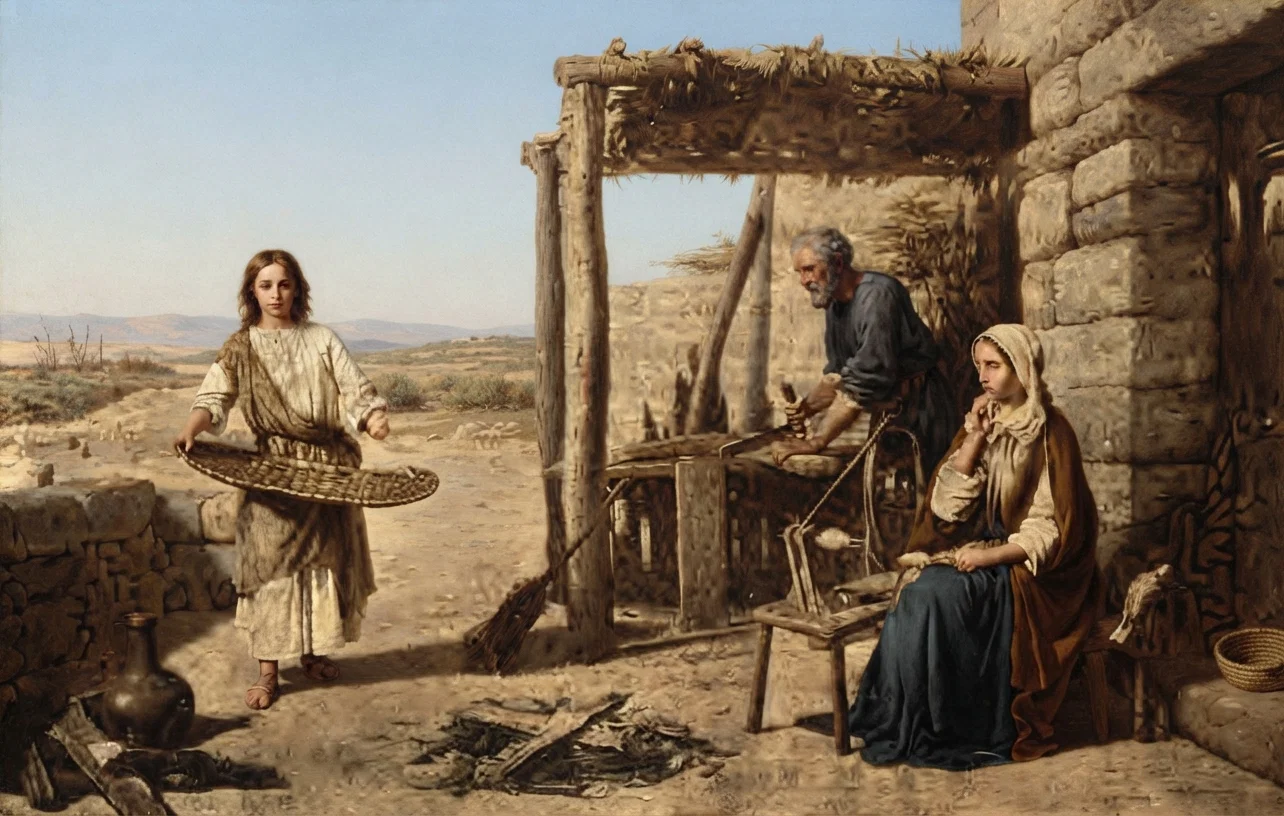
A PART OF THE TRAINING OF THE BOY JESUS
While the mind is taxed, the muscles also should have their proportion of exercise. Every young person should learn how to regulate his dietetic habits,—what to eat, when to eat, and how to eat. He should also learn how many hours may be spent in study, and how much time should be given to physical exercise.
It is a duty which every student owes to himself, to society, and to God, to regulate properly his habits of eating, sleeping, study, and exercise; but there are few who have the moral courage and the self-control to act from principle. The student who studies hard, sleeps and exercises little, and eats irregularly of an improper or inferior quality of food, is obtaining mental discipline at the expense of health and morals, of spirituality, and, it may be, of life itself.
Young persons are naturally active; and if they find no legitimate scope for their pent-up energies after the confinement of the schoolroom, they become restless, and impatient of control. They are thus led to engage in the rude, unmanly sports that disgrace so many schools and colleges, and even to plunge into scenes of dissipation. And many who leave their homes innocent, are corrupted by their associations at school. Much could be done to obviate these evils, if every institution of learning would make provision for manual labor on the part of the students,—for actual practise in agriculture and the mechanic arts. Competent teachers should be provided to instruct the youth in various industrial pursuits, as well as in their studies in the schoolroom. While a part of each day is devoted to mental improvement and physical labor, devotional exercises and the study of the Scriptures should not be overlooked.
Students trained in this manner would have habits of self-reliance, firmness, and perseverance, and would be prepared to engage successfully in the practical duties of life. They would have courage and determination to surmount obstacles, and moral stamina to resist evil influences.
If young persons can have but one set of faculties disciplined, which is most important, the study of the sciences, with the disadvantages to health and morals under which such knowledge is usually obtained, or a thoro training in practical duties, with sound morals and good physical development? In most cases both may be secured if parents will take a little pains; but if both can not be had, we would unhesitatingly decide in favor of the latter.
Where useful labor is combined with study, there is no need of gymnastic exercises; and much more benefit is derived from work performed in the open air than from indoor exercise. The farmer and the mechanic each have physical exercise; yet the farmer is much the healthier of the two, for nothing short of the invigorating air and sunshine will fully meet the wants of the system. The farmer finds in his labor all the movements that were ever practised in the gymnasium. And his movement-room4is the open fields; the canopy of heaven is its roof, and the solid earth its floor. A farmer who is temperate in all his habits usually enjoys good health. His work is pleasant; and his vigorous exercise causes full, deep, and strong inspirations and exhalations, which expand the lungs and purify the blood, sending the warm current of life bounding through arteries and veins.
In what contrast to the habits of the active farmer are those of the student who neglects physical exercise? The student sits day after day in a close room, bending over his desk or table, his chest contracted, his lungs crowded. His brain is taxed to the utmost, while his body is inactive. He can not take full, deep inspirations; his blood moves sluggishly; his feet are cold, his head hot. How can such a person have health? It is not hard study that is destroying the health of students, so much as it is their disregard of nature's laws. Let them take regular exercise that will cause them to breathe deep and full, and they will soon feel that they have a new hold on life.
Young ladies, too, should be taught how to work. Experienced teachers should be employed to instruct them in the mysteries of the kitchen. A knowledge of domestic duties is beyond price to every woman. There are families without number whose happiness is wrecked by the inefficiency of the wife and mother. It is not so important that girls learn painting, fancy work, music, or even the more solid branches of study, as it is that they learn to cut, make, and mend their own clothing, and to prepare palatable and wholesome food. That was a wise father, who, when asked what he intended to do with his daughters, replied, "I intend to apprentice them to their excellent mother, that they may learn the art of improving time, and be fitted to become wives and mothers, heads of families, and useful members of society."
Every young woman should be so educated that if called to fill the position of wife and mother, she may preside as a queen in her own domain. She should be fully competent to guide and instruct her children, and to direct her household affairs. It is her duty to understand the mechanism of the human body and the principles of hygiene, the matters of diet and dress, labor and recreation, and countless other things that intimately concern the well-being of her household. Many ladies, accounted well-educated, having graduated with honors at some institution of learning, are shamefully ignorant of the practical duties of life. They are destitute of the qualifications necessary for the proper regulation of the family, and hence essential to its happiness and well-being. They may talk of woman's rights and her elevated sphere; yet they themselves fall far below the true sphere of woman.
Ignorance of useful employment is contrary to the design of God in the creation of man, and is by no means an essential characteristic of the true gentleman or lady. Idleness is sin, and ignorance of common duties is the result of folly,—a folly which the after-life will give ample occasion to regret bitterly.
"Whether therefore ye eat, or drink, or whatsoever ye do, do all to the glory of God," will be the rule of life with students who desire to serve and honor God. Such students will preserve their integrity in the face of temptation; they will come from school with well-developed intellects, and with health of body and soul, and the world will be the better for their influence and labors.
The Astounding Growth of Spiritualism
By George W. Rine
Magnitude and Popularity
It is only a few years since the phenomena of Spiritualism were generally discredited, scouted, and ridiculed, and its mediums denounced as impostors and charlatans. Men of science were notoriously skeptical, and held all psychical phenomena in contemptuous disdain. As long as the world of culture and learning tabooed Spiritualism, the masses regarded it with suspicion. For many years its votaries were made up of the credulous and those having a pronounced predilection for the weird and mystical. Finally, in 1882 the British Society for Psychical Research was organized. Soon an American branch made its début. Similar societies were shortly in evidence in France, Italy, and Russia. A few scientifically trained men saw clearly that the phenomena produced at Spiritual séances could not be laughed away, for they existed, whether investigated or not.
In spite of their violent prejudices, such world-renowned scientists and authors as Sir William Crookes, Sir Oliver Lodge, F. W. H. Myers, in England, and Prof. William James, Prof. J. H. Hyslop, and Dr. Richard Hodgson, in America, Professors Lombroso, Morselli, and Schiaparelli, in Italy, Professor Charles Richet, and the astronomer Flammarion, in France, and M. Aksakoff, in Russia, condescended to subject the alleged psychical phenomena to rigorous scientific test. Every precaution that scientific prejudice could suggest was taken to prevent fraud or trickery on the part of the mediums whose alleged powers were to be investigated. The most famous non-professional mediums in the world were induced to sit for these scholarly skeptics. Among these mediums were Mrs. Piper of America, Mrs. Verrall of England, and the noted Eusapia Palladino of Italy.
Tho these savants began their investigation in a spirit of ultra-scientific skepticism, they were soon obliged to confess that at least most of the phenomena were absolutely real and could not be attributed to fraud or hallucination. The first reports issued by Crookes, Lodge, Lombroso, and others provoked only shouts of laughter on the part of scientists and other scholars who had stood aloof. Many of these, however, were induced to enter the lists of the inquisitors. Most of these soon underwent a change of heart, until to-day there are actually scores of the world's most eminent thinkers who not only testify to the genuineness of the powers of Spiritualism, but give them a spiritistic interpretation. By "spiritistic interpretation" is meant that the supernormal messages received by "psychics" emanate from spirit personalities dwelling in a supermundane world. Accordingly many of these learned psychical researchers now maintain that the musty old pagan doctrine of human immortality has been scientifically demonstrated. The great Flammarion recently said, "If it [psychical research] helps us to know something of the human soul, and affords us scientific demonstration of its survival, it will give humanity a progress superior to any she has yet received by the gradual evolution of all other sciences put together."
Sir Oliver Lodge writes, "The old series of sittings with Mrs. Piper convinced me of survival, for reasons which I should find hard to formulate in any strict fashion, but that was their distinct effect." The lamented Dr. Myers said respecting psychical research: "What other effort after knowledge is equally worth our pains? What possibility lies before mankind of equal magnitude with this possibility of demonstrating the existence of an unseen world, and man's communication therewith or existence therein?" Much more of the same tenor might be adduced, but space forbids. Within the last ten years literally scores of volumes have been written by these scholars, discussing in learned terminology every conceivable phase of spiritualistic phenomena. The writer counted thirty such books recently in the Oakland public library, and they all bore the marks of being extensively read.
The absorbing interest evinced during the last twenty years by the world of science and letters, in Spiritualism and kindred movements, has given these movements a tremendous prestige in the eye of the public. It has enveloped them in an air of respectability and dignity. That hideous multifarious octopus, Mysticism, including of course Spiritualism, has gripped the public imagination. Of Satan the Scriptures declare, he "deceiveth the whole world." And Satan is doing that very thing now to his heart's content. In season and out of season the people are taught that scientifically conducted psychical research is the paramount science of the present day. It takes precedence of all other sciences, because its object is more vital and far-reaching. The people are led to believe that only by means of psychical research can we determine whether a future life is possible to man. The Bible, the fountain of pure knowledge and divine wisdom, is wholly ignored. Instead of looking to David, Isaiah, the Gospels, Paul, and Peter, the people are looking to Hyslop, Lodge, Wal5lace, Lombroso, and Carrington for an answer to the age-long question, "If a man die, shall he live again?"
One of the latest books from the pen of Professor Hyslop bears the title, "The Coming Science." The author says that if people generally were asked as to what they thought would be the coming science, some would answer, biology; some, radioactivity; some, psychology; and others, industrial chemistry. But he declares it will be none of these, but it will be psychic research. He contends that the era of the animal or brute force, and the succeeding era of intellectualism, are in the past, and that the world is entering the era of spirit, or the spiritual plane. He says, "All religions are based upon the double idea of some all-seeing deity, and upon the persistence of consciousness, or the immortality of the soul." In the next breath he stultifies himself by declaring that "no religion offers any evidence of that fact—immortality."
Why is it that Professor Hyslop has studied his Bible to so little profit? The Christian religion is based upon the teachings of the Bible, and that Book teaches in the clearest possible language that man is mortal, but may ultimately attain to immortality through Christ our Lord. In the very face of this unmistakable Bible testimony, Professor Hyslop goes on to say: "Psychical phenomena offer the only proof that we can ever obtain that a soul or consciousness can ever exist apart from brain functioning. To prove this is the paramount duty." This certainly is a choice bit of that "wisdom of man" which "is foolishness with God." Even the late Mr. Gladstone averred that the psychical research work was "the most important work in the world—by far the most important." How long before psychic research will largely supplant the preaching of the Gospel? Thus millions of souls are turning for light to the darkness and blackness of Spiritualism instead of to the supernal light of the divine Word. "The entrance of Thy words giveth light," wrote by inspiration the psalmist. But the world still loves darkness, and is accordingly putting "darkness for light, and light for darkness."
In his recent book, Mr. W. J. Colville says, "It is almost impossible to avoid meeting talented and influential people who are actively engaged in this important and alluring study." Of course he means the study of psychic phenomena. He declares that France, so impressionable, is honeycombed with clairvoyants; that the large cities of Europe, America, and of Australia are great centers of psychic investigation, leading rapidly to results that are demolishing materialism and putting to rout perverted religious dogmatism. Through his popular book, "The Unknown," Flammarion is leading thousands of the French people to study Spiritualist phenomena who would otherwise never have thought of it. The late famous French dramatist, M. Sardou, has wonderfully popularized Spiritualism by his famous plays. Mr. Colville has no doubt that very soon the stage will prove one of the most efficient aids in propagating a knowledge of psychic forces. He says such plays are immensely popular.
Again he asserts, "It is beyond question that a comprehensive spiritual [Spiritualist] philosophy is the coming philosophy, uniting, as it does, science with religion, and restoring a knowledge of a spiritual universe." Europe, he declares, is undergoing a spiritual renascence, and France is leading the advancing hosts that are patiently and industriously marching forward to ever-increasing victory.
Knowing that the Scriptures are impregnably true, we are forced to conclude that these scientists have been the dupes of the "deceiving spirits" to that extent that the scientists have been led to regard the "spirits" as the discarnate spirits of the human dead. The way has thus been opened for new and ever-widening spheres of demoniacal activity, and for the supply of new and more efficient human channels, or "mediums," through which the spirits may operate. The door has been thrown wide open to the promulgation and acceptance, by credulous humanity, of the doctrines of demons. The devil has thus prepared the way to practise upon humanity the most gigantic deception in the history of fallen man. The whole body social is swiftly becoming infiltrated with the leaven of this wicked movement.
Are we not living in a critical age, in an age fraught with tendencies of eternal moment? Read again Rev. 16:13-16, and you will be impressed with a sense of how swiftly the nations are getting ready to be deceived by those "spirits of devils" who, by "working miracles," will "go forth unto the kings of the earth and OF THE WHOLE WORLD, to gather them to the battle of that great day of God Almighty." Then it is that the Master solemnly declares, "Behold, I come as a thief." How many of us shall escape this overmastering delusion, and so meet the coming Lord of life in peace and gladness?
— ★ ★ —
— ★ ★ —
SOULS who make shipwreck of their lives do so because they lack in faith. They fail to see the hand of God providentially shaping their afflictions and tempering their trials to their need. All affliction is educational, tests are reformatory, our trials are our hope, our burdens make us bigger as we develop muscle in the struggle. Character is made in the conflict, but the struggle must be co-extensive with the development.—Selected.
Lessons in Liberty
By W. M. Healey
IX. Sunday or the Sabbath
Study to shew thyself approved unto God, a workman that needeth not to be ashamed, rightly dividing the Word of truth. 2 Tim. 2: 15.
HE material essential for a building is not put together without reference to its fitness for some particular place. If a builder should use the roof boards and shingles on the floor, the flooring on the roof, the finishing material for the frame, and the frame material for finishing, he would have cause to be ashamed; for the building would be a monstrosity, the material wasted, and much labor lost. God calls His church His building, and those who are employed to erect it are His builders. "For we are laborers together with God: ye are God's husbandry, ye are God's building." 1 Cor. 3:9.
Many persons quote Scripture without any regard as to when, where, or to whom it applies. We heard a man who is called a doctor of divinity, while speaking in one of the largest Protestant churches on the coast, say that "Nehemiah showed his regard for Sunday, and a law to enforce it, by laying hands on those who desecrated it at Jerusalem."
Only think of Nehemiah enforcing Sunday, while this same doctor tells us that Sunday was not observed by the church until after the resurrection of Christ, some four hundred years after the days of Nehemiah. Nehemiah was laboring for a proper observance of the seventh day of the week, the Sabbath of the fourth commandment; and his example is poor material to use for building up first-day observance. If an attorney at law should plead in court that a certain thing should be done on the first day of the week, because the law says it should be done on the seventh day of the week, for which he can cite the law and precedent, would the judge hold him for contempt of court, or commit him to be examined for insanity? The work of Nehemiah was proper and right, but it has no application at this time. If it had, then we should be obliged to compel the "doctor" to rest on the seventh day of the week, provided he is one of the Israel of God; for Nehemiah only enforced the Sabbath on the Jews, and within the territory belonging to them. The men who camped about the city to sell wares, at the close of the Sabbath were driven off from the land belonging to the Jews; but no effort was made to compel them to keep the Sabbath.
The Jews had promised to keep the Sabbath. So if the principle is to be applied to enforcing the Sunday by legal enactment, the law would only have its force upon those who profess faith in Sunday observance, and have promised to keep it. Those who did not choose to keep Sunday could do as they pleased when away from the premises owned and controlled by Sunday-keepers.
A Sunday law to make Sunday-keepers keep Sunday would be the proper thing, if the case has any bearing.
Fire from Heaven
By Delwin Rees Buckner
By Delwin Rees Buckner
A CONDOR, profiled in the western sky,
His sharpened talons holding to a rock,
Prepared to swoop upon a helpless flock
That, frightened, fed upon a hill near by.
But suddenly there fell from overhead
A wriggling serpent of electric light,
That struck the troubler of the silent height,
And left him lying motionless and — dead.
How like a hungry bird of prey that one
Who only evil is, seeks to devour
New victims of his keenly-whet desire!
Yet sometime God — when Sin has run
His course — in His own chosen day and hour,
Will rain upon his head consuming fire.
Colon, Panama.