Copyright, 1910, by
Milton C. Wilcox. "Let the Revelation speak and tell what is truth. . . . Uplift Jesus as the center of all hope."
XXI. The Opening Bible and Results
THE ninth chapter of the Revelation carries us in a general way to the close of the second wo trumpet, even as the sixth chapter carries us to the close of the seventh seal. As the sealing work of chapter seven was supplementary to the period of the sixth seal, so chapters 10 and 11 are supplementary to the period of the sixth trumpet, episodial, which belonged to the time, but are not part of the regular series. God would have His children know that His people and their work are remembered, notwithstanding the prevalence of war.
Having been brought to the close of the sixth trumpet period, the shorter supplemental prophecy is first considered, confined to the period of the sixth trumpet; then a longer one covering in a general way the period of all the trumpets to the close of the sixth, emphasizing as always the latter phases of the prophecy.
The Answer of the Text
[The answers to the questions are from the American Revised Version. Omitting questions, and disregarding sometimes the capital at the beginning and the period at the close of an answer, the text may be read continuously. In notes and comments both versions are used without designation.]
1. Give the description of another angel John saw.
And I saw another strong angel coming down out of heaven, arrayed with a cloud; and the rainbow was upon his head, and his face was as the sun, and his feet as pillars of fire.
2. What did the angel hold in his hand?
And he had in his hand a little book open.
3. Where did he stand?
And he set his right foot upon the sea, and his left upon the earth.
4. How did he cry, and what followed?
And he cried with a great voice, as a lion roareth: and when he cried, the seven thunders uttered their voices.
5. What things might not John record?
And when the seven thunders uttered their voices, I was about to write; and I heard a voice from heaven saying, Seal up the things which the seven thunders uttered, and write them not.
6. What oath did the angel take?
And the angel that I saw standing upon the sea and upon the earth lifted up his right hand to heaven, and swore by Him that liveth forever and ever, who created the heaven and the things that are therein, and the earth and the things that are therein, and the sea and the things that are therein, that there shall be delay no longer.
7. What did he declare would follow?
But in the days of the voice of the seventh angel, when he is about to sound, then is finished the mystery of God, according to the good tidings which He declared to His servants the prophets.
8. What was John instructed to do?
And the voice which I heard from heaven, I heard it again speaking with me, and saying, Go, take the book which is open in the hand of the angel that standeth upon the sea and upon the earth.
9. What was he told to do with reference to the book?
And I went unto the angel, saying unto him that he should give me the little book. And he saith unto me, Take it, and eat it up; and it shall make thy belly bitter, but in thy mouth it shall be sweet as honey.
10. What was John's experience?
And I took the little book out of the angel's hand, and ate it up; and it was in my mouth sweet as honey: and when I had eaten it, my belly was made bitter.
11. What was again said to him?
And they say unto me, Thou must prophecy again over many peoples and nations and tongues and kings.
Note and Comment
1. Another strong angel.—A different angel from those of the trumpets, a mighty angel representing a mighty work, coming down from heaven, indicating great power, divine in its origin. Compare with 18:1 and 14:6. Flying through heaven would simply mean the proclamation of a work that all would see and hear; but coming down from heaven to earth would show that its power would be manifest on the earth. The angel that bears such wondrous likeness to our Lord (see chapter 1:12-18) is held by some writers to be He; but rather it seems to us the angel is representative of a mighty work wrought in the world by the word of Jesus Christ. He is commissioned by Christ, and filled with the power of the Master. The work wrought bears the characteristics of Christ's work. Cloud indicates obscurity, lacking the full clearness of the angel of chapter 18. There is connected with obscurity and clouds more or less of confusion and discouragement; but these are offset by the covenant rainbow, a pledge of God's promises, His everlasting remembrance before His throne. Chapter 4:3. As the sun.—The clear light of righteousness, the shining of which through the clouds revealed the covenant bow of God's mercies. Pillars of fire.—Indicative of passing through the fiery trials and the furnace heat. So Christ's work in the earth will be manifest among His followers.
2. A little book open.—A diminutive book, or scroll, a part of the great book, not the full book, of which the Lamb broke the seals. Chapter 6. Open.—Rotherham and others render it "opened," showing that it had once been sealed or closed. So was the book in the right hand of the Most High, chapter 5:1. So was the revelation of God to Daniel closed up and sealed "till the time of the end." Dan. 12:4, 9. What then is the little book held in the hand of the angel but a part of the seven-sealed book? Not all, not the fullest revelation, not all the light on the purposes of God; for it is a little scroll; not entirely clear, for the angel was arrayed in a cloud. Still there is enough of God's mighty Gospel to be manifested in great power, awaiting its fulness when revealed in the later messages, symbolized by the angel of chapter 18:1. And why was not the beginning of this work manifest when the great Reformation of the sixteenth century broke upon the world, continuing through cloud and discouragement from a worldly view, through the centuries, till it closes the work indicated by the oath of the angel, based on the time prophecies of the sealed book of Daniel, now opened in this "time of the end"? It seems to us that the vision is large enough to compass God's last, prolonged effort to save men, beginning with the open Bible of the Reformation and closing with the opening prophecies of the latter days. The breaking of the first four seals was epochal, and they brought us to the time of the Reformation. They were broken over an apostate church, which would not hear; but in the darkness some heard the great voice. Surely then began the progressive work and revelation for the closing drama. Every later development found its root, its beginning, its birth, in the open Bible, the free Gospel then preached. It was truly a life from God sent down from heaven to a dying world, into an apostate church. There was born again the work of Christ of the first centuries, the work of missions, study of the prophecy. There has been progress on God's part all the way.
3. Sea . . . earth.—The message and work are world-wide. By swift ship and speeding land-conveyances will it go. Said Jesus: "Go ye into all the world, and preach the Gospel;" "This Gospel of the kingdom shall be preached in all the world for a witness unto all nations;7and then shall the end come." Notwithstanding the cloud and discouragement consequent on seeming indifference, union of Church and World, union of Church and State, the rejection of the Word, all the infidelity in the church, war, commercial greed, mad pleasure, God's Gospel has gone steadily forward. The Word has multiplied; it has entered open doors and made open doors. It has by its mighty power changed the face of the world; and to the eye of faith, upon and over all its gloom-clouds shines the glorious bow of promise.
4. A great voice.—One which is heard from afar, one which arouses from apathy and sleep, one which causes fear to the guilty and hope to the faithful. And all this has ever been characteristic of the loyal preaching of God's true Word. It was a great voice which was heard in Pentecostal times; it was a great voice which broke on the darkness when God's light shone into the heart of Luther, Tyndale, and others. It was a great voice which carried the prophetic time message around the world in the days of 1840 to 1844. It has been suggested that the seven thunders which at this time John was forbidden to write would later be revealed in the judgment of the seven last plagues, as thunder is connected with judgment. See chapters 8:5; 11:19; 16:18.
5. Lifted up his right hand and sware.—How we are carried back to Daniel. See chapter 12:7-13. God wishes to make positive and strong His message to His people. Behind the oath is the great Creator, who has all power to meet His promises. "Delay no longer," reads the A.R.V., and many other versions. "Time no longer," reads our Common Version. Either is true. God has delayed His work of judgment, His closing work, again and again. It has seemed to close in the unsealing of the prophetic scroll. "Time shall be no longer," prophetic time, the time periods of Daniel, sealed to the time of the end. Time in the abstract duration can not be meant, because the work of the Gospel herald still goes on. Verse 11. He must prophesy again. Definite prophetic time then came to an end, as God had declared by His servants the prophets. The prophet who pre-eminently declares this is Daniel, in the prophetic time periods of 1260 years, the 1290 years, 1335 years, and 2300 years, the last of which began B.C. 457 and ended A.D. 1844. See the note following.
6. In the days of the voice of the seventh angel.—The time of the second wo ended August 11, 1840, according to our last study. A little period intervened between that wo and the time of the seventh angel. That little period is covered by the word "quickly." Chapter 11:14. The time of the seventh angel begins at the close of the time period of the prophet in 1844. The mystery of God is His Gospel in Jesus Christ. See Rom. 16:25, 26; Gal. 1:11, 12; Eph. 3:3-5; 6:19; Col. 1:25-27; 1 Tim. 3:16. That Gospel was revealed to Israel in the continual service of the sanctuary as set forth in brief in our last issue, and in full in the books of Exodus, Leviticus, Numbers, and Hebrews.
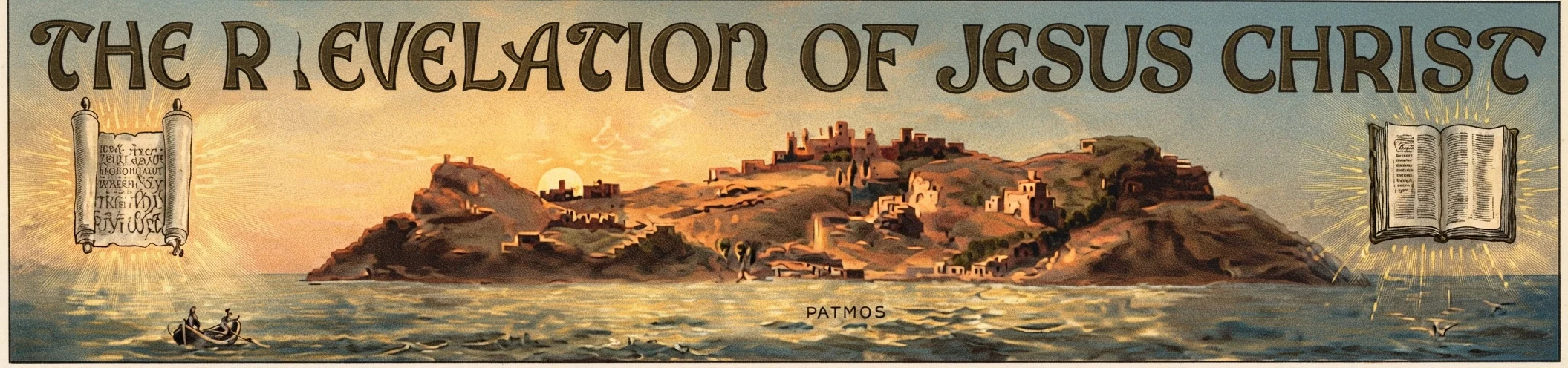
PATMOS
That sanctuary service, when performed in faith, was one constant yearly setting forth in type of the mystery of God, the power of God in Christ Jesus to save men, against which Satan has ever made his constant warfare. The closing of each year's work was the cleansing of that sanctuary from all remembrance of sin of all its worshipers. See Leviticus 16. Hence it was a judgment work, and all who did not avail themselves of the provision of that Gospel on that great Day of Atonement were cut off from the people of God. See Lev. 23: 26-32. When that Day of Atonement began, there began the finishing of the mystery of God for that year in the type; and each year in that service typified Christ's work in this dispensation in its entirety. Therefore when the angel declared that "unto 2,300 days then shall the sanctuary be cleansed" (Dan. 8:14), he referred to the time which should mark the closing work of Christ, the last phase of the Gospel message, the judgment of the righteous dead, the cases of all who are remembered in the sanctuary not made with hands. "When he is about to sound" (so read nearly all translations) we understand to mean the climax of his sounding, which will be at the second coming of Christ. Between the time of the closing of the prophetic time period, 1844, and the time when Christ shall come, when the seventh angel's mighty sounding shall be heard (11:15), there is a waiting time when the vision tarries (see Hab. 2:2, 3), indefinite days, days of trial for God's children. Men not understanding the great sanctuary question will set time for Christ to come, will move and adjust the prophetic dates; but the intelligent student of prophecy will know by faith that all he can do is to wait—wait till the Master says, "It is done." The angel stands ready; "the days" are his. But Infinite Mercy waits. The vision tarries still. The long-suffering of the Lord is salvation to some soul. So can we wait God's plan, resting on the mighty oath that it will be finished soon, for the angel is "about to sound." Then God's mystery shall be finished, then "the good tidings" of the prophet will be complete. Wait.
7. Eat the book.—John represents the church; the book, the Gospel. Eating it is to partake of its message, inwardly digest it, make it a part of one's self. So Ezekiel was to do. See Eze. 2:8; 3:3. Jeremiah says (15:16), "Thy words were found, and I did eat them."
8. Sweet . . . bitter.—The Gospel of God has its sweetness in soul experiences. It has its bitterness in the disappointments which cluster around it. So Ezekiel and Jeremiah found in their labor for backslidden Israel. So the Reformers found it. So especially did those who preached the great time message of 1830 to 1844 find it. Very sweet it was when received. The Master was coming. But they did not see all that the message meant. It was obscured by clouds of error. They did not see all that it meant, more than did the early disciples after three years of instruction by Jesus. "We hoped that it was He," they mournfully say, after His crucifixion, "who should redeem Israel." Luke 24:21. Very bitter was their disappointment. Very bitter also was the disappointment for those who looked for Christ to come in 1844. They had heralded to the world that Christ was then coming. They were doomed to disappointment. Their words and work were discredited. Equally both groups of the disciples were mistaken. God permitted the deception in both cases in order to separate the chaff from the wheat. Later the light shone upon that early group. God was with them in greater light. Greater light now shines upon the later group, and God is with them also, and that light will issue in the glory represented by the angel of Rev. 18:1, whose resplendent shining shall lighten the earth. All this is based on the open Word of Jesus Christ.
NOTE.—We have not space here to explain the time of the beginning and ending of the 2300 days. See "Bible Students' Library," No. 128, "Christ Our Advocate;" "Signs of the Times Leaflet," No. 6, "The 2300 Days," for sale at this office and branches. This message of Revelation 10 brings us to the close of that time, 1844. The finishing of the mystery begins "IN the days of the voice of the seventh angel," the years which follow that date, 1844.
9. Prophesy again.—The work of God's people was not finished then. There are other prophecies, other reforms, other trials, other foes. One more seal, the sixth, is to be opened after this, other truths are to be revealed, other triumphs of the Gospel, and then the breaking of the last seal will disclose the ineffable glory of the Desire of All the Ages. Then, rest, progress, blessing, forever.
SEARCH me, O God, and know my heart.
My need is great.
Try me, and prove my inmost soul,
For Thee I wait.
With friends afar and lights gone out,
I stand alone,
And plead with Thee, an erring child
Before Thy throne.
In shame I hide my face and weep.
Mistakes abound;
The poison root of sin within
My heart is found.
Thy search-light, Lord, O turn on me,
And test each thought.
Let all my acts be nobly true,
In meekness wrought;
O lead me out of self to Thee,
Reveal Thy love,
Forgive, and teach me to forgive,
O God above.
Patient Waiting
By H. E. Sawyer Hopkins
By H. E. Sawyer Hopkins
WHEN brought into strait and trying places, shall we give way to a downcast and discouraged feeling, when the Lord says, "Be strong and of a good courage" (Joshua 1:9); and again, to the faint-hearted, "Be not afraid, neither be thou dismayed"? The trouble with us is that we are anxious to see our way out of every difficulty right off.
How much David has to say about waiting! We plan after our own ideas, or we consult another, instead of following God's plan to wait upon Him. Turning to the last part of Joshua 1:9 we read, "For the Lord thy God is with thee whithersoever thou goest." To Jeremiah in trouble on every hand the Lord says, "Am I a God at hand, . . . and not a God afar off?" These are precious words, left on record for us to remember where our strength lies.
This recalls to mind an experience while passing through a sore trial, and the deliverance that was brought. The trial being very hard to bear, as it was undermining my health, I prayed for deliverance, or strength to endure it.
On opening my Bible one day, I asked for comforting words. The following texts were brought to my attention: "I will send My fear before thee, . . . and I will make all thine enemies turn their backs unto thee." Ex. 23:27. "Ye shall not fear them:8
for the Lord your God He shall fight for you." Deut. 3:22. "Be not afraid nor dismayed; . . . for the battle is not yours, but God's." "Ye shall not need to fight in this battle: set yourselves, stand ye still, and see the salvation of the Lord with you: . . . fear not, nor be dismayed; . . . for the Lord will be with you." 2 Chron. 20:15, 17.
For my encouragement a few days after, this text came to mind: "The Lord shall fight for you, and ye shall hold your peace." Ex. 14:14. In the Lord's own time and way some five weeks after, deliverance came. Surely I had reason to praise Him for His goodness and mercy.
Jesus depended on His Father for help in times of necessity. Why should not His followers? If we are patient it will surely come.
God gave us our faculties not to lie dormant, but to put them into use. If He tells us to "ask and receive," is not here a good opportunity to beseech Him earnestly for divine guidance, wisdom, and good judgment, and at the same time to be willing to submit to whatever His will may be, and wait patiently for Him to act?
O that we might remember we are now living in the patient waiting time, and that each one of us has a lesson to learn to wait upon God after committing our way to Him.
God is our Father; and the command given to Joshua to "be strong and of a good courage," is for us as well as for him. We certainly need to heed this command more and more in these days of trials and perplexities. In Rom. 4:21 we have the word of Paul that what God has promised, He is able to perform. "God's eye is upon His children"—His remnant people; and it is our blessed privilege to expect divine assistance out of every trial and perplexity if we learn to wait His own time and way, or strength to endure them.
Pomona, California.
There Comes a Day
By Max Hill
By Max Hill
THERE comes a day, and hastens on,
When earth shall see her King;
When sin and sorrow shall be gone,
And ransomed hosts shall sing.
There comes a day, a welcome day,
When earth shall see her Lord;
When He shall reign with love's own sway,
By all the saints adored.
There comes a day, O day of peace,
When earth shall bloom again;
When from the curse shall be release
Through Jesus, King of men.
Come, blessed day, with life replete,
Thy joyful bounties bring;
His children wait thy morn to greet
With welcome for their King.
Sanitarium, California.
Protestantism Drifting
By G. B. Thompson
III. Teaching in Our Schools
Nothing perhaps is the decadent condition of professed Protestantism more apparent than in the teaching and acceptance of the theories of "Higher Criticism," some of which were mentioned in the previous article. And instead of repudiating this new form of infidelity, it is endorsed by thousands; it is taught in the pulpit, colleges, and universities, and published in theological works. "Higher Criticism" declares that the text of the sacred Scripture is "seriously corrupt." The authorship of the various books, especially the historical part, is questioned, and their historical accuracy is denied. And these self-constituted critics of the sayings of the Almighty, put forth their claims as tho they were the shibboleth of all scholarships. While they have been working out and changing their conclusions, the spade of the explorer has been at work, and our museums contain tons of archeological specimens that stamp their verdict as false. "These records, chiseled in adamantine volumes, stamped in imperishable clay, painted in the darkness of the tombs, or cut on the mountainside, bring impartial, unimpeachable, and conclusive proof of the veracity of the Old Testament." But these learned critics are in no way abashed when their speculations have been shown to be wrong. They have set their faces like a flint to overthrow at all hazards the word of the Lord. They remind one of the Irish barrister, who, speaking in behalf of his client, said, "Your honor, if I am wrong on this proposition I have another equally conclusive."
Recently, after a personal investigation covering a considerable period of time, Mr. Harold Bolce has written a series of articles for the Cosmopolitan Magazine, setting forth in plain terms the character of the instruction which he finds is given to the thousands of students in Protestant colleges and universities. The editor of the Cosmopolitan sums up the findings of Mr. Bolce in the following stirring language:
What Mr. Bolce sets down here is of the most astounding character. Out of the curricula of American colleges a dynamic movement is upheaving ancient foundations, and promising a way for revolutionary thought and life. Those who are not in close touch with the great colleges of the country will be astonished to learn the creeds being fostered by the faculties of our great universities. In hundreds of class rooms it is being taught daily that the Decalogue is no more sacred than a syllabus; that the home as an institution is doomed; that there are no absolute evils; that immorality is simply an act in contravention of society's accepted standards; that democracy is a failure, and the Declaration of Independence only spectacular rhetoric; that the change from one religion to another is like getting a new hat; that moral precepts are passing shibboleths; that conceptions of right and wrong are as unstable as styles of dress; that wide stairways are open between social levels, but that to the climber children are encumbrances; that the sole effect of prolificacy is to fill tiny graves; and that there can be and are holier alliances without the marriage relation than within it. These are some of the revolutionary and sensational teachings submitted with academic warrant to the minds of hundreds of thousands of students in the United States. It is time that the public realized what is being taught to the youth of this country. "The social question to-day," says Disraeli, "is only a zephyr which rustles the leaves, but will soon become a hurricane." It is a dull ear that can not hear the mutterings of the coming storm.
This is a terrible arraignment. But to show that the conclusions of the learned editor of the Cosmopolitan are not overdrawn, I will quote a few of the statements which Mr. Bolce makes, some of which he credits to leading educators, not in Catholic schools, but in what are considered Protestant institutions.
Prof. Edwin I. Earp, of Syracuse (New York) University, was asked the question, "Do you believe that Moses got the Ten Commandments in the way the Scriptures tell?" He replied: "I do not. It is unscientific and absurd to imagine that God ever turned stone-mason and chiseled commandments on a rock."
History and criticism have made the Bible a new book, or rather a new collection of books, written, for the most part, we know not by what authors or at what dates, and put together, as a Bible, we know not on what principle. All the old landmarks, Moses, Solomon, Job, are gone, and a restless sea of criticism threatens to engulf religion with the records it adored.—Jacob Gould Schurman, President of Cornell University.
The notion that there is anything fundamentally correct implies the existence of a standard outside and above usage, and no such standard exists.—Prof. William G. Sumner, Yale University.
In the February (1910) number of the Cosmopolitan, Mr. Bolce, under the heading, "The Crusade Invisible," gives the result of his investigation in such Protestant schools as Bryn Mawr, Holyoke, Wellesley, Tulane University, and others, and lays bare the unbelief of those who are employed as instructors for the seventy thousand and more lady students. The articles have been prepared with the coöperation of presidents of universities. I have space to quote but a few of his statements:
And young women are coming out of college believing that it is absurd for humanity to stake its hope of salvation on much of what the Christian world has accepted as inspired writings.
They have been taught at the University of California, for example, to reject plans of salvation that can not be accepted by the reason, and at the University of Michigan that "the church must make up its mind whether the permanent elements of religion are to remain fettered, perhaps stultified, by hypotheses relevant to the fourth century, or are capable of plangent statement in terms of our contemporary outlook upon the world and life."
Mr. Bolce tells us further some of the things girls going from Christian homes to these institutions are taught:
The Bible is taught in the co-educational universities of the United States, but the character of that teaching will startle Christendom when the truth is known. The University of Michigan, for example, declares that the books of the Bible are a composite of myth and legend, in the form of epos, hero-saga, fable, proverb, precept, folk-lore, primitive custom, clan and domestic law, and rhapsody. It is further set forth that these are of various and dubious origin; that the texts have been edited and interpolated, "and often corrupted and marred by endless copying;" that the Scriptural writings were ascribed, as a rule, to men who never wrote them; that they are nearly all difficult to understand; and that it is preposterous to ask humanity to stake its hope of salvation upon such a book. And at Chicago and California it is contended that, to the scientific mind, there is no "historic certainty that Jesus ever lived."
Not only does science discount the authenticity of the Old Testament, but having placed a question mark after the name of Jesus, it proceeds to attack the veracity of the New Testament. Mr. Bolce continues:
Not content with discrediting the older history of Israel, the scholars proceed to cast doubt upon the more intimate New Testament. It is explained that, while scholars agree in the main, that the Old Testament stories must take their place with the Greek records of Theseus, Perseus, Jason, Hercules, and other heroes, many people still fondle the delusion that the New Testament is sound, and that, therefore, "the citadel of dogmatic Christianity" is inviolable.
It is with such infidel ideas as these that the great system of Protestantism is being poisoned.
These same critics have learned all they know under the influence of institutions built up through the influence of the very Book they criticized. This ought to inspire a degree of reverence for these ancient writings. It has been well said that if these critics had been born in any land where these Sacred Writings were unknown they would have been exposed in a field, drowned in a pond, or flung into the streets, before they had time to criticize anything; and only for the influence of the Book they find so full of mistakes, they might to-day have been howling and whirling in some circle of dervishes, or sitting besmeared on the banks of the Ganges, seeking purification and salvation amid the obscurities and idolatry of heathen lands. While many in these great Protestant bodies sigh over these abominations, and cry out against them, yet until the great body of Protestantism shall arise and repudiate such teaching she must be charged with endorsing them.
There is a tremendous gulf to be bridged between the "essence of Protestantism," as expressed in the Protest of the Princes in 1529, and the teaching of representative Protestant expositors of the present day.
HARK, Laodicea! Give ear, give attention!
The faithful True Witness has something to say.
Thou last congregation of which we have mention,
This message is given for thee to obey.
The Amen who speaketh, creation's Beginner —
He knoweth thy works, thou deceivest Him not.
Tho boasting perfection, He finds thee a sinner,
In tepid condition — not cold, nor yet hot.
Thy boasted attainment of all thy ambition,
The pride of thy riches, has proven thy fall.
Thou wretched one, pitiful is thy condition.
Thou truly hast nothing, art lacking of all.
Thou who thinkest thyself to be needful of nothing,
Art poor, blind, and naked — thy boasting is vain!
He counsels to buy for thyself needed clothing;
Buy heavenly eye-salve, thy sight to regain.
Buy gold that is pure. Yea, buy wealth in abundance,
In exchange for conditions which now do prevail.
With God there is mercy and wealth in redundance;
His promise is true, and His work can not fail.
Tygh Valley, Oregon.
Our Bible Reading
The Judgment
1. For what does the wise man assure us there is a time?
I said in mine heart, God shall judge the righteous and the wicked: for there is a time there for every purpose and for every work. Eccl. 3: 17.
2. What must there necessarily be in God's plan?
Because He hath appointed a day, in the which He will judge the world in righteousness by that Man whom He hath ordained; whereof He hath given assurance unto all men, in that He hath raised Him from the dead. Acts 17: 31.
NOTE: Every work of probation or trial must end with examination and judgment. This is manifest in every school of the world; in every place where men put themselves on test. There comes a time at last which must determine whether they have met the standard or not; whether they have, in other words, made good what they have attempted. So after the final trials of men in this world have passed, the judgment will determine each case on motive and conduct as to whether the soul has met the test. This judgment-day was appointed in the very beginning, but it can not of necessity come until the close of God's work.
3. In what time did the apostle Paul place the judgment in his day?
And as he reasoned of righteousness, temperance, and judgment to come, Felix trembled, and answered, Go thy way for this time; when I have a convenient season, I will call for thee. Acts 24: 25.
4. When that judgment is impending what message will go forth to the world?
And I saw another angel fly in the midst of heaven, having the everlasting Gospel to preach unto them that dwell on the earth, and to every nation, and kindred, and tongue, and people, saying with a loud voice, Fear God, and give glory to Him; for the hour of His judgment is come: and worship Him that made heaven, and earth, and the sea, and the fountains of waters. Rev. 14: 6, 7.
5. By what other expression does the revelator indicate the judgment?
And sware by Him that liveth forever and ever, who created heaven, and the things that therein are, and the earth, and the things that therein are, and the sea, and the things which are therein, that there should be time no longer: but in the days of the voice of the seventh angel, when he shall begin to sound, the mystery of God should be finished, as He hath declared to His servants the prophets. Rev. 10: 6, 7.
NOTE: By Eph. 6:19 and other scriptures it will be seen that the mystery of God is the Gospel, and the finishing of the mystery of God must be the closing of that work, and that must close with the judgment work, consequently those who prophesied of the judgment pointed to the very work which would take place in the days in which we live and the consummation of the judgment of God.
6. What prophet predicted definite time concerning the beginning of this work of judgment?
NOTE: It will be seen that in our previous scripture the angel swears that the mystery of God would be finished as declared by the prophets, and the one prophet who declares the definite time concerning when that finishing work will begin is Daniel. The book of Daniel was closed and sealed till the time of the end. Dan. 12:4. We must conclude that the little book in the angel's hand which is represented as being opened includes at least the book of Daniel, and the opening of that book is the revelation of the closing of the Gospel work. That began in 2300 days from a certain point of time. That certain point of time was fixed in Daniel 9 as when the decree should go forth to restore and rebuild Jerusalem, beginning in B.C. 457. See the detailed division of this period of time in Daniel 9. We have the beginning of the decree in 457; the building and restoration of the walls of Jerusalem in 408; the coming of the Messiah in 27; His crucifixion in 31; the cutting off of the Jews in 34; and the remaining 1810 years reach to 1844, when the great investigative judgment began in the courts of heaven. Since that time the message of Rev. 14:7 has been due to the world, "The hour of His judgment IS come."
7. What will be the rule of that judgment?
As many as have sinned in the law shall be judged by the law. Rom. 2: 12.
So speak ye, and so do, as they that shall be judged by the law of liberty. James 2: 12.
8. To whom is the work of final judgment committed?
For the Father judgeth no man, but hath committed all judgment unto the Son: that all men should honor the Son, even as they honor the Father. John 5: 22, 23.
9. How will those fare who have believed on Christ to the end?
Verily, verily, I say unto you, The hour is coming, and now is, when the dead shall hear the voice of the Son of God; and they that hear shall live. John 5: 25.
10. How will it be with those who have done evil?
And shall come forth; they that have done good, unto the resurrection of life; and they that have done evil, unto the resurrection of damnation. John 5: 29.
11. What then is our duty in view of the judgment?
Let us hear the conclusion of the whole matter: FEAR GOD, AND KEEP HIS COMMANDMENTS: for this is the WHOLE DUTY of man. For God shall bring EVERY WORK INTO JUDGMENT, with every secret thing, whether it be good, or whether it be evil. Eccl. 12: 13, 14.